Pathogenesis
Chain of more or less distinct event occurring in succession and leading to development and
perpetuation of a disease and pathogen is called pathogenesis or disease cycle.
The disease cycle is close to the life cycle of pathogen, but it refers primarily to the appearance,
development and perpetuation of diseases as a function of pathogen rather than to the pathogen
itself.
The disease cycle involves changes and its symptom in the plant as well as changes in the
pathogen and spans within a growing season and from one growing season to another.
The disease cycle or infection chain can be of two types:
i) Continuous infection chain: In this type of disease cycle, the pathogen remains
continuously active form from one host to another. Most viral and some fungal
diseases come under this category.
ii) Intermittent infection chain: In this type disease cycle, pathogen survives in dormant
state or as active saprophyte to maintain the continuity of chain after the harvest of
crop. Most of fungal, bacterial and nematodes diseases fall under this category
Diseases with intermittent infection chain are further of two types:
a) Monocyclic diseases: In such diseases only one cycle of disease is completed in one
season and there is no repetition of disease cycle within a season. Such diseases are also
called simple interest diseases. Eg. Loose smut of wheat and covered smut of barley etc.
b) Polycyclic diseases: In such diseases many cycle of a disease are repeated within the
same crop season on host through spore-infection-spore chain. Such pathogens are
responsible for epidemics if the environmental condition favors the disease. Such disease
are called compound interests disease. Eg. Rust, powdery mildew, late blight of potato,
apple scab etc.
Depending upon the host plants involved, infection chains can be:
a) Homogenous: when the pathogen survive only one genus of plants.
b) Heterogeneous: when many plant species are involved in disease cycle
Disease developments in plants
For successful development of disease in plants it require three components i.e. virulent
pathogen, susceptible host and favorable environment. If any one of component is absent
there is no disease development.
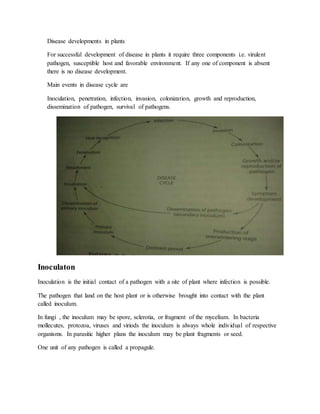
Main events in disease cycle are
Inoculation, penetration, infection, invasion, colonization, growth and reproduction,
dissemination of pathogen, survival of pathogens.
Inoculaton
Inoculation is the initial contact of a pathogen with a site of plant where infection is possible.
The pathogen that land on the host plant or is otherwise brought into contact with the plant
called inoculum.
In fungi , the inoculum may be spore, sclerotia, or fragment of the mycelium. In bacteria
mollecutes, protozoa, viruses and viriods the inoculum is always whole individual of respective
organisms. In parasitic higher plans the inoculum may be plant fragments or seed.
One unit of any pathogen is called a propagule.
Types of inoculum:
 primary inoculum: An inoculum that survive in winter or summer and cause original
infection in spring or autumn on any is called the primary inoculum and the and
theinfection is called primary infections.Eg. Primary inoculum (Sclerotia, mycelium,
oospore)
Generally, more the primary inoculum , more severe is the disease.
 secondary inoculum: An inoculum produced from primary infections is called secondary
inoculum and the infection it causes are called secondary infections. Eg. Secondary
inoculum (conidia, urdospores, zoospores.
Source of inoculum
 Fungi, bacteria, parasitic higher plants and nematodes generally produce their inoculum
on the infected plants or their inoculum reaches the plant surface when the infected tissue
break.
 Virsus, viriods, mollecutes , fastidious bacteria and protozoa produce their inoculum
within the plants and the inoculum never reaches the surface naturally. So in case, the
inoculum may transmitted from one plant to another through some kind of vector
 Soil: Bacteria, Rhizoctonia, Sclerotinia,
 Diseased debris: Alternaria, Phytophthora
 Alternate hosts: Rusts- wheat rust: Barberis vulgaris
 collateral hosts: Viruses: BCMV, PVY, Powdery mildews etc.
Landing and arrival of inoculum
 The inoculum of most of pathogen is carried to host plant passively by wind water and
insects.
 Airborne inoculum reaches the host sometime by gravity or by washing with the rains.
Some zoospore and nematodes may attracted toward the suger or amino acids diffusing
out from the host.
Pre penetration phenomenon
Attachment of pathogen
 Mollecutes protozoa and most of virsus are placed directly into the cell of plant by their
vector and they are immediately surrounded by cytoplasm, cytoplasmic memberanes and
cell wall.
 Fungi, bacteria and parasitic higher plants are first brought into contact or are attached
with external surface of the plant before they colonize the host .
 The propagule of pathogen have mucilage substances and consisting of water soluble
polysaccharides glycoproteins, lipid and febrile materials on their surface which get
moistened become sticky and pathogen to adhere on plant surface.
Sporegermination / seed germination and perception of host surface
 Spore germinates by producing a typical mycelium that infects and grows into host plants
or they produce a short germ tube that produce aspecialized distinct form of mycelium
called haustorium.
Formation of and maturation of appresorium or infection peg
 Appresorium is the swelling produced at the tip of germ tube which contain lipids,
polysacchrides, proteins,and enormous glycerol.
 Apresria in certain cases produce a narrow penetration hypha also called infection peg or
penetration peg from the base of appresorium and use primarily physical forces to
puncture the plant cuticle with that penetration peg.
Recognition between host and pathogen
 It is assumed that when pathogen comes in contact with the host cells, an early events
takes place that trigger a fairly rapid reponse in each organisms which either
aallowsorimpedes further growth of pathogen and development of disease.
Penetration
Fungi may penetrate in either indirect penetration or direct penetration; bacteria mostly enter
through wounds and some time by natural openings and Viruses, viroid’s, phytoplasma, RLOs
etc. by mechanical means (wounds) and by vectors.
Direct penetration
 Through Appressorium (e.g. involved in direct penetration (eg. Colletotrichum spp. and
M .grisea )
 Germtube e.g. (Apple scab- V. inequalis)
 Appressorium give rise to penetration peg
 Haustoria e.g. powdery mildews
 Infection cushion e.g. Fusarium, Sclerotinia – Includes fungi imperfecti&ascomyctes
Indirect Penetration
Penetration through natural openings
 Entry through Stomata e.g. Bean Rust – Uromycesappendiculatus
 Entry through hydathodes :Bactera e.g. Xanthomonascampestrispv. Oryzae
 Nectorthodes: Erwiniaamylovora causing fire blight of apple & pear.
 Lenticels: E. amylovora
Infection
 It is the process by which pathogen establish contact with susceptible cell or tissue of the
host and procure nutrients from them
 Successful infection results in the appearance of symptom, on the host plants. Some
infection remain latent i.e don’t produce symptom right away but at a later when the
environmental conditions or the stage of maturity of plantsbecome more favorable
 Symptom may be appear as soon 2-4 days after inoculation or as late 2-3 year after
inoculation.
 killing the cells or at least not for long time, and still others kill cells and disorganize
surrounding tissue.
Infection process is affected by various factors
– Resistance & susceptibility of the host
– Aggressiveness & virulence of the pathogen
– Environmental factors
– Host nutrition & pH
– Incubation period ( depends upon host- pathogen combination, stage of host and
environment etc.
Invasion
Invasion is the spread of the pathogen in the host. Most fungi soread into all the tissues of the
plant organ (leaves, stem and roots) they infect, either by growing directly through cell as intra-
cellular mycelium or by growing between the cell as an intercellular mycelium.
Different pathogens invade their host as
 Ectoparasite e.g. powdery mildew
 Endoparasites e.g. wilts, viruses etc
 Sub-cuticular pathogens (Apple scab- Venturiainequalis) • Sub-epidermal pathogens
(wheat rust )
 Vascular pathogens (Pseudomonas solanacearum) – Ecto-endo parasites e.g. potato
canker (Corticiumsolani)
Growth and reproduction of the pathogen and their Colonization
a) Growth
 fungi and parasitic higher plants invade and infect tissues by growing. These pathogens
continue to grow and branch out within the infected host indefinitely so that the pathogen
spreads into more and more plant tissues until the spread of infection is stopped or plant
is dead.
 bacteria, mollecutes, viroids, nematodes and protozoa do not increase in size with
time.These pathogens invade and effect new tissues within the plant by reproducing at a
rapid rate and increasing their number tremendously in infected tissues.
 Their progenies then are carried passively into new cells and tissues through
plasmodesmata (viruses and viriods), phloem (viruses, viriods, mollecutes, some
fastidious bacteria and protozoa) or xylem (some bacteria) or they move actively by their
own power as in case of protozoa, nematodes and some bacteria
.
b) Reproduction
 Fungi reproduce by means of asexual or sexual spores.
 Some fungi produce tremendous spores in one growing season while, others produce
them in successive crops. But in any case thousands of spores are produced per square
centimetre of infected tissue.
 Parasitic higher plants reproduce by seeds.
 Bacteria and mollecutes reproduce by fission in which one mature individual splits into
two equal smaller individuals.
 Under optimum nutritional and environmental conditions, the bacteria divide
continuously in the host cells until the nutrients are exhausted..
 Viruses and viroids are replicated by the host cell.
 Nematode female’s lay about 300 to 500 eggs and half of them produce females which
again will lay the same number of eggs.
c) Colonization
 Majority of plant pathogenic fungi and oomycetes produce a mycelium only within the
plants they infect.
 Few fungi and oomycetes produce a mycelium on the surface of their host plants, but
most powdery mildew fungi produce a mycelium only on the surface of their hosts..
 Parasitic higher plants produce their seeds on aerial branches.
 Some nematodes lay their eggs at or near the surface of the host plants.
 Bacteria reproduce between the host cells or in xylem or phloem cells of the hosts and
come to the surface only through wounds, cracks, stomata etc.
 Viruses, viroids, protozoa and fastidious bacteria reproduce only inside the cells and
often do not reach at the surface of the host plant
Dissemination of the pathogen
Dispersal means spread of pathogen propagules from one plant to the another or one area to
another area for short as well as long distance.
Dispersal may be: a) Active - move on own power bacteria (some) Pythium (Zoospores)
Fungi- spores expelled forcibly
pathogen disperse with seed- xanthomonas compestris pv. Compestris black leg of crucifers.
Passive - wind, water, insects, man, animals, machinery
pathogen disperse with seed- xanthomonas compestris pv. Compestris black leg of crucifers.
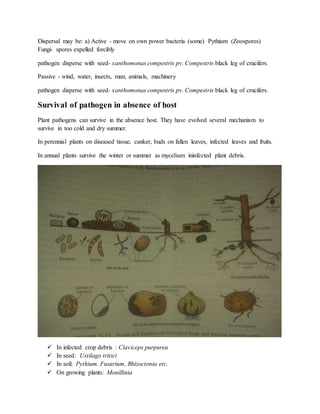
Survival of pathogen in absence of host
Plant pathogens can survive in the absence host. They have evolved several mechanism to
survive in too cold and dry summer.
In perennial plants on diseased tissue, canker, buds on fallen leaves, infected leaves and fruits.
In annual plants survive the winter or summer as mycelium ininfected plant debris.
 In infected crop debris : Claviceps purpurea
 In seed: Ustilago tritici
 In soil: Pythium, Fusarium, Rhizoctonia etc.
 On growing plants: Monillinia
 Infected material on host plant: Erwiniaamylowora, venturiaineaqualis.
 Alternate host:pucciniagraministritici
 As dormant structures e.g. sclerotia, chlamydospores
References
 Plant pathology by g G N Agriose
 Modern plant pathology H C Dube.
 Plant pathology by R S Singh

Pathogenesis

  • 1.
    Pathogenesis Chain of moreor less distinct event occurring in succession and leading to development and perpetuation of a disease and pathogen is called pathogenesis or disease cycle. The disease cycle is close to the life cycle of pathogen, but it refers primarily to the appearance, development and perpetuation of diseases as a function of pathogen rather than to the pathogen itself. The disease cycle involves changes and its symptom in the plant as well as changes in the pathogen and spans within a growing season and from one growing season to another. The disease cycle or infection chain can be of two types: i) Continuous infection chain: In this type of disease cycle, the pathogen remains continuously active form from one host to another. Most viral and some fungal diseases come under this category. ii) Intermittent infection chain: In this type disease cycle, pathogen survives in dormant state or as active saprophyte to maintain the continuity of chain after the harvest of crop. Most of fungal, bacterial and nematodes diseases fall under this category Diseases with intermittent infection chain are further of two types: a) Monocyclic diseases: In such diseases only one cycle of disease is completed in one season and there is no repetition of disease cycle within a season. Such diseases are also called simple interest diseases. Eg. Loose smut of wheat and covered smut of barley etc. b) Polycyclic diseases: In such diseases many cycle of a disease are repeated within the same crop season on host through spore-infection-spore chain. Such pathogens are responsible for epidemics if the environmental condition favors the disease. Such disease are called compound interests disease. Eg. Rust, powdery mildew, late blight of potato, apple scab etc. Depending upon the host plants involved, infection chains can be: a) Homogenous: when the pathogen survive only one genus of plants. b) Heterogeneous: when many plant species are involved in disease cycle
  • 2.
    Disease developments inplants For successful development of disease in plants it require three components i.e. virulent pathogen, susceptible host and favorable environment. If any one of component is absent there is no disease development. Main events in disease cycle are Inoculation, penetration, infection, invasion, colonization, growth and reproduction, dissemination of pathogen, survival of pathogens. Inoculaton Inoculation is the initial contact of a pathogen with a site of plant where infection is possible. The pathogen that land on the host plant or is otherwise brought into contact with the plant called inoculum. In fungi , the inoculum may be spore, sclerotia, or fragment of the mycelium. In bacteria mollecutes, protozoa, viruses and viriods the inoculum is always whole individual of respective organisms. In parasitic higher plans the inoculum may be plant fragments or seed. One unit of any pathogen is called a propagule.
  • 3.
    Types of inoculum: primary inoculum: An inoculum that survive in winter or summer and cause original infection in spring or autumn on any is called the primary inoculum and the and theinfection is called primary infections.Eg. Primary inoculum (Sclerotia, mycelium, oospore) Generally, more the primary inoculum , more severe is the disease.  secondary inoculum: An inoculum produced from primary infections is called secondary inoculum and the infection it causes are called secondary infections. Eg. Secondary inoculum (conidia, urdospores, zoospores. Source of inoculum  Fungi, bacteria, parasitic higher plants and nematodes generally produce their inoculum on the infected plants or their inoculum reaches the plant surface when the infected tissue break.  Virsus, viriods, mollecutes , fastidious bacteria and protozoa produce their inoculum within the plants and the inoculum never reaches the surface naturally. So in case, the inoculum may transmitted from one plant to another through some kind of vector  Soil: Bacteria, Rhizoctonia, Sclerotinia,  Diseased debris: Alternaria, Phytophthora  Alternate hosts: Rusts- wheat rust: Barberis vulgaris  collateral hosts: Viruses: BCMV, PVY, Powdery mildews etc. Landing and arrival of inoculum  The inoculum of most of pathogen is carried to host plant passively by wind water and insects.  Airborne inoculum reaches the host sometime by gravity or by washing with the rains. Some zoospore and nematodes may attracted toward the suger or amino acids diffusing out from the host. Pre penetration phenomenon Attachment of pathogen  Mollecutes protozoa and most of virsus are placed directly into the cell of plant by their vector and they are immediately surrounded by cytoplasm, cytoplasmic memberanes and cell wall.
  • 4.
     Fungi, bacteriaand parasitic higher plants are first brought into contact or are attached with external surface of the plant before they colonize the host .  The propagule of pathogen have mucilage substances and consisting of water soluble polysaccharides glycoproteins, lipid and febrile materials on their surface which get moistened become sticky and pathogen to adhere on plant surface. Sporegermination / seed germination and perception of host surface  Spore germinates by producing a typical mycelium that infects and grows into host plants or they produce a short germ tube that produce aspecialized distinct form of mycelium called haustorium. Formation of and maturation of appresorium or infection peg  Appresorium is the swelling produced at the tip of germ tube which contain lipids, polysacchrides, proteins,and enormous glycerol.  Apresria in certain cases produce a narrow penetration hypha also called infection peg or penetration peg from the base of appresorium and use primarily physical forces to puncture the plant cuticle with that penetration peg. Recognition between host and pathogen  It is assumed that when pathogen comes in contact with the host cells, an early events takes place that trigger a fairly rapid reponse in each organisms which either aallowsorimpedes further growth of pathogen and development of disease. Penetration Fungi may penetrate in either indirect penetration or direct penetration; bacteria mostly enter through wounds and some time by natural openings and Viruses, viroid’s, phytoplasma, RLOs etc. by mechanical means (wounds) and by vectors. Direct penetration  Through Appressorium (e.g. involved in direct penetration (eg. Colletotrichum spp. and M .grisea )  Germtube e.g. (Apple scab- V. inequalis)  Appressorium give rise to penetration peg
  • 5.
     Haustoria e.g.powdery mildews  Infection cushion e.g. Fusarium, Sclerotinia – Includes fungi imperfecti&ascomyctes Indirect Penetration Penetration through natural openings  Entry through Stomata e.g. Bean Rust – Uromycesappendiculatus  Entry through hydathodes :Bactera e.g. Xanthomonascampestrispv. Oryzae  Nectorthodes: Erwiniaamylovora causing fire blight of apple & pear.  Lenticels: E. amylovora Infection  It is the process by which pathogen establish contact with susceptible cell or tissue of the host and procure nutrients from them  Successful infection results in the appearance of symptom, on the host plants. Some infection remain latent i.e don’t produce symptom right away but at a later when the environmental conditions or the stage of maturity of plantsbecome more favorable  Symptom may be appear as soon 2-4 days after inoculation or as late 2-3 year after inoculation.  killing the cells or at least not for long time, and still others kill cells and disorganize surrounding tissue. Infection process is affected by various factors – Resistance & susceptibility of the host – Aggressiveness & virulence of the pathogen – Environmental factors – Host nutrition & pH – Incubation period ( depends upon host- pathogen combination, stage of host and environment etc. Invasion Invasion is the spread of the pathogen in the host. Most fungi soread into all the tissues of the plant organ (leaves, stem and roots) they infect, either by growing directly through cell as intra- cellular mycelium or by growing between the cell as an intercellular mycelium. Different pathogens invade their host as
  • 6.
     Ectoparasite e.g.powdery mildew  Endoparasites e.g. wilts, viruses etc  Sub-cuticular pathogens (Apple scab- Venturiainequalis) • Sub-epidermal pathogens (wheat rust )  Vascular pathogens (Pseudomonas solanacearum) – Ecto-endo parasites e.g. potato canker (Corticiumsolani) Growth and reproduction of the pathogen and their Colonization a) Growth  fungi and parasitic higher plants invade and infect tissues by growing. These pathogens continue to grow and branch out within the infected host indefinitely so that the pathogen spreads into more and more plant tissues until the spread of infection is stopped or plant is dead.  bacteria, mollecutes, viroids, nematodes and protozoa do not increase in size with time.These pathogens invade and effect new tissues within the plant by reproducing at a rapid rate and increasing their number tremendously in infected tissues.  Their progenies then are carried passively into new cells and tissues through plasmodesmata (viruses and viriods), phloem (viruses, viriods, mollecutes, some fastidious bacteria and protozoa) or xylem (some bacteria) or they move actively by their own power as in case of protozoa, nematodes and some bacteria . b) Reproduction  Fungi reproduce by means of asexual or sexual spores.  Some fungi produce tremendous spores in one growing season while, others produce them in successive crops. But in any case thousands of spores are produced per square centimetre of infected tissue.  Parasitic higher plants reproduce by seeds.  Bacteria and mollecutes reproduce by fission in which one mature individual splits into two equal smaller individuals.  Under optimum nutritional and environmental conditions, the bacteria divide continuously in the host cells until the nutrients are exhausted..  Viruses and viroids are replicated by the host cell.  Nematode female’s lay about 300 to 500 eggs and half of them produce females which again will lay the same number of eggs.
  • 7.
    c) Colonization  Majorityof plant pathogenic fungi and oomycetes produce a mycelium only within the plants they infect.  Few fungi and oomycetes produce a mycelium on the surface of their host plants, but most powdery mildew fungi produce a mycelium only on the surface of their hosts..  Parasitic higher plants produce their seeds on aerial branches.  Some nematodes lay their eggs at or near the surface of the host plants.  Bacteria reproduce between the host cells or in xylem or phloem cells of the hosts and come to the surface only through wounds, cracks, stomata etc.  Viruses, viroids, protozoa and fastidious bacteria reproduce only inside the cells and often do not reach at the surface of the host plant Dissemination of the pathogen Dispersal means spread of pathogen propagules from one plant to the another or one area to another area for short as well as long distance.
  • 8.
    Dispersal may be:a) Active - move on own power bacteria (some) Pythium (Zoospores) Fungi- spores expelled forcibly pathogen disperse with seed- xanthomonas compestris pv. Compestris black leg of crucifers. Passive - wind, water, insects, man, animals, machinery pathogen disperse with seed- xanthomonas compestris pv. Compestris black leg of crucifers. Survival of pathogen in absence of host Plant pathogens can survive in the absence host. They have evolved several mechanism to survive in too cold and dry summer. In perennial plants on diseased tissue, canker, buds on fallen leaves, infected leaves and fruits. In annual plants survive the winter or summer as mycelium ininfected plant debris.  In infected crop debris : Claviceps purpurea  In seed: Ustilago tritici  In soil: Pythium, Fusarium, Rhizoctonia etc.  On growing plants: Monillinia
  • 9.
     Infected materialon host plant: Erwiniaamylowora, venturiaineaqualis.  Alternate host:pucciniagraministritici  As dormant structures e.g. sclerotia, chlamydospores References  Plant pathology by g G N Agriose  Modern plant pathology H C Dube.  Plant pathology by R S Singh