What is a CASE??
Case

           Imitates or stimulates a real
           situation.
          Verbal representation of reality
          Puts the reader in the role of a
           participant
          Unit of analysis varies enormously
           from an individual to a department, a
           company, an industry, country or the
           world
myths….

       Cases are stories with knowledge
        embedded in them that students have
        previously received through
        text, expert or both
       Case is a container of truth
       Case analysis is the process of finding
        the correct answer
       Case discussion is an opportunity to
        tell the instructor that the student
        has found the right answer
Purpose of a case

        To represent reality
        To convey a situation with all its
         currents and rough edges
        To shift the learning process from
         authority and officially sanctioned
         truth to unease of ambiguity and
         multiple meanings
        To develop inference making as a
         primary skill
Characteristics of case

        Presents significant business issue or
         issues
        Has sufficient information on which
         conclusion can be based
        No stated conclusions
        Case methods are heuristic
Complicating
properties of a case
        Information that includes noise
        Unstated information that must be
         inferred
        Non-linear structure in which
         relevant information is scattered
        Often disguised or left to inference
Role of student in a
case
        Construct conclusions from
         information in the text
        Filter out irrelevant or low-value
         portions
        Furnish missing information through
         inferences
        Associate evidences from different
         parts and integrate into a conclusion
How to analyze a case

     Analysis=origin=Greek word=dissolving
        to break something into its
         constituent parts
        to study the relationships of the parts
         to the whole
Case Analysis

        THINKING not READING is the key
        Reading is never the primary source
         of case analysis
        As you read, you ask questions about
         the content
        You seek for answers from the case
         itself
        As you find partial or full
         answers, you think about how they
         relate to the big picture
Types of case
situations
        Problems
        Decisions
        Evaluations
        Rules
Problem case

        Something important has happened
         and we don’t know why it did
        Analysis should begin with a problem
         definition
        Work out an explanation of the
         problem by linking the outcome or
         performance to its root cause
Decision case

        Many cases are organized around an
         explicit decision
        Analyzing them requires:
            Decision options

            Decision criteria

            Decision evidence

        The goal is to determine the decision
         that creates the best fit between the
         available evidence and the criteria
Evaluation case

        Express the judgment about the
         worth value or effectiveness of a
         performance, act or outcome
        Finally the outcome can be the
         subject of an assessment
        Evaluation assesses worth, value or
         effectiveness
        Evaluation expresses the best fit
         between the evidence and the criteria
Rules case

        Quantitative method
        For this type you need to know:
            The type of information needed
            The appropriate rule to furnish the same
            The correct way to apply the rule
            The data necessary to execute the rule

        The scope of such a case is very
         narrow, useful only in specific sets of
         circumstances but very productive in
         them
Case analysis as a
process
        The key word is ACTIVE READING
            Interrogative and purposeful

            Iterative

        Three concepts contribute to active
         reading:
            A goal

            A point of view

            A hypothesis
Goal of analysis

        Information familiarization
        To infer conclusion
        Justification of your conclusion
         through evidence
        You have thought about other possible
         conclusions and why yours is
         preferable to them
Point of view of
analysis
        Adopt the point of view of the
         “protagonist”
        Put yourself in her shoes
        Ask ,”why is the person in this
         dilemma”??
Hypothesis of analysis

        One of the most useful tool for
         resolving the protagonist’s dilemma is
         a hypothesis
        Hypothesis= a tentative explanation
         that accounts for a set of facts and
         can be tested by further investigation
        Cases don’t allow just any hypothesis
        The available evidence in the case
         sets the rational limit on the range.
Description of process

        The process has five phases:
            Situation

            Questions

            Hypothesis

            Proof and action

            alternatives
situation

        The most difficult part seems to be
         the beginning
        Start by asking: what is the
         situation?
        Bridge the gap between no knowledge
         and knowledge enough to form an
         hypothesis.
        Usually reading the first and the last
         section is sufficient.
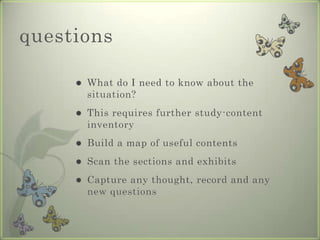
questions

        What do I need to know about the
         situation?
        This requires further study-content
         inventory
        Build a map of useful contents
        Scan the sections and exhibits
        Capture any thought, record and any
         new questions
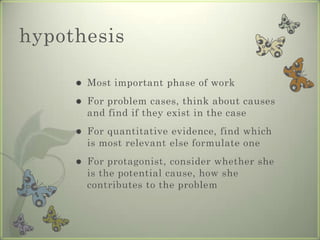
hypothesis

        Most important phase of work
        For problem cases, think about causes
         and find if they exist in the case
        For quantitative evidence, find which
         is most relevant else formulate one
        For protagonist, consider whether she
         is the potential cause, how she
         contributes to the problem
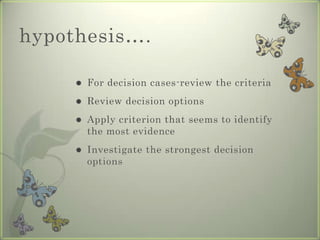
hypothesis….

        For decision cases-review the criteria
        Review decision options
        Apply criterion that seems to identify
         the most evidence
        Investigate the strongest decision
         options
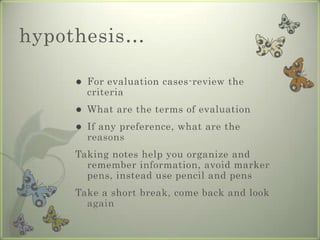
hypothesis…

       For evaluation cases-review the
        criteria
       What are the terms of evaluation
       If any preference, what are the
        reasons
    Taking notes help you organize and
      remember information, avoid marker
      pens, instead use pencil and pens
    Take a short break, come back and look
      again
proof and action

        Remember, you want to prove
         something and look for something to
         prove
        Assess evidence and look more if
         something is missing
        Think in practical real world and not
         ideal world terms
        Think about tangible actions and
         write them down
alternatives

        May sound paradoxical but here you
         question your own hypothesis, its
         strengths and weaknesses
        And what is the strongest alternative
         to it.
        What if hypothesis is wrong-through
         mistakes we learn more about the
         thought process called CASE
         ANALYSIS
Case Discussion

        Aren’t opportunities to recite
         knowledge learned elsewhere
        Its an opportunity to use knowledge
         and intuition to generate new
         knowledge
        Take responsibility of your view of the
         case, develop an argument and listen
         to others who disagree with you
        Arguments enhance learning
Case discussion…

        Collaboration-is what the case
         method is all about
        It is a complete reversal of the lecture
         model
        Everybody works a team with
         instructor as a coach
Classroom risks

        Language barrier
        Gender differences
        Unrelated educational background
        Intellectual fear


     Remember, you share any or all these
       fears with many others
Reducing risk-the
wrong way
        Canned comments
        Speeches
        Delay and assess
Reducing risk-the right
way
        Speak up early
        Be prepared-thorough yet flexible
        Listening is participating
        Remember how to laugh
        Be patient with yourself
        Reflect on what you learn
        Understand the social factor

How to analyze a case study

  • 1.
    What is aCASE??
  • 2.
    Case  Imitates or stimulates a real situation.  Verbal representation of reality  Puts the reader in the role of a participant  Unit of analysis varies enormously from an individual to a department, a company, an industry, country or the world
  • 3.
    myths….  Cases are stories with knowledge embedded in them that students have previously received through text, expert or both  Case is a container of truth  Case analysis is the process of finding the correct answer  Case discussion is an opportunity to tell the instructor that the student has found the right answer
  • 4.
    Purpose of acase  To represent reality  To convey a situation with all its currents and rough edges  To shift the learning process from authority and officially sanctioned truth to unease of ambiguity and multiple meanings  To develop inference making as a primary skill
  • 5.
    Characteristics of case  Presents significant business issue or issues  Has sufficient information on which conclusion can be based  No stated conclusions  Case methods are heuristic
  • 6.
    Complicating properties of acase  Information that includes noise  Unstated information that must be inferred  Non-linear structure in which relevant information is scattered  Often disguised or left to inference
  • 7.
    Role of studentin a case  Construct conclusions from information in the text  Filter out irrelevant or low-value portions  Furnish missing information through inferences  Associate evidences from different parts and integrate into a conclusion
  • 8.
    How to analyzea case Analysis=origin=Greek word=dissolving  to break something into its constituent parts  to study the relationships of the parts to the whole
  • 9.
    Case Analysis  THINKING not READING is the key  Reading is never the primary source of case analysis  As you read, you ask questions about the content  You seek for answers from the case itself  As you find partial or full answers, you think about how they relate to the big picture
  • 10.
    Types of case situations  Problems  Decisions  Evaluations  Rules
  • 11.
    Problem case  Something important has happened and we don’t know why it did  Analysis should begin with a problem definition  Work out an explanation of the problem by linking the outcome or performance to its root cause
  • 12.
    Decision case  Many cases are organized around an explicit decision  Analyzing them requires:  Decision options  Decision criteria  Decision evidence  The goal is to determine the decision that creates the best fit between the available evidence and the criteria
  • 13.
    Evaluation case  Express the judgment about the worth value or effectiveness of a performance, act or outcome  Finally the outcome can be the subject of an assessment  Evaluation assesses worth, value or effectiveness  Evaluation expresses the best fit between the evidence and the criteria
  • 14.
    Rules case  Quantitative method  For this type you need to know:  The type of information needed  The appropriate rule to furnish the same  The correct way to apply the rule  The data necessary to execute the rule  The scope of such a case is very narrow, useful only in specific sets of circumstances but very productive in them
  • 15.
    Case analysis asa process  The key word is ACTIVE READING  Interrogative and purposeful  Iterative  Three concepts contribute to active reading:  A goal  A point of view  A hypothesis
  • 16.
    Goal of analysis  Information familiarization  To infer conclusion  Justification of your conclusion through evidence  You have thought about other possible conclusions and why yours is preferable to them
  • 17.
    Point of viewof analysis  Adopt the point of view of the “protagonist”  Put yourself in her shoes  Ask ,”why is the person in this dilemma”??
  • 18.
    Hypothesis of analysis  One of the most useful tool for resolving the protagonist’s dilemma is a hypothesis  Hypothesis= a tentative explanation that accounts for a set of facts and can be tested by further investigation  Cases don’t allow just any hypothesis  The available evidence in the case sets the rational limit on the range.
  • 19.
    Description of process  The process has five phases:  Situation  Questions  Hypothesis  Proof and action  alternatives
  • 20.
    situation  The most difficult part seems to be the beginning  Start by asking: what is the situation?  Bridge the gap between no knowledge and knowledge enough to form an hypothesis.  Usually reading the first and the last section is sufficient.
  • 21.
    questions  What do I need to know about the situation?  This requires further study-content inventory  Build a map of useful contents  Scan the sections and exhibits  Capture any thought, record and any new questions
  • 22.
    hypothesis  Most important phase of work  For problem cases, think about causes and find if they exist in the case  For quantitative evidence, find which is most relevant else formulate one  For protagonist, consider whether she is the potential cause, how she contributes to the problem
  • 23.
    hypothesis….  For decision cases-review the criteria  Review decision options  Apply criterion that seems to identify the most evidence  Investigate the strongest decision options
  • 24.
    hypothesis…  For evaluation cases-review the criteria  What are the terms of evaluation  If any preference, what are the reasons Taking notes help you organize and remember information, avoid marker pens, instead use pencil and pens Take a short break, come back and look again
  • 25.
    proof and action  Remember, you want to prove something and look for something to prove  Assess evidence and look more if something is missing  Think in practical real world and not ideal world terms  Think about tangible actions and write them down
  • 26.
    alternatives  May sound paradoxical but here you question your own hypothesis, its strengths and weaknesses  And what is the strongest alternative to it.  What if hypothesis is wrong-through mistakes we learn more about the thought process called CASE ANALYSIS
  • 27.
    Case Discussion  Aren’t opportunities to recite knowledge learned elsewhere  Its an opportunity to use knowledge and intuition to generate new knowledge  Take responsibility of your view of the case, develop an argument and listen to others who disagree with you  Arguments enhance learning
  • 28.
    Case discussion…  Collaboration-is what the case method is all about  It is a complete reversal of the lecture model  Everybody works a team with instructor as a coach
  • 29.
    Classroom risks  Language barrier  Gender differences  Unrelated educational background  Intellectual fear Remember, you share any or all these fears with many others
  • 30.
    Reducing risk-the wrong way  Canned comments  Speeches  Delay and assess
  • 31.
    Reducing risk-the right way  Speak up early  Be prepared-thorough yet flexible  Listening is participating  Remember how to laugh  Be patient with yourself  Reflect on what you learn  Understand the social factor