ARIN6912 Week 3 – Tiana Stefanic
‘Is Google making us stupid?’ What the internet is doing to our brainsNicholas Carr (2008)The way we absorb information is changing – largely because of the internet’s manipulation and direction of thought processesGoogle endorses artificial                                      intelligence and efficient                                                 systems – “the human brain is                                                just an outdated computer”Internet demands multitasking – affects our ability to concentrate and absorb large amounts of text	“Unlike footnotes…hyperlinks don’t merely point to related works; they propel you toward them.” (Carr, 2008)
Deep thoughtOur brains have large capacity to adapt based on external stimuliOur brains are being rewired as we adapt to skimming through vast amounts of data We can no longer do ‘deep thinking’ that reading physical books encourage    “Knowing what reading demands of our brain and knowing how it contributes to our capacity to think, to feel, to infer, and to understand other human beings is especially important today as we make the transition from a reading brain to an increasingly digital one.” (Wolf, 2008)
RelevanceCumulative detrimental effects of using the InternetScatters attention – multitasking encouragedDecreases concentration – our minds are unable to solely focus on long, involving tasksWe simply decode information rather than absorbing it“My mind now expects to take in information the way the Net distributes it: in a swiftly moving stream of particles.”                    												 (Carr, 2008)
    “When the Net absorbs a medium, that medium is re-created in the Net’s image. It injects the medium’s content with hyperlinks, blinking ads, and other digital gewgaws, and it surrounds the content with the content of all the other media it has absorbed.”(Carr, 2008)
Points to be further exploredGenerational differencesIn viewing tendencies: audiovisual vs. writtenIn overall media usagePositive outcomes of internet use Reading and creative writingBenefits of multitasking
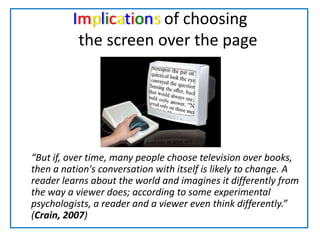
Implications of choosing     the screen over the page	“But if, over time, many people choose television over books, then a nation's conversation with itself is likely to change. A reader learns about the world and imagines it differently from the way a viewer does; according to some experimental psychologists, a reader and a viewer even think differently.” (Crain, 2007)
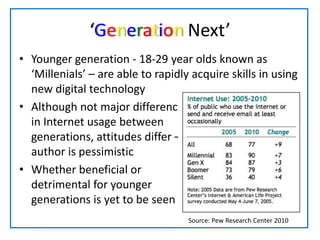
‘Generation Next’Younger generation - 18-29 year olds known as ‘Millenials’ – are able to rapidly acquire skills in using new digital technologyAlthough not major difference                                        in Internet usage between                            generations, attitudes differ –                                          author is pessimisticWhether beneficial or                                         for detrimental for younger                                    generations is yet to be seenSource: Pew Research Center 2010
Internet as tool for creative, collaborative writingCarr fails to take into account the possibilities for creativity inherent in new forms of writing and sharing of information that the Internet enablesBenefit of reading range of critical opinions on blogs and their associated commentaryInternet provides new tools to explore narrative possibilities, such as online role-player games	“The folkloric has always been with us. The Internet is simply the latest stage of its performance.” (Menendez, 2009)
Benefits of multitaskingExploring divergent pathways related to single subject can enhance our understanding of a subjectWe can develop a more complex view of an individual by seeing their personality come across in audio-visual form in addition to written communication
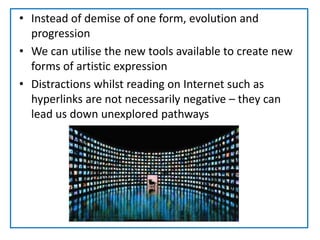
Instead of demise of one form, evolution and progressionWe can utilise the new tools available to create new forms of artistic expressionDistractions whilst reading on Internet such as hyperlinks are not necessarily negative – they can lead us down unexplored pathways
Further ResourcesCarr, N (2008) ‘Is Google Making us Stupid? What the internet is doing to our brains’, Atlantic.com. Washington DC: The Atlantic	This is a thoroughly researched and thought provoking article. It contributes to our overall understanding of the challenges faced by adapting to emerging digital technology that effect embedded practices in our culture such as reading.Crain, C (2007) ‘Twilight of the Books; A Critic at Large’, in The New Yorker, 24 December, Vol. 83, No. 41	This oft-cited article (in other articles related to how the way we read is changing) is full of useful statistics from recent history and a valuable analysis of the implications that reading less have on us collectively. Everhart, N &Valenza, J (2004) ‘Internet-Savvy Students and Their Schools’ in Knowledge Quest, Vol. 32, No.4, P. 50	This article looks at the growing dischord between the computer literacy of students and the knowledge and guidance able to be provided by their teachers and educational institutions.Gabriel, Y (2008) ‘Against the Tyranny of PowerPoint: Technology-in-Use and Technology Abuse’ in Organization Studies, Vol. 29, No. 2, pp. 255-276	I thought this source was suitably ironic. It takes a critical perspective on the PowerPoint program as a medium for visual representation.
Kenyon, S (2008) ‘Internet Use and Time Use: The importance of multitasking’ in Time & Society, Vol. 17, No. 2, pp. 283-318	Takes an analytical look at the multitasking as a dimension of time-use research, which is relevant to this topic because of the implications of the concept for the impact of internet use on time in the information age.Menendez, A (2009) ‘The Future of Narrative’ in Poets & Writers, May-June, Vol. 37, No. 3, pp. 21-24	This author takes a more optimistic approach to trends emerging from widespread use of the internet, such as its provision of new tools for writers. She uses online role-player games as an example of the internet’s facilitation of new forms of imaginative storytelling.Mokhtari, K., Reichard, C.A. & Gardner, A. (2009) ‘The Impact of Internet and television use on the reading habits and practice of college students: the authors explore whether Internet and television use displaces other activities, including recreational reading’ in Journal of Adolescent & Adult Literacy, Vol.  52, No. 7, p. 609 	The title of this article is fairly self-explanatory, and supplements the information in this presentation nicely with a more in-depth look at college students, making it particularly relevant to this class.No author (2003) ‘Google as big brother’ GoogleWatch, http://www.google-watch.org/bigbro.html	Although this site is slightly outdated, it provides a list of criticisms about Google’s practices relating to privacy and the storage of information. It highlights the anti-Google stance that has developed in light of their determination to systematically collect and organise large amounts of data, an issue which is touched upon in Carr’s article.
Taylor, P &Keeter, S (eds.) (2010) Millenials: A Portrait of Generation Next, Pew Research Center, available online: http://pewresearch.org/millenials	This report is part of the ongoing study into the experiences of the young people who make up the generation known here as ‘Millenials’ in the United States that are coming to age in an era of rapidly developing digital technology. It is valuable in providing comprehensive data and analysis.Vascellero, J.E. & Schatz, A (2009) ‘Google Fights Book Backlash’ in Wall Street Journal, Sep. 11, available online: http://online.wsj.com/article/SB125261061059900493.html	This article reflects Carr’s argument that the internet acts as a conduit for all other mediums. Google’s efforts to digitise books have faced criticism and legal action, and this short article highlights the reactions of some of the stakeholders, including Amazon.com and Microsoft.Wolf, M (2008) Proust and the Squid, Thriplow: Icon Publishers	This book is mentioned in many of the sources related to technological innovations and our intake of written information. Wolf takes an in-depth look at how the intellectual and biological intersect in order to explain how the way we read is changing.

ARIN6912 Week 3 Carr Presentation

  • 1.
    ARIN6912 Week 3– Tiana Stefanic
  • 2.
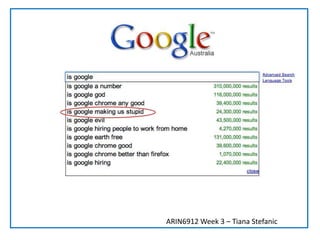
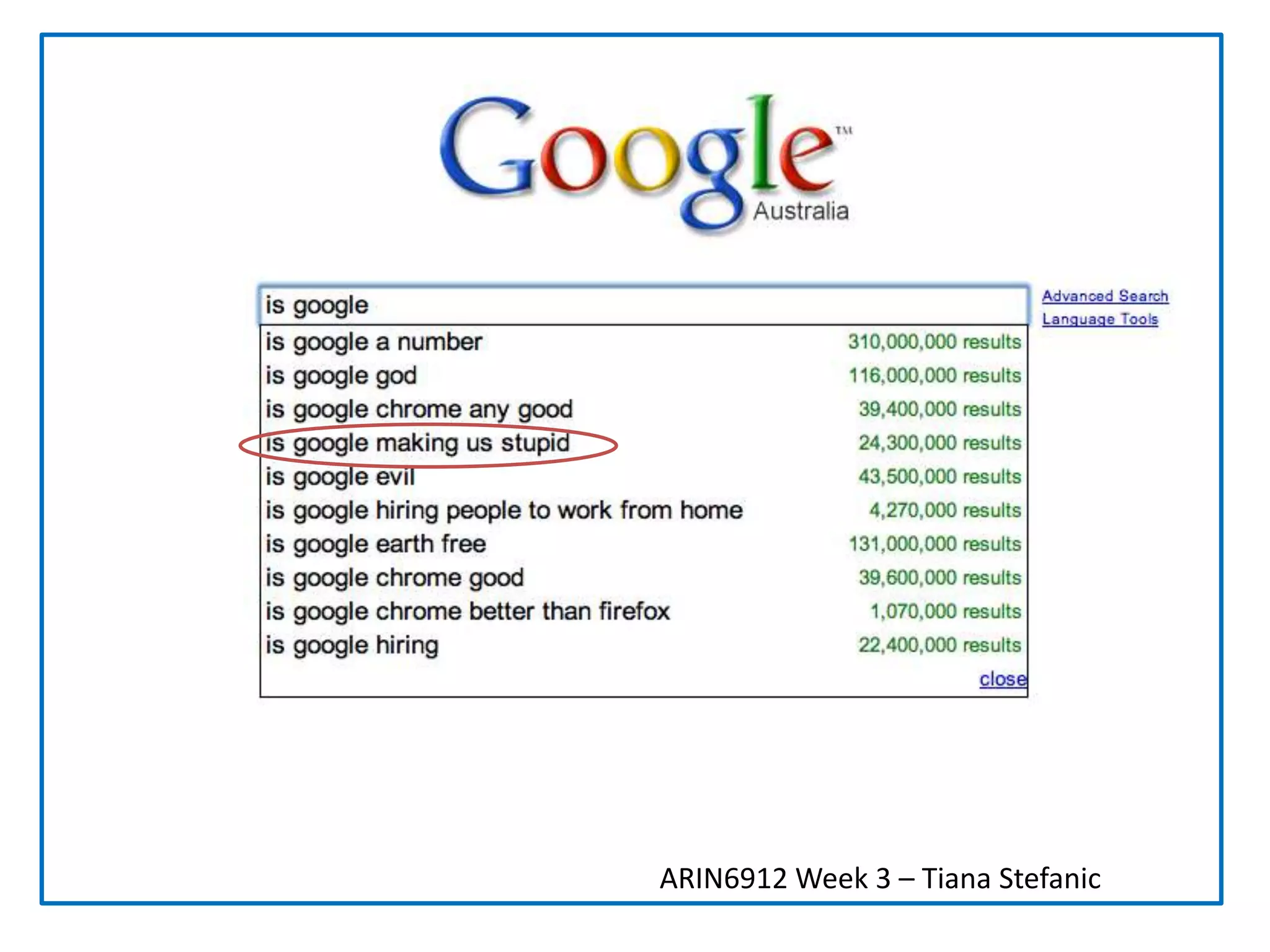
    ‘Is Google makingus stupid?’ What the internet is doing to our brainsNicholas Carr (2008)The way we absorb information is changing – largely because of the internet’s manipulation and direction of thought processesGoogle endorses artificial intelligence and efficient systems – “the human brain is just an outdated computer”Internet demands multitasking – affects our ability to concentrate and absorb large amounts of text “Unlike footnotes…hyperlinks don’t merely point to related works; they propel you toward them.” (Carr, 2008)
  • 3.
    Deep thoughtOur brainshave large capacity to adapt based on external stimuliOur brains are being rewired as we adapt to skimming through vast amounts of data We can no longer do ‘deep thinking’ that reading physical books encourage “Knowing what reading demands of our brain and knowing how it contributes to our capacity to think, to feel, to infer, and to understand other human beings is especially important today as we make the transition from a reading brain to an increasingly digital one.” (Wolf, 2008)
  • 4.
    RelevanceCumulative detrimental effectsof using the InternetScatters attention – multitasking encouragedDecreases concentration – our minds are unable to solely focus on long, involving tasksWe simply decode information rather than absorbing it“My mind now expects to take in information the way the Net distributes it: in a swiftly moving stream of particles.” (Carr, 2008)
  • 5.
    “When the Net absorbs a medium, that medium is re-created in the Net’s image. It injects the medium’s content with hyperlinks, blinking ads, and other digital gewgaws, and it surrounds the content with the content of all the other media it has absorbed.”(Carr, 2008)
  • 7.
    Points to befurther exploredGenerational differencesIn viewing tendencies: audiovisual vs. writtenIn overall media usagePositive outcomes of internet use Reading and creative writingBenefits of multitasking
  • 8.
    Implications of choosing the screen over the page “But if, over time, many people choose television over books, then a nation's conversation with itself is likely to change. A reader learns about the world and imagines it differently from the way a viewer does; according to some experimental psychologists, a reader and a viewer even think differently.” (Crain, 2007)
  • 9.
    ‘Generation Next’Younger generation- 18-29 year olds known as ‘Millenials’ – are able to rapidly acquire skills in using new digital technologyAlthough not major difference in Internet usage between generations, attitudes differ – author is pessimisticWhether beneficial or for detrimental for younger generations is yet to be seenSource: Pew Research Center 2010
  • 10.
    Internet as toolfor creative, collaborative writingCarr fails to take into account the possibilities for creativity inherent in new forms of writing and sharing of information that the Internet enablesBenefit of reading range of critical opinions on blogs and their associated commentaryInternet provides new tools to explore narrative possibilities, such as online role-player games “The folkloric has always been with us. The Internet is simply the latest stage of its performance.” (Menendez, 2009)
  • 11.
    Benefits of multitaskingExploringdivergent pathways related to single subject can enhance our understanding of a subjectWe can develop a more complex view of an individual by seeing their personality come across in audio-visual form in addition to written communication
  • 12.
    Instead of demiseof one form, evolution and progressionWe can utilise the new tools available to create new forms of artistic expressionDistractions whilst reading on Internet such as hyperlinks are not necessarily negative – they can lead us down unexplored pathways
  • 13.
    Further ResourcesCarr, N(2008) ‘Is Google Making us Stupid? What the internet is doing to our brains’, Atlantic.com. Washington DC: The Atlantic This is a thoroughly researched and thought provoking article. It contributes to our overall understanding of the challenges faced by adapting to emerging digital technology that effect embedded practices in our culture such as reading.Crain, C (2007) ‘Twilight of the Books; A Critic at Large’, in The New Yorker, 24 December, Vol. 83, No. 41 This oft-cited article (in other articles related to how the way we read is changing) is full of useful statistics from recent history and a valuable analysis of the implications that reading less have on us collectively. Everhart, N &Valenza, J (2004) ‘Internet-Savvy Students and Their Schools’ in Knowledge Quest, Vol. 32, No.4, P. 50 This article looks at the growing dischord between the computer literacy of students and the knowledge and guidance able to be provided by their teachers and educational institutions.Gabriel, Y (2008) ‘Against the Tyranny of PowerPoint: Technology-in-Use and Technology Abuse’ in Organization Studies, Vol. 29, No. 2, pp. 255-276 I thought this source was suitably ironic. It takes a critical perspective on the PowerPoint program as a medium for visual representation.
  • 14.
    Kenyon, S (2008)‘Internet Use and Time Use: The importance of multitasking’ in Time & Society, Vol. 17, No. 2, pp. 283-318 Takes an analytical look at the multitasking as a dimension of time-use research, which is relevant to this topic because of the implications of the concept for the impact of internet use on time in the information age.Menendez, A (2009) ‘The Future of Narrative’ in Poets & Writers, May-June, Vol. 37, No. 3, pp. 21-24 This author takes a more optimistic approach to trends emerging from widespread use of the internet, such as its provision of new tools for writers. She uses online role-player games as an example of the internet’s facilitation of new forms of imaginative storytelling.Mokhtari, K., Reichard, C.A. & Gardner, A. (2009) ‘The Impact of Internet and television use on the reading habits and practice of college students: the authors explore whether Internet and television use displaces other activities, including recreational reading’ in Journal of Adolescent & Adult Literacy, Vol. 52, No. 7, p. 609 The title of this article is fairly self-explanatory, and supplements the information in this presentation nicely with a more in-depth look at college students, making it particularly relevant to this class.No author (2003) ‘Google as big brother’ GoogleWatch, http://www.google-watch.org/bigbro.html Although this site is slightly outdated, it provides a list of criticisms about Google’s practices relating to privacy and the storage of information. It highlights the anti-Google stance that has developed in light of their determination to systematically collect and organise large amounts of data, an issue which is touched upon in Carr’s article.
  • 15.
    Taylor, P &Keeter,S (eds.) (2010) Millenials: A Portrait of Generation Next, Pew Research Center, available online: http://pewresearch.org/millenials This report is part of the ongoing study into the experiences of the young people who make up the generation known here as ‘Millenials’ in the United States that are coming to age in an era of rapidly developing digital technology. It is valuable in providing comprehensive data and analysis.Vascellero, J.E. & Schatz, A (2009) ‘Google Fights Book Backlash’ in Wall Street Journal, Sep. 11, available online: http://online.wsj.com/article/SB125261061059900493.html This article reflects Carr’s argument that the internet acts as a conduit for all other mediums. Google’s efforts to digitise books have faced criticism and legal action, and this short article highlights the reactions of some of the stakeholders, including Amazon.com and Microsoft.Wolf, M (2008) Proust and the Squid, Thriplow: Icon Publishers This book is mentioned in many of the sources related to technological innovations and our intake of written information. Wolf takes an in-depth look at how the intellectual and biological intersect in order to explain how the way we read is changing.