Chapter 2 :To Search and to Scan Web searching in the world of e-books From  Curtis J. Bonk’s  “ The World is Open ” Summarized by Yeap Hock Aun OUM-MIDT Penang, Malaysia. February 2010
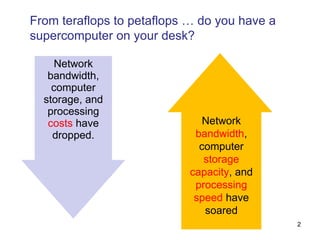
Network bandwidth, computer storage, and processing  costs  have dropped. Network  bandwidth , computer  storage capacity , and  processing speed  have soared From teraflops to petaflops … do you have a supercomputer on your desk?
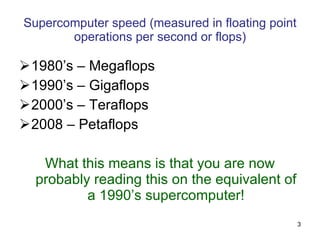
Supercomputer speed (measured in floating point operations per second or flops) 1980’s – Gigaflops 1990’s – Teraflops 2000’s – Petaflops 2009 – 1.759 Petaflops (Cray Jaguar) What this means is that you are now probably reading this on the equivalent of a 1980’s supercomputer!
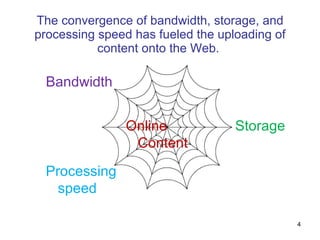
The convergence of bandwidth, storage, and processing speed has fueled the uploading of content onto the Web.  Bandwidth Storage Processing speed Online Content
Educators can now make more resources available online, and this leads to … Niche learning opportunities  where schools are not limited to a finite number of courses and a predetermined list of resources, and where students can pursue their  passions .  Learning 2.0  – a life filled with options, choice, flexibility, and openness in education.  (John Seely Brown)
As more and more information can be found and extracted quickly from the Web, memorizing information is now much less important than knowing how to access information. Elliot Masie  calls this “ Fingertip knowledge ”.
Knowledge on the Web The Web of today provides the foundation for the production and dissemination of knowledge. Web search tools such as  Yahoo! ,  Google , and  MSN Search  can expand and organize our educational quests.
Digitization The digitization of knowledge on the Web has reduced the time between production to the consumption of knowledge to mere milliseconds. Digitization could make every idea in every book in existence available for educational and noneducational use. ( Dr. Brian J. Ford )
About to be “Google-ized” We spend a lot of time each day searching for information, but much of what we find is irrelevant to our needs and interests. A better way to learning is to provide knowledge when it is needed. Learning is shifting from acquiring and assessing knowledge to searching and finding knowledge, and  companies such as Google will provide the tools and guide us in doing this .
Google’s Mission “ To organize all the world’s knowledge and to make it accessible and useful.” This might have sounded  ridiculous  even ten years ago. Today it just might be  plausible . In the near future, it will be  reality .
Redefining  intelligence Technology such as Google’s will change the defining feature of an intelligent person from one having a lot of knowledge in one’s head to one who has the skills in problem finding and solving, information synthesis, knowledge collaboration, originality, and critical analysis.
Learning = Access With the  enormous  amount of information that will be made available by Web search engines,  learning will be increasingly equated with access to information .
The Great Google Scanning Project @ Google Books This is a  mind-boggling project  that aims to bring the information contained in all the world’s books to our homes via the Web. Google will scan millions of books  provided by partners such as the University of California (UC), Stanford, Harvard, Oxford, and the New York Public Library. UC alone will provide 2.5 million books !
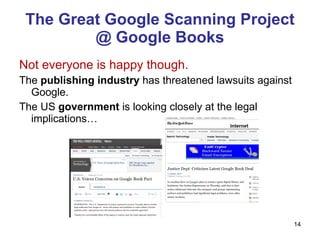
The Great Google Scanning Project @ Google Books Not everyone is happy though. The  publishing industry  has threatened lawsuits against Google. The US  government  is looking closely at the legal implications…
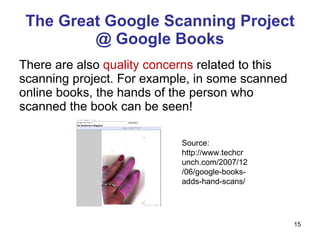
The Great Google Scanning Project @ Google Books There are also  quality concerns  related to this scanning project. For example, in some scanned online books, the hands of the person who scanned the book can be seen! Source:  http://www.techcrunch.com/2007/12/06/google-books-adds-hand-scans/
The Great Google Scanning Project @ Google Books “ Scanning the great libraries is a wonderful idea, but if only one corporation controls access to this digital collection, we’ll have handed too much control to a private entity.” ( Brewster Kahle ) Fortunately for us all, the Internet is about  choice , and so Google has  competition  …
Microsoft Live Search  Books The Microsoft Live Search Books project scanned 750 000 books before it was terminated in May 2008.
Open Content Alliance (OCA) ( http://www.opencontentalliance.org/ ) Provides access to scanned books and multimedia content. Its goal: to have a representative collection of the “creative output of humankind.”
The Open Library ( http://openlibrary.org/) This is the digital card catalog for the OCA and other similar projects. Embraces Web 2.0 technology. Records the discussions and reviews of its users in a free, fully open, and comprehensive archive.
The Global Text Project  ( http://globaltext.terry.uga.edu) Aims to develop  more than a thousand free open-source digital textbooks  for learners in Third World countries who cannot afford to buy paper-based books or cannot access books that they need. It focuses on business, science, and technology books.
The One Million Book Project (http://www.ulib.org/) This is a project by Carnegie Mellon University that  aims to foster creativity by providing free access to all human knowledge . It has scanned  1.5 million books  (a change of project title required?) and made them available on the Web.
“ Blowing Dandelions” “ If you blow your works into the Net like a dandelion clock on the breeze, the Net itself will take care of the copying costs.”  ( Cory Doctorow ) This statement illustrates the belief of some authors that  information should be copied and distributed , not copyrighted and protected.
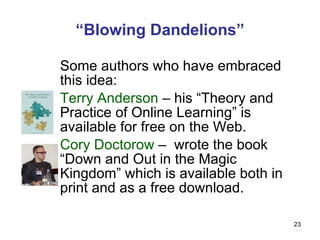
Some authors who have embraced this idea: Terry Anderson  – his “Theory and Practice of Online Learning” is available for free on the Web. Cory Doctorow  –  wrote the book “Down and Out in the Magic Kingdom” which is available both in print and as a free download. “ Blowing Dandelions”
“ Blowing Dandelions” What do these authors get from providing free downloads of their works? Increased audience  – which leads to increased publicity and enhanced reputation. Their readers tend to form  loyal relationships  with them. All of the above helps to  increase the authors influence  in their field of expertise.
The end of the beginning … Filling the Web with a vast amount of knowledge is  just the first step . What is the point of all that knowledge on the Web if few people can reach it and use it effectively? We need to  provide access to people  who have limited technology infrastructure. We must  design creative and educationally beneficial uses  of our information technologies.
Thank You.

HMID6303 Assignment 1 - Yeap

  • 1.
    Chapter 2 :ToSearch and to Scan Web searching in the world of e-books From Curtis J. Bonk’s “ The World is Open ” Summarized by Yeap Hock Aun OUM-MIDT Penang, Malaysia. February 2010
  • 2.
    Network bandwidth, computerstorage, and processing costs have dropped. Network bandwidth , computer storage capacity , and processing speed have soared From teraflops to petaflops … do you have a supercomputer on your desk?
  • 3.
    Supercomputer speed (measuredin floating point operations per second or flops) 1980’s – Gigaflops 1990’s – Teraflops 2000’s – Petaflops 2009 – 1.759 Petaflops (Cray Jaguar) What this means is that you are now probably reading this on the equivalent of a 1980’s supercomputer!
  • 4.
    The convergence ofbandwidth, storage, and processing speed has fueled the uploading of content onto the Web. Bandwidth Storage Processing speed Online Content
  • 5.
    Educators can nowmake more resources available online, and this leads to … Niche learning opportunities where schools are not limited to a finite number of courses and a predetermined list of resources, and where students can pursue their passions . Learning 2.0 – a life filled with options, choice, flexibility, and openness in education. (John Seely Brown)
  • 6.
    As more andmore information can be found and extracted quickly from the Web, memorizing information is now much less important than knowing how to access information. Elliot Masie calls this “ Fingertip knowledge ”.
  • 7.
    Knowledge on theWeb The Web of today provides the foundation for the production and dissemination of knowledge. Web search tools such as Yahoo! , Google , and MSN Search can expand and organize our educational quests.
  • 8.
    Digitization The digitizationof knowledge on the Web has reduced the time between production to the consumption of knowledge to mere milliseconds. Digitization could make every idea in every book in existence available for educational and noneducational use. ( Dr. Brian J. Ford )
  • 9.
    About to be“Google-ized” We spend a lot of time each day searching for information, but much of what we find is irrelevant to our needs and interests. A better way to learning is to provide knowledge when it is needed. Learning is shifting from acquiring and assessing knowledge to searching and finding knowledge, and companies such as Google will provide the tools and guide us in doing this .
  • 10.
    Google’s Mission “To organize all the world’s knowledge and to make it accessible and useful.” This might have sounded ridiculous even ten years ago. Today it just might be plausible . In the near future, it will be reality .
  • 11.
    Redefining intelligenceTechnology such as Google’s will change the defining feature of an intelligent person from one having a lot of knowledge in one’s head to one who has the skills in problem finding and solving, information synthesis, knowledge collaboration, originality, and critical analysis.
  • 12.
    Learning = AccessWith the enormous amount of information that will be made available by Web search engines, learning will be increasingly equated with access to information .
  • 13.
    The Great GoogleScanning Project @ Google Books This is a mind-boggling project that aims to bring the information contained in all the world’s books to our homes via the Web. Google will scan millions of books provided by partners such as the University of California (UC), Stanford, Harvard, Oxford, and the New York Public Library. UC alone will provide 2.5 million books !
  • 14.
    The Great GoogleScanning Project @ Google Books Not everyone is happy though. The publishing industry has threatened lawsuits against Google. The US government is looking closely at the legal implications…
  • 15.
    The Great GoogleScanning Project @ Google Books There are also quality concerns related to this scanning project. For example, in some scanned online books, the hands of the person who scanned the book can be seen! Source: http://www.techcrunch.com/2007/12/06/google-books-adds-hand-scans/
  • 16.
    The Great GoogleScanning Project @ Google Books “ Scanning the great libraries is a wonderful idea, but if only one corporation controls access to this digital collection, we’ll have handed too much control to a private entity.” ( Brewster Kahle ) Fortunately for us all, the Internet is about choice , and so Google has competition …
  • 17.
    Microsoft Live Search Books The Microsoft Live Search Books project scanned 750 000 books before it was terminated in May 2008.
  • 18.
    Open Content Alliance(OCA) ( http://www.opencontentalliance.org/ ) Provides access to scanned books and multimedia content. Its goal: to have a representative collection of the “creative output of humankind.”
  • 19.
    The Open Library( http://openlibrary.org/) This is the digital card catalog for the OCA and other similar projects. Embraces Web 2.0 technology. Records the discussions and reviews of its users in a free, fully open, and comprehensive archive.
  • 20.
    The Global TextProject ( http://globaltext.terry.uga.edu) Aims to develop more than a thousand free open-source digital textbooks for learners in Third World countries who cannot afford to buy paper-based books or cannot access books that they need. It focuses on business, science, and technology books.
  • 21.
    The One MillionBook Project (http://www.ulib.org/) This is a project by Carnegie Mellon University that aims to foster creativity by providing free access to all human knowledge . It has scanned 1.5 million books (a change of project title required?) and made them available on the Web.
  • 22.
    “ Blowing Dandelions”“ If you blow your works into the Net like a dandelion clock on the breeze, the Net itself will take care of the copying costs.” ( Cory Doctorow ) This statement illustrates the belief of some authors that information should be copied and distributed , not copyrighted and protected.
  • 23.
    Some authors whohave embraced this idea: Terry Anderson – his “Theory and Practice of Online Learning” is available for free on the Web. Cory Doctorow – wrote the book “Down and Out in the Magic Kingdom” which is available both in print and as a free download. “ Blowing Dandelions”
  • 24.
    “ Blowing Dandelions”What do these authors get from providing free downloads of their works? Increased audience – which leads to increased publicity and enhanced reputation. Their readers tend to form loyal relationships with them. All of the above helps to increase the authors influence in their field of expertise.
  • 25.
    The end ofthe beginning … Filling the Web with a vast amount of knowledge is just the first step . What is the point of all that knowledge on the Web if few people can reach it and use it effectively? We need to provide access to people who have limited technology infrastructure. We must design creative and educationally beneficial uses of our information technologies.
  • 26.