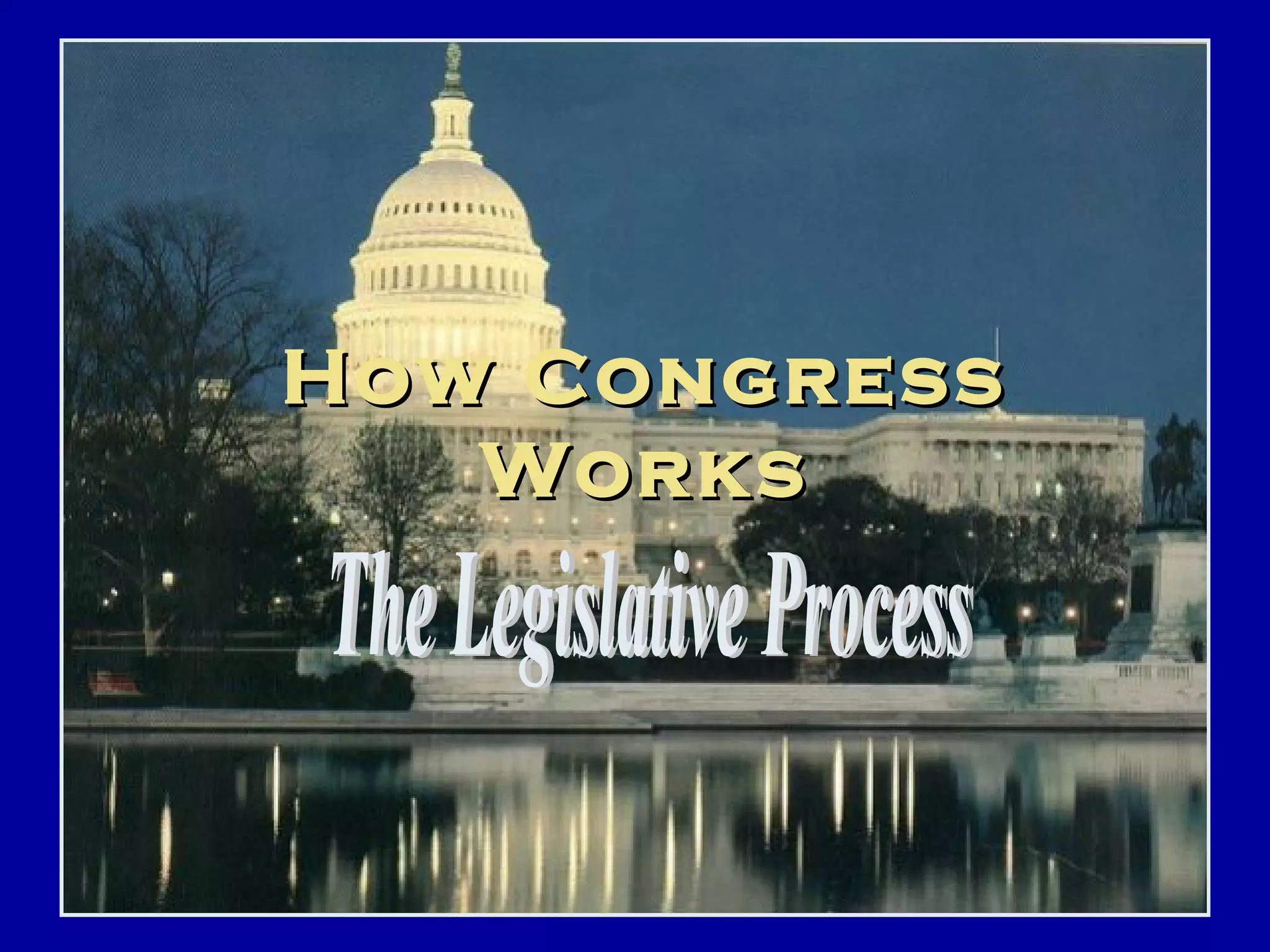
How CongressHow Congress
WorksWorks
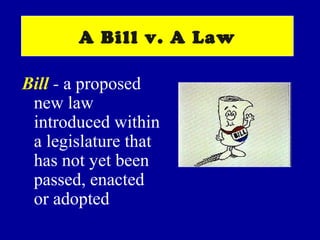
A Bill v. A Law
Bill - a proposed
new law
introduced within
a legislature that
has not yet been
passed, enacted
or adopted
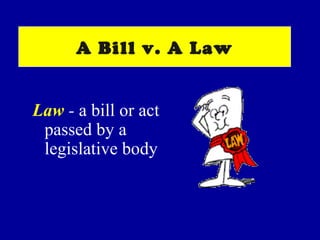
A Bill v. A Law
Law - a bill or act
passed by a
legislative body
Types of BillsTypes of Bills
• public bill – proposed legislative bill that
deals with matters of general concern and
application
• private bill – a proposed legislative bill that
deals with specific private, personal, or
local matters rather than general affairs
• appropriation bill – legislative motion
authorizing the government to spend money
Types of ResolutionsTypes of Resolutions
• simple resolution – measure dealing with “house-
keeping” or procedural matters that only affect one house
• joint resolution – measure when approved by both houses
and the president carries the force of law
• concurrent resolution – legislative motion that must be
approved by both houses, but does not have the force of
law
resolutionresolution -- a measure expressing
opinions on policies or issues
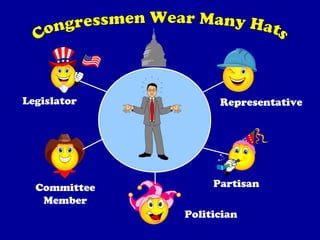
Legislator Representative
Committee
Member
Partisan
Politician
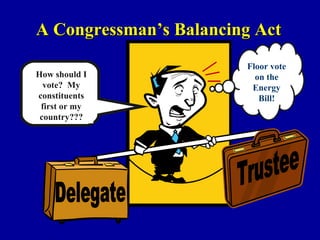
How should I
vote? My
constituents
first or my
country???
Floor vote
on the
Energy
Bill!
A Congressman’s Balancing ActA Congressman’s Balancing Act
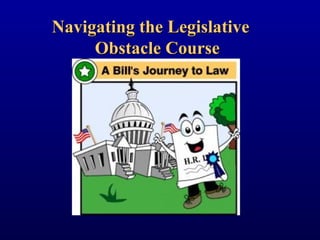
Navigating the LegislativeNavigating the Legislative
Obstacle CourseObstacle Course
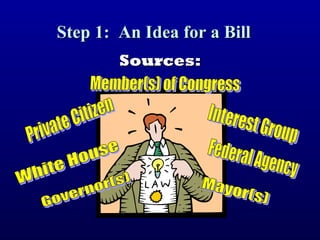
Step 1: An Idea for a BillStep 1: An Idea for a Bill
Sources:Sources:
Step 2: Writing & Introduction of BillStep 2: Writing & Introduction of Bill
Senate:
• Bill formerly
read aloud on
floor
• Bill then given
to clerk
• Referred to
committee by
Steering
Committee
House:
• Bill dropped in hopper
• Referred to committee
by the Speaker
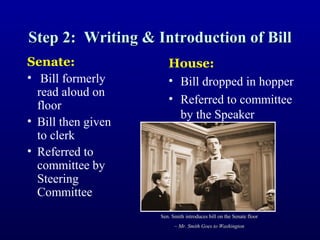
Sen. Smith introduces bill on the Senate floorSen. Smith introduces bill on the Senate floor
~~ Mr. Smith Goes to WashingtonMr. Smith Goes to Washington
Step 3: Committee ActionStep 3: Committee Action
• House & Senate committees conduct
public hearings
• Experts testify
• Markup of bills
• Committee vote:
report favorably,
unfavorably,
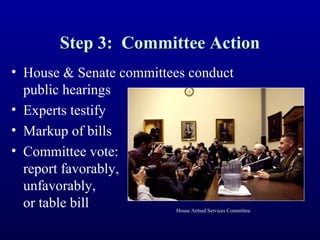
or table bill House Armed Services CommitteeHouse Armed Services Committee
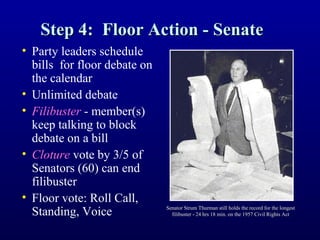
Step 4: Floor Action - SenateStep 4: Floor Action - Senate
• Party leaders schedule
bills for floor debate on
the calendar
• Unlimited debate
• Filibuster - member(s)
keep talking to block
debate on a bill
• Cloture vote by 3/5 of
Senators (60) can end
filibuster
• Floor vote: Roll Call,
Standing, Voice Senator Strum Thurman still holds the record for the longestSenator Strum Thurman still holds the record for the longest
filibuster - 24 hrs 18 min. on the 1957 Civil Rights Actfilibuster - 24 hrs 18 min. on the 1957 Civil Rights Act
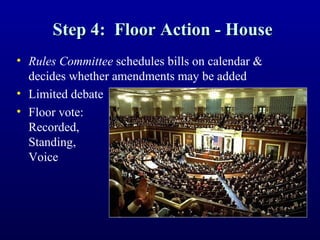
Step 4: Floor Action - HouseStep 4: Floor Action - House
• Rules Committee schedules bills on calendar &
decides whether amendments may be added
• Limited debate
• Floor vote:
Recorded,
Standing,
Voice
Step 5: Approved BillStep 5: Approved Bill
Crosses Over to Other HouseCrosses Over to Other House
• Approved bill
must pass each
chamber by a
simple majority
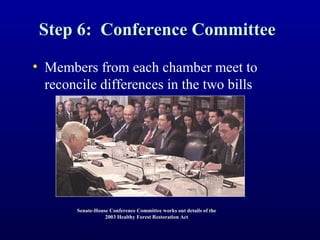
Step 6: Conference CommitteeStep 6: Conference Committee
• Members from each chamber meet to
reconcile differences in the two bills
Senate-House Conference Committee works out details of theSenate-House Conference Committee works out details of the
2003 Healthy Forest Restoration Act2003 Healthy Forest Restoration Act
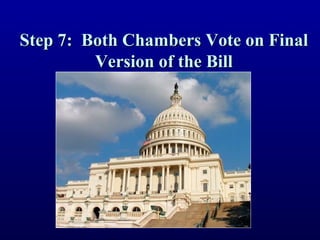
Step 7: Both Chambers Vote on FinalStep 7: Both Chambers Vote on Final
Version of the BillVersion of the Bill
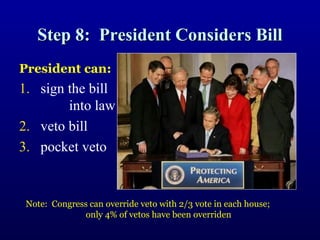
Step 8: President Considers BillStep 8: President Considers Bill
President can:
1. sign the bill
into law
2. veto bill
3. pocket veto
Note: Congress can override veto with 2/3 vote in each house;
only 4% of vetos have been overriden
Critical Thinking:Critical Thinking:
Fact: About 5,000 bills are introduced in CongressFact: About 5,000 bills are introduced in Congress
every year, but only about 150 are signed into law.every year, but only about 150 are signed into law.
1.1. Explain why so few bills become law.Explain why so few bills become law.
2.2. Is that a good thing or a bad thing?Is that a good thing or a bad thing?
3. Should the legislative process in Congress be
reformed? If yes, what changes would you
recommend? If not, why not?
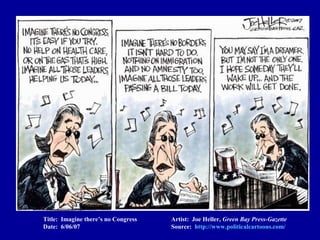
Title: Imagine there’s no Congress Artist: Joe Heller, Green Bay Press-Gazette
Date: 6/06/07 Source: http://www.politicalcartoons.com/
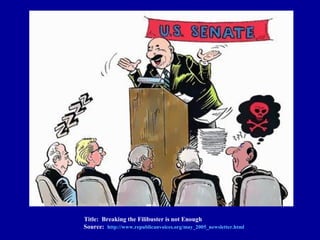
Title: Breaking the Filibuster is not Enough
Source: http://www.republicanvoices.org/may_2005_newsletter.html
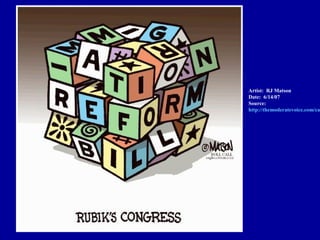
Artist: RJ Matson
Date: 6/14/07
Source:
http://themoderatevoice.com/ca
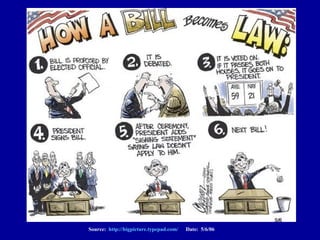
Source: http://bigpicture.typepad.com/ Date: 5/6/06

How congress works 2

  • 1.
  • 2.
    A Bill v.A Law Bill - a proposed new law introduced within a legislature that has not yet been passed, enacted or adopted
  • 3.
    A Bill v.A Law Law - a bill or act passed by a legislative body
  • 4.
    Types of BillsTypesof Bills • public bill – proposed legislative bill that deals with matters of general concern and application • private bill – a proposed legislative bill that deals with specific private, personal, or local matters rather than general affairs • appropriation bill – legislative motion authorizing the government to spend money
  • 5.
    Types of ResolutionsTypesof Resolutions • simple resolution – measure dealing with “house- keeping” or procedural matters that only affect one house • joint resolution – measure when approved by both houses and the president carries the force of law • concurrent resolution – legislative motion that must be approved by both houses, but does not have the force of law resolutionresolution -- a measure expressing opinions on policies or issues
  • 6.
  • 7.
    How should I vote?My constituents first or my country??? Floor vote on the Energy Bill! A Congressman’s Balancing ActA Congressman’s Balancing Act
  • 8.
    Navigating the LegislativeNavigatingthe Legislative Obstacle CourseObstacle Course
  • 9.
    Step 1: AnIdea for a BillStep 1: An Idea for a Bill Sources:Sources:
  • 10.
    Step 2: Writing& Introduction of BillStep 2: Writing & Introduction of Bill Senate: • Bill formerly read aloud on floor • Bill then given to clerk • Referred to committee by Steering Committee House: • Bill dropped in hopper • Referred to committee by the Speaker Sen. Smith introduces bill on the Senate floorSen. Smith introduces bill on the Senate floor ~~ Mr. Smith Goes to WashingtonMr. Smith Goes to Washington
  • 11.
    Step 3: CommitteeActionStep 3: Committee Action • House & Senate committees conduct public hearings • Experts testify • Markup of bills • Committee vote: report favorably, unfavorably, or table bill House Armed Services CommitteeHouse Armed Services Committee
  • 12.
    Step 4: FloorAction - SenateStep 4: Floor Action - Senate • Party leaders schedule bills for floor debate on the calendar • Unlimited debate • Filibuster - member(s) keep talking to block debate on a bill • Cloture vote by 3/5 of Senators (60) can end filibuster • Floor vote: Roll Call, Standing, Voice Senator Strum Thurman still holds the record for the longestSenator Strum Thurman still holds the record for the longest filibuster - 24 hrs 18 min. on the 1957 Civil Rights Actfilibuster - 24 hrs 18 min. on the 1957 Civil Rights Act
  • 13.
    Step 4: FloorAction - HouseStep 4: Floor Action - House • Rules Committee schedules bills on calendar & decides whether amendments may be added • Limited debate • Floor vote: Recorded, Standing, Voice
  • 14.
    Step 5: ApprovedBillStep 5: Approved Bill Crosses Over to Other HouseCrosses Over to Other House • Approved bill must pass each chamber by a simple majority
  • 15.
    Step 6: ConferenceCommitteeStep 6: Conference Committee • Members from each chamber meet to reconcile differences in the two bills Senate-House Conference Committee works out details of theSenate-House Conference Committee works out details of the 2003 Healthy Forest Restoration Act2003 Healthy Forest Restoration Act
  • 16.
    Step 7: BothChambers Vote on FinalStep 7: Both Chambers Vote on Final Version of the BillVersion of the Bill
  • 17.
    Step 8: PresidentConsiders BillStep 8: President Considers Bill President can: 1. sign the bill into law 2. veto bill 3. pocket veto Note: Congress can override veto with 2/3 vote in each house; only 4% of vetos have been overriden
  • 18.
    Critical Thinking:Critical Thinking: Fact:About 5,000 bills are introduced in CongressFact: About 5,000 bills are introduced in Congress every year, but only about 150 are signed into law.every year, but only about 150 are signed into law. 1.1. Explain why so few bills become law.Explain why so few bills become law. 2.2. Is that a good thing or a bad thing?Is that a good thing or a bad thing? 3. Should the legislative process in Congress be reformed? If yes, what changes would you recommend? If not, why not?
  • 19.
    Title: Imagine there’sno Congress Artist: Joe Heller, Green Bay Press-Gazette Date: 6/06/07 Source: http://www.politicalcartoons.com/
  • 20.
    Title: Breaking theFilibuster is not Enough Source: http://www.republicanvoices.org/may_2005_newsletter.html
  • 21.
    Artist: RJ Matson Date:6/14/07 Source: http://themoderatevoice.com/ca
  • 22.