Committees What are committees used for in everyday life?  What about in Congress?
Why do we need committees in the legislative branch? Divide up the work that will be done Congress receives a lot of bills (almost 10,000 a year) How would they do it all by themselves?
Most of the legislative work of Congress occurs in Committees.
Who is in a committee? Majority of each house holds all the committee chairman seats The majority party will also hold a majority of the seats on each committee, effectively controlling all the business of a committee
Most bills receive their most thorough administration in these bodies; members of both bodies usually respect the recommendations that committees make.
Committee Chair The committee member of majority party with most seniority becomes chair
Committee Chair Duties They head standing committees in each chamber.  This is important because of the bulk of the work is done in committees
Committee Chair Continued Decide when committee will meet, which bills they will take up, whether they will hold public hearings, what witnesses to call Manage the debate when the bill is called to the floor
Committee Assignments Determined by House and Senate leadership and a caucus of the two parties Members of Congress attempt to get on a committee that will allow them to do the most for their constituents
Numbers Reps are on 1-2 Committees, Senators are on 3-4
Committees sizes 9-75 members in the House 12-28 members in Senate
Subcommittees Often committees assign bills to smaller groups, subcommittees, for initial consideration MOST WORK IS DONE HERE!! Each subcommittee is responsible for a particular slice of the committees overall workload
Types of Committees Standing Select Joint Conference
Permanent committees in a legislative body to which bills in a specific subject matter area are concerned.  These are the only ones that can propose legislation by reporting a bill out to the full House or Senate, with few exception.  MEMBERS BECOME EXPERTS IN THIS AREA Standing Committees
Currently 20 in the House and 18 in Senate Fate of most bills is decided in the various standing committees, not on the floor of either house Most members try to win assignments on important committees
Examples of important committees HOUSE Ways and Means Appropriations Armed Service Judiciary
International relations House Rules Committee - traffic cop.  Screens the bills, if it reaches the floor it has also cleared the House Rules Committee. Place bill on the calendar, limit debate time, determine allowed amendments
SENATE Foreign Relations Appropriations Finance Judiciary  Armed Services Banking, Housing, Urban Affairs
Select Committees AKA Special Committees  Panels set up for some specific purpose and most often for a limited time
Examples include Watergate or Iran Contra
Appointment to a special committee Speaker or the President of the Senate appoint with the help of leadership in each party
Joint Committees A committee composed of members of both houses Most are permanent and thus standing, but they can also be temporary/select Usually used to communicate to the public or for investigations, but generally do not send bills to the floor
Random Information Committees function by calling interested parties and expert witness who have some information to give
Pigeonhole a bill - Committees can vote a bill out to keep it from being considered in their house.
Congressional Research Service (CRS) Responds to congressional requests for information.  Looks up facts and indicates arguments for and against, but DOES NOT RECOMMEND policy
General Accounting Office (GAO) Financial Audits of money spent by the executive branch.  Investigatory agency
Office of Technology Assessment (OTA) Study and evaluate policies and programs with a significant use of or impact on technology Congressional Budget Office Advises Congress on the effects of spending and provides information about costs
Republican majority in the House of Representatives, elected in 1994, campaigned under a platform called the Contract with America A blueprint for the first 100 days Contract with America
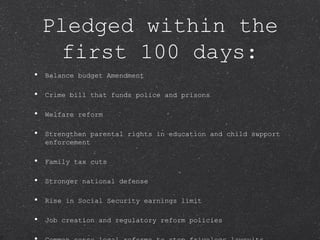
Pledged within the first 100 days: Balance budget Amendment Crime bill that funds police and prisons Welfare reform Strengthen parental rights in education and child support enforcement Family tax cuts Stronger national defense Rise in Social Security earnings limit Job creation and regulatory reform policies Common sense legal reforms to stop frivolous lawsuits A first ever vote on term limits for members of Congress

Legislative Committees

  • 1.
    Committees What arecommittees used for in everyday life? What about in Congress?
  • 2.
    Why do weneed committees in the legislative branch? Divide up the work that will be done Congress receives a lot of bills (almost 10,000 a year) How would they do it all by themselves?
  • 3.
    Most of thelegislative work of Congress occurs in Committees.
  • 4.
    Who is ina committee? Majority of each house holds all the committee chairman seats The majority party will also hold a majority of the seats on each committee, effectively controlling all the business of a committee
  • 5.
    Most bills receivetheir most thorough administration in these bodies; members of both bodies usually respect the recommendations that committees make.
  • 6.
    Committee Chair Thecommittee member of majority party with most seniority becomes chair
  • 7.
    Committee Chair DutiesThey head standing committees in each chamber. This is important because of the bulk of the work is done in committees
  • 8.
    Committee Chair ContinuedDecide when committee will meet, which bills they will take up, whether they will hold public hearings, what witnesses to call Manage the debate when the bill is called to the floor
  • 9.
    Committee Assignments Determinedby House and Senate leadership and a caucus of the two parties Members of Congress attempt to get on a committee that will allow them to do the most for their constituents
  • 10.
    Numbers Reps areon 1-2 Committees, Senators are on 3-4
  • 11.
    Committees sizes 9-75members in the House 12-28 members in Senate
  • 12.
    Subcommittees Often committeesassign bills to smaller groups, subcommittees, for initial consideration MOST WORK IS DONE HERE!! Each subcommittee is responsible for a particular slice of the committees overall workload
  • 13.
    Types of CommitteesStanding Select Joint Conference
  • 14.
    Permanent committees ina legislative body to which bills in a specific subject matter area are concerned. These are the only ones that can propose legislation by reporting a bill out to the full House or Senate, with few exception. MEMBERS BECOME EXPERTS IN THIS AREA Standing Committees
  • 15.
    Currently 20 inthe House and 18 in Senate Fate of most bills is decided in the various standing committees, not on the floor of either house Most members try to win assignments on important committees
  • 16.
    Examples of importantcommittees HOUSE Ways and Means Appropriations Armed Service Judiciary
  • 17.
    International relations HouseRules Committee - traffic cop. Screens the bills, if it reaches the floor it has also cleared the House Rules Committee. Place bill on the calendar, limit debate time, determine allowed amendments
  • 18.
    SENATE Foreign RelationsAppropriations Finance Judiciary Armed Services Banking, Housing, Urban Affairs
  • 19.
    Select Committees AKASpecial Committees Panels set up for some specific purpose and most often for a limited time
  • 20.
  • 21.
    Appointment to aspecial committee Speaker or the President of the Senate appoint with the help of leadership in each party
  • 22.
    Joint Committees Acommittee composed of members of both houses Most are permanent and thus standing, but they can also be temporary/select Usually used to communicate to the public or for investigations, but generally do not send bills to the floor
  • 23.
    Random Information Committeesfunction by calling interested parties and expert witness who have some information to give
  • 24.
    Pigeonhole a bill- Committees can vote a bill out to keep it from being considered in their house.
  • 25.
    Congressional Research Service(CRS) Responds to congressional requests for information. Looks up facts and indicates arguments for and against, but DOES NOT RECOMMEND policy
  • 26.
    General Accounting Office(GAO) Financial Audits of money spent by the executive branch. Investigatory agency
  • 27.
    Office of TechnologyAssessment (OTA) Study and evaluate policies and programs with a significant use of or impact on technology Congressional Budget Office Advises Congress on the effects of spending and provides information about costs
  • 28.
    Republican majority inthe House of Representatives, elected in 1994, campaigned under a platform called the Contract with America A blueprint for the first 100 days Contract with America
  • 29.
    Pledged within thefirst 100 days: Balance budget Amendment Crime bill that funds police and prisons Welfare reform Strengthen parental rights in education and child support enforcement Family tax cuts Stronger national defense Rise in Social Security earnings limit Job creation and regulatory reform policies Common sense legal reforms to stop frivolous lawsuits A first ever vote on term limits for members of Congress