Lesson: Supreme Court Nominations 1/49
Lesson: Supreme Court Nominations 2/49
Lesson: Supreme Court Nominations 3/49
Lesson: Supreme Court Nominations 4/49
SCOTUS Nominations
Lesson: Supreme Court Nominations 5/49
Lesson: Supreme Court Nominations 6/49
Lesson: Supreme Court Nominations 7/49
https://cf.nearpod.com/neareducation/new/Webpage/343404930/iconoriginal.pdf?AWSAccessKeyId=AKIAINYAGM2YWP2OWQBA&Expires=2147483647&Signature=Uyh%2B9I2O2Bg%2B9J0nAwQeFwj%2FuUo%3D
Lesson: Supreme Court Nominations 8/49
Quiz
Lesson: Supreme Court Nominations 9/49
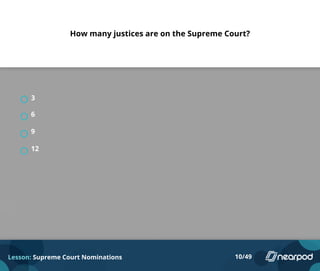
How many justices are on the Supreme Court?
3
6
9
12
Lesson: Supreme Court Nominations 10/49
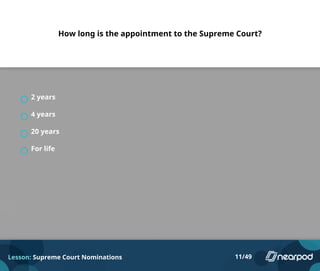
How long is the appointment to the Supreme Court?
2 years
4 years
20 years
For life
Lesson: Supreme Court Nominations 11/49
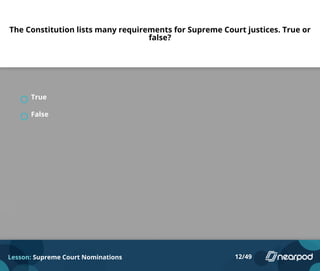
The Constitution lists many requirements for Supreme Court justices. True or
false?
True
False
Lesson: Supreme Court Nominations 12/49
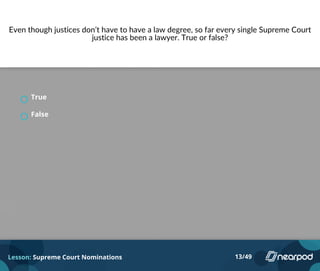
Even though justices don’t have to have a law degree, so far every single Supreme Court
justice has been a lawyer. True or false?
True
False
Lesson: Supreme Court Nominations 13/49
Fill in the Blanks
Lesson: Supreme Court Nominations 14/49
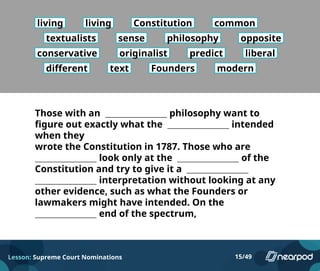
living living Constitution common
textualists sense philosophy opposite
conservative originalist predict liberal
different text Founders modern
Those with an philosophy want to
figure out exactly what the intended
when they
wrote the Constitution in 1787. Those who are
look only at the of the
Constitution and try to give it a
interpretation without looking at any
other evidence, such as what the Founders or
lawmakers might have intended. On the
end of the spectrum,
Lesson: Supreme Court Nominations 15/49
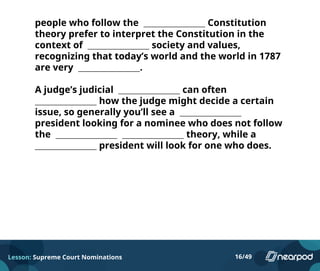
people who follow the Constitution
theory prefer to interpret the Constitution in the
context of society and values,
recognizing that today’s world and the world in 1787
are very .
A judge’s judicial can often
how the judge might decide a certain
issue, so generally you’ll see a
president looking for a nominee who does not follow
the theory, while a
president will look for one who does.
Lesson: Supreme Court Nominations 16/49
Open Ended Question
Lesson: Supreme Court Nominations 17/49
What are some of the benefits and risks of each judicial
philosophy as a method of interpreting the
Constitution?
Lesson: Supreme Court Nominations 18/49
Please enter your answer here.
Open Ended Question
Lesson: Supreme Court Nominations 19/49
How does the nomination and confirmation process let the
executive and legislative branches “check” the judicial branch?
Explain.
Lesson: Supreme Court Nominations 20/49
Please enter your answer here.
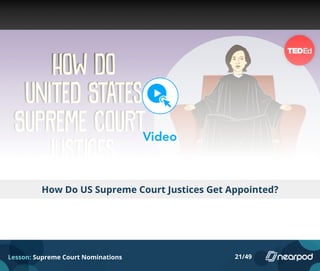
How Do US Supreme Court Justices Get Appointed?
Lesson: Supreme Court Nominations 21/49
Lesson: Supreme Court Nominations 22/49
Lesson: Supreme Court Nominations 23/49
Draw It
Lesson: Supreme Court Nominations 24/49
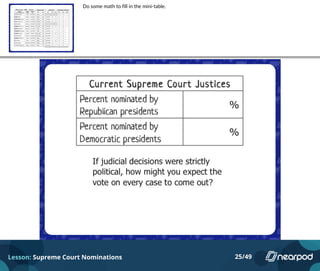
Do some math to fill in the mini-table.
Lesson: Supreme Court Nominations 25/49
Open Ended Question
Lesson: Supreme Court Nominations 26/49
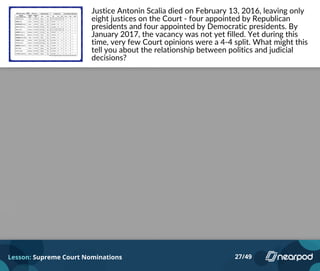
Justice Antonin Scalia died on February 13, 2016, leaving only
eight justices on the Court - four appointed by Republican
presidents and four appointed by Democratic presidents. By
January 2017, the vacancy was not yet filled. Yet during this
time, very few Court opinions were a 4-4 split. What might this
tell you about the relationship between politics and judicial
decisions?
Lesson: Supreme Court Nominations 27/49
Please enter your answer here.
Open Ended Question
Lesson: Supreme Court Nominations 28/49
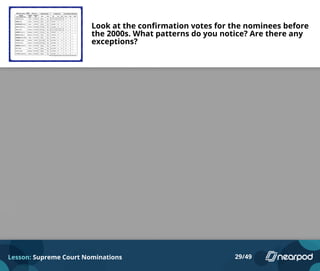
Look at the confirmation votes for the nominees before
the 2000s. What patterns do you notice? Are there any
exceptions?
Lesson: Supreme Court Nominations 29/49
Please enter your answer here.
Open Ended Question
Lesson: Supreme Court Nominations 30/49
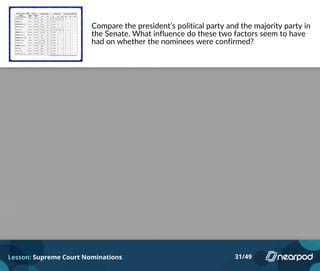
Compare the president’s political party and the majority party in
the Senate. What influence do these two factors seem to have
had on whether the nominees were confirmed?
Lesson: Supreme Court Nominations 31/49
Please enter your answer here.
Open Ended Question
Lesson: Supreme Court Nominations 32/49
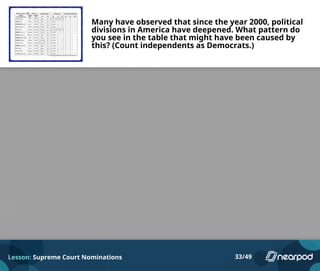
Many have observed that since the year 2000, political
divisions in America have deepened. What pattern do
you see in the table that might have been caused by
this? (Count independents as Democrats.)
Lesson: Supreme Court Nominations 33/49
Please enter your answer here.
Lesson: Supreme Court Nominations 34/49
Change
Lesson: Supreme Court Nominations 35/49
Disqualifying Factors
Lesson: Supreme Court Nominations 36/49
Open Ended Question
Lesson: Supreme Court Nominations 37/49
Why is this lesson important? In other words, how is the Supreme Court
nomination process relevant to your life?
Lesson: Supreme Court Nominations 38/49
Please enter your answer here.
Lesson: Supreme Court Nominations 39/49
Open Ended Question
Lesson: Supreme Court Nominations 40/49
What are three factors a president considers when choosing someone to
nominate to the Supreme Court?
Lesson: Supreme Court Nominations 41/49
Please enter your answer here.
Open Ended Question
Lesson: Supreme Court Nominations 42/49
Judges at all levels are expected to set aside their personal and political views when
they’re behind the bench. However, presidents can still attempt to tilt the Court in

either a conservative or liberal direction. How can they do this? Explain using at least
two examples to illustrate your point.
Lesson: Supreme Court Nominations 43/49
Please enter your answer here.
Lesson: Supreme Court Nominations 44/49
Poll
Lesson: Supreme Court Nominations 45/49
How well do you understand the Supreme Court nomination process?
I am completely confused.
I am slightly confused.
I understand and am ready to move on!
Lesson: Supreme Court Nominations 46/49
Open Ended Question
Lesson: Supreme Court Nominations 47/49
What questions do you still have about the topic of today’s lesson?
Lesson: Supreme Court Nominations 48/49
Please enter your answer here.
Powered by TCPDF (www.tcpdf.org)
Lesson: Supreme Court Nominations 49/49

Supreme court nominations

  • 1.
    Lesson: Supreme CourtNominations 1/49
  • 2.
    Lesson: Supreme CourtNominations 2/49
  • 3.
    Lesson: Supreme CourtNominations 3/49
  • 4.
    Lesson: Supreme CourtNominations 4/49
  • 5.
    SCOTUS Nominations Lesson: SupremeCourt Nominations 5/49
  • 6.
    Lesson: Supreme CourtNominations 6/49
  • 7.
    Lesson: Supreme CourtNominations 7/49
  • 8.
  • 9.
  • 10.
    How many justicesare on the Supreme Court? 3 6 9 12 Lesson: Supreme Court Nominations 10/49
  • 11.
    How long isthe appointment to the Supreme Court? 2 years 4 years 20 years For life Lesson: Supreme Court Nominations 11/49
  • 12.
    The Constitution listsmany requirements for Supreme Court justices. True or false? True False Lesson: Supreme Court Nominations 12/49
  • 13.
    Even though justicesdon’t have to have a law degree, so far every single Supreme Court justice has been a lawyer. True or false? True False Lesson: Supreme Court Nominations 13/49
  • 14.
    Fill in theBlanks Lesson: Supreme Court Nominations 14/49
  • 15.
    living living Constitutioncommon textualists sense philosophy opposite conservative originalist predict liberal different text Founders modern Those with an philosophy want to figure out exactly what the intended when they wrote the Constitution in 1787. Those who are look only at the of the Constitution and try to give it a interpretation without looking at any other evidence, such as what the Founders or lawmakers might have intended. On the end of the spectrum, Lesson: Supreme Court Nominations 15/49
  • 16.
    people who followthe Constitution theory prefer to interpret the Constitution in the context of society and values, recognizing that today’s world and the world in 1787 are very . A judge’s judicial can often how the judge might decide a certain issue, so generally you’ll see a president looking for a nominee who does not follow the theory, while a president will look for one who does. Lesson: Supreme Court Nominations 16/49
  • 17.
    Open Ended Question Lesson:Supreme Court Nominations 17/49
  • 18.
    What are someof the benefits and risks of each judicial philosophy as a method of interpreting the Constitution? Lesson: Supreme Court Nominations 18/49 Please enter your answer here.
  • 19.
    Open Ended Question Lesson:Supreme Court Nominations 19/49
  • 20.
    How does thenomination and confirmation process let the executive and legislative branches “check” the judicial branch? Explain. Lesson: Supreme Court Nominations 20/49 Please enter your answer here.
  • 21.
    How Do USSupreme Court Justices Get Appointed? Lesson: Supreme Court Nominations 21/49
  • 22.
    Lesson: Supreme CourtNominations 22/49
  • 23.
    Lesson: Supreme CourtNominations 23/49
  • 24.
    Draw It Lesson: SupremeCourt Nominations 24/49
  • 25.
    Do some mathto fill in the mini-table. Lesson: Supreme Court Nominations 25/49
  • 26.
    Open Ended Question Lesson:Supreme Court Nominations 26/49
  • 27.
    Justice Antonin Scaliadied on February 13, 2016, leaving only eight justices on the Court - four appointed by Republican presidents and four appointed by Democratic presidents. By January 2017, the vacancy was not yet filled. Yet during this time, very few Court opinions were a 4-4 split. What might this tell you about the relationship between politics and judicial decisions? Lesson: Supreme Court Nominations 27/49 Please enter your answer here.
  • 28.
    Open Ended Question Lesson:Supreme Court Nominations 28/49
  • 29.
    Look at theconfirmation votes for the nominees before the 2000s. What patterns do you notice? Are there any exceptions? Lesson: Supreme Court Nominations 29/49 Please enter your answer here.
  • 30.
    Open Ended Question Lesson:Supreme Court Nominations 30/49
  • 31.
    Compare the president’spolitical party and the majority party in the Senate. What influence do these two factors seem to have had on whether the nominees were confirmed? Lesson: Supreme Court Nominations 31/49 Please enter your answer here.
  • 32.
    Open Ended Question Lesson:Supreme Court Nominations 32/49
  • 33.
    Many have observedthat since the year 2000, political divisions in America have deepened. What pattern do you see in the table that might have been caused by this? (Count independents as Democrats.) Lesson: Supreme Court Nominations 33/49 Please enter your answer here.
  • 34.
    Lesson: Supreme CourtNominations 34/49
  • 35.
  • 36.
  • 37.
    Open Ended Question Lesson:Supreme Court Nominations 37/49
  • 38.
    Why is thislesson important? In other words, how is the Supreme Court nomination process relevant to your life? Lesson: Supreme Court Nominations 38/49 Please enter your answer here.
  • 39.
    Lesson: Supreme CourtNominations 39/49
  • 40.
    Open Ended Question Lesson:Supreme Court Nominations 40/49
  • 41.
    What are threefactors a president considers when choosing someone to nominate to the Supreme Court? Lesson: Supreme Court Nominations 41/49 Please enter your answer here.
  • 42.
    Open Ended Question Lesson:Supreme Court Nominations 42/49
  • 43.
    Judges at alllevels are expected to set aside their personal and political views when they’re behind the bench. However, presidents can still attempt to tilt the Court in either a conservative or liberal direction. How can they do this? Explain using at least two examples to illustrate your point. Lesson: Supreme Court Nominations 43/49 Please enter your answer here.
  • 44.
    Lesson: Supreme CourtNominations 44/49
  • 45.
    Poll Lesson: Supreme CourtNominations 45/49
  • 46.
    How well doyou understand the Supreme Court nomination process? I am completely confused. I am slightly confused. I understand and am ready to move on! Lesson: Supreme Court Nominations 46/49
  • 47.
    Open Ended Question Lesson:Supreme Court Nominations 47/49
  • 48.
    What questions doyou still have about the topic of today’s lesson? Lesson: Supreme Court Nominations 48/49 Please enter your answer here.
  • 49.
    Powered by TCPDF(www.tcpdf.org) Lesson: Supreme Court Nominations 49/49