How a Bill becomes a Law “ You think you know, but you have no idea.”
How a Bill becomes a Law? General Considerations: *Only Members of the House or Senate can introduce a Bill What is a Bill? -  It is a  proposed  law. -  THOUSANDS  are proposed a year (very      few survive the process). Types: Public bills-  measures that apply to the nation as a whole. (i.e. water regulations, etc.) Private bills- measures that apply to certain places or people  (i.e. schools/ roads in Western Pennsylvania) -  Often  riders  are attached to bills, which are provisions that are designed to aid a group of people, but do not pertain to the bill as a whole.
How a Bill becomes a Law? The Law Making Process- The Bill will start in either the House or the Senate (all revenue bill must start in the House) STEP 1:   Bill is placed in the hopper (box), read titled and numbered. EX:  H.R.0157 = “House Resolution” 1057 S.4556 = “Senate” 4556 STEP 2:   Bill is sent to the proper Standing Committee. EX:  H.R.4185  : To direct the Consumer Product Safety Commission to  strengthen regulations concerning the flammability of children's clothing. Sponsor:   Rep Andrews, Robert E.  [NJ-1] (introduced 11/1/2007)      Cosponsors  (None)  Committees:  House Energy and Commerce  Latest Major Action:  11/1/2007 Referred to House committee. Status:  Referred to the House Committee on Energy and Commerce
How a Bill becomes a Law? The Law Making Process- Once in a committee, they will have the following options: 1:  Report the bill favorably -  pass recommendation. (don’t pass the bill) 2:  Report the bill unfavorably - do not pass recommendation. 3:  Report the bill in an amended form (make changes to it) 4:  Report a committee bill (make their own substitute bill) 5:  Pigeonhole it:  -bill is effectively dead b/c the committee never deals with it. *  MOST BILLS DIE IN THE COMMITTEE STAGE .
How a Bill becomes a Law? The Law Making Process- STEP 3 :  Bill is Sent to the House Rules Committee and  placed on the calendar or just placed on a calendar  in the Senate. House Rules Committee can do following: - grant a rule = place on calendar - do not grant rule = bill is dead - grant a special rule- set conditions which bill can be discussed. - grant a privileged rule – bill receives immediate action. STEP 4:  Bill is retuned to the House or Senate. -  Read a 2 nd  time, a quorum must be present to take a vote in House. quorum = majority + 1 = 218 Representatives
How a Bill becomes a Law? The Law Making Process- Voting (con’t) In the House =   -  debate is limited to an hour per member, the Speaker can cut that short In the Senate =  no time limit for debate. Filibuster = Senators can speak for as long as they want to. -  A filibuster can be ended by invoking  cloture , which requires    3/5 th  of the Senate, debate is then limited to an hour. Ex:  Strom Thurmond holds the record for the longest filibuster:  It lasted 24 hours and 18 minutes.  He was attempting to delay a vote on the Civil Rights Act of 1957.  He read from the Bible and the Washington Phone Book to prolong the debate.  It was unsuccessful.
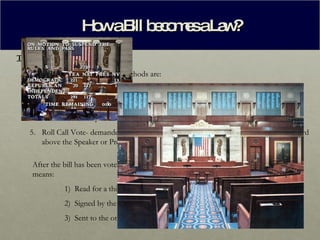
How a Bill becomes a Law? The Law Making Process- The different types of voting methods are: 1.  Voice Vote- Aye or Nay 2.  Standing Vote- members stand and are counted, must be requested. Teller Vote- one person from each party counts the vote, 1/5 th  quorum request. Roll Call Vote- demanded by 1/5 th  of members present, vote appears over large board above the Speaker or President of Senate, 15 minutes to cast vote. After the bill has been voted on and passed, it is  engrossed , which means: 1)  Read for a third time. 2)  Signed by the presiding officer. 3)  Sent to the other house of Congress.
How a Bill becomes a Law? The Law Making Process- STEP 5-8:  The same steps 1-4 are repeated in the other house of Congress. *  If the bills differ between the House and Senate = -  a Conference committee is formed to work out the differences b/t the two bills (must be identical) *  If the bill are identical = -  the bill is sent to the President.
How a Bill becomes a Law? The Law Making Process- President’s options for a bill: 1:  Sign bill-  becomes a law 2:  Veto bill- must return it to the originating housewith reasons why. -  Can be over ridden with a 2/3 rd  vote of both houses. 3:  Allow a bill to become a law by not signing it-  -  if a bill sits on the President’s desk for 10 days w/o   action while Congress is in session, it becomes a law.  4:  Pocket veto-  -  if a bill sits on the President’s desk for 10 days while      Congress is leaving or out of session, it is dead.
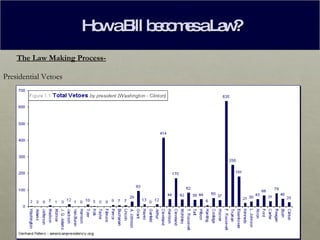
How a Bill becomes a Law? The Law Making Process- Presidential Vetoes
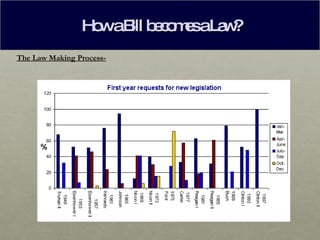
How a Bill becomes a Law? The Law Making Process-

How a Bill becomes a Law?

  • 1.
    How a Billbecomes a Law “ You think you know, but you have no idea.”
  • 2.
    How a Billbecomes a Law? General Considerations: *Only Members of the House or Senate can introduce a Bill What is a Bill? - It is a proposed law. - THOUSANDS are proposed a year (very few survive the process). Types: Public bills- measures that apply to the nation as a whole. (i.e. water regulations, etc.) Private bills- measures that apply to certain places or people (i.e. schools/ roads in Western Pennsylvania) - Often riders are attached to bills, which are provisions that are designed to aid a group of people, but do not pertain to the bill as a whole.
  • 3.
    How a Billbecomes a Law? The Law Making Process- The Bill will start in either the House or the Senate (all revenue bill must start in the House) STEP 1: Bill is placed in the hopper (box), read titled and numbered. EX: H.R.0157 = “House Resolution” 1057 S.4556 = “Senate” 4556 STEP 2: Bill is sent to the proper Standing Committee. EX: H.R.4185 : To direct the Consumer Product Safety Commission to strengthen regulations concerning the flammability of children's clothing. Sponsor: Rep Andrews, Robert E. [NJ-1] (introduced 11/1/2007)      Cosponsors (None) Committees: House Energy and Commerce Latest Major Action: 11/1/2007 Referred to House committee. Status: Referred to the House Committee on Energy and Commerce
  • 4.
    How a Billbecomes a Law? The Law Making Process- Once in a committee, they will have the following options: 1: Report the bill favorably - pass recommendation. (don’t pass the bill) 2: Report the bill unfavorably - do not pass recommendation. 3: Report the bill in an amended form (make changes to it) 4: Report a committee bill (make their own substitute bill) 5: Pigeonhole it: -bill is effectively dead b/c the committee never deals with it. * MOST BILLS DIE IN THE COMMITTEE STAGE .
  • 5.
    How a Billbecomes a Law? The Law Making Process- STEP 3 : Bill is Sent to the House Rules Committee and placed on the calendar or just placed on a calendar in the Senate. House Rules Committee can do following: - grant a rule = place on calendar - do not grant rule = bill is dead - grant a special rule- set conditions which bill can be discussed. - grant a privileged rule – bill receives immediate action. STEP 4: Bill is retuned to the House or Senate. - Read a 2 nd time, a quorum must be present to take a vote in House. quorum = majority + 1 = 218 Representatives
  • 6.
    How a Billbecomes a Law? The Law Making Process- Voting (con’t) In the House = - debate is limited to an hour per member, the Speaker can cut that short In the Senate = no time limit for debate. Filibuster = Senators can speak for as long as they want to. - A filibuster can be ended by invoking cloture , which requires 3/5 th of the Senate, debate is then limited to an hour. Ex: Strom Thurmond holds the record for the longest filibuster: It lasted 24 hours and 18 minutes. He was attempting to delay a vote on the Civil Rights Act of 1957. He read from the Bible and the Washington Phone Book to prolong the debate. It was unsuccessful.
  • 7.
    How a Billbecomes a Law? The Law Making Process- The different types of voting methods are: 1. Voice Vote- Aye or Nay 2. Standing Vote- members stand and are counted, must be requested. Teller Vote- one person from each party counts the vote, 1/5 th quorum request. Roll Call Vote- demanded by 1/5 th of members present, vote appears over large board above the Speaker or President of Senate, 15 minutes to cast vote. After the bill has been voted on and passed, it is engrossed , which means: 1) Read for a third time. 2) Signed by the presiding officer. 3) Sent to the other house of Congress.
  • 8.
    How a Billbecomes a Law? The Law Making Process- STEP 5-8: The same steps 1-4 are repeated in the other house of Congress. * If the bills differ between the House and Senate = - a Conference committee is formed to work out the differences b/t the two bills (must be identical) * If the bill are identical = - the bill is sent to the President.
  • 9.
    How a Billbecomes a Law? The Law Making Process- President’s options for a bill: 1: Sign bill- becomes a law 2: Veto bill- must return it to the originating housewith reasons why. - Can be over ridden with a 2/3 rd vote of both houses. 3: Allow a bill to become a law by not signing it- - if a bill sits on the President’s desk for 10 days w/o action while Congress is in session, it becomes a law. 4: Pocket veto- - if a bill sits on the President’s desk for 10 days while Congress is leaving or out of session, it is dead.
  • 10.
    How a Billbecomes a Law? The Law Making Process- Presidential Vetoes
  • 11.
    How a Billbecomes a Law? The Law Making Process-