The Leadership
Committees
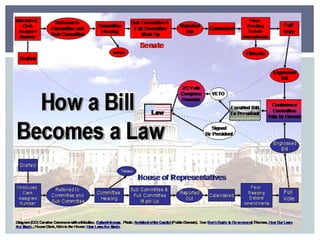
The Bill in the
House
The Bill in the
Senate
CONGRESS
IN ACTION
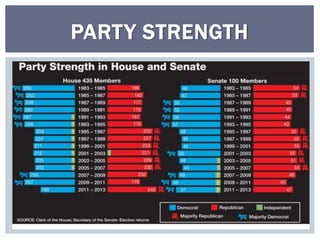
PARTY STRENGTH
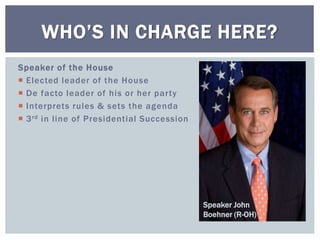
Speaker of the House
 Elected leader of the House
 De facto leader of his or her party
 Interprets rules & sets the agenda
 3rd in line of Presidential Succession
WHO’S IN CHARGE HERE?
Speaker John
Boehner (R-OH)
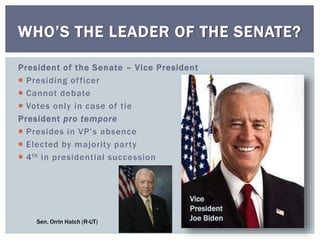
President of the Senate – Vice President
 Presiding officer
 Cannot debate
 Votes only in case of tie
President pro tempore
 Presides in VP’s absence
 Elected by majority party
 4th in presidential succession
WHO’S THE LEADER OF THE SENATE?
Vice
President
Joe BidenSen. Orrin Hatch (R-UT)
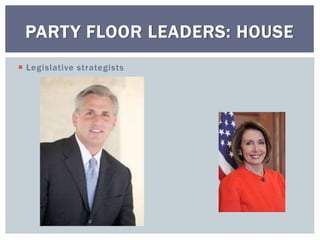
 Legislative strategists
PARTY FLOOR LEADERS: HOUSE
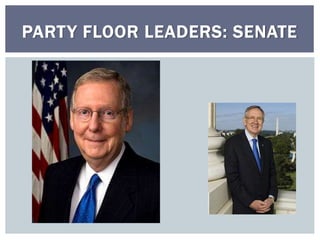
PARTY FLOOR LEADERS: SENATE
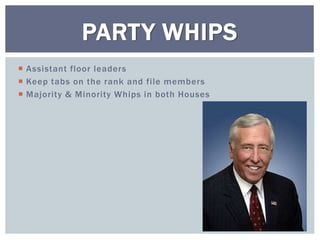
 Assistant floor leaders
 Keep tabs on the rank and file members
 Majority & Minority Whips in both Houses
PARTY WHIPS
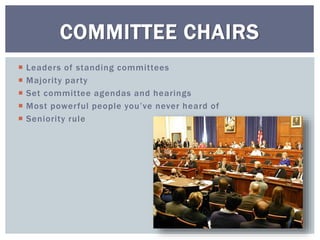
 Leaders of standing committees
 Majority party
 Set committee agendas and hearings
 Most powerful people you’ve never heard of
 Seniority rule
COMMITTEE CHAIRS
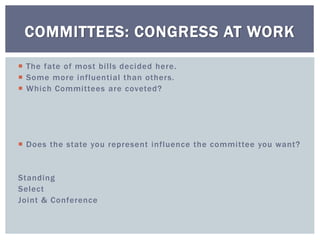
 The fate of most bills decided here.
 Some more influential than others.
 Which Committees are coveted?
 Does the state you represent influence the committee you want?
Standing
Select
Joint & Conference
COMMITTEES: CONGRESS AT WORK
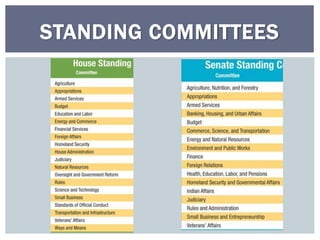
STANDING COMMITTEES
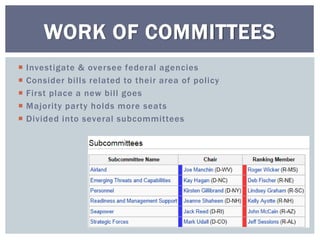
 Investigate & oversee federal agencies
 Consider bills related to their area of policy
 First place a new bill goes
 Majority party holds more seats
 Divided into several subcommittees
WORK OF COMMITTEES
 How powerful is the Rules
Committee?
 “Traffic cop” of the House
 Most bills must go through
this before reaching the
floor
HOUSE RULES COMMITTEE
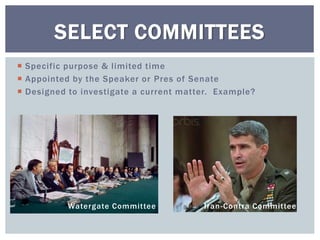
 Specific purpose & limited time
 Appointed by the Speaker or Pres of Senate
 Designed to investigate a current matter. Example?
Watergate Committee Iran-Contra Committee
SELECT COMMITTEES
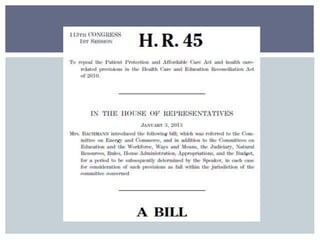
 Proposed law
 All tax bills must start in the House
Types of Bills & Resolutions
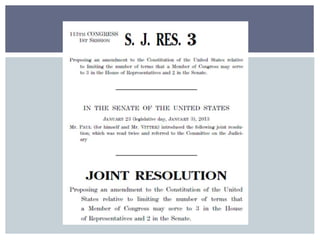
 Bill: proposed law (most appropriations)
 Joint Resolution: force of law; special circumstances
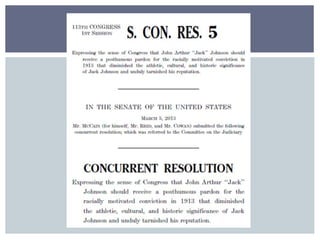
 Concurrent Resolution: position on an issue; no force of law
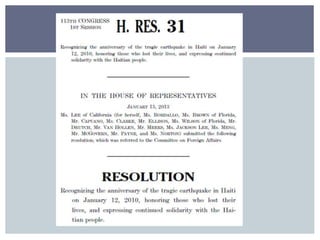
 Resolution: often trivial matters of one house; no force of law
WHAT’S A BILL?
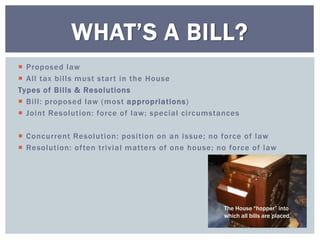
The House “hopper” into
which all bills are placed.
 Most die here (pigeonholed)
 “Mark up”: bills are changed and modified (riders)
 Hearings may be held
Committee Options
 Report favorably
 Report an amended bill
 Report unfavorably (rare – why?)
 Report a substituted bill
THE BILL IN COMMITTEE
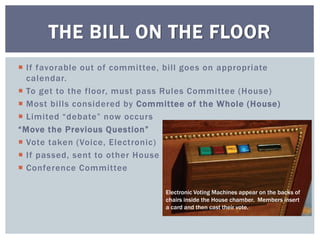
 If favorable out of committee, bill goes on appropriate
calendar.
 To get to the floor, must pass Rules Committee (House)
 Most bills considered by Committee of the Whole (House)
 Limited “debate” now occurs
“Move the Previous Question”
 Vote taken (Voice, Electronic)
 If passed, sent to other House
 Conference Committee
THE BILL ON THE FLOOR
Electronic Voting Machines appear on the backs of
chairs inside the House chamber. Members insert
a card and then cast their vote.
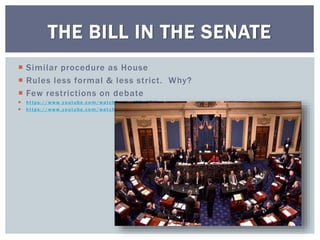
 Similar procedure as House
 Rules less formal & less strict. Why?
 Few restrictions on debate
 https://www.youtube.com/watch?v=tyeJ55o3El0
 https://www.youtube.com/watch?v=Pl3sgKj6oTQ
THE BILL IN THE SENATE
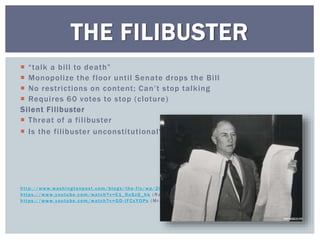
 “talk a bill to death”
 Monopolize the floor until Senate drops the Bill
 No restrictions on content; Can’t stop talking
 Requires 60 votes to stop (cloture)
Silent Filibuster
 Threat of a filibuster
 Is the filibuster unconstitutional?
http://www.washing tonpost.com/blog s/the -fix/wp/2013/02/14/the -sil ent-fil ibuster-explained /
https://www.youtube.com/watch?v=E1_9nSzG_hk (R and Pa ul )
https://www.youtube.com/watch?v=GD -l FCsYOPs (Mr. Sm i th) (4 :15)
THE FILIBUSTER
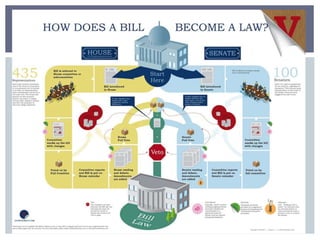
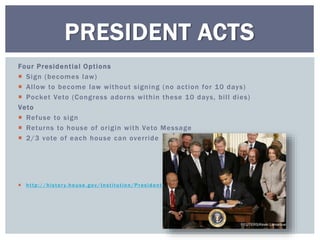
Four Presidential Options
 Sign (becomes law)
 Allow to become law without signing (no action for 10 days)
 Pocket Veto (Congress adorns within these 10 days, bill dies)
Veto
 Refuse to sign
 Returns to house of origin with Veto Message
 2/3 vote of each house can override
 http://history.house.gov/Institution/Presidential-Vetoes/Presidential-Vetoes/
PRESIDENT ACTS

Congress in action

  • 1.
    The Leadership Committees The Billin the House The Bill in the Senate CONGRESS IN ACTION
  • 2.
  • 3.
    Speaker of theHouse  Elected leader of the House  De facto leader of his or her party  Interprets rules & sets the agenda  3rd in line of Presidential Succession WHO’S IN CHARGE HERE? Speaker John Boehner (R-OH)
  • 4.
    President of theSenate – Vice President  Presiding officer  Cannot debate  Votes only in case of tie President pro tempore  Presides in VP’s absence  Elected by majority party  4th in presidential succession WHO’S THE LEADER OF THE SENATE? Vice President Joe BidenSen. Orrin Hatch (R-UT)
  • 5.
  • 6.
  • 7.
     Assistant floorleaders  Keep tabs on the rank and file members  Majority & Minority Whips in both Houses PARTY WHIPS
  • 8.
     Leaders ofstanding committees  Majority party  Set committee agendas and hearings  Most powerful people you’ve never heard of  Seniority rule COMMITTEE CHAIRS
  • 9.
     The fateof most bills decided here.  Some more influential than others.  Which Committees are coveted?  Does the state you represent influence the committee you want? Standing Select Joint & Conference COMMITTEES: CONGRESS AT WORK
  • 10.
  • 11.
     Investigate &oversee federal agencies  Consider bills related to their area of policy  First place a new bill goes  Majority party holds more seats  Divided into several subcommittees WORK OF COMMITTEES
  • 12.
     How powerfulis the Rules Committee?  “Traffic cop” of the House  Most bills must go through this before reaching the floor HOUSE RULES COMMITTEE
  • 13.
     Specific purpose& limited time  Appointed by the Speaker or Pres of Senate  Designed to investigate a current matter. Example? Watergate Committee Iran-Contra Committee SELECT COMMITTEES
  • 15.
     Proposed law All tax bills must start in the House Types of Bills & Resolutions  Bill: proposed law (most appropriations)  Joint Resolution: force of law; special circumstances  Concurrent Resolution: position on an issue; no force of law  Resolution: often trivial matters of one house; no force of law WHAT’S A BILL? The House “hopper” into which all bills are placed.
  • 20.
     Most diehere (pigeonholed)  “Mark up”: bills are changed and modified (riders)  Hearings may be held Committee Options  Report favorably  Report an amended bill  Report unfavorably (rare – why?)  Report a substituted bill THE BILL IN COMMITTEE
  • 21.
     If favorableout of committee, bill goes on appropriate calendar.  To get to the floor, must pass Rules Committee (House)  Most bills considered by Committee of the Whole (House)  Limited “debate” now occurs “Move the Previous Question”  Vote taken (Voice, Electronic)  If passed, sent to other House  Conference Committee THE BILL ON THE FLOOR Electronic Voting Machines appear on the backs of chairs inside the House chamber. Members insert a card and then cast their vote.
  • 22.
     Similar procedureas House  Rules less formal & less strict. Why?  Few restrictions on debate  https://www.youtube.com/watch?v=tyeJ55o3El0  https://www.youtube.com/watch?v=Pl3sgKj6oTQ THE BILL IN THE SENATE
  • 23.
     “talk abill to death”  Monopolize the floor until Senate drops the Bill  No restrictions on content; Can’t stop talking  Requires 60 votes to stop (cloture) Silent Filibuster  Threat of a filibuster  Is the filibuster unconstitutional? http://www.washing tonpost.com/blog s/the -fix/wp/2013/02/14/the -sil ent-fil ibuster-explained / https://www.youtube.com/watch?v=E1_9nSzG_hk (R and Pa ul ) https://www.youtube.com/watch?v=GD -l FCsYOPs (Mr. Sm i th) (4 :15) THE FILIBUSTER
  • 25.
    Four Presidential Options Sign (becomes law)  Allow to become law without signing (no action for 10 days)  Pocket Veto (Congress adorns within these 10 days, bill dies) Veto  Refuse to sign  Returns to house of origin with Veto Message  2/3 vote of each house can override  http://history.house.gov/Institution/Presidential-Vetoes/Presidential-Vetoes/ PRESIDENT ACTS

Editor's Notes

  • #6 House Majority leader – Kevin McCarthy (R-CA)