
The Legislative Branch
Bicameral A legislative body with two houses established by the Constitution- Article I modeled after the British Parliament
Term Length of time between elections in Congress terms begin according to the  20th Amendment   in  January Terms are numbered consecutively   9, 10, 11,12, 13,… 1st Congress      March 4, 1789
Session Formal meetings in which members perform legislative work  (each term divided into   2 sessions) until WWII    4 month sessions currently full year sessions with short recess
CONSTITUENTS     the people who are represented CONTINUOUS BODY     all seats are never up for election at the same time Vocabulary
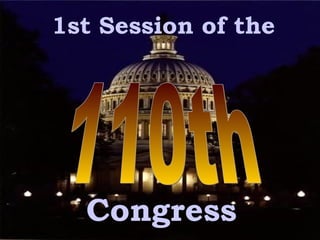
110th 1st Session of the Congress
“ I have come to the conclusion that one useless man is called a disgrace, that two are called a law firm, and that three or more become a Congress.” 1776, A Musical Play
“ It can probably be shown by facts & figures that there is no distinctly native American criminal class except Congress.” Samuel L. Clemens (Mark Twain)
If the opposite of  pro  is  con , then the opposite of  progress  must be  Congress.
House of Representatives # of seats not fixed  apportioned      distributed based on population serve 2 year terms without term limitation
Reapportion     Redistribute every 10 years    Census 435 is “permanent” size Congress can change size Elections    ALL re-elected even number years House of Representatives
Districts drawn up to elect reps. to House (Census) Gerrymander to draw districts to give an advantage to a political party House of Representatives
* 25  years of age *U.S. Citizen for  7  years *Inhabit state represented *can’t be arrested while in session unless commit treason OR felony custom dictates representative must live in district House Qualifications
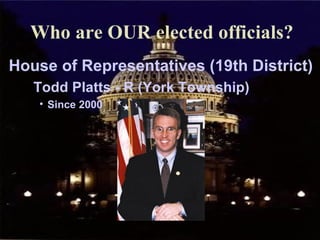
Who are OUR elected officials? House of Representatives (19th District) Todd Platts - R (York Township) Since 2000
Senate # of seats fixed by  “C”    100 2 from each State 6 year terms Represent entire State NO DISTRICTS
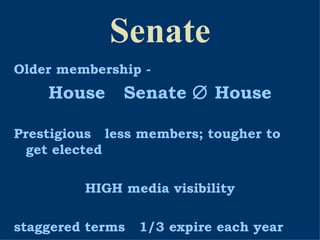
Older membership -  House    Senate    House Prestigious    less members; tougher to get elected HIGH media visibility staggered terms    1/3 expire each year Senate
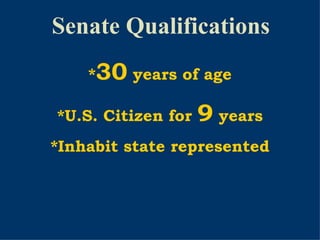
Senate Qualifications * 30  years of age *U.S. Citizen for  9  years *Inhabit state represented
Who are OUR elected officials? Arlen Specter-R since 1981 Class III Bob Casey-D since 2007 Class I
The Powers of Congress Expressed vs. Implied
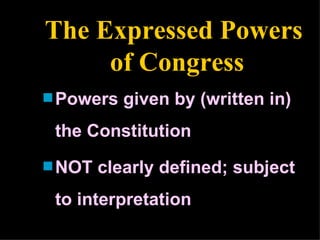
The Expressed Powers  of Congress Powers given by (written in) the Constitution  NOT clearly defined; subject to interpretation
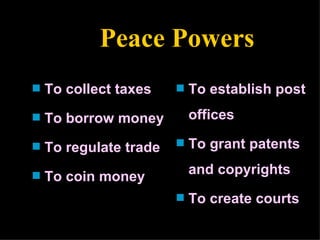
Peace Powers To collect taxes To borrow money To regulate trade To coin money To establish post offices  To grant patents and copyrights To create courts
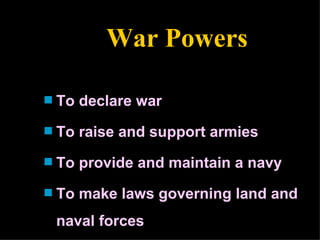
War Powers To declare war To raise and support armies To provide and maintain a navy To make laws governing land and naval forces
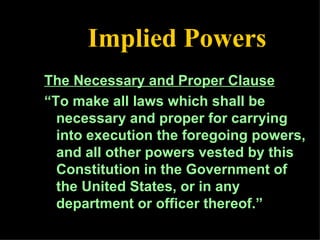
Implied Powers The Necessary and Proper Clause “ To make all laws which shall be necessary and proper for carrying into execution the foregoing powers, and all other powers vested by this Constitution in the Government of the United States, or in any department or officer thereof.”
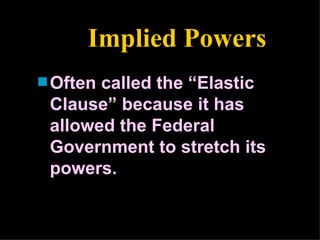
Implied Powers Often called the “Elastic Clause” because it has allowed the Federal Government to stretch its powers.
Implied Powers Examples -…collect taxes --- IMPLIES the power to make tax evasion a crime and provide for its punishment -... raise armies and a navy --- IMPLIES the power to draft men into the armed forces -…regulate trade ---IMPLIES the power to fix minimum wages and maximum work hours
August 4, 1974
The Non-legislative Powers Impeachment House has the sole power to  impeach -bring charges against Senate has the sole power to  judge  an impeachment case
The Non-legislative Powers Constitutional Amendments Electoral Duties Election of a President by House, if no majority from the electoral college Each state receives one vote Election of V-P by Senate, if no majority from the electoral college
The Non-legislative Powers Executive Powers confirmation of major appointments by the President
The Non-legislative Powers Investigative Power Oversee operation of executive branch Expose questionable activities of public officials
Interest group - a private organization that tries to “influence” lawmakers
Lobbying  - the activities of a person for a pressure or interest group, usually influencing lawmakers
The basic job of a lobbyist is to try to get a member of Congress to vote in a beneficial way toward the group the lobbyist represents.
Congressional Voting Options Trustee- Members of Congress vote on issues “as they see fit.”  They are not influenced by outside groups  OR  constituents
Congressional Voting Options Delegate - Member is an agent of those who elected them.  Vote based on what “the folks back home” would want
Congressional Voting Options Partisan - Member owes 1st allegiance to their political party.  Leading factor in influencing votes.
Congressional Voting Options Politico - tries to balance all three
Congressional Voting Options Sellout - gives in to the pressure put on by lobbyists, interest groups, & PACs
Congress Organizes House of Representatives Speaker of the House Maintains order in the House supposed to remain  bipartisan  in decision-making process elected by peers - from the majority party
Congress Organizes House of Representatives Majority Leader top ranking official of the party with the  most  members assisted by the  majority whip Minority Leader top ranking official of the party with the  least  members assisted by the  minority whip
Senate President of the Senate Vice President of the United States maintains order in the Senate supposed to remain  bipartisan  in decision-making process
Senate President Pro Tempore performs the duties of the President of the Senate in his absence elected by his peers - from the majority party
Senate Majority Leader top ranking official of the party with the most members assisted by the  majority whip Minority Leader top ranking official of the party with the least members assisted by the  minority whip
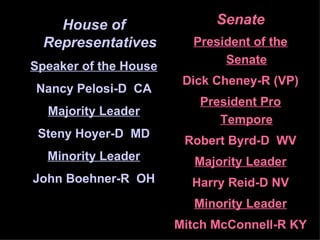
House of Representatives Speaker of the House Nancy Pelosi-D  CA Majority Leader Steny Hoyer-D  MD Minority Leader John Boehner-R  OH Senate President of the Senate Dick Cheney-R (VP) President Pro Tempore Robert Byrd-D  WV Majority Leader Harry Reid-D NV Minority Leader Mitch McConnell-R KY
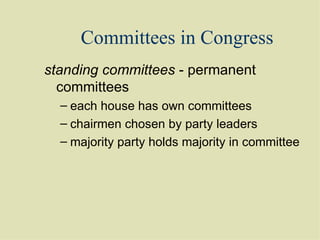
Committees in Congress standing committees  - permanent committees each house has own committees chairmen chosen by party leaders majority party holds majority in committee
Committees in Congress Joint committees   composed of members of both houses
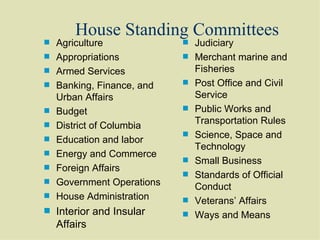
House Standing Committees Agriculture Appropriations Armed Services Banking, Finance, and Urban Affairs Budget District of Columbia Education and labor Energy and Commerce Foreign Affairs Government Operations House Administration Interior and Insular Affairs Judiciary Merchant marine and Fisheries Post Office and Civil Service Public Works and Transportation Rules Science, Space and Technology Small Business Standards of Official Conduct Veterans’ Affairs Ways and Means
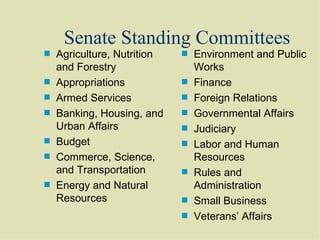
Senate Standing Committees Agriculture, Nutrition and Forestry Appropriations Armed Services Banking, Housing, and Urban Affairs Budget Commerce, Science, and Transportation Energy and Natural Resources Environment and Public Works Finance Foreign Relations Governmental Affairs Judiciary Labor and Human Resources Rules and Administration Small Business Veterans’ Affairs
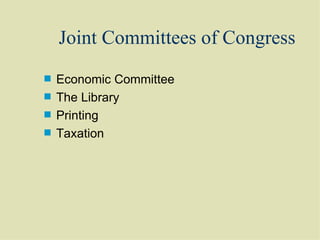
Joint Committees of Congress Economic Committee The Library Printing Taxation
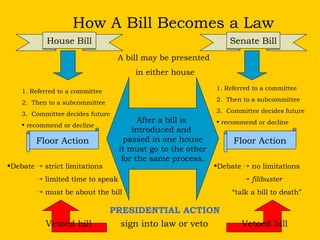
How A Bill Becomes a Law After a bill is  introduced and  passed in one house it must go to the other  for the same process. 1. Referred to a committee 2.  Then to a subcommittee 3.  Committee decides future recommend or decline Floor Action Debate    strict limitations    limited time to speak    must be about the bill Vetoed bill A bill may be presented  in either house 1. Referred to a committee 2.  Then to a subcommittee 3.  Committee decides future recommend or decline Floor Action Debate    no limitations    filibuster   “ talk a bill to death” Vetoed bill PRESIDENTIAL ACTION sign into law or veto Senate Bill House Bill

Legislative Branch Notes

  • 1.
  • 2.
    Bicameral A legislativebody with two houses established by the Constitution- Article I modeled after the British Parliament
  • 3.
    Term Length oftime between elections in Congress terms begin according to the 20th Amendment in January Terms are numbered consecutively  9, 10, 11,12, 13,… 1st Congress  March 4, 1789
  • 4.
    Session Formal meetingsin which members perform legislative work (each term divided into 2 sessions) until WWII  4 month sessions currently full year sessions with short recess
  • 5.
    CONSTITUENTS  the people who are represented CONTINUOUS BODY  all seats are never up for election at the same time Vocabulary
  • 6.
    110th 1st Sessionof the Congress
  • 7.
    “ I havecome to the conclusion that one useless man is called a disgrace, that two are called a law firm, and that three or more become a Congress.” 1776, A Musical Play
  • 8.
    “ It canprobably be shown by facts & figures that there is no distinctly native American criminal class except Congress.” Samuel L. Clemens (Mark Twain)
  • 9.
    If the oppositeof pro is con , then the opposite of progress must be Congress.
  • 10.
    House of Representatives# of seats not fixed apportioned  distributed based on population serve 2 year terms without term limitation
  • 11.
    Reapportion  Redistribute every 10 years  Census 435 is “permanent” size Congress can change size Elections  ALL re-elected even number years House of Representatives
  • 12.
    Districts drawn upto elect reps. to House (Census) Gerrymander to draw districts to give an advantage to a political party House of Representatives
  • 13.
    * 25 years of age *U.S. Citizen for 7 years *Inhabit state represented *can’t be arrested while in session unless commit treason OR felony custom dictates representative must live in district House Qualifications
  • 14.
    Who are OURelected officials? House of Representatives (19th District) Todd Platts - R (York Township) Since 2000
  • 15.
    Senate # ofseats fixed by “C”  100 2 from each State 6 year terms Represent entire State NO DISTRICTS
  • 16.
    Older membership - House  Senate  House Prestigious  less members; tougher to get elected HIGH media visibility staggered terms  1/3 expire each year Senate
  • 17.
    Senate Qualifications *30 years of age *U.S. Citizen for 9 years *Inhabit state represented
  • 18.
    Who are OURelected officials? Arlen Specter-R since 1981 Class III Bob Casey-D since 2007 Class I
  • 19.
    The Powers ofCongress Expressed vs. Implied
  • 20.
    The Expressed Powers of Congress Powers given by (written in) the Constitution NOT clearly defined; subject to interpretation
  • 21.
    Peace Powers Tocollect taxes To borrow money To regulate trade To coin money To establish post offices To grant patents and copyrights To create courts
  • 22.
    War Powers Todeclare war To raise and support armies To provide and maintain a navy To make laws governing land and naval forces
  • 23.
    Implied Powers TheNecessary and Proper Clause “ To make all laws which shall be necessary and proper for carrying into execution the foregoing powers, and all other powers vested by this Constitution in the Government of the United States, or in any department or officer thereof.”
  • 24.
    Implied Powers Oftencalled the “Elastic Clause” because it has allowed the Federal Government to stretch its powers.
  • 25.
    Implied Powers Examples-…collect taxes --- IMPLIES the power to make tax evasion a crime and provide for its punishment -... raise armies and a navy --- IMPLIES the power to draft men into the armed forces -…regulate trade ---IMPLIES the power to fix minimum wages and maximum work hours
  • 26.
  • 27.
    The Non-legislative PowersImpeachment House has the sole power to impeach -bring charges against Senate has the sole power to judge an impeachment case
  • 28.
    The Non-legislative PowersConstitutional Amendments Electoral Duties Election of a President by House, if no majority from the electoral college Each state receives one vote Election of V-P by Senate, if no majority from the electoral college
  • 29.
    The Non-legislative PowersExecutive Powers confirmation of major appointments by the President
  • 30.
    The Non-legislative PowersInvestigative Power Oversee operation of executive branch Expose questionable activities of public officials
  • 31.
    Interest group -a private organization that tries to “influence” lawmakers
  • 32.
    Lobbying -the activities of a person for a pressure or interest group, usually influencing lawmakers
  • 33.
    The basic jobof a lobbyist is to try to get a member of Congress to vote in a beneficial way toward the group the lobbyist represents.
  • 34.
    Congressional Voting OptionsTrustee- Members of Congress vote on issues “as they see fit.” They are not influenced by outside groups OR constituents
  • 35.
    Congressional Voting OptionsDelegate - Member is an agent of those who elected them. Vote based on what “the folks back home” would want
  • 36.
    Congressional Voting OptionsPartisan - Member owes 1st allegiance to their political party. Leading factor in influencing votes.
  • 37.
    Congressional Voting OptionsPolitico - tries to balance all three
  • 38.
    Congressional Voting OptionsSellout - gives in to the pressure put on by lobbyists, interest groups, & PACs
  • 39.
    Congress Organizes Houseof Representatives Speaker of the House Maintains order in the House supposed to remain bipartisan in decision-making process elected by peers - from the majority party
  • 40.
    Congress Organizes Houseof Representatives Majority Leader top ranking official of the party with the most members assisted by the majority whip Minority Leader top ranking official of the party with the least members assisted by the minority whip
  • 41.
    Senate President ofthe Senate Vice President of the United States maintains order in the Senate supposed to remain bipartisan in decision-making process
  • 42.
    Senate President ProTempore performs the duties of the President of the Senate in his absence elected by his peers - from the majority party
  • 43.
    Senate Majority Leadertop ranking official of the party with the most members assisted by the majority whip Minority Leader top ranking official of the party with the least members assisted by the minority whip
  • 44.
    House of RepresentativesSpeaker of the House Nancy Pelosi-D CA Majority Leader Steny Hoyer-D MD Minority Leader John Boehner-R OH Senate President of the Senate Dick Cheney-R (VP) President Pro Tempore Robert Byrd-D WV Majority Leader Harry Reid-D NV Minority Leader Mitch McConnell-R KY
  • 45.
    Committees in Congressstanding committees - permanent committees each house has own committees chairmen chosen by party leaders majority party holds majority in committee
  • 46.
    Committees in CongressJoint committees composed of members of both houses
  • 47.
    House Standing CommitteesAgriculture Appropriations Armed Services Banking, Finance, and Urban Affairs Budget District of Columbia Education and labor Energy and Commerce Foreign Affairs Government Operations House Administration Interior and Insular Affairs Judiciary Merchant marine and Fisheries Post Office and Civil Service Public Works and Transportation Rules Science, Space and Technology Small Business Standards of Official Conduct Veterans’ Affairs Ways and Means
  • 48.
    Senate Standing CommitteesAgriculture, Nutrition and Forestry Appropriations Armed Services Banking, Housing, and Urban Affairs Budget Commerce, Science, and Transportation Energy and Natural Resources Environment and Public Works Finance Foreign Relations Governmental Affairs Judiciary Labor and Human Resources Rules and Administration Small Business Veterans’ Affairs
  • 49.
    Joint Committees ofCongress Economic Committee The Library Printing Taxation
  • 50.
    How A BillBecomes a Law After a bill is introduced and passed in one house it must go to the other for the same process. 1. Referred to a committee 2. Then to a subcommittee 3. Committee decides future recommend or decline Floor Action Debate  strict limitations  limited time to speak  must be about the bill Vetoed bill A bill may be presented in either house 1. Referred to a committee 2. Then to a subcommittee 3. Committee decides future recommend or decline Floor Action Debate  no limitations  filibuster “ talk a bill to death” Vetoed bill PRESIDENTIAL ACTION sign into law or veto Senate Bill House Bill