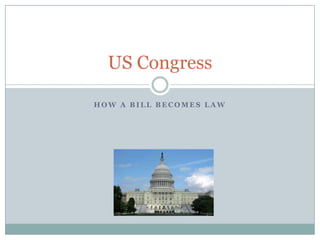
US Congress

HOW A BILL BECOMES LAW
Step 7

 Bill Becomes a law
Introduction

 Welcome
 Process
 Questions
 Answers
 Conclusion
Instructions

 How to use your interactive study guide for Intro to
    US Government: How a Bill Becomes Law
 Play Me

Please also note that I have also included a slide that will ask you the questions again and then allow you to navigate directly to that
appropriate slide with the answer. This will test your ability to recall information throughout the presentation. Click on the the red
question box at the end of each sentence on slide 10 to navigate you to the question. There is also a question box with hyperlink on
the bottom left corner of each of these slides that will navigate you back to slide 10.
Question 1

Bill is introduced by a member of:
 A. Senate
 B. House
 C. Any member of Congress
Questions
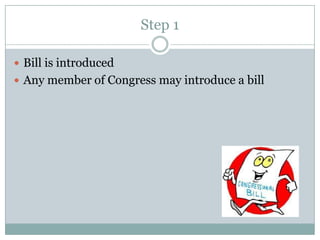
Step 1

 Bill is introduced
 Any member of Congress may introduce a bill
Step 2

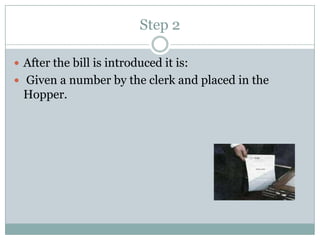
 After the bill is introduced it is:
 Given a number by the clerk and placed in the
  Hopper.
Step 3

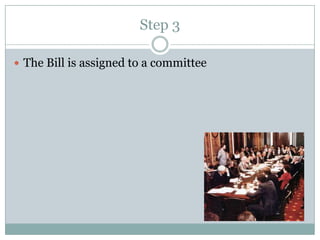
 The Bill is assigned to a committee
Step 3 cont..

 A committee may hold a "mark-up" session during
 which time it will make revisions and additions. If
 substantial amendments are made, the committee
 can order the introduction of a "clean bill" which will
 include the proposed amendments. This new bill will
 have a new number and will be sent to the floor while
 the old bill is discarded. The chamber must
 approve, change or reject all committee amendments
 before conducting a final passage vote.
Step 3 cont..

 After the bill is reported, the committee staff
 prepares a written report explaining why they favor
 the bill and why they wish to see their
 amendments, if any, adopted. Committee members
 who oppose a bill sometimes write a dissenting
 opinion in the report. The report is sent back to the
 whole chamber and is placed on the calendar.
Step 3 cont…

 In the House, most bills go to the Rules committee
 before reaching the floor. The committee adopts
 rules that will govern the procedures under which
 the bill will be considered by the House. A "closed
 rule" sets strict time limits on debate and forbids the
 introduction of amendments. These rules can have a
 major impact on whether the bill passes. The rules
 committee can be bypassed in three ways: 1)
 members can move rules to be suspended (requires
 2/3 vote)2) a discharge petition can be filed 3) the
 House can use a Calendar Wednesday procedure.
Step 4

 Bill is sent to the floor where it is placed on the
  House calendar or Legislative Calendar in the Senate
 Debate
 Vote
Step 5

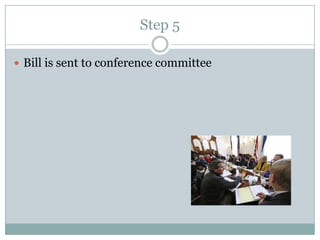
 Bill is sent to conference committee
Step 6

 Bill is sent to President where he can:
 Sign and it becomes a law
 Veto
 Ignore signing the bill using his power of a pocket
 veto
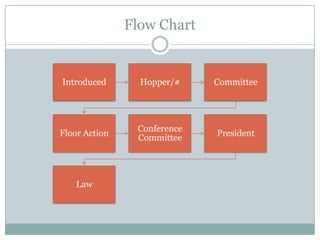
Flow Chart


Introduced       Hopper/#    Committee


                Conference
Floor Action                 President
                Committee


   Law
Question 2

Both legislative branches must agree on a bill’s
 contents before it becomes law.
  True
  False
Question 3

What happens to the bill once both houses are in
    agreement of the bill’s content?
A. Goes to the president.
B. It is made a law
C. It’s returned to committee
D. It’s voted on by both houses
Question 4

What power does the president have in regards to
  bills?
A. Sign the bill
B. Veto
C. Do nothing
D. All the above
Question 5

A pocket veto prevents the President from blocking
  legislation from being passed.
 True
 False
Question 6

After a bill is introduced it is then given a number then
  given to the House Clerk where it will be given to the
  appropriate committee.
 True
 False
Recall of Answers

1. Who can initially introduce a bill to Congress
2. Both legislative branches must agree on a bill’s contents
   before it becomes law
3. What happens to the bill once both houses are in
   agreement of the bill’s content
4. What power does the president have in regards to bills
5. A pocket veto prevents the President from blocking
   legislation from being passed
6. After a bill is introduced it is then given a number then
   given to the House Clerk where it will be given to the
   appropriate committee
Conclusion

 Remember the actual steps and process from the
  beginning until the end of the bills passage (see
  handout from class and lecture material)
 Recall key terms
 Exam will be multiple choice and true false only
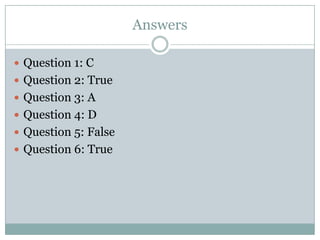
Answers

 Question 1: C
 Question 2: True
 Question 3: A
 Question 4: D
 Question 5: False
 Question 6: True

How a Bill Becomes Law

  • 1.
    US Congress HOW ABILL BECOMES LAW
  • 2.
    Step 7  BillBecomes a law
  • 3.
    Introduction  Welcome  Process Questions  Answers  Conclusion
  • 4.
    Instructions  How touse your interactive study guide for Intro to US Government: How a Bill Becomes Law  Play Me Please also note that I have also included a slide that will ask you the questions again and then allow you to navigate directly to that appropriate slide with the answer. This will test your ability to recall information throughout the presentation. Click on the the red question box at the end of each sentence on slide 10 to navigate you to the question. There is also a question box with hyperlink on the bottom left corner of each of these slides that will navigate you back to slide 10.
  • 6.
    Question 1 Bill isintroduced by a member of: A. Senate B. House C. Any member of Congress
  • 7.
  • 8.
    Step 1  Billis introduced  Any member of Congress may introduce a bill
  • 9.
    Step 2  Afterthe bill is introduced it is:  Given a number by the clerk and placed in the Hopper.
  • 10.
    Step 3  TheBill is assigned to a committee
  • 11.
    Step 3 cont.. A committee may hold a "mark-up" session during which time it will make revisions and additions. If substantial amendments are made, the committee can order the introduction of a "clean bill" which will include the proposed amendments. This new bill will have a new number and will be sent to the floor while the old bill is discarded. The chamber must approve, change or reject all committee amendments before conducting a final passage vote.
  • 12.
    Step 3 cont.. After the bill is reported, the committee staff prepares a written report explaining why they favor the bill and why they wish to see their amendments, if any, adopted. Committee members who oppose a bill sometimes write a dissenting opinion in the report. The report is sent back to the whole chamber and is placed on the calendar.
  • 13.
    Step 3 cont… In the House, most bills go to the Rules committee before reaching the floor. The committee adopts rules that will govern the procedures under which the bill will be considered by the House. A "closed rule" sets strict time limits on debate and forbids the introduction of amendments. These rules can have a major impact on whether the bill passes. The rules committee can be bypassed in three ways: 1) members can move rules to be suspended (requires 2/3 vote)2) a discharge petition can be filed 3) the House can use a Calendar Wednesday procedure.
  • 14.
    Step 4  Billis sent to the floor where it is placed on the House calendar or Legislative Calendar in the Senate  Debate  Vote
  • 15.
    Step 5  Billis sent to conference committee
  • 16.
    Step 6  Billis sent to President where he can:  Sign and it becomes a law  Veto  Ignore signing the bill using his power of a pocket veto
  • 17.
    Flow Chart Introduced Hopper/# Committee Conference Floor Action President Committee Law
  • 18.
    Question 2 Both legislativebranches must agree on a bill’s contents before it becomes law. True False
  • 19.
    Question 3 What happensto the bill once both houses are in agreement of the bill’s content? A. Goes to the president. B. It is made a law C. It’s returned to committee D. It’s voted on by both houses
  • 20.
    Question 4 What powerdoes the president have in regards to bills? A. Sign the bill B. Veto C. Do nothing D. All the above
  • 21.
    Question 5 A pocketveto prevents the President from blocking legislation from being passed.  True  False
  • 22.
    Question 6 After abill is introduced it is then given a number then given to the House Clerk where it will be given to the appropriate committee.  True  False
  • 23.
    Recall of Answers 1.Who can initially introduce a bill to Congress 2. Both legislative branches must agree on a bill’s contents before it becomes law 3. What happens to the bill once both houses are in agreement of the bill’s content 4. What power does the president have in regards to bills 5. A pocket veto prevents the President from blocking legislation from being passed 6. After a bill is introduced it is then given a number then given to the House Clerk where it will be given to the appropriate committee
  • 24.
    Conclusion  Remember theactual steps and process from the beginning until the end of the bills passage (see handout from class and lecture material)  Recall key terms  Exam will be multiple choice and true false only
  • 25.
    Answers  Question 1:C  Question 2: True  Question 3: A  Question 4: D  Question 5: False  Question 6: True

Editor's Notes

  • #5 Please also note that I have also included a slide that will ask you the questions again and then allow you to navigate directly to that appropriate slide with the answer. This will test your ability to recall information throughout the presentation. Click on the the red question box at the end of each sentence on slide 10 to navigate you to the question. There is also a question box with hyperlink on the bottom left corner of each of these slides that will navigate you back to slide 10.
  • #6 Reference: School House, R. (Producer) (1975). Schoolhouse rock- how a bill becomes a law [Web]. Retrieved from <http://www.youtube.com/watch?v=VxT7QjlvDqM&feature=player_embedded>