HOUSE KEEPING IN A HOSPITAL

Dr. A. K. KHANDELWAL


CONSULTANT HOSPITAL MANAGEMENT

ASSESOR OF NATIONAL ACCREDITATION BOARD FOR
HOSPITAL AND HEALTH SERVICE
PROVIDER

MEDICAL DIRECTOR

ANANDALOKE HOSPITAL &NEUROSCIENCES CENTRE
SILIGURI
Housekeeping is defined as the provision of a clean,
comfortable and safe environment for the patients and
public in a hospital setup.

The need for a separate housekeeping department
has arisen due to the increasing public awareness of
healthcare, technology and increasing competition
inhealthcare fields.
The concept of housekeeping is simplistic but when one
considers maintaining a ‘house’ of several hundreds of
rooms and numerous public areas, the task becomes
gigantic.
In most of the hospitals of modern times, the
housekeeping workers are under the direction of
housekeeping department and not under the direction of
nursing service personnel.
The advantage of this arrangement is that the head
nurse is relieved of the housekeeping responsibilities
and has more time to devote to nursing administration
Aims of Housekeeping department
* Achieve the maximum efficiency possible in the care
and comfort of the patients and in the smooth running
of the hospital.
* Establish a welcoming atmosphere and a courteous,
reliable service from staffs of all departments.
* Ensure a high standard of cleanliness and general
upkeep in all areas.
* Train, control and supervise the staffs of
housekeeping department.
* Establish a good working relationship with other
department.
* Ensure that safety and security regulations are
followed.
RESPONSIBILITIES OF THE HOUSEKEEPING
DEPARTMENT

 Cleanliness (Includes Infection control)

Maintenance (Civil, Electrical, Plumbing, Carpentry &
House keeping related activities)

Prevention of fire

- Aesthetic upkeep of the hospital
QUALITIES OF A GOOD HOUSE KEEPER:
• Develop procedures with specific goals of the hospital
housekeeping department and with abroad overall goal of
the hospital
• Coordinate programs
• Delegate authority
• Analyze problems and make decisions, taking into full
consideration a wide range of factors and requirements
• Communicate effectively with a wide variety of people.
• Develop familiarity with hospital rules and regulations, in
areas such as budget, personnel
• Develop knowledge of hospital housekeeping methods
and techniques; of various floor, wall, and ceiling covering
materials and their properties; and of current developments
concerning new cleaning agents, techniques and
equipment.
SUPERVISORY HOUSEKEEPER’S
TASKS
• Coordinate and supervise work activities of cleaning
personnel, to ensure clean, orderly, and attractive
rooms.
• Assign duties, inspect work, and investigate
complaints regarding housekeeping service and
equipment
• Confirm to prescribed standards of cleanliness and
take corrective action.
• Take periodic inventory for purchase of housekeeping
supplies and equipments.
• Prepare reports concerning room occupancy, payroll,
and expenses.
• Recommend for improvement of service and ensure
more efficient operation.
• Conduct meetings to discuss policies and patrons’
complaints.
• Evaluate records to forecast manpower requirements.
Conducts orientation training and in service training to
explain policies, work procedures
• Demonstrate use and maintenance of equipment.
• Record data regarding her subordinate’s work
assignments, personnel actions, time cards and
prepare periodic reports and recommends for promotions,
transfers, and dismissals.
• Obtain list of rooms to be cleaned immediately and list
of prospective checkouts or discharges to prepare work
assignments.
• Perform cleaning duties in cases of emergency or staff
shortage.
JUNIOR HOUSEKEEPER’S TASKS
They are responsible to,
• Make note of complaints and arrange for relevant
person to deliver it.
• Make note of meetings / seminars / workshops /
examinations and the events of the hospitals
and make necessary arrangements like chair
arrangements, over-head projector, drinking
water etc.
• List the inventories like cleaning solutions etc., and
bring to the notice of the Supervisory
Housekeepers.
• Examine building to determine need for repairs or
replacement of furniture or equipment, and
makes recommendations to the management.
• Supplies equipment and accessories to workers.
Environmental Services
GUIDELINES FOR ROUTINE CLEANING OF
HOUSEKEEPING SURFACES
Rankings
Recommendations are categorized according to the
following designations:
Category IA - Strongly recommended for implementation
and strongly supported by well-designed experimental,
clinical, or epidemiological studies.

Category IB - Strongly recommended for implementation
and supported by some experimental, clinical, or
epidemiological studies and a strong theoretical
rationale.

Category IC - Required by state or federal regulations,
rules, or standards.
Category II - Suggested for implementation and
supported by suggestive clinical or
epidemiological studies or a theoretical
rationale.

No recommendation - Unresolved issue.
Practices for which insufficient evidence or no
consensus regarding efficacy exists.
Cleaning and Disinfecting Strategies for
Environmental Surfaces in Patient-Care Areas
1 Do not use high-level disinfectants/liquid chemical
sterilants on non-critical surfaces for disinfection.
Category IC
2 Follow manufacturers’ instructions for cleaning and
maintaining non-critical medical equipment. Category II
3 In the absence of manufacturers’ cleaning instructions,
follow these procedures:
   .a Depending on the nature of the surface and the
degree of contamination, clean non-critical medical
equipment surfaces with a detergent/disinfectant or soap
and water, followed with an application of low-to
intermediate-level chemical germicide at proper use
dilution and for the full contact time required Category II
  b Do not use alcohol to disinfect large surfaces.
Category II
.c Use barrier protective coverings as appropriate for
non-critical surfaces that are: 1) touched frequently with
gloved hands during the delivery of patient care; 2) likely
to become contaminated with blood or body substances;
or 3) difficult to clean. Category II
.4 Keep housekeeping surfaces (e.g., floors, walls,
tabletops) visibly clean on a regular basis and as spills
occur. Category II
     a Use a one-step process and water/detergent or an
EPA-registered hospital grade disinfectant/detergent
designed for general housekeeping purposes. Category
II
 .b Follow manufacturers’ instructions for proper use of
cleaning/disinfecting products, paying close attention to
specified use dilutions and stated contact times
Category II
c Clean and disinfect high-touch surfaces (e.g.,
doorknobs, bedrails, light switches, surfaces in and
around toilets in patients’ rooms) on a more frequent
schedule compared to that for minimal touch
housekeeping surfaces. Category II
  d Clean walls, blinds, and window curtains in patient-
care areas when they are visibly dusty or soiled.
Category II
5 Do not do disinfectant fogging for routine purposes in
patient-care areas Category IB
6 Avoid large-surface cleaning methods that produce
mists or aerosols or disperse dust in patient-care
areas.9, 20, 109, 262 Category IB
7 Follow proper procedures for effective use of mops, cloths,
and solutions: Category II
    a Prepare cleaning solutions daily or as needed, and
replace with fresh solution frequently according to facility
policies and procedures. Category II
  b Use clean mops and cloths every time a bucket of cleaning
solution is emptied and replenished with clean, fresh solution.
Category II
  c Clean mops and cloths after use and allow to dry before
reuse, or, use single-use, disposable mop heads and
cloths.915, 929 - 931 Category II
8 After the last surgical procedure of the day or night, wet
vacuum or mop the operating room floors with a single-use
mop and an EPA-registered hospital disinfectant. Category IB
9 Do not use tacky mats at the entrance to operating rooms or
infection-control suites. Category IB
10 Use proper dusting methods for patient-care areas designated for
immunosuppressed patients (e.g., HSCT patients):Category IB
   a.Wet-dust horizontal surfaces daily using cloths moistened with an EPA-
registered hospital disinfectant. Category IB
  b Avoid dusting methods that disperse dust (i.e., featherdusting). Category
IB
11 Keep vacuums in good repair, and equip vacuums with HEPA filters for
use in high-risk patient-care areas. Category IB
12 Close the doors of immunocompromised patients’ rooms when
vacuuming corridor floors to minimize exposure to airborne dust. Category
IB
13 Take precautions when using phenolic disinfectants in neonatal units.
Category IB
  a Prepare solutions to correct concentrations in accordance with
manufacturers’ use instructions, or, use pre-mixed formulations. Category IB
b Do not use phenolics to disinfect bassinets or incubators during an infant’s
stay. Category IB
 c Rinse phenolic-treated surfaces with water Category IB
CLEANING SPILLS OF BLOOD AND BODY
SUBSTANCES
1 Promptly clean and decontaminate spills of blood or other
potentially infectious materials. Category IC (OSHA)
2 Follow proper procedures for site decontamination of spills
of blood or blood-containing body fluids. Category IC
  .a Use protective gloves and other personal protective
equipment appropriate for this task. Category IC (OSHA)
.b If the spill contains large amounts of blood or body fluids,
clean the visible matter with disposable absorbent material,
and discard the used cleaning materials in appropriate,
labeled containment. Category IC

.c Swab the area with a disposable cloth moderately wetted
with disinfectant, and allow the surface to dry. Category IC
3 Use intermediate-level germicides (germicides
registered by the EPA for use as hospital disinfectants
and labeled tuberculocidal) at recommended dilution and
full contact time to decontaminate spills of blood and
other body fluids.Category IC (OSHA)
4 Use a one-step cleaning/disinfecting procedure for
small spills. Category II
5 If sodium hypochlorite solutions (e.g., household
chlorine bleach) are selected for use:
  .a Use a 1:100 dilution (500 ppm available chlorine) to
decontaminate nonporous surfaces after cleaning a spill
of either blood or body fluids in patient-care settings.
Category IB
.b If a spill involves large amounts of blood or body fluids,
or if a blood or culture spill occurs in the laboratory, use a
1:10 dilution (5,000 ppm available chlorine) for the first
application of germicide before cleaning. Category IB
CARPETING AND CLOTH FURNISHINGS
.1 Vacuum carpeting in public areas of healthcare facilities
and in general patient-care areas regularly with well-
maintained equipment designed to minimize dust dispersion.
Category II

.2 Perform a thorough, deep cleaning of carpeting
periodically as determined by facility policy using a method
that minimizes the production of aerosols and leaves little or
no residue. Category II

3 Avoid the use of carpeting in high-traffic zones in patient-
care areas or where spills are likely (e.g., burn therapy units,
operating rooms, laboratories, intensive care units).
 Category II
.4 Follow proper procedures for managing spills on carpeting.
Category I
.a Spot-clean blood or body substance spills promptly.
Category IC
.b If a spill occurs on carpet tiles, replace any tiles
contaminated by blood and body fluids or body substances.
Category IC
.c Thoroughly dry or replace wet carpeting within 72 hours to
prevent the growth of fungi. Category IB
5 No recommendation on the routine use of fungicidal or
bactericidal treatments for carpeting in public areas of a
healthcare facility or in general patient-care areas.
Unresolved issue
6 Avoid the use of carpeting in hallways and patient
rooms in areas housing immunosuppressed patients
(i.e., PE areas). Category IB
7 Avoid the use of upholstered furniture and furnishings
in high-risk patient-care areas and in areas with
increased potential for body substance contamination
(e.g., pediatrics units). Category II
8 No recommendation on the use of upholstered
furniture and furnishings in general patient-care areas.
Unresolved issue
Flowers and Plants in Patient-Care Areas
.1 Flowers and potted plants need not be restricted from
areas for immunocompetent patients. Category II

2 Designate the care and maintenance of flowers and
potted plants to staff not directly involved with patient
care. Category II

.3 Do not allow flowers (fresh or dried) or potted plants in
patient-care areas for immunosuppressed patients
Category II
PEST CONTROL
1 Develop pest control strategies, with emphasis on
kitchens, cafeterias, laundries, central sterile supply
areas, operating rooms, loading docks, and other areas
prone to infestations. Category II
2 Install screens on all windows that open to the
outside; keep screens in good repair. Category II
.3 Contract for routine pest control service by a
credentialed pest control specialist who will tailor the
application to the needs of a healthcare facility.
Category II
.4 Place laboratory specimens (e.g., fixed sputum
smears) in covered containers for overnight storage.
Category II
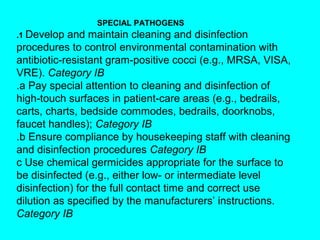
SPECIAL PATHOGENS
.1 Develop  and maintain cleaning and disinfection
procedures to control environmental contamination with
antibiotic-resistant gram-positive cocci (e.g., MRSA, VISA,
VRE). Category IB
.a Pay special attention to cleaning and disinfection of
high-touch surfaces in patient-care areas (e.g., bedrails,
carts, charts, bedside commodes, bedrails, doorknobs,
faucet handles); Category IB
.b Ensure compliance by housekeeping staff with cleaning
and disinfection procedures Category IB
c Use chemical germicides appropriate for the surface to
be disinfected (e.g., either low- or intermediate level
disinfection) for the full contact time and correct use
dilution as specified by the manufacturers’ instructions.
Category IB
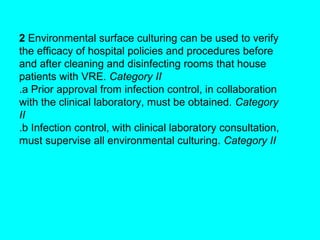
2 Environmental surface culturing can be used to verify
the efficacy of hospital policies and procedures before
and after cleaning and disinfecting rooms that house
patients with VRE. Category II
.a Prior approval from infection control, in collaboration
with the clinical laboratory, must be obtained. Category
II
.b Infection control, with clinical laboratory consultation,
must supervise all environmental culturing. Category II
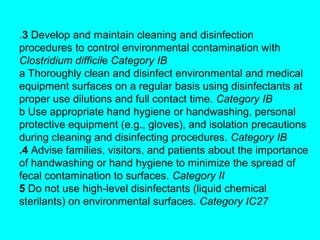
.3 Develop and maintain cleaning and disinfection
procedures to control environmental contamination with
Clostridium difficile Category IB
a Thoroughly clean and disinfect environmental and medical
equipment surfaces on a regular basis using disinfectants at
proper use dilutions and full contact time. Category IB
b Use appropriate hand hygiene or handwashing, personal
protective equipment (e.g., gloves), and isolation precautions
during cleaning and disinfecting procedures. Category IB
.4 Advise families, visitors, and patients about the importance
of handwashing or hand hygiene to minimize the spread of
fecal contamination to surfaces. Category II
5 Do not use high-level disinfectants (liquid chemical
sterilants) on environmental surfaces. Category IC27
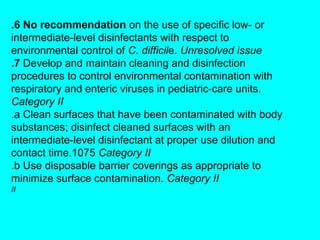
.6 No recommendation on the use of specific low- or
intermediate-level disinfectants with respect to
environmental control of C. difficile. Unresolved issue
.7 Develop and maintain cleaning and disinfection
procedures to control environmental contamination with
respiratory and enteric viruses in pediatric-care units.
Category II
.a Clean surfaces that have been contaminated with body
substances; disinfect cleaned surfaces with an
intermediate-level disinfectant at proper use dilution and
contact time.1075 Category II
.b Use disposable barrier coverings as appropriate to
minimize surface contamination. Category II
II
.8 Develop and maintain cleaning and disinfection
procedures to control environmental contamination with
Creutzfeldt-Jakob disease (CJD) agent in patient-care
areas. Category II
.a In the absence of contamination with central nervous
system tissue, extraordinary measures (e.g., use of 2N
sodium hydroxide [NaOH] or full-strength sodium
hypochlorite [chlorine bleach]) are not needed for routine
cleaning or terminal disinfection of a room housing a
known or suspected CJD patient. Category II
.b Use standard procedures for containment, cleaning,
and decontamination of blood spills on surfaces as
previously described (3-2). Category II
.c Use: 1) a sodium hypochlorite solution of >20,000
ppm [1:2 dilution] for 2 hour contact time; or 2) 1N
NaOH for 2 hours contact time; or 3) 2N NaOH for 1
hour contact time to decontaminate operating room
or autopsy surfaces with central nervous system or
cerebral spinal fluid contamination from a known or
suspected CJD patient.
Category II
d Use disposable, impervious covers to minimize
body substance contamination to autopsy tables and
surfaces. Category
ENVIRONMENTAL SAMPLING

 General Recommendations
.1 Do not conduct random, undirected microbiologic
sampling of air, water, and environmental surfaces in
healthcare facilities. Category IB
.2 When indicated, conduct microbiologic sampling as
part of an epidemiologic investigation. Category IB
.3 Limit microbiologic sampling for quality assurance
purposes to: 1) biological monitoring of sterilization
processes; 2) monthly cultures of water and dialysate
in hemodialysis units; and 3) short-term evaluation of
the impact of infection control measures or changes
in infection control protocols. Category IB
2 Air, Water, and Environmental Surface Sampling
.1 Select a high-volume air sampling device if
anticipated levels of microbial airborne contamination
are expected to be low. Category II
.2 Do not use settle plates to quantify the concentration
of airborne fungal sporesCategory II
.3 When sampling water, choose growth media and
incubation conditions that will facilitate the recovery of
waterborne organisms Category II
.4 When using a sample/rinse method for sampling an
environmental surface, develop and document a
procedure for manipulating the swab, gauze, or sponge
in a reproducible manner so that results are comparable
Category II
.
5 When environmental samples and patient specimens
are available for comparison, perform the laboratory
analysis on the recovered microorganisms down to the
species level at a minimum and beyond the species
level if possible. Category II
.6 When conducting any form of environmental
sampling, fully document departures from standard
methods Category II.
DISINFECTION
Spaulding proposed three levels of disinfection for the
treatment of devices and surfaces that do not require
sterility for safe use. These disinfection levels are
"high-level," "intermediate-level," and "low-level
HIGH LEVEL DISINFECTION
The process of high-level disinfection, an appropriate standard
of treatment for heat-sensitive, semi-critical medical
instruments (e.g., flexible, fiberoptic endoscopes), is capable of
inactivating all vegetative bacteria, mycobacteria, viruses,
fungi, and some bacterial spores if they are present.
 High-level disinfection is accomplished with powerful,
sporicidal chemicals
 Glutaraldehyde,
 Peracetic acid,
 Hydrogen peroxide
These are not appropriate for use on housekeeping surfaces.
INTREMEDIATE LEVEL DISINFECTION
Intermediate-level disinfection does not necessarily kill
bacterial spores, but does inactivate Mycobacterium
tuberculosis var. bovis, which is significantly more
resistant to chemical germicides than ordinary vegetative
bacteria, fungi, and medium- to small viruses (with or
without lipid envelopes). Chemical germicides with
sufficient potency to achieve intermediate-level
disinfection:
 Sodium hypochlorite
 Alcohols,
 Some phenolics,
Some iodophors.
LOW LEVEL DISINFECTION
Low-level disinfectants, which may also be referred to as
"sanitizers,“
Low-level disinfection inactivates vegetative bacteria, fungi,
enveloped viruses (e.g., human immunodeficiency virus
[HIV], influenza viruses), and some non-enveloped viruses
(e.g., adenoviruses).
These include:
 Quaternary ammonium compounds,
 Some phenolics,
Some iodophors.
Germicidal chemicals cleared as skin antiseptics are not
appropriate for use as environmental surface disinfectants.
BARRIER PROTECTION
Barrier protection of surfaces and equipment is useful,
especially if these surfaces are: 1) touched frequently by
gloved hands during the delivery of patient care; 2) likely
to become contaminated with body substances; or 3)
difficult to clean.
 Impervious-backed paper, aluminum foil, plastic or fluid-
resistant covers are suitable for use as barrier protection.
An example of this approach is the use of plastic
wrapping to cover the handle of the operatory light in
dental care settings. Coverings should be removed and
discarded while the healthcare worker is still gloved. The
healthcare worker, after ungloving and hand hygiene,
covers these surfaces with clean materials before the
next patient encounter.
House Keeping

House Keeping

  • 1.
    HOUSE KEEPING INA HOSPITAL Dr. A. K. KHANDELWAL CONSULTANT HOSPITAL MANAGEMENT ASSESOR OF NATIONAL ACCREDITATION BOARD FOR HOSPITAL AND HEALTH SERVICE PROVIDER MEDICAL DIRECTOR ANANDALOKE HOSPITAL &NEUROSCIENCES CENTRE SILIGURI
  • 2.
    Housekeeping is definedas the provision of a clean, comfortable and safe environment for the patients and public in a hospital setup. The need for a separate housekeeping department has arisen due to the increasing public awareness of healthcare, technology and increasing competition inhealthcare fields.
  • 3.
    The concept ofhousekeeping is simplistic but when one considers maintaining a ‘house’ of several hundreds of rooms and numerous public areas, the task becomes gigantic. In most of the hospitals of modern times, the housekeeping workers are under the direction of housekeeping department and not under the direction of nursing service personnel. The advantage of this arrangement is that the head nurse is relieved of the housekeeping responsibilities and has more time to devote to nursing administration
  • 4.
    Aims of Housekeepingdepartment * Achieve the maximum efficiency possible in the care and comfort of the patients and in the smooth running of the hospital. * Establish a welcoming atmosphere and a courteous, reliable service from staffs of all departments. * Ensure a high standard of cleanliness and general upkeep in all areas. * Train, control and supervise the staffs of housekeeping department. * Establish a good working relationship with other department. * Ensure that safety and security regulations are followed.
  • 5.
    RESPONSIBILITIES OF THEHOUSEKEEPING DEPARTMENT  Cleanliness (Includes Infection control) Maintenance (Civil, Electrical, Plumbing, Carpentry & House keeping related activities) Prevention of fire - Aesthetic upkeep of the hospital
  • 6.
    QUALITIES OF AGOOD HOUSE KEEPER: • Develop procedures with specific goals of the hospital housekeeping department and with abroad overall goal of the hospital • Coordinate programs • Delegate authority • Analyze problems and make decisions, taking into full consideration a wide range of factors and requirements • Communicate effectively with a wide variety of people. • Develop familiarity with hospital rules and regulations, in areas such as budget, personnel • Develop knowledge of hospital housekeeping methods and techniques; of various floor, wall, and ceiling covering materials and their properties; and of current developments concerning new cleaning agents, techniques and equipment.
  • 7.
    SUPERVISORY HOUSEKEEPER’S TASKS • Coordinateand supervise work activities of cleaning personnel, to ensure clean, orderly, and attractive rooms. • Assign duties, inspect work, and investigate complaints regarding housekeeping service and equipment • Confirm to prescribed standards of cleanliness and take corrective action. • Take periodic inventory for purchase of housekeeping supplies and equipments. • Prepare reports concerning room occupancy, payroll, and expenses. • Recommend for improvement of service and ensure more efficient operation.
  • 8.
    • Conduct meetingsto discuss policies and patrons’ complaints. • Evaluate records to forecast manpower requirements. Conducts orientation training and in service training to explain policies, work procedures • Demonstrate use and maintenance of equipment. • Record data regarding her subordinate’s work assignments, personnel actions, time cards and prepare periodic reports and recommends for promotions, transfers, and dismissals. • Obtain list of rooms to be cleaned immediately and list of prospective checkouts or discharges to prepare work assignments. • Perform cleaning duties in cases of emergency or staff shortage.
  • 9.
    JUNIOR HOUSEKEEPER’S TASKS Theyare responsible to, • Make note of complaints and arrange for relevant person to deliver it. • Make note of meetings / seminars / workshops / examinations and the events of the hospitals and make necessary arrangements like chair arrangements, over-head projector, drinking water etc. • List the inventories like cleaning solutions etc., and bring to the notice of the Supervisory Housekeepers. • Examine building to determine need for repairs or replacement of furniture or equipment, and makes recommendations to the management. • Supplies equipment and accessories to workers.
  • 10.
  • 11.
    GUIDELINES FOR ROUTINECLEANING OF HOUSEKEEPING SURFACES Rankings Recommendations are categorized according to the following designations: Category IA - Strongly recommended for implementation and strongly supported by well-designed experimental, clinical, or epidemiological studies. Category IB - Strongly recommended for implementation and supported by some experimental, clinical, or epidemiological studies and a strong theoretical rationale. Category IC - Required by state or federal regulations, rules, or standards.
  • 12.
    Category II -Suggested for implementation and supported by suggestive clinical or epidemiological studies or a theoretical rationale. No recommendation - Unresolved issue. Practices for which insufficient evidence or no consensus regarding efficacy exists.
  • 13.
    Cleaning and DisinfectingStrategies for Environmental Surfaces in Patient-Care Areas 1 Do not use high-level disinfectants/liquid chemical sterilants on non-critical surfaces for disinfection. Category IC 2 Follow manufacturers’ instructions for cleaning and maintaining non-critical medical equipment. Category II 3 In the absence of manufacturers’ cleaning instructions, follow these procedures: .a Depending on the nature of the surface and the degree of contamination, clean non-critical medical equipment surfaces with a detergent/disinfectant or soap and water, followed with an application of low-to intermediate-level chemical germicide at proper use dilution and for the full contact time required Category II b Do not use alcohol to disinfect large surfaces. Category II
  • 14.
    .c Use barrierprotective coverings as appropriate for non-critical surfaces that are: 1) touched frequently with gloved hands during the delivery of patient care; 2) likely to become contaminated with blood or body substances; or 3) difficult to clean. Category II .4 Keep housekeeping surfaces (e.g., floors, walls, tabletops) visibly clean on a regular basis and as spills occur. Category II a Use a one-step process and water/detergent or an EPA-registered hospital grade disinfectant/detergent designed for general housekeeping purposes. Category II .b Follow manufacturers’ instructions for proper use of cleaning/disinfecting products, paying close attention to specified use dilutions and stated contact times Category II
  • 15.
    c Clean anddisinfect high-touch surfaces (e.g., doorknobs, bedrails, light switches, surfaces in and around toilets in patients’ rooms) on a more frequent schedule compared to that for minimal touch housekeeping surfaces. Category II d Clean walls, blinds, and window curtains in patient- care areas when they are visibly dusty or soiled. Category II 5 Do not do disinfectant fogging for routine purposes in patient-care areas Category IB 6 Avoid large-surface cleaning methods that produce mists or aerosols or disperse dust in patient-care areas.9, 20, 109, 262 Category IB
  • 16.
    7 Follow properprocedures for effective use of mops, cloths, and solutions: Category II a Prepare cleaning solutions daily or as needed, and replace with fresh solution frequently according to facility policies and procedures. Category II b Use clean mops and cloths every time a bucket of cleaning solution is emptied and replenished with clean, fresh solution. Category II c Clean mops and cloths after use and allow to dry before reuse, or, use single-use, disposable mop heads and cloths.915, 929 - 931 Category II 8 After the last surgical procedure of the day or night, wet vacuum or mop the operating room floors with a single-use mop and an EPA-registered hospital disinfectant. Category IB 9 Do not use tacky mats at the entrance to operating rooms or infection-control suites. Category IB
  • 17.
    10 Use properdusting methods for patient-care areas designated for immunosuppressed patients (e.g., HSCT patients):Category IB a.Wet-dust horizontal surfaces daily using cloths moistened with an EPA- registered hospital disinfectant. Category IB b Avoid dusting methods that disperse dust (i.e., featherdusting). Category IB 11 Keep vacuums in good repair, and equip vacuums with HEPA filters for use in high-risk patient-care areas. Category IB 12 Close the doors of immunocompromised patients’ rooms when vacuuming corridor floors to minimize exposure to airborne dust. Category IB 13 Take precautions when using phenolic disinfectants in neonatal units. Category IB a Prepare solutions to correct concentrations in accordance with manufacturers’ use instructions, or, use pre-mixed formulations. Category IB b Do not use phenolics to disinfect bassinets or incubators during an infant’s stay. Category IB c Rinse phenolic-treated surfaces with water Category IB
  • 18.
    CLEANING SPILLS OFBLOOD AND BODY SUBSTANCES 1 Promptly clean and decontaminate spills of blood or other potentially infectious materials. Category IC (OSHA) 2 Follow proper procedures for site decontamination of spills of blood or blood-containing body fluids. Category IC .a Use protective gloves and other personal protective equipment appropriate for this task. Category IC (OSHA) .b If the spill contains large amounts of blood or body fluids, clean the visible matter with disposable absorbent material, and discard the used cleaning materials in appropriate, labeled containment. Category IC .c Swab the area with a disposable cloth moderately wetted with disinfectant, and allow the surface to dry. Category IC
  • 19.
    3 Use intermediate-levelgermicides (germicides registered by the EPA for use as hospital disinfectants and labeled tuberculocidal) at recommended dilution and full contact time to decontaminate spills of blood and other body fluids.Category IC (OSHA) 4 Use a one-step cleaning/disinfecting procedure for small spills. Category II 5 If sodium hypochlorite solutions (e.g., household chlorine bleach) are selected for use: .a Use a 1:100 dilution (500 ppm available chlorine) to decontaminate nonporous surfaces after cleaning a spill of either blood or body fluids in patient-care settings. Category IB .b If a spill involves large amounts of blood or body fluids, or if a blood or culture spill occurs in the laboratory, use a 1:10 dilution (5,000 ppm available chlorine) for the first application of germicide before cleaning. Category IB
  • 20.
    CARPETING AND CLOTHFURNISHINGS .1 Vacuum carpeting in public areas of healthcare facilities and in general patient-care areas regularly with well- maintained equipment designed to minimize dust dispersion. Category II .2 Perform a thorough, deep cleaning of carpeting periodically as determined by facility policy using a method that minimizes the production of aerosols and leaves little or no residue. Category II 3 Avoid the use of carpeting in high-traffic zones in patient- care areas or where spills are likely (e.g., burn therapy units, operating rooms, laboratories, intensive care units). Category II .4 Follow proper procedures for managing spills on carpeting. Category I
  • 21.
    .a Spot-clean bloodor body substance spills promptly. Category IC .b If a spill occurs on carpet tiles, replace any tiles contaminated by blood and body fluids or body substances. Category IC .c Thoroughly dry or replace wet carpeting within 72 hours to prevent the growth of fungi. Category IB 5 No recommendation on the routine use of fungicidal or bactericidal treatments for carpeting in public areas of a healthcare facility or in general patient-care areas. Unresolved issue
  • 22.
    6 Avoid theuse of carpeting in hallways and patient rooms in areas housing immunosuppressed patients (i.e., PE areas). Category IB 7 Avoid the use of upholstered furniture and furnishings in high-risk patient-care areas and in areas with increased potential for body substance contamination (e.g., pediatrics units). Category II 8 No recommendation on the use of upholstered furniture and furnishings in general patient-care areas. Unresolved issue
  • 23.
    Flowers and Plantsin Patient-Care Areas .1 Flowers and potted plants need not be restricted from areas for immunocompetent patients. Category II 2 Designate the care and maintenance of flowers and potted plants to staff not directly involved with patient care. Category II .3 Do not allow flowers (fresh or dried) or potted plants in patient-care areas for immunosuppressed patients Category II
  • 24.
    PEST CONTROL 1 Developpest control strategies, with emphasis on kitchens, cafeterias, laundries, central sterile supply areas, operating rooms, loading docks, and other areas prone to infestations. Category II 2 Install screens on all windows that open to the outside; keep screens in good repair. Category II .3 Contract for routine pest control service by a credentialed pest control specialist who will tailor the application to the needs of a healthcare facility. Category II .4 Place laboratory specimens (e.g., fixed sputum smears) in covered containers for overnight storage. Category II
  • 25.
    SPECIAL PATHOGENS .1 Develop and maintain cleaning and disinfection procedures to control environmental contamination with antibiotic-resistant gram-positive cocci (e.g., MRSA, VISA, VRE). Category IB .a Pay special attention to cleaning and disinfection of high-touch surfaces in patient-care areas (e.g., bedrails, carts, charts, bedside commodes, bedrails, doorknobs, faucet handles); Category IB .b Ensure compliance by housekeeping staff with cleaning and disinfection procedures Category IB c Use chemical germicides appropriate for the surface to be disinfected (e.g., either low- or intermediate level disinfection) for the full contact time and correct use dilution as specified by the manufacturers’ instructions. Category IB
  • 26.
    2 Environmental surfaceculturing can be used to verify the efficacy of hospital policies and procedures before and after cleaning and disinfecting rooms that house patients with VRE. Category II .a Prior approval from infection control, in collaboration with the clinical laboratory, must be obtained. Category II .b Infection control, with clinical laboratory consultation, must supervise all environmental culturing. Category II
  • 27.
    .3 Develop andmaintain cleaning and disinfection procedures to control environmental contamination with Clostridium difficile Category IB a Thoroughly clean and disinfect environmental and medical equipment surfaces on a regular basis using disinfectants at proper use dilutions and full contact time. Category IB b Use appropriate hand hygiene or handwashing, personal protective equipment (e.g., gloves), and isolation precautions during cleaning and disinfecting procedures. Category IB .4 Advise families, visitors, and patients about the importance of handwashing or hand hygiene to minimize the spread of fecal contamination to surfaces. Category II 5 Do not use high-level disinfectants (liquid chemical sterilants) on environmental surfaces. Category IC27
  • 28.
    .6 No recommendationon the use of specific low- or intermediate-level disinfectants with respect to environmental control of C. difficile. Unresolved issue .7 Develop and maintain cleaning and disinfection procedures to control environmental contamination with respiratory and enteric viruses in pediatric-care units. Category II .a Clean surfaces that have been contaminated with body substances; disinfect cleaned surfaces with an intermediate-level disinfectant at proper use dilution and contact time.1075 Category II .b Use disposable barrier coverings as appropriate to minimize surface contamination. Category II II
  • 29.
    .8 Develop andmaintain cleaning and disinfection procedures to control environmental contamination with Creutzfeldt-Jakob disease (CJD) agent in patient-care areas. Category II .a In the absence of contamination with central nervous system tissue, extraordinary measures (e.g., use of 2N sodium hydroxide [NaOH] or full-strength sodium hypochlorite [chlorine bleach]) are not needed for routine cleaning or terminal disinfection of a room housing a known or suspected CJD patient. Category II .b Use standard procedures for containment, cleaning, and decontamination of blood spills on surfaces as previously described (3-2). Category II
  • 30.
    .c Use: 1)a sodium hypochlorite solution of >20,000 ppm [1:2 dilution] for 2 hour contact time; or 2) 1N NaOH for 2 hours contact time; or 3) 2N NaOH for 1 hour contact time to decontaminate operating room or autopsy surfaces with central nervous system or cerebral spinal fluid contamination from a known or suspected CJD patient. Category II d Use disposable, impervious covers to minimize body substance contamination to autopsy tables and surfaces. Category
  • 31.
    ENVIRONMENTAL SAMPLING GeneralRecommendations .1 Do not conduct random, undirected microbiologic sampling of air, water, and environmental surfaces in healthcare facilities. Category IB .2 When indicated, conduct microbiologic sampling as part of an epidemiologic investigation. Category IB .3 Limit microbiologic sampling for quality assurance purposes to: 1) biological monitoring of sterilization processes; 2) monthly cultures of water and dialysate in hemodialysis units; and 3) short-term evaluation of the impact of infection control measures or changes in infection control protocols. Category IB
  • 32.
    2 Air, Water,and Environmental Surface Sampling .1 Select a high-volume air sampling device if anticipated levels of microbial airborne contamination are expected to be low. Category II .2 Do not use settle plates to quantify the concentration of airborne fungal sporesCategory II .3 When sampling water, choose growth media and incubation conditions that will facilitate the recovery of waterborne organisms Category II .4 When using a sample/rinse method for sampling an environmental surface, develop and document a procedure for manipulating the swab, gauze, or sponge in a reproducible manner so that results are comparable Category II .
  • 33.
    5 When environmentalsamples and patient specimens are available for comparison, perform the laboratory analysis on the recovered microorganisms down to the species level at a minimum and beyond the species level if possible. Category II .6 When conducting any form of environmental sampling, fully document departures from standard methods Category II.
  • 34.
    DISINFECTION Spaulding proposed threelevels of disinfection for the treatment of devices and surfaces that do not require sterility for safe use. These disinfection levels are "high-level," "intermediate-level," and "low-level
  • 35.
    HIGH LEVEL DISINFECTION Theprocess of high-level disinfection, an appropriate standard of treatment for heat-sensitive, semi-critical medical instruments (e.g., flexible, fiberoptic endoscopes), is capable of inactivating all vegetative bacteria, mycobacteria, viruses, fungi, and some bacterial spores if they are present. High-level disinfection is accomplished with powerful, sporicidal chemicals  Glutaraldehyde,  Peracetic acid,  Hydrogen peroxide These are not appropriate for use on housekeeping surfaces.
  • 36.
    INTREMEDIATE LEVEL DISINFECTION Intermediate-leveldisinfection does not necessarily kill bacterial spores, but does inactivate Mycobacterium tuberculosis var. bovis, which is significantly more resistant to chemical germicides than ordinary vegetative bacteria, fungi, and medium- to small viruses (with or without lipid envelopes). Chemical germicides with sufficient potency to achieve intermediate-level disinfection:  Sodium hypochlorite  Alcohols,  Some phenolics, Some iodophors.
  • 37.
    LOW LEVEL DISINFECTION Low-leveldisinfectants, which may also be referred to as "sanitizers,“ Low-level disinfection inactivates vegetative bacteria, fungi, enveloped viruses (e.g., human immunodeficiency virus [HIV], influenza viruses), and some non-enveloped viruses (e.g., adenoviruses). These include:  Quaternary ammonium compounds,  Some phenolics, Some iodophors. Germicidal chemicals cleared as skin antiseptics are not appropriate for use as environmental surface disinfectants.
  • 38.
    BARRIER PROTECTION Barrier protectionof surfaces and equipment is useful, especially if these surfaces are: 1) touched frequently by gloved hands during the delivery of patient care; 2) likely to become contaminated with body substances; or 3) difficult to clean. Impervious-backed paper, aluminum foil, plastic or fluid- resistant covers are suitable for use as barrier protection. An example of this approach is the use of plastic wrapping to cover the handle of the operatory light in dental care settings. Coverings should be removed and discarded while the healthcare worker is still gloved. The healthcare worker, after ungloving and hand hygiene, covers these surfaces with clean materials before the next patient encounter.