Strategy
30 Health Biz Insight August & September 2018
By: Dr AK Khandelwal
H
ealthcare organisations
are very complex and
in spite standardisation
of most processes, failure and
catastrophes do occur. Sudden
death in an imaging room, fall
of patients, suicide of patients,
wrong site, wrong patient
surgery, wrong investigations,
failure of treatment, failure of
equipment are some examples
of unexpected events. So, it is
important to recognise that
standardisation is necessary
but not sufficient for achieving
resilient and reliable healthcare
systems.
Managing the expected is
the paramount for a healthcare
organisation.
Industries like airline,
gas and oil, nuclear power
are working in high hazard
domains without serious events
and catastrophic failure by
implementing principle of high
reliability organisation. This
principle of high reliability
organisation is a paramount
necessity to ensure safe
healthcare ecosystem and
healthcare organisations should
adopt lessons about safety
management practices in safety-
critical industries. Examples
include the introduction of
incident reporting systems
and the WHO Surgical Safety
Check List.
What is High Reliability
organisation?
Literature mentions that high
reliability organisations are
those that
manage to have few or no
significant accidents even
though they operate complex
technology in highly hazardous
environments, such as aircraft
carriers and nuclear power
plants.
It is based on the principle
of persistent mindfulness in
the organisation of deficiency
or failure of services resulting
in damage or death. Literature
mentions that high reliability
organisations cultivate
resilience by relentlessly
priotising safety over the
performance pressure. High
reliability organisations
consider safety as a dynamic
culture changing with the
new emerging threats in
the healthcare ecosystem.
Managing the Unexpected
The principle of high reliability organisation is a paramount
necessity to ensure a safe healthcare ecosystem
Strategy
www.healthbizinsight.com
31
Health Biz Insight August & September 2018
An administrator in a
high reliability healthcare
organisation should anticipate
emerging safety threat, detect
early and act early to mitigate
catastrophic damage.
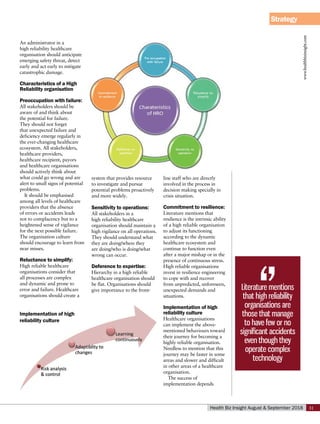
Characteristics of a High
Reliability organisation
Preoccupation with failure:
All stakeholders should be
aware of and think about
the potential for failure.
They should not forget
that unexpected failure and
deficiency emerge regularly in
the ever-changing healthcare
ecosystem. All stakeholders,
healthcare providers,
healthcare recipient, payors
and healthcare organisations
should actively think about
what could go wrong and are
alert to small signs of potential
problems.
It should be emphasised
among all levels of healthcare
providers that the absence
of errors or accidents leads
not to complacency but to a
heightened sense of vigilance
for the next possible failure.
The organisation culture
should encourage to learn from
near misses.
Reluctance to simplify:
High reliable healthcare
organisations consider that
all processes are complex
and dynamic and prone to
error and failure. Healthcare
organisations should create a
system that provides resource
to investigate and pursue
potential problems proactively
and more widely.
Sensitivity to operations:
All stakeholders in a
high reliability healthcare
organisation should maintain a
high vigilance on all operations.
They should understand what
they are doing/where they
are doing/who is doing/what
wrong can occur.
Deference to expertise:
Hierarchy in a high reliable
healthcare organisation should
be flat. Organisations should
give importance to the front-
line staff who are directly
involved in the process in
decision making specially in
crisis situation.
Commitment to resilience:
Literature mentions that
resilience is the intrinsic ability
of a high reliable organisation
to adjust its functioning
according to the dynamic
healthcare ecosystem and
continue to function even
after a major mishap or in the
presence of continuous stress.
High reliable organisations
invest in resilience engineering
to cope with and recover
from unpredicted, unforeseen,
unexpected demands and
situations.
Implementation of high
reliability culture
Healthcare organisations
can implement the above-
mentioned behaviours toward
their journey for becoming a
highly reliable organisation.
Needless to mention that this
journey may be faster in some
areas and slower and difficult
in other areas of a healthcare
organisation.
The success of
implementation depends
Literature mentions
that high reliability
organisations are
those that manage
to have few or no
significant accidents
even though they
operate complex
technology
Implementation of high
reliability culture
Strategy
32 Health Biz Insight August & September 2018
upon three main abilities of
healthcare organisation: risk
analysis and control, adapting
capacity to changes, and
learning continuously.
Risk analysis
Experts suggest that there is
large variation in the reliability
of different care processes, and
that overall, care process have
a significant failure rate that
can be improved upon.
Healthcare organisations
should identify high
risk process like CPR,
IV cannulation, oxygen
administration, operations,
invasive procedures,
identifications, blood
transfusions, sedations,
anesthesia etc. and anticipate
the probability of failure and
severity of outcome of failure
by most effective quality tool
like failure mode and effect
analysis (FMEA).
Risk control
In order to improve the
reliability of processes,
organisations usually attempt
to exert greater managerial
control over how care is
delivered. This can be achieved
by simplification
and standardisation of
processes by using a
management tool like process
mapping, lean method, care
bundle etc.
Investing in such activities
is a prerequisite for enhancing
the reliability of care processes
to higher levels, and it is a
key component of mindful
organising.
Learning continuously
A healthcare organisation
should develop culture of
learning organisation to
provide safe and reliable
healthcare. Safe and reliable
care is facilitated by individual
learning, team learning and
organisation learning.
Conclusion
Managing the unexpected in
a healthcare organisation is a
challenging and arduous task.
Experience of other
industries like aviation, nuclear
power etc. have proved that
it is possible to achieve this.
A healthcare organisation
can start its journey towards
becoming an HRO with
vision, leadership and safety
culture. HBI
About the author
Dr. Ashok Kumar
Khandelwal is the VP
& Medical Director,
Anandaloke Hospital &
Neurosciences Centre,
West Bengal. He is a
trained Assessor from the
National Accreditation
Board for Hospital and
Health Care Provider
(NABH). He carries
around two decades of
experience in the hospital
industry and 20 years of
experience as a hospital
administrator.
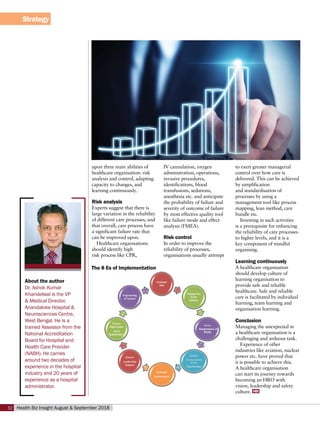
The 8 Es of Implementation

Managing the Unexpected.pdf

  • 1.
    Strategy 30 Health BizInsight August & September 2018 By: Dr AK Khandelwal H ealthcare organisations are very complex and in spite standardisation of most processes, failure and catastrophes do occur. Sudden death in an imaging room, fall of patients, suicide of patients, wrong site, wrong patient surgery, wrong investigations, failure of treatment, failure of equipment are some examples of unexpected events. So, it is important to recognise that standardisation is necessary but not sufficient for achieving resilient and reliable healthcare systems. Managing the expected is the paramount for a healthcare organisation. Industries like airline, gas and oil, nuclear power are working in high hazard domains without serious events and catastrophic failure by implementing principle of high reliability organisation. This principle of high reliability organisation is a paramount necessity to ensure safe healthcare ecosystem and healthcare organisations should adopt lessons about safety management practices in safety- critical industries. Examples include the introduction of incident reporting systems and the WHO Surgical Safety Check List. What is High Reliability organisation? Literature mentions that high reliability organisations are those that manage to have few or no significant accidents even though they operate complex technology in highly hazardous environments, such as aircraft carriers and nuclear power plants. It is based on the principle of persistent mindfulness in the organisation of deficiency or failure of services resulting in damage or death. Literature mentions that high reliability organisations cultivate resilience by relentlessly priotising safety over the performance pressure. High reliability organisations consider safety as a dynamic culture changing with the new emerging threats in the healthcare ecosystem. Managing the Unexpected The principle of high reliability organisation is a paramount necessity to ensure a safe healthcare ecosystem
  • 2.
    Strategy www.healthbizinsight.com 31 Health Biz InsightAugust & September 2018 An administrator in a high reliability healthcare organisation should anticipate emerging safety threat, detect early and act early to mitigate catastrophic damage. Characteristics of a High Reliability organisation Preoccupation with failure: All stakeholders should be aware of and think about the potential for failure. They should not forget that unexpected failure and deficiency emerge regularly in the ever-changing healthcare ecosystem. All stakeholders, healthcare providers, healthcare recipient, payors and healthcare organisations should actively think about what could go wrong and are alert to small signs of potential problems. It should be emphasised among all levels of healthcare providers that the absence of errors or accidents leads not to complacency but to a heightened sense of vigilance for the next possible failure. The organisation culture should encourage to learn from near misses. Reluctance to simplify: High reliable healthcare organisations consider that all processes are complex and dynamic and prone to error and failure. Healthcare organisations should create a system that provides resource to investigate and pursue potential problems proactively and more widely. Sensitivity to operations: All stakeholders in a high reliability healthcare organisation should maintain a high vigilance on all operations. They should understand what they are doing/where they are doing/who is doing/what wrong can occur. Deference to expertise: Hierarchy in a high reliable healthcare organisation should be flat. Organisations should give importance to the front- line staff who are directly involved in the process in decision making specially in crisis situation. Commitment to resilience: Literature mentions that resilience is the intrinsic ability of a high reliable organisation to adjust its functioning according to the dynamic healthcare ecosystem and continue to function even after a major mishap or in the presence of continuous stress. High reliable organisations invest in resilience engineering to cope with and recover from unpredicted, unforeseen, unexpected demands and situations. Implementation of high reliability culture Healthcare organisations can implement the above- mentioned behaviours toward their journey for becoming a highly reliable organisation. Needless to mention that this journey may be faster in some areas and slower and difficult in other areas of a healthcare organisation. The success of implementation depends Literature mentions that high reliability organisations are those that manage to have few or no significant accidents even though they operate complex technology Implementation of high reliability culture
  • 3.
    Strategy 32 Health BizInsight August & September 2018 upon three main abilities of healthcare organisation: risk analysis and control, adapting capacity to changes, and learning continuously. Risk analysis Experts suggest that there is large variation in the reliability of different care processes, and that overall, care process have a significant failure rate that can be improved upon. Healthcare organisations should identify high risk process like CPR, IV cannulation, oxygen administration, operations, invasive procedures, identifications, blood transfusions, sedations, anesthesia etc. and anticipate the probability of failure and severity of outcome of failure by most effective quality tool like failure mode and effect analysis (FMEA). Risk control In order to improve the reliability of processes, organisations usually attempt to exert greater managerial control over how care is delivered. This can be achieved by simplification and standardisation of processes by using a management tool like process mapping, lean method, care bundle etc. Investing in such activities is a prerequisite for enhancing the reliability of care processes to higher levels, and it is a key component of mindful organising. Learning continuously A healthcare organisation should develop culture of learning organisation to provide safe and reliable healthcare. Safe and reliable care is facilitated by individual learning, team learning and organisation learning. Conclusion Managing the unexpected in a healthcare organisation is a challenging and arduous task. Experience of other industries like aviation, nuclear power etc. have proved that it is possible to achieve this. A healthcare organisation can start its journey towards becoming an HRO with vision, leadership and safety culture. HBI About the author Dr. Ashok Kumar Khandelwal is the VP & Medical Director, Anandaloke Hospital & Neurosciences Centre, West Bengal. He is a trained Assessor from the National Accreditation Board for Hospital and Health Care Provider (NABH). He carries around two decades of experience in the hospital industry and 20 years of experience as a hospital administrator. The 8 Es of Implementation