CENTRAL STERILE & SUPPLY
DEPARTMENT
IN A QUATERNARY CARE HOSPITAL
Understanding Process & SWOT analysis
Dr. Sudha Pathak & Mr. Omkar More
CSSD is a service unit in a hospital that processes, issue
& controls the sterile stores supply to all departments of
the hospital.
Or
CSSD is the Department which deals with receiving,
cleaning, packing, disinfecting, sterilizing, storing and
distributing all surgical instruments and equipments as per
well-delineated protocols and standardized procedures.
FACTS
o First CSSD was set in India at Jaslok Hospital in
July, 1973 by Nalini Gaithonde
o Analysts say that 85 per cent of most of the
upcoming hospitals have a well-equipped CSSD.
WHY CSSD ???
• By having separate CSSD, we can decrease the cost of
sterilizers through centralization of equipment in one
department. Besides, this would also ensure that a dedicated
staff can effectively monitor the sterilization process as per
the Standard Operative Procedures (SOPs).”
 Ganesh Devadiga, Head, CSSD, Dr L H Hiranandani Hospital,
Mumbai.
• “CSSD requires technical competency, which implies that the
department controls all the activities of asset management
pertaining to selective procurement of general and
specialised surgical instruments and other inventory.
 Vishwanath Kokitkar, CSSD and Laundry In- Charge, S L Raheja
Hospital.
WHY CSSD ???
• “The rise in incidence of nosocomial infection with
corresponding increase in mortality, length of stay
and cost can be brought down by establishing a
good CSSD set-up.”
 Gopinathan T, Manager, CSSD, Amrita
Institute of Medical Sciences (AIMS), Kochi.
• CSSD was generally looked upon as an essential
part of an OT as the use of sterile supplies in a
hospital is maximum to the OT. However, all that
has changed. CSSD is considered today, integral
to the function of Out Patient Department (OPDs),
wards and other departments.”
 Rekha Batura, Asst Medical Superindentent,
Tata Memorial Hospital (TMH), Mumbai.
COST OF INFECTIONS
• Prolonged stay in hospital
• Additional resources and burden on hospital.
• Loss of manhours - doctors and patients
• Mental agony
• Significant economical loss.
• Poor surgical results
FUNCTION OF CSSD
1. Receiving unsterile stores, instruments, equipment & linens from medical stores & various consumer
department of hospital.
2. Sorting out the items.
3. Washing, disinfection & drying.
4. Checking & packing of sets/trays/instruments.
5. Sterilization of all items received, by using the appropriate techniques as applicable to the items.
6. Storage & issue of the sterilized items to the consumer departments.
7. Maintaining records of the stores received, processed & issued.
8. Validation of the effectiveness of sterilization techniques.
9. Training of staff in techniques of sterilization.
10. Advice to consumer departments on sterilization of items of different nature
QUALITY MANAGEMENT OF SERVICES IN CSSD
 Quality management of services in CSSD is
extremely important in view of its role
• In hospital infection control &
• The catastrophic effects the poor quality service
may have on patients.
 However, quality of services can be judged from
level of satisfaction of the clientele.
 The clients in case of CSSD are all internal
(Consumer departments/clinicians).
QUALITY MANAGEMENT OF SERVICES IN CSSD
 High quality CSSD services to them means:
 Hundred percent reliability of sterility of stores supplied by
CSSD.
 Timely supplies in right time.
 Contents of the trays/ sets are as per the standard list
provided by users & all the contents are in full operational
order.
 Trays/ Sets are labeled correctly.
 The sterile items supplied remain sterile up to their pre-
determined shelf life.
 Quality of the items does not deteriorate by the sterilization
technique used.
 (The quality of outcome, however, depends upon the
quality of infrastructure & process used in CSSD.)
SPACE, LAYOUT, SURFACE FINISH
 The space requirement in CSSD is 7-10 sq. F/ bed.
 The layout must follow the zoning concept & functional flow with
receipt (dirty) counter on one end & sterile issue on other end.
 Inside CSSD there should be no criss crossing & area should be
divided by partitions into dirty, clean & sterile zones.
 Similarly, gas & steam sterilization should be separated.
 The entrance lobby should have….
o A changing room with toilet & hand washing facility.
 The flooring should be non-skid type.
2. ORGANIZATION & STAFFING
 Department should be under overall control of HOD
of OT/Nursing.
 Should be headed by trained & experienced
manager.
 Should have trained staff(technicians, attendants)
on each shift at each zone irrespective of volume
3. EQUIPMENT QUALITY /AVAILABILITY
• Ultrasound cleaners.
• Instrument washers
• Steel racks for storage of unsterile & sterile sets.
• Work tables
• Gas sterilizers
• ETO
• Autoclave machines fitted with sterimeters for temperature/time recording,
• Self recording pressure gauze for pressure/ time recording.
• Computer terminals.
4. QUALITY OF MATERIALS
 Quality of disinfectants, detergents, cotton-wool
gauze & other supplies should be of ensured.
5. ENGINEERING SUPPORT SERVICES
• Stable & uninterrupted power supply.
• Running water of desired quality
• Temperature with comfort zone.
• Ventilation with 10 air change per hour.
• Humidity level 50-60 %
• Illumination level of 200 Lux
IN QUATERNARY CARE CENTER
CURRENT SITUATIONS
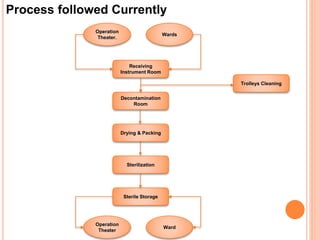
Operation
Theater.
Wards
Receiving
Instrument Room
Decontamination
Room
Drying & Packing
Sterilization
Sterile Storage
Trolleys Cleaning
Operation
Theater
Ward
Process followed Currently
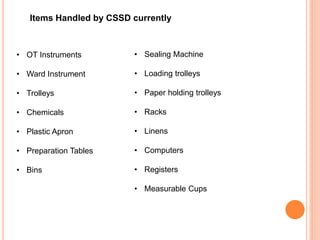
• OT Instruments
• Ward Instrument
• Trolleys
• Chemicals
• Plastic Apron
• Preparation Tables
• Bins
• Sealing Machine
• Loading trolleys
• Paper holding trolleys
• Racks
• Linens
• Computers
• Registers
• Measurable Cups
Items Handled by CSSD currently
MAN POWER
CSSD Manager
Technicians(4)
Helpers(6)
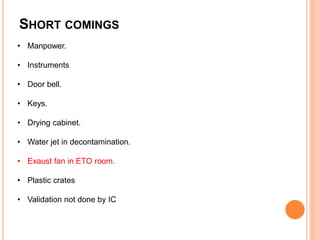
SHORT COMINGS
• Manpower.
• Instruments
• Door bell.
• Keys.
• Drying cabinet.
• Water jet in decontamination.
• Exaust fan in ETO room.
• Plastic crates
• Validation not done by IC
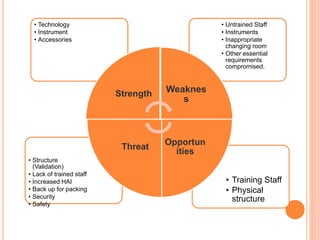
SWOT ANALYSIS
Strengths Weakness
Opportunities Threats
• Training Staff
• Physical
structure
• Structure
(Validation)
• Lack of trained staff
• Increased HAI
• Back up for packing
• Security
• Safety
• Untrained Staff
• Instruments
• Inappropriate
changing room
• Other essential
requirements
compromised.
• Technology
• Instrument
• Accessories
Strength Weaknes
s
Opportun
ities
Threat
IMPROVEMENT INITIATED
• Manuals & SOPS are ready.
• Key are provided to department.
• Backups have been planed.
• Safety is been considered.
• Checklist is provided.
THANK YOU

Central Sterile & Supply Department (CSSD)

  • 1.
    CENTRAL STERILE &SUPPLY DEPARTMENT IN A QUATERNARY CARE HOSPITAL Understanding Process & SWOT analysis Dr. Sudha Pathak & Mr. Omkar More
  • 2.
    CSSD is aservice unit in a hospital that processes, issue & controls the sterile stores supply to all departments of the hospital. Or CSSD is the Department which deals with receiving, cleaning, packing, disinfecting, sterilizing, storing and distributing all surgical instruments and equipments as per well-delineated protocols and standardized procedures.
  • 3.
    FACTS o First CSSDwas set in India at Jaslok Hospital in July, 1973 by Nalini Gaithonde o Analysts say that 85 per cent of most of the upcoming hospitals have a well-equipped CSSD.
  • 4.
    WHY CSSD ??? •By having separate CSSD, we can decrease the cost of sterilizers through centralization of equipment in one department. Besides, this would also ensure that a dedicated staff can effectively monitor the sterilization process as per the Standard Operative Procedures (SOPs).”  Ganesh Devadiga, Head, CSSD, Dr L H Hiranandani Hospital, Mumbai. • “CSSD requires technical competency, which implies that the department controls all the activities of asset management pertaining to selective procurement of general and specialised surgical instruments and other inventory.  Vishwanath Kokitkar, CSSD and Laundry In- Charge, S L Raheja Hospital.
  • 5.
    WHY CSSD ??? •“The rise in incidence of nosocomial infection with corresponding increase in mortality, length of stay and cost can be brought down by establishing a good CSSD set-up.”  Gopinathan T, Manager, CSSD, Amrita Institute of Medical Sciences (AIMS), Kochi. • CSSD was generally looked upon as an essential part of an OT as the use of sterile supplies in a hospital is maximum to the OT. However, all that has changed. CSSD is considered today, integral to the function of Out Patient Department (OPDs), wards and other departments.”  Rekha Batura, Asst Medical Superindentent, Tata Memorial Hospital (TMH), Mumbai.
  • 6.
    COST OF INFECTIONS •Prolonged stay in hospital • Additional resources and burden on hospital. • Loss of manhours - doctors and patients • Mental agony • Significant economical loss. • Poor surgical results
  • 7.
    FUNCTION OF CSSD 1.Receiving unsterile stores, instruments, equipment & linens from medical stores & various consumer department of hospital. 2. Sorting out the items. 3. Washing, disinfection & drying. 4. Checking & packing of sets/trays/instruments. 5. Sterilization of all items received, by using the appropriate techniques as applicable to the items. 6. Storage & issue of the sterilized items to the consumer departments. 7. Maintaining records of the stores received, processed & issued. 8. Validation of the effectiveness of sterilization techniques. 9. Training of staff in techniques of sterilization. 10. Advice to consumer departments on sterilization of items of different nature
  • 8.
    QUALITY MANAGEMENT OFSERVICES IN CSSD  Quality management of services in CSSD is extremely important in view of its role • In hospital infection control & • The catastrophic effects the poor quality service may have on patients.  However, quality of services can be judged from level of satisfaction of the clientele.  The clients in case of CSSD are all internal (Consumer departments/clinicians).
  • 9.
    QUALITY MANAGEMENT OFSERVICES IN CSSD  High quality CSSD services to them means:  Hundred percent reliability of sterility of stores supplied by CSSD.  Timely supplies in right time.  Contents of the trays/ sets are as per the standard list provided by users & all the contents are in full operational order.  Trays/ Sets are labeled correctly.  The sterile items supplied remain sterile up to their pre- determined shelf life.  Quality of the items does not deteriorate by the sterilization technique used.  (The quality of outcome, however, depends upon the quality of infrastructure & process used in CSSD.)
  • 10.
    SPACE, LAYOUT, SURFACEFINISH  The space requirement in CSSD is 7-10 sq. F/ bed.  The layout must follow the zoning concept & functional flow with receipt (dirty) counter on one end & sterile issue on other end.  Inside CSSD there should be no criss crossing & area should be divided by partitions into dirty, clean & sterile zones.  Similarly, gas & steam sterilization should be separated.  The entrance lobby should have…. o A changing room with toilet & hand washing facility.  The flooring should be non-skid type.
  • 11.
    2. ORGANIZATION &STAFFING  Department should be under overall control of HOD of OT/Nursing.  Should be headed by trained & experienced manager.  Should have trained staff(technicians, attendants) on each shift at each zone irrespective of volume
  • 12.
    3. EQUIPMENT QUALITY/AVAILABILITY • Ultrasound cleaners. • Instrument washers • Steel racks for storage of unsterile & sterile sets. • Work tables • Gas sterilizers • ETO • Autoclave machines fitted with sterimeters for temperature/time recording, • Self recording pressure gauze for pressure/ time recording. • Computer terminals.
  • 13.
    4. QUALITY OFMATERIALS  Quality of disinfectants, detergents, cotton-wool gauze & other supplies should be of ensured.
  • 14.
    5. ENGINEERING SUPPORTSERVICES • Stable & uninterrupted power supply. • Running water of desired quality • Temperature with comfort zone. • Ventilation with 10 air change per hour. • Humidity level 50-60 % • Illumination level of 200 Lux
  • 15.
    IN QUATERNARY CARECENTER CURRENT SITUATIONS
  • 16.
    Operation Theater. Wards Receiving Instrument Room Decontamination Room Drying &Packing Sterilization Sterile Storage Trolleys Cleaning Operation Theater Ward Process followed Currently
  • 17.
    • OT Instruments •Ward Instrument • Trolleys • Chemicals • Plastic Apron • Preparation Tables • Bins • Sealing Machine • Loading trolleys • Paper holding trolleys • Racks • Linens • Computers • Registers • Measurable Cups Items Handled by CSSD currently
  • 18.
  • 19.
    SHORT COMINGS • Manpower. •Instruments • Door bell. • Keys. • Drying cabinet. • Water jet in decontamination. • Exaust fan in ETO room. • Plastic crates • Validation not done by IC
  • 20.
  • 21.
    • Training Staff •Physical structure • Structure (Validation) • Lack of trained staff • Increased HAI • Back up for packing • Security • Safety • Untrained Staff • Instruments • Inappropriate changing room • Other essential requirements compromised. • Technology • Instrument • Accessories Strength Weaknes s Opportun ities Threat
  • 22.
    IMPROVEMENT INITIATED • Manuals& SOPS are ready. • Key are provided to department. • Backups have been planed. • Safety is been considered. • Checklist is provided.
  • 23.