Host parasite relationships
-Nidhi Jodhwani
• Host: A larger organism that supports the
survival and growth of a smaller organism is
called the host.
• Parasites : those organisms that live on or
within a host organism and are metabolically
dependent on the host.(any organism that
causes disease is a parasite)
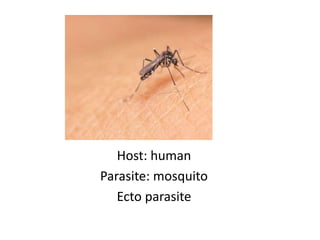
Host: human
Parasite: mosquito
Ecto parasite
Host: Human
Parasite: Plasmodium spp.
Endo-parasite
Infection: When a parasite is growing and
multiplying within or on a host, the host is
said to have an infection .
Infection and disease are same?
• No. When host’s normal body is not capable
of doing its normal function due to presence
of parasite or its products, host is said to be
suffering from disease.
• Pathogen: Any organism or agent that
produces such a disease is also known as a
pathogen
• Pathogenicity: Its ability to cause disease is
called pathogenicity .
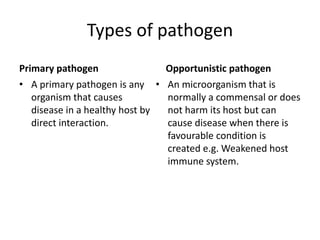
Types of pathogen
Primary pathogen
• A primary pathogen is any
organism that causes
disease in a healthy host by
direct interaction.
Opportunistic pathogen
• An microorganism that is
normally a commensal or does
not harm its host but can
cause disease when there is
favourable condition is
created e.g. Weakened host
immune system.
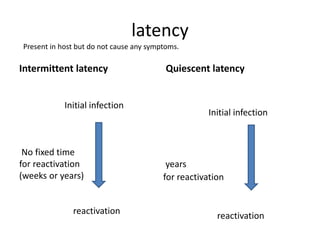
latency
Intermittent latency
Initial infection
No fixed time
for reactivation
(weeks or years)
reactivation
Quiescent latency
Initial infection
years
for reactivation
reactivation
Present in host but do not cause any symptoms.
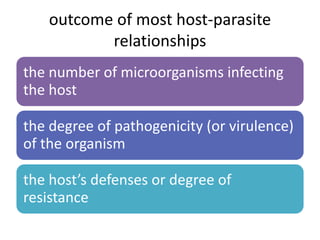
outcome of most host-parasite
relationships
the number of microorganisms infecting
the host
the degree of pathogenicity (or virulence)
of the organism
the host’s defenses or degree of
resistance
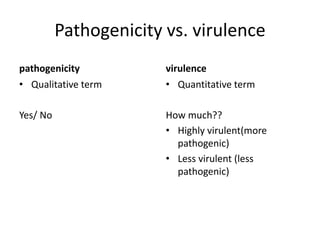
Pathogenicity vs. virulence
pathogenicity
• Qualitative term
Yes/ No
virulence
• Quantitative term
How much??
• Highly virulent(more
pathogenic)
• Less virulent (less
pathogenic)
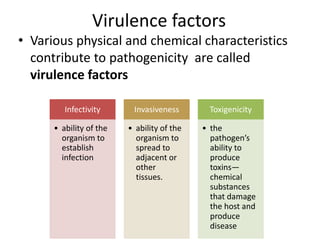
Virulence factors
• Various physical and chemical characteristics
contribute to pathogenicity are called
virulence factors
Infectivity
• ability of the
organism to
establish
infection
Invasiveness
• ability of the
organism to
spread to
adjacent or
other
tissues.
Toxigenicity
• the
pathogen’s
ability to
produce
toxins—
chemical
substances
that damage
the host and
produce
disease
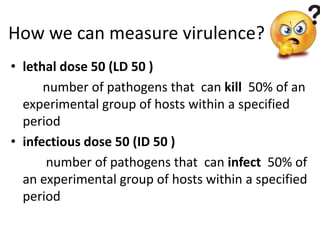
How we can measure virulence?
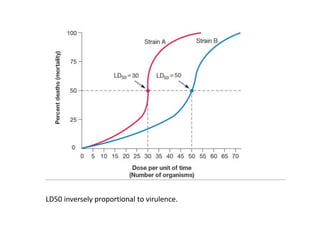
• lethal dose 50 (LD 50 )
number of pathogens that can kill 50% of an
experimental group of hosts within a specified
period
• infectious dose 50 (ID 50 )
number of pathogens that can infect 50% of
an experimental group of hosts within a specified
period
LD50 inversely proportional to virulence.
1.1 Host parasite relationships
Reference
Joanne M. Willey , Linda M. Sherwood ,
and Christopher J.
Woolverton . 2011. McGraw-Hill Higher
Education, New York, NY.

host parasite relationship

  • 1.
  • 2.
    • Host: Alarger organism that supports the survival and growth of a smaller organism is called the host. • Parasites : those organisms that live on or within a host organism and are metabolically dependent on the host.(any organism that causes disease is a parasite)
  • 3.
  • 4.
  • 5.
    Infection: When aparasite is growing and multiplying within or on a host, the host is said to have an infection . Infection and disease are same? • No. When host’s normal body is not capable of doing its normal function due to presence of parasite or its products, host is said to be suffering from disease. • Pathogen: Any organism or agent that produces such a disease is also known as a pathogen • Pathogenicity: Its ability to cause disease is called pathogenicity .
  • 6.
    Types of pathogen Primarypathogen • A primary pathogen is any organism that causes disease in a healthy host by direct interaction. Opportunistic pathogen • An microorganism that is normally a commensal or does not harm its host but can cause disease when there is favourable condition is created e.g. Weakened host immune system.
  • 7.
    latency Intermittent latency Initial infection Nofixed time for reactivation (weeks or years) reactivation Quiescent latency Initial infection years for reactivation reactivation Present in host but do not cause any symptoms.
  • 8.
    outcome of mosthost-parasite relationships the number of microorganisms infecting the host the degree of pathogenicity (or virulence) of the organism the host’s defenses or degree of resistance
  • 9.
    Pathogenicity vs. virulence pathogenicity •Qualitative term Yes/ No virulence • Quantitative term How much?? • Highly virulent(more pathogenic) • Less virulent (less pathogenic)
  • 10.
    Virulence factors • Variousphysical and chemical characteristics contribute to pathogenicity are called virulence factors Infectivity • ability of the organism to establish infection Invasiveness • ability of the organism to spread to adjacent or other tissues. Toxigenicity • the pathogen’s ability to produce toxins— chemical substances that damage the host and produce disease
  • 11.
    How we canmeasure virulence? • lethal dose 50 (LD 50 ) number of pathogens that can kill 50% of an experimental group of hosts within a specified period • infectious dose 50 (ID 50 ) number of pathogens that can infect 50% of an experimental group of hosts within a specified period
  • 12.
  • 16.
    1.1 Host parasiterelationships
  • 17.
    Reference Joanne M. Willey, Linda M. Sherwood , and Christopher J. Woolverton . 2011. McGraw-Hill Higher Education, New York, NY.