Presented To : Dr. (Mrs.) Daisy Thomas Ma’am
Presented By : Fateh chand
M.Sc. Nursing (Prev.)
RAKCON
INTRODUCTION
Information system department - Newest and most dynamic
departments of the hospital.
• Computer technology – now pervaded almost every
activity and has revolutionized the flow of information
within the hospital.
• There are various titles and acronyms to managing the
information flow and storage in hospital routine services,
such as:
Hospital Information System (HIS)
Healthcare Information System
Clinical Information System (CIS)
Patient Data Management System (PDMS).
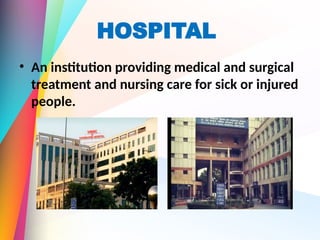
HOSPITAL
• An institution providing medical and surgical
treatment and nursing care for sick or injured
people.
MANAGEMENT
• Planning, implementation and
control of the use of a set of
resources to achieve objectives.
INFORMATION
• The data transmitted before or after
processing.
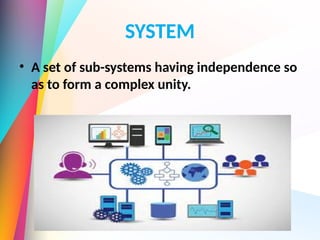
SYSTEM
• A set of sub-systems having independence so
as to form a complex unity.
DEFINITIONS
Health Information System (HIS) is information
system that uses computers, communication
equipment and programs to collect, store,
process, retrieve and communicate patient
care and administrative information.
• HMIS - refers to interrelated component parts
for acquiring and analyzing data and providing
information (management information, health
statistics, and health literature) for the
management of a health program or system
and for monitoring health activities (WHO).
• According to Peter Drucker: "Information is
now recognized as a valuable resource and
has been termed as one of the “8 M”-men,
materials, machine, money, methods,
markets, moments and messages.
IMPORTANCE OF HMIS
• Strengthening the information management
practices within the primary health care (PHC)
sector with larger aim to improve processes
concerning healthcare delivery for the rural
community.
• Develop capacity of the health staff to better deal
with computers, health information systems, and
health indicators and targets.
• Better governance of the health sector and
improved delivery of healthcare to the
community.
NEED OF HEALTH INFORMATION
SYSTEM
• Increased complexity of organizations
• Development of technological revolution
• Emphasis on research and development
• Diversification of functions and activities
• Information Explosion
• Complex management issues
• Development of computer, internet, E-
commerce and E-governance.
EVOLUTION OF HMIS
• HMIS have been started around early 70s.
• The United States of America has definitely taken a lead
in the evolution, primarily because of its insurance-
centric healthcare delivery system.
OBJECTIVES OF MANAGEMENT INFORMATION SYSTEM
• To enhance communication among employees
• To provide a system for recording and aggregating
information
• To reduce the expenses related to employees' manual
activities
• To support organization's strategic goals and directions
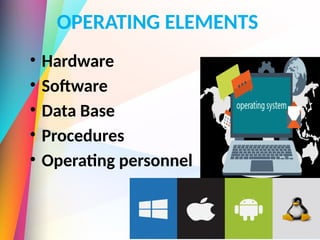
OPERATING ELEMENTS
• Hardware
• Software
• Data Base
• Procedures
• Operating personnel
ESSENTIALS OF GOOD HMIS
 Accuracy and Timelines
 Qualitative Adequacy
 Designing tools according to the needs
 Cyclical flow constantly
 Economical value
 Recipient’s point of view
 Managerial View
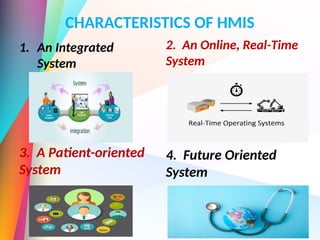
CHARACTERISTICS OF HMIS
1. An Integrated
System
3. A Patient-oriented
System
2. An Online, Real-Time
System
4. Future Oriented
System
CONTD…
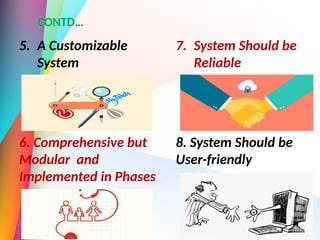
5. A Customizable
System
6. Comprehensive but
Modular and
Implemented in Phases
7. System Should be
Reliable
8. System Should be
User-friendly
CONTD…
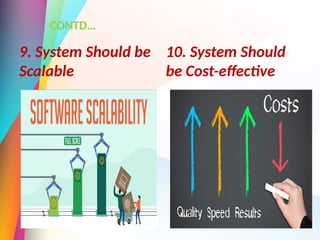
10. System Should
be Cost-effective
9. System Should be
Scalable
FUNCTIONS OF HMIS
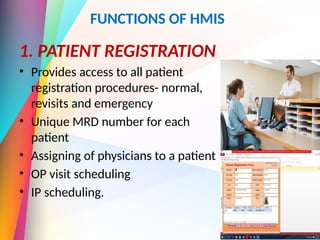
1. PATIENT REGISTRATION
• Provides access to all patient
registration procedures- normal,
revisits and emergency
• Unique MRD number for each
patient
• Assigning of physicians to a patient
• OP visit scheduling
• IP scheduling.
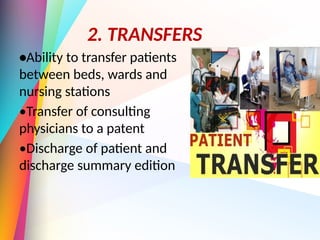
2. TRANSFERS
•Ability to transfer patients
between beds, wards and
nursing stations
•Transfer of consulting
physicians to a patent
•Discharge of patient and
discharge summary edition
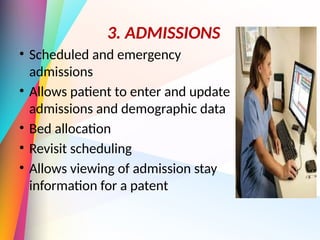
3. ADMISSIONS
• Scheduled and emergency
admissions
• Allows patient to enter and update
admissions and demographic data
• Bed allocation
• Revisit scheduling
• Allows viewing of admission stay
information for a patent
4. OUTPATIENT
•Viewing scheduled patients for the
day
•Recording results of patient
consultation
•Order communication-pharmacy
and nursing
•Special alerts to consultants
•Admission orders with IP plans.
5. INPATIENT
• Viewing inpatient with locations
• Recording results of patient consultation
• Order communication- pharmacy and nursing
• Special alerts to consultants
• Procedure notes
• Recording diagnosis using ICD codes
• Browsing medical history from MRD
• Viewing inpatient progress
• Preparing discharge summaries
6. NURSING-INPATIENT CARE
• Accessing all the patients at a particular nursing station
• Recording and monitoring patient progress
• Graphical representation of temperature, pulse and
respiration (TPR) charts
• Drug administration and recording
• Viewing and processing doctor's orders
• Viewing archived reports
• Intake and output recording
• Bed transfer
• Nursing sub -store management
• Nursing care plans' implementation.
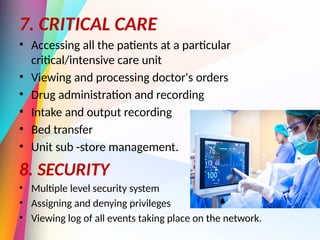
7. CRITICAL CARE
• Accessing all the patients at a particular
critical/intensive care unit
• Viewing and processing doctor's orders
• Drug administration and recording
• Intake and output recording
• Bed transfer
• Unit sub -store management.
8. SECURITY
• Multiple level security system
• Assigning and denying privileges
• Viewing log of all events taking place on the network.
9. OPERATION THEATRE
 Viewing status of procedure orders
 Recording pre post operation details
 Recording of material and pharmacy items issued to the patient
 Inventory management/OT sub stores
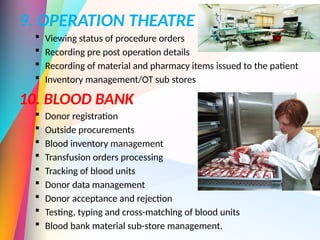
10. BLOOD BANK
 Donor registration
 Outside procurements
 Blood inventory management
 Transfusion orders processing
 Tracking of blood units
 Donor data management
 Donor acceptance and rejection
 Testing, typing and cross-matching of blood units
 Blood bank material sub-store management.
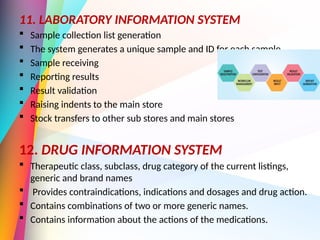
11. LABORATORY INFORMATION SYSTEM
 Sample collection list generation
 The system generates a unique sample and ID for each sample
 Sample receiving
 Reporting results
 Result validation
 Raising indents to the main store
 Stock transfers to other sub stores and main stores
12. DRUG INFORMATION SYSTEM
 Therapeutic class, subclass, drug category of the current listings,
generic and brand names
 Provides contraindications, indications and dosages and drug action.
 Contains combinations of two or more generic names.
 Contains information about the actions of the medications.
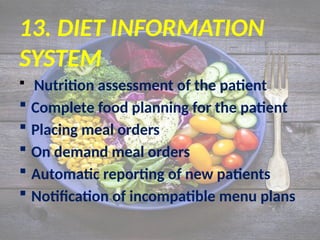
13. DIET INFORMATION
SYSTEM
 Nutrition assessment of the patient
 Complete food planning for the patient
 Placing meal orders
 On demand meal orders
 Automatic reporting of new patients
 Notification of incompatible menu plans
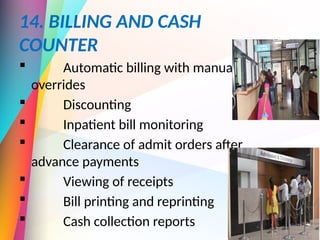
14. BILLING AND CASH
COUNTER
 Automatic billing with manual
overrides
 Discounting
 Inpatient bill monitoring
 Clearance of admit orders after
advance payments
 Viewing of receipts
 Bill printing and reprinting
 Cash collection reports
15. Medical Records
• Authorized personnel can have access to all current
and historical data Records can be Tracked down and
located. Reports can be sorted and sequenced in a
variety of ways.
16. Executive Information System
• HMIS can enable the hospital administrator and
senior management team of a hospital to utilize
the information captured in HMIS for effective
monitoring and control and planning of restore
resources.
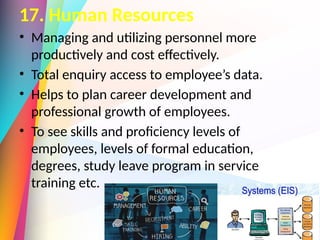
17. Human Resources
• Managing and utilizing personnel more
productively and cost effectively.
• Total enquiry access to employee’s data.
• Helps to plan career development and
professional growth of employees.
• To see skills and proficiency levels of
employees, levels of formal education,
degrees, study leave program in service
training etc.
SOME ADVANCED COMPUTER APPLICATIONS
• In the area of diagnostic imaging Medical
information system such as Picture Archival and
Communication System (PACS).
• The PACS system is designed to capture radiological
images or any other patient information, archive
them, assist in their retrieval and distribute them
over long distances-all without paperwork within
the hospital system, thus serving costs on film and
other imaging materials.
• Advantage - images and record being available
anywhere, anytime.
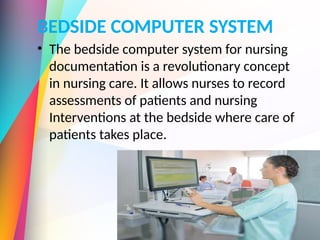
BEDSIDE COMPUTER SYSTEM
• The bedside computer system for nursing
documentation is a revolutionary concept
in nursing care. It allows nurses to record
assessments of patients and nursing
Interventions at the bedside where care of
patients takes place.
ADVANTAGES OF HMIS
One-time data capture is sufficient.
It reduce the possibility of human error
Function independently and notify other
departments needing the information
automatically
Information resource is accurate and up-to-
date.
Integration into an Unified system
Data mining for research.
Decision making
Utilization of resources
Enhance communication
Strategic planning
Quality assurance
Reduces waiting time
Medical audit/nursing audit
Reduces the cost
Shortens the stay
Continuity of patient care
Effective referral system
Timely available information
develops a high degree of confidence
between top executives and the
members of the management.
The management need not resort to
frequent meetings to sort out various
Issue.
PITFALLS
• Absence of management system to build
reliable information system
• No clear definition of purpose
• No objectives for the organization
• Absence of management participation
• Over-reliance on the consultation or
manufacturer
• Communication gap
• Performance of key people
DISADVANTAGES OF HMIS
1. Complexities
2. Duplication Of Effort
3. Variation In Field Processing
4. In Accessibility Of Data
5. Time Lapse
6. Inaccurate Sources Data
7. Limited Information Support
 It the most limiting factor is that government institutions and their
employees are often unaccustomed to significant change.
 Overcoming this resistance Is the biggest challenge for any
program of modernization and development.
 Systems that use client/server architecture where one or
more client nodes are directly connected to a central server.
 This is the most commonly used type of system in many
organisations where client sends a request to a company
server and receives the response.
Characteristics of Centralized System
• Presence of a global clock
• One single central unit
• Dependent failure of components
• Components of Centralized System
- Node (Computer, Mobile, etc.).
- Server
- Communication link (Cables, Wi-Fi, etc.)
CENTRALISED INFORMATION SYSTEM
Advantages of Centralized System
• Easy to physically secure : It is easy to secure
and service the server and client nodes by
virtue of their location
• Smooth and elegant personal experience : A
client has a dedicated system which he
uses(for example, a personal computer) and
the company has a similar system which can be
modified to suit custom needs
• Dedicated resources (memory, CPU cores, etc.)
DISADVANTAGES OF CENTRALISED
INFORMATION SYSTEM
• Lack of cooperation from managers who
don’t like to be under control of
centralised data processing department.
• Difficult to provide equitable services to
various departments.
• Data security is also questioned.
DECENTERLISED INFORMATION SYSTEM
 An interconnected information system in which no
single entity is the sole authority.
 Decentralized systems usually take the form of
networked computers.
 For example: the Internet is a decentralized system,
although it has become increasingly centralized over
time.
Characteristics of Decentralized System
• Lack of a global clock
• Multiple central units (Computers/Nodes/Servers)
• Dependent failure of components
Advantages of Decentralized System
• Minimal problem of performance bottlenecks
occurring – The entire load gets balanced on all
the nodes; leading to minimal to no bottleneck
situations
• High availability – Some nodes (computers,
mobiles, servers) are always available/online for
work, leading to high availability
• More autonomy and control over resources – As
each node controls its own behavior, it has better
autonomy leading to more control over resources
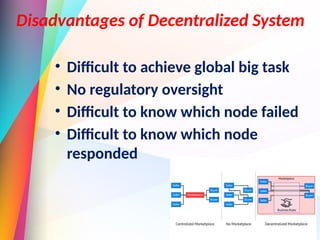
Disadvantages of Decentralized System
• Difficult to achieve global big task
• No regulatory oversight
• Difficult to know which node failed
• Difficult to know which node
responded
Common Software Used In Hospitals For
Management
 Sanela HMS
 Sanela Care - Clinic Management System
 Quanta WebHIMS
 SoftClinic
 Aarogya - Hospital Management Software
 nsta HMS
 eHospital
 ACGIL Hospital Management
 DocEngage
 HMSDESK
 Archiz CRM - CRM Software in Medical
NURSE’S
RESPONSIBILITY
IN HMIS
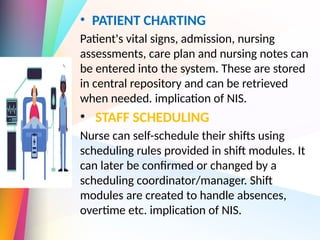
• PATIENT CHARTING
Patient's vital signs, admission, nursing
assessments, care plan and nursing notes can
be entered into the system. These are stored
in central repository and can be retrieved
when needed. implication of NIS.
• STAFF SCHEDULING
Nurse can self-schedule their shifts using
scheduling rules provided in shift modules. It
can later be confirmed or changed by a
scheduling coordinator/manager. Shift
modules are created to handle absences,
overtime etc. implication of NIS.
• CLINICAL DATA INTEGRATION
Clinical information from all other
departments/disciplines can be retrieved, viewed and
analyzed by nursing staff. Then, it can be put into the
patient's care plan. implication of NIS (cont.)
• DECISION SUPPORT
Provide prompts and reminders, along with guides
to disease linkages between signs & symptoms and
related factors. Online access to medical resources
are also available. implication of NIS (cont.)
• COLLECT CLINICAL DATA
Record data Interpret data to produce information Use
™
information to produce knowledge Share knowledge
™
with those who need it.
ROLE OF NURSE MANAGER IN NURSING INFORMATICS
• Tracking Of Patient's Lab/Test Results-
nurses Easy To Collect The Test
Reports By UHID No.
• Storing Of Patient Information In The
Computer
• Patient Billing
• Staffing & Scheduling
• Pharmacy Ordering
• Prescription Handling
• Clinical Laboratory
SUMMARY & CONCLUSION
• A hospital information system (HIS) is an element
of health informatics that focuses mainly on the
administrational needs of hospitals.
• In many implementations, an HIS is a
comprehensive, integrated information system
designed to manage all the aspects of a hospital's
operation, such as medical, administrative,
financial, and legal issues and the corresponding
processing of services.
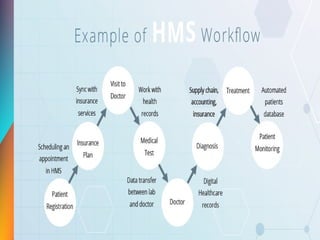
• Hospital information system is also known as
hospital management software (HMS) or hospital
management system.
Hospital management system..............

Hospital management system..............

  • 1.
    Presented To :Dr. (Mrs.) Daisy Thomas Ma’am Presented By : Fateh chand M.Sc. Nursing (Prev.) RAKCON
  • 2.
    INTRODUCTION Information system department- Newest and most dynamic departments of the hospital. • Computer technology – now pervaded almost every activity and has revolutionized the flow of information within the hospital. • There are various titles and acronyms to managing the information flow and storage in hospital routine services, such as: Hospital Information System (HIS) Healthcare Information System Clinical Information System (CIS) Patient Data Management System (PDMS).
  • 3.
    HOSPITAL • An institutionproviding medical and surgical treatment and nursing care for sick or injured people.
  • 4.
    MANAGEMENT • Planning, implementationand control of the use of a set of resources to achieve objectives.
  • 5.
    INFORMATION • The datatransmitted before or after processing.
  • 6.
    SYSTEM • A setof sub-systems having independence so as to form a complex unity.
  • 8.
    DEFINITIONS Health Information System(HIS) is information system that uses computers, communication equipment and programs to collect, store, process, retrieve and communicate patient care and administrative information.
  • 9.
    • HMIS -refers to interrelated component parts for acquiring and analyzing data and providing information (management information, health statistics, and health literature) for the management of a health program or system and for monitoring health activities (WHO). • According to Peter Drucker: "Information is now recognized as a valuable resource and has been termed as one of the “8 M”-men, materials, machine, money, methods, markets, moments and messages.
  • 10.
    IMPORTANCE OF HMIS •Strengthening the information management practices within the primary health care (PHC) sector with larger aim to improve processes concerning healthcare delivery for the rural community. • Develop capacity of the health staff to better deal with computers, health information systems, and health indicators and targets. • Better governance of the health sector and improved delivery of healthcare to the community.
  • 11.
    NEED OF HEALTHINFORMATION SYSTEM • Increased complexity of organizations • Development of technological revolution • Emphasis on research and development • Diversification of functions and activities • Information Explosion • Complex management issues • Development of computer, internet, E- commerce and E-governance.
  • 12.
    EVOLUTION OF HMIS •HMIS have been started around early 70s. • The United States of America has definitely taken a lead in the evolution, primarily because of its insurance- centric healthcare delivery system. OBJECTIVES OF MANAGEMENT INFORMATION SYSTEM • To enhance communication among employees • To provide a system for recording and aggregating information • To reduce the expenses related to employees' manual activities • To support organization's strategic goals and directions
  • 14.
    OPERATING ELEMENTS • Hardware •Software • Data Base • Procedures • Operating personnel
  • 15.
    ESSENTIALS OF GOODHMIS  Accuracy and Timelines  Qualitative Adequacy  Designing tools according to the needs  Cyclical flow constantly  Economical value  Recipient’s point of view  Managerial View
  • 16.
    CHARACTERISTICS OF HMIS 1.An Integrated System 3. A Patient-oriented System 2. An Online, Real-Time System 4. Future Oriented System
  • 17.
    CONTD… 5. A Customizable System 6.Comprehensive but Modular and Implemented in Phases 7. System Should be Reliable 8. System Should be User-friendly
  • 18.
    CONTD… 10. System Should beCost-effective 9. System Should be Scalable
  • 19.
    FUNCTIONS OF HMIS 1.PATIENT REGISTRATION • Provides access to all patient registration procedures- normal, revisits and emergency • Unique MRD number for each patient • Assigning of physicians to a patient • OP visit scheduling • IP scheduling.
  • 20.
    2. TRANSFERS •Ability totransfer patients between beds, wards and nursing stations •Transfer of consulting physicians to a patent •Discharge of patient and discharge summary edition
  • 21.
    3. ADMISSIONS • Scheduledand emergency admissions • Allows patient to enter and update admissions and demographic data • Bed allocation • Revisit scheduling • Allows viewing of admission stay information for a patent
  • 22.
    4. OUTPATIENT •Viewing scheduledpatients for the day •Recording results of patient consultation •Order communication-pharmacy and nursing •Special alerts to consultants •Admission orders with IP plans.
  • 23.
    5. INPATIENT • Viewinginpatient with locations • Recording results of patient consultation • Order communication- pharmacy and nursing • Special alerts to consultants • Procedure notes • Recording diagnosis using ICD codes • Browsing medical history from MRD • Viewing inpatient progress • Preparing discharge summaries
  • 24.
    6. NURSING-INPATIENT CARE •Accessing all the patients at a particular nursing station • Recording and monitoring patient progress • Graphical representation of temperature, pulse and respiration (TPR) charts • Drug administration and recording • Viewing and processing doctor's orders • Viewing archived reports • Intake and output recording • Bed transfer • Nursing sub -store management • Nursing care plans' implementation.
  • 25.
    7. CRITICAL CARE •Accessing all the patients at a particular critical/intensive care unit • Viewing and processing doctor's orders • Drug administration and recording • Intake and output recording • Bed transfer • Unit sub -store management. 8. SECURITY • Multiple level security system • Assigning and denying privileges • Viewing log of all events taking place on the network.
  • 26.
    9. OPERATION THEATRE Viewing status of procedure orders  Recording pre post operation details  Recording of material and pharmacy items issued to the patient  Inventory management/OT sub stores 10. BLOOD BANK  Donor registration  Outside procurements  Blood inventory management  Transfusion orders processing  Tracking of blood units  Donor data management  Donor acceptance and rejection  Testing, typing and cross-matching of blood units  Blood bank material sub-store management.
  • 27.
    11. LABORATORY INFORMATIONSYSTEM  Sample collection list generation  The system generates a unique sample and ID for each sample  Sample receiving  Reporting results  Result validation  Raising indents to the main store  Stock transfers to other sub stores and main stores 12. DRUG INFORMATION SYSTEM  Therapeutic class, subclass, drug category of the current listings, generic and brand names  Provides contraindications, indications and dosages and drug action.  Contains combinations of two or more generic names.  Contains information about the actions of the medications.
  • 28.
    13. DIET INFORMATION SYSTEM Nutrition assessment of the patient  Complete food planning for the patient  Placing meal orders  On demand meal orders  Automatic reporting of new patients  Notification of incompatible menu plans
  • 29.
    14. BILLING ANDCASH COUNTER  Automatic billing with manual overrides  Discounting  Inpatient bill monitoring  Clearance of admit orders after advance payments  Viewing of receipts  Bill printing and reprinting  Cash collection reports
  • 30.
    15. Medical Records •Authorized personnel can have access to all current and historical data Records can be Tracked down and located. Reports can be sorted and sequenced in a variety of ways. 16. Executive Information System • HMIS can enable the hospital administrator and senior management team of a hospital to utilize the information captured in HMIS for effective monitoring and control and planning of restore resources.
  • 31.
    17. Human Resources •Managing and utilizing personnel more productively and cost effectively. • Total enquiry access to employee’s data. • Helps to plan career development and professional growth of employees. • To see skills and proficiency levels of employees, levels of formal education, degrees, study leave program in service training etc.
  • 32.
    SOME ADVANCED COMPUTERAPPLICATIONS • In the area of diagnostic imaging Medical information system such as Picture Archival and Communication System (PACS). • The PACS system is designed to capture radiological images or any other patient information, archive them, assist in their retrieval and distribute them over long distances-all without paperwork within the hospital system, thus serving costs on film and other imaging materials. • Advantage - images and record being available anywhere, anytime.
  • 33.
    BEDSIDE COMPUTER SYSTEM •The bedside computer system for nursing documentation is a revolutionary concept in nursing care. It allows nurses to record assessments of patients and nursing Interventions at the bedside where care of patients takes place.
  • 34.
    ADVANTAGES OF HMIS One-timedata capture is sufficient. It reduce the possibility of human error Function independently and notify other departments needing the information automatically Information resource is accurate and up-to- date. Integration into an Unified system Data mining for research.
  • 35.
    Decision making Utilization ofresources Enhance communication Strategic planning Quality assurance Reduces waiting time Medical audit/nursing audit Reduces the cost Shortens the stay
  • 36.
    Continuity of patientcare Effective referral system Timely available information develops a high degree of confidence between top executives and the members of the management. The management need not resort to frequent meetings to sort out various Issue.
  • 37.
    PITFALLS • Absence ofmanagement system to build reliable information system • No clear definition of purpose • No objectives for the organization • Absence of management participation • Over-reliance on the consultation or manufacturer • Communication gap • Performance of key people
  • 38.
    DISADVANTAGES OF HMIS 1.Complexities 2. Duplication Of Effort 3. Variation In Field Processing 4. In Accessibility Of Data 5. Time Lapse 6. Inaccurate Sources Data 7. Limited Information Support  It the most limiting factor is that government institutions and their employees are often unaccustomed to significant change.  Overcoming this resistance Is the biggest challenge for any program of modernization and development.
  • 40.
     Systems thatuse client/server architecture where one or more client nodes are directly connected to a central server.  This is the most commonly used type of system in many organisations where client sends a request to a company server and receives the response. Characteristics of Centralized System • Presence of a global clock • One single central unit • Dependent failure of components • Components of Centralized System - Node (Computer, Mobile, etc.). - Server - Communication link (Cables, Wi-Fi, etc.) CENTRALISED INFORMATION SYSTEM
  • 41.
    Advantages of CentralizedSystem • Easy to physically secure : It is easy to secure and service the server and client nodes by virtue of their location • Smooth and elegant personal experience : A client has a dedicated system which he uses(for example, a personal computer) and the company has a similar system which can be modified to suit custom needs • Dedicated resources (memory, CPU cores, etc.)
  • 42.
    DISADVANTAGES OF CENTRALISED INFORMATIONSYSTEM • Lack of cooperation from managers who don’t like to be under control of centralised data processing department. • Difficult to provide equitable services to various departments. • Data security is also questioned.
  • 43.
    DECENTERLISED INFORMATION SYSTEM An interconnected information system in which no single entity is the sole authority.  Decentralized systems usually take the form of networked computers.  For example: the Internet is a decentralized system, although it has become increasingly centralized over time. Characteristics of Decentralized System • Lack of a global clock • Multiple central units (Computers/Nodes/Servers) • Dependent failure of components
  • 44.
    Advantages of DecentralizedSystem • Minimal problem of performance bottlenecks occurring – The entire load gets balanced on all the nodes; leading to minimal to no bottleneck situations • High availability – Some nodes (computers, mobiles, servers) are always available/online for work, leading to high availability • More autonomy and control over resources – As each node controls its own behavior, it has better autonomy leading to more control over resources
  • 45.
    Disadvantages of DecentralizedSystem • Difficult to achieve global big task • No regulatory oversight • Difficult to know which node failed • Difficult to know which node responded
  • 46.
    Common Software UsedIn Hospitals For Management  Sanela HMS  Sanela Care - Clinic Management System  Quanta WebHIMS  SoftClinic  Aarogya - Hospital Management Software  nsta HMS  eHospital  ACGIL Hospital Management  DocEngage  HMSDESK  Archiz CRM - CRM Software in Medical
  • 47.
  • 48.
    • PATIENT CHARTING Patient'svital signs, admission, nursing assessments, care plan and nursing notes can be entered into the system. These are stored in central repository and can be retrieved when needed. implication of NIS. • STAFF SCHEDULING Nurse can self-schedule their shifts using scheduling rules provided in shift modules. It can later be confirmed or changed by a scheduling coordinator/manager. Shift modules are created to handle absences, overtime etc. implication of NIS.
  • 49.
    • CLINICAL DATAINTEGRATION Clinical information from all other departments/disciplines can be retrieved, viewed and analyzed by nursing staff. Then, it can be put into the patient's care plan. implication of NIS (cont.) • DECISION SUPPORT Provide prompts and reminders, along with guides to disease linkages between signs & symptoms and related factors. Online access to medical resources are also available. implication of NIS (cont.) • COLLECT CLINICAL DATA Record data Interpret data to produce information Use ™ information to produce knowledge Share knowledge ™ with those who need it.
  • 50.
    ROLE OF NURSEMANAGER IN NURSING INFORMATICS • Tracking Of Patient's Lab/Test Results- nurses Easy To Collect The Test Reports By UHID No. • Storing Of Patient Information In The Computer • Patient Billing • Staffing & Scheduling • Pharmacy Ordering • Prescription Handling • Clinical Laboratory
  • 51.
    SUMMARY & CONCLUSION •A hospital information system (HIS) is an element of health informatics that focuses mainly on the administrational needs of hospitals. • In many implementations, an HIS is a comprehensive, integrated information system designed to manage all the aspects of a hospital's operation, such as medical, administrative, financial, and legal issues and the corresponding processing of services. • Hospital information system is also known as hospital management software (HMS) or hospital management system.