1
Nursing Informatics
Management of Information &
evaluation system
M.Viswanathan
viswanthrissur@gmail.com
Mob: 9447614792
2
Silence & Smile are two powerful tools,
Smile is the way to solve many problems &
Silence is the way to avoid many problems
3
Nursing Informatics?
Nursing informatics (NI) is a
specialty that integrates
nursing science, computer
science, and information
science to manage and
communicate data, information,
knowledge, and wisdom in
nursing practice.
4
In all types of health care organizations, nursing is the
hub of the information flow.
“Developing the science and technology of nursing
informatics will enhance the information available to
nurses for clinical practice, management, education,
and research and will facilitate the role of nurses as
communicators."
- Patricia F. Brennan (1996),
American Medical Informatics Association
Nursing Informatics: The Emerging Field
5
The Value of Nurse Informatics
• Analyze clinical and financial data
• Promote and facilitate access to
resources and references
• Provide nursing content to
standardized languages
• Enhance continuity of care
• Improve relationships between
providers and recipients of health
care
• Enable cost savings and
productivity goals
• Facilitate change management
6
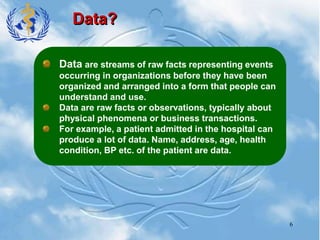
Data?
Data are streams of raw facts representing events
occurring in organizations before they have been
organized and arranged into a form that people can
understand and use.
Data are raw facts or observations, typically about
physical phenomena or business transactions.
For example, a patient admitted in the hospital can
produce a lot of data. Name, address, age, health
condition, BP etc. of the patient are data.
7
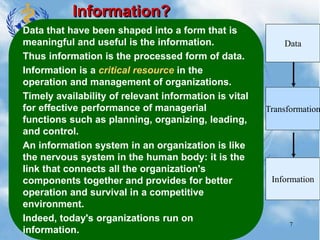
Information?
Data that have been shaped into a form that is
meaningful and useful is the information.
Thus information is the processed form of data.
Information is a critical resource in the
operation and management of organizations.
Timely availability of relevant information is vital
for effective performance of managerial
functions such as planning, organizing, leading,
and control.
An information system in an organization is like
the nervous system in the human body: it is the
link that connects all the organization's
components together and provides for better
operation and survival in a competitive
environment.
Indeed, today's organizations run on
information.
Data
Information
Transformation
8
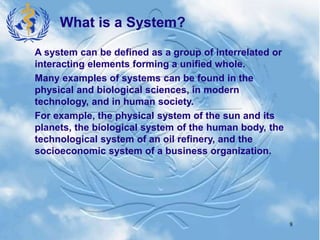
A system can be defined as a group of interrelated or
interacting elements forming a unified whole.
Many examples of systems can be found in the
physical and biological sciences, in modern
technology, and in human society.
For example, the physical system of the sun and its
planets, the biological system of the human body, the
technological system of an oil refinery, and the
socioeconomic system of a business organization.
What is a System?
9
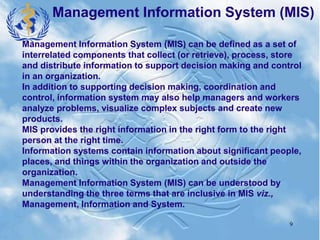
Management Information System (MIS)
Management Information System (MIS) can be defined as a set of
interrelated components that collect (or retrieve), process, store
and distribute information to support decision making and control
in an organization.
In addition to supporting decision making, coordination and
control, information system may also help managers and workers
analyze problems, visualize complex subjects and create new
products.
MIS provides the right information in the right form to the right
person at the right time.
Information systems contain information about significant people,
places, and things within the organization and outside the
organization.
Management Information System (MIS) can be understood by
understanding the three terms that are inclusive in MIS viz.,
Management, Information and System.
10
Management Information System (MIS)
Management is simply the process of decision-making and
control over the action of human beings for the expressed
purpose of attaining the pre-determined goal decisions
regarding planning, operation and control of an organization.
Information is data that has been processed into a form of
that is meaningful to the recipient for action or decision
making.
System is a complex set of interrelated functions and
processes that are arranged in a definite sequence to
achieve the predefined objectives.
According to Davis and Olsan, “Management information
system is an integrated user machine system for providing
information to support the management, analysis and
decision-making functions in an organisation."
11
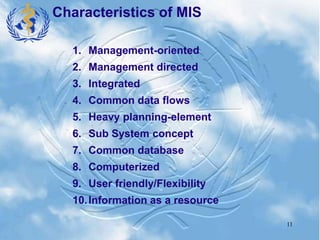
Characteristics of MIS
1. Management-oriented
2. Management directed
3. Integrated
4. Common data flows
5. Heavy planning-element
6. Sub System concept
7. Common database
8. Computerized
9. User friendly/Flexibility
10.Information as a resource
12
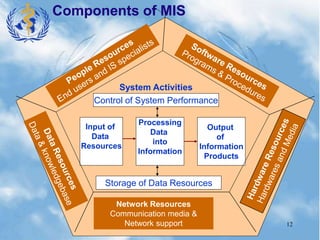
Components of MIS
Control of System Performance
Network Resources
Communication media &
Network support
System Activities
Input of
Data
Resources
Processing
Data
into
Information
Output
of
Information
Products
Storage of Data Resources
13
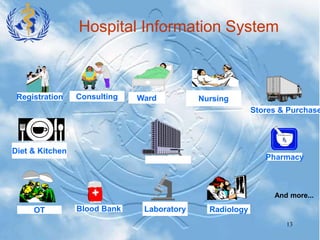
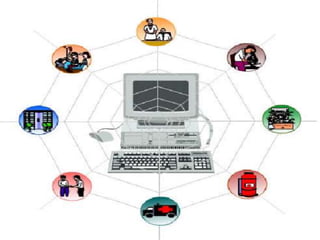
Hospital Information System
Registration Consulting Ward Nursing
Pharmacy
Stores & Purchase
Radiology
Laboratory
OT Blood Bank
Diet & Kitchen
And more...
14
Hospital Management Information
System (HMIS)
The HMIS has been defined as a system that provides an
appropriate information support to each decision making
level of the health care delivery system.
It supports all hospital functions and activities such as
patient records, scheduling, administration, charge-back
and billing, and often links to or includes clinical
information systems such as RIS (Radiology Information
System).
15
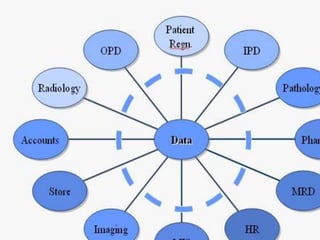
The Information of the hospital
comes from
• Front office
• Doctors consultation room
• Ward
• Laboratory
• The service providers like financial
and insurance service provider
• And so on
16
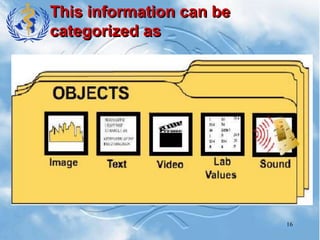
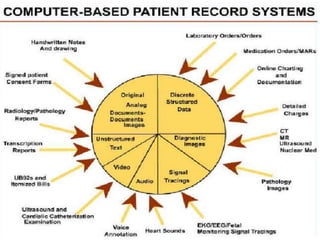
This information can be
categorized as
17
18
19
Aim of HIS
To adequately enable the execution
of information processing functions
– for patient care, including
administration as well as
– for research and education
considering economic hospital
management, as well as legal and
other requirements.
20
Aim of HIS
HIS should provide
• information, primarily about patients, in a
way that it is correct, pertinent and up to
date, in time, accessible by the right
persons at the right site in a usable format
• knowledge, primarily about diseases, but
also, for example, about the effects of drug
interaction, to support diagnosis and
therapy
• information about the quality of patient
care, hospital performance and costs
21
Components of HMIS
• The HMIS is a group of interrelated sub systems in
medical specialties
• Laboratory Information System (LIS)
• Radiology Information System (RIS)
• Clinical Information System (CIS)
• Financial Information System (FIS)
• Nursing Information Systems (NIS)
• Picture archiving Communication System (PACS)
• Pharmacy Information System (PIS)
22
Laboratory Information System (LIS)
Laboratory Information System (LIS), is a class of
software which handles receiving, processing and
storing information generated by medical laboratory
processes.
These systems often must interface with
instruments and other information systems
LIS include haematology, Biochemistry, immunology,
blood bank (Donor and Transfusion Management),
surgical pathology, anatomical pathology, flow
cytometry and microbiology.
23
Radiology Information System (RIS)
Radiology Information System (RIS), is a
computerized database used by radiology
departments to store, manipulate and distribute
patient radiological data and imagery.
The system generally consists of patient tracking
and scheduling, result reporting and image tracking
capabilities.
24
Clinical Information System (CIS)
Clinical Information System (CIS) is a
computer based system that is designed for
collecting, storing, manipulating and making
available clinical information important to the
healthcare delivery process. (e.g. electronic
medical records)
25
Financial Information System (FIS)
Financial Information System (FIS) are
computer systems that manage the business
aspect of a hospital.
While healthcare organizations’ primary
priority is to save lives and not making profits,
they do acquire running costs from day to day
operations; including purchases and staff
payroll.
26
Pharmacy Information System (PIS)
Pharmacy Information System (PIS) are
complex computer systems that have been
designed to meet the needs of a pharmacy
department.
Through the use of such systems, pharmacists
can supervise and have inputs on how
medication is used in a hospital.
27
Nursing Information System (NIS)
Nursing Information System (NIS) are
computer systems that manage clinical
data from a variety of healthcare
environments, and made available in a
timely and orderly fashion to aid nurses
in improving patient care.
28
Picture Archiving Communication
System (PACS)
Picture Archiving Communication
System (PACS) is a loose term to
describe a set of systems that facilitate
the archiving, processing and viewing
of digital radiological images and their
related information.
29
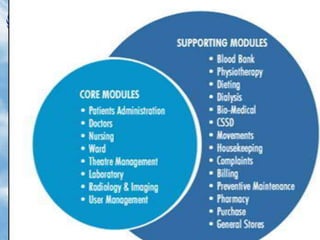
Modules Involved
• PATIENT REGISTRATION
• PATIENT RELATIONS
• APPOINTMENT SCHEDULING
• BED MANAGEMENT
• WARD MANAGEMENT
• ADMISSION, DISCHARGE,
TRANSFER
• MEDICAL RECORDING
• LABORATORY INFORMATION
• RADIOLOGY INFORMATION
• PHARMACY
• CENTRAL STERILIZATION SUPPLY
DEPARTMENT
• BLOOD BANK
• DIETRY
• HOUSE KEEPING
• EQUIPMENT MAINTAINANCE
• HEALTH CARE PACKAGES
• PATIENT BILLING
30
31
32
Advantages of HMIS
Savings – Substantial savings in manpower, time
and costs through improved productivity
Effectiveness – Increased administrative &
operational effectiveness and improved
communications between the peripheral labs with
the central lab
Simplification – Improved and simplified work /
process flow through automation
Quality – Reduced errors and duplication of work.
GENERAL BENEFITS
33
Advantages of HMIS
Savings – Substantial savings in manpower, time and costs
through improved productivity
Effectiveness – Increased administrative & operational
effectiveness and improved communications between the
peripheral labs with the central lab
Simplification – Improved and simplified work / process flow
through automation
Quality – Reduced errors and duplication of work.
Centralization – Consolidation of information into a single
point
Optimization – Empowers better use of existing resources
(people, time and money) at the organization
Competitive Advantage – Improved customer satisfaction
and market position.
GENERAL BENEFITS
34
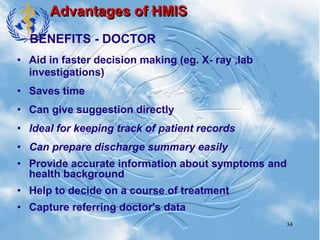
Advantages of HMIS
• Aid in faster decision making (eg. X- ray ,lab
investigations)
• Saves time
• Can give suggestion directly
• Ideal for keeping track of patient records
• Can prepare discharge summary easily
• Provide accurate information about symptoms and
health background
• Help to decide on a course of treatment
• Capture referring doctor's data
BENEFITS - DOCTOR
35
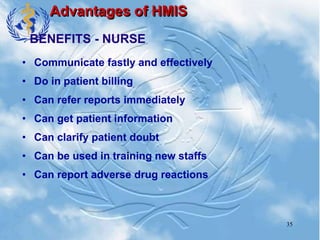
Advantages of HMIS
• Communicate fastly and effectively
• Do in patient billing
• Can refer reports immediately
• Can get patient information
• Can clarify patient doubt
• Can be used in training new staffs
• Can report adverse drug reactions
BENEFITS - NURSE
36
Advantages of HMIS
• Prepare online (up-to-date) patient bill
when the patient is discharged
• Daily collection report for OPD & Indoor
patient wise -cash / check collected
• Inventory management
BENEFITS - MANAGERS
37
Advantages of HMIS
• Better treatment (faster)
• Adequate information regarding treatment
and tests
• Can do OPD booking
• Can access special packages
• Can contact health team
• Can foresee the cost of treatment
• Can give feed backs
BENEFITS - PATIENTS
38
Advantages of HMIS
• Management can convey their message to all
workers regularly (hospital orders , events,
circulars)
• Can get feed back from employees and
patients
• Can assess the current functioning of
hospital
BENEFITS - ADMINISTRATORS
39
Disadvantages of HMIS
• Costly in maintenance and upgrading
• Difficult to train all the workers
• Misuse of data stored
• Hardware and software problems will have a
tremendous effect in hospital functioning
40
System Development
A new information system is built as a solution to some type
of problem or set of problems the organization perceives it is
facing.
The activities that go into producing an information system
solution to an organizational problem or opportunity are
called systems development.
Systems development is a structured kind of problem
solving with distinct activities.
These activities consist of systems analysis, systems
design, programming, testing, conversion, and production
and maintenance.
41
System Development
A new information system is acquired by the following ways:
1. By use of their own IT Personnel
2. By purchasing from vendors
3. Outsourcing
4. End user development
42
The development of effective information systems is
a necessary precursor to managerial improvement.
A health information system (HIS) is a process
whereby health data (input) are recorded, stored,
retrieved and processed for decision-making (output).
Decision making broadly includes managerial aspects
such as the planning, organizing and control of health
care facilities at the national, state and institution
levels and clinical aspects which can be subdivided
into
(1) providing optimal patient care,
(2) training of medical personnel to generate appropriate
human resources, and
(3) facilitate research and development activities in
various fields of medicine.
Evaluation of Information Systems
43
A health information system (HIS) may consists the
following components/sub-systems.
1. Epidemiological surveillance
Identification/notification of diseases and risk factors,
Investigation, follow-up, control measures
2. Routine service reporting
3. Specific program reporting
4. Administrative systems
Account and financial systems
Drugs management (procurement, storage and delivery)
Personnel management
Asset management (equipment/buildings etc)
Maintenance system
5. Vital registration
Birth, deaths, migration etc.,
Components/sub-systems of
Information Systems
44
A health information system (HIS) is evaluated based on
1. Ease of Use
2. Impact on Patients and Safety
Does it provide the patient’s complete list of current
medications?
Does it provide assistance with appropriate dose
verification, including a dosing calculator
3. Technological Considerations
Does it have the capability to interface with other
systems?
Does it interface with patient monitoring instruments to
download patient monitoring data?
What are its reporting capabilities (internally and
externally)?
Is it easy for researchers and clinicians to query for data ?
Evaluation criteria of Information
Systems
45
4. Finance and Investment
Does the system ultimately save money?
What is the cost and potential return on investment (ROI)?
What are the costs for routine support and maintenance?
5. Configurability
The likelihood that a system exists that can be applied to
any health care system
6. Usability
The system must be “usable” to all present and future
users.
7. Automated Decision Support
If well-designed and powered by real-time data, it can
increase patient safety and has been shown to decrease
improper usage of medications.
Evaluation criteria of Information
Systems
46
8. Current and Future Technology Capability
The system should allow for future technological advances like
wireless data entry, barcoding etc., to be easily integrated as well.
9. System Speed and Security
The system must provide information quickly and reliably to the
clinician .
10. Accuracy and Reliability of data
The clinician accessing the patient data must be confident that
the information they are receiving is accurate and truly reflective
of the patient’s condition
11. Scalability
A HCIS should possess properties that allow it to work on a small
or large scale.
12. Vendor
A thorough vendor evaluation including their reputation, their
history of service, support, etc. should be considered when
choosing a HCIS.
Evaluation criteria of Information
Systems

mis.pptx

  • 1.
    1 Nursing Informatics Management ofInformation & evaluation system M.Viswanathan viswanthrissur@gmail.com Mob: 9447614792
  • 2.
    2 Silence & Smileare two powerful tools, Smile is the way to solve many problems & Silence is the way to avoid many problems
  • 3.
    3 Nursing Informatics? Nursing informatics(NI) is a specialty that integrates nursing science, computer science, and information science to manage and communicate data, information, knowledge, and wisdom in nursing practice.
  • 4.
    4 In all typesof health care organizations, nursing is the hub of the information flow. “Developing the science and technology of nursing informatics will enhance the information available to nurses for clinical practice, management, education, and research and will facilitate the role of nurses as communicators." - Patricia F. Brennan (1996), American Medical Informatics Association Nursing Informatics: The Emerging Field
  • 5.
    5 The Value ofNurse Informatics • Analyze clinical and financial data • Promote and facilitate access to resources and references • Provide nursing content to standardized languages • Enhance continuity of care • Improve relationships between providers and recipients of health care • Enable cost savings and productivity goals • Facilitate change management
  • 6.
    6 Data? Data are streamsof raw facts representing events occurring in organizations before they have been organized and arranged into a form that people can understand and use. Data are raw facts or observations, typically about physical phenomena or business transactions. For example, a patient admitted in the hospital can produce a lot of data. Name, address, age, health condition, BP etc. of the patient are data.
  • 7.
    7 Information? Data that havebeen shaped into a form that is meaningful and useful is the information. Thus information is the processed form of data. Information is a critical resource in the operation and management of organizations. Timely availability of relevant information is vital for effective performance of managerial functions such as planning, organizing, leading, and control. An information system in an organization is like the nervous system in the human body: it is the link that connects all the organization's components together and provides for better operation and survival in a competitive environment. Indeed, today's organizations run on information. Data Information Transformation
  • 8.
    8 A system canbe defined as a group of interrelated or interacting elements forming a unified whole. Many examples of systems can be found in the physical and biological sciences, in modern technology, and in human society. For example, the physical system of the sun and its planets, the biological system of the human body, the technological system of an oil refinery, and the socioeconomic system of a business organization. What is a System?
  • 9.
    9 Management Information System(MIS) Management Information System (MIS) can be defined as a set of interrelated components that collect (or retrieve), process, store and distribute information to support decision making and control in an organization. In addition to supporting decision making, coordination and control, information system may also help managers and workers analyze problems, visualize complex subjects and create new products. MIS provides the right information in the right form to the right person at the right time. Information systems contain information about significant people, places, and things within the organization and outside the organization. Management Information System (MIS) can be understood by understanding the three terms that are inclusive in MIS viz., Management, Information and System.
  • 10.
    10 Management Information System(MIS) Management is simply the process of decision-making and control over the action of human beings for the expressed purpose of attaining the pre-determined goal decisions regarding planning, operation and control of an organization. Information is data that has been processed into a form of that is meaningful to the recipient for action or decision making. System is a complex set of interrelated functions and processes that are arranged in a definite sequence to achieve the predefined objectives. According to Davis and Olsan, “Management information system is an integrated user machine system for providing information to support the management, analysis and decision-making functions in an organisation."
  • 11.
    11 Characteristics of MIS 1.Management-oriented 2. Management directed 3. Integrated 4. Common data flows 5. Heavy planning-element 6. Sub System concept 7. Common database 8. Computerized 9. User friendly/Flexibility 10.Information as a resource
  • 12.
    12 Components of MIS Controlof System Performance Network Resources Communication media & Network support System Activities Input of Data Resources Processing Data into Information Output of Information Products Storage of Data Resources
  • 13.
    13 Hospital Information System RegistrationConsulting Ward Nursing Pharmacy Stores & Purchase Radiology Laboratory OT Blood Bank Diet & Kitchen And more...
  • 14.
    14 Hospital Management Information System(HMIS) The HMIS has been defined as a system that provides an appropriate information support to each decision making level of the health care delivery system. It supports all hospital functions and activities such as patient records, scheduling, administration, charge-back and billing, and often links to or includes clinical information systems such as RIS (Radiology Information System).
  • 15.
    15 The Information ofthe hospital comes from • Front office • Doctors consultation room • Ward • Laboratory • The service providers like financial and insurance service provider • And so on
  • 16.
    16 This information canbe categorized as
  • 17.
  • 18.
  • 19.
    19 Aim of HIS Toadequately enable the execution of information processing functions – for patient care, including administration as well as – for research and education considering economic hospital management, as well as legal and other requirements.
  • 20.
    20 Aim of HIS HISshould provide • information, primarily about patients, in a way that it is correct, pertinent and up to date, in time, accessible by the right persons at the right site in a usable format • knowledge, primarily about diseases, but also, for example, about the effects of drug interaction, to support diagnosis and therapy • information about the quality of patient care, hospital performance and costs
  • 21.
    21 Components of HMIS •The HMIS is a group of interrelated sub systems in medical specialties • Laboratory Information System (LIS) • Radiology Information System (RIS) • Clinical Information System (CIS) • Financial Information System (FIS) • Nursing Information Systems (NIS) • Picture archiving Communication System (PACS) • Pharmacy Information System (PIS)
  • 22.
    22 Laboratory Information System(LIS) Laboratory Information System (LIS), is a class of software which handles receiving, processing and storing information generated by medical laboratory processes. These systems often must interface with instruments and other information systems LIS include haematology, Biochemistry, immunology, blood bank (Donor and Transfusion Management), surgical pathology, anatomical pathology, flow cytometry and microbiology.
  • 23.
    23 Radiology Information System(RIS) Radiology Information System (RIS), is a computerized database used by radiology departments to store, manipulate and distribute patient radiological data and imagery. The system generally consists of patient tracking and scheduling, result reporting and image tracking capabilities.
  • 24.
    24 Clinical Information System(CIS) Clinical Information System (CIS) is a computer based system that is designed for collecting, storing, manipulating and making available clinical information important to the healthcare delivery process. (e.g. electronic medical records)
  • 25.
    25 Financial Information System(FIS) Financial Information System (FIS) are computer systems that manage the business aspect of a hospital. While healthcare organizations’ primary priority is to save lives and not making profits, they do acquire running costs from day to day operations; including purchases and staff payroll.
  • 26.
    26 Pharmacy Information System(PIS) Pharmacy Information System (PIS) are complex computer systems that have been designed to meet the needs of a pharmacy department. Through the use of such systems, pharmacists can supervise and have inputs on how medication is used in a hospital.
  • 27.
    27 Nursing Information System(NIS) Nursing Information System (NIS) are computer systems that manage clinical data from a variety of healthcare environments, and made available in a timely and orderly fashion to aid nurses in improving patient care.
  • 28.
    28 Picture Archiving Communication System(PACS) Picture Archiving Communication System (PACS) is a loose term to describe a set of systems that facilitate the archiving, processing and viewing of digital radiological images and their related information.
  • 29.
    29 Modules Involved • PATIENTREGISTRATION • PATIENT RELATIONS • APPOINTMENT SCHEDULING • BED MANAGEMENT • WARD MANAGEMENT • ADMISSION, DISCHARGE, TRANSFER • MEDICAL RECORDING • LABORATORY INFORMATION • RADIOLOGY INFORMATION • PHARMACY • CENTRAL STERILIZATION SUPPLY DEPARTMENT • BLOOD BANK • DIETRY • HOUSE KEEPING • EQUIPMENT MAINTAINANCE • HEALTH CARE PACKAGES • PATIENT BILLING
  • 30.
  • 31.
  • 32.
    32 Advantages of HMIS Savings– Substantial savings in manpower, time and costs through improved productivity Effectiveness – Increased administrative & operational effectiveness and improved communications between the peripheral labs with the central lab Simplification – Improved and simplified work / process flow through automation Quality – Reduced errors and duplication of work. GENERAL BENEFITS
  • 33.
    33 Advantages of HMIS Savings– Substantial savings in manpower, time and costs through improved productivity Effectiveness – Increased administrative & operational effectiveness and improved communications between the peripheral labs with the central lab Simplification – Improved and simplified work / process flow through automation Quality – Reduced errors and duplication of work. Centralization – Consolidation of information into a single point Optimization – Empowers better use of existing resources (people, time and money) at the organization Competitive Advantage – Improved customer satisfaction and market position. GENERAL BENEFITS
  • 34.
    34 Advantages of HMIS •Aid in faster decision making (eg. X- ray ,lab investigations) • Saves time • Can give suggestion directly • Ideal for keeping track of patient records • Can prepare discharge summary easily • Provide accurate information about symptoms and health background • Help to decide on a course of treatment • Capture referring doctor's data BENEFITS - DOCTOR
  • 35.
    35 Advantages of HMIS •Communicate fastly and effectively • Do in patient billing • Can refer reports immediately • Can get patient information • Can clarify patient doubt • Can be used in training new staffs • Can report adverse drug reactions BENEFITS - NURSE
  • 36.
    36 Advantages of HMIS •Prepare online (up-to-date) patient bill when the patient is discharged • Daily collection report for OPD & Indoor patient wise -cash / check collected • Inventory management BENEFITS - MANAGERS
  • 37.
    37 Advantages of HMIS •Better treatment (faster) • Adequate information regarding treatment and tests • Can do OPD booking • Can access special packages • Can contact health team • Can foresee the cost of treatment • Can give feed backs BENEFITS - PATIENTS
  • 38.
    38 Advantages of HMIS •Management can convey their message to all workers regularly (hospital orders , events, circulars) • Can get feed back from employees and patients • Can assess the current functioning of hospital BENEFITS - ADMINISTRATORS
  • 39.
    39 Disadvantages of HMIS •Costly in maintenance and upgrading • Difficult to train all the workers • Misuse of data stored • Hardware and software problems will have a tremendous effect in hospital functioning
  • 40.
    40 System Development A newinformation system is built as a solution to some type of problem or set of problems the organization perceives it is facing. The activities that go into producing an information system solution to an organizational problem or opportunity are called systems development. Systems development is a structured kind of problem solving with distinct activities. These activities consist of systems analysis, systems design, programming, testing, conversion, and production and maintenance.
  • 41.
    41 System Development A newinformation system is acquired by the following ways: 1. By use of their own IT Personnel 2. By purchasing from vendors 3. Outsourcing 4. End user development
  • 42.
    42 The development ofeffective information systems is a necessary precursor to managerial improvement. A health information system (HIS) is a process whereby health data (input) are recorded, stored, retrieved and processed for decision-making (output). Decision making broadly includes managerial aspects such as the planning, organizing and control of health care facilities at the national, state and institution levels and clinical aspects which can be subdivided into (1) providing optimal patient care, (2) training of medical personnel to generate appropriate human resources, and (3) facilitate research and development activities in various fields of medicine. Evaluation of Information Systems
  • 43.
    43 A health informationsystem (HIS) may consists the following components/sub-systems. 1. Epidemiological surveillance Identification/notification of diseases and risk factors, Investigation, follow-up, control measures 2. Routine service reporting 3. Specific program reporting 4. Administrative systems Account and financial systems Drugs management (procurement, storage and delivery) Personnel management Asset management (equipment/buildings etc) Maintenance system 5. Vital registration Birth, deaths, migration etc., Components/sub-systems of Information Systems
  • 44.
    44 A health informationsystem (HIS) is evaluated based on 1. Ease of Use 2. Impact on Patients and Safety Does it provide the patient’s complete list of current medications? Does it provide assistance with appropriate dose verification, including a dosing calculator 3. Technological Considerations Does it have the capability to interface with other systems? Does it interface with patient monitoring instruments to download patient monitoring data? What are its reporting capabilities (internally and externally)? Is it easy for researchers and clinicians to query for data ? Evaluation criteria of Information Systems
  • 45.
    45 4. Finance andInvestment Does the system ultimately save money? What is the cost and potential return on investment (ROI)? What are the costs for routine support and maintenance? 5. Configurability The likelihood that a system exists that can be applied to any health care system 6. Usability The system must be “usable” to all present and future users. 7. Automated Decision Support If well-designed and powered by real-time data, it can increase patient safety and has been shown to decrease improper usage of medications. Evaluation criteria of Information Systems
  • 46.
    46 8. Current andFuture Technology Capability The system should allow for future technological advances like wireless data entry, barcoding etc., to be easily integrated as well. 9. System Speed and Security The system must provide information quickly and reliably to the clinician . 10. Accuracy and Reliability of data The clinician accessing the patient data must be confident that the information they are receiving is accurate and truly reflective of the patient’s condition 11. Scalability A HCIS should possess properties that allow it to work on a small or large scale. 12. Vendor A thorough vendor evaluation including their reputation, their history of service, support, etc. should be considered when choosing a HCIS. Evaluation criteria of Information Systems