GENDER
SENSITIVE ISSUES AND WOMEN
EMPOWERMENT
PRESENTED BY:
Fateh chand
M.sc.Nursing 1st
year
INTRODUCTION
 As Psychologist and sociologists point out- gender ,roles and
expectations are assigned at birth. As soon as people put the
label on the child ‘girl’ or ‘boy’ they begin treating the child in
a stereotypical fashion . Though the Indian Constitution
prohibits any kind of discrimination on the ground of sex but
discrimination against girl child continues to be practiced in
various parts of our Country in areas such as distribution of
food in quality and amount,education ,skill
training,religion,employment etc.
GENDER STATISTICS
 As per Census 2011, the population of India is 1210.19 million comprising 586.47
million (48.5%) females and 623.72 million (51.5%) males.
 The sex ratio (number of women per 1000 men) is 940 in 2011
‐ which shows continued
improvement over the sex ratios of 927 in 1991 and 933 in 2001. Among the States, in
Census 2011, Kerala has the highest sex ratio of
‐ 1084 and Haryana has the lowest of 877.
 46% of women are not involved in any kind of decision making. It is found that 32.7%
illiterate women, 21.6% unemployed women are not involved in any decision making.
 Cruelty by husband and relatives continues to occupy the highest share (43.4%) among the
crimes committed against women in 2011 followed by molestation (18.8%). 15.6% cases
are that of kidnapping, 10.6% of rape, 3.8% of dowry deaths and 3.7% of sexual
harassment.The highest conviction rate of 16.5% was observed for the crime ‘importation
of girls’ and the lowest of 4.0% for ‘indecent representation of women’.
CONCEPT OF GENDER
SEX VS GENDER:
 Sex refers to the biological and physiological characteristics that define men
and women. Whereas,
 Gender refers to the socially constructed roles, behavior,activities,and
attributes that a given society considers appropriate for men and women.
 Thus while sex is permanent and universal ,gender construction varies from
one society to another.
 To put in another way male and female are sex catagories while Masculine and
Feminine are gender catagories.
DEFINITION
 The WHO noted: "The word gender is used to describe the
characteristics, roles and responsibilities of women and men, boys and
girls, which are socially constructed. Gender is related to how we are
perceived and expected to think and act as women and men because of
the way society is organized, not because of our biological differences."
 Gender has been defined as: "The commonly shared expectations and
norms within a society about appropriate male and female behavior,
characteristics and roles. Gender can be considered a social and cultural
construct that differentiates females from males and thus defines the
ways in which females and males interact with each other. These roles
and expectations are learned and they can change over time as well as
vary within and between cultures." --( GR GUPTA).
ROLE OF GENDER
Gender role determines how a male or females should think.speak,dress,and interact
within the context of society.
 ▲ Women are expected to take care of the family and or domestic duties and
remain close to home. Mostly it is women who do the house work like
cooking,cleaning and washing etc. which are repetitive and boring. Whereas-
 ▲ All Men are expected to work and earn for the family.
 ▲Women have entire responsibility for child rearing
 ▲ Women have to look after older and sick people of the family.
 ▲ Women are always known by their father and husband name-they have no
individual identity.
All these work performed by a women is unpaid labour/work and it has no
economic value.
EXPLORING GENDER STEROTYPES
MEN WOMEN
Adventurous Patient
Brave Tolerant
Strong Forgiving
Hard tough Motherly
Manly Sacrificing
Intellegent,Handsome Beautiful,soft,loving
Bread-winner Caring
Hardworking Adjusting,quiet
Independent Sympathetic
Angry Cries easily.
REASONS FOR GENDER
INEQUALITIES
 The root cause of gender inequality in Indian society lies in its patriarchy system.
According to the famous sociologists Sylvia Walby, patriarchy is “a system of
social structure and practices in which men dominate, oppress and exploit
women”.
 The unfortunate part of gender inequality in our society is that the women too,
continued socio-cultural conditioning, have accepted their subordinate position to
men. And they are also part and parcel of same patriarchal system.
 ● Extreme poverty and lack of education
 ● Lack of punishment for perpetrators of violence.
 ● Lack of safe spaces for women and girls.
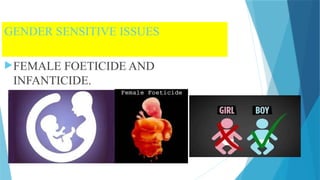
GENDER SENSITIVE ISSUES
FEMALE FOETICIDE AND
INFANTICIDE.
INEQUALITY IN HEALTH CARE
 Women receive less healthcare facilities than men.
 Women in developing countries face great health risks such
as maternal mortality, sexually transmitted diseases (STDs)
such as AIDS, and malnutrition. Women in developing
countries have an 80 to 60 percent higher death rate when
givingbirth than do women in developed countries. The
reasons include giving birth without knowledgeable help,
lack of emergency backup medical care, anaemia, and
malnutrition
 INEQUALITY IN NUTRITION
 INEQUALITY IN ACCESS TO EDUCATION:
It has been seen that women receives less education than men.
Only 18 per cent of women between 15 and 24 years of age can
read. . Also a woman's perception of increased social status and
power is dependent on her education and occupation. Programs
which provide a meal for children who attend school lead to an
increase of girls attendance at school.
 INEQUALITY IN RELIGION.
 INEQUALITY IN EMPLOYMENT AND ECONOMIC INEQUALITY:-
 Women work two-thirds of the world’s working hours, according to the United
nations Millennium Campaign to halve world poverty by the year 2015. The
overwhelming majority of the labor that sustains life growing food, cooking,
raising children, caring for the elderly maintaining a house, hauling water is
done by women. Universally this work is accorded low status and no pay.
Women earn only 10 percent of the world’s income. Lower income,
unregulated and insecure work and a lack of economic security makes women
more dependent and places them at greater risk of impoverishment and
violence. This is particularly true in developing countries, where economic
inequalities are often even more pronounced.
 INEQUALITY IN RIGHT TO TRAVEL
 VICTIMS OF VIOLENCE:-NCRB records that the highest
percentage of crime against women is torture (37.7%) followed
by Moleslation (22.4%), Rape (11.8%), Kidnapping(8.8%) and
immoral traffic (3.7%).
 WIFE-BEATING:
SEXUAL HARRASMENT:
Sexual harassment is another form of intimidation used against
women. Rape is also a common occurrence worldwide. Females are
kidnapped or lured to other countries by promises of good
employment and then are forced into prostitution Two million girls
between the ages of 5-15 are introduced into the commercial sex
market each year.
 DOWRY
 MEDIA
 INEQAULITY IN POLITICS
GENDER SENSITIVITY
 Gender sensitivity is the awareness and insight into the state of
other sex with reference to historical roots of sexiest stero-typing,
discrimination and violence. Another definition would be the
awareness and acceptance of the roles and duties of each as
expected from them and from the people that they work with.
Gender sensitivity is an integral part of decision making in
industrialized countries where there is a growing number of
female headed households, especially in the urban setting.
However, Gender Sensitivity is not about pitting women against
men. An education that is gender sensitive benefits members of
both sexes.
PROMOTE GENDER SENSITIVE EDUCATION
 Universal Primary Education (UPE) was launched in
1997. The policy emphasises equal opportunity for both boys
and girls. It focuses on promoting gender parity in
enrolment, retention, and performance in primary education.
As a result of this, girls’ enrolment in primary schools has
increased from 46 % in 1997 to 48 % in 1999
 The National Strategy for Girls Education (NSGE)
was launched to foster gender parity in education.It acts as a
master plan for use by all stakeholders in girls’ education
 The Promotion of Girls Education (PGE) scheme aims at improving
girls’ retention and performance at school.
 The Equity in the Classroom (EIC)Programme aims
at facilitating equal participation of girls and boys in the
classroom. It is a USAID funded program that provides
Technical Assistance and Training workshops whose great
target is to increase girls’ classroom participation and
completion of primary school. It is in line with the MoES’
mission to “provide quality education to all. Teachers have
been sensitised to change any negative attitudes towards girls’
education and adopt methods to promote equity in the
classroom.
RIGHTS OF WOMEN:
 CRIMINAL PROCEDURE CODE 1973
 → HINDU LAW
 DOWRY PROHIBITION ACT (1961
 →FACTORIES ACT (1948)
 → MATERNITY BENEFIT ACT (1961)
WOMEN
EMPOWERMENT
‘’ Wherever Women is respected, God resides there’’- Vedic verse.
 For centuries women were not treated equal to men in many ways.
They were not allowed to own property,they did not have a share in
the property of their parents, they had no freedom to choose their
work or job and so on. Now, we have to come out of these oppression
of women there is a need for strong movement to fight for the rights
of the women and to ensure that they get all the rights which men
have or in other words a movement for the empowerment of women.
DEFINITIONS:
 The manisfestation of redistribution of power that
challenges patriarchal ideology and male dominance –
Chandra (1997)
 ● Empowerment is an active process of enabling
women to realize their identity,potentiality and power in
all spheres of their lives.---- Sharma (1992)
 )

● Women empowerment is the process by which
women strengthens their capacity, individuality,
and collectively to identify ,understand and
overcome gender discrimination thus taking
control of their lives — Arrow (1995
Historical Background of Women
Empowerment in India
THE VEDIC AGE
MUGHAL PERIOD/BRITISH RULE
AFTER INDEPENDENCE
In vedic age
 During this period, women had high social and religious status.
 There is sufficient evidence in Vedic literature that in Vedic period women were imparted
Vedic education and used to take part in religious rites.
 They were also authors of certain Vedic hymns.
 Women of that age were capable of learning and understanding philosophical doctrines.
 In Vedic age women remain unmarried for higher studies.
 The women education has been highly appreciated in Atharva Veda.
 Manu emphasized that it was the duty of parents to give her daughters integral
education.
 However, there was a gradual decline in female education during later Vedic age.
Status in modern India
• Position and starts of today’s woman in India is considerably changed in modern
Indian society.
• A country or a community cannot be considered civilized where woman is not honored.
• Indian laws are being need without any discrimination against woman.
• As a result Indian woman enjoying high position in our society.
• Modern Indian woman today occupy high ranking pests live I.A.S., I.P.S.,
Defense services, participate in various sports.
• Woman of recent times like Mother Teressa, Vijay Laxmi Pandit, M.S. Subhalaxmi,
Lata Mangeskar our ex-president Smt. Prathibha Patil etc. have achieved international
fame.
• Women have also achieved high fame in the areas of literature, music and acting. More
over woman are joining the field of science and technology also.
Why Women Empowerment is
Important?
 1. Underemployed and unemployed:
 2. Inspiration for others:
 3. Talented:
 4. Overall development of society:
 5. Economic Benefits:
 6. Reduction in domestic violence: .
 7. Reduction in corruption:
 8. Reduce Poverty:
 9. National Development:
 10. Availability of Quality workforce:
 11. Self-esteem:
 12. Improved health:
 13. Human rights:
 14. Cleanliness and hygiene:
 15. Educated society:
 16. Gender equality:
 17. Political representation:
 18. Women empowerment helps realize the
potential
SIX ‘S’ FOR WOMEN EMPOWERMENT
1. Shiksha
2. Swasthya
3. Swavlamban
4. Samajik Nyay
5. Samvedan
6. Samta
= Education
= Health
= Self Reliance
= Justice
= Sensitivity
= Equality
PRE-REQUISITES OF EMPOWERMENT
Active participation in social
economic and political spheres.
Desired Self-respect.
Social dignity.
PRINCIPLES OF WOMEN EMPOWERMENT
 Principle 1: Leadership Promotes Gender Equality
 Principle 2: Equal Opportunity, Inclusion and Non
discrimination
 Principle 3: Health, Safety and Freedom from Violence
 Principle 4: Education and Training
 Principle 5: Enterprise Development, Supply Chain and
Marketing Practices
 .Principle 6: Community Leadership and Engagement
 Principle 7: Transparency, Measuring and Reporting
EMPOWERING WOMEN IN DIFFERENT
ASPECT
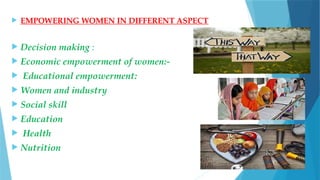
 EMPOWERING WOMEN IN DIFFERENT ASPECT
 Decision making :
 Economic empowerment of women:-
 Educational empowerment:
 Women and industry
 Social skill
 Education
 Health
 Nutrition
MILLENIUM DEVELOPMENT GOAL- 3 (PROMOTE
GENDER EQUALITY AND EMPOWER WOMEN )
Three indicators of assessment:
• Eliminate gender disparities in education;
• Increase women’s economic independence and
access to economic resources;
• Increase women’s participation in and influence on
political decision-making
NATIONAL POLICIES FOR
EMPOWERMENT OF WOMEN:
 FIFTH FIVE YEAR PLAN (1974-78) has marked a shift in the approach to
women issues from welfare to development .In recent years the empowerment
of women has been recognized as the central issue in determining the status of
women.The 73rd
and 74th
Amendments (1993) of the constitution of India has
provided for reservation of seats in the local bodies of Panchayats and
Municipalities for women.
 Seventh Five-Year Plan emphasised provision of gainful employment to
women and youth.
 NINTH & TENTH FIVE YEAR PLAN gave special attention to the
empowerment of women as the agent of social change and development.
 The Swarnajayanti Gram Swarojgar Yojana (SGSY):
 The Indira Awas Yojana (IAY):- Its aims at providing assistance for
construction of houses for people below the poverty lines in rural areas. Under
this scheme, priority is extended to widows and unmarried women. It is
stipulated that IAY houses are to be allotted in the name of women members of
the household or alternatively, in the joint names of husband and wife.
 Rashtriya Mahilakosh (RMK):It was constituted in 1993, by the Govt. to
facilitate credit support or microfinance to poor women for income generating
activities. RMK offers support to develop and stabilize Self Help Groups
(SHGs) and to conduct awareness programmes
 Adolescent Health (Sanitary Napkins for Girls)
 Midday Meal Planning (MDM)
 ICDS: It was started in 1975. There is strong nutrition component in this
program in the form of supplementary nutrition prophylaxis and iron and folic
acid distribution.
 Kishori Shakti yojana
 Training for Rural Youth and Self Employment (TRYSEM) :- Under this
programme action is being taken to provide technical skills and upgrades the
traditional skills of rural youth and finances are given for self-employment. The
Ninth plan (1997-2002) specifically stipulated identifying “Women component
plans” for which at least 30% of funds should flow to women development
schemes
 All India Women’s Education Fund Association: Its aim is to promote education
of women and girls in India while the federation of university women wants to
stimulate the interest of university women in academic, cultural and civic life.
 BALIKA SAMRIDDHI YOJANA :- Started on 1997 target is BPL girls
 National commission for Women:- This Act was set-up in 1990 to sage-guard the
rights and legal entitlements of Women.
 Janani Suraksha yojana
PROGRAMMES/SCHEMES FOR
WOMEN EMPOWERMENT
• Beti Bachao Beti Padhao Scheme (22 Jan, 2015)
• One Stop Centre Scheme (1 April, 2015)
• Women Helpline Scheme (1 April, 2015)
• UJJAWALA (Dec, 2007)
• Working Women Hostel (Introduced in 1972-73 and after amendment re-launched
on 6 April 2017)
• Rajiv Gandhi National Crèche scheme for the children of Working Mothers (2010-
11)
• SWADHAR Scheme (A scheme for women in difficult circumstances), (2001-02)
• Support to Training & Employment Programme for women (STEP),
(Launched in 2003-04 and revised in Dec 2014)
NGO’S IN WOMEN EMPOWERMENT
 AWAKE (Association of women Entrepreneurs of Karnataka) – 1983- Aim to
promote entrepreunership among and there by empower them economically and
improving social status.
 SEWA ( Self –employed Women Association)- 1972- It is an organization of poor ,self
employed women worker who earn diving through their own labour or small business.
OXFAM (Oxford committee for family relief ) 1951- Its area of concern is –
poverty,economic justice,gender injustice etc.
RESEARCH ARTICLE
A STUDY TO ASSESS THE KNOWLEDGE OF GENDER SENSITIVE ISSUES AMONG THE HEALTH CARE
PERSONNELS
Author: sakshi dubey
Place : bhuvneshwar
Done : july 2018
Background:
Although gender plays an important role in health, most healthcare providers lack knowledge in
providing gender-sensitive care. Offering gender-sensitivity training for healthcare providers can
help to address gender-based health inequalities.
 Method:
A mixed-methods systematic review of gender-sensitivity training programmes or interventions
for healthcare providers was undertaken to assess their outcomes and to document areas for
future research. Comprehensive searches of seven international databases were conducted or
peer-reviewed literature published
 Results:
Twenty-nine studies met the inclusion criteria. Fourteen studies focused on gender-
sensitivity in reducing gender bias towards men and women, and 1 5 studies focused on
addressing the needs of lesbian, gay, bisexual and transgender (LGBT) patients. Thirty-seven
percent of studies showed a significant improvement in gender-related knowledge, attitudes
or practice after the training. Multiple training methods were used to teach gender-sensitive
care. Common content of the training included learning sex/gender terminology,
understanding gender issues and inequalities in health, stigma and discrimination and
communication skills. The duration and frequency of interventions ranged considerably. Sex
differences in training outcomes also occurred among the learners.
 Conclusion:
Review findings highlight that although gender-sensitivity training for healthcare providers is
increasing, there is insufficient evidence to determine its effectiveness. Additional, more
rigorously designed studies are needed to assess the long-term implications on learner
behaviours and practices, , especially across a wide variety of healthcare providers.
Although gender plays an important role in health, most healthcare providers lack knowledge
in providing gender-sensitive knowledge and education.
CONCLUSION
• Women represent half of the world’s population and gender inequality
exists in every nation on the planet.
• Until women are given the same opportunities that men are, entire
societies will be destined to perform below their true potentials.
• The greatest need of the hour is change of social attitude to women.
• The dream of women empowerment shall not be fulfill unless they are
empowered to play equal decisive and appropriate role in the family,
which is the basic unit of empowerment.
REFERENCES
 Navdeep Kaur Brar, HC Rawat, textbook of advanced nursing practice, first
edition, the health sciences publisher, New Delhi: pg no.;- 1026-1031
 Taylor C,Lillis C, Fundamentals of nursing 4th
edition; Lippincott; Williams,
page no: 501-502
 https://pubmed.ncbi.nlm.nih.gov/?term=Gender+issues
 https://libraryguides.mta.co/gender_studies.
 https://doi.org/10.1177/SAGE-JOURNALS-UPDATE-POLICY
 ESSENCE - International Journal for Environmental Rehabilitation and
Conservation, Volume VIII: No. 1 2017 [160 – 167] [ISSN 0975 - 6272]
Women Empowerment in India: Rationale and Present Status
 http://weprinciples.unglobalcompact.org/Site/Principle5/
QUES. Enlist 6 gender sensitive issues?
● Inequality in nutrition
● Inequality in healthcare
● Inequality in religion
● inequality in access to education
● Inequality in right to travel
● Inequality in employment
● Clothing requirements
● Forbidden from driving
● Female infanticide
Ques. Why Women Empowerment is Important?
 Inspiration for others:
 Talented:
 Overall development of society:
 Economic Benefits:
 Reduction in domestic violence: .
 Reduction in corruption:
 Reduce Poverty:
 National Development:
 Availability of Quality workforce:
 Ques. Enlist some rights and acts for women?
 CRIMINAL PROCEDURE CODE 1973
 → HINDU LAW
 DOWRY PROHIBITION ACT (1961)
 →FACTORIES ACT (1948) :-
 → MATERNITY BENEFIT ACT (1961)
THANK YOU

anp gender sensitive issues ppt.ppt Msc. nursingx

  • 1.
    GENDER SENSITIVE ISSUES ANDWOMEN EMPOWERMENT PRESENTED BY: Fateh chand M.sc.Nursing 1st year
  • 2.
    INTRODUCTION  As Psychologistand sociologists point out- gender ,roles and expectations are assigned at birth. As soon as people put the label on the child ‘girl’ or ‘boy’ they begin treating the child in a stereotypical fashion . Though the Indian Constitution prohibits any kind of discrimination on the ground of sex but discrimination against girl child continues to be practiced in various parts of our Country in areas such as distribution of food in quality and amount,education ,skill training,religion,employment etc.
  • 3.
    GENDER STATISTICS  Asper Census 2011, the population of India is 1210.19 million comprising 586.47 million (48.5%) females and 623.72 million (51.5%) males.  The sex ratio (number of women per 1000 men) is 940 in 2011 ‐ which shows continued improvement over the sex ratios of 927 in 1991 and 933 in 2001. Among the States, in Census 2011, Kerala has the highest sex ratio of ‐ 1084 and Haryana has the lowest of 877.  46% of women are not involved in any kind of decision making. It is found that 32.7% illiterate women, 21.6% unemployed women are not involved in any decision making.  Cruelty by husband and relatives continues to occupy the highest share (43.4%) among the crimes committed against women in 2011 followed by molestation (18.8%). 15.6% cases are that of kidnapping, 10.6% of rape, 3.8% of dowry deaths and 3.7% of sexual harassment.The highest conviction rate of 16.5% was observed for the crime ‘importation of girls’ and the lowest of 4.0% for ‘indecent representation of women’.
  • 4.
    CONCEPT OF GENDER SEXVS GENDER:  Sex refers to the biological and physiological characteristics that define men and women. Whereas,  Gender refers to the socially constructed roles, behavior,activities,and attributes that a given society considers appropriate for men and women.  Thus while sex is permanent and universal ,gender construction varies from one society to another.  To put in another way male and female are sex catagories while Masculine and Feminine are gender catagories.
  • 5.
    DEFINITION  The WHOnoted: "The word gender is used to describe the characteristics, roles and responsibilities of women and men, boys and girls, which are socially constructed. Gender is related to how we are perceived and expected to think and act as women and men because of the way society is organized, not because of our biological differences."  Gender has been defined as: "The commonly shared expectations and norms within a society about appropriate male and female behavior, characteristics and roles. Gender can be considered a social and cultural construct that differentiates females from males and thus defines the ways in which females and males interact with each other. These roles and expectations are learned and they can change over time as well as vary within and between cultures." --( GR GUPTA).
  • 6.
    ROLE OF GENDER Genderrole determines how a male or females should think.speak,dress,and interact within the context of society.  ▲ Women are expected to take care of the family and or domestic duties and remain close to home. Mostly it is women who do the house work like cooking,cleaning and washing etc. which are repetitive and boring. Whereas-  ▲ All Men are expected to work and earn for the family.  ▲Women have entire responsibility for child rearing  ▲ Women have to look after older and sick people of the family.  ▲ Women are always known by their father and husband name-they have no individual identity. All these work performed by a women is unpaid labour/work and it has no economic value.
  • 7.
    EXPLORING GENDER STEROTYPES MENWOMEN Adventurous Patient Brave Tolerant Strong Forgiving Hard tough Motherly Manly Sacrificing Intellegent,Handsome Beautiful,soft,loving Bread-winner Caring Hardworking Adjusting,quiet Independent Sympathetic Angry Cries easily.
  • 8.
    REASONS FOR GENDER INEQUALITIES The root cause of gender inequality in Indian society lies in its patriarchy system. According to the famous sociologists Sylvia Walby, patriarchy is “a system of social structure and practices in which men dominate, oppress and exploit women”.  The unfortunate part of gender inequality in our society is that the women too, continued socio-cultural conditioning, have accepted their subordinate position to men. And they are also part and parcel of same patriarchal system.  ● Extreme poverty and lack of education  ● Lack of punishment for perpetrators of violence.  ● Lack of safe spaces for women and girls.
  • 9.
    GENDER SENSITIVE ISSUES FEMALEFOETICIDE AND INFANTICIDE.
  • 10.
    INEQUALITY IN HEALTHCARE  Women receive less healthcare facilities than men.  Women in developing countries face great health risks such as maternal mortality, sexually transmitted diseases (STDs) such as AIDS, and malnutrition. Women in developing countries have an 80 to 60 percent higher death rate when givingbirth than do women in developed countries. The reasons include giving birth without knowledgeable help, lack of emergency backup medical care, anaemia, and malnutrition
  • 11.
     INEQUALITY INNUTRITION  INEQUALITY IN ACCESS TO EDUCATION: It has been seen that women receives less education than men. Only 18 per cent of women between 15 and 24 years of age can read. . Also a woman's perception of increased social status and power is dependent on her education and occupation. Programs which provide a meal for children who attend school lead to an increase of girls attendance at school.
  • 12.
     INEQUALITY INRELIGION.  INEQUALITY IN EMPLOYMENT AND ECONOMIC INEQUALITY:-  Women work two-thirds of the world’s working hours, according to the United nations Millennium Campaign to halve world poverty by the year 2015. The overwhelming majority of the labor that sustains life growing food, cooking, raising children, caring for the elderly maintaining a house, hauling water is done by women. Universally this work is accorded low status and no pay. Women earn only 10 percent of the world’s income. Lower income, unregulated and insecure work and a lack of economic security makes women more dependent and places them at greater risk of impoverishment and violence. This is particularly true in developing countries, where economic inequalities are often even more pronounced.
  • 13.
     INEQUALITY INRIGHT TO TRAVEL  VICTIMS OF VIOLENCE:-NCRB records that the highest percentage of crime against women is torture (37.7%) followed by Moleslation (22.4%), Rape (11.8%), Kidnapping(8.8%) and immoral traffic (3.7%).  WIFE-BEATING:
  • 14.
    SEXUAL HARRASMENT: Sexual harassmentis another form of intimidation used against women. Rape is also a common occurrence worldwide. Females are kidnapped or lured to other countries by promises of good employment and then are forced into prostitution Two million girls between the ages of 5-15 are introduced into the commercial sex market each year.
  • 15.
     DOWRY  MEDIA INEQAULITY IN POLITICS
  • 16.
    GENDER SENSITIVITY  Gendersensitivity is the awareness and insight into the state of other sex with reference to historical roots of sexiest stero-typing, discrimination and violence. Another definition would be the awareness and acceptance of the roles and duties of each as expected from them and from the people that they work with. Gender sensitivity is an integral part of decision making in industrialized countries where there is a growing number of female headed households, especially in the urban setting. However, Gender Sensitivity is not about pitting women against men. An education that is gender sensitive benefits members of both sexes.
  • 17.
    PROMOTE GENDER SENSITIVEEDUCATION  Universal Primary Education (UPE) was launched in 1997. The policy emphasises equal opportunity for both boys and girls. It focuses on promoting gender parity in enrolment, retention, and performance in primary education. As a result of this, girls’ enrolment in primary schools has increased from 46 % in 1997 to 48 % in 1999  The National Strategy for Girls Education (NSGE) was launched to foster gender parity in education.It acts as a master plan for use by all stakeholders in girls’ education
  • 18.
     The Promotionof Girls Education (PGE) scheme aims at improving girls’ retention and performance at school.  The Equity in the Classroom (EIC)Programme aims at facilitating equal participation of girls and boys in the classroom. It is a USAID funded program that provides Technical Assistance and Training workshops whose great target is to increase girls’ classroom participation and completion of primary school. It is in line with the MoES’ mission to “provide quality education to all. Teachers have been sensitised to change any negative attitudes towards girls’ education and adopt methods to promote equity in the classroom.
  • 19.
    RIGHTS OF WOMEN: CRIMINAL PROCEDURE CODE 1973  → HINDU LAW  DOWRY PROHIBITION ACT (1961  →FACTORIES ACT (1948)  → MATERNITY BENEFIT ACT (1961)
  • 20.
  • 21.
    ‘’ Wherever Womenis respected, God resides there’’- Vedic verse.  For centuries women were not treated equal to men in many ways. They were not allowed to own property,they did not have a share in the property of their parents, they had no freedom to choose their work or job and so on. Now, we have to come out of these oppression of women there is a need for strong movement to fight for the rights of the women and to ensure that they get all the rights which men have or in other words a movement for the empowerment of women.
  • 22.
    DEFINITIONS:  The manisfestationof redistribution of power that challenges patriarchal ideology and male dominance – Chandra (1997)  ● Empowerment is an active process of enabling women to realize their identity,potentiality and power in all spheres of their lives.---- Sharma (1992)  )
  • 23.
     ● Women empowermentis the process by which women strengthens their capacity, individuality, and collectively to identify ,understand and overcome gender discrimination thus taking control of their lives — Arrow (1995
  • 24.
    Historical Background ofWomen Empowerment in India THE VEDIC AGE MUGHAL PERIOD/BRITISH RULE AFTER INDEPENDENCE
  • 25.
    In vedic age During this period, women had high social and religious status.  There is sufficient evidence in Vedic literature that in Vedic period women were imparted Vedic education and used to take part in religious rites.  They were also authors of certain Vedic hymns.  Women of that age were capable of learning and understanding philosophical doctrines.  In Vedic age women remain unmarried for higher studies.  The women education has been highly appreciated in Atharva Veda.  Manu emphasized that it was the duty of parents to give her daughters integral education.  However, there was a gradual decline in female education during later Vedic age.
  • 26.
    Status in modernIndia • Position and starts of today’s woman in India is considerably changed in modern Indian society. • A country or a community cannot be considered civilized where woman is not honored. • Indian laws are being need without any discrimination against woman. • As a result Indian woman enjoying high position in our society. • Modern Indian woman today occupy high ranking pests live I.A.S., I.P.S., Defense services, participate in various sports. • Woman of recent times like Mother Teressa, Vijay Laxmi Pandit, M.S. Subhalaxmi, Lata Mangeskar our ex-president Smt. Prathibha Patil etc. have achieved international fame. • Women have also achieved high fame in the areas of literature, music and acting. More over woman are joining the field of science and technology also.
  • 27.
    Why Women Empowermentis Important?  1. Underemployed and unemployed:  2. Inspiration for others:  3. Talented:  4. Overall development of society:  5. Economic Benefits:  6. Reduction in domestic violence: .  7. Reduction in corruption:  8. Reduce Poverty:  9. National Development:  10. Availability of Quality workforce:
  • 28.
     11. Self-esteem: 12. Improved health:  13. Human rights:  14. Cleanliness and hygiene:  15. Educated society:  16. Gender equality:  17. Political representation:  18. Women empowerment helps realize the potential
  • 29.
    SIX ‘S’ FORWOMEN EMPOWERMENT 1. Shiksha 2. Swasthya 3. Swavlamban 4. Samajik Nyay 5. Samvedan 6. Samta = Education = Health = Self Reliance = Justice = Sensitivity = Equality
  • 30.
    PRE-REQUISITES OF EMPOWERMENT Activeparticipation in social economic and political spheres. Desired Self-respect. Social dignity.
  • 31.
    PRINCIPLES OF WOMENEMPOWERMENT  Principle 1: Leadership Promotes Gender Equality  Principle 2: Equal Opportunity, Inclusion and Non discrimination  Principle 3: Health, Safety and Freedom from Violence  Principle 4: Education and Training  Principle 5: Enterprise Development, Supply Chain and Marketing Practices  .Principle 6: Community Leadership and Engagement  Principle 7: Transparency, Measuring and Reporting
  • 32.
    EMPOWERING WOMEN INDIFFERENT ASPECT
  • 33.
     EMPOWERING WOMENIN DIFFERENT ASPECT  Decision making :  Economic empowerment of women:-  Educational empowerment:  Women and industry  Social skill  Education  Health  Nutrition
  • 34.
    MILLENIUM DEVELOPMENT GOAL-3 (PROMOTE GENDER EQUALITY AND EMPOWER WOMEN ) Three indicators of assessment: • Eliminate gender disparities in education; • Increase women’s economic independence and access to economic resources; • Increase women’s participation in and influence on political decision-making
  • 35.
    NATIONAL POLICIES FOR EMPOWERMENTOF WOMEN:  FIFTH FIVE YEAR PLAN (1974-78) has marked a shift in the approach to women issues from welfare to development .In recent years the empowerment of women has been recognized as the central issue in determining the status of women.The 73rd and 74th Amendments (1993) of the constitution of India has provided for reservation of seats in the local bodies of Panchayats and Municipalities for women.  Seventh Five-Year Plan emphasised provision of gainful employment to women and youth.  NINTH & TENTH FIVE YEAR PLAN gave special attention to the empowerment of women as the agent of social change and development.
  • 36.
     The SwarnajayantiGram Swarojgar Yojana (SGSY):  The Indira Awas Yojana (IAY):- Its aims at providing assistance for construction of houses for people below the poverty lines in rural areas. Under this scheme, priority is extended to widows and unmarried women. It is stipulated that IAY houses are to be allotted in the name of women members of the household or alternatively, in the joint names of husband and wife.  Rashtriya Mahilakosh (RMK):It was constituted in 1993, by the Govt. to facilitate credit support or microfinance to poor women for income generating activities. RMK offers support to develop and stabilize Self Help Groups (SHGs) and to conduct awareness programmes  Adolescent Health (Sanitary Napkins for Girls)  Midday Meal Planning (MDM)  ICDS: It was started in 1975. There is strong nutrition component in this program in the form of supplementary nutrition prophylaxis and iron and folic acid distribution.  Kishori Shakti yojana
  • 37.
     Training forRural Youth and Self Employment (TRYSEM) :- Under this programme action is being taken to provide technical skills and upgrades the traditional skills of rural youth and finances are given for self-employment. The Ninth plan (1997-2002) specifically stipulated identifying “Women component plans” for which at least 30% of funds should flow to women development schemes  All India Women’s Education Fund Association: Its aim is to promote education of women and girls in India while the federation of university women wants to stimulate the interest of university women in academic, cultural and civic life.  BALIKA SAMRIDDHI YOJANA :- Started on 1997 target is BPL girls  National commission for Women:- This Act was set-up in 1990 to sage-guard the rights and legal entitlements of Women.  Janani Suraksha yojana
  • 38.
    PROGRAMMES/SCHEMES FOR WOMEN EMPOWERMENT •Beti Bachao Beti Padhao Scheme (22 Jan, 2015) • One Stop Centre Scheme (1 April, 2015) • Women Helpline Scheme (1 April, 2015) • UJJAWALA (Dec, 2007) • Working Women Hostel (Introduced in 1972-73 and after amendment re-launched on 6 April 2017) • Rajiv Gandhi National Crèche scheme for the children of Working Mothers (2010- 11) • SWADHAR Scheme (A scheme for women in difficult circumstances), (2001-02) • Support to Training & Employment Programme for women (STEP), (Launched in 2003-04 and revised in Dec 2014)
  • 39.
    NGO’S IN WOMENEMPOWERMENT  AWAKE (Association of women Entrepreneurs of Karnataka) – 1983- Aim to promote entrepreunership among and there by empower them economically and improving social status.  SEWA ( Self –employed Women Association)- 1972- It is an organization of poor ,self employed women worker who earn diving through their own labour or small business. OXFAM (Oxford committee for family relief ) 1951- Its area of concern is – poverty,economic justice,gender injustice etc.
  • 40.
    RESEARCH ARTICLE A STUDYTO ASSESS THE KNOWLEDGE OF GENDER SENSITIVE ISSUES AMONG THE HEALTH CARE PERSONNELS Author: sakshi dubey Place : bhuvneshwar Done : july 2018 Background: Although gender plays an important role in health, most healthcare providers lack knowledge in providing gender-sensitive care. Offering gender-sensitivity training for healthcare providers can help to address gender-based health inequalities.  Method: A mixed-methods systematic review of gender-sensitivity training programmes or interventions for healthcare providers was undertaken to assess their outcomes and to document areas for future research. Comprehensive searches of seven international databases were conducted or peer-reviewed literature published
  • 41.
     Results: Twenty-nine studiesmet the inclusion criteria. Fourteen studies focused on gender- sensitivity in reducing gender bias towards men and women, and 1 5 studies focused on addressing the needs of lesbian, gay, bisexual and transgender (LGBT) patients. Thirty-seven percent of studies showed a significant improvement in gender-related knowledge, attitudes or practice after the training. Multiple training methods were used to teach gender-sensitive care. Common content of the training included learning sex/gender terminology, understanding gender issues and inequalities in health, stigma and discrimination and communication skills. The duration and frequency of interventions ranged considerably. Sex differences in training outcomes also occurred among the learners.  Conclusion: Review findings highlight that although gender-sensitivity training for healthcare providers is increasing, there is insufficient evidence to determine its effectiveness. Additional, more rigorously designed studies are needed to assess the long-term implications on learner behaviours and practices, , especially across a wide variety of healthcare providers. Although gender plays an important role in health, most healthcare providers lack knowledge in providing gender-sensitive knowledge and education.
  • 42.
    CONCLUSION • Women representhalf of the world’s population and gender inequality exists in every nation on the planet. • Until women are given the same opportunities that men are, entire societies will be destined to perform below their true potentials. • The greatest need of the hour is change of social attitude to women. • The dream of women empowerment shall not be fulfill unless they are empowered to play equal decisive and appropriate role in the family, which is the basic unit of empowerment.
  • 43.
    REFERENCES  Navdeep KaurBrar, HC Rawat, textbook of advanced nursing practice, first edition, the health sciences publisher, New Delhi: pg no.;- 1026-1031  Taylor C,Lillis C, Fundamentals of nursing 4th edition; Lippincott; Williams, page no: 501-502  https://pubmed.ncbi.nlm.nih.gov/?term=Gender+issues  https://libraryguides.mta.co/gender_studies.  https://doi.org/10.1177/SAGE-JOURNALS-UPDATE-POLICY  ESSENCE - International Journal for Environmental Rehabilitation and Conservation, Volume VIII: No. 1 2017 [160 – 167] [ISSN 0975 - 6272] Women Empowerment in India: Rationale and Present Status  http://weprinciples.unglobalcompact.org/Site/Principle5/
  • 45.
    QUES. Enlist 6gender sensitive issues? ● Inequality in nutrition ● Inequality in healthcare ● Inequality in religion ● inequality in access to education ● Inequality in right to travel ● Inequality in employment ● Clothing requirements ● Forbidden from driving ● Female infanticide
  • 46.
    Ques. Why WomenEmpowerment is Important?  Inspiration for others:  Talented:  Overall development of society:  Economic Benefits:  Reduction in domestic violence: .  Reduction in corruption:  Reduce Poverty:  National Development:  Availability of Quality workforce:
  • 47.
     Ques. Enlistsome rights and acts for women?  CRIMINAL PROCEDURE CODE 1973  → HINDU LAW  DOWRY PROHIBITION ACT (1961)  →FACTORIES ACT (1948) :-  → MATERNITY BENEFIT ACT (1961)
  • 48.