GENETIC
COUNSELLING
PREPARED BY:
FATEH CHAND
INTRODUCTION
SHELDON REED
PROPOSED GENETIC
COUNSELLING IN
1947
GENETIC
◦ Branch of science which studies genes and the pattern of
inheritance of particular diseases.
COUNSELLING
◦ According to Webster’s Dictionary, “Counseling is consultation, mutual
interchange of opinions, deliberating together.”
◦
GENETIC COUNSELING
◦ The American Society of Human Genetics developed following Definition
◦ It is a communication process which deals with the human problems associated with the
occurrence or the risk of occurrence of a genetic disorder in a family. This process
involves an attempt by one or more appropriately trained persons to help the individual or
family.
1. Comprehend the medical facts.
2. Appreciate the way heredity contributes to the disorder, and the risk of recurrence in
specified relatives;
3. Understand the options for dealing with risk of recurrence;
4. Choose the course of action which seems appropriate to them in view of their risk and
their family goals and act in accordance with that decision; and
5. Make the best possible adjustment to the disorder in an affected family member and/or
to the risk of recurrence of that disorder."
NEED OF GENETIC COUNSELING
◦To promote informed decisions by involved family
members.
◦To clarify the family’s options available treatment and
prognosis.
◦To explain alternatives to reduce the risk of genetic
disorders.
◦Decreasing the incidence of genetic disorders.
◦To reduce the impact of the disorders.
◦ Planning to have a baby and want to learn more about
screening for genetic conditions
◦ A woman who has had trouble getting pregnant or had several
miscarriages
◦ A mother who had a baby with a genetic birth defect and
are concerned about it happening again
◦ Curious about your family’s history of genetic conditions
◦ Looking for screening information about genetic conditions
common in specific ethnic groups, such as sickle-cell anemia
among African-Americans
◦ Seeking information on how genetic testing is done.
INDICATIONS OF GENETIC COUNSELLING
◦ Family history of a known or suspected genetic disorder.
◦ Known carrier of a genetic condition.
◦ Consanguinity (blood relationship of parents, first cousins, or closer).
◦ Fetal structural anomaly on prenatal ultrasound.
◦ Abnormal screening test result either traditional serum screening or cell-
free DNA screening.
◦ Known teratogenic exposure.
◦ Recurrent pregnancy loss (3 or more first-trimester losses, stillbirth, or
neonatal or fetal loss with structural anomalies).
◦ Patient request for additional information regarding genetic test options.
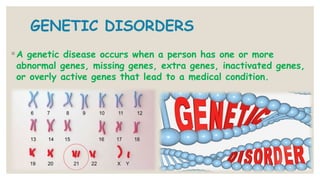
GENETIC DISORDERS
◦ A genetic disease occurs when a person has one or more
abnormal genes, missing genes, extra genes, inactivated genes,
or overly active genes that lead to a medical condition.
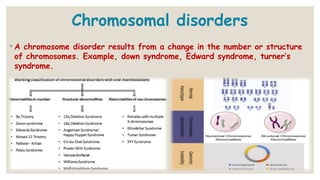
Chromosomal disorders
◦ A chromosome disorder results from a change in the number or structure
of chromosomes. Example, down syndrome, Edward syndrome, turner’s
syndrome.
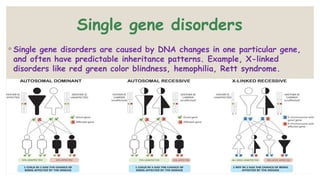
Single gene disorders
◦ Single gene disorders are caused by DNA changes in one particular gene,
and often have predictable inheritance patterns. Example, X-linked
disorders like red green color blindness, hemophilia, Rett syndrome.
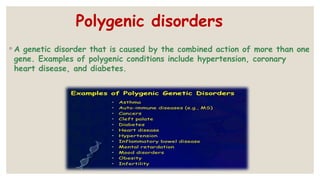
Polygenic disorders
◦ A genetic disorder that is caused by the combined action of more than one
gene. Examples of polygenic conditions include hypertension, coronary
heart disease, and diabetes.
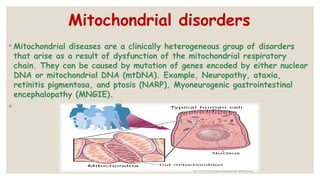
Mitochondrial disorders
◦ Mitochondrial diseases are a clinically heterogeneous group of disorders
that arise as a result of dysfunction of the mitochondrial respiratory
chain. They can be caused by mutation of genes encoded by either nuclear
DNA or mitochondrial DNA (mtDNA). Example, Neuropathy, ataxia,
retinitis pigmentosa, and ptosis (NARP), Myoneurogenic gastrointestinal
encephalopathy (MNGIE).
◦
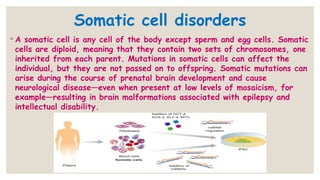
Somatic cell disorders
◦ A somatic cell is any cell of the body except sperm and egg cells. Somatic
cells are diploid, meaning that they contain two sets of chromosomes, one
inherited from each parent. Mutations in somatic cells can affect the
individual, but they are not passed on to offspring. Somatic mutations can
arise during the course of prenatal brain development and cause
neurological disease—even when present at low levels of mosaicism, for
example—resulting in brain malformations associated with epilepsy and
intellectual disability.
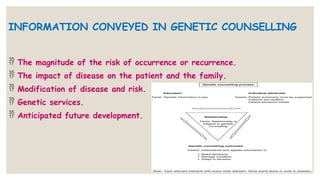
INFORMATION CONVEYED IN GENETIC COUNSELLING
 The magnitude of the risk of occurrence or recurrence.
 The impact of disease on the patient and the family.
 Modification of disease and risk.
 Genetic services.
 Anticipated future development.
Who provides genetic counseling services?
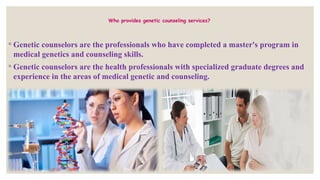
◦ Genetic counselors are the professionals who have completed a master's program in
medical genetics and counseling skills.
◦ Genetic counselors are the health professionals with specialized graduate degrees and
experience in the areas of medical genetic and counseling.
Role of a Genetic Counselor
 Helping people understand information about the birth defects or inheritance genetic
disorders.
 Providing non-directive supporting counseling.
 Helping individuals and families make decisions .
 Connecting individuals and families with appropriate resources.
 Identify family at risk.
 Investigate the problem present in the family.
 Interpret information about the disorders.
 Analyze the inheritance patterns and risks of recurrence.
 Review available options with the family.
The Setting
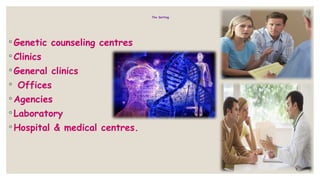
◦ Genetic counseling centres
◦ Clinics
◦ General clinics
◦ Offices
◦ Agencies
◦ Laboratory
◦ Hospital & medical centres.
Referral of clients
◦ The major source of referrals are physicians, nurses self-
referrals, social service agencies (e.g., planned parenthood
&mental health department ) adoption agencies, speech &
hearing clinic, health department, & teachers. Although health
practitioners in the clinical specialty of obstetrics & pediatrics
still dominate referrals.
◦ The persons most likely to be referred for genetic counseling are the following:
 Child with a birth defect or known genetic disorder..
 Heterozygous carriers of a specific genetic disease.
 Suspected to be inherited.
 Suspected inherited disorder in the family and are contemplating either marriage or
starting a family.
 Reproductive problems such as infertility, multiple miscarriages, or stillbirths.
 Contemplating marriage to a relative or entering an interracial marriage.
 Exposure to toxic agents, illnesses, or mutagens during pregnancy.
 Women 35 years of age and older who are considering prenatal diagnosis.
 Persons seeking risk assessment prior to genetic testing and/or interpretation of
genetic tests for certain complex disorders.
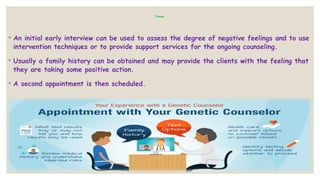
Timings
◦ An initial early interview can be used to assess the degree of negative feelings and to use
intervention techniques or to provide support services for the ongoing counseling.
◦ Usually a family history can be obtained and may provide the clients with the feeling that
they are taking some positive action.
◦ A second appointment is then scheduled.
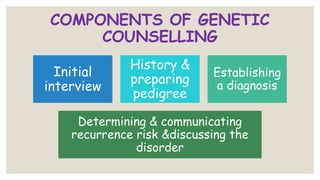
COMPONENTS OF GENETIC
COUNSELLING
Initial
interview
History &
preparing
pedigree
Establishing
a diagnosis
Determining & communicating
recurrence risk &discussing the
disorder
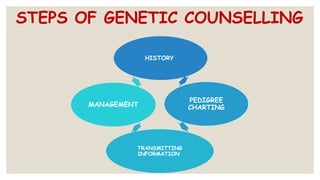
STEPS OF GENETIC COUNSELLING
HISTORY
PEDIGREE
CHARTING
TRANSMITTING
INFORMATION
MANAGEMENT
History
◦ A proper record of the history of the patient is necessary:
◦ This includes both present and relevant past history.
◦ Family history includes siblings and other relatives also. Kindly note if
there is any other person in the family with a similar problem.
◦ Obstetric history includes exposure to teratogens (drugs, X-rays) in
pregnancy. History of abortion or stillbirth, if any, should be recorded.
◦ Enquiry should be made about consanguinity as it increases the risk
especially in autosomal recessive disorders.
Pedigree Charting
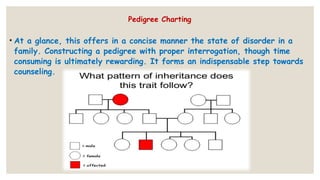
• At a glance, this offers in a concise manner the state of disorder in a
family. Constructing a pedigree with proper interrogation, though time
consuming is ultimately rewarding. It forms an indispensable step towards
counseling.
Estimation of Risk:
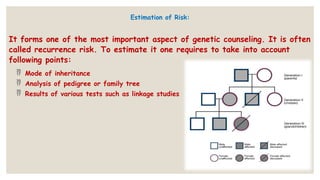
It forms one of the most important aspect of genetic counseling. It is often
called recurrence risk. To estimate it one requires to take into account
following points:
 Mode of inheritance
 Analysis of pedigree or family tree
 Results of various tests such as linkage studies
Transmitting Information:
◦ After completing the diagnosis, pedigree charging and estimation of risk
the next most important step is of communicating this information to the
consultants.
◦ This important functioning involves various factors such as:-
 Psychology of the patient.
 The Emotional stress under prevailing circumstances.
 Attitude of family members towards the patients.
 Educational, social and financial background of the family.
 Gaining confidence of consultants in subsequence meetings during follow up.
 Ethical, moral and legal implications involved in the process.
 Above all, communication skills to transmit facts in an effective manner i.e. making
them more acceptable and palatable.
Management:
◦ In genetics, “Treatment” implies a very limited scope. It naturally aims
for prevention rather then cure. In fact for most of the genetic disorders
cure is unknown. Treatment is therefore directed towards minimizing the
damage by early detection and preventing further irreversible damage.
TYPES OF GENETIC COUNSELING
◦ Prospective
◦ Retrospective
◦ Pediatric Genetic Counseling
◦ Adult Genetic Counseling
◦ Cancer Genetic Counseling
◦ Directive vs Non -Directive genetic counseling
◦ Group vs Individual Genetic counseling
◦ Preconception or Prepregnancy Genetic Counseling
Prospective
◦ This approach may find wider application to cover a number of recessive
defects.
◦ This approach identifies the individuals for any particular defect by
screening, e.g. Sickle cell anemia and thalassemia, which can be
prevented.
Retrospective
◦ This can be done after contraception, pregnancy termination and
sterilization.
◦ When blood relatives marry each other, there is an increased risk in the
offspring of traits controlled by recessive genes, eg. Albinism.
◦ Alkaptonuria
◦ Phenylketonuria
Pediatric Genetic Counseling
◦ Families or pediatricians seek genetic counseling when a child has features of an
inherited condition.
◦ Genetic testing is also available for many other childhood illnesses, such as hemophilia
and muscular dystrophy.
◦ Genetic counselors work with medical geneticists to determine if a genetic syndrome is
present.
◦ The genetic counselor also helps the family adjust to the diagnosis by providing emotional
support and counseling.
Adult Genetic Counseling
◦ Adults may seek genetic counseling when a person in the family decides to
be tested for the presence of a known genetic condition, when an adult
begins exhibiting symptoms of an inherited condition, or when there is a
new diagnosis of someone with an adult-onset disorder in the family.
◦ Genetic counseling for adults may lead to the consideration of

presymptomatic genetic testing-testing a person to determine the
likelihood for a condition existing before any symptoms occur in an area of

controversy.
◦ Genetic counselors help people sort through their feelings about such
testing and whether or not the results would be helpful to them.
Cancer Genetic Counseling
◦ A family history of early onset breast, ovarian or colon cancer in multiple
generation of a family is a common reason. A person would seek a genetic
counselor, who works with people who have cancer.
◦ While most of the cancer is not inherited, there are some families in which a
dominant gene is present and causing the disease.
◦ A genetic counselor is able to discuss the chances that the cancer in the family
is related to a dominantly inherited gene.
◦ Emotional support is important for these people, as they have often lost close
relatives from cancer and are fearful of their own risks. For families in which a
dominant form of cancer is detected through genetic testing, a plan can be
made for increased surveillance of disease symptoms.
Directive vs Non -Directive genetic counseling
◦ The use of a non-directive approach implies that both decision-making and chosen courses
of action become primarily the responsibility of the counselees and not the counselor. This
allows the counselee to maintain autonomy and control and to play an active role in
decision-making. It also provides some feelings of security fat the counselor by relieving
him or her of any decision-making burden.
◦ In directive counseling the client may expect that the counselor should give expert advice
because of their skills & knowledge. They may expect that as part of duty fulfilment and
"getting their money's worth. "However, some counselor now advocate a directive the
directive approach. They believe that when the client asks what to do or” what would you
do if were in my place? "An honest answer can be made with the modifier of "I lean towards
doing……, but I do not know for certain how I would act if I were you.”
Group vs Individual Genetic counseling
◦ Group, rather than individual, genetic counseling, at relatively new
consideration.
◦ Advantages
◦ It includes verbalization of questions by some participants that other participants may have
hesitated to ask, feelings of a shared group experience, realizing that they were not alone
with their problem, maximizing cost effectiveness, and widening access to a busy
professional.
◦ Disadvantages
◦ It include the loss of privacy and confidentiality, reluctance to expose sensitive or private
issues and concerns that may result in their never being aired. Unintentional coercion to
accept feelings, Values or decisions of the majority of the group, a sense of feeling
pressured.
◦ Sometimes group counseling is used for discussing general material & assessing risk,
followed by individual counseling for those at increased risk.
Preconception or Prepregnancy Genetic Counseling
◦ Preconception or Prepregnancy genetic counseling may be considered to
identify couples at increased risk for less than desirable pregnancy outcome.
◦ Good assessment, family, health, social, occupational, and environmental
histories, physical examination, and knowledge of genetic risk factors can
help to identify such individuals who are often seen in the primary care
setting.
◦ Their male partner should also be counselled.
◦ Person at risk thus needs to consider their chances of conception, the effect
of pregnancy on their own health, the effect on the developing foetus in the
uterus, how its impact pregnancy complications & also the chance of having a
child with similar disorder if they are themselves affected.
FOLLOW-UP
 After counseling is completed, a post -counseling follow up letter should
be sent to the counselee & the referring professional, reiterating the
essential information that was covered in the counseling session.
 A phone call is used to see if there are any additional question.
 A home visit can be arranged through the community health nurse or
genetic clinic nurse to assess coping, to identify problems, & to answers
question.
NURSE IN THE GENETIC COUNSELING
PROCESS
 Become familiar with terminology and concepts used in genetics.
 Become involved with public education about genetic disorders and their prevention.
 Help increase public awareness of availability of genetic services.
 After providing a referral or information about genetic counseling, follow up on the action that
was taken.
 May tell clients what they can expect from the genetic counseling session.
 May accompany clients to the session if, for example, the nurse has a close professional
relationship with them, and all parties involved agree.
 Identify meaning of the genetic problem involved for this client and family.
 Clarify misinterpretations and misunderstandings including information about pre symptomatic or
cancer risk assessment.
 Reinforce the information given by the geneticist. Help in alleviating guilt of family.
 Encourage the family or client to voice fears about issues such as acceptance, stigmatization,
dependency, and uncertainties.
 Assess the coping mechanisms of the client or family and build upon strengths.
 Be able to explain meanings of results of commonly used genetic tests in the practice area
of the nurse.
 Help in identifying and getting external supports needed friends, agencies, financial aid
sources, equipment resources, and others.
 Help the family identify ways to cope with the reactions of family, relatives, friends, and
others.
 Refer client or family to community resources, schools, parent groups, and so on.
 Act as a liaison between the client or family and the resources and sources they will need.
If the nurse identifies a significant degree of misunderstanding and misinterpretation, he
or she may notify the geneticist so that the family may be recontacted immediately.
 Assess the client and family's ability to carry out the treatment plan or long-range goals.
 Be sensitive to common potential problems, such as strains within the mate relationship and
problems arising in siblings.
ASSESSING CLIENTS AT GENETIC RISKS
• Help the individual or family to reaffirm self-worth and value Refer the family for further
psychotherapeutic counseling if it appears necessary.
 Assist the family in decision-making by clarifying and identifying viable options.
 Clarify the available options related to reproductive planning and assist clients in obtaining
necessary information.
 Be alert for crises in parenting if it is the child who has a genetic disorder.
 It may be appropriate for nurses to found and lead a group of parents if none exists in the area.
 Support decisions of client or family.
 Maintain contact and follow-up.
 Apprise counselor of any special information about the counselee that may assist him or her (eg..
cultural beliefs of the community).
 Assist in placing the genetic counseling information in the client's cultural context.
 Act as advocate for the family.
CONCLUSION
◦ Genetic counseling enables couples/ affected individual to make decision
about a future pregnancy. It helps the affected individual to educate
and cope with the disorders with minimal clinical problem. Therefore,
genetic counselling is done in an objective manner, so that any treatment
selected remains the personal choice of the individual involved.
◦ Hence thorough knowledge of the disease for giving information regarding
the cause and risk factors of the disease is necessary before
counselling.
Effectiveness of the Interventions Utilized in
Genetic Counseling
◦ Advances in genetic science and biotechnology accumulated huge knowledge of genes and
various genetic tests and diagnostic tools for healthcare providers including nurses. Genetic
counseling became important to assist patients making decisions about obtaining genetic testing
or preventive measures. Method. This review was conducted to describe the counseling topics,
various interventions adopted in genetic counseling, and their effectiveness. Experimental
studies () published between 1999 and 2012 were synthesized. Results. The most frequently
covered topic was benefits and limitations of genetic testing on breast cancer ovarian and
colorectal cancers. Most of researchers focused on evaluating cognitive aspect and
psychological well-being. Conclusion. No single intervention was consistently reported to be
effective. Decision aids enhanced with information technologies have potential to improve the
outcomes of genetic counseling by providing tailored information and facilitating active
engagement of patients in information uptake. Clinical Implication. When nurses are familiar
with topics and interventions of genetic counseling, they are well positioned to provide
genetic/genomic information to the patient and families.
genetic counselling, ADVANCED NURSING PRACTICE