VARSHA KUNJIR
M.SC (N) 2ND YEAR
NURSING MANAGEMENT
DEFINITIONS
“The use of computers technology to support
nursing, including clinical practice administration,
education, and research.” -Hebda (1998)
“The development and evaluation of applications, tools,
processes, and structures which assist nurses with the
management of data in taking care of patients or
supporting the practice of nursing.”
- (ANA) (1994)
3. “A combination of computer science,
information science and nursing science
designed to assist in the management
and processing of nursing data,
information and knowledge to support
the practice of nursing the delivery of
nursing care.
- Graves, J. R., & Corcoran, S. (1998).
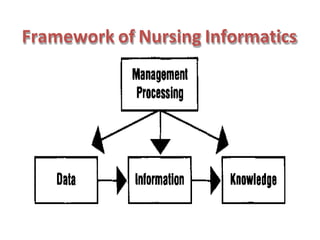
Framework of Nursing Informatics
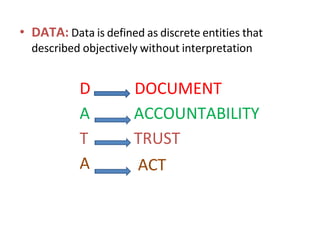
• DATA: Data is defined as discrete entities that
described objectively without interpretation
D
A
T
A
DOCUMENT
ACCOUNTABILITY
TRUST
ACT
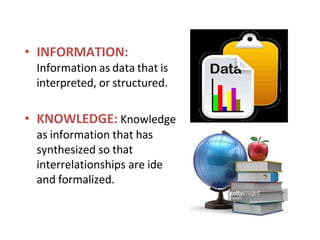
• INFORMATION:
Information as data that is
interpreted, or structured.
• KNOWLEDGE: Knowledge
as information that has
synthesized so that
interrelationships are ide
and formalized.
Nursing Process
Enables the professional nurse to be the "Coordinator
of each patient's care:
 Communicate and coordinates care with all
other clinical disciplines
 Coordinate discharge planning, education
and teaching, transition of care
 Manages all information related to the
nursing process and patient
DOCUMENTATION
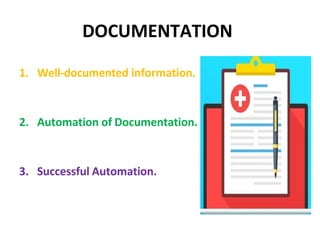
1. Well-documented information.
2. Automation of Documentation.
3. Successful Automation.
1.Well-documented information
It provides:
 What care has been provided and
what is outstanding.
 Outcomes of care provided and responses to
the plan of care.
 Current patient status & assessments Support
decisions based on assessments to drive sew plans of
care.
2.Automation of Documentation
 Up to-date
accurate information of each step of the nursing
Process is the Power behind safe, high quality
patient-centered care.
3.Successful Automation
Successful implementation of information Systems
requires:
a) Well-designed systems
b) Acceptance & integration of information systems
c) Resources.
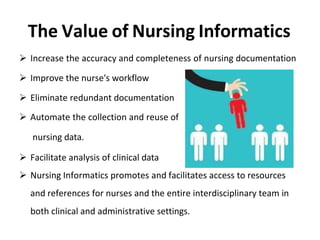
The Value of Nursing Informatics
 Increase the accuracy and completeness of nursing documentation
 Improve the nurse's workflow
 Eliminate redundant documentation
 Automate the collection and reuse of
nursing data.
 Facilitate analysis of clinical data
 Nursing Informatics promotes and facilitates access to resources
and references for nurses and the entire interdisciplinary team in
both clinical and administrative settings.
CONTD…
 Benefits for nurses and the interdisciplinary team:
-Support for their mission to deliver high quality, evidence-based care
-Support for better service by facilitating true interdisciplinary care
 Promotes improvement in key relationships with physicians, peers
 Interdisciplinary care team members, patients & families
 Benefits in the administrative setting
-Support for cost savings and productivity goals
-Facilitate change management.
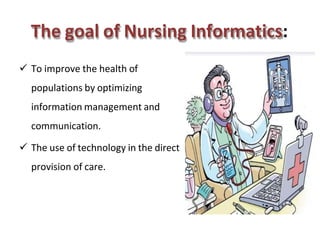
The goal of Nursing Informatics:
 To improve the health of
populations by optimizing
information management and
communication.
 The use of technology in the direct
provision of care.
General purpose of Nursing Informatics
 Nursing informatics is a way of keeping patient information
properly organized.
 Technologies, including tablet computers and mobile devices,
can help nurses keep up with what they need.
 Integrated systems allow nurses to make notes that everyone
can access, meaning that each change of shift runs smoothly,
and time isn't taken up with trying to convey information.
General purpose of Nursing Informatics
 Nursing informatics is a way of keeping patient information
properly organized.
 Technologies, including tablet computers and mobile devices,
can help nurses keep up with what they need.
 Integrated systems allow nurses to make notes that everyone
can access, meaning that each change of shift runs smoothly,
and time isn't taken up with trying to convey information.
 Nursing informatics can also help with doing instructions,
staff assignments, and lab results. The idea is that technology
and information should be easily accessible to nurses so that
they can do a better job of caring for their patients
 Another function of nursing informatics is to help create care
plans.
 Nursing informatics makes use of the information coordinated
by technology to help nurses make better decisions.
Nursing skill need related to informatics and
technology
• Use information and communication technology to document
and evaluate patient care, advance patient education &
enhance the accessibility of care.
•
•
Use appropriate technology to assess and monitor patients.
Work on an interdisciplinary team to make ethical decisions
regarding the application of technologies and the acquisition
of data.
CONTD..
•
•
•
Adapt the use of technologies to meet patient needs.
Teach patients about health care technologies
Protect the safety and privacy of patients in relation ID the
use of health care and information technologies.
• Use information technologies to enhance one's own
knowledge base.
Challenges of Managing Health related to
informatics and technology
 Confidentiality of client health information
 Ethics related to new therapies
 Evaluating the quality of information
 Information security
 Potential health and personal problems from too much
technology.
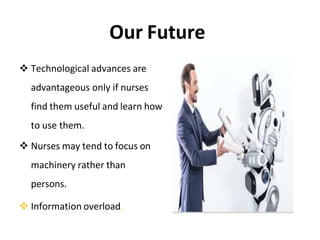
Our Future
 Technological advances are
advantageous only if nurses
find them useful and learn how
to use them.
 Nurses may tend to focus on
machinery rather than
persons.
 Information overload.
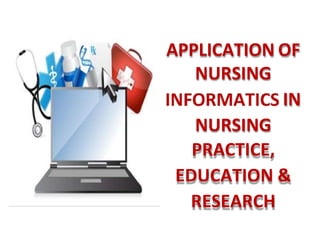
APPLICATION OF
NURSING
IN
NURSING
PRACTICE,
EDUCATION &
RESEARCH
DEFINITION
• “A specialty that integrates nursing science, computer
science, and information science to manage and
communicate data, information, knowledge and wisdom in
nursing practice."
- (ANA) 2008
GOAL
• This includes the use of technology
in the direct provision of care, in
establishing effective administrative
systems, in managing and delivering
education experiences, in
supporting life-long learning, and in
supporting nursing research.
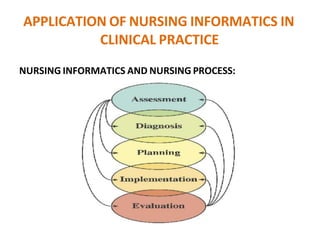
APPLICATION OF NURSING INFORMATICS IN
CLINICAL PRACTICE
NURSING INFORMATICS AND NURSING PROCESS:
APPLICATION OF NURSING INFORMATICS
IN NURSING ADMINISTRATION:
Nursing Administration (Health Care Information Systems)
 E-mail for improved communication
•
•
Cost analysis and finding trends for budget purposes
Quality assurance and outcomes analysis
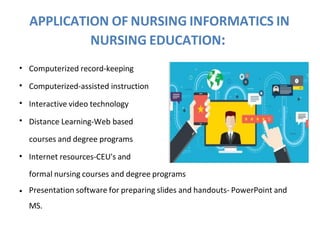
APPLICATION OF NURSING INFORMATICS IN
NURSING EDUCATION:
•
•
•
•
Computerized record-keeping
Computerized-assisted instruction
Interactive video technology
Distance Learning-Web based
courses and degree programs
• Internet resources-CEU's and
formal nursing courses and degree programs
• Presentation software for preparing slides and handouts- PowerPoint and
MS.
APPLICATION OF NURSING INFORMATICS
IN NURSING RESEARCH:
• Computerized literature searching-CINAHL, Medline and Web
sources
• The adoption of standardized language related to nursing
terms-NANDA, TIMES NEW ROMAN etc.
• The ability to find trends in aggregate data, that is data
derived from large population groups-Statistical Software,
SPSS
• Effective data management and trend-finding include the
ability to provide historical or current data reports.
CONTD…
• Data related to treatment such as inpatient length of stay and
the lowest level of care provider required can be used to
decrease costs.
COMPUTER
USES IN
HOSPITAL
AND
COMMUNITY
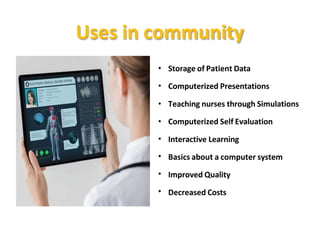
Uses in community
Storage of Patient Data
Computerized Presentations
Teaching nurses through Simulations
Interactive Learning
Basics about a computer system
Improved Quality
•
•
•
• Computerized Self Evaluation
•
•
•
• Decreased Costs
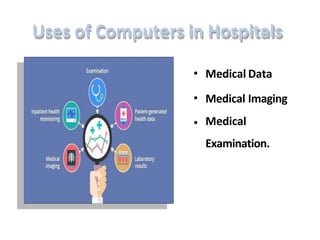
Uses of Computers in Hospitals
Medical Data
Medical Imaging
•
•
• Medical
Examination.
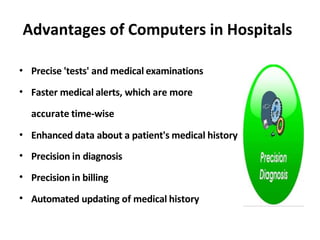
Advantages of Computers in Hospitals
•
•
Precise 'tests' and medical examinations
Faster medical alerts, which are more
accurate time-wise
•
•
•
•
Enhanced data about a patient's medical history
Precision in diagnosis
Precision in billing
Automated updating of medical history
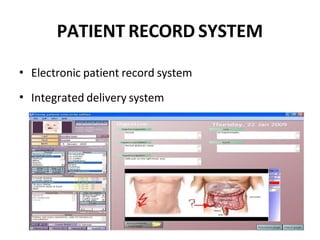
PATIENT RECORD SYSTEM
•
•
Electronic patient record system
Integrated delivery system
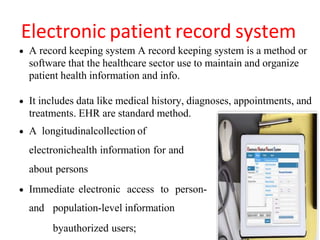
Electronic patient record system
 A record keeping system A record keeping system is a method or
software that the healthcare sector use to maintain and organize
patient health information and info.
 It includes data like medical history, diagnoses, appointments, and
treatments. EHR are standard method.
 A longitudinalcollection of
electronichealth information for and
about persons
 Immediate electronic access to person-
and population-level information
byauthorized users;
 Provision of knowledgeand decision-
support systems [that enhance the
quality,safety, and efficiency of
patient care] and
 Support for efficient processes for health
care delivery.
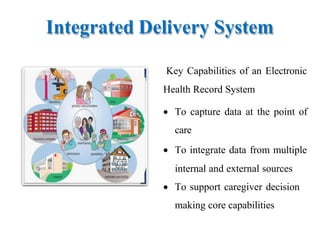
Integrated Delivery System
Key Capabilities of an Electronic
Health Record System
 To capture data at the point of
care
 To integrate data from multiple
internal and external sources
 To support caregiver decision
making core capabilities
Contd…
1. Health information and data
2. Result management
3. Order management
4. Decision support
5. Electronic communication and connectivity
6. Patient support
7. Administrative processes
8. Reporting
Advantages Improve quality of care
1. The implementation of electronic health records (EHR) can help lessen patient sufferance
due to medical errors and the inability of analysts to assess quality.
2. EHR systems are claimed to help reduce medical errors by providing healthcare workers
with decision support.
3. Computerized Physician Order Entry (CP0E)— one component of EHR—increases patient
safety by listing instructions for physicians to follow when
patients.
4. Promote evidence-based medicine.
they prescribe drugs to
5. EHRs provide access to unprecedented amounts of clinical data for research that can
accelerate the level of knowledge of effective medical practices.
6. Realistically, these benefits may only be realized if the EHR systems are interoperable and
wide spread ( for example, national or regional level) so that various systems can easily
share information.
Disadvantages
 They spend more time entering data into an empty EHR than they used to
spend updating a paper chart with a simple dictation.
 Such hurdles can be overcome once the software has some data, as
physicians learn to use templates for data entry, and as workflow in the
practice changes, but not every practice gets that far.
 Surveyors found that hospital administrators and physicians who had
adopted EHR noted that any gains in efficiency were offset by reduced
productivity as the technology was implemented, as well as the need to
increase information technology staff to maintain the system.
Contd…
 Often, doctors do not want to spend the time to learn a new system.
Some doctors believe that adopting a system with EHRs could reduce
clinical productivity
Governance, privacy and legal issues
 In Western countries, the concept of a national centralized server
model of health care data has I been poorly received. Issues of privacy
andsecurity in such a model have been of concern.
 Records that are exchanged over the Internet are subject to the
samesecurity concerns as any other type of data transaction over the
Internet.
ISSUES
Integrated systems require consistent use of standards in e.g., medical
terminologies and high I quality data to support information sharing across wide
networks.
1. Ethical, legal and technical issues linked to accuracy, security confidentiality
and access rights are set to increase as national EMR systems come online.
2. Common record architectures, structures.
3. Clinical information standards and communications protocols.
4. Security and confidentiality of information.
5. Patient data quality; data sets, data dictionaries.
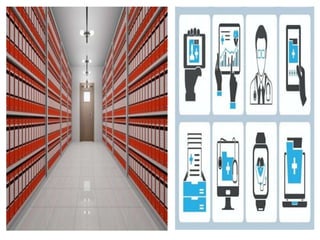
Storage of records
 The required length of storage of an individual electronic health
record will depend on national and state regulations, which are
subject to change over time. While it is currently unknown
precisely how long EHRs will be preserved, it is certain that length
of time will exceed the average shelf-life of paper records.
 Ruotsalainen and Manning have found that the typical
preservation time of patient data varies between 20 and 100years.
Synchronization of records
When care is provided at two different facilities, it may be difficult to update
records at both locations in a coordinated fashion.
Two models have been used to satisfy this problem:
1. A centralized data server solution
2. A peer-to-peer file synchronization program
nursing-informatics PPT (1).pptxftfut7r66

nursing-informatics PPT (1).pptxftfut7r66

  • 1.
    VARSHA KUNJIR M.SC (N)2ND YEAR NURSING MANAGEMENT
  • 2.
    DEFINITIONS “The use ofcomputers technology to support nursing, including clinical practice administration, education, and research.” -Hebda (1998)
  • 3.
    “The development andevaluation of applications, tools, processes, and structures which assist nurses with the management of data in taking care of patients or supporting the practice of nursing.” - (ANA) (1994)
  • 4.
    3. “A combinationof computer science, information science and nursing science designed to assist in the management and processing of nursing data, information and knowledge to support the practice of nursing the delivery of nursing care. - Graves, J. R., & Corcoran, S. (1998).
  • 5.
  • 6.
    • DATA: Datais defined as discrete entities that described objectively without interpretation D A T A DOCUMENT ACCOUNTABILITY TRUST ACT
  • 7.
    • INFORMATION: Information asdata that is interpreted, or structured. • KNOWLEDGE: Knowledge as information that has synthesized so that interrelationships are ide and formalized.
  • 8.
    Nursing Process Enables theprofessional nurse to be the "Coordinator of each patient's care:  Communicate and coordinates care with all other clinical disciplines  Coordinate discharge planning, education and teaching, transition of care  Manages all information related to the nursing process and patient
  • 9.
    DOCUMENTATION 1. Well-documented information. 2.Automation of Documentation. 3. Successful Automation.
  • 10.
    1.Well-documented information It provides: What care has been provided and what is outstanding.  Outcomes of care provided and responses to the plan of care.  Current patient status & assessments Support decisions based on assessments to drive sew plans of care.
  • 11.
    2.Automation of Documentation Up to-date accurate information of each step of the nursing Process is the Power behind safe, high quality patient-centered care.
  • 12.
    3.Successful Automation Successful implementationof information Systems requires: a) Well-designed systems b) Acceptance & integration of information systems c) Resources.
  • 13.
    The Value ofNursing Informatics  Increase the accuracy and completeness of nursing documentation  Improve the nurse's workflow  Eliminate redundant documentation  Automate the collection and reuse of nursing data.  Facilitate analysis of clinical data  Nursing Informatics promotes and facilitates access to resources and references for nurses and the entire interdisciplinary team in both clinical and administrative settings.
  • 14.
    CONTD…  Benefits fornurses and the interdisciplinary team: -Support for their mission to deliver high quality, evidence-based care -Support for better service by facilitating true interdisciplinary care  Promotes improvement in key relationships with physicians, peers  Interdisciplinary care team members, patients & families  Benefits in the administrative setting -Support for cost savings and productivity goals -Facilitate change management.
  • 15.
    The goal ofNursing Informatics:  To improve the health of populations by optimizing information management and communication.  The use of technology in the direct provision of care.
  • 16.
    General purpose ofNursing Informatics  Nursing informatics is a way of keeping patient information properly organized.  Technologies, including tablet computers and mobile devices, can help nurses keep up with what they need.  Integrated systems allow nurses to make notes that everyone can access, meaning that each change of shift runs smoothly, and time isn't taken up with trying to convey information.
  • 18.
    General purpose ofNursing Informatics  Nursing informatics is a way of keeping patient information properly organized.  Technologies, including tablet computers and mobile devices, can help nurses keep up with what they need.  Integrated systems allow nurses to make notes that everyone can access, meaning that each change of shift runs smoothly, and time isn't taken up with trying to convey information.
  • 19.
     Nursing informaticscan also help with doing instructions, staff assignments, and lab results. The idea is that technology and information should be easily accessible to nurses so that they can do a better job of caring for their patients  Another function of nursing informatics is to help create care plans.  Nursing informatics makes use of the information coordinated by technology to help nurses make better decisions.
  • 20.
    Nursing skill needrelated to informatics and technology • Use information and communication technology to document and evaluate patient care, advance patient education & enhance the accessibility of care. • • Use appropriate technology to assess and monitor patients. Work on an interdisciplinary team to make ethical decisions regarding the application of technologies and the acquisition of data.
  • 21.
    CONTD.. • • • Adapt the useof technologies to meet patient needs. Teach patients about health care technologies Protect the safety and privacy of patients in relation ID the use of health care and information technologies. • Use information technologies to enhance one's own knowledge base.
  • 22.
    Challenges of ManagingHealth related to informatics and technology  Confidentiality of client health information  Ethics related to new therapies  Evaluating the quality of information  Information security  Potential health and personal problems from too much technology.
  • 23.
    Our Future  Technologicaladvances are advantageous only if nurses find them useful and learn how to use them.  Nurses may tend to focus on machinery rather than persons.  Information overload.
  • 24.
  • 25.
    DEFINITION • “A specialtythat integrates nursing science, computer science, and information science to manage and communicate data, information, knowledge and wisdom in nursing practice." - (ANA) 2008
  • 26.
    GOAL • This includesthe use of technology in the direct provision of care, in establishing effective administrative systems, in managing and delivering education experiences, in supporting life-long learning, and in supporting nursing research.
  • 27.
    APPLICATION OF NURSINGINFORMATICS IN CLINICAL PRACTICE NURSING INFORMATICS AND NURSING PROCESS:
  • 28.
    APPLICATION OF NURSINGINFORMATICS IN NURSING ADMINISTRATION: Nursing Administration (Health Care Information Systems)  E-mail for improved communication • • Cost analysis and finding trends for budget purposes Quality assurance and outcomes analysis
  • 29.
    APPLICATION OF NURSINGINFORMATICS IN NURSING EDUCATION: • • • • Computerized record-keeping Computerized-assisted instruction Interactive video technology Distance Learning-Web based courses and degree programs • Internet resources-CEU's and formal nursing courses and degree programs • Presentation software for preparing slides and handouts- PowerPoint and MS.
  • 30.
    APPLICATION OF NURSINGINFORMATICS IN NURSING RESEARCH: • Computerized literature searching-CINAHL, Medline and Web sources • The adoption of standardized language related to nursing terms-NANDA, TIMES NEW ROMAN etc. • The ability to find trends in aggregate data, that is data derived from large population groups-Statistical Software, SPSS • Effective data management and trend-finding include the ability to provide historical or current data reports.
  • 31.
    CONTD… • Data relatedto treatment such as inpatient length of stay and the lowest level of care provider required can be used to decrease costs.
  • 32.
  • 33.
    Uses in community Storageof Patient Data Computerized Presentations Teaching nurses through Simulations Interactive Learning Basics about a computer system Improved Quality • • • • Computerized Self Evaluation • • • • Decreased Costs
  • 35.
    Uses of Computersin Hospitals Medical Data Medical Imaging • • • Medical Examination.
  • 36.
    Advantages of Computersin Hospitals • • Precise 'tests' and medical examinations Faster medical alerts, which are more accurate time-wise • • • • Enhanced data about a patient's medical history Precision in diagnosis Precision in billing Automated updating of medical history
  • 37.
    PATIENT RECORD SYSTEM • • Electronicpatient record system Integrated delivery system
  • 38.
    Electronic patient recordsystem  A record keeping system A record keeping system is a method or software that the healthcare sector use to maintain and organize patient health information and info.  It includes data like medical history, diagnoses, appointments, and treatments. EHR are standard method.  A longitudinalcollection of electronichealth information for and about persons  Immediate electronic access to person- and population-level information byauthorized users;
  • 39.
     Provision ofknowledgeand decision- support systems [that enhance the quality,safety, and efficiency of patient care] and  Support for efficient processes for health care delivery.
  • 40.
    Integrated Delivery System KeyCapabilities of an Electronic Health Record System  To capture data at the point of care  To integrate data from multiple internal and external sources  To support caregiver decision making core capabilities
  • 41.
    Contd… 1. Health informationand data 2. Result management 3. Order management 4. Decision support 5. Electronic communication and connectivity 6. Patient support 7. Administrative processes 8. Reporting
  • 42.
    Advantages Improve qualityof care 1. The implementation of electronic health records (EHR) can help lessen patient sufferance due to medical errors and the inability of analysts to assess quality. 2. EHR systems are claimed to help reduce medical errors by providing healthcare workers with decision support. 3. Computerized Physician Order Entry (CP0E)— one component of EHR—increases patient safety by listing instructions for physicians to follow when patients. 4. Promote evidence-based medicine. they prescribe drugs to 5. EHRs provide access to unprecedented amounts of clinical data for research that can accelerate the level of knowledge of effective medical practices. 6. Realistically, these benefits may only be realized if the EHR systems are interoperable and wide spread ( for example, national or regional level) so that various systems can easily share information.
  • 43.
    Disadvantages  They spendmore time entering data into an empty EHR than they used to spend updating a paper chart with a simple dictation.  Such hurdles can be overcome once the software has some data, as physicians learn to use templates for data entry, and as workflow in the practice changes, but not every practice gets that far.  Surveyors found that hospital administrators and physicians who had adopted EHR noted that any gains in efficiency were offset by reduced productivity as the technology was implemented, as well as the need to increase information technology staff to maintain the system.
  • 44.
    Contd…  Often, doctorsdo not want to spend the time to learn a new system. Some doctors believe that adopting a system with EHRs could reduce clinical productivity Governance, privacy and legal issues  In Western countries, the concept of a national centralized server model of health care data has I been poorly received. Issues of privacy andsecurity in such a model have been of concern.  Records that are exchanged over the Internet are subject to the samesecurity concerns as any other type of data transaction over the Internet.
  • 45.
    ISSUES Integrated systems requireconsistent use of standards in e.g., medical terminologies and high I quality data to support information sharing across wide networks. 1. Ethical, legal and technical issues linked to accuracy, security confidentiality and access rights are set to increase as national EMR systems come online. 2. Common record architectures, structures. 3. Clinical information standards and communications protocols. 4. Security and confidentiality of information. 5. Patient data quality; data sets, data dictionaries.
  • 46.
    Storage of records The required length of storage of an individual electronic health record will depend on national and state regulations, which are subject to change over time. While it is currently unknown precisely how long EHRs will be preserved, it is certain that length of time will exceed the average shelf-life of paper records.  Ruotsalainen and Manning have found that the typical preservation time of patient data varies between 20 and 100years.
  • 48.
    Synchronization of records Whencare is provided at two different facilities, it may be difficult to update records at both locations in a coordinated fashion. Two models have been used to satisfy this problem: 1. A centralized data server solution 2. A peer-to-peer file synchronization program