Presented By – Atul Yadav
(RN.RM)
Introduction
 A home visit is one of the essential parts of the
community health services because most of the people
are found in a home. Home visit fulfils the needs of
individual, family and community in general for
nursing service and health counselling.
 A home visit is considered as the backbone of
community health service. A home visit is a family –
nurse contact which allows the health worker to assess
the home and family situation in order to provide the
necessary nursing care and health-related a
Definition of Home Visit
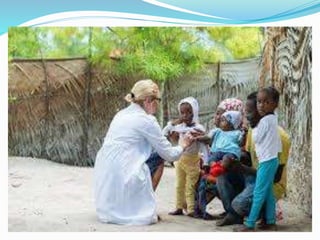
 “ A home visit is defined as the process of providing
the nursing care to patients at their door steps”.
 It requires technical skills, resourcefulness, judgment,
relationships.
 “It is defined as providing the services to family at their
door step to maintain the health & to reduce the
mortality & morbidity in family.”
HOME VISITING
Home visiting is the backbone of public health nursing.
The purpose of home visiting is
(1) to carry out simple nursing care in the home
(2) for the prevention of disease and
(3) promotion of health of the members of the family.
Principle of home visiting
 When carrying out the home visit, the community health
nurse should follow certain basic principles which are as
follow:
 The home visit should have a purpose and objectives.
 The home visit should be planned according to priority.
 The purpose of the home visit should be clear, regular,
and flexible according to the needs of the family.
 First of all, introduce yourself, your institution, your
purpose, of a home visit, and collects facts about an
individual, family environment.
 Establish a good interpersonal relationship between
families and be polite, courage, friendly.
Cont…
 Carefully listen the family and understand the others person
view.
 Health education, nursing care should be scientific.
 Use safe technical skills and scientific nursing procedures.
 Involve whole family members as much as possible during
nursing care.
 The nurse and family member must develop a positive
interpersonal relationship in their work to achieve present
goals.
 Evaluate your own work periodically.
 Make a note of important facts about the home visit in your
diary.
 Thanks to the family members and individual for good
response.
Purposes of home visiting
 To find out needs of individual, family and community
in relation to health, socioeconomic and cultural
aspects.
 To provide domiciliary midwifery as care for pregnant,
delivery, and puerperal mother and infant.
 To give care to the sick, to a postpartum mother and
her newborn with the view teach a responsible family
member to give subsequent care.
 To assess the living condition of the patient and his
family and their health practices in order to provide the
appropriate health teachings.
Cot…
To provide basic health services for minor ailments.
(i.e. injury, boils, abrasions)
 To provide counselling on family planning,
immunization, nutrition.
 To give health teaching regarding the prevention and
control of diseases. To establish a close relationship
between the nurses and the public for promotion of
health.
To make use of an inter-referral system and to promote
the utilization of community services
Advantage of home visiting
 It helps to develop an interpersonal relationship between
family members and the nurses.
 Community health nurse assess the individual and family
member in their own environment.
 It gives an opportunity to observe the background of the
family member and their relationship.
 It helps in the basic understanding of physical and
emotional needs of individual and to guide them.
 It helps to gain more knowledge and become realistic as a
family member are more relaxed in their own
surroundings.
 It also gives an opportunity to find out new health
problems
Planning and evaluation
Planning is an art and science. The purpose of planning is to
achieve definite objectives within a specified time and with
in the available resources.
(1) First make a survey and prepare a map of the area with
details of topography, location of villages, population,
roads, all information of the community. Prepare family
folders and individual cards.
(2) (2) Identify the families or individuals in need of home
visiting. These are usually the antenatal and postnatal
cases, infants, toddlers, chronically sick and those who
are unable to attend a etc. Collect the background
treatment centre.
Cont…
 (3) On the first visit, the public health nurse should
introduce herself to the family and explain the purpose
of the visit. The talk should be informal giving plenty
of opportunity to ask questions and raise discussion.
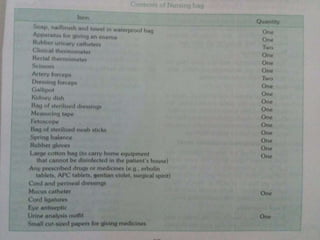
 (4) Take the nursing bag. Treat minor illnesses. Advise
hospitalization where Undertake immunization
necessary. where necessary. Give health instruction on
personal and environmental hygiene.
Cont…
 (5) Follow-up : This is the most important part of
home visiting, to find out how far the instructions
given were followed; and to give credit for what they
have done.
 (6)Evaluation : Try to evaluate what has been achieved
against the goals. The questions to be raised are : How
far the visit has been useful ? What have been the
difficulties ? What more needs to be done ?
BAG TECHNIQUE
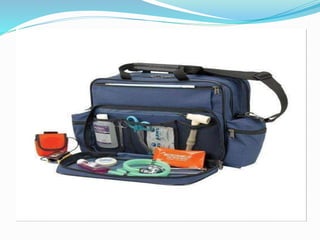
 The bag
 1)The bag should be made of canvas, Leather or light
metal.
 (2) It should be such that it can be carried by the hand
or on the shoulder.
 (3) The bag should have outside pockets for keeping a
note-book, tape measure tape, newspaper or plastic
sheet, towel, soap in a soap dish, and a nail brush.
Bag technique
 As the same bag may have to be used in several
homes, every effort should be made to keep the bag as
clean as possible.
 (1) First spread the newspaper or plastic sheet on a flat
surface in a clean are a and place the bag on it. It
should be kept away from children and animals.
 (2)Wash hands with soap and water each time before
opening the bag.
Cont…
 (3) Remove only what is needed.
 (4) Carry out the nursing procedure. Wash and boil all
the instruments after
 (5) finishing the work; wash hands, open the bag and
replace them in the bag.
 (6)When this is not possible, place them in a separate
bag. Burn the soiled dressings.
 (7) Fold the used newspaper with used side inside and
keep it in the outer pocket.
Clinics :-
 1. Village level
 One of the basic tenets of primary health care is
universal coverage and equitable distribution of health
resources. To implement this policy at village level, the
following schemes are in operation:
 a. Village Health Guides Scheme.
 b. Training of Local Dais.
 c. ICDS Scheme.
 d. ASHA Scheme.
a. HEALTH GUIDES
 In India, about 68.8 per cent of the population live in
rural areas. They are hardly covered by health services.
It is now realized that a wide range of illnesses can be
treated or prevented at the village level by a person
relatively simple training with or a preparation. He has
been called a village Health Guide (formerly known as
community health worker or community health
volunteer).
Functions
 The village health guides perform vaccinations. They
give advice on simple health education measures. They
give advice on the construction of latrines, garbage
disposal, and disinfection of water supplies. They refer
cases to the nearest primary health centre where and
when necessary. They provide primary health care
services with greater emphasis on child survival and
MCH programme. Their work is supervised by the
Community Health Nurses and Health Assistants.
b. TRAINED DAIS
 Dais have a vital role in providing domiciliary
midwifery services in rural areas. They are trained for
one month at the primary health centre or sub centre.
Training is given for 2 days in a week and on the other
4 days, they accompany the Health Worker, female
(ANM or auxiliary nurse-midwife) to the villages. They
are required to conduct at least 2 deliveries under the
guidance and supervision of the Health Worker (F).
During the period of training, they receive a stipend of
Rs.300/-.
C. ANGANWADI WORKER
 Under the ICDS (Integrated Child Development Services)
Schemes, there is one anganwadi worker for 1,000
population. The services rendered by her comprise:
 health check-up
 immunization
 supplementary nutrition
 health education
 referral services
 pre-school non formal education
 The beneficiaries are especially nursing and pregnant
women and children below the age of 6 years.
2. At the sub-centre
 The sub-centre is the most peripheral health care
facility. Each sub-centre caters to a population of about
5000 (3000 in hilly and difficult areas). The staff at
each sub-centre consists of:
Health Worker (male) – 1
Health Worker (female)/ANM – 1
Voluntary Worker
Functions :-
treatment of minor illnesses
maternal and child health
family planning
control of communicable diseases
 immunization
dais training
nutrition (distribution of iron and folic acid tablets,
and vitamin A, etc).
record keeping
referral services.
3. Primary health centres
 At present, primary health centres form the nucleus
of health services in rural areas. There are over 25,020
PHCS as of date (March 2014) functioning in the
country. Additional PHCS are being established in a
phased manner, under the Minimum Needs
Programme, so as to provide one PHC for30,000
population (20,000 population in tribal and hilly
areas).
The functions of a PHC
 1.Medical care.
 2.Maternal and child health care
(a) Antenatal care;
(b) Intranatal care;
(c) Post-natal care;
(d) New born care; and
(e) care of the child (includes IMNCI).
 3.Full range of family planning services and medical
termination of pregnancy.
Cont…
4.Health education for prevention and management of
RTI/STI.
5.Nutrition services.
6.School health services.
7.Adolescent health care.
8.Disease surveillance and control of epidemics.
9.Collectionand reporting of vital statistics.
10. Promotion of sanitation including use of toilet and
appropriate garbage disposal.
Cont…
11. Testing of water quality and disinfection of water
sources.
12. National health programmes.
13. Appropriate and prompt referral of needing special
care and providing transport facilities.
14. Training health workers and traditional birth
attendants, ASHA, ANM and initial and periodic
training of paramedics; training under IMNCI,
training of AYUSH doctors.
Cont…
15. Record of vital events.
16.Basic laboratory services.
17. Monitoring and supervision.
18. Selected surgical procedures.
19. Mainstreaming of AYUSH,
4.Community health centres
In order to provide adequate treatment and referral
services, the Government is establishing one
community health centre(CHC) for every population
by upgrading some PHCS and sub district hospitals. As
of March 2014, there are about 5,363 CHCS in the
country.4.80,000 to 120,000.
Functions of CHC are same as PHC.
Family health care settings home visit (Unit - VI)