UNIT -3
COMMUNITY HEALTH
NURSING
2
• What you do?
• Where do you begin ?
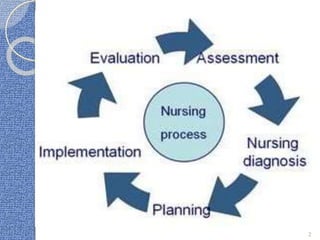
You begin with Assessment
3
INTRODUCTION
 Health is a state of wellbeing.
(WHO)
 Assessment is defined as a systematic,
dynamic process by which the nurse
through interaction with client, significant
others and health providers collects and
analyse the data about the client.
(ANA)
Cont…
 Health assessment is essential for
planning, implementation, evaluation and
taking related decision of health and
community services.
 It’s a regular and continuous process.
Definition
It is defined as detailed investigation in
terms of physical, mental, social and
spiritual health & well being; formal &
informal social support & economic
resources; physical environment ;
nutritional status; life style including
exercise & use of drugs including alcohol
and tobacco.
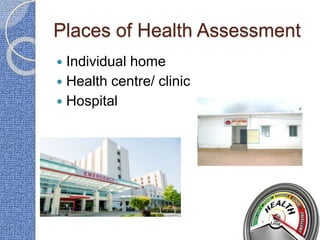
Places of Health Assessment
 Individual home
 Health centre/ clinic
 Hospital
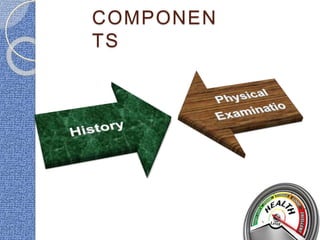
COMPONEN
TS
History Taking
 It is a collection of subjective data in
detail regarding client’s health in a
chronological order.
Format of history taking
 biographic DATA
 CHIEF COMPLAINTS
 HISTORY OF PRESENT ILLNESS
 PAST HEALTH HISTORY
 FAMILY health HISTORY
 OCCUPATIONAL AND Environmental
HISTORY
 PSYCHOSOCIAL HISTORY
 Review OF SYSTEMS
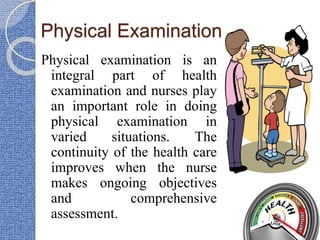
Physical Examination
Physical examination is an
integral part of health
examination and nurses play
an important role in doing
physical examination in
varied situations. The
continuity of the health care
improves when the nurse
makes ongoing objectives
and comprehensive
assessment.
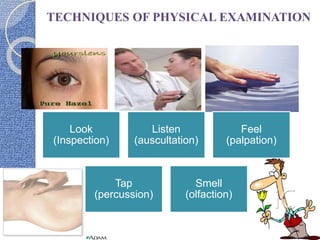
Look
(Inspection)
Listen
(auscultation)
Feel
(palpation)
Tap
(percussion)
Smell
(olfaction)
TECHNIQUES OF PHYSICAL EXAMINATION
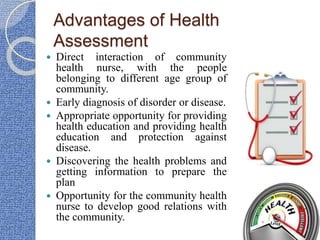
Advantages of Health
Assessment
 Direct interaction of community
health nurse, with the people
belonging to different age group of
community.
 Early diagnosis of disorder or disease.
 Appropriate opportunity for providing
health education and providing health
education and protection against
disease.
 Discovering the health problems and
getting information to prepare the
plan
 Opportunity for the community health
nurse to develop good relations with
the community.
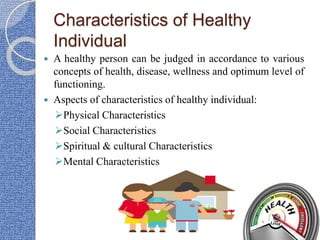
Characteristics of Healthy
Individual
 A healthy person can be judged in accordance to various
concepts of health, disease, wellness and optimum level of
functioning.
 Aspects of characteristics of healthy individual:
Physical Characteristics
Social Characteristics
Spiritual & cultural Characteristics
Mental Characteristics
Physical Characteristics
 It accounts for a major part of an
individual’s health and most of them can be
measured by head to toe examination.
 Aspects of physical characteristics:
General Physical Appearance: Healthy
appearance, weight and height according to
normal standard, intelligent, pleasant,
smiling face, friendly in nature, properly
dressed and good posture.
 Mental Status: well oriented to time,
place and person, prompt response in
answering, maintain eye contact, fully
conscious, good judgement capability.
Speech: Clear and appropriate, correct
selection of words during speech,
command on sentences and wordings.
Head and Neck: Head symmetrically rounded
with full range of motion (ROM).
Hair: Clean, shining, oiled and combed without
dandruff.
Scalp and skull: Smooth, firm symmetrical with
no inflammation, cysts, lesions or tenderness.
Face: Shining, no abnormal marks or movements.
Neck: symmetrical with smooth controlled
movement, without scar and lesion, trachea in
middle, lymph nodes not palpable.
 Eyes: Symmetrical and in alignment with top of ears,
eyebrows with equal distribution, lashes evenly spaced,
blinking symmetrical and involuntary, lacrimal glands
without tenderness, no exudates from puncta, conjunctiva is
clear, vision normal (6/6 with or without spectacles).
 Ears: Normal in size and symmetrical, without any lump,
deformity, discharge, tympanic membrane shiny, hearing
normal
 Nose: Same colour as face, no lesion or nodule, no discharge
or crusting from nose, nasal septum midline symmetrical
without deviation and bleeding, olfactory actions normal,
correct identification of scent and aroma.
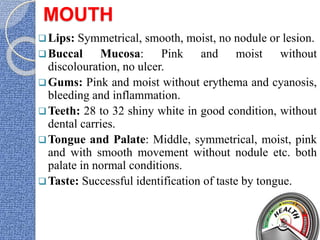
MOUTH
Lips: Symmetrical, smooth, moist, no nodule or lesion.
Buccal Mucosa: Pink and moist without
discolouration, no ulcer.
Gums: Pink and moist without erythema and cyanosis,
bleeding and inflammation.
Teeth: 28 to 32 shiny white in good condition, without
dental carries.
Tongue and Palate: Middle, symmetrical, moist, pink
and with smooth movement without nodule etc. both
palate in normal conditions.
Taste: Successful identification of taste by tongue.
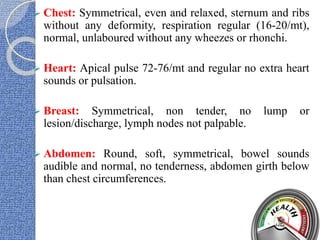
 Chest: Symmetrical, even and relaxed, sternum and ribs
without any deformity, respiration regular (16-20/mt),
normal, unlaboured without any wheezes or rhonchi.
 Heart: Apical pulse 72-76/mt and regular no extra heart
sounds or pulsation.
 Breast: Symmetrical, non tender, no lump or
lesion/discharge, lymph nodes not palpable.
 Abdomen: Round, soft, symmetrical, bowel sounds
audible and normal, no tenderness, abdomen girth below
than chest circumferences.
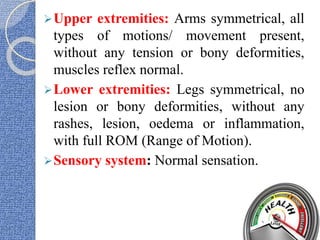
Upper extremities: Arms symmetrical, all
types of motions/ movement present,
without any tension or bony deformities,
muscles reflex normal.
Lower extremities: Legs symmetrical, no
lesion or bony deformities, without any
rashes, lesion, oedema or inflammation,
with full ROM (Range of Motion).
Sensory system: Normal sensation.

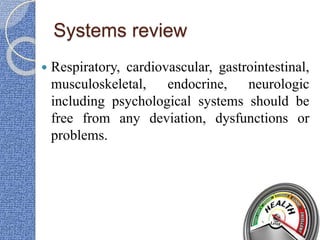
Systems review
 Respiratory, cardiovascular, gastrointestinal,
musculoskeletal, endocrine, neurologic
including psychological systems should be
free from any deviation, dysfunctions or
problems.
Social Characteristics
 Have good relations, harmony with
members of society or community.
 Be positive in social interactions.
 Follow the social change, socialization
process and social control.
 Be active socially for overall well being of
the society.
Spiritual & Cultural
Characteristics
It plays an important role in health. A healthy
individual should :-
Have Holistic approach
Believe & respect the own religion as well as
other’s religion.
Follow ethics and principles
Respect the cultural values of self, society as
well as other’s cultural norms and values.
Mentally Characteristics
The person has:
 Ability to make adjustments
 Sense of personal worth, feels worth while important.
 Solve his/her problem by his/her own efforts and make
his/her own decision.
 Sense of personal security and shows understanding of
others problem.
 Sense of responsibility.
 Give and accept love.
 Live in reality rather than fantasy.
 Shows emotional maturity.
 Generally live a well balanced life of work, rest and
recreation.
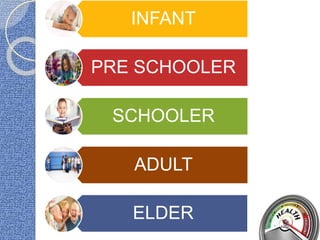
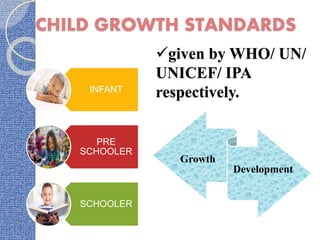
INFANT
PRE SCHOOLER
SCHOOLER
ADULT
ELDER
given by WHO/ UN/
UNICEF/ IPA
respectively.INFANT
PRE
SCHOOLER
SCHOOLER
Growth
Development
CHILD GROWTH STANDARDS
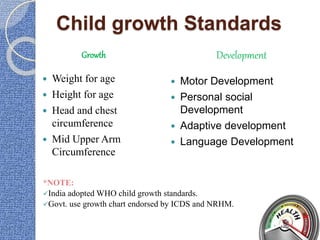
Child growth Standards
Growth Development
 Weight for age
 Height for age
 Head and chest
circumference
 Mid Upper Arm
Circumference
 Motor Development
 Personal social
Development
 Adaptive development
 Language Development
*NOTE:
India adopted WHO child growth standards.
Govt. use growth chart endorsed by ICDS and NRHM.
 Children below 1 year of age are
called infants.
 Mother has an important role in
the health assessment of the
infant because a lot of
information about the health of
the infant can be procured from
her.
 In the absence of mother, these
can be obtained from the other
responsible parent.
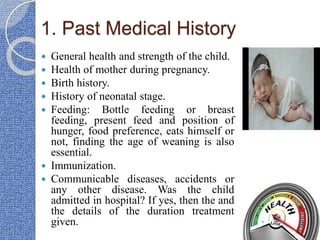
1. Past Medical History
 General health and strength of the child.
 Health of mother during pregnancy.
 Birth history.
 History of neonatal stage.
 Feeding: Bottle feeding or breast
feeding, present feed and position of
hunger, food preference, eats himself or
not, finding the age of weaning is also
essential.
 Immunization.
 Communicable diseases, accidents or
any other disease. Was the child
admitted in hospital? If yes, then the and
the details of the duration treatment
given.
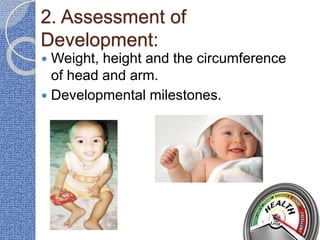
2. Assessment of
Development:
 Weight, height and the circumference
of head and arm.
 Developmental milestones.
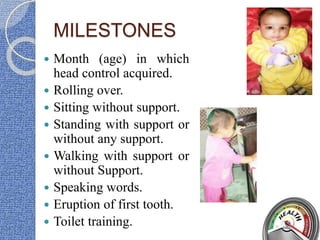
MILESTONES
 Month (age) in which
head control acquired.
 Rolling over.
 Sitting without support.
 Standing with support or
without any support.
 Walking with support or
without Support.
 Speaking words.
 Eruption of first tooth.
 Toilet training.
3. Family History: Information about the
financial, social, domestic, educational
and nutritional condition of the family can
be obtained from the mother or other
guardian because these have direct or
indirect effect on the health of the infant.
4. Present Illness and Chief Complaint:
Here, the attempt is made to find out the
present illness and main complaint of the
child.
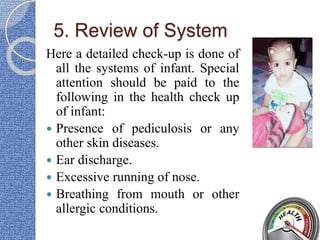
5. Review of System
Here a detailed check-up is done of
all the systems of infant. Special
attention should be paid to the
following in the health check up
of infant:
 Presence of pediculosis or any
other skin diseases.
 Ear discharge.
 Excessive running of nose.
 Breathing from mouth or other
allergic conditions.
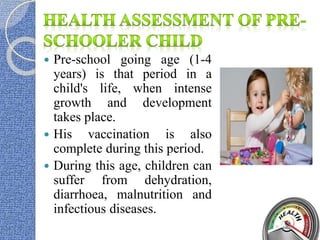
 Pre-school going age (1-4
years) is that period in a
child's life, when intense
growth and development
takes place.
 His vaccination is also
complete during this period.
 During this age, children can
suffer from dehydration,
diarrhoea, malnutrition and
infectious diseases.
Components of Health
Assessment
1. Past medical history of child.
2. Personal and family history of child.
3. Various health check-ups related to
the growth and development of child.
4. Immunization status of child.
5. Nutrition level of child and his eating
habits (dietary pattern).
6. Present condition of a child's health
and his major health problems.
7. Head-to-toe physical examination of
child and a review of all systems of
his body.
 Health assessment of
school going children is an
important part of school
health service.
 Along with community
health nurse, physician and
teachers also share the
responsibility of this
assessment.
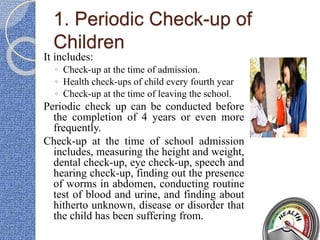
1. Periodic Check-up of
Children
It includes:
◦ Check-up at the time of admission.
◦ Health check-ups of child every fourth year
◦ Check-up at the time of leaving the school.
Periodic check up can be conducted before
the completion of 4 years or even more
frequently.
Check-up at the time of school admission
includes, measuring the height and weight,
dental check-up, eye check-up, speech and
hearing check-up, finding out the presence
of worms in abdomen, conducting routine
test of blood and urine, and finding about
hitherto unknown, disease or disorder that
the child has been suffering from.
2. Nutritional Assessment:
 This includes assessment of food, child
gets at home and the supplementary meals
given in school.
3. Daily Examination
 Daily examination of child is conducted by the
teachers. For this, it is essential that the teachers
be trained in diagnosing the illness and
providing routine treatment. During daily
examination it is necessary to keep an eye on
the cold, cough, headache, skin diseases and
other infections.
4. Personal and Family History of Children
 History can be collected through parent-teacher
or parent-community health nurse meeting held
at the time of admission in the school or later
from time to time, which is desirable for health
assessments.
5. Past Medical History
 Past medical history of the child can be
procured from the child or the parents.
 Thus, teachers, parents, community health
nurses and doctors etc. share the joint
responsibility of the health assessment of
school going child.
 It is necessary to clarify that a comprehensive
record of all the facts and information gathered
from health assessment should be documented
in the health card of the child.
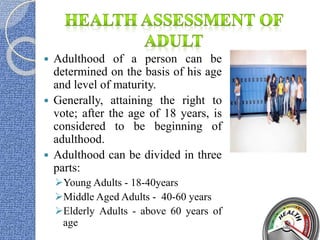
 Adulthood of a person can be
determined on the basis of his age
and level of maturity.
 Generally, attaining the right to
vote; after the age of 18 years, is
considered to be beginning of
adulthood.
 Adulthood can be divided in three
parts:
Young Adults - 18-40years
Middle Aged Adults - 40-60 years
Elderly Adults - above 60 years of
age
Cont..
 Complete physical check-up and history have
an important place in the health assessment of
an adult person.
 Since, complete physical and stability is
achieved in this age, it is essential to pay
attention to the following steps of health
assessment:
Psychosocial development.
Cognitive development.
Moral and spiritual development.
Cont..
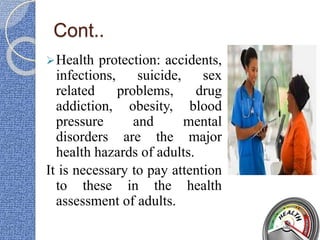
Health protection: accidents,
infections, suicide, sex
related problems, drug
addiction, obesity, blood
pressure and mental
disorders are the major
health hazards of adults.
It is necessary to pay attention
to these in the health
assessment of adults.
Introduction
Taking history and complete physical check-up are the major
components of health assessment of aged persons, but it is
necessary to pay attention to the following factors:
 Old people may be suffering from more than one health problem.
Solitude, lack of productivity and negligence further increases
the problems.
 Symptoms of disease may not be well pronounced in the old
people.
 The complaint of pain may be unbelievable, in most of the cases,
because there may be a change in their attitude about the feeling
of pain.
 Old people may habitat to live with the diseases, as they believe
that now there is no remedy for it or they may think that
complain will make others ignore them.
 Behaviour of family and society towards aged persons plays an
important role in their health assessment.
1. Assessment of Disabilities:
 Old persons may be suffering from physical,
psychological, social and sexual disabilities or
impairments.
 Problem in movement, sitting and getting up, climbing the
stairs, Opening the jar or box, holding the small objects,
stretching to reach the objects kept above the level of their
head and maintaining balance etc.
 Similarly, cooking, domestic work, shop keeping, taking
medicine, managing money and conducting daily living
activity (going to toilet, having bath, changing clothes,
taking food etc.) may also pose problems for them.
 Dependency on others
 Use of some aids/devices to assist them.
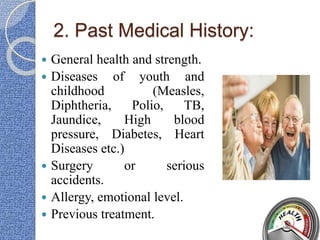
2. Past Medical History:
 General health and strength.
 Diseases of youth and
childhood (Measles,
Diphtheria, Polio, TB,
Jaundice, High blood
pressure, Diabetes, Heart
Diseases etc.)
 Surgery or serious
accidents.
 Allergy, emotional level.
 Previous treatment.
3. Personal and Family
History:
 It includes; place of birth, domestic
environment, marriage, divorce, socio-
economic group, education, cultural
background, position of family, interests and
different aspects of general life.
 Family history to find out about any genetic
diseases.
 Sexual behaviour, vocational conduct, journeys
undertaken, religious beliefs and the financial
limits.
4. Review of Systems:
 Though, head-to-toe physical examination is
desirable for correct assessment but it is not
necessary to review all the systems every time.
 Through physical examination, the health level
can be assessed by examining all the vital
organs and systems of the body.
 Here it should be remembered that old age is
called the home of diseases, hence results of
this examination help in determining many
diseases or health problems.
5. Present Illness
 Its assessment may vary with the individual,
and there may be one or more reasons for it.
6. Chief Complaint
 While assessing the health of old people, their
chief complaint should be inquired so as the
priorities may be decided in the implementation
of care. At the end of health assessment,
community health nurse should question
herself, if any information is still remaining,
which should be procured by asking questions,
and accordingly attempts should be made to
collect related information and facts.
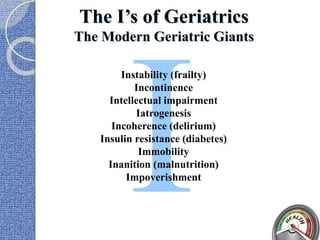
The I’s of Geriatrics
The Modern Geriatric Giants
Instability (frailty)
Incontinence
Intellectual impairment
Iatrogenesis
Incoherence (delirium)
Insulin resistance (diabetes)
Immobility
Inanition (malnutrition)
Impoverishment
Standard assessment tool
Measure of functional Ability:
Index of activity of daily living
Katzetal 1963
Lewtan Instrumental ADL
Barthel ADL Index, 1965
 Mental health status:
1. MMSE Folstein et. al. 1975, 1998, 2001
2. Short Portal Mental Status ( Pfeiffer,
E. A.)
3. Measures of Psychosocial status and
mood abbreviated mental test.
4. Geriatric Depression; scale (Yesavage
et. al. , 1983)
 Disability:
◦ Townsend’s Disability Scale (Sansbury)
1973
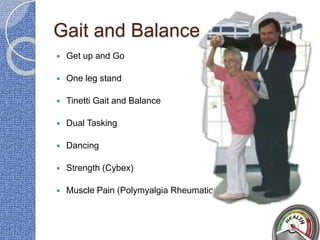
Gait and Balance
 Get up and Go
 One leg stand
 Tinetti Gait and Balance
 Dual Tasking
 Dancing
 Strength (Cybex)
 Muscle Pain (Polymyalgia Rheumatica)
Other Tests
 Hearing
 Vision
 Sleep apnea
 Advance Directives
 Health Promotion
 Hallpike-Dix
 Driving
 Guns
 Sex (ADAM)
 Right from the time of
confirmation of pregnancy,
antenatal health assessment of
the pregnant woman begins.
 The most important objective
of antenatal health assessment
is to find out the physical and
psychological response of the
pregnant woman towards
pregnancy.
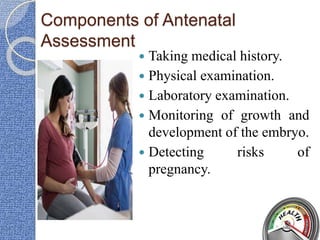
Components of Antenatal
Assessment
 Taking medical history.
 Physical examination.
 Laboratory examination.
 Monitoring of growth and
development of the embryo.
 Detecting risks of
pregnancy.
1. Medical History
 Taking medical history is an important method
of data collection. In antenatal assessment,
attention is paid to the following sections of
medical history:
i) History Regarding Menstrual Cycle
 Age at which menstrual cycle started (Date of
menarche).
 Regularity of menstrual cycle, flow, amount
and interval.
 Complications regarding menstrual cycle.
CONT..
ii) Obstetrical History
 Previous pregnancy.
 Date.
 Experiences at the time of delivery and in the post
delivery period
 Age, sex and birth weight of the child delivered
before the existing pregnancy.
 Health condition of former child, at present.
 Present Pregnancy
Planned/unplanned/unwanted
Signs and symptoms of pregnancy.
CONT..
(iii) Personal and Family History
 Social history.
 Educational standard of woman and her
husband.
 Marital and sexual history.
 Occupation of pregnant and her husband
 Habits related to exercise, rest, sleep, food,
recreation and elimination.
 General status of health.
2. Physical Examination
 General Examination
 Measuring weight and height.
 Taking temperature, pulse, respiration,
blood pressure and pulse oximetry.
 Gynaecological Examination
 Examination of breasts.
 Examination of abdomen and palpation.
 Vaginal examination, if necessary.
3. Laboratory Examination
 Laboratory examinations are done according to the
physical condition of the pregnant woman.
 Some important ones are:
Testing haemoglobin.
Blood group and Rh factor.
WBC count and DLC count.
Urine examination (generally for glucose and albumin)
and microscopic examination.
Papanicolaou smear test (PAP Smear)
Blood sugar test.
Blood serum examination.
Stool test.
Chest X-ray if necessary
Ultra Sonography
4. Monitoring of Growth and
Development of Fetus
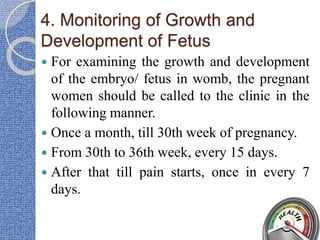
 For examining the growth and development
of the embryo/ fetus in womb, the pregnant
women should be called to the clinic in the
following manner.
 Once a month, till 30th week of pregnancy.
 From 30th to 36th week, every 15 days.
 After that till pain starts, once in every 7
days.
5. Detecting the High Risk
Pregnancy
 Age of the pregnant women is either below 15 years or above 30
years.
 Multipara pregnant woman.
 Anaemia.
 Malpresentation.
 More than one baby in the womb.
 Pre-eclampsia and eclampsia.
 Ante partum Haemorrhage (APH).
 Earlier stillbirth, baby died in womb, instrumental delivery,
caesarean section.
 Longer period of gestation (2 weeks or more than the due date of
delivery).
 Hydramnios.
 Pregnant woman suffering from heart diseases, kidney diseases,
diabetes, TB etc.
 Height of the pregnant woman is less than 140 cm
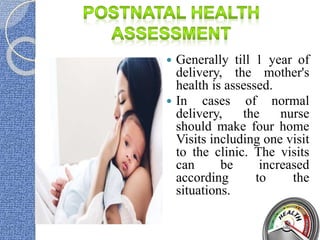
 Generally till 1 year of
delivery, the mother's
health is assessed.
 In cases of normal
delivery, the nurse
should make four home
Visits including one visit
to the clinic. The visits
can be increased
according to the
situations.
Cont..
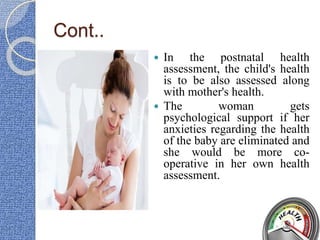
 In the postnatal health
assessment, the child's health
is to be also assessed along
with mother's health.
 The woman gets
psychological support if her
anxieties regarding the health
of the baby are eliminated and
she would be more co-
operative in her own health
assessment.
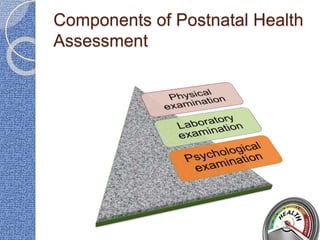
Components of Postnatal Health
Assessment
1. Physical Examination
The objectives of postnatal physical examination are:
Collecting data regarding postnatal uterus involution.
Assessing the needs of the lactating mother,
Providing health education
 General observation: During the entire period of
physical examination, mother's condition, posture, facial
expression etc. are to be noted.
 Examination of Vital Signs: After delivery the woman's
temperature, pulse, respiration and blood pressure are to
be measured. Because of the labour, temperature may be
little raised after delivery, but pulse rate may decrease.
Pulse Oximetry may be taken according to need.
Cont..
 Abdominal Examination: Because of the
prolonged distension of abdominal muscles
during pregnancy, these may become weak or
loose. After delivery the muscles can be
brought back into its original position with
proper exercises.
 Breast Examination: Breasts may become
heavy due to lactation. The child should be put
to breast as early as possible. Heaviness of
breast can be reduced by early breast feeding.
Nipples also need keen examination.
Cont..
 Uterus Examination: During puerperium several
retrogressive changes take place in uterus. After delivery,
the size of the uterus is about the size of head of the
baby. In 6-8 weeks, it recedes into the pelvic cavity.
Decidua forms layers inside the uterus in 1-2 days. The
outer layer secretes lochia. This secretion is red in the
beginning, then changes to pink colour and later
becomes white. During puerperium, vagina, uterus,
cervix and perineum regain their tone.
 Urinary Bladder Examination: Just after delivery,
there may be swelling in the urinary bladder, its capacity
might increase but sensitivity decreases. In order to
avoid expansion of urinary bladder, the woman should be
encouraged to urinate.
 Pelvic Examination: Any abnormality after 6 weeks of
delivery like tear, injury due to episiotomy, etc. can be
detected only by pelvic examination.
2. Laboratory Examination
 Blood examination (to detect
anaemia).
 Urine examination.
 Sonography (if necessary).
3. Finding out Psychological
Responses
 Developmental Approach
 .Acceptance of the baby.
 .Feeling of release from the discomforts of pregnancy, labour pains and
delivery
 .Regaining physical and mental strength.
 .Learn to take care of newborn.
 .Re-establishment of domestic life.
 .Establishing family relationship with the baby.
 Dependent Phase: For a few days after delivery, the woman is dependent
on the assistance of other people. How long she will take to become
independent, depends upon the nature and experience of the woman.
Emotional ups and downs may be observed during this period.
 Bonding with Infant: Mother gazing at the infant steadily with loving
eyes, hold its head close to herself etc. shows her affection for the baby.
During this stage father and other family especially children, find
members satisfaction in touching the baby, seeing it or assisting in its
care.
 Adverse Responses : In some instances, when the child is unwanted or it
was born out of some compulsion, the mother's responses to the child
may be of anger, hatred or rejection.
BREAST EXAMINATION
 Breast examination should be made a necessary
part of regular health check-up.
 Not only women's but men's breasts also need to be
examined from time to time.
 Women should also be encouraged to do Breast
Self Examination (BSE).
 We have to remember this fact, that the woman
should not be scared of breast examination,
because it is very common to find lumps in the
breast but most of them are not cancer causing.
Time of Breast Examination
 At the time of general health check-up.
 At least once a year by a doctor/nursing
personnel.
 If there is a history of breast cancer in family,
twice a year.
 Once a month, breast self examination.
 During menopause, once a month either breast
self examination or by doctor.
In general, breast examination should be done
after 1 week of menses.
Components of Breast
Examination
 Physical examination or general examination.
 Breast self examination.
 Laboratory examination (examination of
secretion etc.).
 Biopsy.
 Radiographic examination of the breasts is
done by mammography.
 Technique of General Examination of Breast
For general examination of the breasts
inspection and palpation are done.
Positions for Breast
Examination
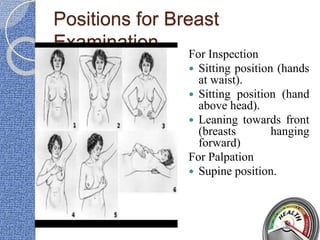
For Inspection
 Sitting position (hands
at waist).
 Sitting position (hand
above head).
 Leaning towards front
(breasts hanging
forward)
For Palpation
 Supine position.
Breast Inspection
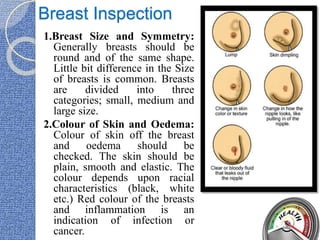
1.Breast Size and Symmetry:
Generally breasts should be
round and of the same shape.
Little bit difference in the Size
of breasts is common. Breasts
are divided into three
categories; small, medium and
large size.
2.Colour of Skin and Oedema:
Colour of skin off the breast
and oedema should be
checked. The skin should be
plain, smooth and elastic. The
colour depends upon racial
characteristics (black, white
etc.) Red colour of the breasts
and inflammation is an
indication of infection or
cancer.
Cont..
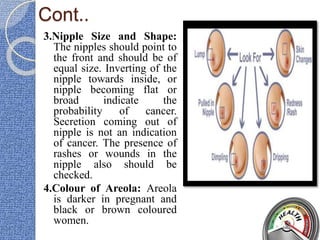
3.Nipple Size and Shape:
The nipples should point to
the front and should be of
equal size. Inverting of the
nipple towards inside, or
nipple becoming flat or
broad indicate the
probability of cancer.
Secretion coming out of
nipple is not an indication
of cancer. The presence of
rashes or wounds in the
nipple also should be
checked.
4.Colour of Areola: Areola
is darker in pregnant and
black or brown coloured
women.
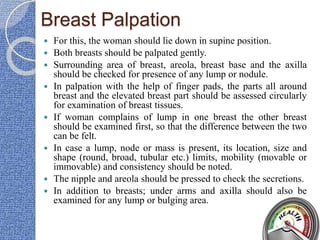
Breast Palpation
 For this, the woman should lie down in supine position.
 Both breasts should be palpated gently.
 Surrounding area of breast, areola, breast base and the axilla
should be checked for presence of any lump or nodule.
 In palpation with the help of finger pads, the parts all around
breast and the elevated breast part should be assessed circularly
for examination of breast tissues.
 If woman complains of lump in one breast the other breast
should be examined first, so that the difference between the two
can be felt.
 In case a lump, node or mass is present, its location, size and
shape (round, broad, tubular etc.) limits, mobility (movable or
immovable) and consistency should be noted.
 The nipple and areola should be pressed to check the secretions.
 In addition to breasts; under arms and axilla should also be
examined for any lump or bulging area.
Breast Self Examination
(BSE)
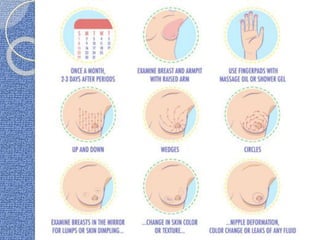
 Breast self examination should be done
after menses.
 This examination may be done in
bedroom or bathroom and standing in
front of a mirror.
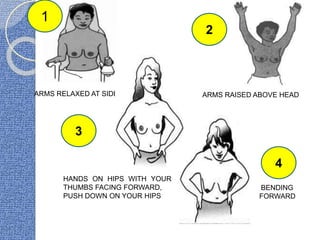
BENDING
FORWARD
ARMS RELAXED AT SIDE
HANDS ON HIPS WITH YOUR
THUMBS FACING FORWARD,
PUSH DOWN ON YOUR HIPS
ARMS RAISED ABOVE HEAD
2
3
1
4
STEPS OF BSE
1. Lie down straight on the back and place a pillow under the
right shoulder and keep the right arm under the head.
2. Use the finger pads of three middle fingers of the left hand
to feel any lump or nodule in the right breast.
3. Place the finger pads try to feel all around the breast for the
presence of any lump or elevated area.
4. Either circular movement or from bottom to top, any method
may be followed, but the entire breast should be examined.
5. If there is any change in the colour or elevation of breasts,
nipple or areola, it should be noted, this change can be seen
by standing in front of the mirror.
6. After examining the right breast, also examine the left
breast.
7. If any abnormality is found, take the advice of doctor.
Examination of Male Breast
 Male also should examine their breasts
from time to time by palpation and check
for any abnormality in colour, size, areola,
nipple or presence of any lump.
THANK YOU