3.
FERTILIZERS
• Fertilizers are the natural or synthetic organic and inorganic materials,
applied to soil or plants to supply the elements that are essential for the
growth and development of plants.
• The term manure was used sometime before to denote materials, such as
cattle manure, farm yard manure and other natural substances, that are
applied to the land for increasing soil productivity (soil productivity refers to
the capacity of the soil to produce crops per unit area).
• Later, chemical substances, such as ammonium sulphate, urea, etc., began to
use for the same purpose.
• Nowadays, the organic substances used for increasing crop production are
called manures, and the inorganic substances used for the same purpose are
termed fertilizers.
Maintenance of soil fertility
• One of the most serious problems a crop producer has to face is the
maintenance of soil fertility.
• Soil fertility refers to the ability of the soil to supply plants all essential nutrients
in optimum amounts and readily utilizable forms, Organic manures are excellent
sources of organic matter, but are relatively low in nutrients.
• Therefore, organic manures need to be applied in huge amounts to compensate
their low nutrient content.
• Organic manures supply enough humus to improve the physical condition of the
soil.
• The source of plant nutrients may be organic or inorganic.
• Most of the fertilizers applied in horticultural fields are inorganic.
A. Organic manure
• Organic manures are usually derived from animal or plant sources.
• They may be classified into bulky organic manures and concentrated organic
manures.
• Bulky organic manures include farmyard manure (FYM), compost and green
manure.
• Concentrated organic manures contain higher percentages of Nitrogen,
Phosphorus and Potassium than in bulky organic manures.
• The common concentrated organic manures are oilcakes, blood meal, fish
manure, meat meal, cotton and wool wastes, etc.
Oil-cakes
• Oilcakes are the leftover materials after extracting oil from oil-seeds. Oilcakes
contain N, P,O, and K,O and a large percentage of organic matter.
• Oilcakes are quick acting organic manures.
• Their nitrogen becomes available to plants within a few days after application.
• They should be well powdered before application, so that they can be spread
evenly and can be easily decomposed by micro-organisms.
• Well-powdered oilcakes can be applied during sowing.
Blood meal
• Blood meal, or dried blood, is made from the blood collected from slaughter
houses.
• It contains 10-12% Nitrogen and 1-2% phosphoric acid.
• Blood meal is a quick-acting manure and is effective for all crops in all types of
soils.
Meat meal
• Meat meal is obtained from dried meat and meat wastes.
• It contains about 10.5% Nitrogen and 2.5% phosphoric acid.
• It is also a quick-acting manure and is applied to many crops.
Fish meal
• Fish meal or fish manure is prepared by drying and crushing the non-edible
parts and the carcasses of fishes.
• It contains 4-9% Nitrogen, 3-9% phosphoric acid and 0.3 to 1.5 % potash.
• It is a quick-acting organic manure, ideal for all crops and soils.
Cotton and wool wastes
• Cotton and wool wastes, known as shoddy, supply about 50-150 kg of Nitrogen
per tonne and may be applied as organic manure at the rate of 2.5 to 5.0 tonnes
per hectare.
• They are suitable for all types of crops and soils.
Application of organic manure
• To get the maximum advantage of manure, the following guidelines should be
observed while applying organic manure.
1. Manure must be applied a couple of weeks or a few days before planting. If applied
too far in advance, some Nitrogen may be lost by leaching. To avoid burning of the
seeds and seedlings, fresh manure should be applied at least four weeks in advance;
rotten manure does not cause damage.
2. Manure, containing large amounts of straw, may actually cause a temporary
Nitrogen deficiency unless some Nitrogen fertilizer is added.
3. Soil should be ploughed or hoed soon after the application of manure. A delay may
cause loss of Nitrogen as Ammonia gas.
4. If manure is available in limited quantities, always use at moderate rates over a large
area, rather than at high rates over a small area.
5. Even high rates of manure will not always satisfy a crop's entire N-P-K needs. In such
situations, some supplementary inorganic fertilizers may be added.
Advantages of organic manure
1. Coarse organic manure on the soil surface reduces the impact of rainfall. It permits
clear water to seep gently into the soil. Also, it reduces surface runoff and soil
erosion so that more water may be available for plant growth.
2. Decomposing organic matter produces slime which helps the formation and
stabilization of the desirable soil structure.
3. Dead organic bodies decay and provide channels through which new plant roots
grow more luxuriantly. These channels are effective in transmitting water downward.
4. Fresh organic matter supplies food for soil organisms, such as earthworms. These
animals burrow in the soil and make the soil more porous. This helps plant roots to
obtain oxygen and to release carbon dioxide as they grow.
5. Surface mulches lower soil temperatures in the summer and keep the soil warmer in
winter.
6. Organic mulches reduce the loss of water by evaporation.
7. Upon decomposition, organic matter supplies almost all nutrients. These nutrients
are released as per the needs of the plants. When environmental conditions are
favorable for rapid plant growth, there will be a rapid release of nutrients from the
organic matter.
• 8.A soil, high in organic matter, has more available water for plant growth
than the same soil with less organic matter.
• 9. Organic matter helps to buffer soils against rapid chemical changes cause the
addition of lime and fertilizers.
• 10. Organic acids released during the decomposition of organic matter help to
dissolve minerals and to make them more available to growing plants.
• 11. Humus acts as a storehouse for the exchangeable and available cations, such
as K+, Ca2+ and Mg2+
Disadvantages of organic manure
• Organic manures are not commonly used in horticulture fields because of the
following reasons:
1. They are bulky to handle and require large amounts of space to store.
2. Since their nutrient content is low, large quantities of them are required to
provide appreciable amounts of the nutrients needed.
3. They are difficult to quantify and apply according to the given specifications.
4. The nutrients they contain are released slowly by decomposition, and the rate
of their decomposition varies depending on the environmental conditions.
5. They are difficult to apply uniformly in the soil.
6. They can be applied only to the soil, and not to leaves or other plant parts.
B. Inorganic fertilizers
• Inorganic fertilizers are also called commercial or chemical fertilizers.
• They contain higher concentrations of nutrients than in organic manures, but
lack soil-improving qualities.
• Inorganic fertilizers are classified into straight, complex and mixed fertilizers.
a) Straight fertilizers
• These are the fertilizers which supply only primary plant nutrients, such as
nitrogen, phosphorus and potassium.
• Urea, ammonium sulphate, potassium chloride and potassium sulphate are the
common examples.
b) Complex fertilizers
• The inorganic fertilizers which contain two or three primary plant nutrients of
which two are in chemical combination.
• These fertilizers are produced in granular form Diammonium phosphate,
nitrophosphate, and ammonium phosphates are complex fertilizers.
c) Mixed fertilizers
• These are the physical mixtures of straight fertilizers.
• They contain two or three primary plant nutrients.
• Mixed fertilizers are made by thoroughly mixing the ingredients either
mechanically or manually.
Advantages of inorganic fertilizers
• Inorganic fertilizers are most widely used to provide supplementary nutrients to
horticultural plants in the field or in containers.
• They are popular because of the following reasons:
1. They are easy to store.
2. They have higher nutrient content than in organic fertilizers.
3. They can be formulated for specific purposes.
4. Inorganic fertilizers are easy to apply and can be applied uniformly.
5. They are available in liquid and solid forms.
6. They can be applied to both soil and leaves.
7. Accurate quantitative application is possible.
8. Nutrients are readily available to plants.
9. Growers can mix their own formulations accurately.
Methods of fertilizer application
• The method of application of fertilizers depends on their form, whether liquid or
solid (dry).
• Fertilizers may be applied either to the soil or to the plant leaves.
• In any case, they may be spread out, or confined to a small area.
• Nitrogen fertilizers are available as single-element or as compound forms.
• While applying nitrogen fertilizers, the stage of development of the crop as well
as the season have to be considered.
• Nitrogen is needed most by almost all crops in the early stages of growth and
development.
• When applied in cold conditions in ammonium form, the change to usable nitrate
form is slow.
• Nitrogen fertilizers may be acidic, alkaline, or neutral in reaction.
Application of fertilizers
• The first step in a fertilizer programme is to determine the type and amount of
fertilizer needed.
• Excessive fertilization is economically wasteful and may even injure or kill the
plants. Fertilizers may be applied before planting (pre-plant).
• The recommended amount may be distributed almost uniformly all over the
area.
• Sometimes, fertilizers are applied after germination, and also at various stages
of the growth of the crop.
(1) Dry application
• Dry fertilizers are often applied to the soil.
• They may be spread out or trated in bands or spots.
• Four general methods of application are usually emplo namely broadcasting,
banding, side dressing and drill hole method.
a) Broadcasting
• Broadcasting is the manual or mechanical spreading of the fertilizer over the
surface area of the soil as evenly as possible.
• If it is done during soil preparation, a plough may be used to incorporate the
fertilizer with the soil.
• The disadvantage of this method is that every part of the field is not equally
fertilized so that much of the fertilizer may not not utilized by widely spaced
horticultural plants.
b) Banding
• As the name implies, banding is the localised application of fertilizers near around the seed or
plant.
• Care must be taken to place the fertilizer 2 to 3 inches (5.1 to 7.6 centimeters) apart either
beside or beneath the seed or plant to prevent injury to the seedlings from the excessive salts.
• This excess of salts is usually a concern when especially strong nitrogen and potassium
fertilizers are used.
c) Side dressing
• This is the fertilizer application in which the soil is not disturbed during application. The time of
application is very important.
• For example, when urea is applied on a hot summer day, the area must be irrigated to reduce
the loss through volatilization.
• Crops planted on beds are usually fertilized by this method.
• Care must be taken not to bring the dry fertilizer in direct contact with the plant foliage.
d) Drill hole method
• This is the method in which holes are drilled up to the root zone of the crop plants and are
then filled with granular fertilizer at the recommended rate.
• This method makes the fertilizer readily available to the root system.
• This method is usually employed to fertilize the plants grown in lawns and courtyards.
(ii) Liquid application
• Liquid fertilizer application is the application of fertilizers in a dissolved liquid
form either to the soil or to the leaves.
• It is accomplished in two ways, namely foliar application and fertigation.
a) Foliar application
• This is the spraying of liquid fertilizers on leaves.
• It is often employed to solve the problems of the deficiency of trace elements.
• Trace elements are required only in minute amounts and so it is safe to
administer them in lower concentration by spraying them directly onto the leaf
surface.
• Since only small amounts of chemicals are applied, this method is not adequate
to meet the nutritional needs of plants.
b) Fertigation
• Fertigation, or chemigation, is the application of fertilizers to crops through
irrigation water.
• This method is usually practiced in greenhouses.
• Drip irrigation method is particularly suitable for fertigation.
• Effectiveness of fertigation depends on the solubility of the fertilizer and the
quality of irrigation water.
• Water-soluble fertilizers should be used in fertigation.
• Hard water, with excessive amounts of dissolved calcium, can be problematic
because it may cause the blockage of holes by calcium deposition.
• Fertigation is effective in soils which drain rapidly (e.g., sandy soil) and also when
the fertilizer is prone to leaching (e.g., Nitrogen).
• Regulation of the flow rate will enable the plants to efficiently utilize the
fertilizer and to maintain optimum moisture content.
COMPOSTING
• Composting is the biological decomposition of solid and putrescible organic
matter into stable mineral compounds.
• It results in the formation of a humus-like material, called compost.
• The organisms involved in composting are bacteria, fungi, earthworms, insects
and some other soil organisms.
• Composting is a deliberate activity by gardeners for the decomposition of
organic matter.
• Organic matter affects both the physical and chemical properties of soil.
• It improves the aeration and the moisture retention capacity of the soil.
• Through gradual decomposition, it releases both major and minor nutrients into
the soil for plant use.
• Composting promotes the production of organic matter and nutrient recycling.
• In the soil, compost acts as a source of slow-release fertilizer.
Principles of composting
• The basic mechanism of composting is the decomposition of organic wastes and
residues for the incorporation of their chemical constituents into the soil in order
to modify and improve the physical properties and the chemical qualities of the
soil, and also to enhance its nutrient level.
• Composting essentially involves the interaction between biotic and abiotic factors
of the environment. Decomposers are the biotic agents and organic matter is the
abiotic factor.
• Decomposers convert organic matter into compost through decomposition.
• There are two groups of decomposers that inhabit the soil, namely
microorganisms and macroorganisms.
• The major microorganisms involved in decomposition are bacteria and fungi, and
the major macroorganisms include earthworms, insects and insect grubs.
• These organisms should be provided with appropriate environmental or abiotic
factors for their growth. development and composting activity.
• An active compost heap represents an environment, crowed with a wide variety of
microorganisms.
• These organisms operate successively, depending on the temperature in the heap.
• The temperature in the heap changes because heat is released during the metabolic
activity of the composting organisms.
• Bacteria can operate over a wide range of temperature conditions.
• Some prefer cool conditions, while the others prefer warm conditions.
• There are three groups of microbes involved in composting.
• They are psychrophiles, mesophiles and thermophiles.
• Psychrophiles are active at low temperatures, mesophiles are active at moderate
temperatures, and thermophiles are active at high temperatures.
• Psychrophiles operate at temperatures even below the freezing point (at -2.22°C), but
they work best around 12.8°C.
• They dominate in compost heap at the initial stage when the temperature is low.
• Their metabolic activities cause the temperature to go high.
• Mesophiles operate at a temperature range between 21.1 and 32.2°C.
• They form the major work-force of composting.
• However, at or above 37.8°C, they are replaced by thermophiles.
• Thermophiles are the heat-loving bacteria which work at a much higher
temperature.
• They raise the temperature of the compost heap to a 71°C or more.
• However, these microbes cannot act upon cellulose, lignin, and other hard-to-
metabolize substances.
• So, such substances are left behind in the heap.
• Only fungi are able to decompose them.
• Their presence in the heap is indicated by the occurrence of whitish strands or
cobweb-like structures.
• Macroorganisms, such as earthworms, are also important in the compost heap.
• They feed on organic matter and excrete materials rich in nutrients for plant
growth.
• Earthworms are abundant in soils that have high microbial activity.
Compostable materials
• The quality of compost depends on the materials used in the compost heap.
• Good compostable materials include household garbage, leaves, sawdust, straw
or hay, animal dung, ash, etc.
• Non-biodegradable substances, and the substances which yield toxic products
that are harmful to decomposing organisms, are undesirable in a compost heap.
• These materials include plastics, synthetic cloths, pesticides, etc...
Compost activators
• To accelerate the process of decomposition a compost pile is inoculated with
materials called activators. Compost activators can be natural or artificial.
(1) Natural activators
• Natural compost activators include loamy soil, finished compost, protein meal,
organic manure, etc.
1. Loamy soil - The decaying organic component of a loamy soil contains soil
microbes.
2. Finished compost - Finished compost from a previous pile may be used to
inoculate a fresh compost heap.
3. Protein meal - Protein meals, derived from high-protein plant materials or
animal sources, including fish meal, bone meal, and blood-meal, promote
composting.
4. Organic manure - Organic mannure from a variety of farm animals, such as
poultry, cattle, and sheep, is a good activator. However, it should not be used
afresh. It is safe when it is well decomposed.
(ii) Artificial activators
• Artificial compost activators include fertilizere, inoculants, etc.
a) Fertilizers - These are less efficient than natural activators because they lack
protein. Compound fertilizers, consisting of nitrogen, phosphorus, and
potassium (10:10:10), may be used.
b) Inoculants - These are the agents commercially prepared from dormant
bacteria and fungi and packaged as tablets or granules.
Composting systems
• Basically there are two types of composting, namely non-container (in situ) method and
container (ex situ) method.
(i) Non-container (in situ) method or sheet composting
• Non-container method, or in situ method, is the direct way of composting.
• In it, the raw materials are composted in the same location in the soil where their products will
be used.
• The raw materials used include leaves, plant residues after harvesting, grass clippings, animal
dung, etc.
• These materials are incorporated into the soil by an appropriate implement, such as spade or
mechanical tiller.
• Another version of this method, called green manuring, involves the growing of leguminous
species (clover, alfalfa, peas, soybean, etc.) and ploughing them a little deep into the soil while
they are fresh.
• In situ or sheet composting is simple and it allows the complete decomposition of organic
matter.
• Its major disadvantage is that it takes several months for the completion of decomposition.
• Another disadvantage is that heat does not build up in it to a high level at which weed seeds
are killed.
(ii) Container (ex situ) method
• This is the composting of organic matter in pits or in specially
constructed containers from where the compost is transported to
other places for application.
• Thus in this method, compost is prepared in one place and used
somewhere else.
General procedure of ex situ composting
• The success of ex situ composting depends on the observance of four principal
aspects, namely layering, moisture supply, size of compost pile and aeration.
1. Layering
• This is the orderly stacking of the composting materials in layers, instead of
irregularly dumping them in open heaps.
• Dry materials, such as straw, should be arranged in layers, alternating with fresh
materials, such as grass clippings and vegetable matter.
• Nitrogen-rich materials should alternate with carbon-rich materials.
• After several layers, the activator should be spread evenly before another set of
material is added.
• This pattern is repeated until the container is filled.
• 2. Moisture supply
• Water is essential for microbial decomposition.
• At the same time, too much of water causes anaerobic conditions in the heap,
and too little of water slows down decomposition.
• So, maximum care should be taken to provide moisture most appropriately and
almost uniformly all over the heap.
• This is accomplished by moistening the different layers of the material one after
another.
• A well-moistened compost heap may be as moist as a wet sponge.
• Overwatering of the compost heap is wasteful and it may cause the leaching of
nutrients.
• Rain water is ideal for watering, since it contains useful microorganisms, minerals
and oxygen.
3. Size of the heap
• The size of the compost heap should be manageable and self insulating, without causing
compaction in the layers.
• A large heap may cause overheating and anaerobic conditions in its interior.
• This situation is detrimental to bacteria.
• A small heap, on the other hand, may be overventilated so that it may not reach peak
temperatures.
• In such cases, artificial insulation is to be given.
• Since the heap has to be regularly turned over, a huge heap may be unmanageable.
4. Aeration
• Compost heap should be well ventilated for the multiplication of aerobic bacteria.
• It may be built around ventilating pipes or a tube of wire mesh.
• This is necessary when the compost heap is left unturned, or turned only less frequently.
• Turning the compost heap frequently is tedious, but it accelerates the rate of decomposition.
• Home composters turn their heaps less frequently unless a foul odour develops.
• Frequent turning must be done only after a peak temperature has been attained in the heap
every time (to kill weed seeds).
• Turning the heap too frequently is disadvantageous to the activity of the decomposers.
Different methods of ex situ composting
• There are four major methods of ex situ composting, namely trench composting, open
window composting, mechanical composting and vermicomposting.
(a) Trench composting
• This is the composting carried out in specially made trenches in open ground.
• In this method, 4 to 10m long, 2 to 3m wide, and 0.7 to 1.Om deep trenches are
excavated.
• Solid waste is spread in these trenches in 15cm thick layers, sandwiched by 5cm thick
layers of semi-liquid cattle dung, until the waste heap rises to 30cm or more above the
ground level.
• Then, a 5 to 7.5 cm thick layer of soil is spread over the top of the heap.
• This prevents wind-blowing of the waste and blocks the entry of insects.
• In about 4 to 5 months, decomposition is completed and humus-like compost gets
stabilized.
• It is removed, seived and used as a manure.
(b) Open window composting
• This is the composting carried out on open ground surface.
• In this method, solid waste is dumped on open ground as 5 to 10m long, 1 to 2m
wide, and 0.5 to 1.0m high heaps.
• The top of each heap is covered with cattle dung.
• After a few days, the heaps are raked and turned upside down for cooling and
aeration.
• In about 4 to 6 weeks, the compost gets stabilized.
(c) Mechanical composting
• This is the method in which putrescible solid wastes are converted to compost
by mechanical devices in composting plants.
• The whole process is completed in about 3 to 6 days.
• Mechanical composting involves segregation, shredding (pulverization) and
stabilization of the waste, and the processing of the stabilized mass for
marketing.
(d) Vermicomposting
• Vermicomposting is the composting of solid organic wastes using some species of
earthworms.
• It is much faster than trench composting and open-window composting.
• The compost, produced by the breakdown of organic debris by earthworms, is
known as vermicompost.
• There is a growing realisation that vermi-compost provides nutrients and growth
enhancing hormones for plant growth.
• The fruits, flowers, vegetables, etc. produced by using vermicompost, are
reported to have better keeping quality.
• Presently, a number of individuals and institutions are taking interest in
vermicomposting.
• Vermicomposting can be carried out in bins, tanks, or other suitable containers
• The solid waste is first allowed for natural primary decomposition.
• Then, it in Then, it is filled to the vermicomposting containers.
• Now, earthworms are released to the com They gradually bring about
composting.
• The whole process is completed in abin about 60 to 75 days.
• The composting of crop residues using earthworms involves the spreading of
agricultural wastes and cow dung in alternating 1.5 m wide and 0.9 m thick
layers beds of required length.
• Earthworms are introduced in between the layers at the of 350 worms per m of
bed volume.
• The beds are maintained at about 40 to 500 moisture content and a
temperature of 20 to 30°C by sprinkling water over the beds Earthworms are
voracious eaters.
• They consume the biodegradable matter and give out a part of it as excreta or
vermi-casting.
• The vermi-casting, containing nutrients is a rich manure for the plants.
Vermiculture
• Vermiculture is the artificial rearing or cultivation of earthworms for the
production of vermicompost and vermiwash, and also for the manufacture of
animal feed.
• Vermicompost is the nutrient-rich and humus-like excreta of earthworms.
• Earthworms eat biodegradable wastes, such as cow-dung, farm yard manure and
other farm wastes.
• When these organic wastes pass through their alimentary canal, they will get
converted into vermicompost.
• Municipal wastes, non-toxic solid and liquid industrial wastes and household
garbage can also be converted into vermicompost in the same manner.
• Earthworms not only convert garbage into valuable manure but also keep the
environment clean and healthy.
Method of preparation of vermicompost
• A thatched roof shed, preferably open from all sides and with unpaved (katcha) floor, is
constructed in east-west direction lengthwise to protect the site from direct sunlight.
• A 12 m x 12 m shed area is sufficient to accommodate three 10 mx 3 m size vermibeds,
with sufficent spaces in between them for the treatment of 9-12 quintals of waste in a
cycle of 40-45 days.
• The length of the shed can be increased or decreased, depending upon the quantity of
the waste to be treated and the availability of space.
• The height of thatched roof is kept at 8 feet from the centre and 6 feet from the sides.
• The floor of the site is raised at least 6 inches above ground to protect the procedure
given below. it from flooding during the rains.
• Vermibeds are laid over the raised ground as per
• The site of vermibeds on the raised ground is watered first.
• Then, a 4"-6" thick layer of slowly biodegradable agricultural residue, such as dried
leaves, straw, sugarcane trash, etc. is laid over it after soaking with water.
• This is followed by 1" thick layer of vermicompost or farm yard manure.
• Earthworms are released to each vermibed at the following rates:
1) For the treatment of cow dung or agricultural waste: 1.0 kg. / bed
2) For the treatment of household garbage: 1.5 kg. / bed
• The frequency and limits of loading the waste may vary, depending upon the convenience of
the user.
• The loaded waste is finally covered with a jute mat to protect earthworms from birds and
insects.
• Water is sprinkled on the vermibeds daily according to the requirement and the season to
keep them moist.
• The waste is turned upside down fortnightly, without disturbing the basal layer (vermibed).
• The appearance of black, granular and crumbly powder on the top of vermibeds indicates the
harvest stage of the compost.
• Watering is stopped for at least 5 days at this stage.
• The earthworms go down and the compost is collected from the top without disturbing the
lower layer (vermibed).
• The first lot of vermicompost is ready for harvesting after 2 - 212 months and the subsequent
lots can be harvested after every 6 weeks of loading.
• The vermibeds can be loaded further for subsequent treatment cycle.
Multiplication of earthworms
• Multiplication of earthworms can be achieved as follows. Prepare a mixture of
cow-dung and dried leaves in 1:1 proportion.
• Release earthworms at the rate of 50 numbers/10 kg. of the mixture.
• Add more dried grass, leaves, or husk and mix well and keep the mixture in
shade.
• Sprinkle water over it from time to time to maintain the moisture level.
• Earthworms multiply nearly 300 times within one to two months.
• These earthworms can be used to prepare vermicompost.
Advantages of vermicompost
• Vermicomposting is not only a source of non-chemical or non-synthetic natural
fertilizers, but also a technology for the management of biodegradable wastes.
• Earthworms eat biodegradable wastes and convert them into vermicompost.
• Municipal wastes, non-toxic solid and liquid industrial wastes and domestic
garbage can be converted into vermicompost in this manner.
• Earthworms not only convert garbage into valuable manures but also keep the
environment healthy.
• Conversion of garbage by earthworms into compost and the multiplication of
earthworms are simple processess and can be easily managed by the farmers.
• The major advantages of vermicompost are the following:
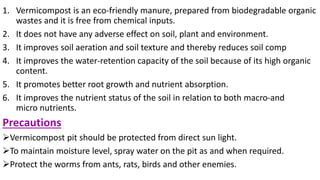
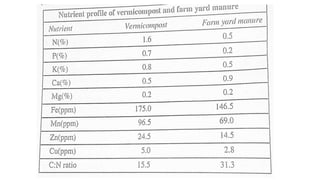
1. Vermicompost is an eco-friendly manure, prepared from biodegradable organic
wastes and it is free from chemical inputs.
2. It does not have any adverse effect on soil, plant and environment.
3. It improves soil aeration and soil texture and thereby reduces soil comp
4. It improves the water-retention capacity of the soil because of its high organic
content.
5. It promotes better root growth and nutrient absorption.
6. It improves the nutrient status of the soil in relation to both macro-and
micro nutrients.
Precautions
Vermicompost pit should be protected from direct sun light.
To maintain moisture level, spray water on the pit as and when required.
Protect the worms from ants, rats, birds and other enemies.
Composting worms
• Earthworms are of two groups, namely humus-formers and humus-feeders.
• The members of the first group dwell in the surface soil and feed on nearly 90%
fresh organic materials and 10% soil.
• They are generally red in colour, have a flat caudal region, and are called epegeic
or detritivorous worms.
• These are the worms that are harnessed for vermicomposting.
• Earthworm species with high composting potential are selected for vermiculture.
• The species, commonly employed in India, are the following:
1) Endemic species - Perionyx excavatus, P.sansibaricus, P.scales, Dendrobaena
veneta, Dichogaster spp., etc.
2) Exotic species - Eudrilus eugeniae, Eisenia fetida, Lumbricus rubellus, etc.
• Of the above mentioned species, Eudrilus euginiae is found to have higher
feeding capacity, faster growth rate, and greater biodegradation potential,
compared to the other species.
• Earthworm action enhances the natural biodegradation and decomposition of
wastes (60-80 percent under optimum conditions), significantly reducing the
composting time by several weeks.
• Within 5 to 6 weeks, 95-100 percent degradation of all cellulosic materials can
be achieved.
• Even hard fruits, egg shells and bones can be degraded, although it may take
more time.
• An earthworm, on reaching the reproductive age of about six weeks, lays one
egg capsule in every 7 - 10 days.
• Three to seven worms emerge out of each capsule.
• Thus, the multiplication of worms under optimum growth conditions is very fast.
• The worms live for about 2 years.
• Fully grown worms could be separated and dried in an oven to make 'worm
meal' which is a rich source of protein (70%) for use in animal feed.
Uses
• Vermicompost, apart from supplying nutrients and growth-enhancing hormones
to plants, improves the soil structure and increases the water and nutrient-
holding capacities of soil.
• Chemical fertilizers in moderate doses can also be applied together with
vermicompost.
• Vermicomposting is a technology for the disposal of domestic garbage, solid
municipal waste and non-toxic solid and liquid industrial wastes, for the
production of non-chemical and non-synthetic manure, and also for keeping the
environment clean and healthy.
Production of vermiwash
• Vermiwash is the coelomic fluid extract and other secretions of earthworms.
• In recent times, commercial vermiculturists have started promoting this product
for foliar application.
• For the production of vermiwash, earthworms are cultured in tanks with double
vessels.
• The inner vessel will have an outlet at the lower side.
• The inner vessel is filled with decomposing organic matter.
• About 1 to 2 kg earthworms are accommodated in a 12 to 16 litre capacity vessel.
• As the earthworms start feeding on the waste, water is slowly added into the
vessel in excess.
• The excess water flows out through the outlet as a thick syrupy fluid.
• It is collected in the outer vessel.
• The fluid so collected is siphoned out, diluted and used as a foliar spray to
different crops.
• In some farmlands, the tank is built at an elevated place.
• The slope in the tank, enables excess water to flow out in drops as a thick
syrupy through a small outlet.
• It is collected in a container and stored in bottles.
• It is and sprayed on crops.
• Vermiwash spray is believed to contain enzymes, stimulate the growth and
yield of crops and even develop resistance in crops.
BIOFERTILIZERS
• Explosive growth of mankind necessitated a corresponding increase in food
production also to feed the booming millions.
• For achieving this goal, intensive farming methods, making use of high-yielding crop
plants, advanced agricultural technologies, and chemical fertilizers and pesticides have
been introduced.
• Even though this has tremendously boosted up food production, it has also polluted
and poisoned the biosphere and severely affected the quality and productivity of the
soil.
• To minimize these hazards, and to support sustainable and highly productive
agriculture, a combination of traditional and modern agricultural practices has to be
adopted.
• This calls for the use of eco-friendly biofertilizers and biopesticides.
• Bio-fertilizers are organisms that enrich the nutrient quality of the soil.
• The main sources of bio-fertilizers are bacteria, cyanobacteria (blue-green algae) and
fungi.
• The most striking symbiotic relationship of biofertilizers with plants is mutually
beneficial to both the partners.
• Plants have different kinds of relationships with fungi, bacteria, and algae.
• The commonest examples are
1. the symbiotic relationship between Rhizohium and legumes, and also
between Anabaena and Azolla,
2. the association of certain bacteria (e.g., Azospirillum) with some plants,
3. the relation of some free-living nitrogen-fixing soil bacteria (e.g., Azotobacter,
Bacillus polymyxa) and cyanobacteria with plants, and
4. the mycorrhizal relation between some fungi and the root system of some
seed plants.
• These relationships are known to deliver a number of benefits including plant
nutrition, disease resistance, and tolerance to adverse soil and climatic
conditions.
• Apart from these, bio-fertilizers solve such problems as increased soil salinity,
and chemical run-off from agricultural fields.
• Thus, biofertilizers are very important if we are committed to ensure a healthy
future for the generations to come.
1. Mycorrhiza
• Mycorrhiza is a symbiotic association between fungal mycelium and the roots of seed-
plants.
• In fact, seedlings having mycorrhizal fungi growing on their roots survive better and
grow faster after transplantation.
• Mycorrhizal association increases the uptake of water and nutrients by plants.
• The fungal symbiont gets shelter and food from the plant.
• The plant, in return, is benefited by better uptake of phosphorus, higher tolerance to
salinity and drought, proper maintenance of water balance, and an overall increase in
growth and development.
• There is some degree of specificity with regard to the partners of this association.
• Thus, there are specific fungi for vegetables, fodder crops, flowering plants, trees, etc.
• Mycorrhizal fungi can increase the yield of a land by 30%-40%.
• They absorb phosphorus from the soil and pass it on to the plants.
• Mycorrhizal plants have higher tolerance against high soil temperatures, various soil-
borne and root-borne pathogens, and heavy metal toxicity.
• Mycorrhizal association is of two types, namely ectomycorrhiza and endomycorrhiza.
a) Ectomycorrhiza
• This is the mycorrhizal association in which the fungus grows on the root surface of
the plant.
• In this case, a well developed fungal mycelium forms a mantle on the surface of the
root.
• From the mantle, hyphal branches penetrate the root cortex and also the soil.
• This increases the contact area between soil and the absorptive surface of the root.
• This, in turn, increases the uptake of water and nutrients.
• The fungal hyphae in the soil can convert complex organic compounds to simple ones,
which are then absorbed by plants.
• Ectomycorrhizae commonly occur on the roots of pine, oak, peach and eucalyptus.
• They can absorb and store nitrogen, phosphorus, potassium and calcium into their
cells.
b) Endomycorrhiza
• This is the mycelial association in which the fungus lives within roots.
• It is common in orchids and some woody plants.
• In some endomycorrhizae, the fungus lives in between the cells of the root
cortex and develops temporary hyphal projections, which penetrate the cortical
cells.
• Such projections may be simple vesicles or branched masses, called arbuscules.
• So, there are two types of endomycorrhizae, namely vesicular endomycorrhizae
and arbuscular endomycorrhizae.
• Endomycorrhizae are very important in the phosphate nutrition of plants.
• Many grasses and crop plants establish a symbiotic relation with them.
2. Rhizobium-legume association
• Rhizobium is a symbiotic, nitrogen-fixing bacterium inhabiting the root nodule: of
leguminous plants.
• It is capable of fixing atmospheric nitrogen and excreting amino acids.
• This increases the soil fertility.
• Rhizobium cultures, raised in laborato ries, are now commercially available.
• Nitrogen fixation is also controlled by th availability of phosphorus.
• Therefore, a combination of phosphatic fertilizers an Rhizobium can be used for better
results.
• Different specie of Rhizobium are used for associating with the leguminous crops, For
example, Rhizobium leguminosarum is used for peas (Pisum), Rhizobium phaseoli is
used for kidney beans (Phascolus), and Rhizobium japonicum is used to soya beans
(Glycine).
• Rhizobium species enter the roots of the host plants and form nodules on the root
surface.
• The bacteria depend on the host plants for carbohydrate and water.
• At the same time, they supply nitrogen to their hosts.
3. Blue-green algae (Cyanobacteria)
• Several species of blue green algae fix atmospheric nitrogen and release amino
acids and proteins.
• The most important ones are the species of Anabaena, Aulosiro and Nostoc.
• The amount of nitrogen fixed by blue green algae varies from 25-30 kg/ha.
• Standing water of 2-10 cm depth in the field is a prerequisite for the growth of
blue green algae.
• They can grow at a temperature range of 25-45°C. Bright sunshine increases their
growth rate, while rains and cloudiness slow down the growth rate.
• Also, they grow well in a pH range between 7 and 8, and in soils with high
organic matter.
• Blue-green algae are recommended for wet land paddy cultivation, especially in
neutral and slightly alkaline soils.
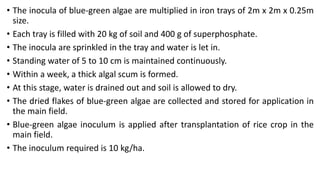
• The inocula of blue-green algae are multiplied in iron trays of 2m x 2m x 0.25m
size.
• Each tray is filled with 20 kg of soil and 400 g of superphosphate.
• The inocula are sprinkled in the tray and water is let in.
• Standing water of 5 to 10 cm is maintained continuously.
• Within a week, a thick algal scum is formed.
• At this stage, water is drained out and soil is allowed to dry.
• The dried flakes of blue-green algae are collected and stored for application in
the main field.
• Blue-green algae inoculum is applied after transplantation of rice crop in the
main field.
• The inoculum required is 10 kg/ha.
• Certain blue-green algae live intimately with other organisms in a symbiotic
relationship.
• Some are associated with fungi, forming lichens.
• The ability of bluegreen algae for photosynthesis and also to fix atmospheric
nitrogen accounts for their symbiotic associations and also for their presence in
paddy fields.
• Blue-green algae are of immense economic value as they add organic matter to
the soil and increase soil fertility.
• Barren alkaline lands in India have been reclaimed and made productive by
promoting the proper growth of certain blue-green algae.
4. Azolla - Anabaena association
• Azolla is a free-floating and fast-growing fresh-water fern Azolla pinnata is the
commonest species recommended in India as a biofertilizer for rice.
• The cyanobacterium Anabaena azollae lives as an endophyte in the leaf cavities
of Azolla It can fix atmospheric N, and excrete nitrogenous compounds into the
leaf cavities of Azolla.
• A thick mass of Azolla supplies 30-40 kg N/ha.
• Unlike blue-green algae,it thrives well at low temperature.
• Normal growth of Azolla occurs in a temperature range between 20 and 30°C.
• It grows better during monsoon season with frequent rains and cloudiness.
• Nursery area of Azolla should be under the shade of trees.
• Small plots of 4m x 2m with bunds of 30 to 40 cm height all around are prepared.
• The bunds may be lined with polythene sheets to avoid leakage of water from
plots.
• Water is let into the plots and Azolla is applied at the rate of 0.1 to 0.5 kg/m2.
• For faster growth, super-phosphate at the rate of 2.5g/m2 is applied.
• Carbofuran granules at 1.2 g/mare applied to control leaf eating caterpillars and
other pests.
• Azolla is applied to the main field as a green manure crop and also as a dual
crop.
• As a green manure crop, it is allowed to grow on the flooded fields for 2 to 3
weeks before transplanting.
• Later, water is drained and Azolla is incorporated by ploughing in.
• The left over Azolla develops again as a second crop.
• For the better growth of Azolla, 25 to 50 Kg/ha of superphosphate is applied.
• Standing water of 5 to 10 cm is maintained continuously in the rice fields.
5. Azospirillum
• Azospirillum is a nitrogen-fixing bacterium, living in association with the roots
of grasses and maize.
• In India, the yield of rice, sorghum and maize has been increased through
Azospirillum application.
• A combination of chemical fertilizers with Azospirillum may give better results.
6. Other free-living soil bacteria
• Free-living soil bacteria, such as Clostridium, Azotobacter, Bacillus polymyxa,
etc., can fix atmospheric nitrogen and make it available to crops.
• Azotobacter, when grown with rice, maize, jowar and cotton, helps to save
nitrogenous fertilizers.
Methods of application of biofertilizers
1. Seed treatment:
• On an average, 500g of commercially available biofertilizer will be required for
the treatment of the seeds meant for one hectare area.
• A thick slurry of the biofertilizer is initially prepared by mixing with 1.25 litres
of 10% jaggery solution or 5% sugar solution containing 40% gum arabic or
1.25 litres of thick rice gruel water.
• The seed material is gently mixed with this slurry, dried in shade and sown
immediately in moist soil.
2. Seedling treatment:
• This method of application is recommended only for transplanted crops.
• In this procedure, the roots of the seedlings are dipped in a loose slurry of the
biofertilizer (500g in 2.5 litres water) for 20 minutes prior to transplanting.
• The above quantity of inoculum will be sufficient for treatment of seedlings raised
from about 10 Kg of seeds.
3. Soil application:
• Soil application is recommended for all types of biofer except Rhizobium.
• The recommended practice is to apply the biofertilizer after with farm-yard manure,
compost or vermicompost in the proportion 1:25.
• For of 6 month duration, 1-2 Kg/ha of biofertilizer is required.
• This can be increase 2-4 Kg/ha for crops of more than 6 months duration.
• The biofertilizer can be appli at the time of sowing, transplanting or intercultural
practices.
• In the case of perennial crops, 10 to 25 g of biofertilizer per plant or tree is
recommended during the first year, and 25 to 50 g during subsequent years.
Horticulture 3

Horticulture 3

  • 1.
  • 2.
    • Fertilizers arethe natural or synthetic organic and inorganic materials, applied to soil or plants to supply the elements that are essential for the growth and development of plants. • The term manure was used sometime before to denote materials, such as cattle manure, farm yard manure and other natural substances, that are applied to the land for increasing soil productivity (soil productivity refers to the capacity of the soil to produce crops per unit area). • Later, chemical substances, such as ammonium sulphate, urea, etc., began to use for the same purpose. • Nowadays, the organic substances used for increasing crop production are called manures, and the inorganic substances used for the same purpose are termed fertilizers.
  • 3.
    Maintenance of soilfertility • One of the most serious problems a crop producer has to face is the maintenance of soil fertility. • Soil fertility refers to the ability of the soil to supply plants all essential nutrients in optimum amounts and readily utilizable forms, Organic manures are excellent sources of organic matter, but are relatively low in nutrients. • Therefore, organic manures need to be applied in huge amounts to compensate their low nutrient content. • Organic manures supply enough humus to improve the physical condition of the soil. • The source of plant nutrients may be organic or inorganic. • Most of the fertilizers applied in horticultural fields are inorganic.
  • 4.
    A. Organic manure •Organic manures are usually derived from animal or plant sources. • They may be classified into bulky organic manures and concentrated organic manures. • Bulky organic manures include farmyard manure (FYM), compost and green manure. • Concentrated organic manures contain higher percentages of Nitrogen, Phosphorus and Potassium than in bulky organic manures. • The common concentrated organic manures are oilcakes, blood meal, fish manure, meat meal, cotton and wool wastes, etc.
  • 5.
    Oil-cakes • Oilcakes arethe leftover materials after extracting oil from oil-seeds. Oilcakes contain N, P,O, and K,O and a large percentage of organic matter. • Oilcakes are quick acting organic manures. • Their nitrogen becomes available to plants within a few days after application. • They should be well powdered before application, so that they can be spread evenly and can be easily decomposed by micro-organisms. • Well-powdered oilcakes can be applied during sowing. Blood meal • Blood meal, or dried blood, is made from the blood collected from slaughter houses. • It contains 10-12% Nitrogen and 1-2% phosphoric acid. • Blood meal is a quick-acting manure and is effective for all crops in all types of soils.
  • 6.
    Meat meal • Meatmeal is obtained from dried meat and meat wastes. • It contains about 10.5% Nitrogen and 2.5% phosphoric acid. • It is also a quick-acting manure and is applied to many crops. Fish meal • Fish meal or fish manure is prepared by drying and crushing the non-edible parts and the carcasses of fishes. • It contains 4-9% Nitrogen, 3-9% phosphoric acid and 0.3 to 1.5 % potash. • It is a quick-acting organic manure, ideal for all crops and soils. Cotton and wool wastes • Cotton and wool wastes, known as shoddy, supply about 50-150 kg of Nitrogen per tonne and may be applied as organic manure at the rate of 2.5 to 5.0 tonnes per hectare. • They are suitable for all types of crops and soils.
  • 7.
    Application of organicmanure • To get the maximum advantage of manure, the following guidelines should be observed while applying organic manure. 1. Manure must be applied a couple of weeks or a few days before planting. If applied too far in advance, some Nitrogen may be lost by leaching. To avoid burning of the seeds and seedlings, fresh manure should be applied at least four weeks in advance; rotten manure does not cause damage. 2. Manure, containing large amounts of straw, may actually cause a temporary Nitrogen deficiency unless some Nitrogen fertilizer is added. 3. Soil should be ploughed or hoed soon after the application of manure. A delay may cause loss of Nitrogen as Ammonia gas. 4. If manure is available in limited quantities, always use at moderate rates over a large area, rather than at high rates over a small area. 5. Even high rates of manure will not always satisfy a crop's entire N-P-K needs. In such situations, some supplementary inorganic fertilizers may be added.
  • 8.
    Advantages of organicmanure 1. Coarse organic manure on the soil surface reduces the impact of rainfall. It permits clear water to seep gently into the soil. Also, it reduces surface runoff and soil erosion so that more water may be available for plant growth. 2. Decomposing organic matter produces slime which helps the formation and stabilization of the desirable soil structure. 3. Dead organic bodies decay and provide channels through which new plant roots grow more luxuriantly. These channels are effective in transmitting water downward. 4. Fresh organic matter supplies food for soil organisms, such as earthworms. These animals burrow in the soil and make the soil more porous. This helps plant roots to obtain oxygen and to release carbon dioxide as they grow. 5. Surface mulches lower soil temperatures in the summer and keep the soil warmer in winter. 6. Organic mulches reduce the loss of water by evaporation. 7. Upon decomposition, organic matter supplies almost all nutrients. These nutrients are released as per the needs of the plants. When environmental conditions are favorable for rapid plant growth, there will be a rapid release of nutrients from the organic matter.
  • 9.
    • 8.A soil,high in organic matter, has more available water for plant growth than the same soil with less organic matter. • 9. Organic matter helps to buffer soils against rapid chemical changes cause the addition of lime and fertilizers. • 10. Organic acids released during the decomposition of organic matter help to dissolve minerals and to make them more available to growing plants. • 11. Humus acts as a storehouse for the exchangeable and available cations, such as K+, Ca2+ and Mg2+
  • 10.
    Disadvantages of organicmanure • Organic manures are not commonly used in horticulture fields because of the following reasons: 1. They are bulky to handle and require large amounts of space to store. 2. Since their nutrient content is low, large quantities of them are required to provide appreciable amounts of the nutrients needed. 3. They are difficult to quantify and apply according to the given specifications. 4. The nutrients they contain are released slowly by decomposition, and the rate of their decomposition varies depending on the environmental conditions. 5. They are difficult to apply uniformly in the soil. 6. They can be applied only to the soil, and not to leaves or other plant parts.
  • 11.
    B. Inorganic fertilizers •Inorganic fertilizers are also called commercial or chemical fertilizers. • They contain higher concentrations of nutrients than in organic manures, but lack soil-improving qualities. • Inorganic fertilizers are classified into straight, complex and mixed fertilizers. a) Straight fertilizers • These are the fertilizers which supply only primary plant nutrients, such as nitrogen, phosphorus and potassium. • Urea, ammonium sulphate, potassium chloride and potassium sulphate are the common examples.
  • 12.
    b) Complex fertilizers •The inorganic fertilizers which contain two or three primary plant nutrients of which two are in chemical combination. • These fertilizers are produced in granular form Diammonium phosphate, nitrophosphate, and ammonium phosphates are complex fertilizers. c) Mixed fertilizers • These are the physical mixtures of straight fertilizers. • They contain two or three primary plant nutrients. • Mixed fertilizers are made by thoroughly mixing the ingredients either mechanically or manually.
  • 13.
    Advantages of inorganicfertilizers • Inorganic fertilizers are most widely used to provide supplementary nutrients to horticultural plants in the field or in containers. • They are popular because of the following reasons: 1. They are easy to store. 2. They have higher nutrient content than in organic fertilizers. 3. They can be formulated for specific purposes. 4. Inorganic fertilizers are easy to apply and can be applied uniformly. 5. They are available in liquid and solid forms. 6. They can be applied to both soil and leaves. 7. Accurate quantitative application is possible. 8. Nutrients are readily available to plants. 9. Growers can mix their own formulations accurately.
  • 14.
    Methods of fertilizerapplication • The method of application of fertilizers depends on their form, whether liquid or solid (dry). • Fertilizers may be applied either to the soil or to the plant leaves. • In any case, they may be spread out, or confined to a small area. • Nitrogen fertilizers are available as single-element or as compound forms. • While applying nitrogen fertilizers, the stage of development of the crop as well as the season have to be considered. • Nitrogen is needed most by almost all crops in the early stages of growth and development. • When applied in cold conditions in ammonium form, the change to usable nitrate form is slow. • Nitrogen fertilizers may be acidic, alkaline, or neutral in reaction.
  • 15.
    Application of fertilizers •The first step in a fertilizer programme is to determine the type and amount of fertilizer needed. • Excessive fertilization is economically wasteful and may even injure or kill the plants. Fertilizers may be applied before planting (pre-plant). • The recommended amount may be distributed almost uniformly all over the area. • Sometimes, fertilizers are applied after germination, and also at various stages of the growth of the crop.
  • 16.
    (1) Dry application •Dry fertilizers are often applied to the soil. • They may be spread out or trated in bands or spots. • Four general methods of application are usually emplo namely broadcasting, banding, side dressing and drill hole method. a) Broadcasting • Broadcasting is the manual or mechanical spreading of the fertilizer over the surface area of the soil as evenly as possible. • If it is done during soil preparation, a plough may be used to incorporate the fertilizer with the soil. • The disadvantage of this method is that every part of the field is not equally fertilized so that much of the fertilizer may not not utilized by widely spaced horticultural plants.
  • 17.
    b) Banding • Asthe name implies, banding is the localised application of fertilizers near around the seed or plant. • Care must be taken to place the fertilizer 2 to 3 inches (5.1 to 7.6 centimeters) apart either beside or beneath the seed or plant to prevent injury to the seedlings from the excessive salts. • This excess of salts is usually a concern when especially strong nitrogen and potassium fertilizers are used. c) Side dressing • This is the fertilizer application in which the soil is not disturbed during application. The time of application is very important. • For example, when urea is applied on a hot summer day, the area must be irrigated to reduce the loss through volatilization. • Crops planted on beds are usually fertilized by this method. • Care must be taken not to bring the dry fertilizer in direct contact with the plant foliage. d) Drill hole method • This is the method in which holes are drilled up to the root zone of the crop plants and are then filled with granular fertilizer at the recommended rate. • This method makes the fertilizer readily available to the root system. • This method is usually employed to fertilize the plants grown in lawns and courtyards.
  • 18.
    (ii) Liquid application •Liquid fertilizer application is the application of fertilizers in a dissolved liquid form either to the soil or to the leaves. • It is accomplished in two ways, namely foliar application and fertigation. a) Foliar application • This is the spraying of liquid fertilizers on leaves. • It is often employed to solve the problems of the deficiency of trace elements. • Trace elements are required only in minute amounts and so it is safe to administer them in lower concentration by spraying them directly onto the leaf surface. • Since only small amounts of chemicals are applied, this method is not adequate to meet the nutritional needs of plants.
  • 19.
    b) Fertigation • Fertigation,or chemigation, is the application of fertilizers to crops through irrigation water. • This method is usually practiced in greenhouses. • Drip irrigation method is particularly suitable for fertigation. • Effectiveness of fertigation depends on the solubility of the fertilizer and the quality of irrigation water. • Water-soluble fertilizers should be used in fertigation. • Hard water, with excessive amounts of dissolved calcium, can be problematic because it may cause the blockage of holes by calcium deposition. • Fertigation is effective in soils which drain rapidly (e.g., sandy soil) and also when the fertilizer is prone to leaching (e.g., Nitrogen). • Regulation of the flow rate will enable the plants to efficiently utilize the fertilizer and to maintain optimum moisture content.
  • 20.
    COMPOSTING • Composting isthe biological decomposition of solid and putrescible organic matter into stable mineral compounds. • It results in the formation of a humus-like material, called compost. • The organisms involved in composting are bacteria, fungi, earthworms, insects and some other soil organisms. • Composting is a deliberate activity by gardeners for the decomposition of organic matter. • Organic matter affects both the physical and chemical properties of soil. • It improves the aeration and the moisture retention capacity of the soil. • Through gradual decomposition, it releases both major and minor nutrients into the soil for plant use. • Composting promotes the production of organic matter and nutrient recycling. • In the soil, compost acts as a source of slow-release fertilizer.
  • 21.
    Principles of composting •The basic mechanism of composting is the decomposition of organic wastes and residues for the incorporation of their chemical constituents into the soil in order to modify and improve the physical properties and the chemical qualities of the soil, and also to enhance its nutrient level. • Composting essentially involves the interaction between biotic and abiotic factors of the environment. Decomposers are the biotic agents and organic matter is the abiotic factor. • Decomposers convert organic matter into compost through decomposition. • There are two groups of decomposers that inhabit the soil, namely microorganisms and macroorganisms. • The major microorganisms involved in decomposition are bacteria and fungi, and the major macroorganisms include earthworms, insects and insect grubs. • These organisms should be provided with appropriate environmental or abiotic factors for their growth. development and composting activity.
  • 22.
    • An activecompost heap represents an environment, crowed with a wide variety of microorganisms. • These organisms operate successively, depending on the temperature in the heap. • The temperature in the heap changes because heat is released during the metabolic activity of the composting organisms. • Bacteria can operate over a wide range of temperature conditions. • Some prefer cool conditions, while the others prefer warm conditions. • There are three groups of microbes involved in composting. • They are psychrophiles, mesophiles and thermophiles. • Psychrophiles are active at low temperatures, mesophiles are active at moderate temperatures, and thermophiles are active at high temperatures. • Psychrophiles operate at temperatures even below the freezing point (at -2.22°C), but they work best around 12.8°C. • They dominate in compost heap at the initial stage when the temperature is low. • Their metabolic activities cause the temperature to go high. • Mesophiles operate at a temperature range between 21.1 and 32.2°C. • They form the major work-force of composting. • However, at or above 37.8°C, they are replaced by thermophiles.
  • 23.
    • Thermophiles arethe heat-loving bacteria which work at a much higher temperature. • They raise the temperature of the compost heap to a 71°C or more. • However, these microbes cannot act upon cellulose, lignin, and other hard-to- metabolize substances. • So, such substances are left behind in the heap. • Only fungi are able to decompose them. • Their presence in the heap is indicated by the occurrence of whitish strands or cobweb-like structures. • Macroorganisms, such as earthworms, are also important in the compost heap. • They feed on organic matter and excrete materials rich in nutrients for plant growth. • Earthworms are abundant in soils that have high microbial activity.
  • 24.
    Compostable materials • Thequality of compost depends on the materials used in the compost heap. • Good compostable materials include household garbage, leaves, sawdust, straw or hay, animal dung, ash, etc. • Non-biodegradable substances, and the substances which yield toxic products that are harmful to decomposing organisms, are undesirable in a compost heap. • These materials include plastics, synthetic cloths, pesticides, etc... Compost activators • To accelerate the process of decomposition a compost pile is inoculated with materials called activators. Compost activators can be natural or artificial.
  • 25.
    (1) Natural activators •Natural compost activators include loamy soil, finished compost, protein meal, organic manure, etc. 1. Loamy soil - The decaying organic component of a loamy soil contains soil microbes. 2. Finished compost - Finished compost from a previous pile may be used to inoculate a fresh compost heap. 3. Protein meal - Protein meals, derived from high-protein plant materials or animal sources, including fish meal, bone meal, and blood-meal, promote composting. 4. Organic manure - Organic mannure from a variety of farm animals, such as poultry, cattle, and sheep, is a good activator. However, it should not be used afresh. It is safe when it is well decomposed.
  • 26.
    (ii) Artificial activators •Artificial compost activators include fertilizere, inoculants, etc. a) Fertilizers - These are less efficient than natural activators because they lack protein. Compound fertilizers, consisting of nitrogen, phosphorus, and potassium (10:10:10), may be used. b) Inoculants - These are the agents commercially prepared from dormant bacteria and fungi and packaged as tablets or granules.
  • 27.
    Composting systems • Basicallythere are two types of composting, namely non-container (in situ) method and container (ex situ) method. (i) Non-container (in situ) method or sheet composting • Non-container method, or in situ method, is the direct way of composting. • In it, the raw materials are composted in the same location in the soil where their products will be used. • The raw materials used include leaves, plant residues after harvesting, grass clippings, animal dung, etc. • These materials are incorporated into the soil by an appropriate implement, such as spade or mechanical tiller. • Another version of this method, called green manuring, involves the growing of leguminous species (clover, alfalfa, peas, soybean, etc.) and ploughing them a little deep into the soil while they are fresh. • In situ or sheet composting is simple and it allows the complete decomposition of organic matter. • Its major disadvantage is that it takes several months for the completion of decomposition. • Another disadvantage is that heat does not build up in it to a high level at which weed seeds are killed.
  • 28.
    (ii) Container (exsitu) method • This is the composting of organic matter in pits or in specially constructed containers from where the compost is transported to other places for application. • Thus in this method, compost is prepared in one place and used somewhere else.
  • 29.
    General procedure ofex situ composting • The success of ex situ composting depends on the observance of four principal aspects, namely layering, moisture supply, size of compost pile and aeration. 1. Layering • This is the orderly stacking of the composting materials in layers, instead of irregularly dumping them in open heaps. • Dry materials, such as straw, should be arranged in layers, alternating with fresh materials, such as grass clippings and vegetable matter. • Nitrogen-rich materials should alternate with carbon-rich materials. • After several layers, the activator should be spread evenly before another set of material is added. • This pattern is repeated until the container is filled.
  • 30.
    • 2. Moisturesupply • Water is essential for microbial decomposition. • At the same time, too much of water causes anaerobic conditions in the heap, and too little of water slows down decomposition. • So, maximum care should be taken to provide moisture most appropriately and almost uniformly all over the heap. • This is accomplished by moistening the different layers of the material one after another. • A well-moistened compost heap may be as moist as a wet sponge. • Overwatering of the compost heap is wasteful and it may cause the leaching of nutrients. • Rain water is ideal for watering, since it contains useful microorganisms, minerals and oxygen.
  • 31.
    3. Size ofthe heap • The size of the compost heap should be manageable and self insulating, without causing compaction in the layers. • A large heap may cause overheating and anaerobic conditions in its interior. • This situation is detrimental to bacteria. • A small heap, on the other hand, may be overventilated so that it may not reach peak temperatures. • In such cases, artificial insulation is to be given. • Since the heap has to be regularly turned over, a huge heap may be unmanageable. 4. Aeration • Compost heap should be well ventilated for the multiplication of aerobic bacteria. • It may be built around ventilating pipes or a tube of wire mesh. • This is necessary when the compost heap is left unturned, or turned only less frequently. • Turning the compost heap frequently is tedious, but it accelerates the rate of decomposition. • Home composters turn their heaps less frequently unless a foul odour develops. • Frequent turning must be done only after a peak temperature has been attained in the heap every time (to kill weed seeds). • Turning the heap too frequently is disadvantageous to the activity of the decomposers.
  • 32.
    Different methods ofex situ composting • There are four major methods of ex situ composting, namely trench composting, open window composting, mechanical composting and vermicomposting. (a) Trench composting • This is the composting carried out in specially made trenches in open ground. • In this method, 4 to 10m long, 2 to 3m wide, and 0.7 to 1.Om deep trenches are excavated. • Solid waste is spread in these trenches in 15cm thick layers, sandwiched by 5cm thick layers of semi-liquid cattle dung, until the waste heap rises to 30cm or more above the ground level. • Then, a 5 to 7.5 cm thick layer of soil is spread over the top of the heap. • This prevents wind-blowing of the waste and blocks the entry of insects. • In about 4 to 5 months, decomposition is completed and humus-like compost gets stabilized. • It is removed, seived and used as a manure.
  • 33.
    (b) Open windowcomposting • This is the composting carried out on open ground surface. • In this method, solid waste is dumped on open ground as 5 to 10m long, 1 to 2m wide, and 0.5 to 1.0m high heaps. • The top of each heap is covered with cattle dung. • After a few days, the heaps are raked and turned upside down for cooling and aeration. • In about 4 to 6 weeks, the compost gets stabilized. (c) Mechanical composting • This is the method in which putrescible solid wastes are converted to compost by mechanical devices in composting plants. • The whole process is completed in about 3 to 6 days. • Mechanical composting involves segregation, shredding (pulverization) and stabilization of the waste, and the processing of the stabilized mass for marketing.
  • 35.
    (d) Vermicomposting • Vermicompostingis the composting of solid organic wastes using some species of earthworms. • It is much faster than trench composting and open-window composting. • The compost, produced by the breakdown of organic debris by earthworms, is known as vermicompost. • There is a growing realisation that vermi-compost provides nutrients and growth enhancing hormones for plant growth. • The fruits, flowers, vegetables, etc. produced by using vermicompost, are reported to have better keeping quality. • Presently, a number of individuals and institutions are taking interest in vermicomposting. • Vermicomposting can be carried out in bins, tanks, or other suitable containers • The solid waste is first allowed for natural primary decomposition.
  • 36.
    • Then, itin Then, it is filled to the vermicomposting containers. • Now, earthworms are released to the com They gradually bring about composting. • The whole process is completed in abin about 60 to 75 days. • The composting of crop residues using earthworms involves the spreading of agricultural wastes and cow dung in alternating 1.5 m wide and 0.9 m thick layers beds of required length. • Earthworms are introduced in between the layers at the of 350 worms per m of bed volume. • The beds are maintained at about 40 to 500 moisture content and a temperature of 20 to 30°C by sprinkling water over the beds Earthworms are voracious eaters. • They consume the biodegradable matter and give out a part of it as excreta or vermi-casting. • The vermi-casting, containing nutrients is a rich manure for the plants.
  • 37.
    Vermiculture • Vermiculture isthe artificial rearing or cultivation of earthworms for the production of vermicompost and vermiwash, and also for the manufacture of animal feed. • Vermicompost is the nutrient-rich and humus-like excreta of earthworms. • Earthworms eat biodegradable wastes, such as cow-dung, farm yard manure and other farm wastes. • When these organic wastes pass through their alimentary canal, they will get converted into vermicompost. • Municipal wastes, non-toxic solid and liquid industrial wastes and household garbage can also be converted into vermicompost in the same manner. • Earthworms not only convert garbage into valuable manure but also keep the environment clean and healthy.
  • 38.
    Method of preparationof vermicompost • A thatched roof shed, preferably open from all sides and with unpaved (katcha) floor, is constructed in east-west direction lengthwise to protect the site from direct sunlight. • A 12 m x 12 m shed area is sufficient to accommodate three 10 mx 3 m size vermibeds, with sufficent spaces in between them for the treatment of 9-12 quintals of waste in a cycle of 40-45 days. • The length of the shed can be increased or decreased, depending upon the quantity of the waste to be treated and the availability of space. • The height of thatched roof is kept at 8 feet from the centre and 6 feet from the sides. • The floor of the site is raised at least 6 inches above ground to protect the procedure given below. it from flooding during the rains. • Vermibeds are laid over the raised ground as per • The site of vermibeds on the raised ground is watered first. • Then, a 4"-6" thick layer of slowly biodegradable agricultural residue, such as dried leaves, straw, sugarcane trash, etc. is laid over it after soaking with water.
  • 39.
    • This isfollowed by 1" thick layer of vermicompost or farm yard manure. • Earthworms are released to each vermibed at the following rates: 1) For the treatment of cow dung or agricultural waste: 1.0 kg. / bed 2) For the treatment of household garbage: 1.5 kg. / bed • The frequency and limits of loading the waste may vary, depending upon the convenience of the user. • The loaded waste is finally covered with a jute mat to protect earthworms from birds and insects. • Water is sprinkled on the vermibeds daily according to the requirement and the season to keep them moist. • The waste is turned upside down fortnightly, without disturbing the basal layer (vermibed). • The appearance of black, granular and crumbly powder on the top of vermibeds indicates the harvest stage of the compost. • Watering is stopped for at least 5 days at this stage. • The earthworms go down and the compost is collected from the top without disturbing the lower layer (vermibed). • The first lot of vermicompost is ready for harvesting after 2 - 212 months and the subsequent lots can be harvested after every 6 weeks of loading. • The vermibeds can be loaded further for subsequent treatment cycle.
  • 40.
    Multiplication of earthworms •Multiplication of earthworms can be achieved as follows. Prepare a mixture of cow-dung and dried leaves in 1:1 proportion. • Release earthworms at the rate of 50 numbers/10 kg. of the mixture. • Add more dried grass, leaves, or husk and mix well and keep the mixture in shade. • Sprinkle water over it from time to time to maintain the moisture level. • Earthworms multiply nearly 300 times within one to two months. • These earthworms can be used to prepare vermicompost.
  • 41.
    Advantages of vermicompost •Vermicomposting is not only a source of non-chemical or non-synthetic natural fertilizers, but also a technology for the management of biodegradable wastes. • Earthworms eat biodegradable wastes and convert them into vermicompost. • Municipal wastes, non-toxic solid and liquid industrial wastes and domestic garbage can be converted into vermicompost in this manner. • Earthworms not only convert garbage into valuable manures but also keep the environment healthy. • Conversion of garbage by earthworms into compost and the multiplication of earthworms are simple processess and can be easily managed by the farmers. • The major advantages of vermicompost are the following:
  • 42.
    1. Vermicompost isan eco-friendly manure, prepared from biodegradable organic wastes and it is free from chemical inputs. 2. It does not have any adverse effect on soil, plant and environment. 3. It improves soil aeration and soil texture and thereby reduces soil comp 4. It improves the water-retention capacity of the soil because of its high organic content. 5. It promotes better root growth and nutrient absorption. 6. It improves the nutrient status of the soil in relation to both macro-and micro nutrients. Precautions Vermicompost pit should be protected from direct sun light. To maintain moisture level, spray water on the pit as and when required. Protect the worms from ants, rats, birds and other enemies.
  • 44.
    Composting worms • Earthwormsare of two groups, namely humus-formers and humus-feeders. • The members of the first group dwell in the surface soil and feed on nearly 90% fresh organic materials and 10% soil. • They are generally red in colour, have a flat caudal region, and are called epegeic or detritivorous worms. • These are the worms that are harnessed for vermicomposting. • Earthworm species with high composting potential are selected for vermiculture. • The species, commonly employed in India, are the following: 1) Endemic species - Perionyx excavatus, P.sansibaricus, P.scales, Dendrobaena veneta, Dichogaster spp., etc. 2) Exotic species - Eudrilus eugeniae, Eisenia fetida, Lumbricus rubellus, etc. • Of the above mentioned species, Eudrilus euginiae is found to have higher feeding capacity, faster growth rate, and greater biodegradation potential, compared to the other species.
  • 45.
    • Earthworm actionenhances the natural biodegradation and decomposition of wastes (60-80 percent under optimum conditions), significantly reducing the composting time by several weeks. • Within 5 to 6 weeks, 95-100 percent degradation of all cellulosic materials can be achieved. • Even hard fruits, egg shells and bones can be degraded, although it may take more time. • An earthworm, on reaching the reproductive age of about six weeks, lays one egg capsule in every 7 - 10 days. • Three to seven worms emerge out of each capsule. • Thus, the multiplication of worms under optimum growth conditions is very fast. • The worms live for about 2 years. • Fully grown worms could be separated and dried in an oven to make 'worm meal' which is a rich source of protein (70%) for use in animal feed.
  • 46.
    Uses • Vermicompost, apartfrom supplying nutrients and growth-enhancing hormones to plants, improves the soil structure and increases the water and nutrient- holding capacities of soil. • Chemical fertilizers in moderate doses can also be applied together with vermicompost. • Vermicomposting is a technology for the disposal of domestic garbage, solid municipal waste and non-toxic solid and liquid industrial wastes, for the production of non-chemical and non-synthetic manure, and also for keeping the environment clean and healthy.
  • 47.
    Production of vermiwash •Vermiwash is the coelomic fluid extract and other secretions of earthworms. • In recent times, commercial vermiculturists have started promoting this product for foliar application. • For the production of vermiwash, earthworms are cultured in tanks with double vessels. • The inner vessel will have an outlet at the lower side. • The inner vessel is filled with decomposing organic matter. • About 1 to 2 kg earthworms are accommodated in a 12 to 16 litre capacity vessel. • As the earthworms start feeding on the waste, water is slowly added into the vessel in excess. • The excess water flows out through the outlet as a thick syrupy fluid.
  • 48.
    • It iscollected in the outer vessel. • The fluid so collected is siphoned out, diluted and used as a foliar spray to different crops. • In some farmlands, the tank is built at an elevated place. • The slope in the tank, enables excess water to flow out in drops as a thick syrupy through a small outlet. • It is collected in a container and stored in bottles. • It is and sprayed on crops. • Vermiwash spray is believed to contain enzymes, stimulate the growth and yield of crops and even develop resistance in crops.
  • 49.
    BIOFERTILIZERS • Explosive growthof mankind necessitated a corresponding increase in food production also to feed the booming millions. • For achieving this goal, intensive farming methods, making use of high-yielding crop plants, advanced agricultural technologies, and chemical fertilizers and pesticides have been introduced. • Even though this has tremendously boosted up food production, it has also polluted and poisoned the biosphere and severely affected the quality and productivity of the soil. • To minimize these hazards, and to support sustainable and highly productive agriculture, a combination of traditional and modern agricultural practices has to be adopted. • This calls for the use of eco-friendly biofertilizers and biopesticides. • Bio-fertilizers are organisms that enrich the nutrient quality of the soil. • The main sources of bio-fertilizers are bacteria, cyanobacteria (blue-green algae) and fungi. • The most striking symbiotic relationship of biofertilizers with plants is mutually beneficial to both the partners.
  • 50.
    • Plants havedifferent kinds of relationships with fungi, bacteria, and algae. • The commonest examples are 1. the symbiotic relationship between Rhizohium and legumes, and also between Anabaena and Azolla, 2. the association of certain bacteria (e.g., Azospirillum) with some plants, 3. the relation of some free-living nitrogen-fixing soil bacteria (e.g., Azotobacter, Bacillus polymyxa) and cyanobacteria with plants, and 4. the mycorrhizal relation between some fungi and the root system of some seed plants. • These relationships are known to deliver a number of benefits including plant nutrition, disease resistance, and tolerance to adverse soil and climatic conditions. • Apart from these, bio-fertilizers solve such problems as increased soil salinity, and chemical run-off from agricultural fields. • Thus, biofertilizers are very important if we are committed to ensure a healthy future for the generations to come.
  • 51.
    1. Mycorrhiza • Mycorrhizais a symbiotic association between fungal mycelium and the roots of seed- plants. • In fact, seedlings having mycorrhizal fungi growing on their roots survive better and grow faster after transplantation. • Mycorrhizal association increases the uptake of water and nutrients by plants. • The fungal symbiont gets shelter and food from the plant. • The plant, in return, is benefited by better uptake of phosphorus, higher tolerance to salinity and drought, proper maintenance of water balance, and an overall increase in growth and development. • There is some degree of specificity with regard to the partners of this association. • Thus, there are specific fungi for vegetables, fodder crops, flowering plants, trees, etc. • Mycorrhizal fungi can increase the yield of a land by 30%-40%. • They absorb phosphorus from the soil and pass it on to the plants. • Mycorrhizal plants have higher tolerance against high soil temperatures, various soil- borne and root-borne pathogens, and heavy metal toxicity.
  • 52.
    • Mycorrhizal associationis of two types, namely ectomycorrhiza and endomycorrhiza. a) Ectomycorrhiza • This is the mycorrhizal association in which the fungus grows on the root surface of the plant. • In this case, a well developed fungal mycelium forms a mantle on the surface of the root. • From the mantle, hyphal branches penetrate the root cortex and also the soil. • This increases the contact area between soil and the absorptive surface of the root. • This, in turn, increases the uptake of water and nutrients. • The fungal hyphae in the soil can convert complex organic compounds to simple ones, which are then absorbed by plants. • Ectomycorrhizae commonly occur on the roots of pine, oak, peach and eucalyptus. • They can absorb and store nitrogen, phosphorus, potassium and calcium into their cells.
  • 53.
    b) Endomycorrhiza • Thisis the mycelial association in which the fungus lives within roots. • It is common in orchids and some woody plants. • In some endomycorrhizae, the fungus lives in between the cells of the root cortex and develops temporary hyphal projections, which penetrate the cortical cells. • Such projections may be simple vesicles or branched masses, called arbuscules. • So, there are two types of endomycorrhizae, namely vesicular endomycorrhizae and arbuscular endomycorrhizae. • Endomycorrhizae are very important in the phosphate nutrition of plants. • Many grasses and crop plants establish a symbiotic relation with them.
  • 54.
    2. Rhizobium-legume association •Rhizobium is a symbiotic, nitrogen-fixing bacterium inhabiting the root nodule: of leguminous plants. • It is capable of fixing atmospheric nitrogen and excreting amino acids. • This increases the soil fertility. • Rhizobium cultures, raised in laborato ries, are now commercially available. • Nitrogen fixation is also controlled by th availability of phosphorus. • Therefore, a combination of phosphatic fertilizers an Rhizobium can be used for better results. • Different specie of Rhizobium are used for associating with the leguminous crops, For example, Rhizobium leguminosarum is used for peas (Pisum), Rhizobium phaseoli is used for kidney beans (Phascolus), and Rhizobium japonicum is used to soya beans (Glycine). • Rhizobium species enter the roots of the host plants and form nodules on the root surface. • The bacteria depend on the host plants for carbohydrate and water. • At the same time, they supply nitrogen to their hosts.
  • 55.
    3. Blue-green algae(Cyanobacteria) • Several species of blue green algae fix atmospheric nitrogen and release amino acids and proteins. • The most important ones are the species of Anabaena, Aulosiro and Nostoc. • The amount of nitrogen fixed by blue green algae varies from 25-30 kg/ha. • Standing water of 2-10 cm depth in the field is a prerequisite for the growth of blue green algae. • They can grow at a temperature range of 25-45°C. Bright sunshine increases their growth rate, while rains and cloudiness slow down the growth rate. • Also, they grow well in a pH range between 7 and 8, and in soils with high organic matter. • Blue-green algae are recommended for wet land paddy cultivation, especially in neutral and slightly alkaline soils.
  • 56.
    • The inoculaof blue-green algae are multiplied in iron trays of 2m x 2m x 0.25m size. • Each tray is filled with 20 kg of soil and 400 g of superphosphate. • The inocula are sprinkled in the tray and water is let in. • Standing water of 5 to 10 cm is maintained continuously. • Within a week, a thick algal scum is formed. • At this stage, water is drained out and soil is allowed to dry. • The dried flakes of blue-green algae are collected and stored for application in the main field. • Blue-green algae inoculum is applied after transplantation of rice crop in the main field. • The inoculum required is 10 kg/ha.
  • 57.
    • Certain blue-greenalgae live intimately with other organisms in a symbiotic relationship. • Some are associated with fungi, forming lichens. • The ability of bluegreen algae for photosynthesis and also to fix atmospheric nitrogen accounts for their symbiotic associations and also for their presence in paddy fields. • Blue-green algae are of immense economic value as they add organic matter to the soil and increase soil fertility. • Barren alkaline lands in India have been reclaimed and made productive by promoting the proper growth of certain blue-green algae.
  • 58.
    4. Azolla -Anabaena association • Azolla is a free-floating and fast-growing fresh-water fern Azolla pinnata is the commonest species recommended in India as a biofertilizer for rice. • The cyanobacterium Anabaena azollae lives as an endophyte in the leaf cavities of Azolla It can fix atmospheric N, and excrete nitrogenous compounds into the leaf cavities of Azolla. • A thick mass of Azolla supplies 30-40 kg N/ha. • Unlike blue-green algae,it thrives well at low temperature. • Normal growth of Azolla occurs in a temperature range between 20 and 30°C. • It grows better during monsoon season with frequent rains and cloudiness. • Nursery area of Azolla should be under the shade of trees. • Small plots of 4m x 2m with bunds of 30 to 40 cm height all around are prepared. • The bunds may be lined with polythene sheets to avoid leakage of water from plots.
  • 59.
    • Water islet into the plots and Azolla is applied at the rate of 0.1 to 0.5 kg/m2. • For faster growth, super-phosphate at the rate of 2.5g/m2 is applied. • Carbofuran granules at 1.2 g/mare applied to control leaf eating caterpillars and other pests. • Azolla is applied to the main field as a green manure crop and also as a dual crop. • As a green manure crop, it is allowed to grow on the flooded fields for 2 to 3 weeks before transplanting. • Later, water is drained and Azolla is incorporated by ploughing in. • The left over Azolla develops again as a second crop. • For the better growth of Azolla, 25 to 50 Kg/ha of superphosphate is applied. • Standing water of 5 to 10 cm is maintained continuously in the rice fields.
  • 60.
    5. Azospirillum • Azospirillumis a nitrogen-fixing bacterium, living in association with the roots of grasses and maize. • In India, the yield of rice, sorghum and maize has been increased through Azospirillum application. • A combination of chemical fertilizers with Azospirillum may give better results. 6. Other free-living soil bacteria • Free-living soil bacteria, such as Clostridium, Azotobacter, Bacillus polymyxa, etc., can fix atmospheric nitrogen and make it available to crops. • Azotobacter, when grown with rice, maize, jowar and cotton, helps to save nitrogenous fertilizers.
  • 61.
    Methods of applicationof biofertilizers 1. Seed treatment: • On an average, 500g of commercially available biofertilizer will be required for the treatment of the seeds meant for one hectare area. • A thick slurry of the biofertilizer is initially prepared by mixing with 1.25 litres of 10% jaggery solution or 5% sugar solution containing 40% gum arabic or 1.25 litres of thick rice gruel water. • The seed material is gently mixed with this slurry, dried in shade and sown immediately in moist soil.
  • 62.
    2. Seedling treatment: •This method of application is recommended only for transplanted crops. • In this procedure, the roots of the seedlings are dipped in a loose slurry of the biofertilizer (500g in 2.5 litres water) for 20 minutes prior to transplanting. • The above quantity of inoculum will be sufficient for treatment of seedlings raised from about 10 Kg of seeds. 3. Soil application: • Soil application is recommended for all types of biofer except Rhizobium. • The recommended practice is to apply the biofertilizer after with farm-yard manure, compost or vermicompost in the proportion 1:25. • For of 6 month duration, 1-2 Kg/ha of biofertilizer is required. • This can be increase 2-4 Kg/ha for crops of more than 6 months duration. • The biofertilizer can be appli at the time of sowing, transplanting or intercultural practices. • In the case of perennial crops, 10 to 25 g of biofertilizer per plant or tree is recommended during the first year, and 25 to 50 g during subsequent years.