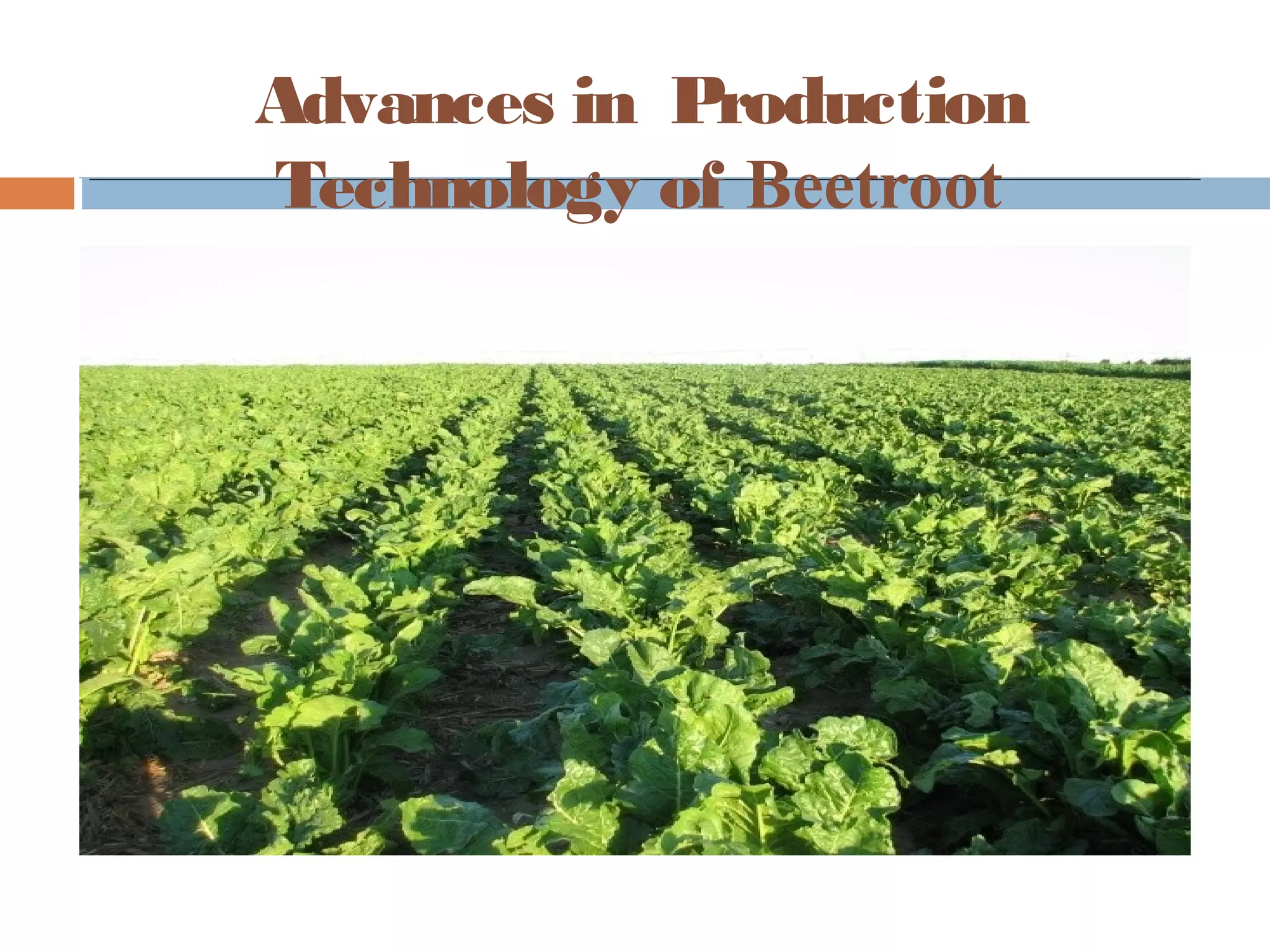
Advances in Production
Technology of Beetroot
Beetroot
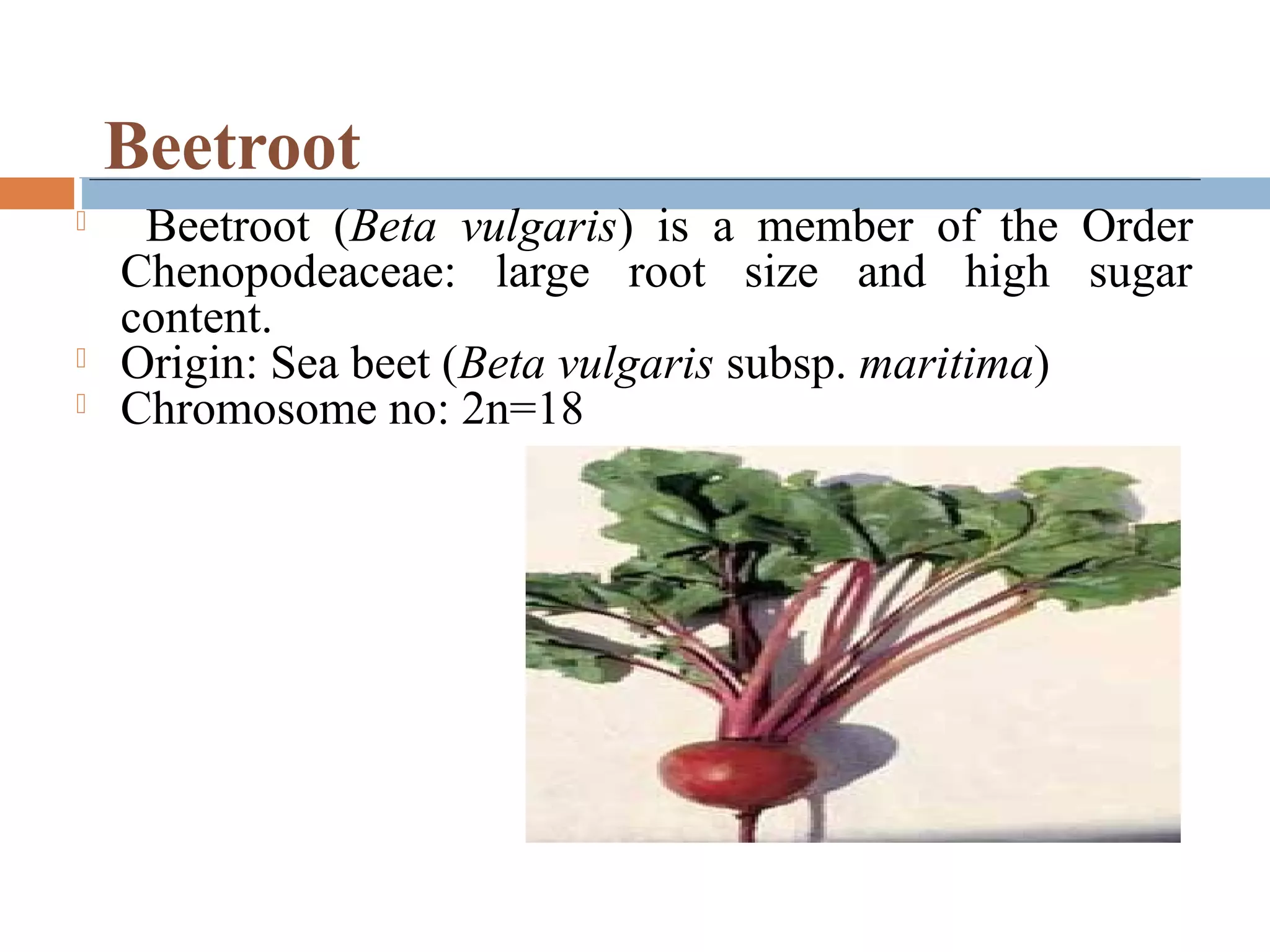
 Beetroot (Beta vulgaris) is a member of the Order
Chenopodeaceae: large root size and high sugar
content.
 Origin: Sea beet (Beta vulgaris subsp. maritima)
 Chromosome no: 2n=18
Cultivars
 Albino', heirloom (white root)
 'Bull's Blood', heirloom
 'Chioggia', heirloom (distinct red and white zoned
root)‘
 Crosby's Egyptian', heirloom
 'Cylindra' / 'Formanova', heirloom (elongated root)‘
 Detroit Dark Red Medium Top', heirloom
 'Early Wonder', heirloom
 'Golden Beet' / 'Burpee's Golden', heirloom (yellow
root)‘
 Perfected Detroit', 1934 AAS winner
 'Red Ace' Hybrid
 'Ruby Queen', 1957 AAS winner
 'Touchstone Gold' (yellow root)
Importance of Beetroot
 Popularly known as beet, the vegetable is called
“Chukandar” in Hindi, “Remolachas” in Spanish,
and “Hong cai tou” in Chinese and back in the
Indian households, beets have been used for a long
time as a treatment for Anemia.
 Many studies indicate that eating more plant foods,
like beetroot, decreases the risk of obesity, overall
mortality, diabetes, and heart disease and promotes
a healthy complexion and hair, increased energy,
and overall lower weight.
 In Indian cuisine, chopped, cooked, spiced beet is a
common side dish
 Nutritional value/100gm
Sugar-7gm
Carbohydrates-9.56g
Dietary fiber-2.8g
Fat-0.17g
Protein-1.61g
Varieties
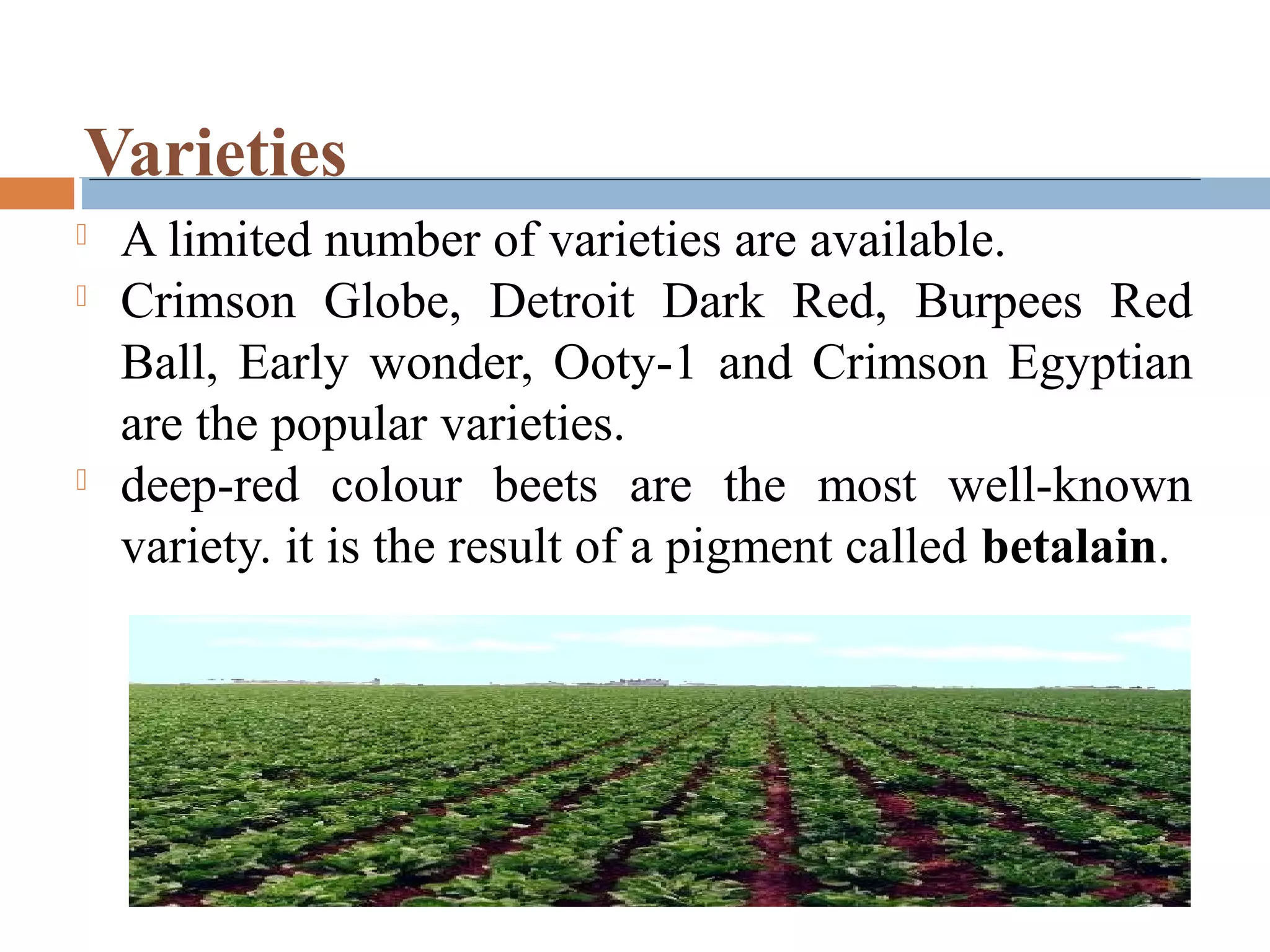
 A limited number of varieties are available.
 Crimson Globe, Detroit Dark Red, Burpees Red
Ball, Early wonder, Ooty-1 and Crimson Egyptian
are the popular varieties.
 deep-red colour beets are the most well-known
variety. it is the result of a pigment called betalain.
Characters of varieties
 Crimson Globe is a great, fine fleshed, eating and storage
variety. Grows well in most soils. This is an improved version
of the very famous Detroit Dark red, with slightly rounder
roots. This beetroot performs exceptionally well as a pickler
and freezes very well. Outer skin is medium red and flesh is
crimson red without zonations; duration 55-60 days.
 Dtroit dark red is a Prolific, matures in an average of 58
days. Roots are nearly globe shaped, 2.5-3 inches in diameter
with smooth skin. Blood red color with virtually no zoning.
Solid, good keeping root. Medium green tops with tinges of
red. Resistant to Downy Mildew.
 Burpee's Red Ball is a classic Burpee bred variety
with uniform roots 3" in diameter and smooth, deep
red skin. It's been proven tops for productivity,
flavor and wide adaptability. Baby beets make
excellent eating, and harvesting them helps the
remaining beets grow better. When planting, mix
beet seeds with fast-sprouting radish seeds to mark
the rows. Grows best in cool weather and full sun.
 A few of the improved varieties popular in India
are:
 Detroit Dark Red: Roots perfectly round with
smooth uniform deep red skin; flesh dark blood red
with light red zoning; heavy yielder with a
duration of 80-100 days.
 Early Wonder: Roots flat globular with dark red
skin and dark red flesh and light red zoning.
 Ooty-1: This TNAU variety has round roots with
blood red flesh colour; yields 28 t/ha in 120 days;
it sets seeds under Nilgiris conditions.
 Crosby Egyptian: Roots flat globe with dark
purplish red flesh; duration 55-60 days; produces
white zoning under warm weather.
 Madhur, Ruby Queen and Ruby Red are a few of
the varieties marketed by private seed industry.
Sowing
Time, rate & method of seed sowing
 Beetroot is planted during July – August. but in some
part of india sown early in spring to obtain a long
growing season and high yields.
 About 6 kg seeds are required for a hectare.
 Pre-soaking of seeds for 12 hours in water facilitates
better germination in the field. Before sowing, the
seeds are treated with thiram or captan (2.5-3 g/kg of
seed) to control pre-emergence damping off. It is
usually grown on ridges to facilitate good root
production.
 Sown using a precision seeder: as beet seed is
irregular in shape it is pelleted to make it more
usable, seeds are coated with inert clay materials
moulded into a spherical shape before the precision
seeder can use it. The inert clay dissolves in the
soil.
 Sugar beet comes up well in
all types of friable soils. The
suitable soil pH is 6.0-7.0. It
is considered to be a cool
weather crop.
 Shallow soils or soils with
compacted layers lead to root
forking which in turn leads to
a high level of tare.
Soil suitability & Climate
Preparation of seedbed
 Beetroot requires a fine seedbed for uniform seed
germination and plant establishment.
 Autumn plough the land if possible.
 In spring cultivate the land to a depth of 20 cm with a
spike rotavator.
Thinning
 Hand thinning is done soon after the germination.
 Thinning is necessary to have root tubers of
uniform shape and size by providing optimum
space for uniform development of the root.
Nutrition & Fertilisers
 Soil should be tested before
applying fertilizer to determine
what is requirement and how much.
 In addition to balanced amounts of
N, P, K, sodium and boron are also
found in these fertilizers.
 Sodium is essential for the salt
loving beet.
 Boron is added to prevent the
occurrence of heart rot.
 Spread on ploughed ground &
cultivated into the seed bed
 Application of fertilizers
Apply FYM at 20 t/ha and 60:160:100 kg of
NPK/ha as basal and 60 kg N/ha after 30 days.
 Fertigation:
Fertigation requirement: 120:160:100kg / ha
 Spacing
30 x30 x10 cm as four rows in each paired row /
raised bed system.
 Fertigation schedule
Recommended Dose: 120:160:100 kg/ha
Irrigation
 Irrigate the field immediately after sowing and
irrigated at an interval of 4-5 days in summer and
10-12 days in winter..
 Drip irrigation
Install the drip system with main and sub main
pipes and place the inline lateral tubes at an interval
of 1.5 m. Place the drippers in lateral tubes at an
interval of 60 cm and 50cm spacing with 4 LPH
and 3.5 LPH capacities respectively.
Crop Rotation
 Crop rotation must be practiced in order to avoid
serious build up of soil borne diseases and pests
e.g. the beet cyst nematode.
 Beet roots and other host crops (Fodder beet,
mangel, sugar beet , spinach beet, turnips, Swedes,
rape and kale) must not be grown on the same soil
(in same field) more frequently than 1 in 3 years.
 E.g. Grass- beet- Barley- potatoes
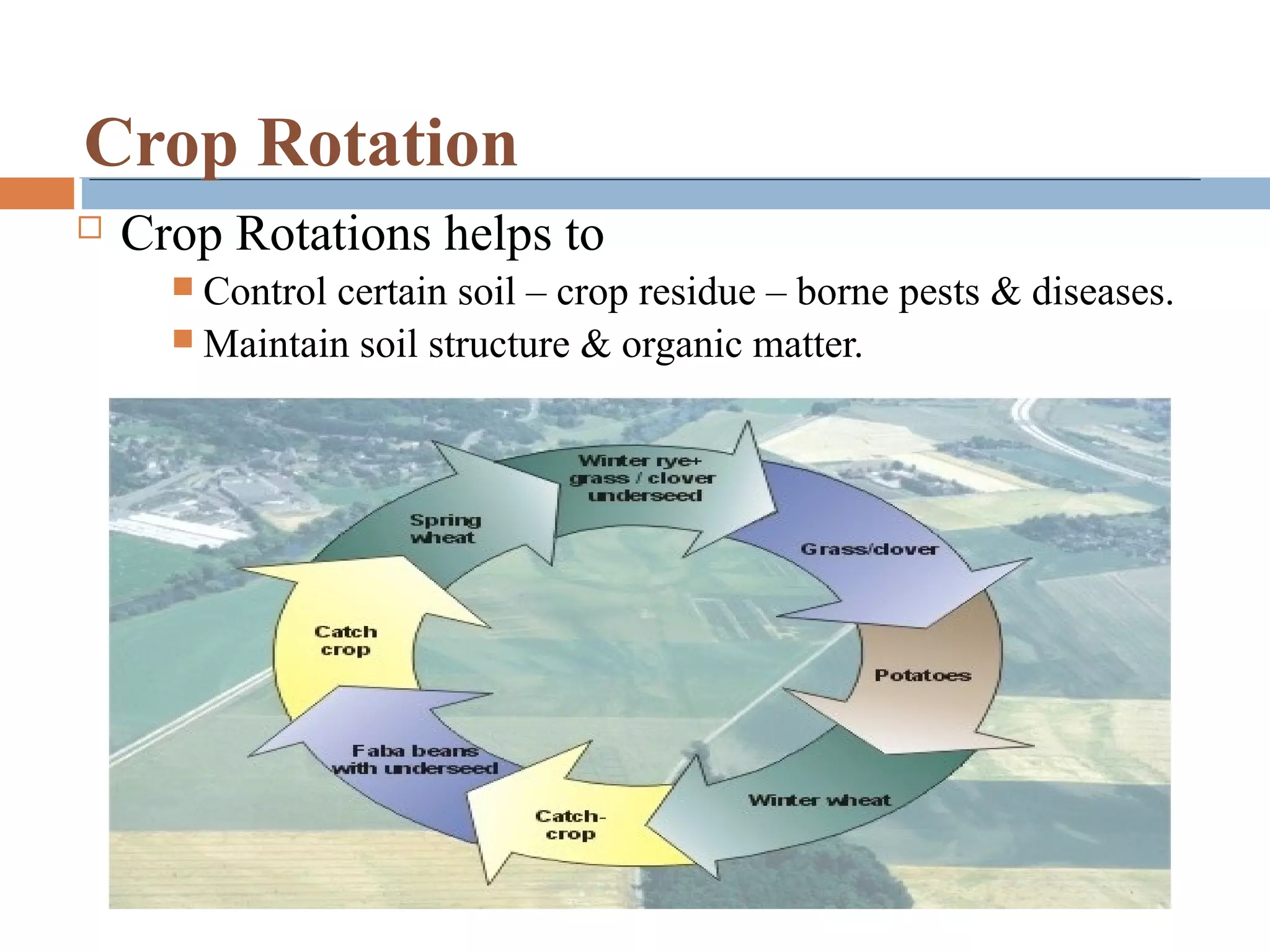
Crop Rotation
 Crop Rotations helps to
 Control certain soil – crop residue – borne pests & diseases.
 Maintain soil structure & organic matter.
 Diseases
 The most important disease of beet is Virus Yellow.
The peach potato aphid or green aphid
transmits virus yellows.
The foliage of infected plants becomes
chlorotic and yield losses result.
Disease and pest control
 Cercospora leaf spot
Cercospora leaf spot can be controlled by spraying
Mancozeb at 2 g/lit.
 Rhizoctonia root rot
Rhizoctonia root rot can be controlled by spot
drenching with Carbendazim at 1 g/lit.
 Pests
Leaf miner and flea beetle
Leaf miner and flea beetle can be controlled by
spraying Malathion 50 EC 2 ml/lit.
Crop residues should be ploughed in quickly and
headlands and loading areas should be cleaned
off quickly after use.
Crops should be sprayed with a systemic
aphicide’s if populations reach 2 per plant.
 The main pest is the beet cyst nematode, which is
controlled by crop rotation (Methyl bromide, Neem
seed cake, tea powder)
Weed control
 Spraying with a mix of a
total contact herbicide &
residual herbicide twice
between sowing & full
leaf cover.
 Weeding should be done
at regular intervals to
keep down the weeds.
Manual weeding is
commonly practiced.
Avoid deep cultivation as
it may damage the crop.
Earthing up
 Earthing up is done to support the structure of the
plant and to prevent the exposure of roots to
sunlight.
 Earthing up should be done, when the root starts
growing.
 Shallow hoeing is necessary to facilitate better root
growth.
Harvesting
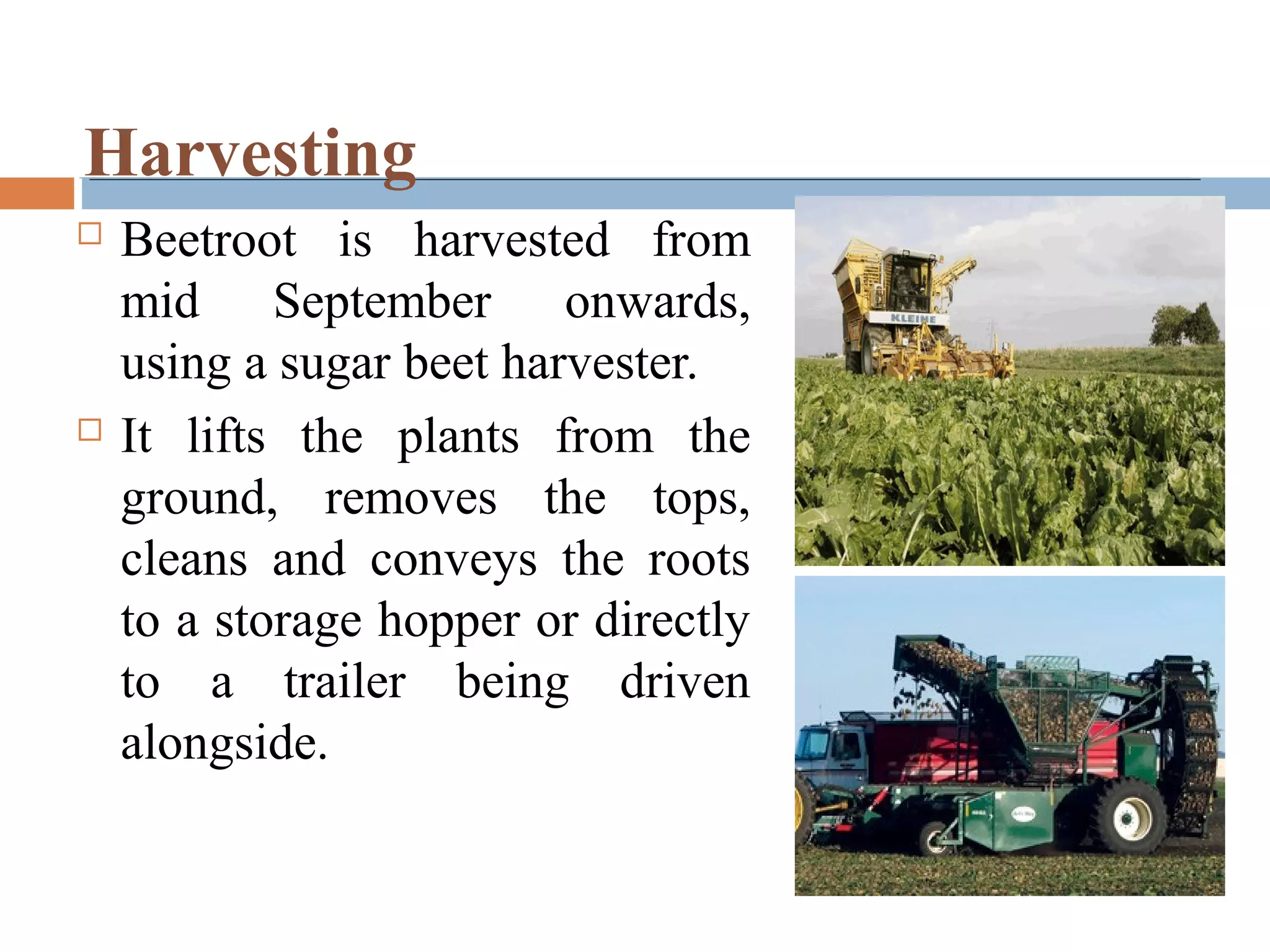
 Beetroot is harvested from
mid September onwards,
using a sugar beet harvester.
 It lifts the plants from the
ground, removes the tops,
cleans and conveys the roots
to a storage hopper or directly
to a trailer being driven
alongside.
 Precaution: The beet root crop
become ready for harvest
within 60-75 days of sowing
when the roots attain diameter
of 3-5 cm.
 The roots are harvested before
the development of spongy
tissue within the roots.
 beet tops are normally left in the
field after the harvesting
operation.
 They can be fed to cattle or sheep
in situ: using electric fence to
strip graze.
 They can also be transported to
yards and shed for feeding
animals.
Yield
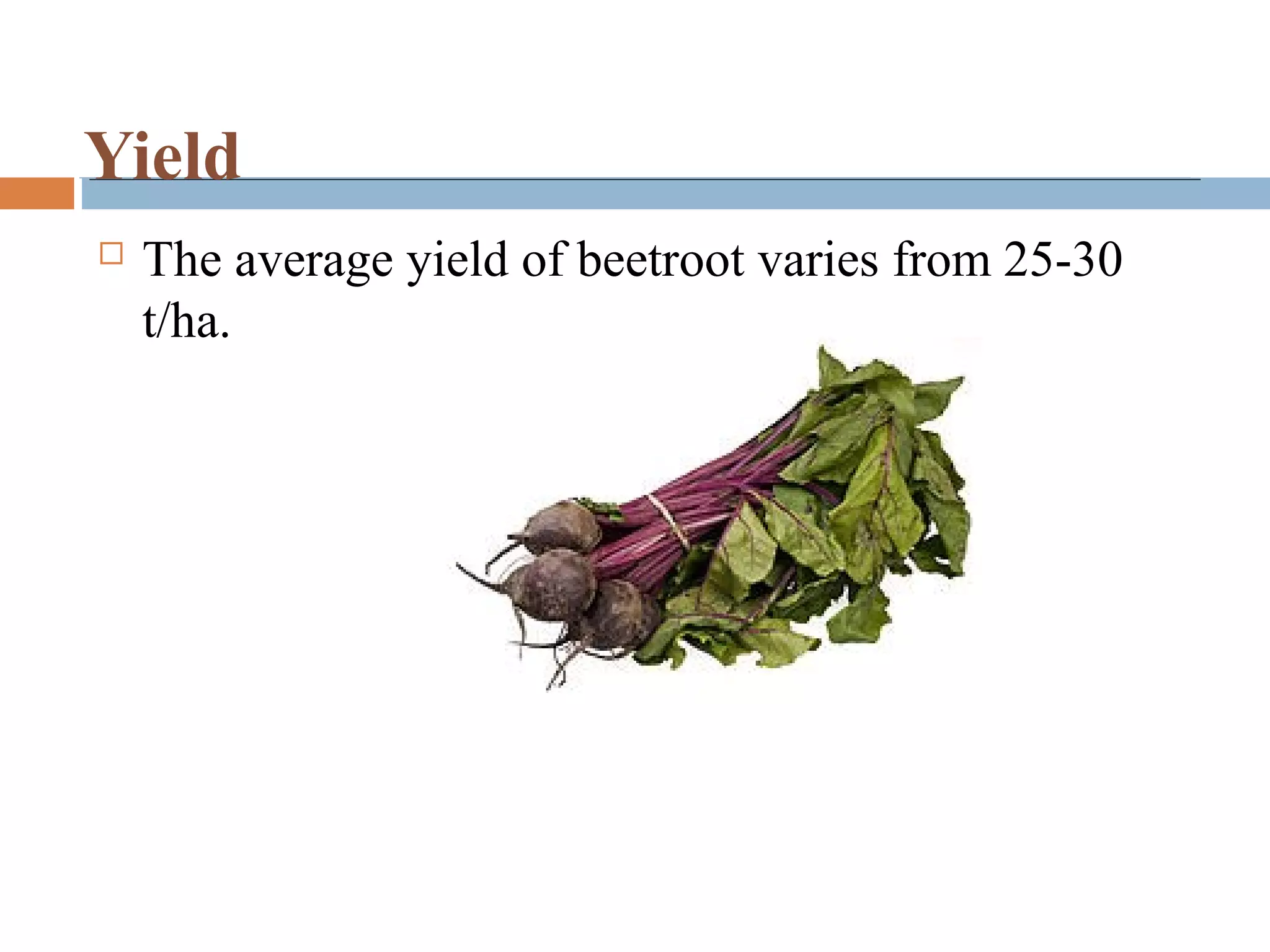
 The average yield of beetroot varies from 25-30
t/ha.
Cooling and Storage
 Proper pre-cooling and packaging retard
subsequent discolouration of the leaves, weight loss
and decay.
 Bunched beets should be pre-cooled to below 4°C
within 4 to 6 hours of harvest.
 Mature harvested beets should be pre-cooled
within 24 hours after harvest to below 5°C with
forced-air cooling.
 Red beets can be in air-ventilated storage for 4 to 6
months and in mechanical refrigerated storage for
as long as 8 months.
Beetroot as food
Usually the deep purple roots of beetroot are eaten boiled, roasted, or raw, and either
alone or combined with any salad vegetable.
Salad of grated
beetroot and
apple
Juice drink Pickled
beetroot
Borscht sour
soup
PRODUCTION TECHNOLOGY OF BEETROOT

PRODUCTION TECHNOLOGY OF BEETROOT

  • 1.
  • 2.
    Beetroot  Beetroot (Betavulgaris) is a member of the Order Chenopodeaceae: large root size and high sugar content.  Origin: Sea beet (Beta vulgaris subsp. maritima)  Chromosome no: 2n=18
  • 3.
    Cultivars  Albino', heirloom(white root)  'Bull's Blood', heirloom  'Chioggia', heirloom (distinct red and white zoned root)‘  Crosby's Egyptian', heirloom  'Cylindra' / 'Formanova', heirloom (elongated root)‘  Detroit Dark Red Medium Top', heirloom  'Early Wonder', heirloom
  • 4.
     'Golden Beet'/ 'Burpee's Golden', heirloom (yellow root)‘  Perfected Detroit', 1934 AAS winner  'Red Ace' Hybrid  'Ruby Queen', 1957 AAS winner  'Touchstone Gold' (yellow root)
  • 5.
    Importance of Beetroot Popularly known as beet, the vegetable is called “Chukandar” in Hindi, “Remolachas” in Spanish, and “Hong cai tou” in Chinese and back in the Indian households, beets have been used for a long time as a treatment for Anemia.  Many studies indicate that eating more plant foods, like beetroot, decreases the risk of obesity, overall mortality, diabetes, and heart disease and promotes a healthy complexion and hair, increased energy, and overall lower weight.
  • 6.
     In Indiancuisine, chopped, cooked, spiced beet is a common side dish  Nutritional value/100gm Sugar-7gm Carbohydrates-9.56g Dietary fiber-2.8g Fat-0.17g Protein-1.61g
  • 7.
    Varieties  A limitednumber of varieties are available.  Crimson Globe, Detroit Dark Red, Burpees Red Ball, Early wonder, Ooty-1 and Crimson Egyptian are the popular varieties.  deep-red colour beets are the most well-known variety. it is the result of a pigment called betalain.
  • 8.
    Characters of varieties Crimson Globe is a great, fine fleshed, eating and storage variety. Grows well in most soils. This is an improved version of the very famous Detroit Dark red, with slightly rounder roots. This beetroot performs exceptionally well as a pickler and freezes very well. Outer skin is medium red and flesh is crimson red without zonations; duration 55-60 days.  Dtroit dark red is a Prolific, matures in an average of 58 days. Roots are nearly globe shaped, 2.5-3 inches in diameter with smooth skin. Blood red color with virtually no zoning. Solid, good keeping root. Medium green tops with tinges of red. Resistant to Downy Mildew.
  • 9.
     Burpee's RedBall is a classic Burpee bred variety with uniform roots 3" in diameter and smooth, deep red skin. It's been proven tops for productivity, flavor and wide adaptability. Baby beets make excellent eating, and harvesting them helps the remaining beets grow better. When planting, mix beet seeds with fast-sprouting radish seeds to mark the rows. Grows best in cool weather and full sun.
  • 10.
     A fewof the improved varieties popular in India are:  Detroit Dark Red: Roots perfectly round with smooth uniform deep red skin; flesh dark blood red with light red zoning; heavy yielder with a duration of 80-100 days.  Early Wonder: Roots flat globular with dark red skin and dark red flesh and light red zoning.  Ooty-1: This TNAU variety has round roots with blood red flesh colour; yields 28 t/ha in 120 days; it sets seeds under Nilgiris conditions.
  • 11.
     Crosby Egyptian:Roots flat globe with dark purplish red flesh; duration 55-60 days; produces white zoning under warm weather.  Madhur, Ruby Queen and Ruby Red are a few of the varieties marketed by private seed industry.
  • 12.
    Sowing Time, rate &method of seed sowing  Beetroot is planted during July – August. but in some part of india sown early in spring to obtain a long growing season and high yields.  About 6 kg seeds are required for a hectare.  Pre-soaking of seeds for 12 hours in water facilitates better germination in the field. Before sowing, the seeds are treated with thiram or captan (2.5-3 g/kg of seed) to control pre-emergence damping off. It is usually grown on ridges to facilitate good root production.
  • 13.
     Sown usinga precision seeder: as beet seed is irregular in shape it is pelleted to make it more usable, seeds are coated with inert clay materials moulded into a spherical shape before the precision seeder can use it. The inert clay dissolves in the soil.
  • 14.
     Sugar beetcomes up well in all types of friable soils. The suitable soil pH is 6.0-7.0. It is considered to be a cool weather crop.  Shallow soils or soils with compacted layers lead to root forking which in turn leads to a high level of tare. Soil suitability & Climate
  • 15.
    Preparation of seedbed Beetroot requires a fine seedbed for uniform seed germination and plant establishment.  Autumn plough the land if possible.  In spring cultivate the land to a depth of 20 cm with a spike rotavator.
  • 16.
    Thinning  Hand thinningis done soon after the germination.  Thinning is necessary to have root tubers of uniform shape and size by providing optimum space for uniform development of the root.
  • 17.
    Nutrition & Fertilisers Soil should be tested before applying fertilizer to determine what is requirement and how much.  In addition to balanced amounts of N, P, K, sodium and boron are also found in these fertilizers.  Sodium is essential for the salt loving beet.  Boron is added to prevent the occurrence of heart rot.  Spread on ploughed ground & cultivated into the seed bed
  • 18.
     Application offertilizers Apply FYM at 20 t/ha and 60:160:100 kg of NPK/ha as basal and 60 kg N/ha after 30 days.  Fertigation: Fertigation requirement: 120:160:100kg / ha  Spacing 30 x30 x10 cm as four rows in each paired row / raised bed system.  Fertigation schedule Recommended Dose: 120:160:100 kg/ha
  • 19.
    Irrigation  Irrigate thefield immediately after sowing and irrigated at an interval of 4-5 days in summer and 10-12 days in winter..  Drip irrigation Install the drip system with main and sub main pipes and place the inline lateral tubes at an interval of 1.5 m. Place the drippers in lateral tubes at an interval of 60 cm and 50cm spacing with 4 LPH and 3.5 LPH capacities respectively.
  • 20.
    Crop Rotation  Croprotation must be practiced in order to avoid serious build up of soil borne diseases and pests e.g. the beet cyst nematode.  Beet roots and other host crops (Fodder beet, mangel, sugar beet , spinach beet, turnips, Swedes, rape and kale) must not be grown on the same soil (in same field) more frequently than 1 in 3 years.  E.g. Grass- beet- Barley- potatoes
  • 22.
    Crop Rotation  CropRotations helps to  Control certain soil – crop residue – borne pests & diseases.  Maintain soil structure & organic matter.
  • 23.
     Diseases  Themost important disease of beet is Virus Yellow. The peach potato aphid or green aphid transmits virus yellows. The foliage of infected plants becomes chlorotic and yield losses result. Disease and pest control
  • 24.
     Cercospora leafspot Cercospora leaf spot can be controlled by spraying Mancozeb at 2 g/lit.  Rhizoctonia root rot Rhizoctonia root rot can be controlled by spot drenching with Carbendazim at 1 g/lit.
  • 25.
     Pests Leaf minerand flea beetle Leaf miner and flea beetle can be controlled by spraying Malathion 50 EC 2 ml/lit.
  • 26.
    Crop residues shouldbe ploughed in quickly and headlands and loading areas should be cleaned off quickly after use. Crops should be sprayed with a systemic aphicide’s if populations reach 2 per plant.  The main pest is the beet cyst nematode, which is controlled by crop rotation (Methyl bromide, Neem seed cake, tea powder)
  • 29.
    Weed control  Sprayingwith a mix of a total contact herbicide & residual herbicide twice between sowing & full leaf cover.  Weeding should be done at regular intervals to keep down the weeds. Manual weeding is commonly practiced. Avoid deep cultivation as it may damage the crop.
  • 30.
    Earthing up  Earthingup is done to support the structure of the plant and to prevent the exposure of roots to sunlight.  Earthing up should be done, when the root starts growing.  Shallow hoeing is necessary to facilitate better root growth.
  • 31.
    Harvesting  Beetroot isharvested from mid September onwards, using a sugar beet harvester.  It lifts the plants from the ground, removes the tops, cleans and conveys the roots to a storage hopper or directly to a trailer being driven alongside.
  • 32.
     Precaution: Thebeet root crop become ready for harvest within 60-75 days of sowing when the roots attain diameter of 3-5 cm.  The roots are harvested before the development of spongy tissue within the roots.
  • 33.
     beet topsare normally left in the field after the harvesting operation.  They can be fed to cattle or sheep in situ: using electric fence to strip graze.  They can also be transported to yards and shed for feeding animals.
  • 34.
    Yield  The averageyield of beetroot varies from 25-30 t/ha.
  • 35.
    Cooling and Storage Proper pre-cooling and packaging retard subsequent discolouration of the leaves, weight loss and decay.  Bunched beets should be pre-cooled to below 4°C within 4 to 6 hours of harvest.  Mature harvested beets should be pre-cooled within 24 hours after harvest to below 5°C with forced-air cooling.  Red beets can be in air-ventilated storage for 4 to 6 months and in mechanical refrigerated storage for as long as 8 months.
  • 36.
    Beetroot as food Usuallythe deep purple roots of beetroot are eaten boiled, roasted, or raw, and either alone or combined with any salad vegetable. Salad of grated beetroot and apple Juice drink Pickled beetroot Borscht sour soup