CAD CAM Dentistry
and
Digital Impression
Greetings from AECS Maaruti
College of Dental Sciences
Bangalore
Dentistry v/s CAD CAM Dentistry
“Lemon”
Dr. Werner Mörmann,
Dr. Marco Brandestini,
Dr. Alain Ferru
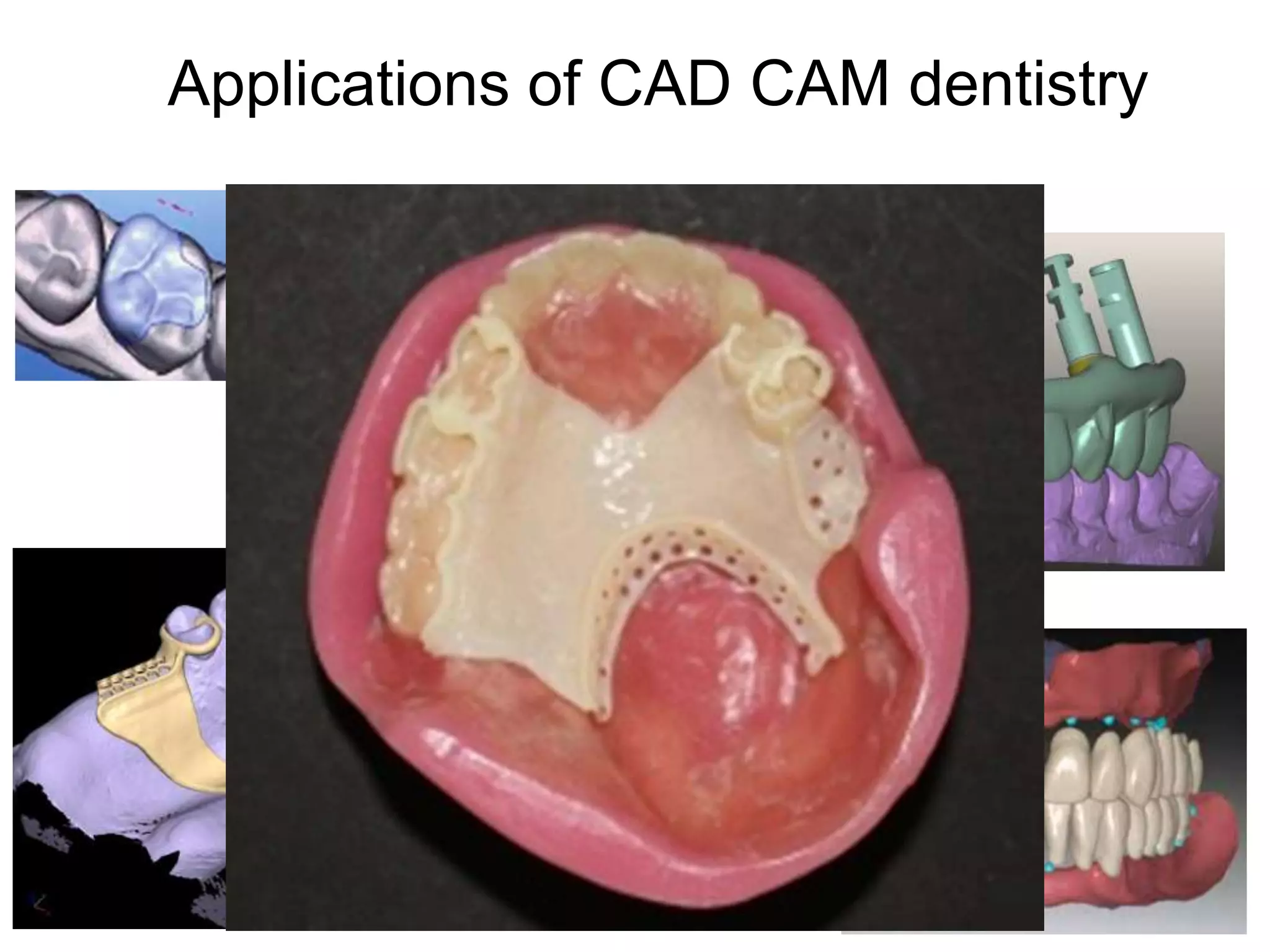
Applications of CAD CAM dentistry
Impression
A negative likeness or copy in reverse of the
surface of an object ; imprint of teeth and adjacent
structures for use in dentistry. GPT – 8
Conventional v/s Digital
• The digital impression cuts down turnaround time
• more comfortable for the patient
• gives more accurate fit and remakes are fewer
• improves dentist/lab communication
• gives a competitive advantage
Year, first author Test variability Conclusion
2014, Svanborg etal Marginal fit, Digital
and conventional
impression
The digital impression is more accurate and
can generate a 3unit FDPs with significantly
closer fit than VPS impression
2014, Yuzbasigolu
etal
Patient comfort,
effectiveness,
clinical outcome
The digital impression is time effective and
patient prefer digital impression method than
the traditional one.
2014, Ender etal Accuracy of digital
and conventional
impression
The digital impression showed excellent
clinical results within their indications and
applying the right technique of scanning
2013, Lee etal Digital impression
perception of
student and
clinician
The digital impression was most effective
technique and students find difficulty in
conducting traditional technique.
2012, Galhano etal Optical impression
methods
The digital impression was speed, effective
and less invasive than traditional methods.
2010,Poticny etal Predictability and
esthetic out comes
The digital impression allows immediate
evaluation of preparations and margins
Digital Impression
Basic components of CAD CAM involves:
1. Digitalized Scanner
• Optical Scanner
• Mechanical scanner
2. Design Software
3. Processing Device or Computer numeric control
machine
“ Could cavities be scanned by ultrasound ? ”
Optical Scanner
• Based on the principle of triangulation
• The light source and the receptor unit are in a
definite angulation in relation to each other
Eg: Everest scan, Lava Scan, es1
Mechanical Scanner
• The master cast is read mechanically line by line
by means of a ruby ball
• The 3D structure is measured
Eg: Procera scanner
Open v/s. Closed Architecture
Based on data files created :
• Open-architecture files, typically termed STL files,
are not dependent on the manufacturer, and can be
used virtually in any design software to fabricate a
final restoration
• Closed-system software architecture collects and
manipulates data modules by the same
manufacturer, offering laboratory owners security
and a one-stop for resolving problems
Based on the location of
processing unit
• Chairside Production
• Laboratory Production
• Centralised fabrication in production
centre
Chairside digital impression systems with
laboratory transfer capability
i-Tero Lava C.O.S CEREC AC
Features Candent i-Tero 3M Lava C.O.S Sirona CEREC AC
Optical
technology
Parallel confocal /
telecentric
Wavefront Sampling
technology
LED / Laser sampling
Powder
requirement
No Yes Yes (optispray)
Models
Milled PU, removable
dies, soft tissue profile
Additive / SLA blue
resin one solid model
& one working model
Additive / SLA;
no tissue
Digital
interface
Open Closed ( LAVA) Closed
(CEREC In-Lab)
Articulators
All movements,
attachment to Whipmix
full articulator for
complex cases
Articulated;
Centric and lateral
excursions
Hinge only
Indications All Upto 4UB and
singles
All
Recent Advances
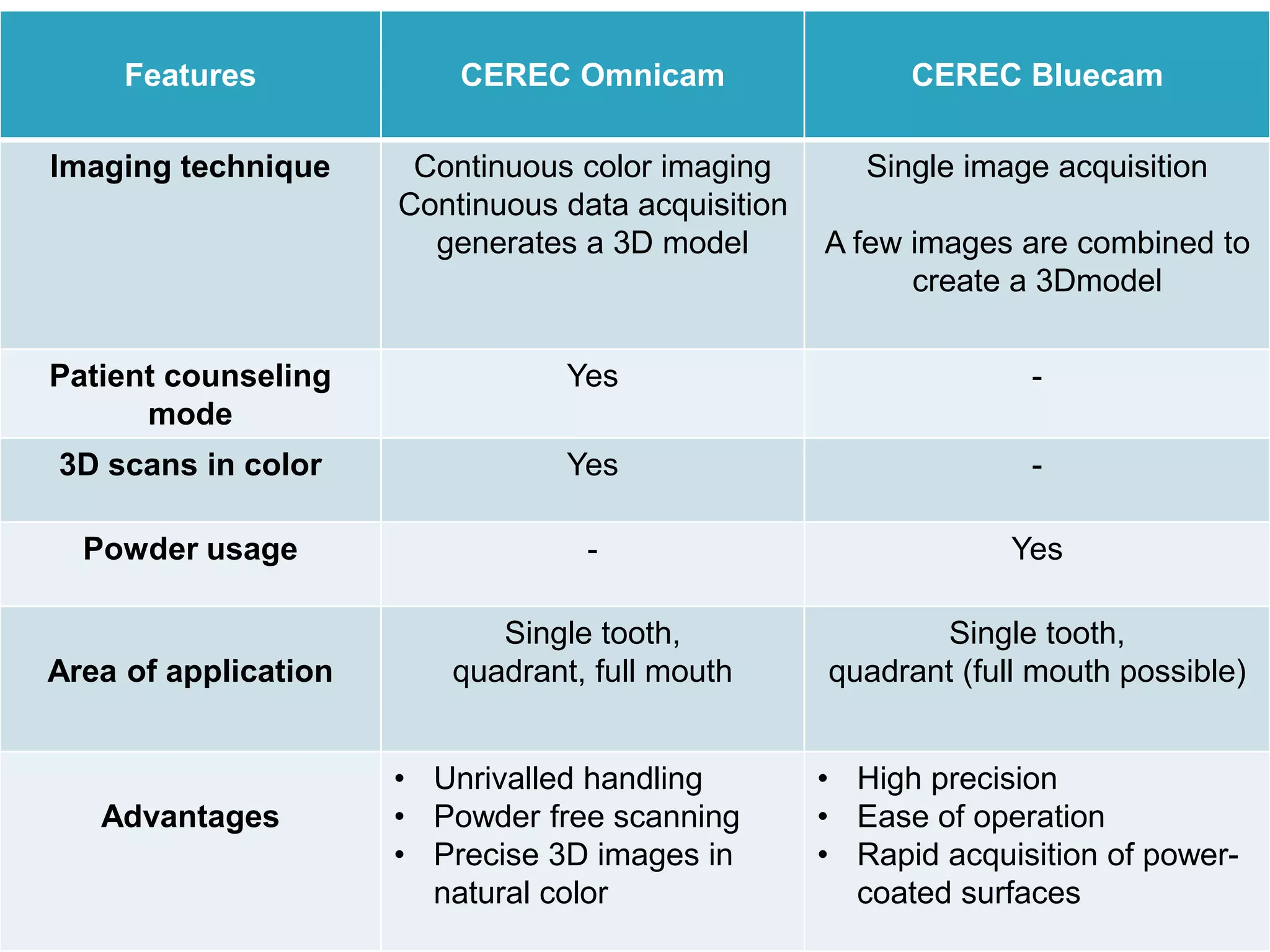
Features CEREC Omnicam CEREC Bluecam
Imaging technique Continuous color imaging
Continuous data acquisition
generates a 3D model
Single image acquisition
A few images are combined to
create a 3Dmodel
Patient counseling
mode
Yes -
3D scans in color Yes -
Powder usage - Yes
Area of application
Single tooth,
quadrant, full mouth
Single tooth,
quadrant (full mouth possible)
Advantages
• Unrivalled handling
• Powder free scanning
• Precise 3D images in
natural color
• High precision
• Ease of operation
• Rapid acquisition of power-
coated surfaces
Clinic and laboratory relationship
• Adopting CAD/CAM technology into a practice,
even at the highest level, does not have to mean
an end to the doctor-laboratory relationship
• The integration of digital scanning technology can
save time and reduce remake rates for the
laboratory.
• Digital scanning and digital photography both offer
the ability to convey accurate digital information
between the clinician and the laboratory technician
and vice versa
References
• Mörmann WH, The evolution of the CEREC
systemJADA 2006;137(9 supplement):7S-13S.
• Abduo J, Lyons K, Bennamoun M, Trends in
Computer-Aided Manufacturing in Prosthodontics: A
Review of the available streams, International
Journal of Dentistry Volume 2014, Article ID 783948,
15 pages
• Prajapati A etal, Dentistry Goes Digital: A Cad-Cam
Way- A Review Article IOSR-JDMS.Vol13, Iss8 Ver.
IV (Aug. 2014), PP 53-59
• Coppa A. et al. "Early Neolithic tradition of dentistry: Flint
tips were surprisingly effective for drilling tooth enamel in
a prehistoric population." Nature. Vol. 440. 6 April 2006.
• Lowe RA. CAD CAM dentistry and digital impression
making.
• Baroudi K., and S. N. Ibraheem. "Assessment of Chair-
side Computer-Aided Design and Computer-Aided
Manufacturing Restorations: A Review of the Literature."
Journal of international oral health: JIOH Vol 7 iss.4
(2015): 96-104.
• Harsono M etal. Evolution of Chairside CAD/CAM
Dentistry. Inside Dentistry October 2012, Vol 8, Iss 10

Cad Cam dentistry and digital impressions

  • 1.
  • 2.
    Greetings from AECSMaaruti College of Dental Sciences Bangalore
  • 4.
    Dentistry v/s CADCAM Dentistry
  • 5.
    “Lemon” Dr. Werner Mörmann, Dr.Marco Brandestini, Dr. Alain Ferru
  • 6.
    Applications of CADCAM dentistry
  • 7.
    Impression A negative likenessor copy in reverse of the surface of an object ; imprint of teeth and adjacent structures for use in dentistry. GPT – 8
  • 8.
    Conventional v/s Digital •The digital impression cuts down turnaround time • more comfortable for the patient • gives more accurate fit and remakes are fewer • improves dentist/lab communication • gives a competitive advantage
  • 9.
    Year, first authorTest variability Conclusion 2014, Svanborg etal Marginal fit, Digital and conventional impression The digital impression is more accurate and can generate a 3unit FDPs with significantly closer fit than VPS impression 2014, Yuzbasigolu etal Patient comfort, effectiveness, clinical outcome The digital impression is time effective and patient prefer digital impression method than the traditional one. 2014, Ender etal Accuracy of digital and conventional impression The digital impression showed excellent clinical results within their indications and applying the right technique of scanning 2013, Lee etal Digital impression perception of student and clinician The digital impression was most effective technique and students find difficulty in conducting traditional technique. 2012, Galhano etal Optical impression methods The digital impression was speed, effective and less invasive than traditional methods. 2010,Poticny etal Predictability and esthetic out comes The digital impression allows immediate evaluation of preparations and margins
  • 10.
    Digital Impression Basic componentsof CAD CAM involves: 1. Digitalized Scanner • Optical Scanner • Mechanical scanner 2. Design Software 3. Processing Device or Computer numeric control machine “ Could cavities be scanned by ultrasound ? ”
  • 11.
    Optical Scanner • Basedon the principle of triangulation • The light source and the receptor unit are in a definite angulation in relation to each other Eg: Everest scan, Lava Scan, es1 Mechanical Scanner • The master cast is read mechanically line by line by means of a ruby ball • The 3D structure is measured Eg: Procera scanner
  • 12.
    Open v/s. ClosedArchitecture Based on data files created : • Open-architecture files, typically termed STL files, are not dependent on the manufacturer, and can be used virtually in any design software to fabricate a final restoration • Closed-system software architecture collects and manipulates data modules by the same manufacturer, offering laboratory owners security and a one-stop for resolving problems
  • 13.
    Based on thelocation of processing unit • Chairside Production • Laboratory Production • Centralised fabrication in production centre
  • 14.
    Chairside digital impressionsystems with laboratory transfer capability i-Tero Lava C.O.S CEREC AC
  • 15.
    Features Candent i-Tero3M Lava C.O.S Sirona CEREC AC Optical technology Parallel confocal / telecentric Wavefront Sampling technology LED / Laser sampling Powder requirement No Yes Yes (optispray) Models Milled PU, removable dies, soft tissue profile Additive / SLA blue resin one solid model & one working model Additive / SLA; no tissue Digital interface Open Closed ( LAVA) Closed (CEREC In-Lab) Articulators All movements, attachment to Whipmix full articulator for complex cases Articulated; Centric and lateral excursions Hinge only Indications All Upto 4UB and singles All
  • 16.
  • 17.
    Features CEREC OmnicamCEREC Bluecam Imaging technique Continuous color imaging Continuous data acquisition generates a 3D model Single image acquisition A few images are combined to create a 3Dmodel Patient counseling mode Yes - 3D scans in color Yes - Powder usage - Yes Area of application Single tooth, quadrant, full mouth Single tooth, quadrant (full mouth possible) Advantages • Unrivalled handling • Powder free scanning • Precise 3D images in natural color • High precision • Ease of operation • Rapid acquisition of power- coated surfaces
  • 18.
    Clinic and laboratoryrelationship • Adopting CAD/CAM technology into a practice, even at the highest level, does not have to mean an end to the doctor-laboratory relationship • The integration of digital scanning technology can save time and reduce remake rates for the laboratory. • Digital scanning and digital photography both offer the ability to convey accurate digital information between the clinician and the laboratory technician and vice versa
  • 20.
    References • Mörmann WH,The evolution of the CEREC systemJADA 2006;137(9 supplement):7S-13S. • Abduo J, Lyons K, Bennamoun M, Trends in Computer-Aided Manufacturing in Prosthodontics: A Review of the available streams, International Journal of Dentistry Volume 2014, Article ID 783948, 15 pages • Prajapati A etal, Dentistry Goes Digital: A Cad-Cam Way- A Review Article IOSR-JDMS.Vol13, Iss8 Ver. IV (Aug. 2014), PP 53-59
  • 21.
    • Coppa A.et al. "Early Neolithic tradition of dentistry: Flint tips were surprisingly effective for drilling tooth enamel in a prehistoric population." Nature. Vol. 440. 6 April 2006. • Lowe RA. CAD CAM dentistry and digital impression making. • Baroudi K., and S. N. Ibraheem. "Assessment of Chair- side Computer-Aided Design and Computer-Aided Manufacturing Restorations: A Review of the Literature." Journal of international oral health: JIOH Vol 7 iss.4 (2015): 96-104. • Harsono M etal. Evolution of Chairside CAD/CAM Dentistry. Inside Dentistry October 2012, Vol 8, Iss 10

Editor's Notes

  • #4 Can be interpreted as : Concepts need not be valid just because they are told in books (holy books especially ;-))), mythologies etc. Nor things are right if they are modern. Gentlemen test and then trust, fools believe what is told and written.