Homomorphic Encryption
Scheme
SNEHA S K
Msc CS
Bishop Heber College, Trichy
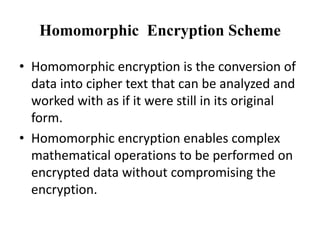
Homomorphic Encryption Scheme
• Homomorphic encryption is the conversion of
data into cipher text that can be analyzed and
worked with as if it were still in its original
form.
• Homomorphic encryption enables complex
mathematical operations to be performed on
encrypted data without compromising the
encryption.
Use Cases
• Privacy Preserving Medical Image Analysis
• Secure Load Balancing over vast regions
• Analysis over sensitive Education data
• Machine Learning as a Service
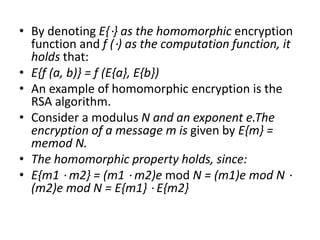
• By denoting E{⋅} as the homomorphic encryption
function and f (⋅) as the computation function, it
holds that:
• E{f (a, b)} = f (E{a}, E{b})
• An example of homomorphic encryption is the
RSA algorithm.
• Consider a modulus N and an exponent e.The
encryption of a message m is given by E{m} =
memod N.
• The homomorphic property holds, since:
• E{m1 ⋅ m2} = (m1 ⋅ m2)e mod N = (m1)e mod N ⋅
(m2)e mod N = E{m1} ⋅ E{m2}
Examples of HE
• An example of homomorphic encryption is the
RSA algorithm.
• Other examples of homomorphic encryption
schemes are
• The ECC encryption [133],
• The ElGamal cryptosystem [150] and
• The Pailler cryptosystem [151].
Pros & Cons
Advantages
• Can perform inference on
encrypted data, so the
model owner never sees
the client's private data and
therefore cannot leak it or
misuse it.
• Doesn't require interactivity
between the data and
model owners to perform
the computation.
Disadvantages
• Computationally expensive.
• Restricted to certain kinds
of calculations.
• Depending on the operation f (⋅) that can be
performed on the encrypted data, the
homomorphic encryption scheme can be defined
as additive or multiplicative.
• Additive homomorphism makes it possible to
compute sums, subtractions, and scalar
multiplication of its operands; multiplicative
homomorphism allows computation of the
product of its operands.
• The RSA algorithm is an example of multiplicative
homomorphic encryption.
• An example of additive homomorphic encryption
is the Pailler cryptosystem.
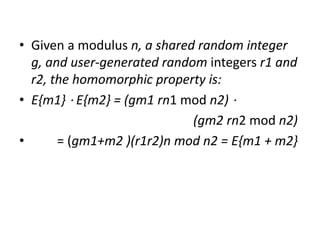
• Given a modulus n, a shared random integer
g, and user-generated random integers r1 and
r2, the homomorphic property is:
• E{m1} ⋅ E{m2} = (gm1 rn1 mod n2) ⋅
(gm2 rn2 mod n2)
• = (gm1+m2 )(r1r2)n mod n2 = E{m1 + m2}
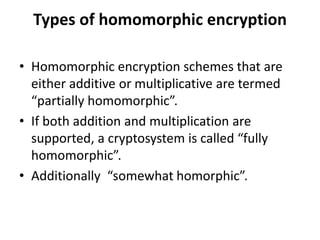
Types of homomorphic encryption
• Homomorphic encryption schemes that are
either additive or multiplicative are termed
“partially homomorphic”.
• If both addition and multiplication are
supported, a cryptosystem is called “fully
homomorphic”.
• Additionally “somewhat homorphic”.
FHE
• Fully homomorphic cryptosystems preserve the
ring structure of the plaintexts and, therefore,
enable more complex procedures to be used.
• The investigation of fully homomorphic
encryption schemes is still in its early stages and
no practical scheme with acceptable performance
has been found (e.g., in terms of decryption
delay).
• Application of these schemes to IoT scenarios is a
rich research topic.
SWHE
• hey tend to be based on schemes that are
capable of "somewhat" homomorphic
encryption. These schemes can only perform a
limited number of successive multiplication
and addition operations on ciphertext before
the results become unreliable and impossible
to decrypt. This limitation arises directly from
the way these systems guarantee security by
relying on noise or error to make relatively
simple problems computationally intractable.
Limitations of Fully Homomorphic
Encryption
• Poor performance: Between slow computation
speed or accuracy problems, fully homomorphic
encryption remains commercially infeasible for
computationally-heavy applications.
• General consensus in the research community is
that fully homomorphic encryption research still
has many years to go, but it is useful today in
conjunction with other privacy-enhancing
technologies like secure multiparty computation.

Homomorphic Encryption Scheme.pptx

  • 1.
    Homomorphic Encryption Scheme SNEHA SK Msc CS Bishop Heber College, Trichy
  • 2.
    Homomorphic Encryption Scheme •Homomorphic encryption is the conversion of data into cipher text that can be analyzed and worked with as if it were still in its original form. • Homomorphic encryption enables complex mathematical operations to be performed on encrypted data without compromising the encryption.
  • 3.
    Use Cases • PrivacyPreserving Medical Image Analysis • Secure Load Balancing over vast regions • Analysis over sensitive Education data • Machine Learning as a Service
  • 4.
    • By denotingE{⋅} as the homomorphic encryption function and f (⋅) as the computation function, it holds that: • E{f (a, b)} = f (E{a}, E{b}) • An example of homomorphic encryption is the RSA algorithm. • Consider a modulus N and an exponent e.The encryption of a message m is given by E{m} = memod N. • The homomorphic property holds, since: • E{m1 ⋅ m2} = (m1 ⋅ m2)e mod N = (m1)e mod N ⋅ (m2)e mod N = E{m1} ⋅ E{m2}
  • 5.
    Examples of HE •An example of homomorphic encryption is the RSA algorithm. • Other examples of homomorphic encryption schemes are • The ECC encryption [133], • The ElGamal cryptosystem [150] and • The Pailler cryptosystem [151].
  • 6.
    Pros & Cons Advantages •Can perform inference on encrypted data, so the model owner never sees the client's private data and therefore cannot leak it or misuse it. • Doesn't require interactivity between the data and model owners to perform the computation. Disadvantages • Computationally expensive. • Restricted to certain kinds of calculations.
  • 7.
    • Depending onthe operation f (⋅) that can be performed on the encrypted data, the homomorphic encryption scheme can be defined as additive or multiplicative. • Additive homomorphism makes it possible to compute sums, subtractions, and scalar multiplication of its operands; multiplicative homomorphism allows computation of the product of its operands. • The RSA algorithm is an example of multiplicative homomorphic encryption. • An example of additive homomorphic encryption is the Pailler cryptosystem.
  • 8.
    • Given amodulus n, a shared random integer g, and user-generated random integers r1 and r2, the homomorphic property is: • E{m1} ⋅ E{m2} = (gm1 rn1 mod n2) ⋅ (gm2 rn2 mod n2) • = (gm1+m2 )(r1r2)n mod n2 = E{m1 + m2}
  • 9.
    Types of homomorphicencryption • Homomorphic encryption schemes that are either additive or multiplicative are termed “partially homomorphic”. • If both addition and multiplication are supported, a cryptosystem is called “fully homomorphic”. • Additionally “somewhat homorphic”.
  • 10.
    FHE • Fully homomorphiccryptosystems preserve the ring structure of the plaintexts and, therefore, enable more complex procedures to be used. • The investigation of fully homomorphic encryption schemes is still in its early stages and no practical scheme with acceptable performance has been found (e.g., in terms of decryption delay). • Application of these schemes to IoT scenarios is a rich research topic.
  • 11.
    SWHE • hey tendto be based on schemes that are capable of "somewhat" homomorphic encryption. These schemes can only perform a limited number of successive multiplication and addition operations on ciphertext before the results become unreliable and impossible to decrypt. This limitation arises directly from the way these systems guarantee security by relying on noise or error to make relatively simple problems computationally intractable.
  • 12.
    Limitations of FullyHomomorphic Encryption • Poor performance: Between slow computation speed or accuracy problems, fully homomorphic encryption remains commercially infeasible for computationally-heavy applications. • General consensus in the research community is that fully homomorphic encryption research still has many years to go, but it is useful today in conjunction with other privacy-enhancing technologies like secure multiparty computation.