Life is a system that tries to regulate itself to preserve its
identity. Maintenance of desire state in particular ways in the
face of disturbances has been given a term Homeostasis.
Homeostasis is derived from two Greek words; Homeo which
means ‘unchanging’ and Stasis which means ‘standing’, in its
simplest form it means ‘staying the same’ It is an organism’s
internal environment which ‘stays the same’. Homeostasis
literally means "same state" and it refers to the process of
keeping the internal body environment in a steady state.
Thus, homeostasis is a key element of species survival
especially via regulation of its body temperature, blood
pressure, blood pH, Oxygen and carbon dioxide
concentration, osmoregulation and blood glucose.
In practice, it comes down to providing a stable environment
for the cells of the body. The living processes in the cells
depend on the activity of enzymes. These enzymes work best
in specific conditions such as those of temperature and pH.
Any change in these conditions affects the function of the
enzymes and may lead to the death of the cells or,
ultimately, the whole organism. This is why the internal
environment needs to be regulated and kept constant.
Negative feedback is the main regulatory mechanism for
homeostasis. To maintain homeostasis organisms must be
able to detect deviations in internal environmental factors
and must be able to control the various body systems
responsible for adjusting these factors.
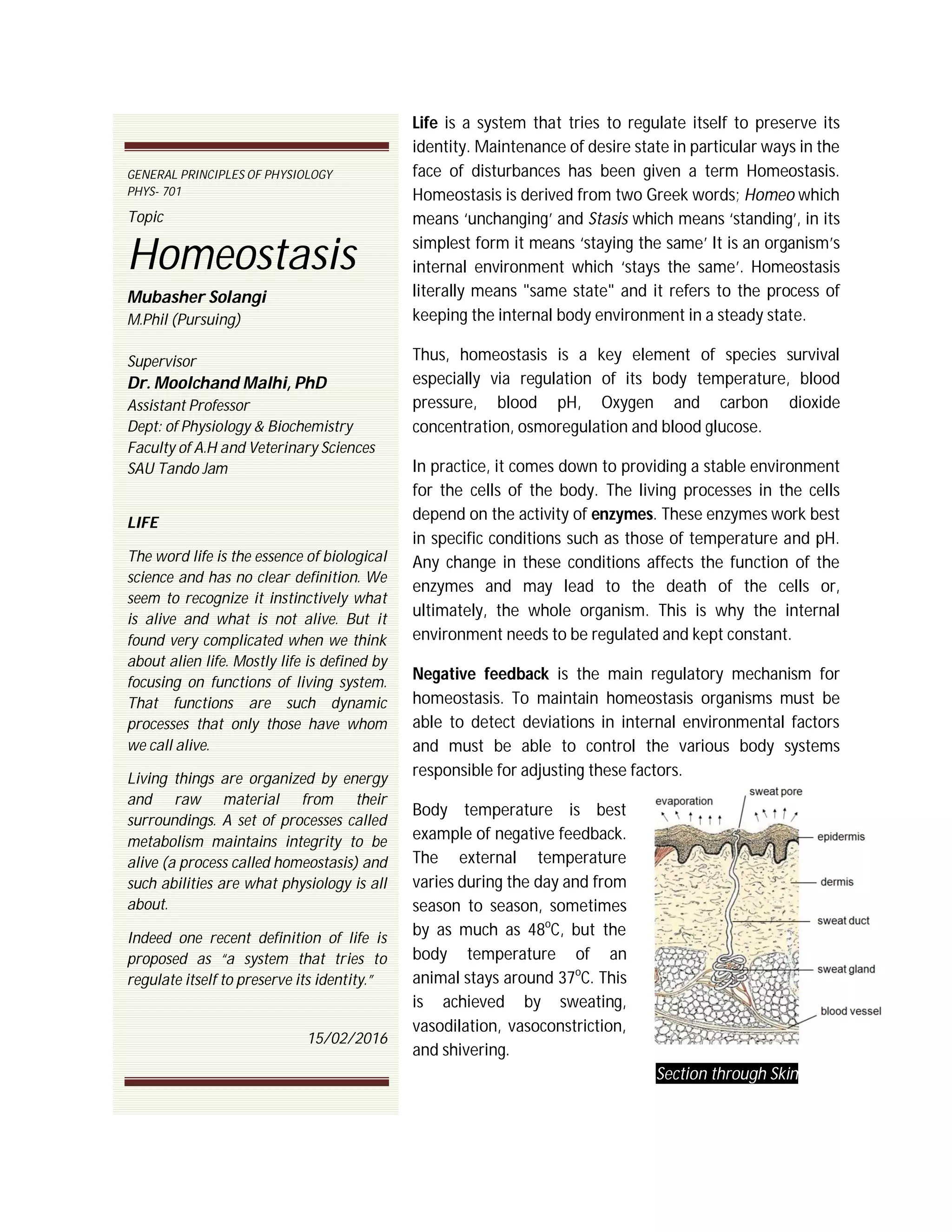
Body temperature is best
example of negative feedback.
The external temperature
varies during the day and from
season to season, sometimes
by as much as 48o
C, but the
body temperature of an
animal stays around 37o
C. This
is achieved by sweating,
vasodilation, vasoconstriction,
and shivering.
Section through Skin
GENERAL PRINCIPLES OF PHYSIOLOGY
PHYS- 701
Topic
Homeostasis
Mubasher Solangi
M.Phil (Pursuing)
Supervisor
Dr. Moolchand Malhi, PhD
Assistant Professor
Dept: of Physiology & Biochemistry
Faculty of A.H and Veterinary Sciences
SAU Tando Jam
LIFE
The word life is the essence of biological
science and has no clear definition. We
seem to recognize it instinctively what
is alive and what is not alive. But it
found very complicated when we think
about alien life. Mostly life is defined by
focusing on functions of living system.
That functions are such dynamic
processes that only those have whom
we call alive.
Living things are organized by energy
and raw material from their
surroundings. A set of processes called
metabolism maintains integrity to be
alive (a process called homeostasis) and
such abilities are what physiology is all
about.
Indeed one recent definition of life is
proposed as “a system that tries to
regulate itself to preserve its identity.”
15/02/2016
Editor: Mubasher Solangi, M.Phil (Pursuing)
Supervisor: Dr. Moolchand Malhi, PhD
General Principles of Physiology (PHYS-701)
Assignment | Homeostasis
2
Department of Physiology and Biochemistry, Faculty of Animal Husbandry and Veterinary Sciences
Sindh Agriculture University Tando Jam
If the body temperature rises, the sweat glands in the skin are activated and secrete sweat on to the
surface of the skin. When the sweat evaporates, it takes heat from the body
and cools it down. The sweat gland extracts sweat from the blood and
passes it up the duct to the skin surface where it evaporates.
Vasodilation: If the body temperature rises, the blood vessels in the skin
dilate (become wider) and allow more blood to flow near the surface. The
heat loss from the blood through the skin helps cool the circulating blood.
Vasoconstriction: If the body temperature falls, the blood vessels in the skin
constrict. Less warm blood flows near the surface so less heat is lost
To carry out its living processes, every
cell in the body needs a supply of
oxygen and food. Waste products such
as carbon dioxide have to be removed
before they reach harmful levels and
damage the cell. These conditions are
maintained by tissue fluid (ESF or
plasma) bathing the cells. Tissue fluid
is derived from the blood. The tissue fluid contains oxygen and food which the cells can absorb, and also
accepts the carbon dioxide and other waste products produced by the cells
Some internal process are not always homeostatic but may be changed by reset and positive feedback
systems.
Reset system is one that changes the reset point of negative feedback system in a temporary,
permanent or cyclic fashion.
Positive feedback system is a rapid change from set point when condition demand. For instance neuron
action potential, lactation, blood clotting, bile release, orgasms, ovulation and some reactions of
immune system are all positive feedback.
Editor: Mubasher Solangi, M.Phil (Pursuing)
Supervisor: Dr. Moolchand Malhi, PhD
General Principles of Physiology (PHYS-701)
Assignment | Homeostasis
3
Department of Physiology and Biochemistry, Faculty of Animal Husbandry and Veterinary Sciences
Sindh Agriculture University Tando Jam
Role of Kidney in Homeostasis
Body consists of a number of systems
having their own importance and
contribution towards keeping animals
alive. As blood flows through the body,
waste products are deposited into the
bloodstream that needs to be removed.
Renal organ vertebrate Kidney
(crustacean antennal glands insect
malpighian tubules in invertebrates)
filters body fluids and regulate water,
ions and many organic substances and
then selectively reabsorb or secrete
these molecules. The output of renal
organ is called urine, these organs with
ductwork and storage chambers (bladder) for the urine are called urinary systems. It is made up of two
kidneys, two ureters, a urinary bladder and a urethra that produce, store and then excrete urine out of
the body.
The kidney
The kidneys lie on the posterior abdominal wall, with one on each side of the vertebral column, and are
held in position by a mass of fat called ‘Adipose’. Kidneys are the primary organs of the urinary system
that filters waste, water and electrolytes from the blood forming urine, through a continuous process.
Importance
Kidney beside adjusting wide variation in ingestion of H2O, salt and other electrolytes but they also
compensate for abnormal losses from thermoregulatory evaporation (sweating, panting), vomiting,
Editor: Mubasher Solangi, M.Phil (Pursuing)
Supervisor: Dr. Moolchand Malhi, PhD
General Principles of Physiology (PHYS-701)
Assignment | Homeostasis
4
Department of Physiology and Biochemistry, Faculty of Animal Husbandry and Veterinary Sciences
Sindh Agriculture University Tando Jam
diarrhea or hemorrhage. Thus urine
composition varies widely as the kidneys
adjust for differences in intake as well as
losses of various substances in an
attempt to maintain the ECF within the
narrow limits required by mammalian
cells.
In the cells, the chemical breakdown of
proteins produces the nitrogenous
compound, urea. If this were allowed to
accumulate in the cells it would damage
or kill them. The concentration of the
blood and tissue fluids tends to vary. If water is lost through evaporation and sweating, the fluids
become more concentrated. The intake of water dilutes the fluids. It is important that the concentration
of blood and tissue fluid is kept within narrow limits if the cells are to function properly. These
homeostatic functions are carried out by the kidneys.
Functions
Kidney mainly perform four functions, it regulate major inorganic solutes (including ions involved in acid
base balance), plasma volume, harmful or unneeded organic molecules and osmotic balance
Function Action Importance
Regulation of major
inorganic solutes
Na+
, K+
, Cl-
, H+
, CO2 and so forth Changes in ECF concentration of
K+
can potentially lead to fatal
cardiac dysfunction
Regulation of proper plasma
water volume
Important for proper circulatory
fluid pressure and general state
of tissue hydration
Removal of non-nutritive and
harmful substances resulting
from metabolism
Ammonia, urea, bilirubin, and so
forth or ingestion such as plant
alkaloids and drugs after they
have had their desired effect
They should be removed after
proper utilization without losing
useful organic molecules such as
nonhormone proteins and
glucose
Maintenance of osmotic
balance
Results from combination of
water and dissolved solutes
Selective reaction and excretion
of water and ions
Nephron
Nephron is the smallest functional unit of vertebrate kidney, (although the renal pelvis modifies the
urine after it leaves all the nephrons). Nephrons are numerous in number and vary from species to
species, bound together by connective tissue. Mammalian kidney consists of two greater regions, an
Editor: Mubasher Solangi, M.Phil (Pursuing)
Supervisor: Dr. Moolchand Malhi, PhD
General Principles of Physiology (PHYS-701)
Assignment | Homeostasis
5
Department of Physiology and Biochemistry, Faculty of Animal Husbandry and Veterinary Sciences
Sindh Agriculture University Tando Jam
outer granular appearing region called renal cortex (seemed granular due to Bowman’s capsule) and an
inner striated region called renal medulla. Larger mammals have compound medulla consists several
striated appearing triangles called renal pyramids (also called papillae).
Each nephron consists of tubules and an
associated vascular (blood vessel) component
which form a ball like knot of capillaries called
glomerulus (the glomerular membrane is 100
times permeable as compare to capillaries
elsewhere) through which water and solutes
are filtered when blood passing through. The
filtrate then passes along tubules of nephron;
these tubules are formed by single layer of
epithelial cells and specialized into functional
areas as follows:
 Tubule segment starts with Bowman’s (glomerular) capsule cups around glomerulus to collect
filtered fluid.
 From first segment it passes into the proximal tubule lies entirely within cortex.
 Proximal tubules opens into loop of Henle (or nephron loop, exists only in birds and mammals),
here tube forms a U shape or hairpin loop that dips into the medulla.
 The descending limb plunges from cortex into the medulla and ascending limb transverse back
into the cortex. The ascending limb returns to the glomerular region where it passes through a
fork to form juxtaglomerular apparatus or complex (juxta= next to), it plays important role in
regulating kidney function.
 Beyond juxtaglomerular complex the tubule again becomes highly coiled to form distal tubule
which empties into collecting ducts. Each collecting duct receives fluid from eight nephrons and
passes away to ureters.
BIBLIOGRAPHY:
Title Text book of Animal Physiology
Author Lauralee Sherwood, Hillar Klandorf and paul H. Yancey
Publication Date 2008
Publisher Cengage Learning India Pvt. Ltd.
ISBN# 10: 81-315-1267-3
13: 978-81-315-1267-8

Homeostasis

  • 1.
    Life is asystem that tries to regulate itself to preserve its identity. Maintenance of desire state in particular ways in the face of disturbances has been given a term Homeostasis. Homeostasis is derived from two Greek words; Homeo which means ‘unchanging’ and Stasis which means ‘standing’, in its simplest form it means ‘staying the same’ It is an organism’s internal environment which ‘stays the same’. Homeostasis literally means "same state" and it refers to the process of keeping the internal body environment in a steady state. Thus, homeostasis is a key element of species survival especially via regulation of its body temperature, blood pressure, blood pH, Oxygen and carbon dioxide concentration, osmoregulation and blood glucose. In practice, it comes down to providing a stable environment for the cells of the body. The living processes in the cells depend on the activity of enzymes. These enzymes work best in specific conditions such as those of temperature and pH. Any change in these conditions affects the function of the enzymes and may lead to the death of the cells or, ultimately, the whole organism. This is why the internal environment needs to be regulated and kept constant. Negative feedback is the main regulatory mechanism for homeostasis. To maintain homeostasis organisms must be able to detect deviations in internal environmental factors and must be able to control the various body systems responsible for adjusting these factors. Body temperature is best example of negative feedback. The external temperature varies during the day and from season to season, sometimes by as much as 48o C, but the body temperature of an animal stays around 37o C. This is achieved by sweating, vasodilation, vasoconstriction, and shivering. Section through Skin GENERAL PRINCIPLES OF PHYSIOLOGY PHYS- 701 Topic Homeostasis Mubasher Solangi M.Phil (Pursuing) Supervisor Dr. Moolchand Malhi, PhD Assistant Professor Dept: of Physiology & Biochemistry Faculty of A.H and Veterinary Sciences SAU Tando Jam LIFE The word life is the essence of biological science and has no clear definition. We seem to recognize it instinctively what is alive and what is not alive. But it found very complicated when we think about alien life. Mostly life is defined by focusing on functions of living system. That functions are such dynamic processes that only those have whom we call alive. Living things are organized by energy and raw material from their surroundings. A set of processes called metabolism maintains integrity to be alive (a process called homeostasis) and such abilities are what physiology is all about. Indeed one recent definition of life is proposed as “a system that tries to regulate itself to preserve its identity.” 15/02/2016
  • 2.
    Editor: Mubasher Solangi,M.Phil (Pursuing) Supervisor: Dr. Moolchand Malhi, PhD General Principles of Physiology (PHYS-701) Assignment | Homeostasis 2 Department of Physiology and Biochemistry, Faculty of Animal Husbandry and Veterinary Sciences Sindh Agriculture University Tando Jam If the body temperature rises, the sweat glands in the skin are activated and secrete sweat on to the surface of the skin. When the sweat evaporates, it takes heat from the body and cools it down. The sweat gland extracts sweat from the blood and passes it up the duct to the skin surface where it evaporates. Vasodilation: If the body temperature rises, the blood vessels in the skin dilate (become wider) and allow more blood to flow near the surface. The heat loss from the blood through the skin helps cool the circulating blood. Vasoconstriction: If the body temperature falls, the blood vessels in the skin constrict. Less warm blood flows near the surface so less heat is lost To carry out its living processes, every cell in the body needs a supply of oxygen and food. Waste products such as carbon dioxide have to be removed before they reach harmful levels and damage the cell. These conditions are maintained by tissue fluid (ESF or plasma) bathing the cells. Tissue fluid is derived from the blood. The tissue fluid contains oxygen and food which the cells can absorb, and also accepts the carbon dioxide and other waste products produced by the cells Some internal process are not always homeostatic but may be changed by reset and positive feedback systems. Reset system is one that changes the reset point of negative feedback system in a temporary, permanent or cyclic fashion. Positive feedback system is a rapid change from set point when condition demand. For instance neuron action potential, lactation, blood clotting, bile release, orgasms, ovulation and some reactions of immune system are all positive feedback.
  • 3.
    Editor: Mubasher Solangi,M.Phil (Pursuing) Supervisor: Dr. Moolchand Malhi, PhD General Principles of Physiology (PHYS-701) Assignment | Homeostasis 3 Department of Physiology and Biochemistry, Faculty of Animal Husbandry and Veterinary Sciences Sindh Agriculture University Tando Jam Role of Kidney in Homeostasis Body consists of a number of systems having their own importance and contribution towards keeping animals alive. As blood flows through the body, waste products are deposited into the bloodstream that needs to be removed. Renal organ vertebrate Kidney (crustacean antennal glands insect malpighian tubules in invertebrates) filters body fluids and regulate water, ions and many organic substances and then selectively reabsorb or secrete these molecules. The output of renal organ is called urine, these organs with ductwork and storage chambers (bladder) for the urine are called urinary systems. It is made up of two kidneys, two ureters, a urinary bladder and a urethra that produce, store and then excrete urine out of the body. The kidney The kidneys lie on the posterior abdominal wall, with one on each side of the vertebral column, and are held in position by a mass of fat called ‘Adipose’. Kidneys are the primary organs of the urinary system that filters waste, water and electrolytes from the blood forming urine, through a continuous process. Importance Kidney beside adjusting wide variation in ingestion of H2O, salt and other electrolytes but they also compensate for abnormal losses from thermoregulatory evaporation (sweating, panting), vomiting,
  • 4.
    Editor: Mubasher Solangi,M.Phil (Pursuing) Supervisor: Dr. Moolchand Malhi, PhD General Principles of Physiology (PHYS-701) Assignment | Homeostasis 4 Department of Physiology and Biochemistry, Faculty of Animal Husbandry and Veterinary Sciences Sindh Agriculture University Tando Jam diarrhea or hemorrhage. Thus urine composition varies widely as the kidneys adjust for differences in intake as well as losses of various substances in an attempt to maintain the ECF within the narrow limits required by mammalian cells. In the cells, the chemical breakdown of proteins produces the nitrogenous compound, urea. If this were allowed to accumulate in the cells it would damage or kill them. The concentration of the blood and tissue fluids tends to vary. If water is lost through evaporation and sweating, the fluids become more concentrated. The intake of water dilutes the fluids. It is important that the concentration of blood and tissue fluid is kept within narrow limits if the cells are to function properly. These homeostatic functions are carried out by the kidneys. Functions Kidney mainly perform four functions, it regulate major inorganic solutes (including ions involved in acid base balance), plasma volume, harmful or unneeded organic molecules and osmotic balance Function Action Importance Regulation of major inorganic solutes Na+ , K+ , Cl- , H+ , CO2 and so forth Changes in ECF concentration of K+ can potentially lead to fatal cardiac dysfunction Regulation of proper plasma water volume Important for proper circulatory fluid pressure and general state of tissue hydration Removal of non-nutritive and harmful substances resulting from metabolism Ammonia, urea, bilirubin, and so forth or ingestion such as plant alkaloids and drugs after they have had their desired effect They should be removed after proper utilization without losing useful organic molecules such as nonhormone proteins and glucose Maintenance of osmotic balance Results from combination of water and dissolved solutes Selective reaction and excretion of water and ions Nephron Nephron is the smallest functional unit of vertebrate kidney, (although the renal pelvis modifies the urine after it leaves all the nephrons). Nephrons are numerous in number and vary from species to species, bound together by connective tissue. Mammalian kidney consists of two greater regions, an
  • 5.
    Editor: Mubasher Solangi,M.Phil (Pursuing) Supervisor: Dr. Moolchand Malhi, PhD General Principles of Physiology (PHYS-701) Assignment | Homeostasis 5 Department of Physiology and Biochemistry, Faculty of Animal Husbandry and Veterinary Sciences Sindh Agriculture University Tando Jam outer granular appearing region called renal cortex (seemed granular due to Bowman’s capsule) and an inner striated region called renal medulla. Larger mammals have compound medulla consists several striated appearing triangles called renal pyramids (also called papillae). Each nephron consists of tubules and an associated vascular (blood vessel) component which form a ball like knot of capillaries called glomerulus (the glomerular membrane is 100 times permeable as compare to capillaries elsewhere) through which water and solutes are filtered when blood passing through. The filtrate then passes along tubules of nephron; these tubules are formed by single layer of epithelial cells and specialized into functional areas as follows:  Tubule segment starts with Bowman’s (glomerular) capsule cups around glomerulus to collect filtered fluid.  From first segment it passes into the proximal tubule lies entirely within cortex.  Proximal tubules opens into loop of Henle (or nephron loop, exists only in birds and mammals), here tube forms a U shape or hairpin loop that dips into the medulla.  The descending limb plunges from cortex into the medulla and ascending limb transverse back into the cortex. The ascending limb returns to the glomerular region where it passes through a fork to form juxtaglomerular apparatus or complex (juxta= next to), it plays important role in regulating kidney function.  Beyond juxtaglomerular complex the tubule again becomes highly coiled to form distal tubule which empties into collecting ducts. Each collecting duct receives fluid from eight nephrons and passes away to ureters. BIBLIOGRAPHY: Title Text book of Animal Physiology Author Lauralee Sherwood, Hillar Klandorf and paul H. Yancey Publication Date 2008 Publisher Cengage Learning India Pvt. Ltd. ISBN# 10: 81-315-1267-3 13: 978-81-315-1267-8