


In this activity, students
play an interactive game,
called the Holland Party
Game. This game was
developed by Richard
Bolles, author of What
Color is Your Parachute?
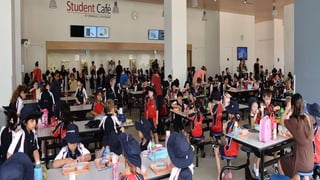
Students will imagine they
are in a hypothetical college
lunchroom observing other
students who are engaged in
conversations.
Based on these conversations,
students are to select their first
choice table to join and the
instructor leads a discussion as
follows.
›Students will demonstrate awareness
of their career Personality Types and
will determine their own unique
career interest Holland Code.
›Students will be able to identify types
of careers that match and do not
match their Holland Code.
Proponent: JOHN HOLLAND
He worked as an Army Classification
Interviewer during World War II and later
as a university counselor. He found that as
he interviewed, he could begin to predict
people’s responses based on patterns he
noticed over the years. He identified
these patterns and divided them into six
broad categories.
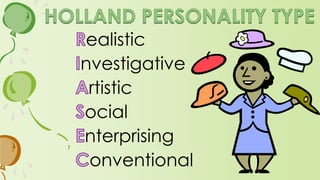
ealistic
nvestigative
rtistic
ocial
nterprising
onventional
These patterns are interesting, but they
become more useful when correlated
to occupations. Dr. Holland believed
that people can be described as a
combination of these six types, and
that work environments can also be
described as a combination of the
same six types.
If people find a compatible
work environment, they are
more likely to be satisfied
and productive.
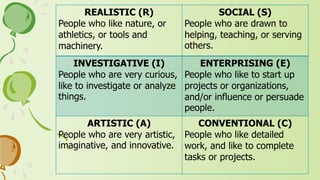
REALISTIC (R)
People who like nature, or
athletics, or tools and
machinery.
SOCIAL (S)
People who are drawn to
helping, teaching, or serving
others.
INVESTIGATIVE (I)
People who are very curious,
like to investigate or analyze
things.
ENTERPRISING (E)
People who like to start up
projects or organizations,
and/or influence or persuade
people.
ARTISTIC (A)
People who are very artistic,
imaginative, and innovative.
CONVENTIONAL (C)
People who like detailed
work, and like to complete
tasks or projects.
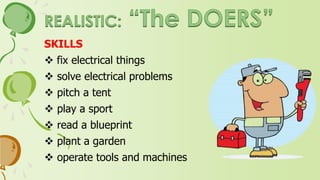
SKILLS
 fix electrical things
 solve electrical problems
 pitch a tent
 play a sport
 read a blueprint
 plant a garden
 operate tools and machines
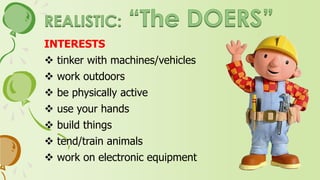
INTERESTS
 tinker with machines/vehicles
 work outdoors
 be physically active
 use your hands
 build things
 tend/train animals
 work on electronic equipment
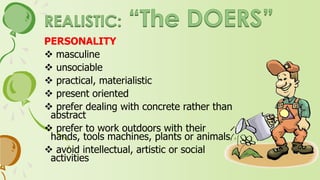
PERSONALITY
 masculine
 unsociable
 practical, materialistic
 present oriented
 prefer dealing with concrete rather than
abstract
 prefer to work outdoors with their
hands, tools machines, plants or animals
 avoid intellectual, artistic or social
activities
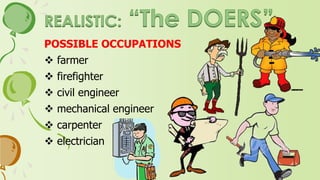
POSSIBLE OCCUPATIONS
 farmer
 firefighter
 civil engineer
 mechanical engineer
 carpenter
 electrician
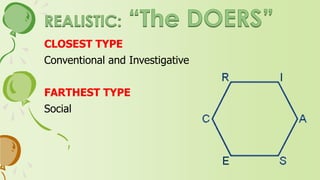
CLOSEST TYPE
Conventional and Investigative
FARTHEST TYPE
Social
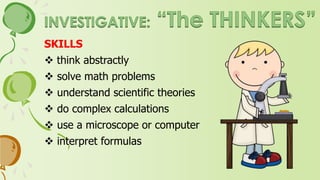
SKILLS
 think abstractly
 solve math problems
 understand scientific theories
 do complex calculations
 use a microscope or computer
 interpret formulas
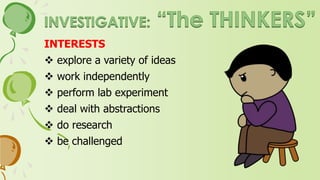
INTERESTS
 explore a variety of ideas
 work independently
 perform lab experiment
 deal with abstractions
 do research
 be challenged
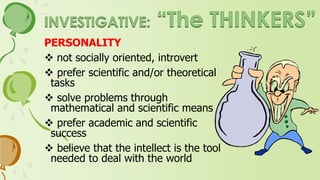
PERSONALITY
 not socially oriented, introvert
 prefer scientific and/or theoretical
tasks
 solve problems through
mathematical and scientific means
 prefer academic and scientific
success
 believe that the intellect is the tool
needed to deal with the world
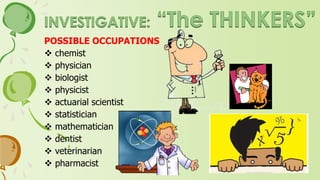
POSSIBLE OCCUPATIONS
 chemist
 physician
 biologist
 physicist
 actuarial scientist
 statistician
 mathematician
 dentist
 veterinarian
 pharmacist
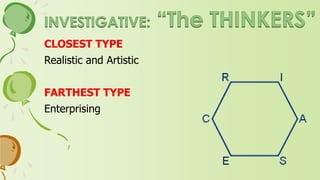
CLOSEST TYPE
Realistic and Artistic
FARTHEST TYPE
Enterprising
SKILLS
 sketch, draw and paints
 play a musical instrument
 writes stories, poetry and music
 sing, act and dance
 design fashions or interios
INTERESTS
 attend concerts, theatre, and
art exhibits
 read fiction, plays and poetry
 work on crafts
 take photography
 express yourself creativity
 deal with ambiguous ideas
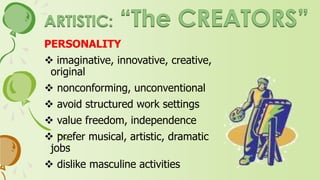
PERSONALITY
 imaginative, innovative, creative,
original
 nonconforming, unconventional
 avoid structured work settings
 value freedom, independence
 prefer musical, artistic, dramatic
jobs
 dislike masculine activities
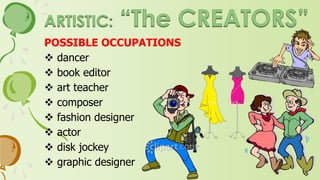
POSSIBLE OCCUPATIONS
 dancer
 book editor
 art teacher
 composer
 fashion designer
 actor
 disk jockey
 graphic designer
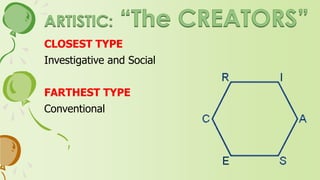
CLOSEST TYPE
Investigative and Social
FARTHEST TYPE
Conventional
SKILLS
 teach/train others
 express yourself clearly
 lead a group discussion
 mediate disputes
 plan and supervise an activity
 cooperate will with others
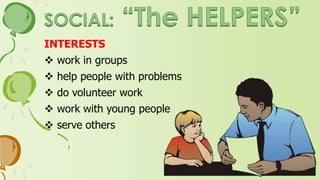
INTERESTS
 work in groups
 help people with problems
 do volunteer work
 work with young people
 serve others
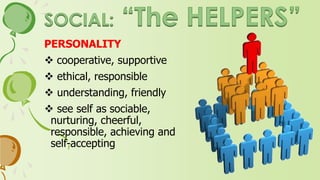
PERSONALITY
 cooperative, supportive
 ethical, responsible
 understanding, friendly
 see self as sociable,
nurturing, cheerful,
responsible, achieving and
self-accepting
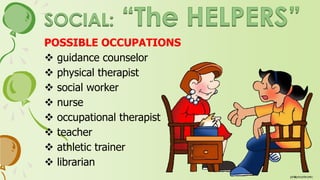
POSSIBLE OCCUPATIONS
 guidance counselor
 physical therapist
 social worker
 nurse
 occupational therapist
 teacher
 athletic trainer
 librarian
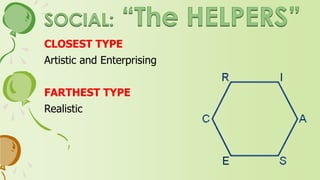
CLOSEST TYPE
Artistic and Enterprising
FARTHEST TYPE
Realistic
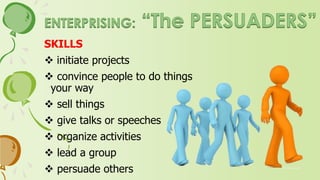
SKILLS
 initiate projects
 convince people to do things
your way
 sell things
 give talks or speeches
 organize activities
 lead a group
 persuade others
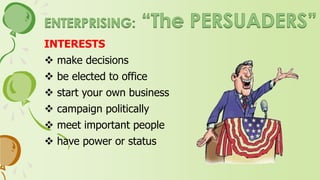
INTERESTS
 make decisions
 be elected to office
 start your own business
 campaign politically
 meet important people
 have power or status
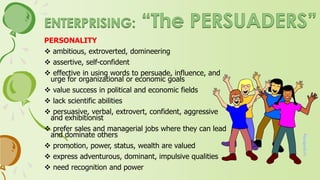
PERSONALITY
 ambitious, extroverted, domineering
 assertive, self-confident
 effective in using words to persuade, influence, and
urge for organizational or economic goals
 value success in political and economic fields
 lack scientific abilities
 persuasive, verbal, extrovert, confident, aggressive
and exhibitionist
 prefer sales and managerial jobs where they can lead
and dominate others
 promotion, power, status, wealth are valued
 express adventurous, dominant, impulsive qualities
 need recognition and power
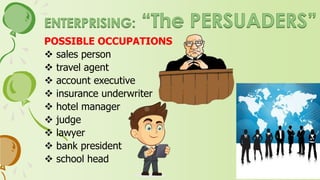
POSSIBLE OCCUPATIONS
 sales person
 travel agent
 account executive
 insurance underwriter
 hotel manager
 judge
 lawyer
 bank president
 school head
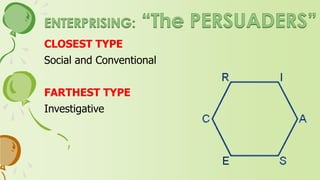
CLOSEST TYPE
Social and Conventional
FARTHEST TYPE
Investigative
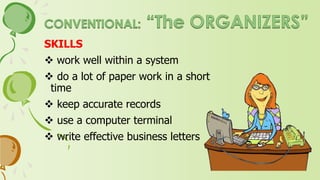
SKILLS
 work well within a system
 do a lot of paper work in a short
time
 keep accurate records
 use a computer terminal
 write effective business letters
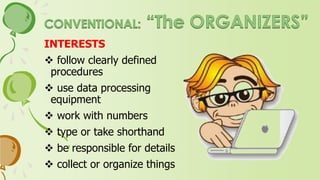
INTERESTS
 follow clearly defined
procedures
 use data processing
equipment
 work with numbers
 type or take shorthand
 be responsible for details
 collect or organize things
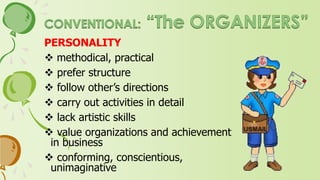
PERSONALITY
 methodical, practical
 prefer structure
 follow other’s directions
 carry out activities in detail
 lack artistic skills
 value organizations and achievement
in business
 conforming, conscientious,
unimaginative
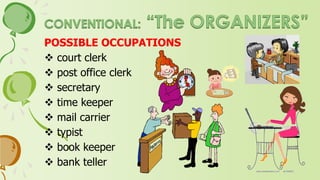
POSSIBLE OCCUPATIONS
 court clerk
 post office clerk
 secretary
 time keeper
 mail carrier
 typist
 book keeper
 bank teller
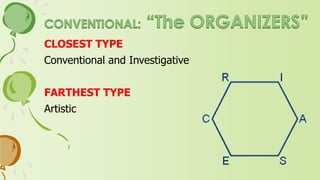
CLOSEST TYPE
Conventional and Investigative
FARTHEST TYPE
Artistic
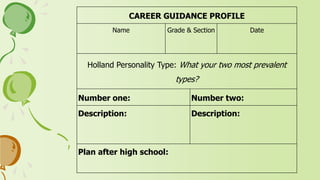
CAREER GUIDANCE PROFILE
Name Grade & Section Date
Holland Personality Type: What your two most prevalent
types?
Number one: Number two:
Description: Description:
Plan after high school:
Holland Party Game

Holland Party Game

  • 2.
    In this activity,students play an interactive game, called the Holland Party Game. This game was developed by Richard Bolles, author of What Color is Your Parachute?
  • 3.
    Students will imaginethey are in a hypothetical college lunchroom observing other students who are engaged in conversations.
  • 4.
    Based on theseconversations, students are to select their first choice table to join and the instructor leads a discussion as follows.
  • 5.
    ›Students will demonstrateawareness of their career Personality Types and will determine their own unique career interest Holland Code. ›Students will be able to identify types of careers that match and do not match their Holland Code.
  • 6.
    Proponent: JOHN HOLLAND Heworked as an Army Classification Interviewer during World War II and later as a university counselor. He found that as he interviewed, he could begin to predict people’s responses based on patterns he noticed over the years. He identified these patterns and divided them into six broad categories.
  • 7.
  • 8.
    These patterns areinteresting, but they become more useful when correlated to occupations. Dr. Holland believed that people can be described as a combination of these six types, and that work environments can also be described as a combination of the same six types.
  • 9.
    If people finda compatible work environment, they are more likely to be satisfied and productive.
  • 12.
    REALISTIC (R) People wholike nature, or athletics, or tools and machinery. SOCIAL (S) People who are drawn to helping, teaching, or serving others. INVESTIGATIVE (I) People who are very curious, like to investigate or analyze things. ENTERPRISING (E) People who like to start up projects or organizations, and/or influence or persuade people. ARTISTIC (A) People who are very artistic, imaginative, and innovative. CONVENTIONAL (C) People who like detailed work, and like to complete tasks or projects.
  • 15.
    SKILLS  fix electricalthings  solve electrical problems  pitch a tent  play a sport  read a blueprint  plant a garden  operate tools and machines
  • 16.
    INTERESTS  tinker withmachines/vehicles  work outdoors  be physically active  use your hands  build things  tend/train animals  work on electronic equipment
  • 17.
    PERSONALITY  masculine  unsociable practical, materialistic  present oriented  prefer dealing with concrete rather than abstract  prefer to work outdoors with their hands, tools machines, plants or animals  avoid intellectual, artistic or social activities
  • 18.
    POSSIBLE OCCUPATIONS  farmer firefighter  civil engineer  mechanical engineer  carpenter  electrician
  • 19.
    CLOSEST TYPE Conventional andInvestigative FARTHEST TYPE Social
  • 20.
    SKILLS  think abstractly solve math problems  understand scientific theories  do complex calculations  use a microscope or computer  interpret formulas
  • 21.
    INTERESTS  explore avariety of ideas  work independently  perform lab experiment  deal with abstractions  do research  be challenged
  • 22.
    PERSONALITY  not sociallyoriented, introvert  prefer scientific and/or theoretical tasks  solve problems through mathematical and scientific means  prefer academic and scientific success  believe that the intellect is the tool needed to deal with the world
  • 23.
    POSSIBLE OCCUPATIONS  chemist physician  biologist  physicist  actuarial scientist  statistician  mathematician  dentist  veterinarian  pharmacist
  • 24.
    CLOSEST TYPE Realistic andArtistic FARTHEST TYPE Enterprising
  • 25.
    SKILLS  sketch, drawand paints  play a musical instrument  writes stories, poetry and music  sing, act and dance  design fashions or interios
  • 26.
    INTERESTS  attend concerts,theatre, and art exhibits  read fiction, plays and poetry  work on crafts  take photography  express yourself creativity  deal with ambiguous ideas
  • 27.
    PERSONALITY  imaginative, innovative,creative, original  nonconforming, unconventional  avoid structured work settings  value freedom, independence  prefer musical, artistic, dramatic jobs  dislike masculine activities
  • 28.
    POSSIBLE OCCUPATIONS  dancer book editor  art teacher  composer  fashion designer  actor  disk jockey  graphic designer
  • 29.
    CLOSEST TYPE Investigative andSocial FARTHEST TYPE Conventional
  • 30.
    SKILLS  teach/train others express yourself clearly  lead a group discussion  mediate disputes  plan and supervise an activity  cooperate will with others
  • 31.
    INTERESTS  work ingroups  help people with problems  do volunteer work  work with young people  serve others
  • 32.
    PERSONALITY  cooperative, supportive ethical, responsible  understanding, friendly  see self as sociable, nurturing, cheerful, responsible, achieving and self-accepting
  • 33.
    POSSIBLE OCCUPATIONS  guidancecounselor  physical therapist  social worker  nurse  occupational therapist  teacher  athletic trainer  librarian
  • 34.
    CLOSEST TYPE Artistic andEnterprising FARTHEST TYPE Realistic
  • 35.
    SKILLS  initiate projects convince people to do things your way  sell things  give talks or speeches  organize activities  lead a group  persuade others
  • 36.
    INTERESTS  make decisions be elected to office  start your own business  campaign politically  meet important people  have power or status
  • 37.
    PERSONALITY  ambitious, extroverted,domineering  assertive, self-confident  effective in using words to persuade, influence, and urge for organizational or economic goals  value success in political and economic fields  lack scientific abilities  persuasive, verbal, extrovert, confident, aggressive and exhibitionist  prefer sales and managerial jobs where they can lead and dominate others  promotion, power, status, wealth are valued  express adventurous, dominant, impulsive qualities  need recognition and power
  • 38.
    POSSIBLE OCCUPATIONS  salesperson  travel agent  account executive  insurance underwriter  hotel manager  judge  lawyer  bank president  school head
  • 39.
    CLOSEST TYPE Social andConventional FARTHEST TYPE Investigative
  • 40.
    SKILLS  work wellwithin a system  do a lot of paper work in a short time  keep accurate records  use a computer terminal  write effective business letters
  • 41.
    INTERESTS  follow clearlydefined procedures  use data processing equipment  work with numbers  type or take shorthand  be responsible for details  collect or organize things
  • 42.
    PERSONALITY  methodical, practical prefer structure  follow other’s directions  carry out activities in detail  lack artistic skills  value organizations and achievement in business  conforming, conscientious, unimaginative
  • 43.
    POSSIBLE OCCUPATIONS  courtclerk  post office clerk  secretary  time keeper  mail carrier  typist  book keeper  bank teller
  • 44.
    CLOSEST TYPE Conventional andInvestigative FARTHEST TYPE Artistic
  • 45.
    CAREER GUIDANCE PROFILE NameGrade & Section Date Holland Personality Type: What your two most prevalent types? Number one: Number two: Description: Description: Plan after high school: