Personal Effectiveness
Careers and Employability
What is Personal Effectiveness?
• Personal effectiveness – the personal
qualities and approach to be an effective
researcher (employee / person).
• What are your thoughts on this? Work
in pairs or small groups to discuss this,
and create a list of traits that you think
are displayed by people with high levels
of personal effectiveness.
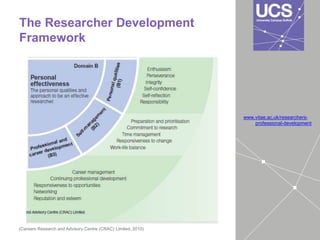
The Researcher Development
Framework
(Careers Research and Advisory Centre (CRAC) Limited, 2010)
www.vitae.ac.uk/researchers-
professional-development
Personal Effectiveness as Skills
• De Grande et al (2014) suggest graduate
personal effectiveness is made up of the
following skills:
• Independence
• Taking initiative
• Learning ability
• Stress management
• Self-confidence
• Flexibility
• Time management
• Dealing with failures
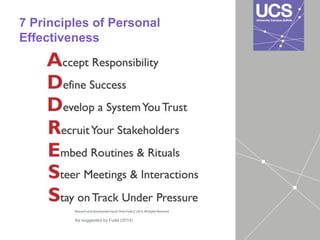
7 Principles of Personal
Effectiveness
As suggested by Fuda (2014)
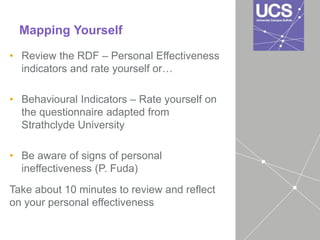
Mapping Yourself
• Review the RDF – Personal Effectiveness
indicators and rate yourself or…
• Behavioural Indicators – Rate yourself on
the questionnaire adapted from
Strathclyde University
• Be aware of signs of personal
ineffectiveness (P. Fuda)
Take about 10 minutes to review and reflect
on your personal effectiveness
Be kind to yourself…
www.vimeo.com/134415510
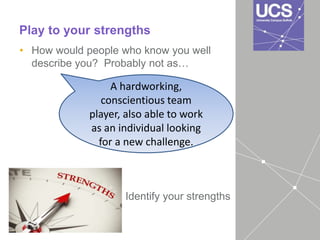
Play to your strengths
• How would people who know you well
describe you? Probably not as…
A hardworking,
conscientious team
player, also able to work
as an individual looking
for a new challenge.
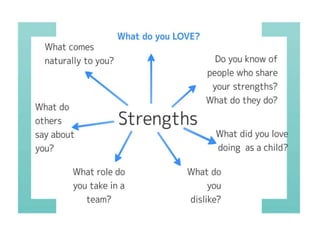
Identify your strengths
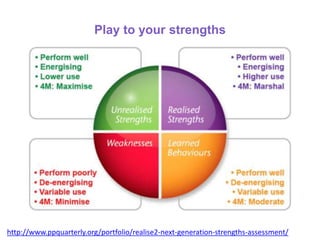
Play to your strengths
http://www.ppquarterly.org/portfolio/realise2-next-generation-strengths-assessment/
Additional resources to identify
your strengths and motivations
www.targetjobs.co.uk/careers-report
www.16personalities.com/free-personality-test
www.myersbriggs.org/my-mbti-personality-
type/mbti-basics/
www2.open.ac.uk/students/careers/
http://destinations.ucs.ac.uk/units/personality.sh
tml
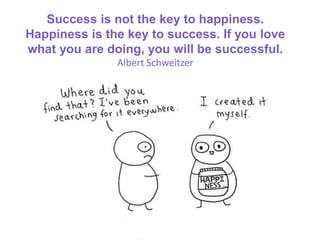
Success is not the key to happiness.
Happiness is the key to success. If you love
what you are doing, you will be successful.
Albert Schweitzer
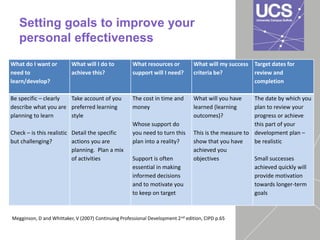
Setting goals to improve your
personal effectiveness
What do I want or
need to
learn/develop?
What will I do to
achieve this?
What resources or
support will I need?
What will my success
criteria be?
Target dates for
review and
completion
Be specific – clearly
describe what you are
planning to learn
Check – is this realistic
but challenging?
Take account of you
preferred learning
style
Detail the specific
actions you are
planning. Plan a mix
of activities
The cost in time and
money
Whose support do
you need to turn this
plan into a reality?
Support is often
essential in making
informed decisions
and to motivate you
to keep on target
What will you have
learned (learning
outcomes)?
This is the measure to
show that you have
achieved you
objectives
The date by which you
plan to review your
progress or achieve
this part of your
development plan –
be realistic
Small successes
achieved quickly will
provide motivation
towards longer-term
goals
Megginson, D and Whittaker, V (2007) Continuing Professional Development 2nd edition, CIPD p.65
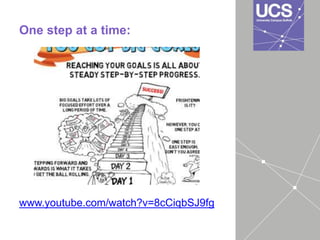
One step at a time:
www.youtube.com/watch?v=8cCiqbSJ9fg
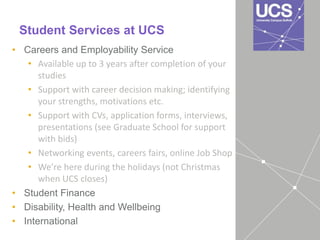
Student Services at UCS
• Careers and Employability Service
• Available up to 3 years after completion of your
studies
• Support with career decision making; identifying
your strengths, motivations etc.
• Support with CVs, application forms, interviews,
presentations (see Graduate School for support
with bids)
• Networking events, careers fairs, online Job Shop
• We’re here during the holidays (not Christmas
when UCS closes)
• Student Finance
• Disability, Health and Wellbeing
• International
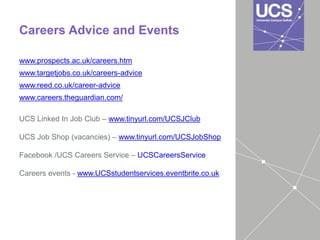
Careers Advice and Events
www.prospects.ac.uk/careers.htm
www.targetjobs.co.uk/careers-advice
www.reed.co.uk/career-advice
www.careers.theguardian.com/
UCS Linked In Job Club – www.tinyurl.com/UCSJClub
UCS Job Shop (vacancies) – www.tinyurl.com/UCSJobShop
Facebook /UCS Careers Service – UCSCareersService
Careers events - www.UCSstudentservices.eventbrite.co.uk
References
• Careers Research and Advisory Centre (CRAC) Limited (2010) Introducing the
Researcher Development Framework. Available at: https://www.vitae.ac.uk/vitae-
publications/rdf-related/introducing-the-vitae-researcher-development-framework-rdf-
to-employers-2011.pdf (Accessed: 1 April 2016).
• De Grande, H., De Boyser, K., Vandevelde, K. And Van Rossem, R. (2014) ‘From
Academia to Industry: Are Doctorate Holders Ready?’, Journal of the Knowledge
Economy. 5(3). DOI: 10.1007/s13132-014-0192-9
• Fuda, P. (2014) The 7 Principles of Personal Effectiveness. Available at:
http://www.peterfuda.com/2014/04/28/the-7-principles-of-personal-effectiveness/
(Accessed: 1 April 2016).
• University of Strathclyde (2016) Personal Effectiveness. Available at:
https://www.strath.ac.uk/careers/skills/peopleskills/personaleffectiveness/ (Accessed:
1 April 2016)
• Linley, A., Willars, J., Biswas-Diener, R. - The Strengths Book: Be Confident, Be
Successful, and Enjoy Better Relationships by Realising the Best of You (2010) Capp
Press
• Approved excerpt from Average to A+: Realising Strengths in Yourself and Others, by
Alex Linley, published by CAPP Press (2008)
www.cappeu.com/Portals/3/Files/Average_to_Aplus_Chapter_4_Strengthspotting.pdf
(Accessed 15/4/2016)
• Megginson, D and Whittaker, V (2007) Continuing Professional Development 2nd
edition, CIPD

Personal effectiveness presentation

  • 1.
  • 2.
    What is PersonalEffectiveness? • Personal effectiveness – the personal qualities and approach to be an effective researcher (employee / person). • What are your thoughts on this? Work in pairs or small groups to discuss this, and create a list of traits that you think are displayed by people with high levels of personal effectiveness.
  • 3.
    The Researcher Development Framework (CareersResearch and Advisory Centre (CRAC) Limited, 2010) www.vitae.ac.uk/researchers- professional-development
  • 4.
    Personal Effectiveness asSkills • De Grande et al (2014) suggest graduate personal effectiveness is made up of the following skills: • Independence • Taking initiative • Learning ability • Stress management • Self-confidence • Flexibility • Time management • Dealing with failures
  • 5.
    7 Principles ofPersonal Effectiveness As suggested by Fuda (2014)
  • 6.
    Mapping Yourself • Reviewthe RDF – Personal Effectiveness indicators and rate yourself or… • Behavioural Indicators – Rate yourself on the questionnaire adapted from Strathclyde University • Be aware of signs of personal ineffectiveness (P. Fuda) Take about 10 minutes to review and reflect on your personal effectiveness
  • 7.
    Be kind toyourself… www.vimeo.com/134415510
  • 8.
    Play to yourstrengths • How would people who know you well describe you? Probably not as… A hardworking, conscientious team player, also able to work as an individual looking for a new challenge. Identify your strengths
  • 10.
    Play to yourstrengths http://www.ppquarterly.org/portfolio/realise2-next-generation-strengths-assessment/
  • 11.
    Additional resources toidentify your strengths and motivations www.targetjobs.co.uk/careers-report www.16personalities.com/free-personality-test www.myersbriggs.org/my-mbti-personality- type/mbti-basics/ www2.open.ac.uk/students/careers/ http://destinations.ucs.ac.uk/units/personality.sh tml
  • 12.
    Success is notthe key to happiness. Happiness is the key to success. If you love what you are doing, you will be successful. Albert Schweitzer
  • 13.
    Setting goals toimprove your personal effectiveness What do I want or need to learn/develop? What will I do to achieve this? What resources or support will I need? What will my success criteria be? Target dates for review and completion Be specific – clearly describe what you are planning to learn Check – is this realistic but challenging? Take account of you preferred learning style Detail the specific actions you are planning. Plan a mix of activities The cost in time and money Whose support do you need to turn this plan into a reality? Support is often essential in making informed decisions and to motivate you to keep on target What will you have learned (learning outcomes)? This is the measure to show that you have achieved you objectives The date by which you plan to review your progress or achieve this part of your development plan – be realistic Small successes achieved quickly will provide motivation towards longer-term goals Megginson, D and Whittaker, V (2007) Continuing Professional Development 2nd edition, CIPD p.65
  • 14.
    One step ata time: www.youtube.com/watch?v=8cCiqbSJ9fg
  • 15.
    Student Services atUCS • Careers and Employability Service • Available up to 3 years after completion of your studies • Support with career decision making; identifying your strengths, motivations etc. • Support with CVs, application forms, interviews, presentations (see Graduate School for support with bids) • Networking events, careers fairs, online Job Shop • We’re here during the holidays (not Christmas when UCS closes) • Student Finance • Disability, Health and Wellbeing • International
  • 16.
    Careers Advice andEvents www.prospects.ac.uk/careers.htm www.targetjobs.co.uk/careers-advice www.reed.co.uk/career-advice www.careers.theguardian.com/ UCS Linked In Job Club – www.tinyurl.com/UCSJClub UCS Job Shop (vacancies) – www.tinyurl.com/UCSJobShop Facebook /UCS Careers Service – UCSCareersService Careers events - www.UCSstudentservices.eventbrite.co.uk
  • 17.
    References • Careers Researchand Advisory Centre (CRAC) Limited (2010) Introducing the Researcher Development Framework. Available at: https://www.vitae.ac.uk/vitae- publications/rdf-related/introducing-the-vitae-researcher-development-framework-rdf- to-employers-2011.pdf (Accessed: 1 April 2016). • De Grande, H., De Boyser, K., Vandevelde, K. And Van Rossem, R. (2014) ‘From Academia to Industry: Are Doctorate Holders Ready?’, Journal of the Knowledge Economy. 5(3). DOI: 10.1007/s13132-014-0192-9 • Fuda, P. (2014) The 7 Principles of Personal Effectiveness. Available at: http://www.peterfuda.com/2014/04/28/the-7-principles-of-personal-effectiveness/ (Accessed: 1 April 2016). • University of Strathclyde (2016) Personal Effectiveness. Available at: https://www.strath.ac.uk/careers/skills/peopleskills/personaleffectiveness/ (Accessed: 1 April 2016) • Linley, A., Willars, J., Biswas-Diener, R. - The Strengths Book: Be Confident, Be Successful, and Enjoy Better Relationships by Realising the Best of You (2010) Capp Press • Approved excerpt from Average to A+: Realising Strengths in Yourself and Others, by Alex Linley, published by CAPP Press (2008) www.cappeu.com/Portals/3/Files/Average_to_Aplus_Chapter_4_Strengthspotting.pdf (Accessed 15/4/2016) • Megginson, D and Whittaker, V (2007) Continuing Professional Development 2nd edition, CIPD

Editor's Notes

  • #3 5 minute discussion
  • #4 Signpost resources in link on left
  • #5 Personal effectiveness for PGRs
  • #6 Personal effectiveness in employment
  • #7 Give out questionnaire and RDF framework
  • #11 Coping mechanisms for weaknesses. Over-played strength can be a weakness. Lots of research online.
  • #13 Strengths-based approach has routes in positive psychology, Martin Seligman.