Resilency
By Tanya Linkletter
What is Resiliency
• Resiliency is the ability to
overcome challenges of all
kinds–trauma, tragedy,
personal crises, life
problems
• The ability to bounce back
stronger, wiser, and more
personally powerful.
Take the Quiz
• How resilient am I?
Ten Keys to Resiliency
www.youtube.com/watch?v=ujvCEDwfTX0
Protective factors
• For people to overcome trouble, somehow the
protective factors in their lives have to outweigh
the forces that drag them down.
• Some of these protective factors are present in
resilient people themselves, characteristics like
insight, independence, initiative, creativity, a
strong ethical sense, and the ability to see the
funny side of difficult situations.
• Other protective factors come from their
environment.
Protective factors
• developing good social skills (the individual)
• having parents who monitor where their children are,
what they are doing and with whom(family)
• participating in positive social activities
(neighbourhood)
• feeling connected to school (school)
• achieving good school grades (school)
• having friends who positively influence decision-
making (peers)
• having supportive adults in the community
(neighbourhood) (AADAC, 2003e, p. 26)
Risk Factors
• becoming involved with ATODG at an early age (the
individual)
• having friends who use or encourage use of ATODG
(peers)
• belonging to a family with a history of substance abuse
(family)
• experiencing conflict within the family (family)
• having a poor connection to school (school)
• getting low school grades (school)
• having easy access to ATODG (neighbourhood)
(AADAC, 2003e, p. 21)
What I need to know
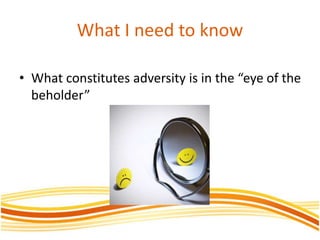
• What constitutes adversity is in the “eye of the
beholder”
Resilience is…
• Managing emotions rather than suppressing
them.
• Facing our difficulties head on.
• Built through pain and struggle.
– It is essential to not get too entrenched in these
negative emotions to the point where they
paralyze you.
Resilience is a process.
• There is not an endpoint at which we can arrive
and say, “Ah! At last I’ve attained resilience,”
• Even though people do become stronger through
overcoming adversity, it doesn’t mean that they
will be “inoculated” to all future adversities.
– You may still may be vulnerable to coping poorly with
future challenges.
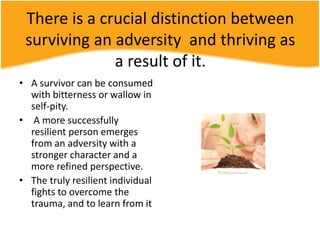
There is a crucial distinction between
surviving an adversity and thriving as
a result of it.
• A survivor can be consumed
with bitterness or wallow in
self-pity.
• A more successfully
resilient person emerges
from an adversity with a
stronger character and a
more refined perspective.
• The truly resilient individual
fights to overcome the
trauma, and to learn from it
keys to Resilience
A sense of humour
 being quick to laugh and easy
to smile has consistently been
associated with a better
psychological state.
 You do not take yourself or
your ideas too seriously
 You are able to step back and
observe with a little more
detachment and objectivity
Self efficacy
• the belief in your ability to get things done
and move your life in a desired direction.
• the capacity to stay focused on your goals and
to carry out the necessary actions to
accomplish them.
– we become a lot more hopeful in our ability to
pull through a tough situation if we have faith in
our ability to successfully take the steps to move
forward.
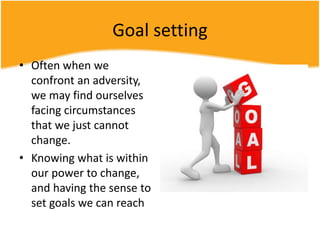
Goal setting
• Often when we
confront an adversity,
we may find ourselves
facing circumstances
that we just cannot
change.
• Knowing what is within
our power to change,
and having the sense to
set goals we can reach
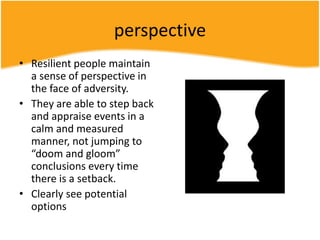
perspective
• Resilient people maintain
a sense of perspective in
the face of adversity.
• They are able to step back
and appraise events in a
calm and measured
manner, not jumping to
“doom and gloom”
conclusions every time
there is a setback.
• Clearly see potential
options
Curiosity
• imply an open-mindedness to experimenting with
different approaches that will increase your
ability to move through an adversity.
• Unsuccessful attempts are viewed as learning
experiences not as failures.
• Higher capacity for self-reflection.
– able to gain insights about themselves and recognize
the growth that emerges from their struggles.
• if you are open to the possibilities of the good
things that can emerge from a trauma, you may
be more likely to reap them.
Authenticity and self acceptance
• The kinder we are to ourselves, the more
resilient we will be in facing adversity.
• Self acceptance implies that we possess
realistic expectations and goals and that we
have an accurate recognition of our strengths
as well as our vulnerabilities.
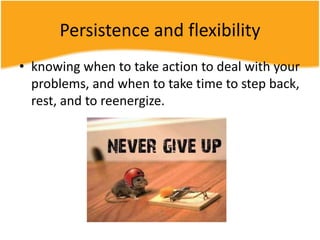
Persistence and flexibility
• knowing when to take action to deal with your
problems, and when to take time to step back,
rest, and to reenergize.
Social Support
• It is well recognized that a good social support network
is necessary to help maintain a positive state.
• Resilient individuals maintain strong connections with
others and tend to have supportive relationships.
• They are not too proud to accept help and guidance
from those they trust.
• Some may find support in their close circles of family
and friends, while others may derive it from being
active in community groups or faith-based
organizations.
Emotional Control
• The ability to moderate the intensity of your
feelings in order to keep your focus in stressful
events.
• The ability to exhibit consistent behaviors
across a wide range of situations.
• People who can regulate their emotions
effectively are better able to rise above
negative scripts that can keep them
ruminating or despairing over a problem.
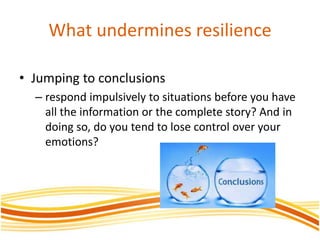
What undermines resilience
• Jumping to conclusions
– respond impulsively to situations before you have
all the information or the complete story? And in
doing so, do you tend to lose control over your
emotions?
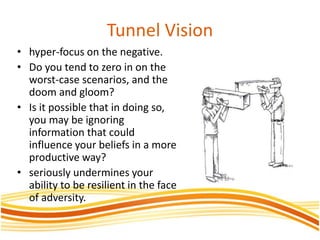
Tunnel Vision
• hyper-focus on the negative.
• Do you tend to zero in on the
worst-case scenarios, and the
doom and gloom?
• Is it possible that in doing so,
you may be ignoring
information that could
influence your beliefs in a more
productive way?
• seriously undermines your
ability to be resilient in the face
of adversity.
Magnifying and minimizing
• Magnifying and minimizing entails collecting
information about a scenario, but proceeding to
overvalue some details of the story and undervalue
others depending on your cognitive biases.
• Can you see how this might lead to a self fulfilling
prophecy if the overemphasis is on a situation’s
negative aspects?
• A resilient mindset is promoted through cultivating a
balanced and accurate appraisal of one’s life
situations.”
Personalization
• Personalization is the default feeling that you are the
cause of your problems.
• Do you automatically attribute your adversities to your
own doing?
• Do you believe it’s usually all your fault?
• Do you feel guilty because you tend to think that your
actions have led to the pain and misfortune of others?
• That’s a whole lot of weight for any psyche to take on.
• Resiliency requires that we be able to accurate discern
our own culpability in situations as opposed to the
causes that are external to us.
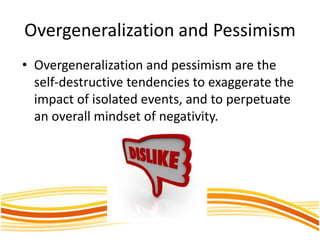
Overgeneralization and Pessimism
• Overgeneralization and pessimism are the
self-destructive tendencies to exaggerate the
impact of isolated events, and to perpetuate
an overall mindset of negativity.
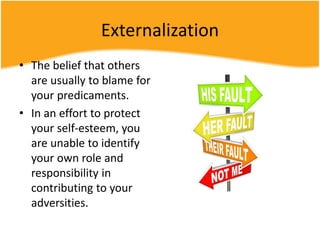
Externalization
• The belief that others
are usually to blame for
your predicaments.
• In an effort to protect
your self-esteem, you
are unable to identify
your own role and
responsibility in
contributing to your
adversities.
Can you avoid the sink Holes
• In groups of 2 respond with the appropriate
sink hole
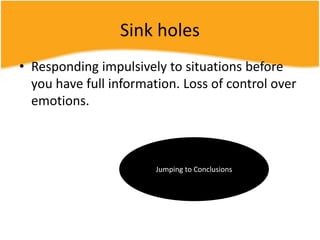
Sink holes
• Responding impulsively to situations before
you have full information. Loss of control over
emotions.
Jumping to Conclusions
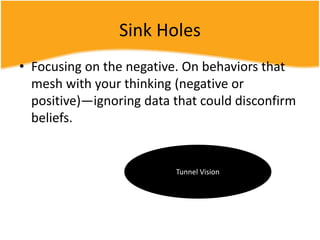
Sink Holes
• Focusing on the negative. On behaviors that
mesh with your thinking (negative or
positive)—ignoring data that could disconfirm
beliefs.
Tunnel Vision
Sink Holes
• Collecting all the information, but overvaluing
some and undervaluing others. Leads to self
fulfilling prophesy. Growth and change
requires a balanced, accurate appraisal of the
situation.
Magnifying and minimizing
Sink holes
• Reflex tendency to attribute problems to one’s
own doing. Often leads to depression and/or
guilt (because others have been violated and
it’s your fault). You only see the internal
causes of a problem and not the external
cause. Resiliency requires accuracy. Self
efficacy requires belief that you can change
the internal causes.
Personalization
Sink Holes
• Opposite of personalizing. Problems are rarely
your fault. Protects the person’s self esteem.
Externalizers fail to identify the problems that
were genuinely their fault and within their
control. They think everyone else has let them
down. Prone to anger.
Externalizing
Sink Holes
• Character assassination reaction to problems
(I’m a bad parent). Explanatory style (me,
always, everything).
Over generalizing
Sink Holes
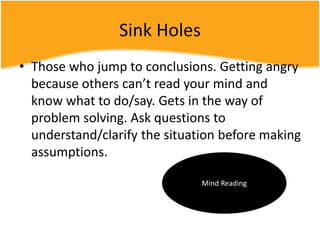
• Those who jump to conclusions. Getting angry
because others can’t read your mind and
know what to do/say. Gets in the way of
problem solving. Ask questions to
understand/clarify the situation before making
assumptions.
Mind Reading
Sink Holes
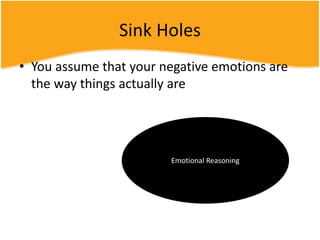
• You assume that your negative emotions are
the way things actually are
Emotional Reasoning
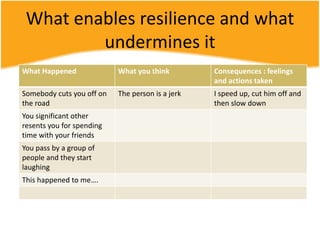
What enables resilience and what
undermines it
What Happened What you think Consequences : feelings
and actions taken
Somebody cuts you off on
the road
The person is a jerk I speed up, cut him off and
then slow down
You significant other
resents you for spending
time with your friends
You pass by a group of
people and they start
laughing
This happened to me….
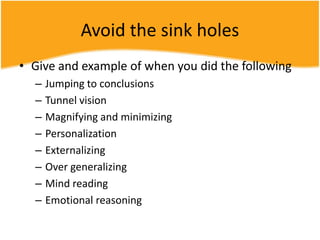
Avoid the sink holes
• Give and example of when you did the following
– Jumping to conclusions
– Tunnel vision
– Magnifying and minimizing
– Personalization
– Externalizing
– Over generalizing
– Mind reading
– Emotional reasoning
Coping strategies and applications
Day to Day Adversity
Step one : Identify the negative beliefs that may
be preventing you from resolving your issue
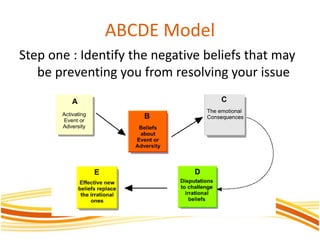
ABCDE Model
Step one : Identify the negative beliefs that may
be preventing you from resolving your issue
ABCDE model animated
• https://youtu.be/Vzp-7-
LKQIs?list=PLTnqK3a4dar-rGo1En-
G1avpIP_RpX9-v
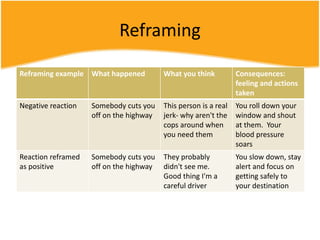
Reframing
Reframing example What happened What you think Consequences:
feeling and actions
taken
Negative reaction Somebody cuts you
off on the highway
This person is a real
jerk- why aren't the
cops around when
you need them
You roll down your
window and shout
at them. Your
blood pressure
soars
Reaction reframed
as positive
Somebody cuts you
off on the highway
They probably
didn't see me.
Good thing I'm a
careful driver
You slow down, stay
alert and focus on
getting safely to
your destination
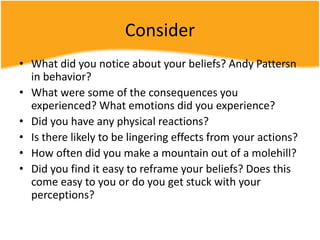
Consider
• What did you notice about your beliefs? Andy Pattersn
in behavior?
• What were some of the consequences you
experienced? What emotions did you experience?
• Did you have any physical reactions?
• Is there likely to be lingering effects from your actions?
• How often did you make a mountain out of a molehill?
• Did you find it easy to reframe your beliefs? Does this
come easy to you or do you get stuck with your
perceptions?
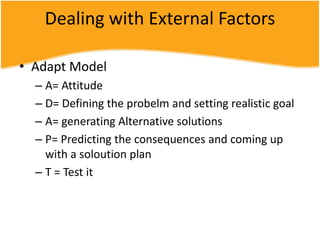
Dealing with External Factors
• Adapt Model
– A= Attitude
– D= Defining the probelm and setting realistic goal
– A= generating Alternative solutions
– P= Predicting the consequences and coming up
with a soloution plan
– T = Test it
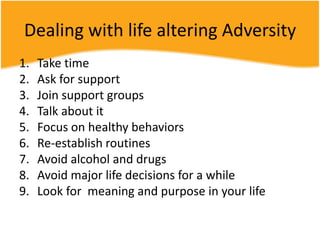
Dealing with life altering Adversity
1. Take time
2. Ask for support
3. Join support groups
4. Talk about it
5. Focus on healthy behaviors
6. Re-establish routines
7. Avoid alcohol and drugs
8. Avoid major life decisions for a while
9. Look for meaning and purpose in your life

Resiliency

  • 1.
  • 2.
    What is Resiliency •Resiliency is the ability to overcome challenges of all kinds–trauma, tragedy, personal crises, life problems • The ability to bounce back stronger, wiser, and more personally powerful.
  • 3.
    Take the Quiz •How resilient am I?
  • 4.
    Ten Keys toResiliency www.youtube.com/watch?v=ujvCEDwfTX0
  • 5.
    Protective factors • Forpeople to overcome trouble, somehow the protective factors in their lives have to outweigh the forces that drag them down. • Some of these protective factors are present in resilient people themselves, characteristics like insight, independence, initiative, creativity, a strong ethical sense, and the ability to see the funny side of difficult situations. • Other protective factors come from their environment.
  • 6.
    Protective factors • developinggood social skills (the individual) • having parents who monitor where their children are, what they are doing and with whom(family) • participating in positive social activities (neighbourhood) • feeling connected to school (school) • achieving good school grades (school) • having friends who positively influence decision- making (peers) • having supportive adults in the community (neighbourhood) (AADAC, 2003e, p. 26)
  • 7.
    Risk Factors • becominginvolved with ATODG at an early age (the individual) • having friends who use or encourage use of ATODG (peers) • belonging to a family with a history of substance abuse (family) • experiencing conflict within the family (family) • having a poor connection to school (school) • getting low school grades (school) • having easy access to ATODG (neighbourhood) (AADAC, 2003e, p. 21)
  • 8.
    What I needto know • What constitutes adversity is in the “eye of the beholder”
  • 9.
    Resilience is… • Managingemotions rather than suppressing them. • Facing our difficulties head on. • Built through pain and struggle. – It is essential to not get too entrenched in these negative emotions to the point where they paralyze you.
  • 10.
    Resilience is aprocess. • There is not an endpoint at which we can arrive and say, “Ah! At last I’ve attained resilience,” • Even though people do become stronger through overcoming adversity, it doesn’t mean that they will be “inoculated” to all future adversities. – You may still may be vulnerable to coping poorly with future challenges.
  • 11.
    There is acrucial distinction between surviving an adversity and thriving as a result of it. • A survivor can be consumed with bitterness or wallow in self-pity. • A more successfully resilient person emerges from an adversity with a stronger character and a more refined perspective. • The truly resilient individual fights to overcome the trauma, and to learn from it
  • 12.
    keys to Resilience Asense of humour  being quick to laugh and easy to smile has consistently been associated with a better psychological state.  You do not take yourself or your ideas too seriously  You are able to step back and observe with a little more detachment and objectivity
  • 13.
    Self efficacy • thebelief in your ability to get things done and move your life in a desired direction. • the capacity to stay focused on your goals and to carry out the necessary actions to accomplish them. – we become a lot more hopeful in our ability to pull through a tough situation if we have faith in our ability to successfully take the steps to move forward.
  • 14.
    Goal setting • Oftenwhen we confront an adversity, we may find ourselves facing circumstances that we just cannot change. • Knowing what is within our power to change, and having the sense to set goals we can reach
  • 15.
    perspective • Resilient peoplemaintain a sense of perspective in the face of adversity. • They are able to step back and appraise events in a calm and measured manner, not jumping to “doom and gloom” conclusions every time there is a setback. • Clearly see potential options
  • 16.
    Curiosity • imply anopen-mindedness to experimenting with different approaches that will increase your ability to move through an adversity. • Unsuccessful attempts are viewed as learning experiences not as failures. • Higher capacity for self-reflection. – able to gain insights about themselves and recognize the growth that emerges from their struggles. • if you are open to the possibilities of the good things that can emerge from a trauma, you may be more likely to reap them.
  • 17.
    Authenticity and selfacceptance • The kinder we are to ourselves, the more resilient we will be in facing adversity. • Self acceptance implies that we possess realistic expectations and goals and that we have an accurate recognition of our strengths as well as our vulnerabilities.
  • 18.
    Persistence and flexibility •knowing when to take action to deal with your problems, and when to take time to step back, rest, and to reenergize.
  • 19.
    Social Support • Itis well recognized that a good social support network is necessary to help maintain a positive state. • Resilient individuals maintain strong connections with others and tend to have supportive relationships. • They are not too proud to accept help and guidance from those they trust. • Some may find support in their close circles of family and friends, while others may derive it from being active in community groups or faith-based organizations.
  • 20.
    Emotional Control • Theability to moderate the intensity of your feelings in order to keep your focus in stressful events. • The ability to exhibit consistent behaviors across a wide range of situations. • People who can regulate their emotions effectively are better able to rise above negative scripts that can keep them ruminating or despairing over a problem.
  • 21.
    What undermines resilience •Jumping to conclusions – respond impulsively to situations before you have all the information or the complete story? And in doing so, do you tend to lose control over your emotions?
  • 22.
    Tunnel Vision • hyper-focuson the negative. • Do you tend to zero in on the worst-case scenarios, and the doom and gloom? • Is it possible that in doing so, you may be ignoring information that could influence your beliefs in a more productive way? • seriously undermines your ability to be resilient in the face of adversity.
  • 23.
    Magnifying and minimizing •Magnifying and minimizing entails collecting information about a scenario, but proceeding to overvalue some details of the story and undervalue others depending on your cognitive biases. • Can you see how this might lead to a self fulfilling prophecy if the overemphasis is on a situation’s negative aspects? • A resilient mindset is promoted through cultivating a balanced and accurate appraisal of one’s life situations.”
  • 24.
    Personalization • Personalization isthe default feeling that you are the cause of your problems. • Do you automatically attribute your adversities to your own doing? • Do you believe it’s usually all your fault? • Do you feel guilty because you tend to think that your actions have led to the pain and misfortune of others? • That’s a whole lot of weight for any psyche to take on. • Resiliency requires that we be able to accurate discern our own culpability in situations as opposed to the causes that are external to us.
  • 25.
    Overgeneralization and Pessimism •Overgeneralization and pessimism are the self-destructive tendencies to exaggerate the impact of isolated events, and to perpetuate an overall mindset of negativity.
  • 26.
    Externalization • The beliefthat others are usually to blame for your predicaments. • In an effort to protect your self-esteem, you are unable to identify your own role and responsibility in contributing to your adversities.
  • 27.
    Can you avoidthe sink Holes • In groups of 2 respond with the appropriate sink hole
  • 28.
    Sink holes • Respondingimpulsively to situations before you have full information. Loss of control over emotions. Jumping to Conclusions
  • 29.
    Sink Holes • Focusingon the negative. On behaviors that mesh with your thinking (negative or positive)—ignoring data that could disconfirm beliefs. Tunnel Vision
  • 30.
    Sink Holes • Collectingall the information, but overvaluing some and undervaluing others. Leads to self fulfilling prophesy. Growth and change requires a balanced, accurate appraisal of the situation. Magnifying and minimizing
  • 31.
    Sink holes • Reflextendency to attribute problems to one’s own doing. Often leads to depression and/or guilt (because others have been violated and it’s your fault). You only see the internal causes of a problem and not the external cause. Resiliency requires accuracy. Self efficacy requires belief that you can change the internal causes. Personalization
  • 32.
    Sink Holes • Oppositeof personalizing. Problems are rarely your fault. Protects the person’s self esteem. Externalizers fail to identify the problems that were genuinely their fault and within their control. They think everyone else has let them down. Prone to anger. Externalizing
  • 33.
    Sink Holes • Characterassassination reaction to problems (I’m a bad parent). Explanatory style (me, always, everything). Over generalizing
  • 34.
    Sink Holes • Thosewho jump to conclusions. Getting angry because others can’t read your mind and know what to do/say. Gets in the way of problem solving. Ask questions to understand/clarify the situation before making assumptions. Mind Reading
  • 35.
    Sink Holes • Youassume that your negative emotions are the way things actually are Emotional Reasoning
  • 36.
    What enables resilienceand what undermines it What Happened What you think Consequences : feelings and actions taken Somebody cuts you off on the road The person is a jerk I speed up, cut him off and then slow down You significant other resents you for spending time with your friends You pass by a group of people and they start laughing This happened to me….
  • 37.
    Avoid the sinkholes • Give and example of when you did the following – Jumping to conclusions – Tunnel vision – Magnifying and minimizing – Personalization – Externalizing – Over generalizing – Mind reading – Emotional reasoning
  • 38.
    Coping strategies andapplications Day to Day Adversity Step one : Identify the negative beliefs that may be preventing you from resolving your issue
  • 39.
    ABCDE Model Step one: Identify the negative beliefs that may be preventing you from resolving your issue
  • 40.
    ABCDE model animated •https://youtu.be/Vzp-7- LKQIs?list=PLTnqK3a4dar-rGo1En- G1avpIP_RpX9-v
  • 41.
    Reframing Reframing example Whathappened What you think Consequences: feeling and actions taken Negative reaction Somebody cuts you off on the highway This person is a real jerk- why aren't the cops around when you need them You roll down your window and shout at them. Your blood pressure soars Reaction reframed as positive Somebody cuts you off on the highway They probably didn't see me. Good thing I'm a careful driver You slow down, stay alert and focus on getting safely to your destination
  • 42.
    Consider • What didyou notice about your beliefs? Andy Pattersn in behavior? • What were some of the consequences you experienced? What emotions did you experience? • Did you have any physical reactions? • Is there likely to be lingering effects from your actions? • How often did you make a mountain out of a molehill? • Did you find it easy to reframe your beliefs? Does this come easy to you or do you get stuck with your perceptions?
  • 43.
    Dealing with ExternalFactors • Adapt Model – A= Attitude – D= Defining the probelm and setting realistic goal – A= generating Alternative solutions – P= Predicting the consequences and coming up with a soloution plan – T = Test it
  • 44.
    Dealing with lifealtering Adversity 1. Take time 2. Ask for support 3. Join support groups 4. Talk about it 5. Focus on healthy behaviors 6. Re-establish routines 7. Avoid alcohol and drugs 8. Avoid major life decisions for a while 9. Look for meaning and purpose in your life