Unit IV:
Career
Development
MODULE 12:
PERSONS AND CAREERS
Objectives:
At the end of the module, you will be able to:
1. explain that understanding of the concepts
of career and life goals can help in
planning your career,
2. identify the personal factors influencing
career choices, and
3. take a self-assessment tool to know your
personality traits and other
personal factors in relation to your goals
How do personal/internal factors
influence your career choices?
TEN MYTHS ABOUT CAREER
PLANNING BUSTED!
Myth 1: Arts/humanities majors usually are
unemployable after college Fact: Skills matter in
every stream
Myth 2: Selecting what's 'hot' at the moment is safe
Fact: What's hot today may not necessarily be
10/20 years later
Myth 3: Career assessments / counselors will not be
of any use for me Fact: You must know what your
aptitude is before choosing a career
Myth 4: If X is happy in a particular field, I will be
happy too Fact: You are not X
Myth 5: If I wait long enough, luck will eventually
bring me to the right career Fact:
Procrastination is no substitute for laziness
Myth 6: Making a lot of money will make me
happy Fact: The ingredients of fulfilling career
also includes passion and commitment to
growth
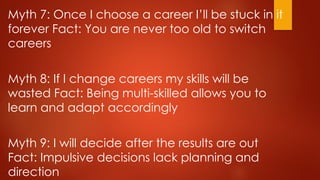
Myth 7: Once I choose a career I’ll be stuck in it
forever Fact: You are never too old to switch
careers
Myth 8: If I change careers my skills will be
wasted Fact: Being multi-skilled allows you to
learn and adapt accordingly
Myth 9: I will decide after the results are out
Fact: Impulsive decisions lack planning and
direction
Myth 10: I love this hobby, but I don’t think I
can make money out of it Fact: If you love
what you do, you will not feel like you are
working
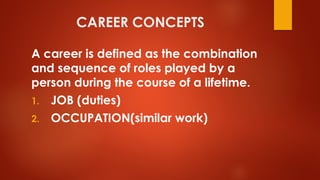
CAREER CONCEPTS
A career is defined as the combination
and sequence of roles played by a
person during the course of a lifetime.
1. JOB (duties)
2. OCCUPATION(similar work)
WHAT INFLUENCES YOUR CAREER
CHOICE?
 Skills and Abilities
 Interest and Personality Type
 Life Roles
 Previous Experiences
 Culture
 Gender
 Social and Economic Conditions
 Childhood Fantasies
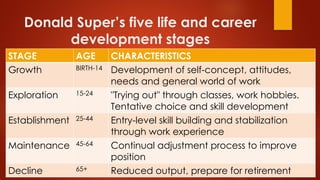
Donald Super’s five life and career
development stages
STAGE AGE CHARACTERISTICS
Growth BIRTH-14 Development of self-concept, attitudes,
needs and general world of work
Exploration 15-24 "Trying out" through classes, work hobbies.
Tentative choice and skill development
Establishment 25-44 Entry-level skill building and stabilization
through work experience
Maintenance 45-64 Continual adjustment process to improve
position
Decline 65+ Reduced output, prepare for retirement
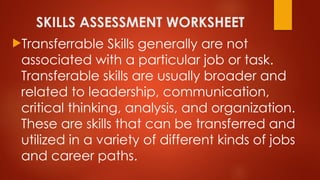
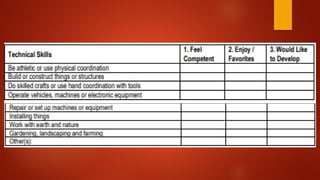
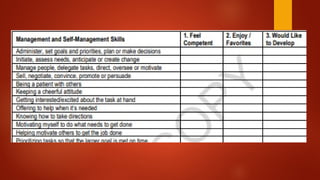
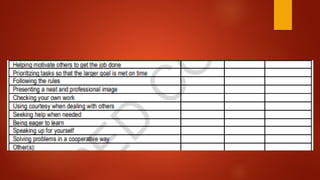
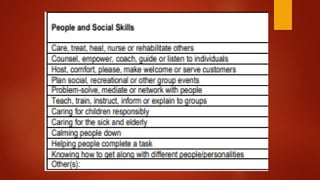
SKILLS ASSESSMENT WORKSHEET
Transferrable Skills generally are not
associated with a particular job or task.
Transferable skills are usually broader and
related to leadership, communication,
critical thinking, analysis, and organization.
These are skills that can be transferred and
utilized in a variety of different kinds of jobs
and career paths.
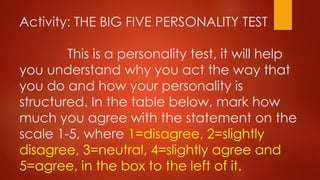
Activity: THE BIG FIVE PERSONALITY TEST
This is a personality test, it will help
you understand why you act the way that
you do and how your personality is
structured. In the table below, mark how
much you agree with the statement on the
scale 1-5, where 1=disagree, 2=slightly
disagree, 3=neutral, 4=slightly agree and
5=agree, in the box to the left of it.
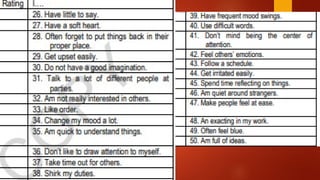
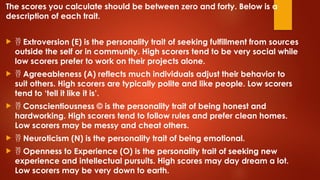
The scores you calculate should be between zero and forty. Below is a
description of each trait.
  Extroversion (E) is the personality trait of seeking fulfillment from sources
outside the self or in community. High scorers tend to be very social while
low scorers prefer to work on their projects alone.
  Agreeableness (A) reflects much individuals adjust their behavior to
suit others. High scorers are typically polite and like people. Low scorers
tend to ‘tell it like it is’.
  Conscientiousness © is the personality trait of being honest and
hardworking. High scorers tend to follow rules and prefer clean homes.
Low scorers may be messy and cheat others.
  Neuroticism (N) is the personality trait of being emotional.
  Openness to Experience (O) is the personality trait of seeking new
experience and intellectual pursuits. High scores may day dream a lot.
Low scorers may be very down to earth.
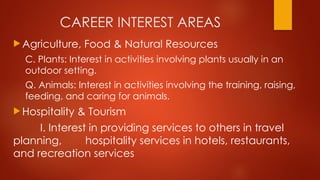
CAREER INTEREST AREAS
 Agriculture, Food & Natural Resources
C. Plants: Interest in activities involving plants usually in an
outdoor setting.
Q. Animals: Interest in activities involving the training, raising,
feeding, and caring for animals.
 Hospitality & Tourism
I. Interest in providing services to others in travel
planning, hospitality services in hotels, restaurants,
and recreation services
 Architecture & Construction
L. Designing and Building: Interest in designing,
planning, managing, building, and maintaining physical
structures.
 Human Services
J. Interest in helping others with their mental,
spiritual, social, physical, or career needs.
 Arts, Audio-Video Technology & Communications
A. Artistic: Interest in creative or performing
arts, communication or A/V
technology
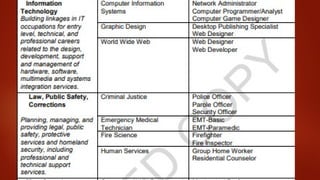
Information Technology
P. Interest in the design, development, support and
management of hardware, software, multimedia,
systems integration services, and technical support
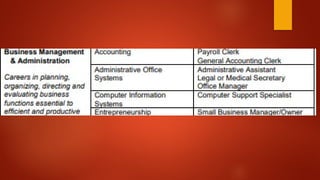
Business, Management & Administration
G. Business Detail: Interest in organizing, directing
and evaluating business functions
Law, Public Safety & Security
D. Interest in judicial, legal and protective services
for people and property.
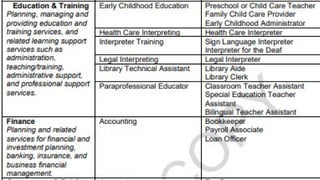
 Education & Training
M. Teaching: Interest in planning, managing, and providing
education and training services, including support services,
library and information services.
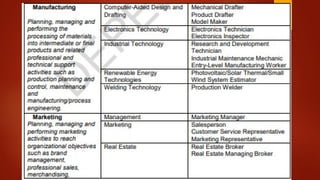
 Manufacturing
E. Mechanical: Interest in applying mechanical principles to
practical situations using machines, hand tools, or techniques.
F. Industrial: Interest in repetitive, organized activities in a
factory/industrial set
 Finance
N. Banking, Investments, and Insurance: Interest in financial
and investment planning & management and providing
banking and insurance services
Marketing, Sales & Service
H. Interest in bringing others to a point of view through
personal persuasion, using sales/promotional techniques.
Government & Public Administration
K. Administration: Interest in performing government
functions at the local, state or federal levels
Science, Technology, Engineering & Mathematics
B. Interest in discovering, collecting, and analyzing
information and applying findings to problems in science,
math and engineering
Health Science
O. Care and Prevention: Interest in the providing
help to others by providing diagnostic,
therapeutic, informational and environmental
services, including researching and developing
new health care services.
Transportation, Distribution & Logistics
R. Interest in the movement of people, materials,
and goods by road, pipeline, air, railroad and
water.
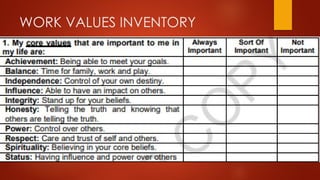
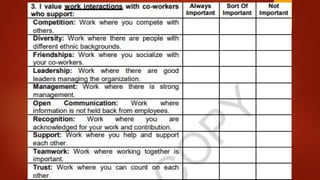
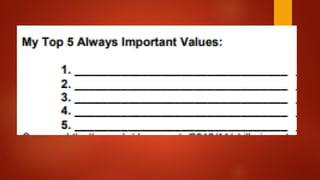
WORK VALUES INVENTORY
HOW TO CHOOSE A MAJOR AND A
JOB PATH USING CAREER CLUSTERS
MODULE 13: Career Pathways
Objectives:
At the end of the module, you will be able to:
1. discuss the external factors influencing career choices
that may help you in career decision making,
2. identify pros and cons of various career options with
the guidance of parent, teacher, or counselor, and
3. prepare a career plan based on your personal goal
and external factors influencing career choices.
Big Question:
How do external factors influence
your career choices?
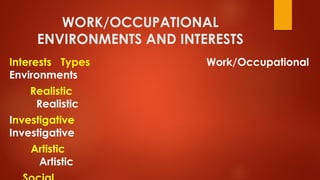
WORK/OCCUPATIONAL
ENVIRONMENTS AND INTERESTS
Interests Types Work/Occupational
Environments
Realistic
Realistic
Investigative
Investigative
Artistic
Artistic
CHOOSE YOUR CAREER FIRST – NOT
YOUR COLLEGE
MODULE 14: INSIGHTS INTO ONE’S
PERSONAL DEVELOPMENT
G12 SENIOR HIGH PERSONAL DEVELOPMENT.pptx

G12 SENIOR HIGH PERSONAL DEVELOPMENT.pptx

  • 1.
  • 2.
    Objectives: At the endof the module, you will be able to: 1. explain that understanding of the concepts of career and life goals can help in planning your career, 2. identify the personal factors influencing career choices, and 3. take a self-assessment tool to know your personality traits and other personal factors in relation to your goals
  • 3.
    How do personal/internalfactors influence your career choices?
  • 4.
    TEN MYTHS ABOUTCAREER PLANNING BUSTED!
  • 5.
    Myth 1: Arts/humanitiesmajors usually are unemployable after college Fact: Skills matter in every stream Myth 2: Selecting what's 'hot' at the moment is safe Fact: What's hot today may not necessarily be 10/20 years later Myth 3: Career assessments / counselors will not be of any use for me Fact: You must know what your aptitude is before choosing a career
  • 6.
    Myth 4: IfX is happy in a particular field, I will be happy too Fact: You are not X Myth 5: If I wait long enough, luck will eventually bring me to the right career Fact: Procrastination is no substitute for laziness Myth 6: Making a lot of money will make me happy Fact: The ingredients of fulfilling career also includes passion and commitment to growth
  • 7.
    Myth 7: OnceI choose a career I’ll be stuck in it forever Fact: You are never too old to switch careers Myth 8: If I change careers my skills will be wasted Fact: Being multi-skilled allows you to learn and adapt accordingly Myth 9: I will decide after the results are out Fact: Impulsive decisions lack planning and direction
  • 8.
    Myth 10: Ilove this hobby, but I don’t think I can make money out of it Fact: If you love what you do, you will not feel like you are working
  • 9.
    CAREER CONCEPTS A careeris defined as the combination and sequence of roles played by a person during the course of a lifetime. 1. JOB (duties) 2. OCCUPATION(similar work)
  • 10.
    WHAT INFLUENCES YOURCAREER CHOICE?  Skills and Abilities  Interest and Personality Type  Life Roles  Previous Experiences  Culture  Gender  Social and Economic Conditions  Childhood Fantasies
  • 11.
    Donald Super’s fivelife and career development stages STAGE AGE CHARACTERISTICS Growth BIRTH-14 Development of self-concept, attitudes, needs and general world of work Exploration 15-24 "Trying out" through classes, work hobbies. Tentative choice and skill development Establishment 25-44 Entry-level skill building and stabilization through work experience Maintenance 45-64 Continual adjustment process to improve position Decline 65+ Reduced output, prepare for retirement
  • 12.
    SKILLS ASSESSMENT WORKSHEET TransferrableSkills generally are not associated with a particular job or task. Transferable skills are usually broader and related to leadership, communication, critical thinking, analysis, and organization. These are skills that can be transferred and utilized in a variety of different kinds of jobs and career paths.
  • 22.
    Activity: THE BIGFIVE PERSONALITY TEST This is a personality test, it will help you understand why you act the way that you do and how your personality is structured. In the table below, mark how much you agree with the statement on the scale 1-5, where 1=disagree, 2=slightly disagree, 3=neutral, 4=slightly agree and 5=agree, in the box to the left of it.
  • 26.
    The scores youcalculate should be between zero and forty. Below is a description of each trait.   Extroversion (E) is the personality trait of seeking fulfillment from sources outside the self or in community. High scorers tend to be very social while low scorers prefer to work on their projects alone.   Agreeableness (A) reflects much individuals adjust their behavior to suit others. High scorers are typically polite and like people. Low scorers tend to ‘tell it like it is’.   Conscientiousness © is the personality trait of being honest and hardworking. High scorers tend to follow rules and prefer clean homes. Low scorers may be messy and cheat others.   Neuroticism (N) is the personality trait of being emotional.   Openness to Experience (O) is the personality trait of seeking new experience and intellectual pursuits. High scores may day dream a lot. Low scorers may be very down to earth.
  • 27.
    CAREER INTEREST AREAS Agriculture, Food & Natural Resources C. Plants: Interest in activities involving plants usually in an outdoor setting. Q. Animals: Interest in activities involving the training, raising, feeding, and caring for animals.  Hospitality & Tourism I. Interest in providing services to others in travel planning, hospitality services in hotels, restaurants, and recreation services
  • 28.
     Architecture &Construction L. Designing and Building: Interest in designing, planning, managing, building, and maintaining physical structures.  Human Services J. Interest in helping others with their mental, spiritual, social, physical, or career needs.  Arts, Audio-Video Technology & Communications A. Artistic: Interest in creative or performing arts, communication or A/V technology
  • 29.
    Information Technology P. Interestin the design, development, support and management of hardware, software, multimedia, systems integration services, and technical support Business, Management & Administration G. Business Detail: Interest in organizing, directing and evaluating business functions Law, Public Safety & Security D. Interest in judicial, legal and protective services for people and property.
  • 30.
     Education &Training M. Teaching: Interest in planning, managing, and providing education and training services, including support services, library and information services.  Manufacturing E. Mechanical: Interest in applying mechanical principles to practical situations using machines, hand tools, or techniques. F. Industrial: Interest in repetitive, organized activities in a factory/industrial set  Finance N. Banking, Investments, and Insurance: Interest in financial and investment planning & management and providing banking and insurance services
  • 31.
    Marketing, Sales &Service H. Interest in bringing others to a point of view through personal persuasion, using sales/promotional techniques. Government & Public Administration K. Administration: Interest in performing government functions at the local, state or federal levels Science, Technology, Engineering & Mathematics B. Interest in discovering, collecting, and analyzing information and applying findings to problems in science, math and engineering
  • 32.
    Health Science O. Careand Prevention: Interest in the providing help to others by providing diagnostic, therapeutic, informational and environmental services, including researching and developing new health care services. Transportation, Distribution & Logistics R. Interest in the movement of people, materials, and goods by road, pipeline, air, railroad and water.
  • 33.
  • 38.
    HOW TO CHOOSEA MAJOR AND A JOB PATH USING CAREER CLUSTERS
  • 46.
    MODULE 13: CareerPathways Objectives: At the end of the module, you will be able to: 1. discuss the external factors influencing career choices that may help you in career decision making, 2. identify pros and cons of various career options with the guidance of parent, teacher, or counselor, and 3. prepare a career plan based on your personal goal and external factors influencing career choices.
  • 47.
    Big Question: How doexternal factors influence your career choices?
  • 48.
    WORK/OCCUPATIONAL ENVIRONMENTS AND INTERESTS InterestsTypes Work/Occupational Environments Realistic Realistic Investigative Investigative Artistic Artistic
  • 49.
    CHOOSE YOUR CAREERFIRST – NOT YOUR COLLEGE
  • 50.
    MODULE 14: INSIGHTSINTO ONE’S PERSONAL DEVELOPMENT