MODULE
13
CAREER
PATHWAYS
Presented b
LEONILA C. MIRAND
G11 – Personality Developmen
What are the
personal/ internal
factors that can
influence CAREER
CHOICES?
What are the
concepts that
you’ve learned
from SUPER’S
CAREER
How do
external
factors
influence
career
choices?
discuss the external
factors influencing
career choices that
may help them in
career decision
making; and
prepare a career plan
based on their
personal goal and
At the end
of the module,
learners will be
MOTIVATION
VIDEO ANALYSIS
“CAREER PATHS”
1. What happened to
the main character?
2. What did you feel
while watching the
video?
3. What insights did
you learned and
realize about
choosing your career
MAIN
ACTIVITY
THE QUICK JOB-HUNTING MAP:
“THE PARTY”
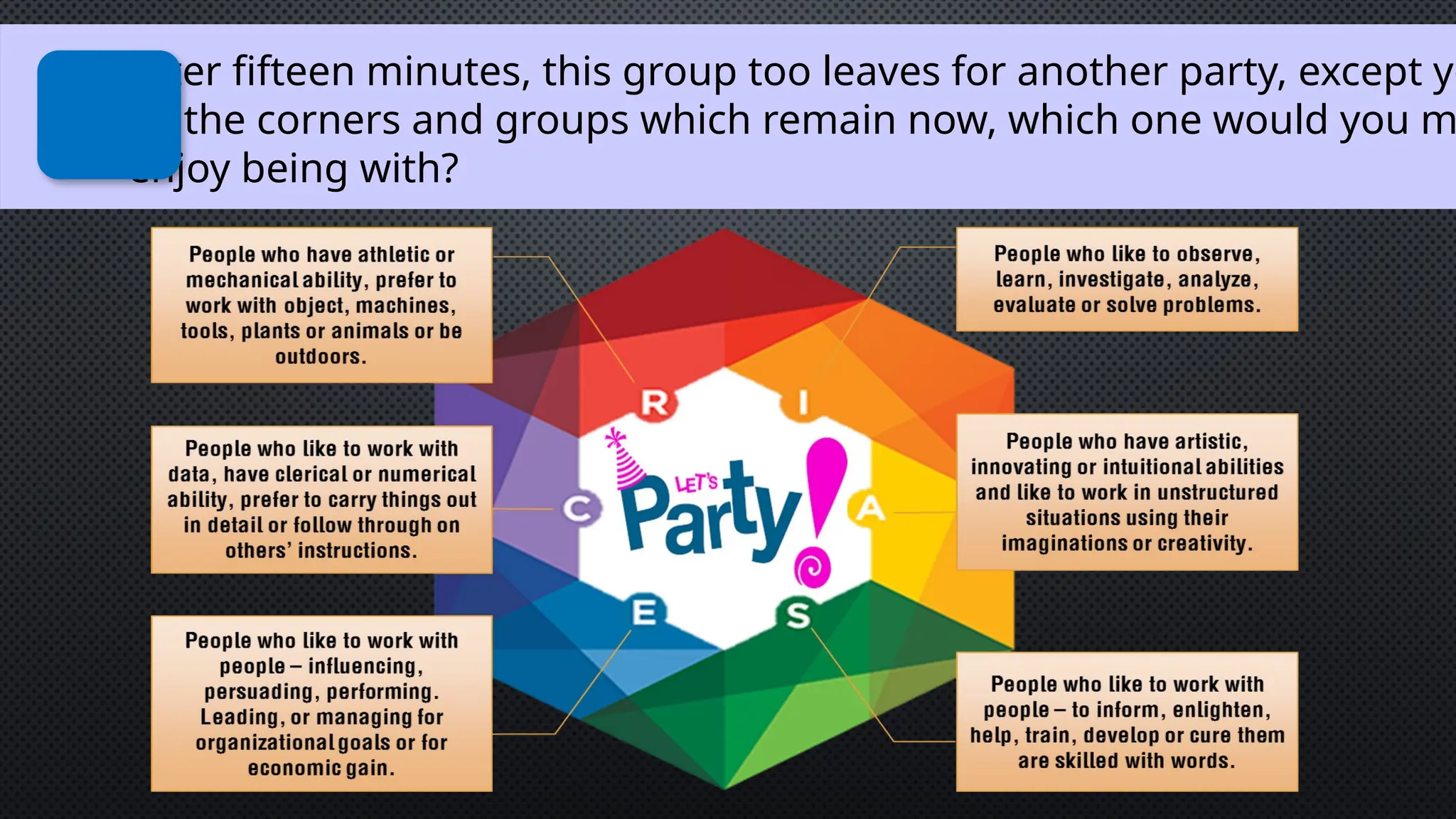
People who like to observe,
learn, investigate, analyze,
evaluate or solve problems.
People who like to work with
people – to inform,
enlighten, help, train,
develop or cure them are
skilled with words.
People who have artistic,
innovating or intuitional
abilities and like to work in
unstructured situations
using their imaginations or
creativity.
People who have athletic or
mechanical ability, prefer to
work with object, machines,
tools, plants or animals or
be outdoors.
People who like to work with
data, have clerical or
numerical ability, prefer to
carry things out in detail or
follow through on others’
instructions.
People who like to work with
people – influencing,
persuading, performing.
Leading, or managing for
organizational goals or for
economic gain.
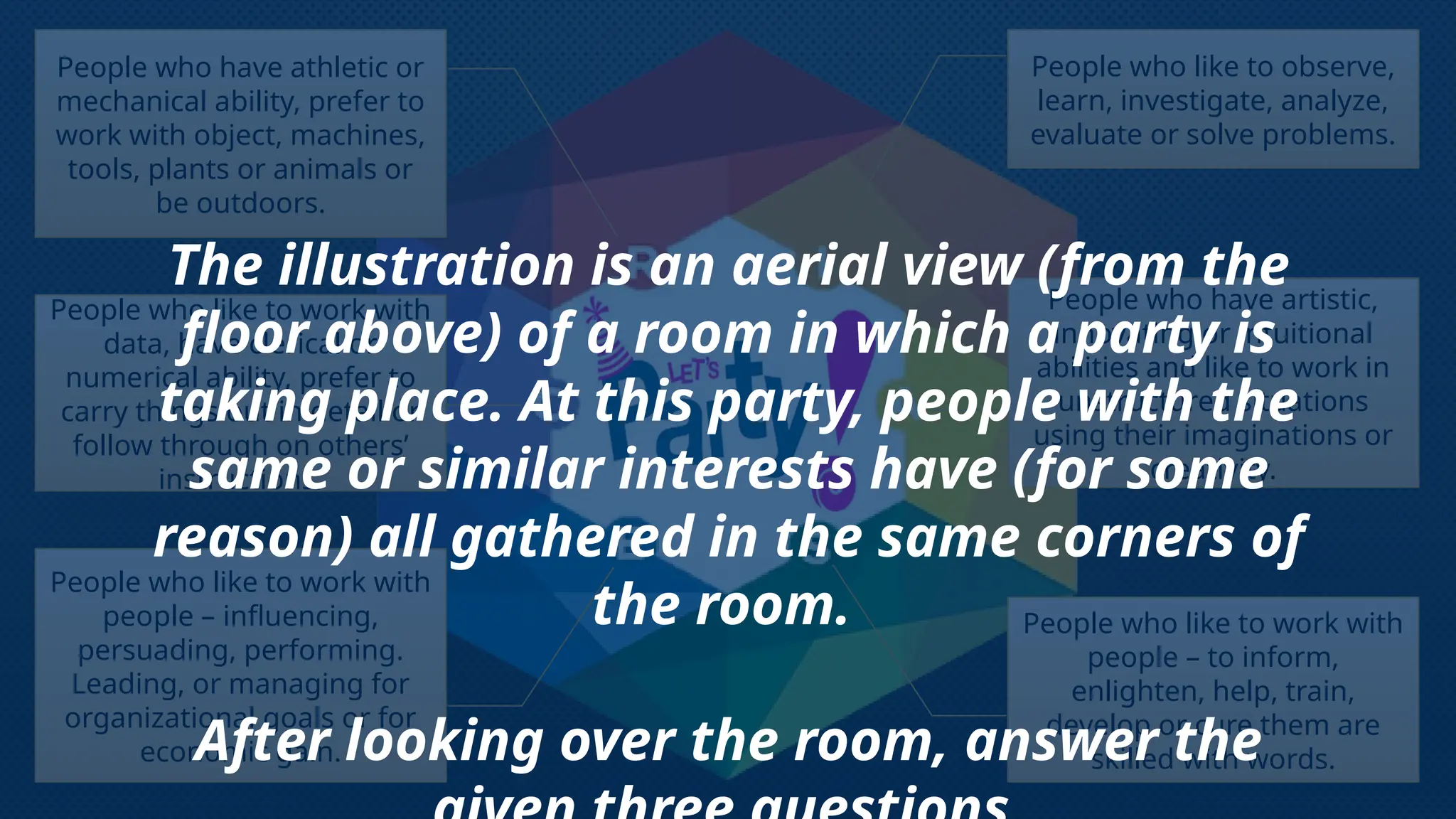
The illustration is an aerial view (from the
floor above) of a room in which a party is
taking place. At this party, people with the
same or similar interests have (for some
reason) all gathered in the same corners of
the room.
After looking over the room, answer the
People who like to observe,
learn, investigate, analyze,
evaluate or solve problems.
People who like to work with
people – to inform,
enlighten, help, train,
develop or cure them are
skilled with words.
People who have artistic,
innovating or intuitional
abilities and like to work in
unstructured situations
using their imaginations or
creativity.
People who have athletic or
mechanical ability, prefer to
work with object, machines,
tools, plants or animals or
be outdoors.
People who like to work with
data, have clerical or
numerical ability, prefer to
carry things out in detail or
follow through on others’
instructions.
People who like to work with
people – influencing,
persuading, performing.
Leading, or managing for
organizational goals or for
economic gain.
Which corner of the room would you instinctively be drawn to as the
group of people you would most enjoy being with for the longest time
(Leave aside any shyness, or whether you would have to talk with them
After fifteen minutes, everyone in the corner you have chosen leaves f
another party across town except you. Of the groups that still remain
now, which corner or group would you be drawn to the most?
After fifteen minutes, this group too leaves for another party, except yo
Of the corners and groups which remain now, which one would you m
enjoy being with?
Considering your answer
in the first question, what
drew you to this side of
the room?
What is it about the people
in this group that made
you decide that they are
the group you would like
to mingle with?
Why did you consider the
group in the next
question as your next
best choice?
What made you not
choose them first yet
would choose them next
once the first group
leaves?
Why did you consider the
last group as you next
choice?
Why was this choice is in
the least of your choices
among the group of
people in the
party? What is it about
them that made you
choose them last?
Looking back at your
scores in the interest and
personality assessment,
how
would you relate this to
your choices?
What were your
realizations after the said
activity?
WORK/OCCUPATIONAL
ENVIRONMENTS AND
INTERESTS
Psychologist JOHN HOLLAND
classified jobs/careers/work
environments as well as
classifies
personalities or interests into
six:
REALISTIC, INVESTIGATIVE, ARTISTIC,
RIASEC
Tend to enjoy creating things
with their hands and working
with tools and objects rather
than working with people
and ideas. Realistic people
tend to be rugged and
practical, enjoying work
outdoors.
Sample Occupations:
forester, industrial arts teacher, radio operator,
auto engineer, mechanical engineer, mining
engineer, vocational agriculture teacher, civil
engineer, industrial engineering technician,
aircraft mechanic, mechanical engineer
technician, fish and game warden, surveyor,
dental technician, architectural draftsman,
electrician, jeweler, powerhouse repairman, tool
and die maker, machinist, mechanic, stone cutter,
locksmith, nuclear reactor technician, tree
surgeon, piano tuner, typesetter, air conditioning
engineer, ship pilot, instrument mechanic,
motion picture projectionist, carpenter, tailor,
machine repairer.
R
REALISTIC
Sample Occupations:
economist, internist, physician, anthropologist,
astronomer, pathologist, physicist, chemist,
production planner, medical lab assistant, biologist,
osteopath, chiropractor, math teacher, natural
science teacher, optometrist, psychiatrist,
psychologist, medical technologist, bacteriologist,
physiologist, research analyst, computer analyst,
programmer, pharmacist, actuary, quality control
technician, computer operator, geologist,
mathematician/ statistician, surgeon, meteorologist,
agronomist, animal scientist, botanist, zoologist,
horticulturist, natural scientist, oceanographer,
biochemist, veterinarian, geographer, x-ray
technician, administrator, dentist, tool designer,
chemical lab technician, engineers
I
INVESTIGATIVE
Tend to work alone than with
other people and are usually
seen as idea-oriented and
creative in scientific areas
such as research. They are
analytical, abstract,
intellectual and task-
oriented.
Sample Occupations:
drama coach, language teacher, journalist-
reporter, drama teacher, foreign language
interpreter, philosopher, art teacher, literature
teacher, music teacher, musician, orchestra
conductor, advertising manager, entertainer,
public relations person, fashion model, writer,
editor, radio program writer, dramatist,
actor/actress, designer, interior decorator,
critic, fashion illustrator, furniture designer,
jewelry designer, furrier, garment designer,
decorator, architect, artist, photographer,
photograph retoucher, photolithographer
(printer),
music arranger, composer
A
ARTISTIC
Artistically inclined, and
usually describe themselves
as independent, imaginative,
creative, and
unconventional, They enjoy
activities related to
language, art, music, drama,
writing, etc.
Sample Occupations:
education, teaching, social welfare, human
development, counseling, health professions
(medicine, nursing, etc.), social service, compensation
advising, etc. In addition, dorm director, interviewer,
employment representative, funeral director, chamber
of commerce executive, employee benefits approver,
food service manager, claim adjuster, production
expediter, health and welfare coordinator, educational
administrator, training director, historian,
environmental health engineer, home service rep.,
community recreation administrator, business agent,
extension agent, physical education teacher, building
superintendent, therapist, political scientist,
sociologist, social and group worker, personnel
director, food and drug inspector, teacher, minister,
librarian, foreign service officer, history teacher
S
SOCIAL
Seen by others as sociable,
popular, and responsible; prefer
social interaction and social
presence; often interested in
the concerns of others, and like
activities that allow them to
teach, inform, train, develop,
cure and help others.
Sample Occupations:
sales and marketing field, banker, insurance
underwriter, real estate appraiser, florist,
industrial engineer, contractor, warehouse
manager, salesperson-technical products,
lawyer, judge, attorney, tv/radio announcer,
branch manager, director industrial relations,
government official, insurance manager,
managers such as restaurant/ office/
traffic/human resource/production, etc., salary
and wage administrator, labor arbitrator,
systems analyst, director of compensation and
benefits, securities, salesperson, human
resource recruiter
E
ENTERPRISING
Involve situations where the
person is in a position of
leading or convincing others
to achieve
team/organizational goals or
economic gain. People high
on this theme are often seen
as enthusiastic, dominant,
Sample Occupations:
clerical, administrative, time study analyst,
business (commercial) teacher, finance
expert, accountant, credit manager,
timekeeper, auto writing machine operator,
bookkeeping machine operator, estimator,
foreign trade clerk, office worker, payroll
clerk, accounting machine operator,
personnel clerk, sales correspondent,
reservations agent, bookkeeper, cashier,
secretary, medical secretary, library
assistant, data processing worker, mail clerk,
personnel secretary, proofreader, and the
like
C
CONVENTIONAL
Tend to prefer jobs where they
are given firm structure and
know exactly what is expected
of them. They enjoy activities
that involve the precise, ordered
use of data such as keeping and
filing records, organizing data,
computing, printing, etc.
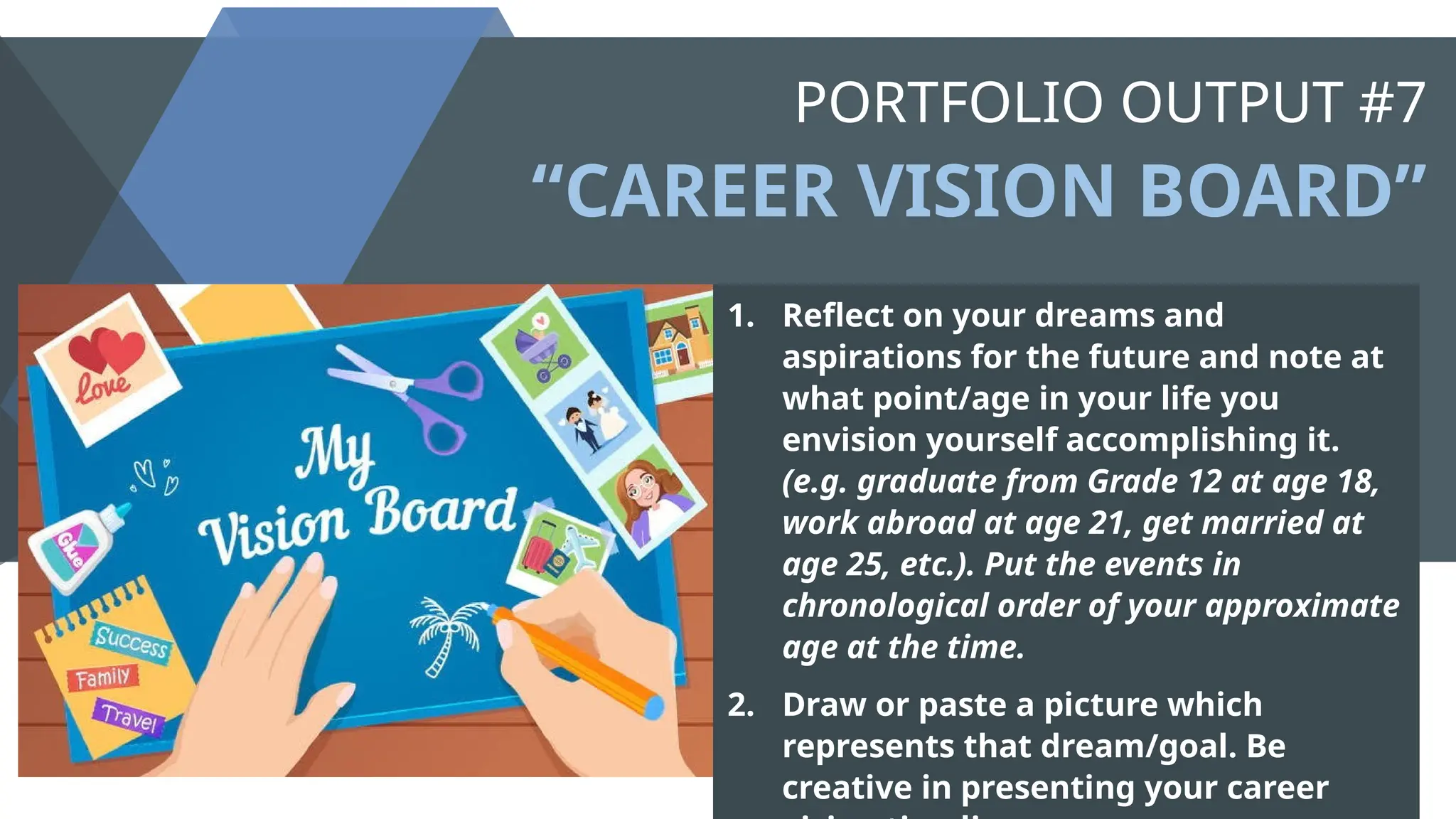
PORTFOLIO OUTPUT #7
“CAREER VISION BOARD”
1. Reflect on your dreams and
aspirations for the future and note at
what point/age in your life you
envision yourself accomplishing it.
(e.g. graduate from Grade 12 at age 18,
work abroad at age 21, get married at
age 25, etc.). Put the events in
chronological order of your approximate
age at the time.
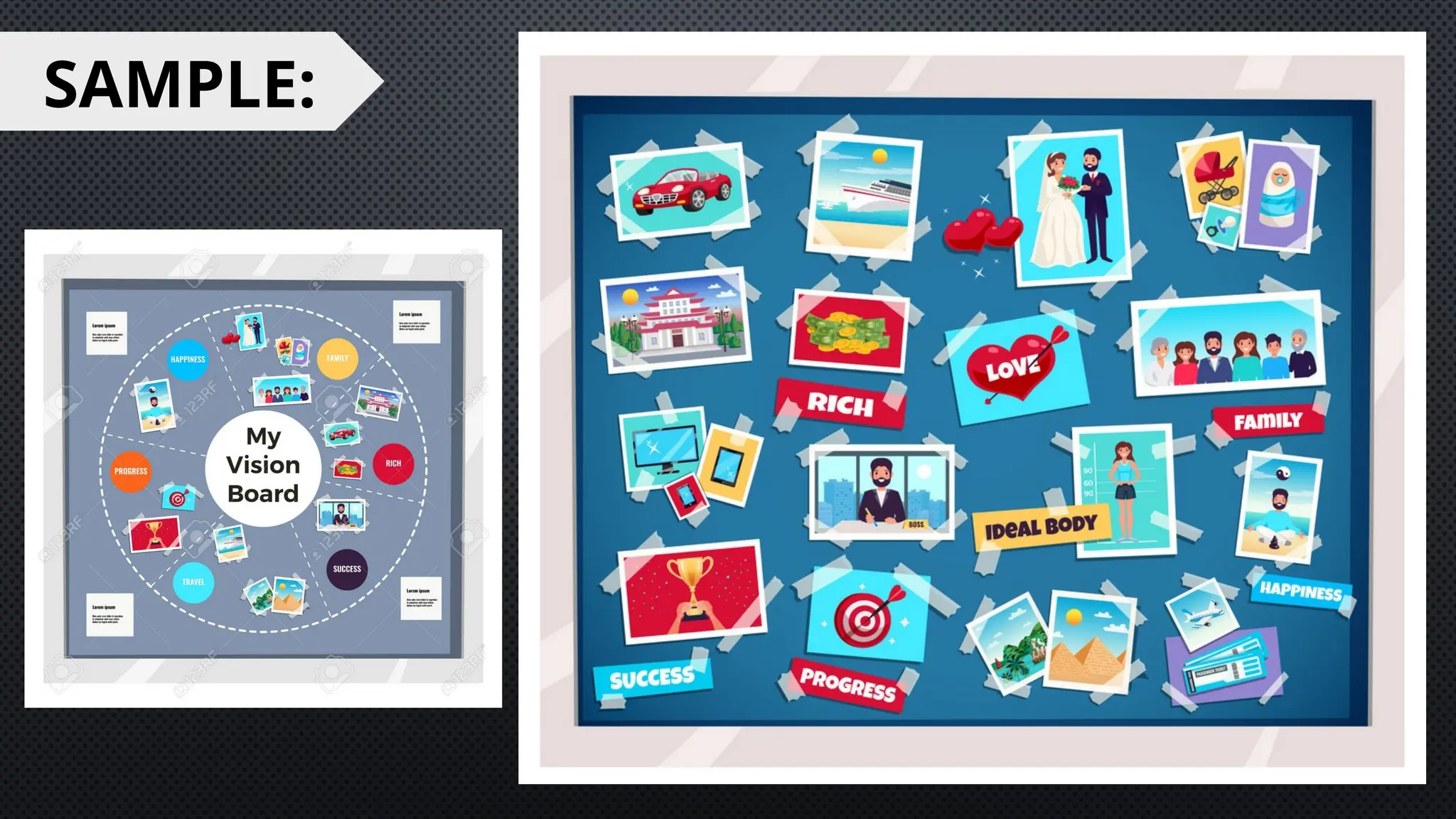
2. Draw or paste a picture which
represents that dream/goal. Be
creative in presenting your career
SAMPLE:
SAMPLE:

PERDEV LM Unit 4 - Module 13 (Career Pathways).pptx

  • 1.
    MODULE 13 CAREER PATHWAYS Presented b LEONILA C.MIRAND G11 – Personality Developmen
  • 2.
    What are the personal/internal factors that can influence CAREER CHOICES? What are the concepts that you’ve learned from SUPER’S CAREER
  • 3.
  • 4.
    discuss the external factorsinfluencing career choices that may help them in career decision making; and prepare a career plan based on their personal goal and At the end of the module, learners will be
  • 5.
  • 7.
    1. What happenedto the main character? 2. What did you feel while watching the video? 3. What insights did you learned and realize about choosing your career
  • 8.
  • 9.
    People who liketo observe, learn, investigate, analyze, evaluate or solve problems. People who like to work with people – to inform, enlighten, help, train, develop or cure them are skilled with words. People who have artistic, innovating or intuitional abilities and like to work in unstructured situations using their imaginations or creativity. People who have athletic or mechanical ability, prefer to work with object, machines, tools, plants or animals or be outdoors. People who like to work with data, have clerical or numerical ability, prefer to carry things out in detail or follow through on others’ instructions. People who like to work with people – influencing, persuading, performing. Leading, or managing for organizational goals or for economic gain. The illustration is an aerial view (from the floor above) of a room in which a party is taking place. At this party, people with the same or similar interests have (for some reason) all gathered in the same corners of the room. After looking over the room, answer the
  • 10.
    People who liketo observe, learn, investigate, analyze, evaluate or solve problems. People who like to work with people – to inform, enlighten, help, train, develop or cure them are skilled with words. People who have artistic, innovating or intuitional abilities and like to work in unstructured situations using their imaginations or creativity. People who have athletic or mechanical ability, prefer to work with object, machines, tools, plants or animals or be outdoors. People who like to work with data, have clerical or numerical ability, prefer to carry things out in detail or follow through on others’ instructions. People who like to work with people – influencing, persuading, performing. Leading, or managing for organizational goals or for economic gain.
  • 11.
    Which corner ofthe room would you instinctively be drawn to as the group of people you would most enjoy being with for the longest time (Leave aside any shyness, or whether you would have to talk with them
  • 12.
    After fifteen minutes,everyone in the corner you have chosen leaves f another party across town except you. Of the groups that still remain now, which corner or group would you be drawn to the most?
  • 13.
    After fifteen minutes,this group too leaves for another party, except yo Of the corners and groups which remain now, which one would you m enjoy being with?
  • 14.
    Considering your answer inthe first question, what drew you to this side of the room? What is it about the people in this group that made you decide that they are the group you would like to mingle with?
  • 15.
    Why did youconsider the group in the next question as your next best choice? What made you not choose them first yet would choose them next once the first group leaves?
  • 16.
    Why did youconsider the last group as you next choice? Why was this choice is in the least of your choices among the group of people in the party? What is it about them that made you choose them last?
  • 17.
    Looking back atyour scores in the interest and personality assessment, how would you relate this to your choices? What were your realizations after the said activity?
  • 18.
  • 19.
    Psychologist JOHN HOLLAND classifiedjobs/careers/work environments as well as classifies personalities or interests into six: REALISTIC, INVESTIGATIVE, ARTISTIC, RIASEC
  • 20.
    Tend to enjoycreating things with their hands and working with tools and objects rather than working with people and ideas. Realistic people tend to be rugged and practical, enjoying work outdoors. Sample Occupations: forester, industrial arts teacher, radio operator, auto engineer, mechanical engineer, mining engineer, vocational agriculture teacher, civil engineer, industrial engineering technician, aircraft mechanic, mechanical engineer technician, fish and game warden, surveyor, dental technician, architectural draftsman, electrician, jeweler, powerhouse repairman, tool and die maker, machinist, mechanic, stone cutter, locksmith, nuclear reactor technician, tree surgeon, piano tuner, typesetter, air conditioning engineer, ship pilot, instrument mechanic, motion picture projectionist, carpenter, tailor, machine repairer. R REALISTIC
  • 21.
    Sample Occupations: economist, internist,physician, anthropologist, astronomer, pathologist, physicist, chemist, production planner, medical lab assistant, biologist, osteopath, chiropractor, math teacher, natural science teacher, optometrist, psychiatrist, psychologist, medical technologist, bacteriologist, physiologist, research analyst, computer analyst, programmer, pharmacist, actuary, quality control technician, computer operator, geologist, mathematician/ statistician, surgeon, meteorologist, agronomist, animal scientist, botanist, zoologist, horticulturist, natural scientist, oceanographer, biochemist, veterinarian, geographer, x-ray technician, administrator, dentist, tool designer, chemical lab technician, engineers I INVESTIGATIVE Tend to work alone than with other people and are usually seen as idea-oriented and creative in scientific areas such as research. They are analytical, abstract, intellectual and task- oriented.
  • 22.
    Sample Occupations: drama coach,language teacher, journalist- reporter, drama teacher, foreign language interpreter, philosopher, art teacher, literature teacher, music teacher, musician, orchestra conductor, advertising manager, entertainer, public relations person, fashion model, writer, editor, radio program writer, dramatist, actor/actress, designer, interior decorator, critic, fashion illustrator, furniture designer, jewelry designer, furrier, garment designer, decorator, architect, artist, photographer, photograph retoucher, photolithographer (printer), music arranger, composer A ARTISTIC Artistically inclined, and usually describe themselves as independent, imaginative, creative, and unconventional, They enjoy activities related to language, art, music, drama, writing, etc.
  • 23.
    Sample Occupations: education, teaching,social welfare, human development, counseling, health professions (medicine, nursing, etc.), social service, compensation advising, etc. In addition, dorm director, interviewer, employment representative, funeral director, chamber of commerce executive, employee benefits approver, food service manager, claim adjuster, production expediter, health and welfare coordinator, educational administrator, training director, historian, environmental health engineer, home service rep., community recreation administrator, business agent, extension agent, physical education teacher, building superintendent, therapist, political scientist, sociologist, social and group worker, personnel director, food and drug inspector, teacher, minister, librarian, foreign service officer, history teacher S SOCIAL Seen by others as sociable, popular, and responsible; prefer social interaction and social presence; often interested in the concerns of others, and like activities that allow them to teach, inform, train, develop, cure and help others.
  • 24.
    Sample Occupations: sales andmarketing field, banker, insurance underwriter, real estate appraiser, florist, industrial engineer, contractor, warehouse manager, salesperson-technical products, lawyer, judge, attorney, tv/radio announcer, branch manager, director industrial relations, government official, insurance manager, managers such as restaurant/ office/ traffic/human resource/production, etc., salary and wage administrator, labor arbitrator, systems analyst, director of compensation and benefits, securities, salesperson, human resource recruiter E ENTERPRISING Involve situations where the person is in a position of leading or convincing others to achieve team/organizational goals or economic gain. People high on this theme are often seen as enthusiastic, dominant,
  • 25.
    Sample Occupations: clerical, administrative,time study analyst, business (commercial) teacher, finance expert, accountant, credit manager, timekeeper, auto writing machine operator, bookkeeping machine operator, estimator, foreign trade clerk, office worker, payroll clerk, accounting machine operator, personnel clerk, sales correspondent, reservations agent, bookkeeper, cashier, secretary, medical secretary, library assistant, data processing worker, mail clerk, personnel secretary, proofreader, and the like C CONVENTIONAL Tend to prefer jobs where they are given firm structure and know exactly what is expected of them. They enjoy activities that involve the precise, ordered use of data such as keeping and filing records, organizing data, computing, printing, etc.
  • 26.
    PORTFOLIO OUTPUT #7 “CAREERVISION BOARD” 1. Reflect on your dreams and aspirations for the future and note at what point/age in your life you envision yourself accomplishing it. (e.g. graduate from Grade 12 at age 18, work abroad at age 21, get married at age 25, etc.). Put the events in chronological order of your approximate age at the time. 2. Draw or paste a picture which represents that dream/goal. Be creative in presenting your career
  • 27.
  • 28.