DISCUSSION ON
“FIXED WINDING HOIST FOR SURGE SHAFT”
Date: 2018-12-06
Presented by
Indra BC (Mech.) /Rupendra GC (Elec.)
Engineer
Upper Trisuli 3A, NEA
OUTLINES:
a. Introduction
b. Technical Specification of FWH
c. Design Methodology for FWH
d. Components of FWH
e. Comments of NWEC (North-West Engineering
Corporation Limited) till date
f. Proposed Acceptance test
g. Methodology for inspection of specific parameters
h. Minute Writings
i. Summary
INTRODUCTION
Briefing:
 Hoisting is the lifting of weight from one location to
another location in reasonable distance.
 Hoisting equipment includes jacks, winches, chain
hoists and cranes etc.
INTRODUCTION (CONTD…)
Common hoisting equipments:
 Cranes:
 Derrick Crane
 Gantry Carne
 Tower Crane
 Mobile Crane etc.
 Hoist
 Chain hoist
 Rope hoist
 Winch
 Jack
 Block
INTRODUCTION (CONTD…)
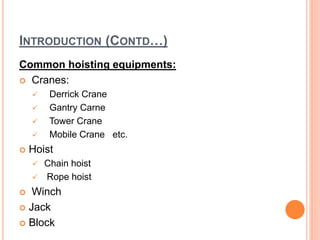
Common hoisting equipments :
Fig: Overhead cranes Fig: Gantry cranes
INTRODUCTION (CONTD…)
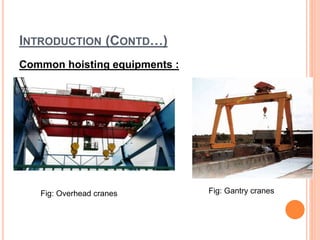
Common hoisting equipments (contd…):
Fig: Mono rail crane
Fig: Jib crane
INTRODUCTION (CONTD…)
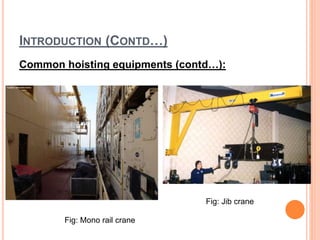
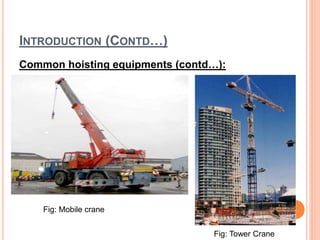
Common hoisting equipments (contd…):
Fig: Tower Crane
Fig: Mobile crane
INTRODUCTION (CONTD…)
Common hoisting equipments (contd…):
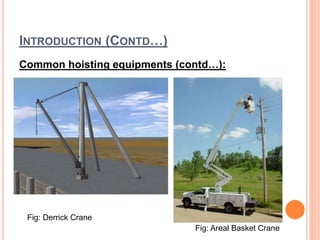
Fig: Derrick Crane
Fig: Areal Basket Crane
INTRODUCTION (CONTD…)
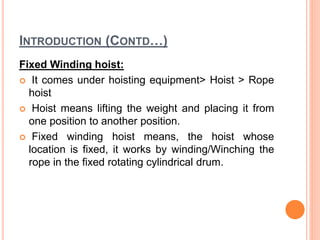
Fixed Winding hoist:
 It comes under hoisting equipment> Hoist > Rope
hoist
 Hoist means lifting the weight and placing it from
one position to another position.
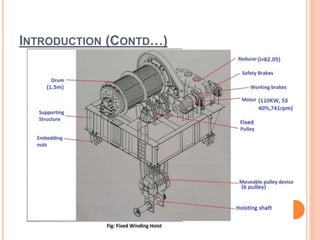
 Fixed winding hoist means, the hoist whose
location is fixed, it works by winding/Winching the
rope in the fixed rotating cylindrical drum.
INTRODUCTION (CONTD…)
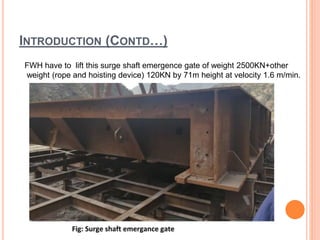
FWH have to lift this surge shaft emergence gate of weight 2500KN+other
weight (rope and hoisting device) 120KN by 71m height at velocity 1.6 m/min.
OBJECTIVE
Main Objective:
 To discuss for factory inspections on “Fixed
winding hoist for surge shaft (FWHSS)”
Specific objectives:
 Visualizing fixed winding hoist
 Discussion on different design parameter of
FWHSS
 Discussion on Inspection methodology
 Discussion about minute making, comment
making, approval etc.
TECHNICAL SPECIFICATION:
Parameter Values Parameter Values
1. Lifting load 2500KN 9. Motor YZPF315M2-8 110kw
(S3 40%) 741 rpm
2. Lifting height 71m 10. Brake YWZ5-400/80
[M]b=630-1250Nm
3. Lifting speed 1.6/3.2 m/min 11. Open gear m=25, Z2=99, Z1=19,
i=5.211
4. Drum
diameter
1500mm 12. Load meter ZHY-30t
5. Job level Q2-light 13. Encoder AVM58
6. Pulley ratio 6 14. Limit switch:
(Mech/Electrical)
QGX-C
7. Wire rope 42ZAB15*K7+IWRC-
1770ZS
15. Power Supply AC400V/230V
8. Reducer QJRS-D710-80 i=82.05 16. Control Source AC230V/DC24V
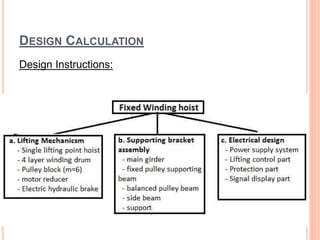
DESIGN CALCULATION
Design Instructions:
DESIGN CALCULATION (CONTD…)
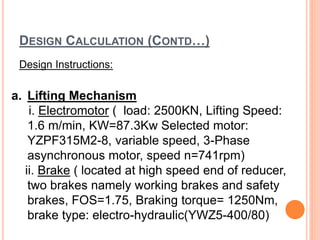
Design Instructions:
a. Lifting Mechanism
i. Electromotor ( load: 2500KN, Lifting Speed:
1.6 m/min, KW=87.3Kw Selected motor:
YZPF315M2-8, variable speed, 3-Phase
asynchronous motor, speed n=741rpm)
ii. Brake ( located at high speed end of reducer,
two brakes namely working brakes and safety
brakes, FOS=1.75, Braking torque= 1250Nm,
brake type: electro-hydraulic(YWZ5-400/80)
DESIGN CALCULATION (CONTD…)
Design Instructions:
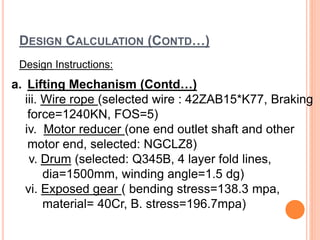
a. Lifting Mechanism (Contd…)
iii. Wire rope (selected wire : 42ZAB15*K77, Braking
force=1240KN, FOS=5)
iv. Motor reducer (one end outlet shaft and other
motor end, selected: NGCLZ8)
v. Drum (selected: Q345B, 4 layer fold lines,
dia=1500mm, winding angle=1.5 dg)
vi. Exposed gear ( bending stress=138.3 mpa,
material= 40Cr, B. stress=196.7mpa)
DESIGN CALCULATION (CONTD…)
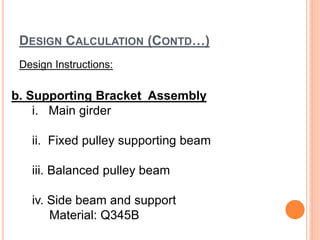
Design Instructions:
b. Supporting Bracket Assembly
i. Main girder
ii. Fixed pulley supporting beam
iii. Balanced pulley beam
iv. Side beam and support
Material: Q345B
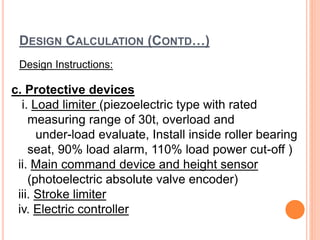
DESIGN CALCULATION (CONTD…)
Design Instructions:
c. Protective devices
i. Load limiter (piezoelectric type with rated
measuring range of 30t, overload and
under-load evaluate, Install inside roller bearing
seat, 90% load alarm, 110% load power cut-off )
ii. Main command device and height sensor
(photoelectric absolute valve encoder)
iii. Stroke limiter
iv. Electric controller
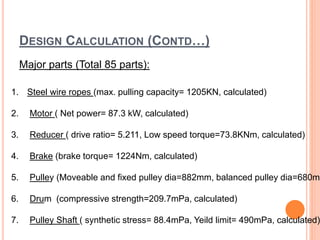
DESIGN CALCULATION (CONTD…)
Major parts (Total 85 parts):
1. Steel wire ropes (max. pulling capacity= 1205KN, calculated)
2. Motor ( Net power= 87.3 kW, calculated)
3. Reducer ( drive ratio= 5.211, Low speed torque=73.8KNm, calculated)
4. Brake (brake torque= 1224Nm, calculated)
5. Pulley (Moveable and fixed pulley dia=882mm, balanced pulley dia=680mm
6. Drum (compressive strength=209.7mPa, calculated)
7. Pulley Shaft ( synthetic stress= 88.4mPa, Yeild limit= 490mPa, calculated)
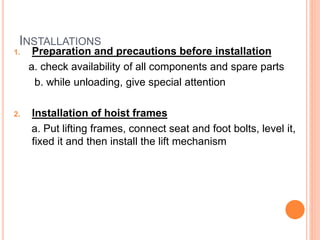
INSTALLATIONS
1. Preparation and precautions before installation
a. check availability of all components and spare parts
b. while unloading, give special attention
2. Installation of hoist frames
a. Put lifting frames, connect seat and foot bolts, level it,
fixed it and then install the lift mechanism
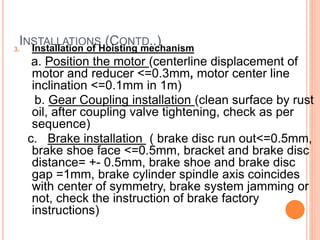
INSTALLATIONS (CONTD..)3. Installation of Hoisting mechanism
a. Position the motor (centerline displacement of
motor and reducer <=0.3mm, motor center line
inclination <=0.1mm in 1m)
b. Gear Coupling installation (clean surface by rust
oil, after coupling valve tightening, check as per
sequence)
c. Brake installation ( brake disc run out<=0.5mm,
brake shoe face <=0.5mm, bracket and brake disc
distance= +- 0.5mm, brake shoe and brake disc
gap =1mm, brake cylinder spindle axis coincides
with center of symmetry, brake system jamming or
not, check the instruction of brake factory
instructions)
INSTALLATIONS (CONTD..)
3. Installation of Hoisting mechanism (contd...)
d. Installation and adjustment of overload devices
- in 90% load warning sign, 110% load power cut
e. Installation and adjustment of height limiter
- restrict at upper and lower limit (power cut)
4. Installation of Electrical equipment
- do as per standard and specifications
- do reliable grounding and use appropriate cable
OPERATION AND MAINTENANCE
Do as per manual
LETTER CORRESPONDENCE
1. NWEC consultant (June 17, 2018)
- to specify pulley diameter
- imply anti corrosion technology
- in drawing put height indicator and relevant part
- separate working and safety braking
- where is anti grooves devices
- put electrical design instruction
2. NWEC consultant (August 14, 2018)
- put spare part list
- put clear indication on electrical drawing and daily
maintenance
- put strength calculation of structural parts
- put separate working and safety brakes
LETTER CORRESPONDENCE (CONTD…)
3. NWEC consultant (November 8, 2018)
- motor insulation resistance should be less than 1Mῼ
- put test on following ( bearing temperature (not
require),
open gear pair contact pattern, brake operation(
brake
clearance, contact area, brake pad, brake wheel)
3. CGGC Contractor (November 21, 2018)
- in dry test no bearing temperature
- internal quality control data of manufacturing process
PROPOSED TEST OUTLINE
1. Purpose:
-To check and test the start up and operation of the
hoist ( performance and quality whether meet the
requirements)
2. Test
- Initial mechanical test
- No load test
3. Acceptance Standard
- for electrical measurement ( design and measured
values deviations <=+-10%)
- for speed measurement ( design and measured
values deviations <=+-10%)
PROPOSED TEST OUTLINE (CONTD…)
4. Equipment required for test
- Multimeter
- Megaohmmeter (1000Mῼ/1000V)
- Stopwatch
- Tachometer (500-3000rpm)
- Plumb line
- 5 meter tape
- 1 meter steel ruler
- Clamp meter (current meter)
Note: Calibration certificate of each equipment should be
submitted
PROPOSED TEST OUTLINE:
5. Test Instruction
5.1 Preliminary electrical test
a. Grounding Continuity test
- Check continuity of connection between electrical
equipment and grounding system
b. Insulation test
- Insulation shall not be less than 0.5 Mῼ (NWEC
>1Mῼ)
PROPOSED TEST OUTLINE (CONTD…)
5. Test Instruction (Contd…)
5.2 Preliminary Mechanical test
a. Visual test
-mainly to check whether the appearance and structure
of the equipment are defective and missing
b. Mechanical test
- check connection reliability of transmission
mechanism
PROPOSED TEST OUTLINE (CONTD…)
5. Test Instruction (Contd…)
5.3 No Load test
a. start and check each mechanism at no load
b. Check whether the emergency stop cut power and reset
c. check ascending and descending mechanism and limit
switches, whether working normally or not
d. check switch action is sensitive and reliable or not
e. check lifting mechanism brake action at all level
f. Verify undistributed switching function of all redundant PLC
system
g. Check whether any abnormal noise in system, if exist then
first rectify before going to next level
PROPOSED TEST OUTLINE (CONTD…)
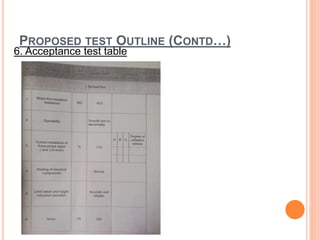
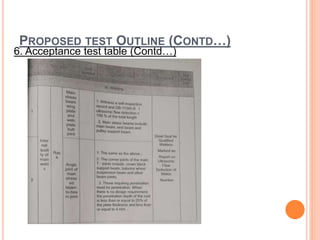
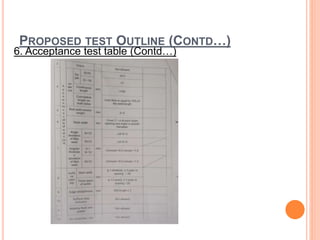
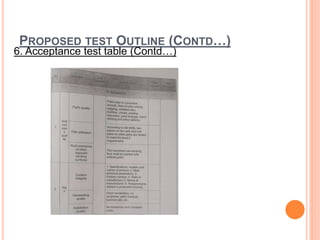
6. Acceptance test table
PROPOSED TEST OUTLINE: (CONTD…)
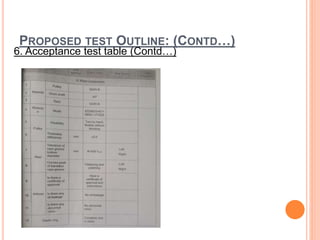
6. Acceptance test table (Contd…)
PROPOSED TEST OUTLINE (CONTD…)
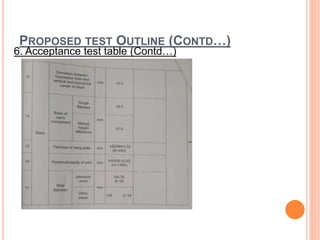
6. Acceptance test table (Contd…)
PROPOSED TEST OUTLINE (CONTD…)
6. Acceptance test table (Contd…)
PROPOSED TEST OUTLINE (CONTD…)
6. Acceptance test table (Contd…)
PROPOSED TEST OUTLINE (CONTD…)
6. Acceptance test table (Contd…)
TESTING METHODS OF SPECIFIC PARAMETERS
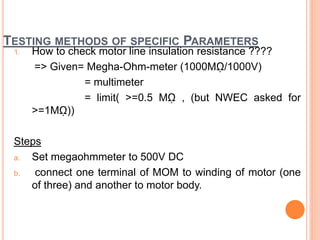
1. How to check motor line insulation resistance ????
=> Given= Megha-Ohm-meter (1000Mῼ/1000V)
= multimeter
= limit( >=0.5 Mῼ , (but NWEC asked for
>=1Mῼ))
Steps
a. Set megaohmmeter to 500V DC
b. connect one terminal of MOM to winding of motor (one
of three) and another to motor body.
TESTING METHODS OF SPECIFIC PARAMETERS
2. How to check Current imbalance of three phase stator(
wire) of motor????
=> Given= multimeter
= limit( <=10%)
= fill (A,B,C, degree of imbalances)
Steps
a. While motor running, put the current meter across each
phase of motor and take A, B, C reading
b. Check the difference to be with in 10%
TESTING METHODS OF SPECIFIC PARAMETERS
3. How to check Noise????
=> Given= limit( dB<=85)
Steps
a. Compare with food blender noise (self)
TESTING METHODS OF SPECIFIC PARAMETERS
4. How to check material Q345-B (Pulley, Reel) and 45#
(Drum shaft) ????
=> Given= Q345 grade {chemical (C<0.2, Mn=1 to 1.6,
Si< 0.55, Ti=0.2), mechanical (yield strength- 345 mpa,
tensile=470 to 630 mpa, elongation=21%), produced by
hot rolled state, comprehensive welding properties, good
for structure), low alloy, low price), density=7.8)} 45#
steel { high quality carbon steel C=0.42-0.50, 610 mpa
tensile strength}
Steps
a. Ask self quality inspection report
TESTING METHODS OF SPECIFIC PARAMETERS
5. How to check tolerance of rope groove bottom diameter
(dia 1458+-0.25) and thickness difference of pulley(
<=3mm) ????
=> Given= 1m steel ruler, 5m tape, size (1.5m)
Steps
a. Use big size vernier caliper (part/part size) or by thread to
measure perimeter
TESTING METHODS OF SPECIFIC PARAMETERS
6. How to check deviation between foundation hole and
vertical and horizontal center of drum (=+-2.5mm) ????
=> Given= 1m steel ruler
Steps
a.
TESTING METHODS OF SPECIFIC PARAMETERS
7. How to check base of each component (single flatness
<=0.5 and Mutual height difference <=1)????
=> Given= 1m steel ruler
Steps
a. By using sprit level gauge, pipe gauge or steel rule, or
theodoscope
TESTING METHODS OF SPECIFIC PARAMETERS
8. How to check flatness of wing plate (<= B/500 <=
1.33mm, B=400))????
=> Given= 1m steel ruler
Steps
a. Same as previous
TESTING METHODS OF SPECIFIC PARAMETERS
9. How to check Perpendicularity of web (
<=H/500<=2.52mm, H=1260)????
=> Given= 1m steel ruler
Steps
a. Use tri-square
TESTING METHODS OF SPECIFIC PARAMETERS
10. How to check web flatness (Pressure zone f<=0.7del,
del=16 and other zone f<=del)????
=> Given= 1m steel ruler
Steps
a. Same as previous
TESTING METHODS OF SPECIFIC PARAMETERS
11. How to check Internal quality of main weld in rack for
main stress beam(main beam, end beam, pulley support
beam) wing plate and web plate butt joint?????
=> Given= witness (self inspection record and
GB11345BI ultrasonic flaw detection of 100% total
length)
Steps
a. Use ultrasonic device
TESTING METHODS OF SPECIFIC PARAMETERS
12. How to check Internal quality of main weld in rack for Angle
joint of main stress beam(main beam, end beam, pulley
support beam) to beam joint , these includes corner joints(
Crown block, support beam, balance wheel suspension
beam, other beam joints)?????
=> Given= witness (self inspection record and GB11345BI
ultrasonic flaw detection of 100% total length)
= if penetration needed (penetration depth of root
<=25% or 4mm)
Steps
a.
TESTING METHODS OF SPECIFIC PARAMETERS
13. How to check Appearance quality of weld joints for
undercut?????
=> Given= depth (<=0.5 for del<=10 and (<=1 for
del>10)
= continuous length (<=100mm)
= cumulative length of both side ( <=10% of
weld length)
Steps
a.
TESTING METHODS OF SPECIFIC PARAMETERS
14. How to check Appearance quality of butt joint weld?????
=> Given= excess height (0 to 3mm)
= weld width (2 to 4mm of each slope and
smooth )
Steps
a.
TESTING METHODS OF SPECIFIC PARAMETERS
15. How to check Angle deviation {limit( if K<=12, del K= 0
to 3, if K>12, del K= 0 to 4)} and angular thickness
deviation {limit( if K<=12, concave <0.5, Convex<1.5 )}
of fillet weld ?????
=> Given=
Steps
a.
TESTING METHODS OF SPECIFIC PARAMETERS
16. How to check Surface porosity of main welds (dia 1
blowhole<=3 pole/m, spacing >20mm) and other welds
(dia 1.5 pores<=3 pole/m, spacing >20mm)?????
=> Given=
Steps
a.
TESTING METHODS OF SPECIFIC PARAMETERS
17. How to check Anti corrosion quality for paint
quality?????
=> Given= check (paint color is consistent, smooth, free
of color mixing, sagging wrinkled skin, bubbles, cracks,
peeling, impurities, paint leakage, hand sticking and
other defects)
Steps
a.
TESTING METHODS OF SPECIFIC PARAMETERS
18. How to check Anti corrosion quality for flim
adhesion?????
=> Given= check (2 place on rack and other place, level
2 requirement)
Steps
a.
MINUTE MAKING
Steps
a. Prepare test parameter measuring table with
limiting condition and methods
b. ask for measuring instruments, and calibration
reports of each, ask to help to take measurement
of each parameter
c. Check the consistency of data, if any issues
arises write roughly to include in minutes for
rectification
d. Take all the data, notes, manuals and if any, stay
cool and prepare the minutes and take signs
MINUTE MAKING (CONTD…)
Sample minutes
SUMMARY
1. Discussion on various hoisting equipments
2. Introduction of Fixed winding hoist (FWH)
3. Design parameter, calculations, selection of
major component of FWH
4. Discussion on Installation methods of FWH
5. Letter correspondence of NWEC and CGGC
6. Discussion on Test outline and specific testing
methods
7. Minute making
Thank- You!!
Suggestions Please???

Hoisting equipment inspection presentation

  • 1.
    DISCUSSION ON “FIXED WINDINGHOIST FOR SURGE SHAFT” Date: 2018-12-06 Presented by Indra BC (Mech.) /Rupendra GC (Elec.) Engineer Upper Trisuli 3A, NEA
  • 2.
    OUTLINES: a. Introduction b. TechnicalSpecification of FWH c. Design Methodology for FWH d. Components of FWH e. Comments of NWEC (North-West Engineering Corporation Limited) till date f. Proposed Acceptance test g. Methodology for inspection of specific parameters h. Minute Writings i. Summary
  • 3.
    INTRODUCTION Briefing:  Hoisting isthe lifting of weight from one location to another location in reasonable distance.  Hoisting equipment includes jacks, winches, chain hoists and cranes etc.
  • 4.
    INTRODUCTION (CONTD…) Common hoistingequipments:  Cranes:  Derrick Crane  Gantry Carne  Tower Crane  Mobile Crane etc.  Hoist  Chain hoist  Rope hoist  Winch  Jack  Block
  • 5.
    INTRODUCTION (CONTD…) Common hoistingequipments : Fig: Overhead cranes Fig: Gantry cranes
  • 6.
    INTRODUCTION (CONTD…) Common hoistingequipments (contd…): Fig: Mono rail crane Fig: Jib crane
  • 7.
    INTRODUCTION (CONTD…) Common hoistingequipments (contd…): Fig: Tower Crane Fig: Mobile crane
  • 8.
    INTRODUCTION (CONTD…) Common hoistingequipments (contd…): Fig: Derrick Crane Fig: Areal Basket Crane
  • 9.
    INTRODUCTION (CONTD…) Fixed Windinghoist:  It comes under hoisting equipment> Hoist > Rope hoist  Hoist means lifting the weight and placing it from one position to another position.  Fixed winding hoist means, the hoist whose location is fixed, it works by winding/Winching the rope in the fixed rotating cylindrical drum.
  • 10.
  • 11.
    INTRODUCTION (CONTD…) FWH haveto lift this surge shaft emergence gate of weight 2500KN+other weight (rope and hoisting device) 120KN by 71m height at velocity 1.6 m/min.
  • 12.
    OBJECTIVE Main Objective:  Todiscuss for factory inspections on “Fixed winding hoist for surge shaft (FWHSS)” Specific objectives:  Visualizing fixed winding hoist  Discussion on different design parameter of FWHSS  Discussion on Inspection methodology  Discussion about minute making, comment making, approval etc.
  • 13.
    TECHNICAL SPECIFICATION: Parameter ValuesParameter Values 1. Lifting load 2500KN 9. Motor YZPF315M2-8 110kw (S3 40%) 741 rpm 2. Lifting height 71m 10. Brake YWZ5-400/80 [M]b=630-1250Nm 3. Lifting speed 1.6/3.2 m/min 11. Open gear m=25, Z2=99, Z1=19, i=5.211 4. Drum diameter 1500mm 12. Load meter ZHY-30t 5. Job level Q2-light 13. Encoder AVM58 6. Pulley ratio 6 14. Limit switch: (Mech/Electrical) QGX-C 7. Wire rope 42ZAB15*K7+IWRC- 1770ZS 15. Power Supply AC400V/230V 8. Reducer QJRS-D710-80 i=82.05 16. Control Source AC230V/DC24V
  • 14.
  • 15.
    DESIGN CALCULATION (CONTD…) DesignInstructions: a. Lifting Mechanism i. Electromotor ( load: 2500KN, Lifting Speed: 1.6 m/min, KW=87.3Kw Selected motor: YZPF315M2-8, variable speed, 3-Phase asynchronous motor, speed n=741rpm) ii. Brake ( located at high speed end of reducer, two brakes namely working brakes and safety brakes, FOS=1.75, Braking torque= 1250Nm, brake type: electro-hydraulic(YWZ5-400/80)
  • 16.
    DESIGN CALCULATION (CONTD…) DesignInstructions: a. Lifting Mechanism (Contd…) iii. Wire rope (selected wire : 42ZAB15*K77, Braking force=1240KN, FOS=5) iv. Motor reducer (one end outlet shaft and other motor end, selected: NGCLZ8) v. Drum (selected: Q345B, 4 layer fold lines, dia=1500mm, winding angle=1.5 dg) vi. Exposed gear ( bending stress=138.3 mpa, material= 40Cr, B. stress=196.7mpa)
  • 17.
    DESIGN CALCULATION (CONTD…) DesignInstructions: b. Supporting Bracket Assembly i. Main girder ii. Fixed pulley supporting beam iii. Balanced pulley beam iv. Side beam and support Material: Q345B
  • 18.
    DESIGN CALCULATION (CONTD…) DesignInstructions: c. Protective devices i. Load limiter (piezoelectric type with rated measuring range of 30t, overload and under-load evaluate, Install inside roller bearing seat, 90% load alarm, 110% load power cut-off ) ii. Main command device and height sensor (photoelectric absolute valve encoder) iii. Stroke limiter iv. Electric controller
  • 19.
    DESIGN CALCULATION (CONTD…) Majorparts (Total 85 parts): 1. Steel wire ropes (max. pulling capacity= 1205KN, calculated) 2. Motor ( Net power= 87.3 kW, calculated) 3. Reducer ( drive ratio= 5.211, Low speed torque=73.8KNm, calculated) 4. Brake (brake torque= 1224Nm, calculated) 5. Pulley (Moveable and fixed pulley dia=882mm, balanced pulley dia=680mm 6. Drum (compressive strength=209.7mPa, calculated) 7. Pulley Shaft ( synthetic stress= 88.4mPa, Yeild limit= 490mPa, calculated)
  • 20.
    INSTALLATIONS 1. Preparation andprecautions before installation a. check availability of all components and spare parts b. while unloading, give special attention 2. Installation of hoist frames a. Put lifting frames, connect seat and foot bolts, level it, fixed it and then install the lift mechanism
  • 21.
    INSTALLATIONS (CONTD..)3. Installationof Hoisting mechanism a. Position the motor (centerline displacement of motor and reducer <=0.3mm, motor center line inclination <=0.1mm in 1m) b. Gear Coupling installation (clean surface by rust oil, after coupling valve tightening, check as per sequence) c. Brake installation ( brake disc run out<=0.5mm, brake shoe face <=0.5mm, bracket and brake disc distance= +- 0.5mm, brake shoe and brake disc gap =1mm, brake cylinder spindle axis coincides with center of symmetry, brake system jamming or not, check the instruction of brake factory instructions)
  • 22.
    INSTALLATIONS (CONTD..) 3. Installationof Hoisting mechanism (contd...) d. Installation and adjustment of overload devices - in 90% load warning sign, 110% load power cut e. Installation and adjustment of height limiter - restrict at upper and lower limit (power cut) 4. Installation of Electrical equipment - do as per standard and specifications - do reliable grounding and use appropriate cable
  • 23.
  • 24.
    LETTER CORRESPONDENCE 1. NWECconsultant (June 17, 2018) - to specify pulley diameter - imply anti corrosion technology - in drawing put height indicator and relevant part - separate working and safety braking - where is anti grooves devices - put electrical design instruction 2. NWEC consultant (August 14, 2018) - put spare part list - put clear indication on electrical drawing and daily maintenance - put strength calculation of structural parts - put separate working and safety brakes
  • 25.
    LETTER CORRESPONDENCE (CONTD…) 3.NWEC consultant (November 8, 2018) - motor insulation resistance should be less than 1Mῼ - put test on following ( bearing temperature (not require), open gear pair contact pattern, brake operation( brake clearance, contact area, brake pad, brake wheel) 3. CGGC Contractor (November 21, 2018) - in dry test no bearing temperature - internal quality control data of manufacturing process
  • 26.
    PROPOSED TEST OUTLINE 1.Purpose: -To check and test the start up and operation of the hoist ( performance and quality whether meet the requirements) 2. Test - Initial mechanical test - No load test 3. Acceptance Standard - for electrical measurement ( design and measured values deviations <=+-10%) - for speed measurement ( design and measured values deviations <=+-10%)
  • 27.
    PROPOSED TEST OUTLINE(CONTD…) 4. Equipment required for test - Multimeter - Megaohmmeter (1000Mῼ/1000V) - Stopwatch - Tachometer (500-3000rpm) - Plumb line - 5 meter tape - 1 meter steel ruler - Clamp meter (current meter) Note: Calibration certificate of each equipment should be submitted
  • 28.
    PROPOSED TEST OUTLINE: 5.Test Instruction 5.1 Preliminary electrical test a. Grounding Continuity test - Check continuity of connection between electrical equipment and grounding system b. Insulation test - Insulation shall not be less than 0.5 Mῼ (NWEC >1Mῼ)
  • 29.
    PROPOSED TEST OUTLINE(CONTD…) 5. Test Instruction (Contd…) 5.2 Preliminary Mechanical test a. Visual test -mainly to check whether the appearance and structure of the equipment are defective and missing b. Mechanical test - check connection reliability of transmission mechanism
  • 30.
    PROPOSED TEST OUTLINE(CONTD…) 5. Test Instruction (Contd…) 5.3 No Load test a. start and check each mechanism at no load b. Check whether the emergency stop cut power and reset c. check ascending and descending mechanism and limit switches, whether working normally or not d. check switch action is sensitive and reliable or not e. check lifting mechanism brake action at all level f. Verify undistributed switching function of all redundant PLC system g. Check whether any abnormal noise in system, if exist then first rectify before going to next level
  • 31.
    PROPOSED TEST OUTLINE(CONTD…) 6. Acceptance test table
  • 32.
    PROPOSED TEST OUTLINE:(CONTD…) 6. Acceptance test table (Contd…)
  • 33.
    PROPOSED TEST OUTLINE(CONTD…) 6. Acceptance test table (Contd…)
  • 34.
    PROPOSED TEST OUTLINE(CONTD…) 6. Acceptance test table (Contd…)
  • 35.
    PROPOSED TEST OUTLINE(CONTD…) 6. Acceptance test table (Contd…)
  • 36.
    PROPOSED TEST OUTLINE(CONTD…) 6. Acceptance test table (Contd…)
  • 37.
    TESTING METHODS OFSPECIFIC PARAMETERS 1. How to check motor line insulation resistance ???? => Given= Megha-Ohm-meter (1000Mῼ/1000V) = multimeter = limit( >=0.5 Mῼ , (but NWEC asked for >=1Mῼ)) Steps a. Set megaohmmeter to 500V DC b. connect one terminal of MOM to winding of motor (one of three) and another to motor body.
  • 38.
    TESTING METHODS OFSPECIFIC PARAMETERS 2. How to check Current imbalance of three phase stator( wire) of motor???? => Given= multimeter = limit( <=10%) = fill (A,B,C, degree of imbalances) Steps a. While motor running, put the current meter across each phase of motor and take A, B, C reading b. Check the difference to be with in 10%
  • 39.
    TESTING METHODS OFSPECIFIC PARAMETERS 3. How to check Noise???? => Given= limit( dB<=85) Steps a. Compare with food blender noise (self)
  • 40.
    TESTING METHODS OFSPECIFIC PARAMETERS 4. How to check material Q345-B (Pulley, Reel) and 45# (Drum shaft) ???? => Given= Q345 grade {chemical (C<0.2, Mn=1 to 1.6, Si< 0.55, Ti=0.2), mechanical (yield strength- 345 mpa, tensile=470 to 630 mpa, elongation=21%), produced by hot rolled state, comprehensive welding properties, good for structure), low alloy, low price), density=7.8)} 45# steel { high quality carbon steel C=0.42-0.50, 610 mpa tensile strength} Steps a. Ask self quality inspection report
  • 41.
    TESTING METHODS OFSPECIFIC PARAMETERS 5. How to check tolerance of rope groove bottom diameter (dia 1458+-0.25) and thickness difference of pulley( <=3mm) ???? => Given= 1m steel ruler, 5m tape, size (1.5m) Steps a. Use big size vernier caliper (part/part size) or by thread to measure perimeter
  • 42.
    TESTING METHODS OFSPECIFIC PARAMETERS 6. How to check deviation between foundation hole and vertical and horizontal center of drum (=+-2.5mm) ???? => Given= 1m steel ruler Steps a.
  • 43.
    TESTING METHODS OFSPECIFIC PARAMETERS 7. How to check base of each component (single flatness <=0.5 and Mutual height difference <=1)???? => Given= 1m steel ruler Steps a. By using sprit level gauge, pipe gauge or steel rule, or theodoscope
  • 44.
    TESTING METHODS OFSPECIFIC PARAMETERS 8. How to check flatness of wing plate (<= B/500 <= 1.33mm, B=400))???? => Given= 1m steel ruler Steps a. Same as previous
  • 45.
    TESTING METHODS OFSPECIFIC PARAMETERS 9. How to check Perpendicularity of web ( <=H/500<=2.52mm, H=1260)???? => Given= 1m steel ruler Steps a. Use tri-square
  • 46.
    TESTING METHODS OFSPECIFIC PARAMETERS 10. How to check web flatness (Pressure zone f<=0.7del, del=16 and other zone f<=del)???? => Given= 1m steel ruler Steps a. Same as previous
  • 47.
    TESTING METHODS OFSPECIFIC PARAMETERS 11. How to check Internal quality of main weld in rack for main stress beam(main beam, end beam, pulley support beam) wing plate and web plate butt joint????? => Given= witness (self inspection record and GB11345BI ultrasonic flaw detection of 100% total length) Steps a. Use ultrasonic device
  • 48.
    TESTING METHODS OFSPECIFIC PARAMETERS 12. How to check Internal quality of main weld in rack for Angle joint of main stress beam(main beam, end beam, pulley support beam) to beam joint , these includes corner joints( Crown block, support beam, balance wheel suspension beam, other beam joints)????? => Given= witness (self inspection record and GB11345BI ultrasonic flaw detection of 100% total length) = if penetration needed (penetration depth of root <=25% or 4mm) Steps a.
  • 49.
    TESTING METHODS OFSPECIFIC PARAMETERS 13. How to check Appearance quality of weld joints for undercut????? => Given= depth (<=0.5 for del<=10 and (<=1 for del>10) = continuous length (<=100mm) = cumulative length of both side ( <=10% of weld length) Steps a.
  • 50.
    TESTING METHODS OFSPECIFIC PARAMETERS 14. How to check Appearance quality of butt joint weld????? => Given= excess height (0 to 3mm) = weld width (2 to 4mm of each slope and smooth ) Steps a.
  • 51.
    TESTING METHODS OFSPECIFIC PARAMETERS 15. How to check Angle deviation {limit( if K<=12, del K= 0 to 3, if K>12, del K= 0 to 4)} and angular thickness deviation {limit( if K<=12, concave <0.5, Convex<1.5 )} of fillet weld ????? => Given= Steps a.
  • 52.
    TESTING METHODS OFSPECIFIC PARAMETERS 16. How to check Surface porosity of main welds (dia 1 blowhole<=3 pole/m, spacing >20mm) and other welds (dia 1.5 pores<=3 pole/m, spacing >20mm)????? => Given= Steps a.
  • 53.
    TESTING METHODS OFSPECIFIC PARAMETERS 17. How to check Anti corrosion quality for paint quality????? => Given= check (paint color is consistent, smooth, free of color mixing, sagging wrinkled skin, bubbles, cracks, peeling, impurities, paint leakage, hand sticking and other defects) Steps a.
  • 54.
    TESTING METHODS OFSPECIFIC PARAMETERS 18. How to check Anti corrosion quality for flim adhesion????? => Given= check (2 place on rack and other place, level 2 requirement) Steps a.
  • 55.
    MINUTE MAKING Steps a. Preparetest parameter measuring table with limiting condition and methods b. ask for measuring instruments, and calibration reports of each, ask to help to take measurement of each parameter c. Check the consistency of data, if any issues arises write roughly to include in minutes for rectification d. Take all the data, notes, manuals and if any, stay cool and prepare the minutes and take signs
  • 56.
  • 57.
    SUMMARY 1. Discussion onvarious hoisting equipments 2. Introduction of Fixed winding hoist (FWH) 3. Design parameter, calculations, selection of major component of FWH 4. Discussion on Installation methods of FWH 5. Letter correspondence of NWEC and CGGC 6. Discussion on Test outline and specific testing methods 7. Minute making
  • 58.

Editor's Notes