HOW TO INCREASE 
RESEARCH VISIBILITY 
A GUIDE FOR RESEARCH WRITERS 
by 
OTUOMA SANYA
PURPOSE 
THIS DOCUMENT WILL PROVIDE YOU WITH VARIOUS TECHNIQUES 
ON HOW YOU CAN INCREASE THE VISIBILITY AND HENCE THE 
IMPACT OF YOUR RESEARCH WORK FROM JUST YOUR LOCAL 
COMMUNITY TO A GLOBAL AUDIENCE.
IMPACT INDICATORS 
Research impact is measured using: 
1. Citation by other writers 
2. Media comment 
3. Usage 
4. Implementation of research into actual practice 
5. Repackaging of research for new audiences 
This document will focus on citation as it is the most widely used indicator of research impact in 
scientific studies on the topic.
CITATION 
❖ A citation is simply a reference to another information resource. 
❖ It is often used to measure the impact of a research work. 
❖ The more your work is cited, the greater its impact. 
❖ The information resource referenced may be in any of the following 
formats: journal article, book, archival manuscript, newspaper editorial, 
dissertation, report, webpage, or a musical composition among others.
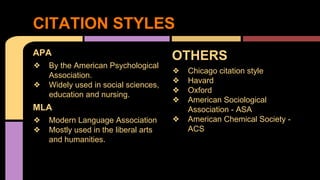
CITATION STYLES 
APA 
❖ By the American Psychological 
Association. 
❖ Widely used in social sciences, 
education and nursing. 
MLA 
❖ Modern Language Association 
❖ Mostly used in the liberal arts 
and humanities. 
OTHERS 
❖ Chicago citation style 
❖ Havard 
❖ Oxford 
❖ American Sociological 
Association - ASA 
❖ American Chemical Society - 
ACS
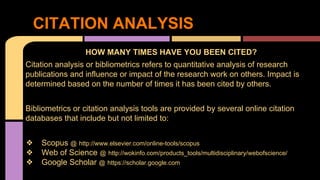
CITATION ANALYSIS 
HOW MANY TIMES HAVE YOU BEEN CITED? 
Citation analysis or bibliometrics refers to quantitative analysis of research 
publications and influence or impact of the research work on others. Impact is 
determined based on the number of times it has been cited by others. 
Bibliometrics or citation analysis tools are provided by several online citation 
databases that include but not limited to: 
❖ Scopus @ http://www.elsevier.com/online-tools/scopus 
❖ Web of Science @ http://wokinfo.com/products_tools/multidisciplinary/webofscience/ 
❖ Google Scholar @ https://scholar.google.com
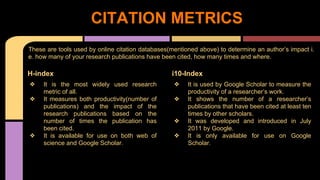
CITATION METRICS 
These are tools used by online citation databases(mentioned above) to determine an author’s impact i. 
e. how many of your research publications have been cited, how many times and where. 
i10-Index 
❖ It is used by Google Scholar to measure the 
productivity of a researcher’s work. 
❖ It shows the number of a researcher’s 
publications that have been cited at least ten 
times by other scholars. 
❖ It was developed and introduced in July 
2011 by Google. 
❖ It is only available for use on Google 
Scholar. 
H-index 
❖ It is the most widely used research 
metric of all. 
❖ It measures both productivity(number of 
publications) and the impact of the 
research publications based on the 
number of times the publication has 
been cited. 
❖ It is available for use on both web of 
science and Google Scholar.
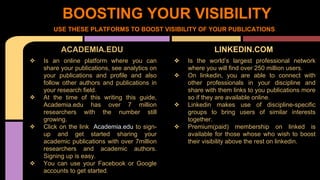
BOOSTING YOUR VISIBILITY 
USE THESE PLATFORMS TO BOOST VISIBILITY OF YOUR PUBLICATIONS 
ACADEMIA.EDU 
❖ Is an online platform where you can 
share your publications, see analytics on 
your publications and profile and also 
follow other authors and publications in 
your research field. 
❖ At the time of this writing this guide, 
Academia.edu has over 7 million 
researchers with the number still 
growing. 
❖ Click on the link Academia.edu to sign-up 
and get started sharing your 
academic publications with over 7million 
researchers and academic authors. 
Signing up is easy. 
❖ You can use your Facebook or Google 
accounts to get started. 
LINKEDIN.COM 
❖ Is the world’s largest professional network 
where you will find over 250 million users. 
❖ On linkedin, you are able to connect with 
other professionals in your discipline and 
share with them links to you publications more 
so if they are available online. 
❖ Linkedin makes use of discipline-specific 
groups to bring users of similar interests 
together. 
❖ Premium(paid) membership on linked is 
available for those whose who wish to boost 
their visibility above the rest on linkedin.
BOOSTING YOUR VISIBILITY 
USE THESE PLATFORMS TO BOOST VISIBILITY OF YOUR PUBLICATIONS 
RESEARCHGATE.NET 
❖ Developed for scientists who want to 
make their work visible, researchgate 
offers you the ability to share your work 
with others. 
❖ On researchgate, you also get the 
chance to collaborate with other 
researchers on your work. 
❖ Other features include viewing statistics 
about citations, views and downloads 
about your publications. 
❖ It is free to join with an option to connect 
using your facebook account. 
MENDELEY.COM 
❖ Widely used, Mendeley is more of a research 
assistant tool with both an online platform and 
a downloadable desktop application. 
❖ It offers you a platform to share and 
collaborate with other users on the platform. 
❖ Mendeley’s reference management tool 
allows you to generate bibliographies and 
citations from microsoft word and open-office 
documents. 
❖ It is free to use and one can use their 
facebook account to join.
BOOSTING YOUR VISIBILITY 
OTHER METHODS 
❖ Attend and give talks - Sometimes you may 
even volunteer to give talks and lectures 
during seminars and conferences. While at it, 
always give reference to your work whenever 
you can. 
❖ Publish with open-access - Research in this 
area has shown that works published in open-access 
platforms are more visible and more 
cited than those published on subscription 
platforms. 
❖ Create a blog of your own - There are a lot 
of freely available tools you can use to create 
a blog. They include wordpress, blogger, 
joomla, drupal etc. Consider writing a post at 
least each time you publish and provide a link 
to where the full-text version of the document 
is published 
❖ Make your google scholar profile public so 
that people and even search engines can 
discover it and hence discover your work. 
❖ Use a consistent name - If you use different 
variations of your name as an author, then 
you appear as different authors and hence 
your citation metrics will suffer. 
❖ Make use of preprints - Publishing in peer 
reviewed journals may take a long time. 
Preprints or unreviewed manuscripts can help 
to make your work usable even before its 
officially published. 
❖ Upload full-text documents - An abstract 
may not contain adequate content sufficient 
for others to cite. Having a full-text document 
increases the usability of your published work.
BOOSTING YOUR VISIBILITY 
OTHER METHODS 
❖ Avoid poorly indexed journals - Making use 
of both google, google scholar and other 
search engines should help you to determine 
this. 
❖ Make use of social media - Tweet and 
make facebook posts about your publications 
especially the new ones. Be on the look-out 
for special interest groups and share with 
them. Linked is most suitable for special 
interest groups. 
❖ Publish quality research work - You only 
cite and refer to good quality work. Others are 
also looking for the same in your work. 
❖ Utilise staff profiles - If your institution has 
staff profile pages, make sure to list here your 
publications. Search engines will rank your 
work higher if there are more links to it on the 
internet hence more visibility. 
❖ Optimise key-words in the abstract - The 
abstract appears in more places that the 
document content itself. Availability of key-words 
in the abstract will make it to appear as 
more relevant. 
❖ Make a deposit in the university repository if 
there is one in place.
BENEFITS TO INSTITUTIONS 
❖ Demonstrates their contribution to the 
knowledge economy 
❖ Increase chances for funding from 
government. 
❖ Increase their chances of being engaged 
by third-party agencies 
OTHER METHODS
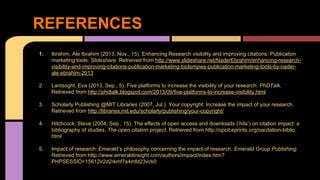
REFERENCES 
1. Ibrahim, Ale Ibrahim (2013, Nov., 15). Enhancing Research visibility and improving citations: Publication 
marketing tools. Slideshare. Retrieved from http://www.slideshare.net/NaderEbrahim/enhancing-research-visibility- 
and-improving-citations-publication-marketing-toolsmpws-publication-marketing-tools-by-nader-ale- 
ebrahim-2013 
2. Lantsoght, Eva (2013, Sep., 5). Five platforms to increase the visibility of your research. PhDTalk. 
Retrieved from http://phdtalk.blogspot.com/2013/09/five-platforms-to-increase-visibility.html 
3. Scholarly Publishing @MIT Libraries (2007, Jul.). Your copyright: Increase the impact of your research. 
Retrieved from http://libraries.mit.edu/scholarly/publishing/your-copyright/ 
4. Hitchcock, Steve (2004, Sep., 15). The effects of open access and downloads (‘hits’) on citation impact: a 
bibliography of studies. The open citation project. Retrieved from http://opcit.eprints.org/oacitation-biblio. 
html 
5. Impact of research: Emerald’s philosophy concerning the impact of research. Emerald Group Publishing. 
Retrieved from http://www.emeraldinsight.com/authors/impact/index.htm? 
PHPSESSID=15612ir2d2rkmf7s4mfd23vck0

Otuoma, sanya

  • 1.
    HOW TO INCREASE RESEARCH VISIBILITY A GUIDE FOR RESEARCH WRITERS by OTUOMA SANYA
  • 2.
    PURPOSE THIS DOCUMENTWILL PROVIDE YOU WITH VARIOUS TECHNIQUES ON HOW YOU CAN INCREASE THE VISIBILITY AND HENCE THE IMPACT OF YOUR RESEARCH WORK FROM JUST YOUR LOCAL COMMUNITY TO A GLOBAL AUDIENCE.
  • 3.
    IMPACT INDICATORS Researchimpact is measured using: 1. Citation by other writers 2. Media comment 3. Usage 4. Implementation of research into actual practice 5. Repackaging of research for new audiences This document will focus on citation as it is the most widely used indicator of research impact in scientific studies on the topic.
  • 4.
    CITATION ❖ Acitation is simply a reference to another information resource. ❖ It is often used to measure the impact of a research work. ❖ The more your work is cited, the greater its impact. ❖ The information resource referenced may be in any of the following formats: journal article, book, archival manuscript, newspaper editorial, dissertation, report, webpage, or a musical composition among others.
  • 5.
    CITATION STYLES APA ❖ By the American Psychological Association. ❖ Widely used in social sciences, education and nursing. MLA ❖ Modern Language Association ❖ Mostly used in the liberal arts and humanities. OTHERS ❖ Chicago citation style ❖ Havard ❖ Oxford ❖ American Sociological Association - ASA ❖ American Chemical Society - ACS
  • 6.
    CITATION ANALYSIS HOWMANY TIMES HAVE YOU BEEN CITED? Citation analysis or bibliometrics refers to quantitative analysis of research publications and influence or impact of the research work on others. Impact is determined based on the number of times it has been cited by others. Bibliometrics or citation analysis tools are provided by several online citation databases that include but not limited to: ❖ Scopus @ http://www.elsevier.com/online-tools/scopus ❖ Web of Science @ http://wokinfo.com/products_tools/multidisciplinary/webofscience/ ❖ Google Scholar @ https://scholar.google.com
  • 7.
    CITATION METRICS Theseare tools used by online citation databases(mentioned above) to determine an author’s impact i. e. how many of your research publications have been cited, how many times and where. i10-Index ❖ It is used by Google Scholar to measure the productivity of a researcher’s work. ❖ It shows the number of a researcher’s publications that have been cited at least ten times by other scholars. ❖ It was developed and introduced in July 2011 by Google. ❖ It is only available for use on Google Scholar. H-index ❖ It is the most widely used research metric of all. ❖ It measures both productivity(number of publications) and the impact of the research publications based on the number of times the publication has been cited. ❖ It is available for use on both web of science and Google Scholar.
  • 8.
    BOOSTING YOUR VISIBILITY USE THESE PLATFORMS TO BOOST VISIBILITY OF YOUR PUBLICATIONS ACADEMIA.EDU ❖ Is an online platform where you can share your publications, see analytics on your publications and profile and also follow other authors and publications in your research field. ❖ At the time of this writing this guide, Academia.edu has over 7 million researchers with the number still growing. ❖ Click on the link Academia.edu to sign-up and get started sharing your academic publications with over 7million researchers and academic authors. Signing up is easy. ❖ You can use your Facebook or Google accounts to get started. LINKEDIN.COM ❖ Is the world’s largest professional network where you will find over 250 million users. ❖ On linkedin, you are able to connect with other professionals in your discipline and share with them links to you publications more so if they are available online. ❖ Linkedin makes use of discipline-specific groups to bring users of similar interests together. ❖ Premium(paid) membership on linked is available for those whose who wish to boost their visibility above the rest on linkedin.
  • 9.
    BOOSTING YOUR VISIBILITY USE THESE PLATFORMS TO BOOST VISIBILITY OF YOUR PUBLICATIONS RESEARCHGATE.NET ❖ Developed for scientists who want to make their work visible, researchgate offers you the ability to share your work with others. ❖ On researchgate, you also get the chance to collaborate with other researchers on your work. ❖ Other features include viewing statistics about citations, views and downloads about your publications. ❖ It is free to join with an option to connect using your facebook account. MENDELEY.COM ❖ Widely used, Mendeley is more of a research assistant tool with both an online platform and a downloadable desktop application. ❖ It offers you a platform to share and collaborate with other users on the platform. ❖ Mendeley’s reference management tool allows you to generate bibliographies and citations from microsoft word and open-office documents. ❖ It is free to use and one can use their facebook account to join.
  • 10.
    BOOSTING YOUR VISIBILITY OTHER METHODS ❖ Attend and give talks - Sometimes you may even volunteer to give talks and lectures during seminars and conferences. While at it, always give reference to your work whenever you can. ❖ Publish with open-access - Research in this area has shown that works published in open-access platforms are more visible and more cited than those published on subscription platforms. ❖ Create a blog of your own - There are a lot of freely available tools you can use to create a blog. They include wordpress, blogger, joomla, drupal etc. Consider writing a post at least each time you publish and provide a link to where the full-text version of the document is published ❖ Make your google scholar profile public so that people and even search engines can discover it and hence discover your work. ❖ Use a consistent name - If you use different variations of your name as an author, then you appear as different authors and hence your citation metrics will suffer. ❖ Make use of preprints - Publishing in peer reviewed journals may take a long time. Preprints or unreviewed manuscripts can help to make your work usable even before its officially published. ❖ Upload full-text documents - An abstract may not contain adequate content sufficient for others to cite. Having a full-text document increases the usability of your published work.
  • 11.
    BOOSTING YOUR VISIBILITY OTHER METHODS ❖ Avoid poorly indexed journals - Making use of both google, google scholar and other search engines should help you to determine this. ❖ Make use of social media - Tweet and make facebook posts about your publications especially the new ones. Be on the look-out for special interest groups and share with them. Linked is most suitable for special interest groups. ❖ Publish quality research work - You only cite and refer to good quality work. Others are also looking for the same in your work. ❖ Utilise staff profiles - If your institution has staff profile pages, make sure to list here your publications. Search engines will rank your work higher if there are more links to it on the internet hence more visibility. ❖ Optimise key-words in the abstract - The abstract appears in more places that the document content itself. Availability of key-words in the abstract will make it to appear as more relevant. ❖ Make a deposit in the university repository if there is one in place.
  • 12.
    BENEFITS TO INSTITUTIONS ❖ Demonstrates their contribution to the knowledge economy ❖ Increase chances for funding from government. ❖ Increase their chances of being engaged by third-party agencies OTHER METHODS
  • 13.
    REFERENCES 1. Ibrahim,Ale Ibrahim (2013, Nov., 15). Enhancing Research visibility and improving citations: Publication marketing tools. Slideshare. Retrieved from http://www.slideshare.net/NaderEbrahim/enhancing-research-visibility- and-improving-citations-publication-marketing-toolsmpws-publication-marketing-tools-by-nader-ale- ebrahim-2013 2. Lantsoght, Eva (2013, Sep., 5). Five platforms to increase the visibility of your research. PhDTalk. Retrieved from http://phdtalk.blogspot.com/2013/09/five-platforms-to-increase-visibility.html 3. Scholarly Publishing @MIT Libraries (2007, Jul.). Your copyright: Increase the impact of your research. Retrieved from http://libraries.mit.edu/scholarly/publishing/your-copyright/ 4. Hitchcock, Steve (2004, Sep., 15). The effects of open access and downloads (‘hits’) on citation impact: a bibliography of studies. The open citation project. Retrieved from http://opcit.eprints.org/oacitation-biblio. html 5. Impact of research: Emerald’s philosophy concerning the impact of research. Emerald Group Publishing. Retrieved from http://www.emeraldinsight.com/authors/impact/index.htm? PHPSESSID=15612ir2d2rkmf7s4mfd23vck0