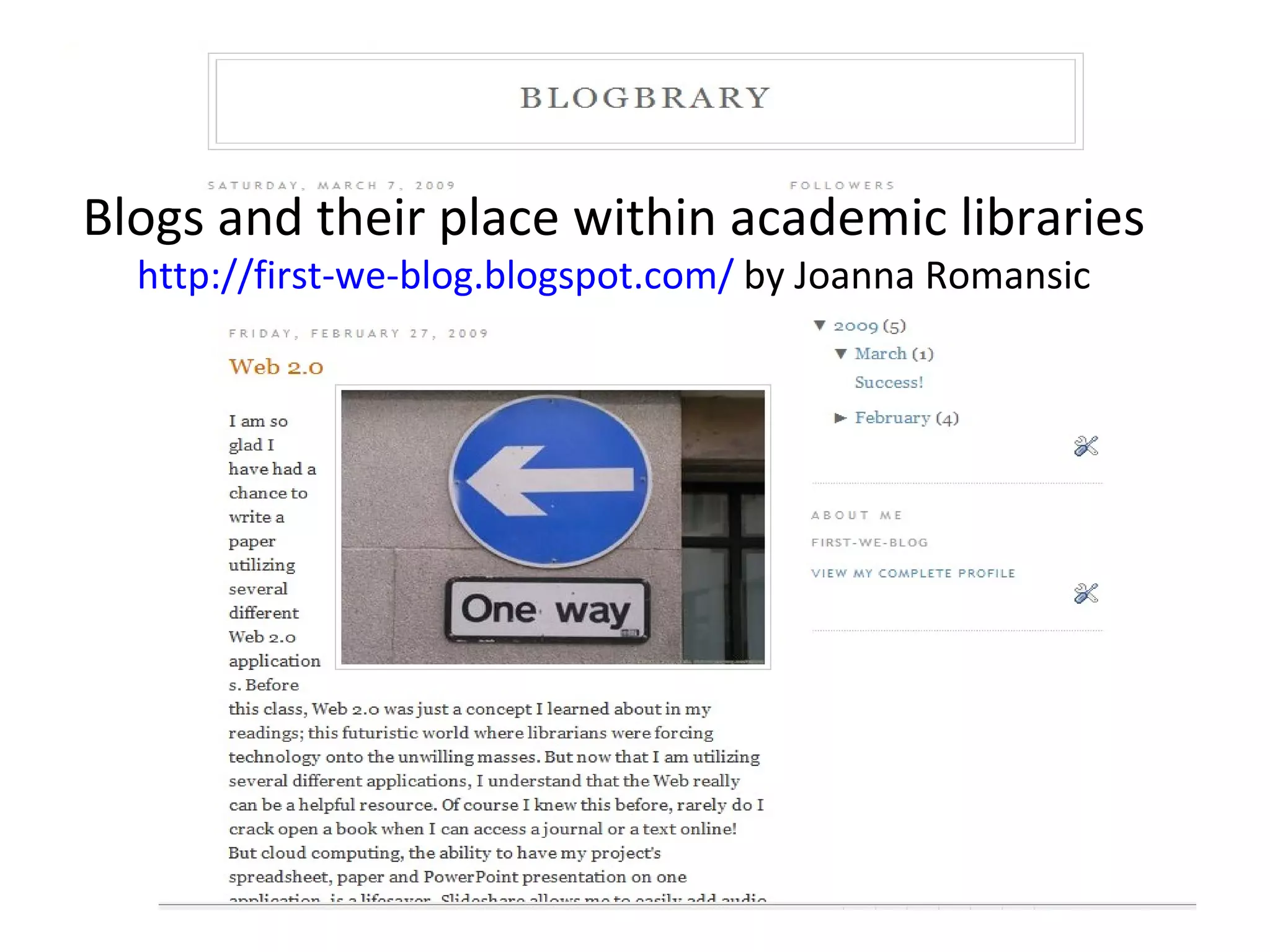
Blogs and their place within academic libraries http://first-we-blog.blogspot.com/  by Joanna Romansic
The Big Picture There’s no going back According to OCLC's study released in 2007, as much as 90% of us have been using the internet for over four years (De Rosa et al., p. 1-2).  It’s Blog! OCLC’s study also stated that 46% of those surveyed worldwide used blogs in 2007, compared to 16% in 2005 (De Rosa et al., p. 1-2). Origin of blogs. How it all began and why they are important to us.
Academic Library as the “heart of the university” An academic library Library is becoming less of a physical space and more of an “information universe” "This parallel universe provides us with constant feedback, resources, monitoring, information, connections, education, and interaction. It can be individualized and personalized, and we can interact individually or collectively with it.” (Eisenberg, 2008).  Students will go to the library if they see it as a quiet place to study and a community within a community A blog can redefine the library as a community This study looked at how effective blogs were within academic libraries.
How Did She Do It, You Ask? (Methodology) One on One interviews with five different academic librarians  They were the main contributors to their blogs Took a nonscientific, subjective look at the blogs Sent out list of questions that focused on three areas: The Blog as a Tool The Practicality of Maintaining a Blog in an Academic Library The Evaluation of each blogs’ effectiveness
Scope/Limitations The sample size is made up of  Two law libraries One medical school library One undergraduate library Because of the small sample size, the study was confined to a simple questionnaire Even though I would have preferred face-to-face interviews, they were done over the phone and by email
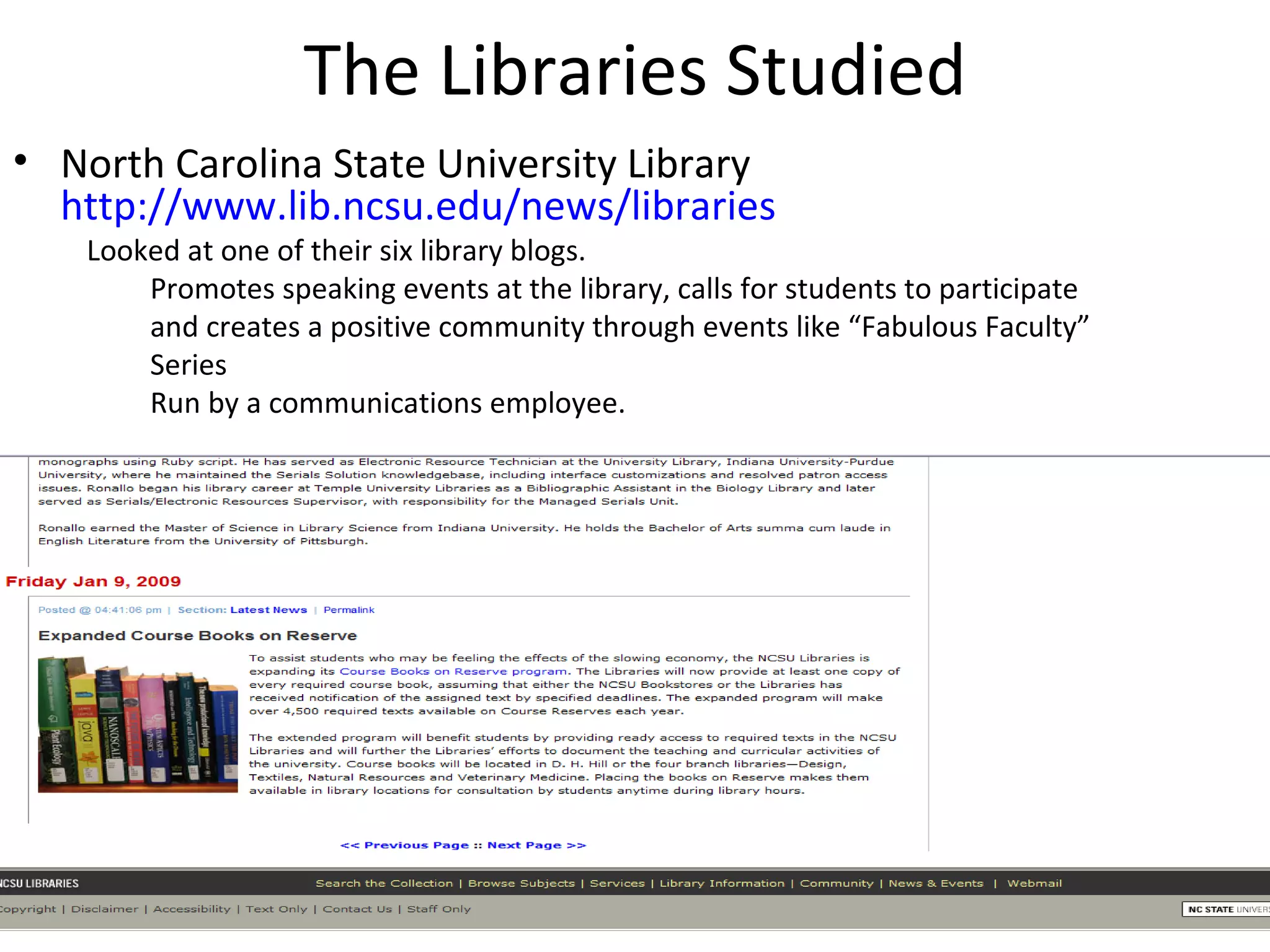
The Libraries Studied North Carolina State University Library  http://www.lib.ncsu.edu/news/libraries Looked at one of their six library blogs. Promotes speaking events at the library, calls for students to participate and creates a positive community through events like “Fabulous Faculty” Series Run by a communications employee.
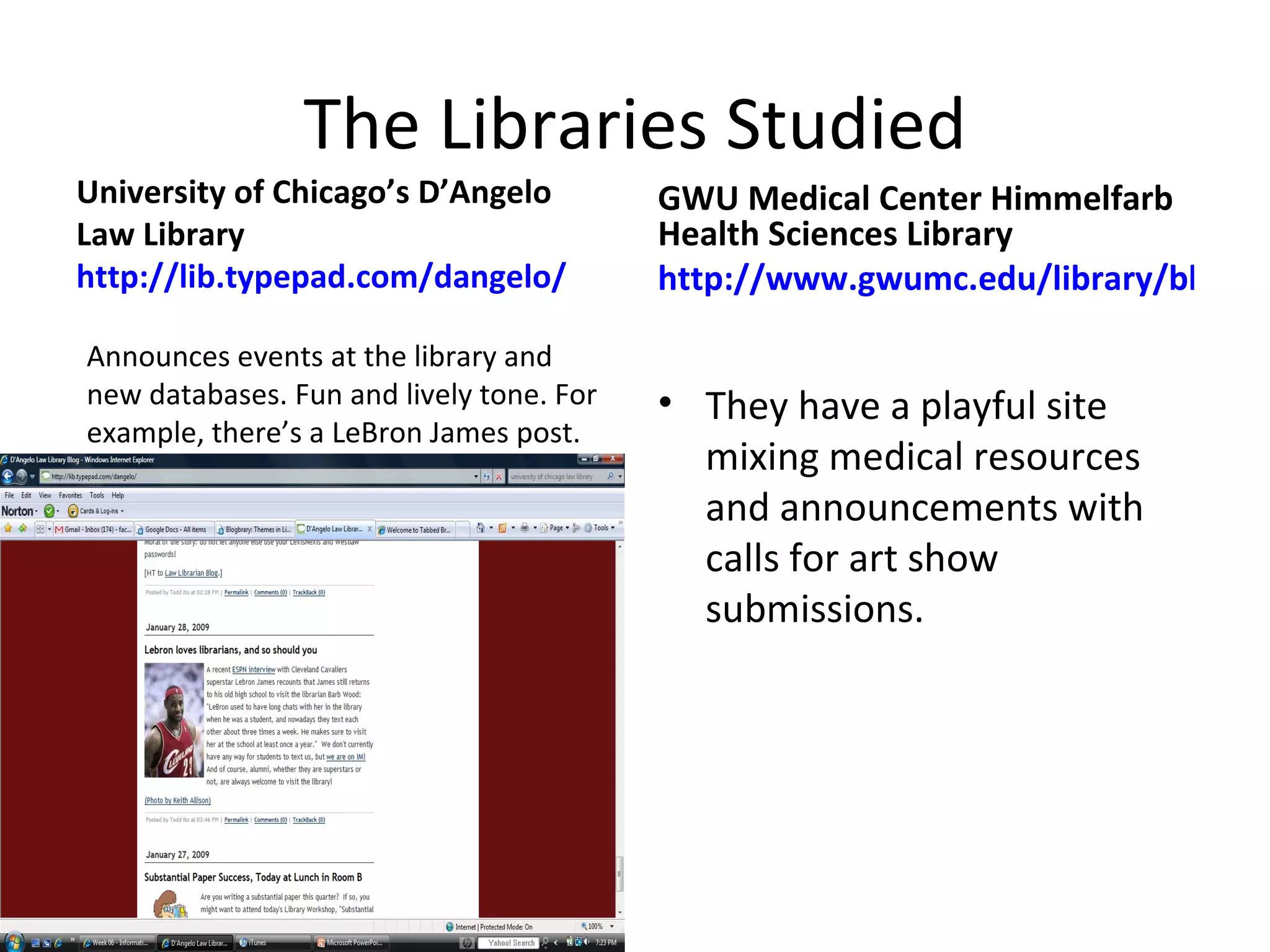
The Libraries Studied University of Chicago’s D’Angelo Law Library  http://lib.typepad.com/dangelo/ GWU Medical Center Himmelfarb Health Sciences Library http://www.gwumc.edu/library/blog/client/ They have a playful site mixing medical resources and announcements with calls for art show submissions. Announces events at the library and new databases. Fun and lively tone. For example, there’s a LeBron James post.
The Libraries Studied Catholic University Mullen Library News and Events http://www.lib.cua.edu/newsevents/ The postings are very short and there are hardly any photos.  Unlike the other blogs, there are little to no current event postings relating what’s going on in the news with library resources Georgetown University Law Library  http://www.ll.georgetown.edu/blog/ Includes announcements on new databases and instructional workshops Includes postings on President’s budges. There is a separate feedback blog that is updated infrequently
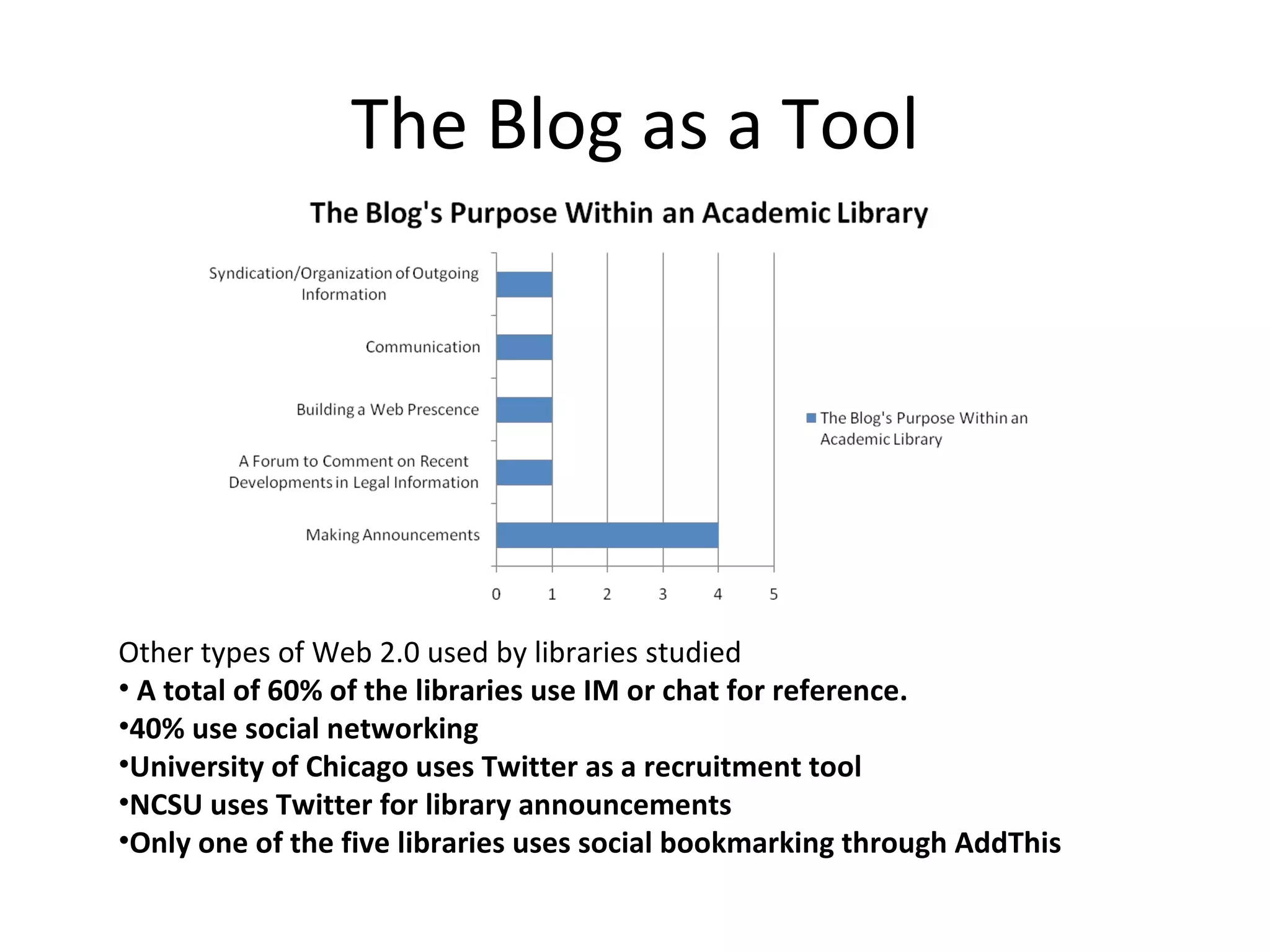
The Blog as a Tool Other types of Web 2.0 used by libraries studied A total of 60% of the libraries use IM or chat for reference. 40% use social networking University of Chicago uses Twitter as a recruitment tool NCSU uses Twitter for library announcements Only one of the five libraries uses social bookmarking through AddThis
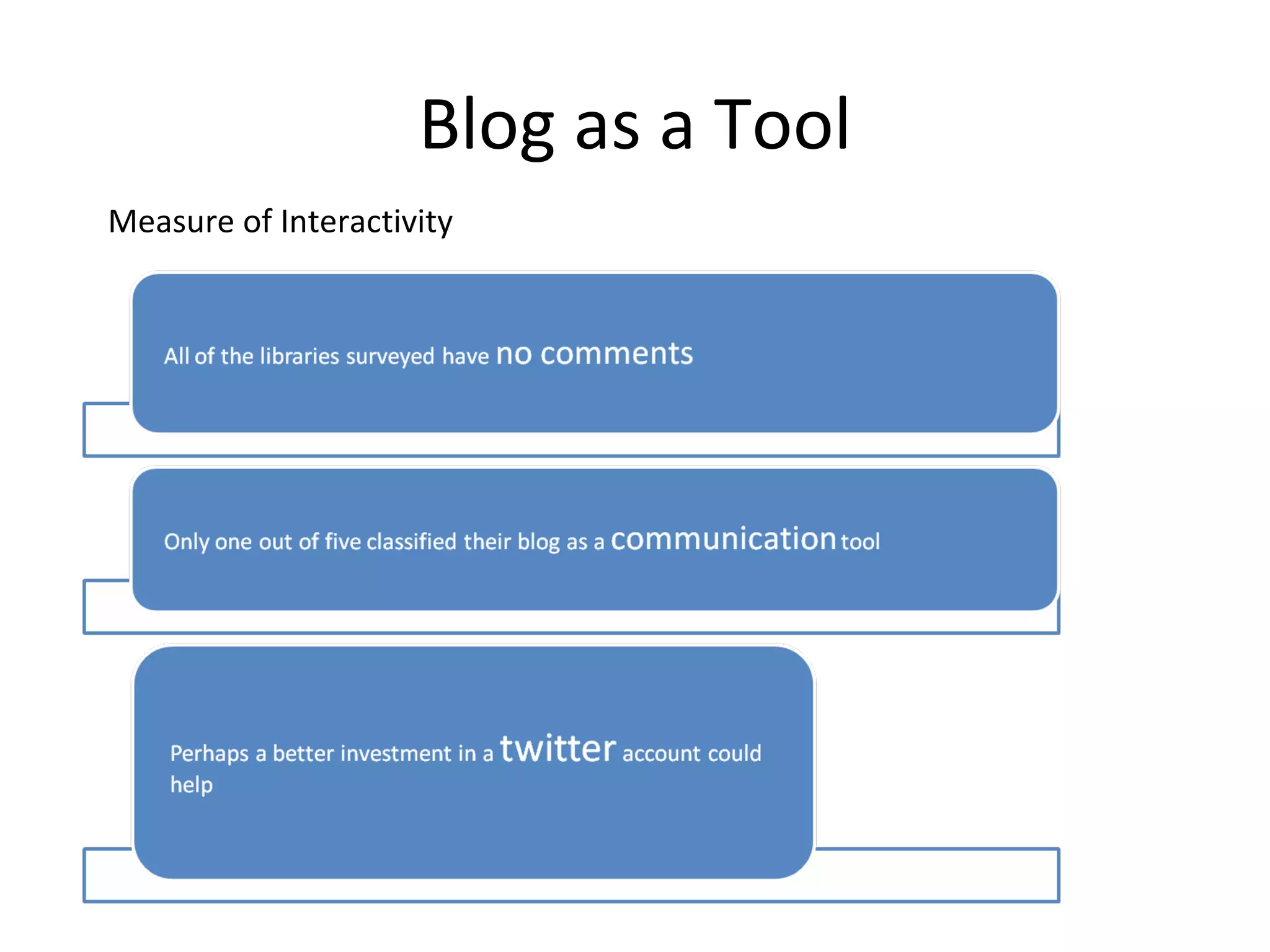
Blog as a Tool Measure of Interactivity
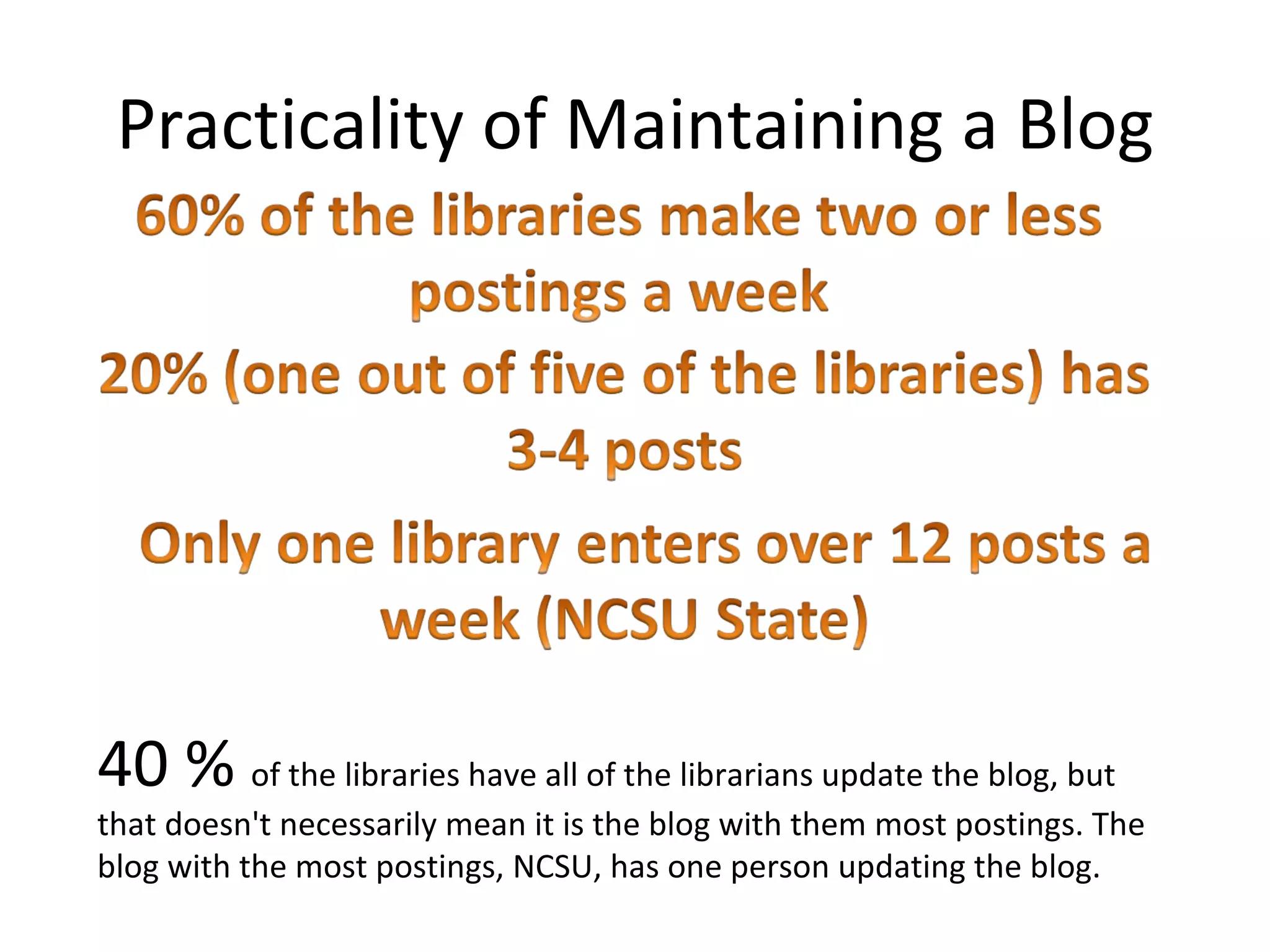
Practicality of Maintaining a Blog 40 %  of the libraries have all of the librarians update the blog, but that doesn't necessarily mean it is the blog with them most postings. The blog with the most postings, NCSU, has one person updating the blog.
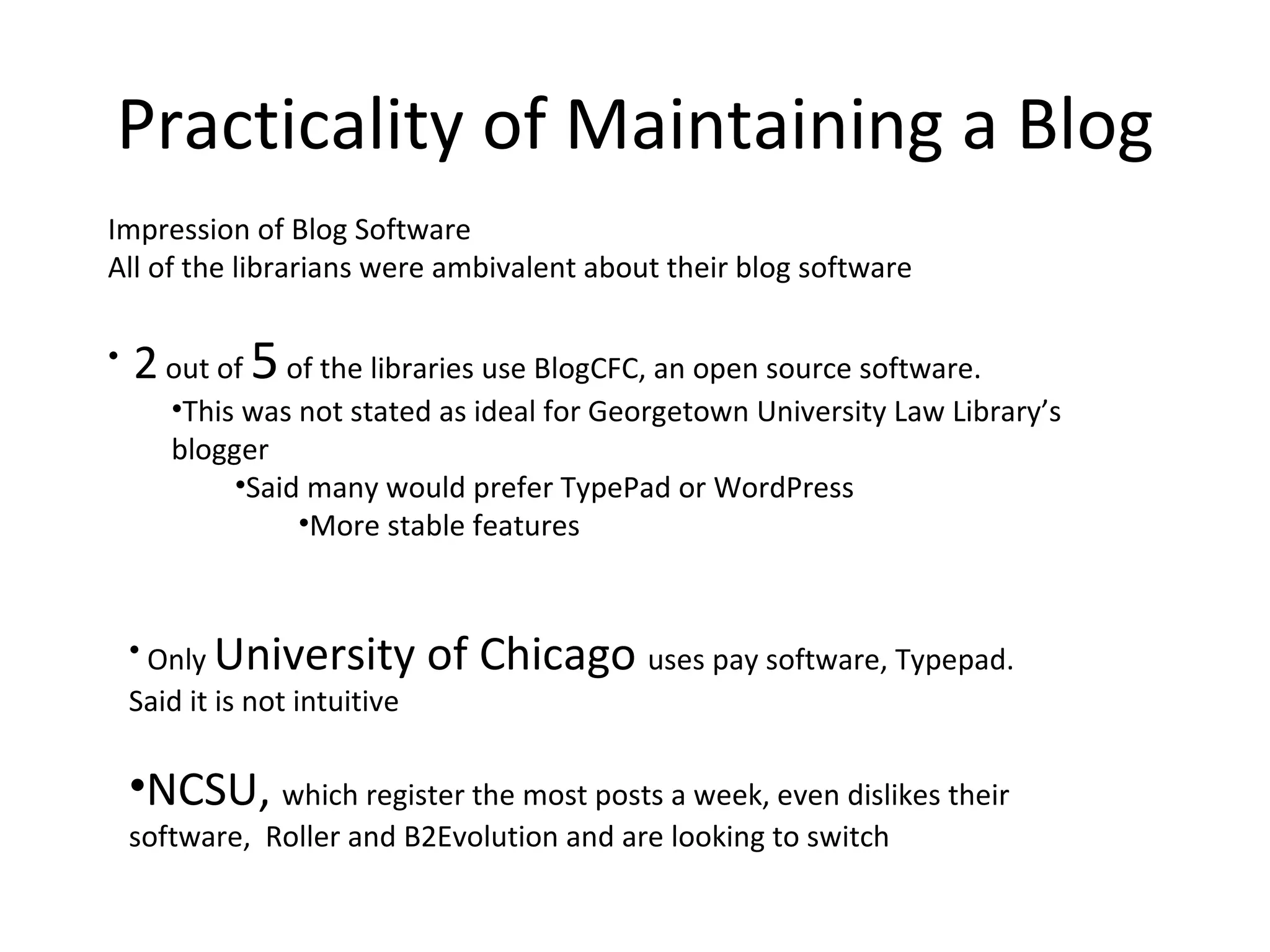
Practicality of Maintaining a Blog Impression of Blog Software All of the librarians were ambivalent about their blog software 2  out of  5  of the libraries use BlogCFC, an open source software.  This was not stated as ideal for Georgetown University Law Library’s blogger Said many would prefer TypePad or WordPress  More stable features  Only  University of Chicago  uses pay software, Typepad. Said it is not intuitive  NCSU,  which register the most posts a week, even dislikes their software,  Roller and B2Evolution and are looking to switch
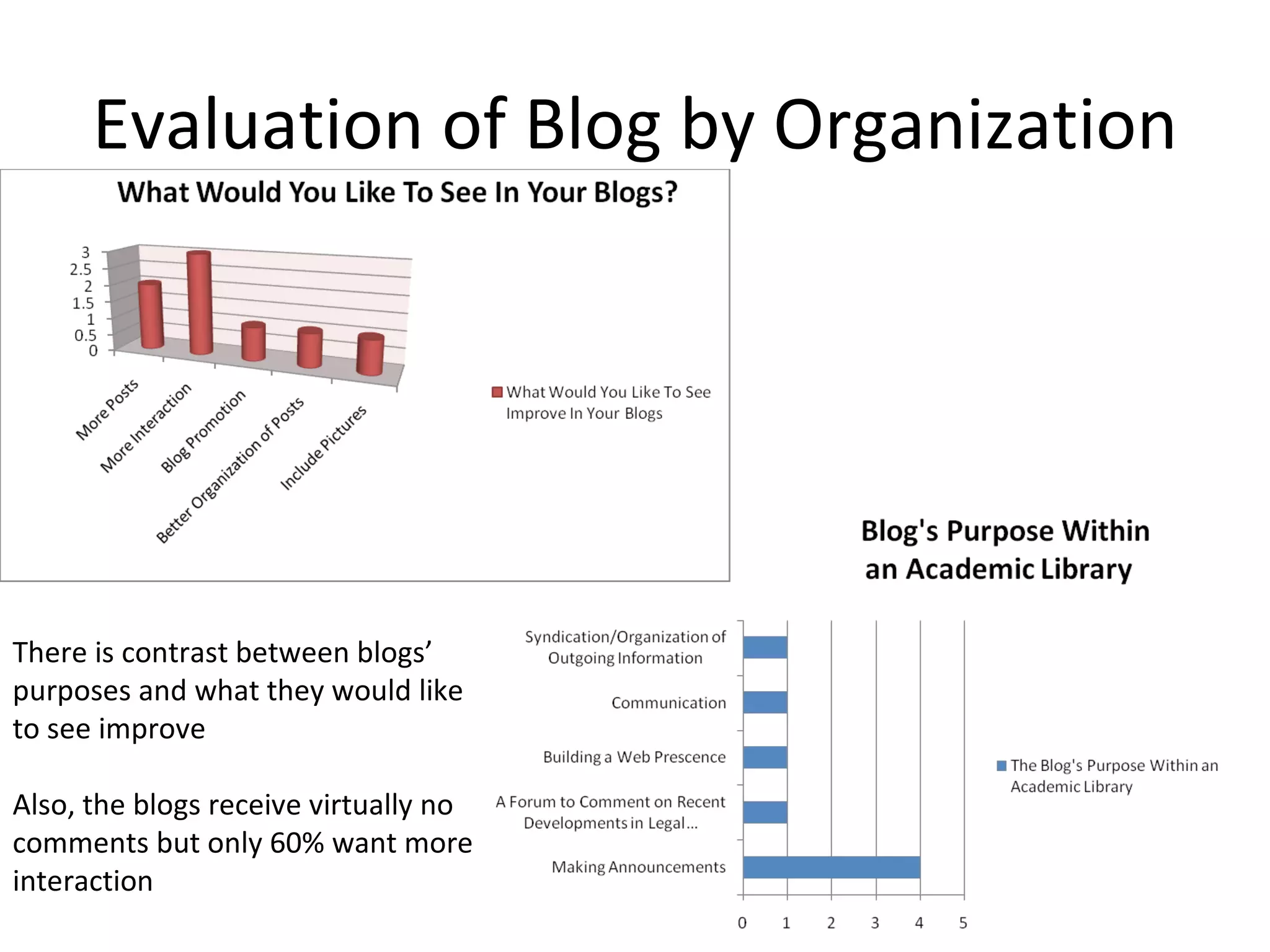
Evaluation of Blog by Organization There is contrast between blogs’ purposes and what they would like to see improve Also, the blogs receive virtually no comments but only 60% want more interaction
Evaluation of Blogs by Organizations None of the libraries effectively evaluate their blogs . Are the blogs priorities in the organizations? Only one of the libraries, NCSU, considers their blog a high priority “ People wanted something,” said Roger Skalbeck of GW’s Law Library More support could = A more effective blog
Conclusions: Focused Purpose The blogs are not being evaluated May benefit from surveying students With no comments, they may still be reading the blogs With no comments Only 60% would like to see increased interaction Only one out of 5 of the libraries stated communication as their blog’s purpose Without focus or mission, library blogs are the New Coke of blog world
Conclusions: Administrative Support Support must be there to motivate staff NCSU’s blog is priority Maintained as PR tool “building communities for knowledge flow,”  “a small cadre of people must be committed to participation” AND there must be evaluation (David Snowden, 2008)
Conclusions: More Interesting Content “A spoonful of sugar make the medicine go down”—Mary Poppins Give holiday shopping tips—GU Law Lib. Build on enthusiasm of presidential election to promote new Obama database resource-GU Law Lib. Have quizzes with prizes
Conclusions: Look at Most Popular Blogs Web’s most popular blogs are technology related This makes sense, but it also provides a challenge. What about television? What if the only people who watched it, knew how it worked Much smaller audience Make software easier
Conclusions: Focus More on Engagement  Combine playful blogs, quizzes with information Make it more like interactive television. Blog must be considered outreach as used as a tool to create a community within the library
References Breeding, Marshall (April 2008). Automation System Marketplace 2008: Opportunity Out of Turmoil,  LibraryJournal.com . Retrieved on March 1, 2009, from  http://www.libraryjournal.com/article/CA6542440.html     Carvin, Andy, (May 22, 2006)  What Exactly is a Blog, Anyway? Retrieved March 6, 2009, from  http://www.pbs.org/teachers/learning.now/2006/05/what_exactly_is_a_blog_anyway.html   Catholic University Mullen   Library, (2009).   Library News & Events.  Retrieved February 22, 2008, from     http://www.lib.cua.edu/newsevents/   D'Angelo Law Library, University of Chicago, (2009).  D’Angelo Law Library Blog.  Retrieved from March 8, 2009, from  http://lib.typepad.com/dangelo/   De Rosa, C., Cantrell, J., Havens, A., Hawk, J., & Jenkins, L. (2007 ).  OCLC's Sharing, Privacy and Trust in Our Networked World. A 2007 report to OCLC membership.  Retrieved from February 20, 2009 from  http://www.oclc.org/reports/sharing/default.htm   Eisenberg, Mike (May 2008). "The Parallel Information Universe: What's Out There and What It Means for Libraries,"  LibraryJournal.com.  Retrieved on March 1, 2009, from  http://www.libraryjournal.com/article/CA6551184.html     FOX News Channel. (2008, November 10) Sarah Palin Interview.  On The Record With Greta Van Sustere.  Clip retrieved from http://www.takepart.com/blog/2008/11/11/sarah-palin-says-me-and-my-pjs-are-to-blame/   Georgetown University Law Library, (2009).  Due Process: The Georgetown Law Library Blog.  Retrieved March 8, 2009, from   http://www.ll.georgetown.edu/blog/ GWU Medical Center Library, (2009).   Himmelfarb Health Sciences Library.  Retrieved March 8, 2009, from  http://www.gwumc.edu/library/blog/client/   NCSU Libraries, (2009).   NCSU Libraries News.  Retrieved from March 8, 2009, from  http://www.lib.ncsu.edu/news/libraries Rating Burner, (2009).  Rating Burner for Blogs.  Retrieved March 8, 2009, from  http://www.ratingburner.com/ Snowden, David (July/August 2008).  Everything Is Fragmented - Build CoPs for Knowledge Flow.  KM  World  magazine. Retrieved July 25, 2008, from  http://www.kmworld.com/Articles/News/News-Analysis/Everything-is-fragmented%E2%80%94Building-CoPs-for-knowledge-flow--49849.aspx   Weiner, Sharon Gray, (Spring, 2005). “The History of Academic Libraries in the United States: a Review of the Literature,”  Library Philosophy and Practice , 7(2). Retrieved on March 7, 2009 from  http://www.webpages.uidaho.edu/~mbolin/weiner.htm

Blogbrary: Blogs and their place within academic libraries

  • 1.
    Blogs and theirplace within academic libraries http://first-we-blog.blogspot.com/ by Joanna Romansic
  • 2.
    The Big PictureThere’s no going back According to OCLC's study released in 2007, as much as 90% of us have been using the internet for over four years (De Rosa et al., p. 1-2). It’s Blog! OCLC’s study also stated that 46% of those surveyed worldwide used blogs in 2007, compared to 16% in 2005 (De Rosa et al., p. 1-2). Origin of blogs. How it all began and why they are important to us.
  • 3.
    Academic Library asthe “heart of the university” An academic library Library is becoming less of a physical space and more of an “information universe” "This parallel universe provides us with constant feedback, resources, monitoring, information, connections, education, and interaction. It can be individualized and personalized, and we can interact individually or collectively with it.” (Eisenberg, 2008). Students will go to the library if they see it as a quiet place to study and a community within a community A blog can redefine the library as a community This study looked at how effective blogs were within academic libraries.
  • 4.
    How Did SheDo It, You Ask? (Methodology) One on One interviews with five different academic librarians They were the main contributors to their blogs Took a nonscientific, subjective look at the blogs Sent out list of questions that focused on three areas: The Blog as a Tool The Practicality of Maintaining a Blog in an Academic Library The Evaluation of each blogs’ effectiveness
  • 5.
    Scope/Limitations The samplesize is made up of Two law libraries One medical school library One undergraduate library Because of the small sample size, the study was confined to a simple questionnaire Even though I would have preferred face-to-face interviews, they were done over the phone and by email
  • 6.
    The Libraries StudiedNorth Carolina State University Library http://www.lib.ncsu.edu/news/libraries Looked at one of their six library blogs. Promotes speaking events at the library, calls for students to participate and creates a positive community through events like “Fabulous Faculty” Series Run by a communications employee.
  • 7.
    The Libraries StudiedUniversity of Chicago’s D’Angelo Law Library http://lib.typepad.com/dangelo/ GWU Medical Center Himmelfarb Health Sciences Library http://www.gwumc.edu/library/blog/client/ They have a playful site mixing medical resources and announcements with calls for art show submissions. Announces events at the library and new databases. Fun and lively tone. For example, there’s a LeBron James post.
  • 8.
    The Libraries StudiedCatholic University Mullen Library News and Events http://www.lib.cua.edu/newsevents/ The postings are very short and there are hardly any photos. Unlike the other blogs, there are little to no current event postings relating what’s going on in the news with library resources Georgetown University Law Library http://www.ll.georgetown.edu/blog/ Includes announcements on new databases and instructional workshops Includes postings on President’s budges. There is a separate feedback blog that is updated infrequently
  • 9.
    The Blog asa Tool Other types of Web 2.0 used by libraries studied A total of 60% of the libraries use IM or chat for reference. 40% use social networking University of Chicago uses Twitter as a recruitment tool NCSU uses Twitter for library announcements Only one of the five libraries uses social bookmarking through AddThis
  • 10.
    Blog as aTool Measure of Interactivity
  • 11.
    Practicality of Maintaininga Blog 40 % of the libraries have all of the librarians update the blog, but that doesn't necessarily mean it is the blog with them most postings. The blog with the most postings, NCSU, has one person updating the blog.
  • 12.
    Practicality of Maintaininga Blog Impression of Blog Software All of the librarians were ambivalent about their blog software 2 out of 5 of the libraries use BlogCFC, an open source software. This was not stated as ideal for Georgetown University Law Library’s blogger Said many would prefer TypePad or WordPress More stable features Only University of Chicago uses pay software, Typepad. Said it is not intuitive NCSU, which register the most posts a week, even dislikes their software, Roller and B2Evolution and are looking to switch
  • 13.
    Evaluation of Blogby Organization There is contrast between blogs’ purposes and what they would like to see improve Also, the blogs receive virtually no comments but only 60% want more interaction
  • 14.
    Evaluation of Blogsby Organizations None of the libraries effectively evaluate their blogs . Are the blogs priorities in the organizations? Only one of the libraries, NCSU, considers their blog a high priority “ People wanted something,” said Roger Skalbeck of GW’s Law Library More support could = A more effective blog
  • 15.
    Conclusions: Focused PurposeThe blogs are not being evaluated May benefit from surveying students With no comments, they may still be reading the blogs With no comments Only 60% would like to see increased interaction Only one out of 5 of the libraries stated communication as their blog’s purpose Without focus or mission, library blogs are the New Coke of blog world
  • 16.
    Conclusions: Administrative SupportSupport must be there to motivate staff NCSU’s blog is priority Maintained as PR tool “building communities for knowledge flow,” “a small cadre of people must be committed to participation” AND there must be evaluation (David Snowden, 2008)
  • 17.
    Conclusions: More InterestingContent “A spoonful of sugar make the medicine go down”—Mary Poppins Give holiday shopping tips—GU Law Lib. Build on enthusiasm of presidential election to promote new Obama database resource-GU Law Lib. Have quizzes with prizes
  • 18.
    Conclusions: Look atMost Popular Blogs Web’s most popular blogs are technology related This makes sense, but it also provides a challenge. What about television? What if the only people who watched it, knew how it worked Much smaller audience Make software easier
  • 19.
    Conclusions: Focus Moreon Engagement Combine playful blogs, quizzes with information Make it more like interactive television. Blog must be considered outreach as used as a tool to create a community within the library
  • 20.
    References Breeding, Marshall(April 2008). Automation System Marketplace 2008: Opportunity Out of Turmoil, LibraryJournal.com . Retrieved on March 1, 2009, from http://www.libraryjournal.com/article/CA6542440.html   Carvin, Andy, (May 22, 2006) What Exactly is a Blog, Anyway? Retrieved March 6, 2009, from http://www.pbs.org/teachers/learning.now/2006/05/what_exactly_is_a_blog_anyway.html   Catholic University Mullen Library, (2009). Library News & Events. Retrieved February 22, 2008, from   http://www.lib.cua.edu/newsevents/   D'Angelo Law Library, University of Chicago, (2009). D’Angelo Law Library Blog. Retrieved from March 8, 2009, from http://lib.typepad.com/dangelo/   De Rosa, C., Cantrell, J., Havens, A., Hawk, J., & Jenkins, L. (2007 ). OCLC's Sharing, Privacy and Trust in Our Networked World. A 2007 report to OCLC membership. Retrieved from February 20, 2009 from http://www.oclc.org/reports/sharing/default.htm   Eisenberg, Mike (May 2008). "The Parallel Information Universe: What's Out There and What It Means for Libraries," LibraryJournal.com. Retrieved on March 1, 2009, from http://www.libraryjournal.com/article/CA6551184.html   FOX News Channel. (2008, November 10) Sarah Palin Interview. On The Record With Greta Van Sustere. Clip retrieved from http://www.takepart.com/blog/2008/11/11/sarah-palin-says-me-and-my-pjs-are-to-blame/   Georgetown University Law Library, (2009). Due Process: The Georgetown Law Library Blog. Retrieved March 8, 2009, from http://www.ll.georgetown.edu/blog/ GWU Medical Center Library, (2009). Himmelfarb Health Sciences Library. Retrieved March 8, 2009, from http://www.gwumc.edu/library/blog/client/   NCSU Libraries, (2009). NCSU Libraries News. Retrieved from March 8, 2009, from http://www.lib.ncsu.edu/news/libraries Rating Burner, (2009). Rating Burner for Blogs. Retrieved March 8, 2009, from http://www.ratingburner.com/ Snowden, David (July/August 2008). Everything Is Fragmented - Build CoPs for Knowledge Flow. KM World magazine. Retrieved July 25, 2008, from http://www.kmworld.com/Articles/News/News-Analysis/Everything-is-fragmented%E2%80%94Building-CoPs-for-knowledge-flow--49849.aspx   Weiner, Sharon Gray, (Spring, 2005). “The History of Academic Libraries in the United States: a Review of the Literature,” Library Philosophy and Practice , 7(2). Retrieved on March 7, 2009 from http://www.webpages.uidaho.edu/~mbolin/weiner.htm