Hive on Spark
Szehon Ho
Cloudera Software Engineer, Apache Hive PMC
2© 2014 Cloudera, Inc. All rights reserved.
Background: Hive
•  MapReduce (2005)
•  Open-source big data processing engine.
•  Hive (2007)
•  Provides SQL access to MapReduce engine.
•  Feature rich, mature (large community)
•  De-facto standard for SQL on Hadoop
•  Most-used Hadoop tool in Cloudera
3© 2014 Cloudera, Inc. All rights reserved.
Background: Spark
•  Second wave of big-data innovation, many projects strive to be an
improved MapReduce (Tez, Flink, etc)
•  Spark (2009)
•  Berkeley research projects
•  General consensus that its most well-placed to replace MapReduce.
•  Grown to be most active Apache project
•  Pig, Mahout, Cascading, Flume, Solr integrating or moving onto Spark.
•  Exposes more expressive API’s, take advantage of modern hardware.
4© 2014 Cloudera, Inc. All rights reserved.
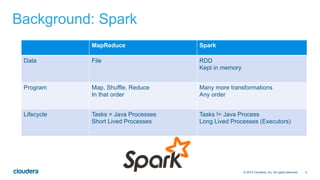
Background: Spark
MapReduce Spark
Data File RDD
Kept in memory
Program Map, Shuffle, Reduce
In that order
Many more transformations
Any order
Lifecycle Tasks = Java Processes
Short Lived Processes
Tasks != Java Process
Long Lived Processes (Executors)
5© 2014 Cloudera, Inc. All rights reserved.
Hive on Spark: Goals
•  Hive as access layer: Users can switch with minimal cost to better
execution engine => Better performance
•  Goals:
•  Hive can run seamlessly on different execution engines (MR, Tez, and Spark).
•  Hive on Spark supports full range of existing Hive features
6© 2014 Cloudera, Inc. All rights reserved.
Design Concepts
•  Challenge: Porting a mature system on a new execution engine
•  Recap of advanced Functionality in Hive:
•  SQL Syntax
•  SQL data types
•  User-Defined Functions
•  File Formats
•  Keeping most of the execution code (Hive operators) same across
execution engines
7© 2014 Cloudera, Inc. All rights reserved.
Design Concepts
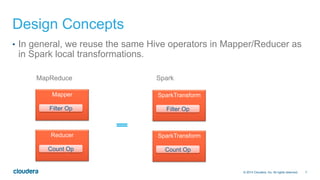
•  In general, we reuse the same Hive operators in Mapper/Reducer as
in Spark local transformations.
MapReduce Spark
SparkTransform
Filter Op
SparkTransform
Count Op
Mapper
Filter Op
Reducer
Count Op
8© 2014 Cloudera, Inc. All rights reserved.
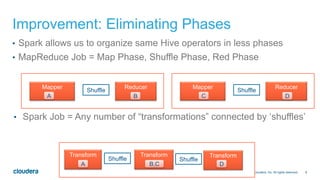
•  Spark allows us to organize same Hive operators in less phases
•  MapReduce Job = Map Phase, Shuffle Phase, Red Phase
•  Spark Job = Any number of “transformations” connected by ‘shuffles’
Improvement: Eliminating Phases
Mapper Reducer
Transform Transform Transform
Shuffle
Shuffle Shuffle
Mapper Reducer
Shuffle
A B C D
A B,C D
9© 2014 Cloudera, Inc. All rights reserved.
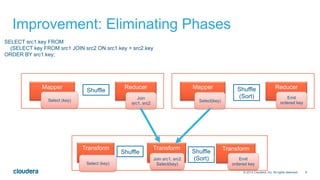
Improvement: Eliminating Phases
Mapper Reducer
Transform Transform Transform
Shuffle
Shuffle Shuffle
(Sort)
Mapper ReducerShuffle
(Sort)
Select (key)
SELECT src1.key FROM
(SELECT key FROM src1 JOIN src2 ON src1.key = src2.key
ORDER BY src1.key;
Join
src1, src2
Select(key)
Emit
ordered key
Select (key)
Join src1, src2
Select(key)
Emit
ordered key
10© 2014 Cloudera, Inc. All rights reserved.
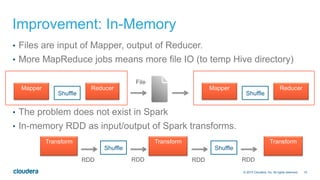
•  Files are input of Mapper, output of Reducer.
•  More MapReduce jobs means more file IO (to temp Hive directory)
•  The problem does not exist in Spark
•  In-memory RDD as input/output of Spark transforms.
Improvement: In-Memory
RDD
Mapper Reducer
Shuffle
Mapper Reducer
Shuffle
Transform Transform
Shuffle
RDD
Transform
RDD
Shuffle
RDD
File
11© 2014 Cloudera, Inc. All rights reserved.
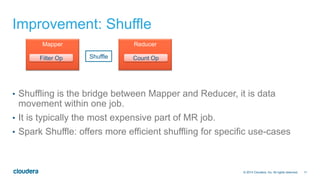
Improvement: Shuffle
•  Shuffling is the bridge between Mapper and Reducer, it is data
movement within one job.
•  It is typically the most expensive part of MR job.
•  Spark Shuffle: offers more efficient shuffling for specific use-cases
Mapper
Filter Op
Reducer
Count OpShuffle
12© 2014 Cloudera, Inc. All rights reserved.
Improvement: Shuffle
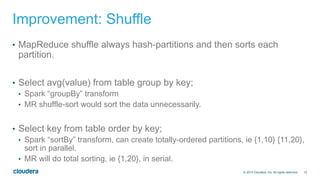
•  MapReduce shuffle always hash-partitions and then sorts each
partition.
•  Select avg(value) from table group by key;
•  Spark “groupBy” transform
•  MR shuffle-sort would sort the data unnecessarily.
•  Select key from table order by key;
•  Spark “sortBy” transform, can create totally-ordered partitions, ie {1,10} {11,20},
sort in parallel.
•  MR will do total sorting, ie {1,20}, in serial.
13© 2014 Cloudera, Inc. All rights reserved.
Improvement: Process Lifecycle
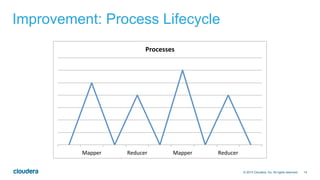
•  In MapReduce, each Map/Reduce phase spawns and terminates
many processes (Mappers, Reducers)
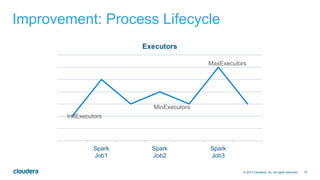
•  In Spark, each “Executor” can be long-lived, runs one or more tasks.
•  A set of Spark Executors = Spark “Application”.
•  In Hive on Spark, one Hive user session has open one Spark
Application.
•  All queries of that user session re-use Application, can re-use the Executor
processes.
14© 2014 Cloudera, Inc. All rights reserved.
Improvement: Process Lifecycle
Mapper& Reducer& Mapper& Reducer&
Processes'
15© 2014 Cloudera, Inc. All rights reserved.
Improvement: Process Lifecycle
MinExecutors
InitExecutors
MaxExecutors
16© 2014 Cloudera, Inc. All rights reserved.
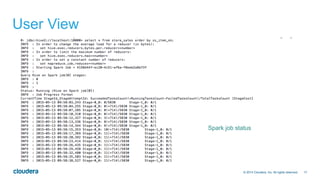
User View
•  Install Hadoop on cluster
•  HDFS
•  YARN (recommended)
•  Install Spark (YARN mode recommended)
•  Install Hive (will pick up static Spark configs, like spark.master, spark.serializer)
•  From Versions: Hive 1.1, Spark 1.3, Hadoop 2.6
•  In Hive client, run “Set hive.execution.engine=spark”; //default is MR
•  Run query
•  The first query will start the Spark application (set of Executors)
17© 2014 Cloudera, Inc. All rights reserved.
User View
Spark job status
18© 2014 Cloudera, Inc. All rights reserved.
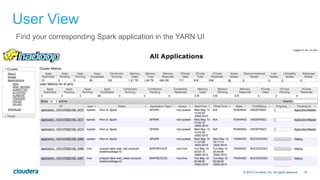
User View
Find your corresponding Spark application in the YARN UI
19© 2014 Cloudera, Inc. All rights reserved.
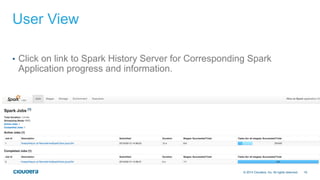
User View
•  Click on link to Spark History Server for Corresponding Spark
Application progress and information.
20© 2014 Cloudera, Inc. All rights reserved.
Dynamic vs Static Allocation
For a Spark Application:
•  Spark dynamic allocation: number of Executor instances variable.
•  spark.executor.dynamicAllocation.enabled=true
•  spark.executor.dynamicAllocation.initialExecutors=1
•  spark.executor.dynamicAllocation.minExecutors=1
•  spark.executor.dynamicAllocation.maxExecutors=10;
•  Spark static allocation: number of Executor instances fixed.
•  Spark.executor.instances = 10
21© 2014 Cloudera, Inc. All rights reserved.
User View
•  Things to tune: memory of Spark executors
•  spark.executor.cores: number of cores per Spark executor.
•  spark.executor.memory: maximum size of each Spark executor's Java heap memory when
Hive is running on Spark.
•  spark.driver.memory: maximum size of each Spark driver's Java heap memory when Hive is
running on Spark.
22© 2014 Cloudera, Inc. All rights reserved.
Perf Benchmarks
•  8 physical nodes
•  Each node: 32 core, 64 GB
•  10000MB/s network between nodes
•  Component Versions
•  Hive: spark-branch (April 2015)
•  Spark: 1.3.0
•  Hadoop: 2.6.0
•  Tez: 0.5.3
23© 2014 Cloudera, Inc. All rights reserved.
Perf Benchmarks
•  320GB and 4TB TPC-DS datasets
•  Three engines share the most of the configurations
•  Memory Vectorization enabled
•  CBO enabled
•  hive.auto.convert.join.noconditionaltask.size = 600MB
24© 2014 Cloudera, Inc. All rights reserved.
Perf Benchmarks
•  Hive on Tez
•  hive.prewarm.numcontainers = 250
•  hive.tez.auto.reducer.parallelism = true
•  hive.tez.dynamic.partition.pruning = true
•  Hive on Spark
•  spark.master = yarn-client
•  spark.executor.memory = 5120m
•  spark.yarn.executor.memoryOverhead = 1024
•  spark.executor.cores = 4
•  spark.kryo.referenceTracking = false
•  spark.io.compression.codec = lzf
25© 2014 Cloudera, Inc. All rights reserved.
Perf Benchmarks
•  Data collection: Run each query twice, first to warm-up, second to
measure.
26© 2014 Cloudera, Inc. All rights reserved.
MR	
  vs	
  Spark	
  vs	
  Tez,	
  320GB	
  
27© 2014 Cloudera, Inc. All rights reserved.
MR	
  vs	
  Spark,	
  4TB	
  
28© 2014 Cloudera, Inc. All rights reserved.
Spark	
  vs	
  Tez,	
  4TB	
  
29© 2014 Cloudera, Inc. All rights reserved.
Perf Benchmarks
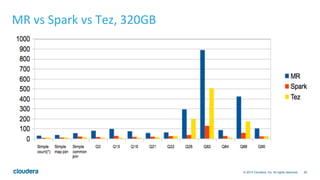
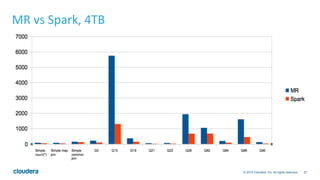
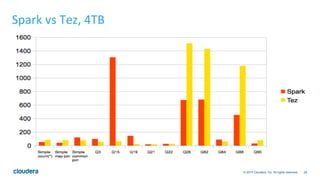
•  Spark is as fastest on many queries
•  Dynamic partition pruning makes Spark slower in some queries (Q3,
Q15, Q19). These queries benefit from eliminating some partition
from bigger-table before a join.
•  Spark is slower on certain queries (common join, Q84) than Tez.
Spark shuffle-sort improvements in the works in Spark community
(Project Tungsten, etc)
30© 2014 Cloudera, Inc. All rights reserved.
Conclusion
•  Available in Hive 1.1+, CDH5.4+
•  Follow HIVE-7292 for more updates
•  Contributors from:
Thank you.
32© 2014 Cloudera, Inc. All rights reserved.
SparkSQL	
  and	
  Hive	
  on	
  Spark	
  
l  SparkSQL	
  is	
  similar	
  to	
  Shark	
  (disconBnued)	
  
l  Forked	
  a	
  version	
  from	
  Hive,	
  thus	
  Bed	
  with	
  a	
  specific	
  version	
  
l  ExecuBng	
  queries	
  using	
  Spark's	
  transformaBons	
  and	
  acBons,	
  instead	
  of	
  Hive	
  
operators.	
  
l All	
  SQL	
  syntaxes,	
  funcBonality	
  implemented	
  from	
  scratch.	
  
l  RelaBvely	
  new	
  
l  Suitable	
  for	
  Spark	
  users	
  occasionally	
  needing	
  to	
  execute	
  SQL	
  
33© 2014 Cloudera, Inc. All rights reserved.
Impala?	
  
l  Tuned	
  for	
  extreme	
  performance/	
  low	
  latency	
  
l  Purpose-­‐built	
  for	
  interacBve	
  BI	
  and	
  SQL	
  analyBcs	
  
l  Best	
  for	
  high	
  concurrency	
  workloads	
  and	
  small	
  result	
  sets	
  

Hive on spark berlin buzzwords

  • 1.
    Hive on Spark SzehonHo Cloudera Software Engineer, Apache Hive PMC
  • 2.
    2© 2014 Cloudera,Inc. All rights reserved. Background: Hive •  MapReduce (2005) •  Open-source big data processing engine. •  Hive (2007) •  Provides SQL access to MapReduce engine. •  Feature rich, mature (large community) •  De-facto standard for SQL on Hadoop •  Most-used Hadoop tool in Cloudera
  • 3.
    3© 2014 Cloudera,Inc. All rights reserved. Background: Spark •  Second wave of big-data innovation, many projects strive to be an improved MapReduce (Tez, Flink, etc) •  Spark (2009) •  Berkeley research projects •  General consensus that its most well-placed to replace MapReduce. •  Grown to be most active Apache project •  Pig, Mahout, Cascading, Flume, Solr integrating or moving onto Spark. •  Exposes more expressive API’s, take advantage of modern hardware.
  • 4.
    4© 2014 Cloudera,Inc. All rights reserved. Background: Spark MapReduce Spark Data File RDD Kept in memory Program Map, Shuffle, Reduce In that order Many more transformations Any order Lifecycle Tasks = Java Processes Short Lived Processes Tasks != Java Process Long Lived Processes (Executors)
  • 5.
    5© 2014 Cloudera,Inc. All rights reserved. Hive on Spark: Goals •  Hive as access layer: Users can switch with minimal cost to better execution engine => Better performance •  Goals: •  Hive can run seamlessly on different execution engines (MR, Tez, and Spark). •  Hive on Spark supports full range of existing Hive features
  • 6.
    6© 2014 Cloudera,Inc. All rights reserved. Design Concepts •  Challenge: Porting a mature system on a new execution engine •  Recap of advanced Functionality in Hive: •  SQL Syntax •  SQL data types •  User-Defined Functions •  File Formats •  Keeping most of the execution code (Hive operators) same across execution engines
  • 7.
    7© 2014 Cloudera,Inc. All rights reserved. Design Concepts •  In general, we reuse the same Hive operators in Mapper/Reducer as in Spark local transformations. MapReduce Spark SparkTransform Filter Op SparkTransform Count Op Mapper Filter Op Reducer Count Op
  • 8.
    8© 2014 Cloudera,Inc. All rights reserved. •  Spark allows us to organize same Hive operators in less phases •  MapReduce Job = Map Phase, Shuffle Phase, Red Phase •  Spark Job = Any number of “transformations” connected by ‘shuffles’ Improvement: Eliminating Phases Mapper Reducer Transform Transform Transform Shuffle Shuffle Shuffle Mapper Reducer Shuffle A B C D A B,C D
  • 9.
    9© 2014 Cloudera,Inc. All rights reserved. Improvement: Eliminating Phases Mapper Reducer Transform Transform Transform Shuffle Shuffle Shuffle (Sort) Mapper ReducerShuffle (Sort) Select (key) SELECT src1.key FROM (SELECT key FROM src1 JOIN src2 ON src1.key = src2.key ORDER BY src1.key; Join src1, src2 Select(key) Emit ordered key Select (key) Join src1, src2 Select(key) Emit ordered key
  • 10.
    10© 2014 Cloudera,Inc. All rights reserved. •  Files are input of Mapper, output of Reducer. •  More MapReduce jobs means more file IO (to temp Hive directory) •  The problem does not exist in Spark •  In-memory RDD as input/output of Spark transforms. Improvement: In-Memory RDD Mapper Reducer Shuffle Mapper Reducer Shuffle Transform Transform Shuffle RDD Transform RDD Shuffle RDD File
  • 11.
    11© 2014 Cloudera,Inc. All rights reserved. Improvement: Shuffle •  Shuffling is the bridge between Mapper and Reducer, it is data movement within one job. •  It is typically the most expensive part of MR job. •  Spark Shuffle: offers more efficient shuffling for specific use-cases Mapper Filter Op Reducer Count OpShuffle
  • 12.
    12© 2014 Cloudera,Inc. All rights reserved. Improvement: Shuffle •  MapReduce shuffle always hash-partitions and then sorts each partition. •  Select avg(value) from table group by key; •  Spark “groupBy” transform •  MR shuffle-sort would sort the data unnecessarily. •  Select key from table order by key; •  Spark “sortBy” transform, can create totally-ordered partitions, ie {1,10} {11,20}, sort in parallel. •  MR will do total sorting, ie {1,20}, in serial.
  • 13.
    13© 2014 Cloudera,Inc. All rights reserved. Improvement: Process Lifecycle •  In MapReduce, each Map/Reduce phase spawns and terminates many processes (Mappers, Reducers) •  In Spark, each “Executor” can be long-lived, runs one or more tasks. •  A set of Spark Executors = Spark “Application”. •  In Hive on Spark, one Hive user session has open one Spark Application. •  All queries of that user session re-use Application, can re-use the Executor processes.
  • 14.
    14© 2014 Cloudera,Inc. All rights reserved. Improvement: Process Lifecycle Mapper& Reducer& Mapper& Reducer& Processes'
  • 15.
    15© 2014 Cloudera,Inc. All rights reserved. Improvement: Process Lifecycle MinExecutors InitExecutors MaxExecutors
  • 16.
    16© 2014 Cloudera,Inc. All rights reserved. User View •  Install Hadoop on cluster •  HDFS •  YARN (recommended) •  Install Spark (YARN mode recommended) •  Install Hive (will pick up static Spark configs, like spark.master, spark.serializer) •  From Versions: Hive 1.1, Spark 1.3, Hadoop 2.6 •  In Hive client, run “Set hive.execution.engine=spark”; //default is MR •  Run query •  The first query will start the Spark application (set of Executors)
  • 17.
    17© 2014 Cloudera,Inc. All rights reserved. User View Spark job status
  • 18.
    18© 2014 Cloudera,Inc. All rights reserved. User View Find your corresponding Spark application in the YARN UI
  • 19.
    19© 2014 Cloudera,Inc. All rights reserved. User View •  Click on link to Spark History Server for Corresponding Spark Application progress and information.
  • 20.
    20© 2014 Cloudera,Inc. All rights reserved. Dynamic vs Static Allocation For a Spark Application: •  Spark dynamic allocation: number of Executor instances variable. •  spark.executor.dynamicAllocation.enabled=true •  spark.executor.dynamicAllocation.initialExecutors=1 •  spark.executor.dynamicAllocation.minExecutors=1 •  spark.executor.dynamicAllocation.maxExecutors=10; •  Spark static allocation: number of Executor instances fixed. •  Spark.executor.instances = 10
  • 21.
    21© 2014 Cloudera,Inc. All rights reserved. User View •  Things to tune: memory of Spark executors •  spark.executor.cores: number of cores per Spark executor. •  spark.executor.memory: maximum size of each Spark executor's Java heap memory when Hive is running on Spark. •  spark.driver.memory: maximum size of each Spark driver's Java heap memory when Hive is running on Spark.
  • 22.
    22© 2014 Cloudera,Inc. All rights reserved. Perf Benchmarks •  8 physical nodes •  Each node: 32 core, 64 GB •  10000MB/s network between nodes •  Component Versions •  Hive: spark-branch (April 2015) •  Spark: 1.3.0 •  Hadoop: 2.6.0 •  Tez: 0.5.3
  • 23.
    23© 2014 Cloudera,Inc. All rights reserved. Perf Benchmarks •  320GB and 4TB TPC-DS datasets •  Three engines share the most of the configurations •  Memory Vectorization enabled •  CBO enabled •  hive.auto.convert.join.noconditionaltask.size = 600MB
  • 24.
    24© 2014 Cloudera,Inc. All rights reserved. Perf Benchmarks •  Hive on Tez •  hive.prewarm.numcontainers = 250 •  hive.tez.auto.reducer.parallelism = true •  hive.tez.dynamic.partition.pruning = true •  Hive on Spark •  spark.master = yarn-client •  spark.executor.memory = 5120m •  spark.yarn.executor.memoryOverhead = 1024 •  spark.executor.cores = 4 •  spark.kryo.referenceTracking = false •  spark.io.compression.codec = lzf
  • 25.
    25© 2014 Cloudera,Inc. All rights reserved. Perf Benchmarks •  Data collection: Run each query twice, first to warm-up, second to measure.
  • 26.
    26© 2014 Cloudera,Inc. All rights reserved. MR  vs  Spark  vs  Tez,  320GB  
  • 27.
    27© 2014 Cloudera,Inc. All rights reserved. MR  vs  Spark,  4TB  
  • 28.
    28© 2014 Cloudera,Inc. All rights reserved. Spark  vs  Tez,  4TB  
  • 29.
    29© 2014 Cloudera,Inc. All rights reserved. Perf Benchmarks •  Spark is as fastest on many queries •  Dynamic partition pruning makes Spark slower in some queries (Q3, Q15, Q19). These queries benefit from eliminating some partition from bigger-table before a join. •  Spark is slower on certain queries (common join, Q84) than Tez. Spark shuffle-sort improvements in the works in Spark community (Project Tungsten, etc)
  • 30.
    30© 2014 Cloudera,Inc. All rights reserved. Conclusion •  Available in Hive 1.1+, CDH5.4+ •  Follow HIVE-7292 for more updates •  Contributors from:
  • 31.
  • 32.
    32© 2014 Cloudera,Inc. All rights reserved. SparkSQL  and  Hive  on  Spark   l  SparkSQL  is  similar  to  Shark  (disconBnued)   l  Forked  a  version  from  Hive,  thus  Bed  with  a  specific  version   l  ExecuBng  queries  using  Spark's  transformaBons  and  acBons,  instead  of  Hive   operators.   l All  SQL  syntaxes,  funcBonality  implemented  from  scratch.   l  RelaBvely  new   l  Suitable  for  Spark  users  occasionally  needing  to  execute  SQL  
  • 33.
    33© 2014 Cloudera,Inc. All rights reserved. Impala?   l  Tuned  for  extreme  performance/  low  latency   l  Purpose-­‐built  for  interacBve  BI  and  SQL  analyBcs   l  Best  for  high  concurrency  workloads  and  small  result  sets