Frantz Fanon was a Martinique-born psychiatrist and philosopher whose works were influential in post-colonial studies and critical theory. He analyzed the psychological effects of colonialism on colonized peoples and the need for authentic decolonization. Fanon believed colonialism destroyed colonized cultures and identities, and advocated for the development of national cultures and consciousness as part of the decolonization process. His major works like Black Skin, White Masks and The Wretched of the Earth diagnosed the impacts of colonialism and prescribed decolonization as the solution to liberate colonized peoples. Fanon's theories remain highly relevant to post-colonial analyses today.
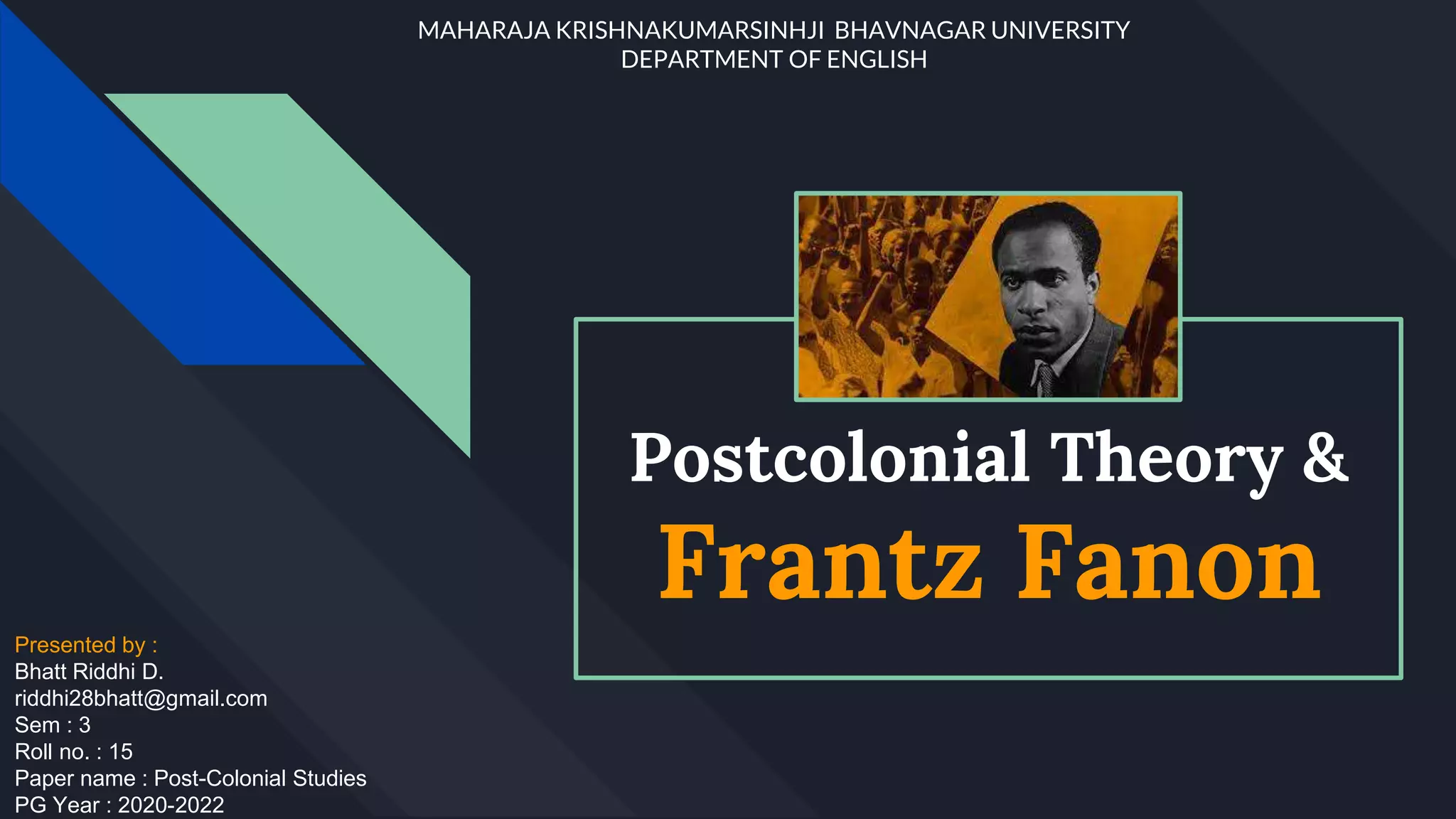
Postcolonial Theory &
FrantzFanon
Presented by :
Bhatt Riddhi D.
riddhi28bhatt@gmail.com
Sem : 3
Roll no. : 15
Paper name : Post-Colonial Studies
PG Year : 2020-2022
MAHARAJA KRISHNAKUMARSINHJI BHAVNAGAR UNIVERSITY
DEPARTMENT OF ENGLISH
2.
Key Objectives
● TheLife of Frantz Fanon: A Brief Sketch
● Postcolonial Theory and Fanon
● The Sociological and Scientific Analysis of Colonialism
3.
The Life ofFrantz Fanon: A Brief Sketch
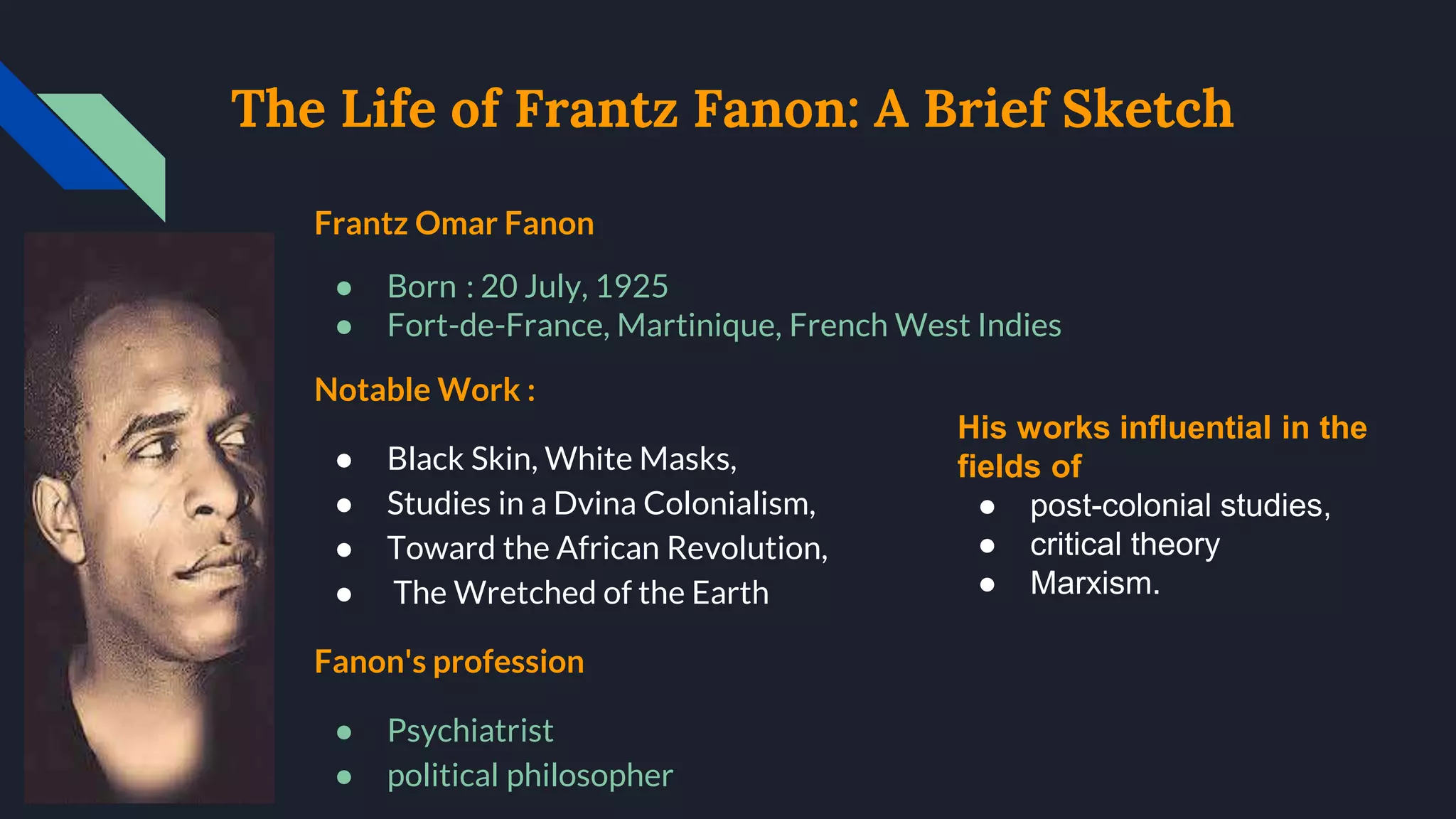
Frantz Omar Fanon
● Born : 20 July, 1925
● Fort-de-France, Martinique, French West Indies
Notable Work :
● Black Skin, White Masks,
● Studies in a Dvina Colonialism,
● Toward the African Revolution,
● The Wretched of the Earth
Fanon's profession
● Psychiatrist
● political philosopher
His works influential in the
fields of
● post-colonial studies,
● critical theory
● Marxism.
4.
Postcolonial Theory andFanon
● Fanon thus develops a psychoanalytical theory of postcolonialism where he
suggests that the European “Self” develops in its relation and encounter with the
“Other.”
● Fanon was the first writer to diagnose colonialism and its destructive impacts in
quite honest, and in the right perspective.
● Fanon's conviction that the mastery of a language, even the colonizer's language,
is a source of immense power, and how effectively he has appropriated the
colonizer's language for his radically 'subversive textuality' of anticolonialism.
● The fact that Fanon had no forerunners when one takes into consideration his
theory of authentic decolonization.
● For, Fanon's theory of decolonization examines all spheres of human life,
including its literary and cultural aspects. This chapter substantiates in
unmistakable terms that Fanon was the prime exponent of authentic
postcolonial theory (and not Edward Said, as Leela Gandhi claims in her
Postcolonial Theory ),
5.
According to LeelaGandhi :
"postcoloniality derives its genealogy from both the narratives".
Fanon's fight was not against the mere "epistemological violence of
the colonial encounter"but, by and large, against the socio-political
and economic pillage of the colonizers against the colonized. What is
more, instead of speaking for a "very limited constituency"
(Postcolonial Theory 22)
6.
The Wretched ofthe Earth
● One could describe the book as one of the foremost
classics of postcolonial political and literary theory
● Fanon propounded idea of a national literature and a
national culture, recognising the significance of
cultural nationalism, leading to national
consciousness.
● Fanon believed that such a national culture must take
recourse to the African myths and cultural practices.
(1961)
7.
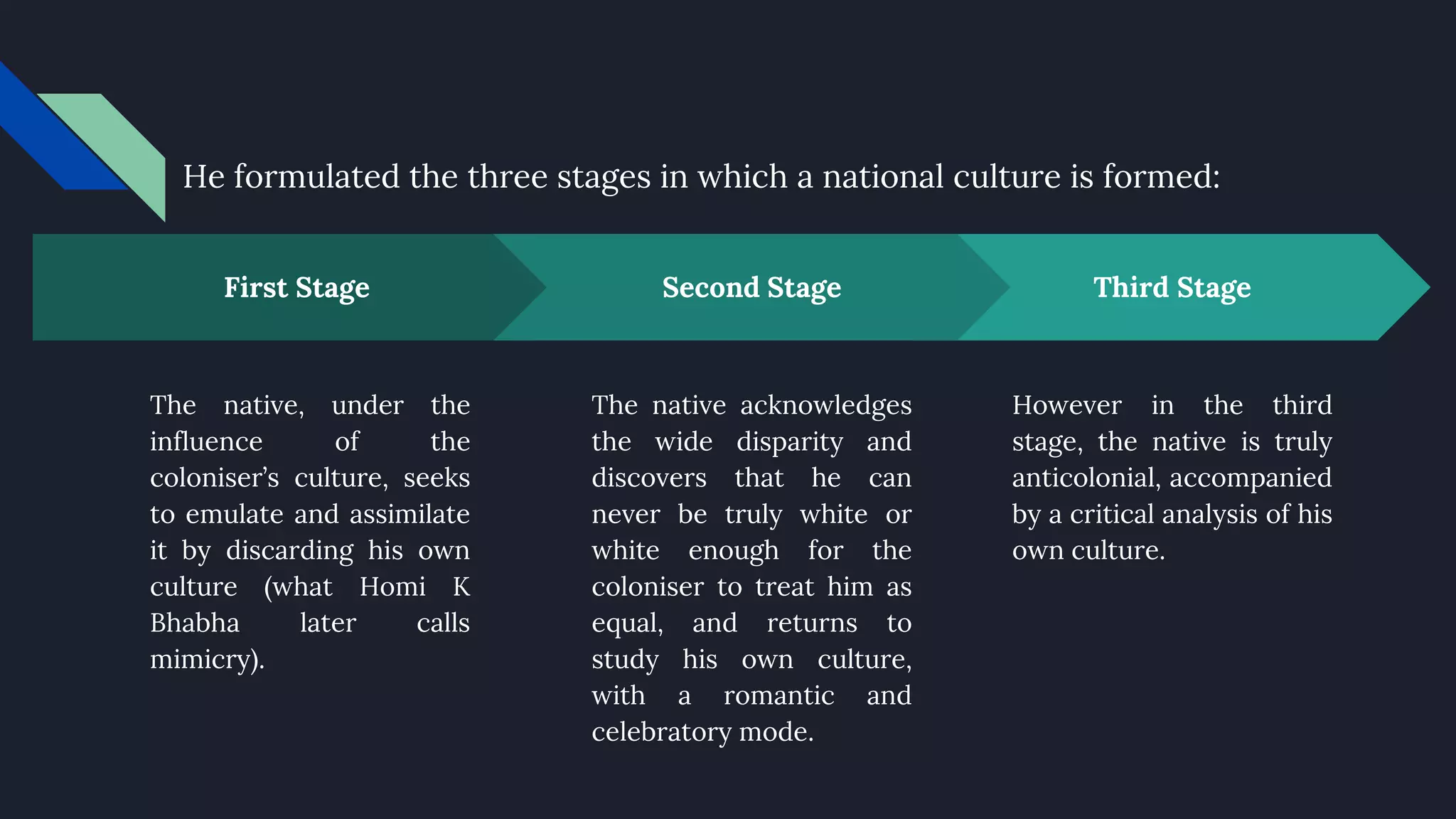
Third Stage
However inthe third
stage, the native is truly
anticolonial, accompanied
by a critical analysis of his
own culture.
First Stage
The native, under the
influence of the
coloniser’s culture, seeks
to emulate and assimilate
it by discarding his own
culture (what Homi K
Bhabha later calls
mimicry).
Second Stage
The native acknowledges
the wide disparity and
discovers that he can
never be truly white or
white enough for the
coloniser to treat him as
equal, and returns to
study his own culture,
with a romantic and
celebratory mode.
He formulated the three stages in which a national culture is formed:
8.
One Example inIndia
● The Indian Police Act which even now guides and formulates the policies
of our police force, was enacted in 1861. The administration of the Indian
criminal law is governed by the Indian Penal Code and the Indian Criminal
Procedure Code, which were passed in 1860 and 1898 respectively. The
much acclaimed Indian Evidence Act was promulgated in 1885.
Therefore, as S. S. Gill observes,
'The fact that India is still governed by a legal system conceived and
formulated in the colonial era, and most of it in the nineteenth century,
shows that this country is even today ruled by the colonial ethos of that
period*
(Dynasty 72).
9.
The Sociological andScientific Analysis of
Colonialism
● Fanon believed that the struggle of the colonized all over the world
has a common nature. He begins his analysis of colonialism
emphasizing the fact that
"man is constantly a challenge to himself" (TAR 3).
● A person who adopts a very passive attitude to the developments
taking place around him/her is contributing to an
"impoverishment of human reality" (TAR 3).
● Three 'popular' theses of his times
(Toward the African Revolution)
(1964)
10.
➔ The firstthesis is that the behaviour of the North African often
causes a medical staff to have misgivings as to the reality of his
illness.
➔ As "the past for him is a burning past" (TAR 41, the North African
never tries to speak about the past symptoms of the disease when
the doctor questions him.
➔ The doctor has to make a "diagnosis of probability", and, in turn,
he proposes "an approximate therapy" (TAR 5). The patient has a
strong feeling that it is because he is an Arab that the doctor does
not treat him like others.
11.
➔ The secondthesis is that the North African does not come with a
substratum, common to his race, but a foundation built by the
European (pre-existing framework).
➔ The cardinal feature of the North African symptom is that the
North African fancies himself/herself to be ill, and so, the Arab is a
pseudo-invalid.
➔ Every Arab is a person who suffers from 'an imaginary ailment'.
12.
● The thirdthesis concerns with the necessity of making a situational
diagnosis. The doctor who treats a patient (especially a North African),
has to find out the patient's relationship with his/her associates,
occupations and preoccupations, sexuality, sense of security or
insecurity, the dangers that threaten him/her, etc.
● In other words, one must make a situational diagnosis. Fanon
responds to this thesis citing all the limitations of the North African
patient. As the patient is alone, helshe has no associates. The patient
busies himselflherself looking for work; the patient has no occupation.
The word 'preoccupation' does not exist at all in the North African's
language.
● The North African's sexuality means 'rape' and prostitution'. Above all
the North African is in a perpetual state of insecurity "a
multisegmented insecurity", as Fanon calls it (TAR 12).
13.
● While speakingof security, Fanon remarks that
"threatened in his affectivity, threatened in his social activity,
threatened in his membership in the community - the North
African combines all the conditions that make a sick man"
(TAR 13).
● In short, the North African leads a death-in-life existence.
14.
Let Us SumUp
● Fanon and his work are very important to see in Post-colonial theory and
● The magnitude of the issues discussed in the presentation drives home
the relevance today of Fanon's surgical diagnosis of colonialism and his
subsequent prescription for the ailments of this world at large - his
concept of authentic decolonization and the vision of an egalitarian global
community.
● This study has further underscored the necessity of the politically
conscious people of the entire world shedding their complacency, and
organizing themselves to do everything possible to mould an ideal world
in which there will be no oppression, no inequality, no poverty, and no
hunger
Is it relevant or helpful today ?
15.
References
● C, Rajan.“The Impact of Frantz Fanon on Contemporary Writing and Politics.”
Shodhganga : a Reservoir of Indian Theses @ INFLIBNET, 7 July 2006,
http://hdl.handle.net/10603/20753.
● Fanon, Frantz.The Wretched of the Earth. Trans. Constance Farrington.
Harmondsworth: Penguin, 1967
● Fanon, Frantz .Toward the African Revolution. Trans. Haakon Chevalier. New
York: Monthly Review Press, 1967
● Gandhi, Leela. Postcolonial Theory: A Critical Introduction. Edinburgh: Edinburgh
University Press, 1998
● Mambrol, Nasrullah. “Frantz Fanon ‘s Contribution to Postcolonial Criticism.”
Literary Theory and Criticism, https://literariness.org/2016/04/07/frantz-
fanon-s-contribution-to-postcolonial-criticism/.
● Peterson, Charles. "Frantz Fanon". Encyclopedia Britannica, 16 Jul. 2021,
https://www.britannica.com/biography/Frantz-Fanon. Accessed 17 October
2021.







![SW critical seminar 3 fanon[1]](https://cdn.slidesharecdn.com/ss_thumbnails/swiv-critical-sw-seminar-3-fanon1-1273647141-phpapp02-thumbnail.jpg?width=640&height=640&fit=bounds)


