Historical Trends in Deep Learning
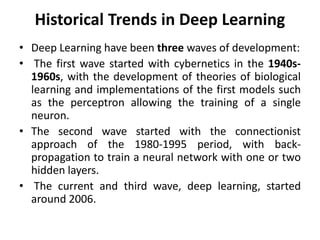
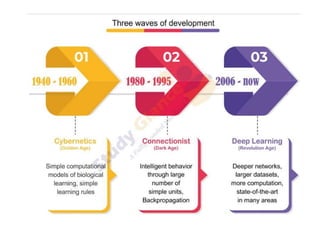
• Deep Learning have been three waves of development:
• The first wave started with cybernetics in the 1940s-
1960s, with the development of theories of biological
learning and implementations of the first models such
as the perceptron allowing the training of a single
neuron.
• The second wave started with the connectionist
approach of the 1980-1995 period, with back-
propagation to train a neural network with one or two
hidden layers.
• The current and third wave, deep learning, started
around 2006.
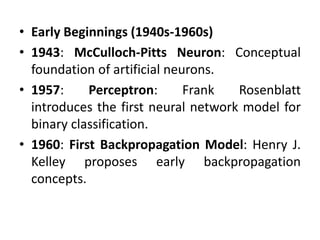
• Early Beginnings (1940s-1960s)
• 1943: McCulloch-Pitts Neuron: Conceptual
foundation of artificial neurons.
• 1957: Perceptron: Frank Rosenblatt
introduces the first neural network model for
binary classification.
• 1960: First Backpropagation Model: Henry J.
Kelley proposes early backpropagation
concepts.
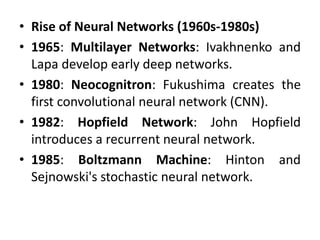
• Rise of Neural Networks (1960s-1980s)
• 1965: Multilayer Networks: Ivakhnenko and
Lapa develop early deep networks.
• 1980: Neocognitron: Fukushima creates the
first convolutional neural network (CNN).
• 1982: Hopfield Network: John Hopfield
introduces a recurrent neural network.
• 1985: Boltzmann Machine: Hinton and
Sejnowski's stochastic neural network.
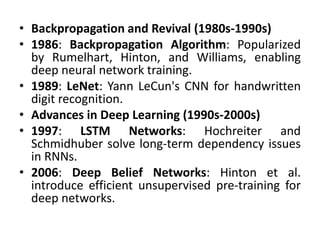
• Backpropagation and Revival (1980s-1990s)
• 1986: Backpropagation Algorithm: Popularized
by Rumelhart, Hinton, and Williams, enabling
deep neural network training.
• 1989: LeNet: Yann LeCun's CNN for handwritten
digit recognition.
• Advances in Deep Learning (1990s-2000s)
• 1997: LSTM Networks: Hochreiter and
Schmidhuber solve long-term dependency issues
in RNNs.
• 2006: Deep Belief Networks: Hinton et al.
introduce efficient unsupervised pre-training for
deep networks.
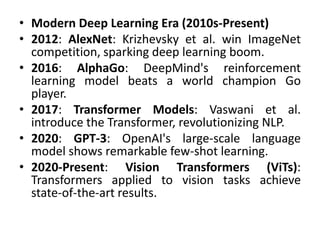
• Modern Deep Learning Era (2010s-Present)
• 2012: AlexNet: Krizhevsky et al. win ImageNet
competition, sparking deep learning boom.
• 2016: AlphaGo: DeepMind's reinforcement
learning model beats a world champion Go
player.
• 2017: Transformer Models: Vaswani et al.
introduce the Transformer, revolutionizing NLP.
• 2020: GPT-3: OpenAI's large-scale language
model shows remarkable few-shot learning.
• 2020-Present: Vision Transformers (ViTs):
Transformers applied to vision tasks achieve
state-of-the-art results.
Historical Trendss in Deep Learning.pptx

Historical Trendss in Deep Learning.pptx

  • 1.
    Historical Trends inDeep Learning • Deep Learning have been three waves of development: • The first wave started with cybernetics in the 1940s- 1960s, with the development of theories of biological learning and implementations of the first models such as the perceptron allowing the training of a single neuron. • The second wave started with the connectionist approach of the 1980-1995 period, with back- propagation to train a neural network with one or two hidden layers. • The current and third wave, deep learning, started around 2006.
  • 3.
    • Early Beginnings(1940s-1960s) • 1943: McCulloch-Pitts Neuron: Conceptual foundation of artificial neurons. • 1957: Perceptron: Frank Rosenblatt introduces the first neural network model for binary classification. • 1960: First Backpropagation Model: Henry J. Kelley proposes early backpropagation concepts.
  • 4.
    • Rise ofNeural Networks (1960s-1980s) • 1965: Multilayer Networks: Ivakhnenko and Lapa develop early deep networks. • 1980: Neocognitron: Fukushima creates the first convolutional neural network (CNN). • 1982: Hopfield Network: John Hopfield introduces a recurrent neural network. • 1985: Boltzmann Machine: Hinton and Sejnowski's stochastic neural network.
  • 5.
    • Backpropagation andRevival (1980s-1990s) • 1986: Backpropagation Algorithm: Popularized by Rumelhart, Hinton, and Williams, enabling deep neural network training. • 1989: LeNet: Yann LeCun's CNN for handwritten digit recognition. • Advances in Deep Learning (1990s-2000s) • 1997: LSTM Networks: Hochreiter and Schmidhuber solve long-term dependency issues in RNNs. • 2006: Deep Belief Networks: Hinton et al. introduce efficient unsupervised pre-training for deep networks.
  • 6.
    • Modern DeepLearning Era (2010s-Present) • 2012: AlexNet: Krizhevsky et al. win ImageNet competition, sparking deep learning boom. • 2016: AlphaGo: DeepMind's reinforcement learning model beats a world champion Go player. • 2017: Transformer Models: Vaswani et al. introduce the Transformer, revolutionizing NLP. • 2020: GPT-3: OpenAI's large-scale language model shows remarkable few-shot learning. • 2020-Present: Vision Transformers (ViTs): Transformers applied to vision tasks achieve state-of-the-art results.