Deep Learning: Towards General
Artificial Intelligence
Dr. Rukshan Batuwita (Machine Learning Scientist)
Senior Data Scientist
Ambiata Pvt Ltd, Sydney, Australia
What is Artificial Intelligence?
• Field of Study to Develop Machines that act
like Humans!
• Recent Definition: Develop Machines that act
rationally!
General AI
• Learning and Reasoning
• Planning
• Adaptability
• Vision
• Speech recognition
• Automation
• Mobility
• etc.
Narrow AI
• Learning and Reasoning
• Planning
• Adaptability
• Vision
• Speech recognition
• Automation
• Mobility
• etc.
• People have been working on for the last 50 years
• This has many applications
Narrow
AI
What is Machine Learning?
• Computer Program: Input to output mapping
Computer Program
(Algorithm/List of
Instructions)
Inputs Outputs
When we know the algorithm to solve a task, then we can program it
?Inputs Outputs
AI Problems:
Ex.
? Cat or Dog
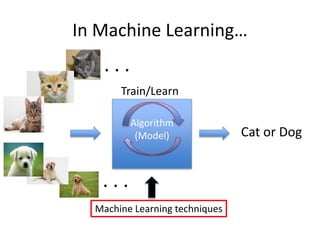
In Machine Learning…
Algorithm
(Model) Cat or Dog
Machine Learning techniques
. . .
. . .
Train/Learn
Introduction to
Artificial Neural
Networks
(Biologically Inspired)
Biological Neurons
Inputs Outputs
Biological Brain Biological Neural Network
Biological Neuron
Processing/Computing
Biological Learning
• Biological Neuron
Learning happens due to some chemical reactions in synaptic connections
A synaptic connection
A typical adult human brain has
about 1014 synapses (connections)
Artificial Neuron
• A computational model
Y
y = f ( wj xj
j=1
d
å )
• Called ‘Perceptron’
• Introduced in 1960’s
• Weights can be learned by an optimization method
like Gradient Descent
Weights (represent
chemicals)
Inputs
Outputs
Processing
/Computing
Inputs
Inputs
Perceptron
Perceptron = Linear Regression
Perceptron = Logistic Regression
Activation Functions:
Y
y = f ( wj xj
j=1
d
å )
Artificial Neural Network
weights
weights
• Artificial Neurons are corrected together to form a network
• Called Multi Layer Perceptron (MLP)
• A Non-linear model of the parameters
• Trained by popular Backpropagation (Gradient Descent)
Backpropagation – Main Idea
1. Calculate Error/Loss = f(Label , Prediction)
2. Calculate Gradient/Derivative of the Loss w.r.t. each weight
3. In order to calculate the gradient of the inner weights,
apply the chain rule of derivatives
4. Update each weight in the direction of the negative gradient (Gradient
Descent)
Error = f(label, prediction)
Evolution of Neural
Networks
• Quite popular in 1980’s and 1990’s
• Worked well for some pattern recognition
problems:
– Ex: Handwritten digit recognition Le-Net
used by US postal department
• Other ML methods (ex. Kernel methods such as
SVMs) dominated ANNs in early 2000’s
• Main problems of ANNs:
– Local-minima (since the loss function is non-convex)
– Difficult to train networks with more then 3/4 layers
• Overfitting
• Computational time
• Vanishing Gradient problem (e.g. when Sigmoid
activation is used)
• (didn’t work well in more complex problems like general
image classification)
Before 2006…
(LeCun et al., 1998)
Yan LeCun, NYU
Geoff Hinton,
Uni Torento
Yoshua Bengio,
Uni Montreal
After 2006…
• Several major breakthroughs happened giving birth to
Deep Learning
• In general, Deep Learning is nothing but good old
Neural Networks with many layers:
…
N
…
• Deep Learning methods have been significantly
outperforming the existing methods in major Computer
Vision and Speech Recognition competitions since 2010
ImageNet Results…
About 14M images of 100k categories/concepts
Main Advancements
made Deep Learning
possible
1. Unsupervised Feature Learning
• In classical Machine Learning:
Feature ExtractionRaw Data Feature pre-
processing
Model Learning
80%-90% of the effort (Human effort)
• In Deep Learning:
Feature LearningRaw Data Model Learning
Deep Learning
+
Model
Model
Feature Learning = Representation Learning = Embedding Learning
Feature Learning/Representation Learning
(Ex. Face Detection)
Layer 1
(Detects Edges)
Layer 2
(Detects Face parts
Combination of edges)
Deeper layer
(Detects Faces)
Input
Pixels
InputPixels
Techniques for Representation
Learning
1. Layer-wise unsupervised pre-training
1. Stacked Autoencoders
Input Output
Encode Decode
Edge Detectors
Autoencoder
• No labels required
• Unsupervised Training
Pixelinput
Pixeloutput
Stacked Autoencoders
1. Train one layer autoencoder at a time [unsupervised learning] and stack
them
2. Then train the final network using the available labels [supervised learning]
Low level features
Higher level features
INPUT LABEL
Techniques for Representation
Learning
Input
1. Layer-wise unsupervised pre-training
2. Deep Belief Networks (Restricted Boltzmann
MMachines (RBM) are stacked together)
Techniques for Representation
Learning
Techniques for Representation
Learning
2. Deep Convolution Networks
Convolution Filters
Kernel/convolution matrix/mask/filter
Edge Detector
X_1 … …
… … …
… … X_9
W_1 … …
… … …
… … W_9
zi = xiwi
i=1
9
å
X
3x3 Image patch
Z
CONV( ),
Techniques for feature learning
2. Deep Convolution Networks
Feature Extraction Classification
• Convolutional Filters (low-level and high-level) are also learned automatically with Backprop
Subsampling = average, max (max pooling) - noise reduction
Different types of filters result in
different feature maps
Techniques for feature learning
2. Deep Convolution Networks
Inputlayer
W_1
x1
x1 x2
x3 x4
W_2
W_3
W_4
x5
x6
x2
x3
x4
x5
x6
W_1
W_2
W_3
W_4
… … …
…
…
…
W_1 W_2
W_3 W_4
2X2 filter
x5
x6
… … …
…
…
…
W_1 W_2
W_3 W_4
x1
x3
… … …
…
…
…
W_1 W_2
W_3 W_4
• Each layer is represented by connected neurons
• Each convolution layer is connected to the previous layers sparsely and with shared weights
Techniques for feature learning
2. Deep Convolution Networks
• Convolution and Subsampling (Pooling) leads to detect translational invariance features
• Works with language (document classification, translation) and Voice recognition
Motivations for
Feature/Representation/Embeddin
g Learning
Motivations for
Feature/Representation learning
1. Cut down the effort of handcrafting features
2. Hierarchical, distributed, compositional knowledge
representations in Brain
– Humans organize their concepts and ideas hierarchically
– Humans first learn simple concepts and compose them
together to represent complex ideas
– Human problem solving/Engineering (multiple level of
abstractions)
– Human language understanding
– Pattern recognition in brain, etc.
Motivations for
Feature/Representation learning
• Hierarchical, distributed, compositional
knowledge representation/pattern recognition
in Brain
Pattern Recognition in Brain Pattern Recognition
In Deep Learning
Motivations for
Feature/Representation learning
3. Power of distributed, compositional
representations
• Concepts are represented as composition of features
at different levels
• The number of concepts can be represented grow
exponentially with the size of the network
Input
Low-level representations (e.x. edges) High-level representations
Motivations for
Feature/Representation learning
4. Manifold Learning
• Assumption: Input data has some structure (not 100%
random) which is concentrated in a lower-dimensional
manifold of the original features
• Ex: most of the arbitrary pixel value configurations don’t create
the images of faces
• Representation in each layer can be considered as a
learned manifold of the previous layer
28!
F or AI T a sk s: Ma n i f ol d st r uct ur e
• examples!concentrate!near!a!lower!dimensional!“manifold!
• Evidence:$most$input$configuraDons$are$unlikely$
Pixels (32*32 image)
E.x.
Motivations for
Feature/Representation learning
5. Transfer Learning
– Generalization: ability of a model to predict well on
unseen test data
– Representation of complex concepts -> Deep
Networks
– Good generalization of complex models like Deep
Neural Networks rely on the availability of large
number of labeled training data
– Most of the available data are not labeled
– In Transfer Learning
1. Train a Deep Network with unlabeled data in unsupervised
manner
2. Use the available labeled data to train the required model
Motivations for
Feature/Representation learning
5. Transfer Learning
Example: Image recognition model
. . .
Unsupervised
pre-training with unlabeled data
to learn the representations of
different levels of abstraction
Transfer the
knowledge
car
Supervised Learning with
available labeled data
...
Hu
man
Variations of Transfer Learning
• Multi-Instance Learning (when labels are not
available at the instance level)
Document Classification Model
Based on the similarity of the sentence/word
embedding [Kotzias, Denil and deFreitas, 2014]
Variations of Transfer Learning
• Max-margin Learning without labels
[From machine learning to machine reasoning, Leon Bottou, 2014]
Variations of Transfer Learning
• Max-margin Learning without labels
[NLP almost from scratch, Ronan Collobert et al., 2011]
Other advancements
made Deep Learning
possible
Other advancements…
• ‘Dropouts’ regularization for training with
Backpropagation for higher generalization
• Rectified Linear Functions instead of Sigmoid
(avoid vanishing gradient problem)
Other architectures…
• Memory Networks (LSTM)
– Question answering
• Recurrent Networks
– Detecting inputs with sequential relationships
(voice recognition)
• Combination of existing architectures
Improved Computing Power…
GPU Computation
– Parallel Neural Network Training on GPU clusters
(ideal for simple Matrix/Vector operations, hence for
backpropagation)
– Reduced the training time of deep networks from
weeks to days
– NVIDIA CUDA Deep Neural Network library
Improved Computing Power…
• Commodity Hardware
– Multi-core single machines, clusters, GUP clusters
• Open source software
– Torch (open source ML library,
https://github.com/torch/torch7/)
– From Yoshua Bengio’s group
http://deeplearning.net/software/theano/)
– Caffe
– Google TensorFlow
Industrial Applications of
Deep Learning
Techniques
Google Brain Project
– Started by Andrew Ng in 2011
– In 2012: Neural Network with 1 Billion connection
was trained across 16,000 CPU cores
– They considered this ANN as simulating a very small-
scale “newborn brain,” and show it YouTube video
for a week, what will it learn?
– Used an Unsupervised (Self-taught-learning) to learn
features from unlabeled Google images –
Autoencoder
– Exposed to fames of 10M YouTube videos over a
week
http://googleblog.blogspot.com.au/2012/06/using-large-scale-brain-simulations-for.html
http://static.googleusercontent.com/media/research.google.com/en//archive/unsupervised_icml2012.pdf
Andrew Ng,
Standford
Google Brain Project
What Happened?
• One of the artificial neurons learned to respond strongly
to pictures of Cats.
Evolution of Deep Leaning at Google
– Google has been heavily investing on Deep
Learning research
– In 2013 Google hired Geoff Hinton and acquired
his start-up company DNNResearch Inc.
– In 2014 they purchased a UK-based Machine
Learning company called DeepMind Technologies
for estimated $650 Million
Deep Mind
Apollo Program for AI
Working towards solving General AI with
Deep Reinforcement Learning….
DeepMind
• Famous paper: Applying Deep RL to train agents to play classic Atari games
DeepMind Video
• https://www.youtube.com/watch?v=V1eYniJ0
Rnk
AlphaGo
• Traditional Chinese game - Go
• The most complex board game of all
• Alpha Go beat the world champion in Go 4/5
Lee Sedol
Deep Dream
(http://deepdreamgenerator.com)
• What features will be picked up by Google’s
Deep ANNs?
Deep ANN
Original
Image
Original
Image + Recognized
Features
Google Voice Recognition (in Android and Search by Voice)
Deep Learning Products at Google
Google search by Image
(Search for similar images to an uploaded
image)
Facebook
• Yann Lecun is the head of Facebook AI Research
• Face Recognition: Deep Face
• claim to have close to human-level performance
• Personal Assistant:
Facebook M
Other…
• Microsoft Cortana, Skype Translate
• Nvida Self Driving Cars
• Image Captioning Systems
• Siemens Medical Image Diagnostics
Deep Learning in Robotics
• Computer Vision, Speech Recognition and NLP
are direct applications in Robotics
• Training Robots to do specific tasks through
Deep Learning
– At UC Berkley: Train robot to perform tasks via
trial and error (e.x. screw a cap into water bottle)
Deep Learning in Robotics
• At Cornell: Deep Learning for detecting
Robotic Grasps (using Baxter)
Deep Learning for Detecting Robotic Grasps, Ian Lenz, Honglak Lee, Ashutosh Saxena. To
appear in International Journal of Robotics Research (IJRR), 2014.
http://pr.cs.cornell.edu/deepgrasping/
Challenges
• So far worked only in Patter-recognition
domains where there is good structural
patterns in the input data (Vision, Voice,
Language)
• With other kind of datasets (finance,
marketing, human behavior, biology), there
are not any known applications
Resources
Yann Lecun,
NYU, Facebook AI Research
Geoff Hinton,
Uni Torento, Google
Yoshua Bengio,
Uni Montreal
Andrew Ng,
Standford, Baidu Nando De Freitas,
Oxford, Deepmind
Key players for talks, lectures, papers, tutorials,
datasets, etc.
Thank you!

Deep Learning: Towards General Artificial Intelligence

  • 1.
    Deep Learning: TowardsGeneral Artificial Intelligence Dr. Rukshan Batuwita (Machine Learning Scientist) Senior Data Scientist Ambiata Pvt Ltd, Sydney, Australia
  • 2.
    What is ArtificialIntelligence? • Field of Study to Develop Machines that act like Humans! • Recent Definition: Develop Machines that act rationally!
  • 3.
    General AI • Learningand Reasoning • Planning • Adaptability • Vision • Speech recognition • Automation • Mobility • etc.
  • 4.
    Narrow AI • Learningand Reasoning • Planning • Adaptability • Vision • Speech recognition • Automation • Mobility • etc. • People have been working on for the last 50 years • This has many applications Narrow AI
  • 5.
    What is MachineLearning? • Computer Program: Input to output mapping Computer Program (Algorithm/List of Instructions) Inputs Outputs When we know the algorithm to solve a task, then we can program it ?Inputs Outputs AI Problems: Ex. ? Cat or Dog
  • 6.
    In Machine Learning… Algorithm (Model)Cat or Dog Machine Learning techniques . . . . . . Train/Learn
  • 7.
  • 8.
    Biological Neurons Inputs Outputs BiologicalBrain Biological Neural Network Biological Neuron Processing/Computing
  • 9.
    Biological Learning • BiologicalNeuron Learning happens due to some chemical reactions in synaptic connections A synaptic connection A typical adult human brain has about 1014 synapses (connections)
  • 10.
    Artificial Neuron • Acomputational model Y y = f ( wj xj j=1 d å ) • Called ‘Perceptron’ • Introduced in 1960’s • Weights can be learned by an optimization method like Gradient Descent Weights (represent chemicals) Inputs Outputs Processing /Computing Inputs Inputs
  • 11.
    Perceptron Perceptron = LinearRegression Perceptron = Logistic Regression Activation Functions: Y y = f ( wj xj j=1 d å )
  • 12.
    Artificial Neural Network weights weights •Artificial Neurons are corrected together to form a network • Called Multi Layer Perceptron (MLP) • A Non-linear model of the parameters • Trained by popular Backpropagation (Gradient Descent)
  • 13.
    Backpropagation – MainIdea 1. Calculate Error/Loss = f(Label , Prediction) 2. Calculate Gradient/Derivative of the Loss w.r.t. each weight 3. In order to calculate the gradient of the inner weights, apply the chain rule of derivatives 4. Update each weight in the direction of the negative gradient (Gradient Descent) Error = f(label, prediction)
  • 14.
  • 15.
    • Quite popularin 1980’s and 1990’s • Worked well for some pattern recognition problems: – Ex: Handwritten digit recognition Le-Net used by US postal department • Other ML methods (ex. Kernel methods such as SVMs) dominated ANNs in early 2000’s • Main problems of ANNs: – Local-minima (since the loss function is non-convex) – Difficult to train networks with more then 3/4 layers • Overfitting • Computational time • Vanishing Gradient problem (e.g. when Sigmoid activation is used) • (didn’t work well in more complex problems like general image classification) Before 2006… (LeCun et al., 1998) Yan LeCun, NYU Geoff Hinton, Uni Torento Yoshua Bengio, Uni Montreal
  • 16.
    After 2006… • Severalmajor breakthroughs happened giving birth to Deep Learning • In general, Deep Learning is nothing but good old Neural Networks with many layers: … N … • Deep Learning methods have been significantly outperforming the existing methods in major Computer Vision and Speech Recognition competitions since 2010
  • 17.
    ImageNet Results… About 14Mimages of 100k categories/concepts
  • 18.
    Main Advancements made DeepLearning possible
  • 19.
    1. Unsupervised FeatureLearning • In classical Machine Learning: Feature ExtractionRaw Data Feature pre- processing Model Learning 80%-90% of the effort (Human effort) • In Deep Learning: Feature LearningRaw Data Model Learning Deep Learning + Model Model Feature Learning = Representation Learning = Embedding Learning
  • 20.
    Feature Learning/Representation Learning (Ex.Face Detection) Layer 1 (Detects Edges) Layer 2 (Detects Face parts Combination of edges) Deeper layer (Detects Faces) Input Pixels InputPixels
  • 21.
    Techniques for Representation Learning 1.Layer-wise unsupervised pre-training 1. Stacked Autoencoders Input Output Encode Decode Edge Detectors Autoencoder • No labels required • Unsupervised Training Pixelinput Pixeloutput
  • 22.
    Stacked Autoencoders 1. Trainone layer autoencoder at a time [unsupervised learning] and stack them 2. Then train the final network using the available labels [supervised learning] Low level features Higher level features Higher level features INPUT LABEL Techniques for Representation Learning Input
  • 23.
    1. Layer-wise unsupervisedpre-training 2. Deep Belief Networks (Restricted Boltzmann MMachines (RBM) are stacked together) Techniques for Representation Learning
  • 24.
    Techniques for Representation Learning 2.Deep Convolution Networks Convolution Filters Kernel/convolution matrix/mask/filter Edge Detector X_1 … … … … … … … X_9 W_1 … … … … … … … W_9 zi = xiwi i=1 9 å X 3x3 Image patch Z CONV( ),
  • 25.
    Techniques for featurelearning 2. Deep Convolution Networks Feature Extraction Classification • Convolutional Filters (low-level and high-level) are also learned automatically with Backprop Subsampling = average, max (max pooling) - noise reduction Different types of filters result in different feature maps
  • 26.
    Techniques for featurelearning 2. Deep Convolution Networks Inputlayer W_1 x1 x1 x2 x3 x4 W_2 W_3 W_4 x5 x6 x2 x3 x4 x5 x6 W_1 W_2 W_3 W_4 … … … … … … W_1 W_2 W_3 W_4 2X2 filter x5 x6 … … … … … … W_1 W_2 W_3 W_4 x1 x3 … … … … … … W_1 W_2 W_3 W_4 • Each layer is represented by connected neurons • Each convolution layer is connected to the previous layers sparsely and with shared weights
  • 27.
    Techniques for featurelearning 2. Deep Convolution Networks • Convolution and Subsampling (Pooling) leads to detect translational invariance features • Works with language (document classification, translation) and Voice recognition
  • 28.
  • 29.
    Motivations for Feature/Representation learning 1.Cut down the effort of handcrafting features 2. Hierarchical, distributed, compositional knowledge representations in Brain – Humans organize their concepts and ideas hierarchically – Humans first learn simple concepts and compose them together to represent complex ideas – Human problem solving/Engineering (multiple level of abstractions) – Human language understanding – Pattern recognition in brain, etc.
  • 30.
    Motivations for Feature/Representation learning •Hierarchical, distributed, compositional knowledge representation/pattern recognition in Brain Pattern Recognition in Brain Pattern Recognition In Deep Learning
  • 31.
    Motivations for Feature/Representation learning 3.Power of distributed, compositional representations • Concepts are represented as composition of features at different levels • The number of concepts can be represented grow exponentially with the size of the network Input Low-level representations (e.x. edges) High-level representations
  • 32.
    Motivations for Feature/Representation learning 4.Manifold Learning • Assumption: Input data has some structure (not 100% random) which is concentrated in a lower-dimensional manifold of the original features • Ex: most of the arbitrary pixel value configurations don’t create the images of faces • Representation in each layer can be considered as a learned manifold of the previous layer 28! F or AI T a sk s: Ma n i f ol d st r uct ur e • examples!concentrate!near!a!lower!dimensional!“manifold! • Evidence:$most$input$configuraDons$are$unlikely$ Pixels (32*32 image) E.x.
  • 33.
    Motivations for Feature/Representation learning 5.Transfer Learning – Generalization: ability of a model to predict well on unseen test data – Representation of complex concepts -> Deep Networks – Good generalization of complex models like Deep Neural Networks rely on the availability of large number of labeled training data – Most of the available data are not labeled – In Transfer Learning 1. Train a Deep Network with unlabeled data in unsupervised manner 2. Use the available labeled data to train the required model
  • 34.
    Motivations for Feature/Representation learning 5.Transfer Learning Example: Image recognition model . . . Unsupervised pre-training with unlabeled data to learn the representations of different levels of abstraction Transfer the knowledge car Supervised Learning with available labeled data ... Hu man
  • 35.
    Variations of TransferLearning • Multi-Instance Learning (when labels are not available at the instance level) Document Classification Model Based on the similarity of the sentence/word embedding [Kotzias, Denil and deFreitas, 2014]
  • 36.
    Variations of TransferLearning • Max-margin Learning without labels [From machine learning to machine reasoning, Leon Bottou, 2014]
  • 37.
    Variations of TransferLearning • Max-margin Learning without labels [NLP almost from scratch, Ronan Collobert et al., 2011]
  • 38.
  • 39.
    Other advancements… • ‘Dropouts’regularization for training with Backpropagation for higher generalization • Rectified Linear Functions instead of Sigmoid (avoid vanishing gradient problem)
  • 40.
    Other architectures… • MemoryNetworks (LSTM) – Question answering • Recurrent Networks – Detecting inputs with sequential relationships (voice recognition) • Combination of existing architectures
  • 41.
    Improved Computing Power… GPUComputation – Parallel Neural Network Training on GPU clusters (ideal for simple Matrix/Vector operations, hence for backpropagation) – Reduced the training time of deep networks from weeks to days – NVIDIA CUDA Deep Neural Network library
  • 42.
    Improved Computing Power… •Commodity Hardware – Multi-core single machines, clusters, GUP clusters • Open source software – Torch (open source ML library, https://github.com/torch/torch7/) – From Yoshua Bengio’s group http://deeplearning.net/software/theano/) – Caffe – Google TensorFlow
  • 43.
  • 44.
    Google Brain Project –Started by Andrew Ng in 2011 – In 2012: Neural Network with 1 Billion connection was trained across 16,000 CPU cores – They considered this ANN as simulating a very small- scale “newborn brain,” and show it YouTube video for a week, what will it learn? – Used an Unsupervised (Self-taught-learning) to learn features from unlabeled Google images – Autoencoder – Exposed to fames of 10M YouTube videos over a week http://googleblog.blogspot.com.au/2012/06/using-large-scale-brain-simulations-for.html http://static.googleusercontent.com/media/research.google.com/en//archive/unsupervised_icml2012.pdf Andrew Ng, Standford
  • 45.
    Google Brain Project WhatHappened? • One of the artificial neurons learned to respond strongly to pictures of Cats.
  • 46.
    Evolution of DeepLeaning at Google – Google has been heavily investing on Deep Learning research – In 2013 Google hired Geoff Hinton and acquired his start-up company DNNResearch Inc. – In 2014 they purchased a UK-based Machine Learning company called DeepMind Technologies for estimated $650 Million
  • 47.
    Deep Mind Apollo Programfor AI Working towards solving General AI with Deep Reinforcement Learning….
  • 48.
    DeepMind • Famous paper:Applying Deep RL to train agents to play classic Atari games
  • 49.
  • 50.
    AlphaGo • Traditional Chinesegame - Go • The most complex board game of all • Alpha Go beat the world champion in Go 4/5 Lee Sedol
  • 51.
    Deep Dream (http://deepdreamgenerator.com) • Whatfeatures will be picked up by Google’s Deep ANNs? Deep ANN Original Image Original Image + Recognized Features
  • 52.
    Google Voice Recognition(in Android and Search by Voice) Deep Learning Products at Google Google search by Image (Search for similar images to an uploaded image)
  • 53.
    Facebook • Yann Lecunis the head of Facebook AI Research • Face Recognition: Deep Face • claim to have close to human-level performance • Personal Assistant: Facebook M
  • 54.
    Other… • Microsoft Cortana,Skype Translate • Nvida Self Driving Cars • Image Captioning Systems • Siemens Medical Image Diagnostics
  • 55.
    Deep Learning inRobotics • Computer Vision, Speech Recognition and NLP are direct applications in Robotics • Training Robots to do specific tasks through Deep Learning – At UC Berkley: Train robot to perform tasks via trial and error (e.x. screw a cap into water bottle)
  • 56.
    Deep Learning inRobotics • At Cornell: Deep Learning for detecting Robotic Grasps (using Baxter) Deep Learning for Detecting Robotic Grasps, Ian Lenz, Honglak Lee, Ashutosh Saxena. To appear in International Journal of Robotics Research (IJRR), 2014. http://pr.cs.cornell.edu/deepgrasping/
  • 57.
    Challenges • So farworked only in Patter-recognition domains where there is good structural patterns in the input data (Vision, Voice, Language) • With other kind of datasets (finance, marketing, human behavior, biology), there are not any known applications
  • 58.
    Resources Yann Lecun, NYU, FacebookAI Research Geoff Hinton, Uni Torento, Google Yoshua Bengio, Uni Montreal Andrew Ng, Standford, Baidu Nando De Freitas, Oxford, Deepmind Key players for talks, lectures, papers, tutorials, datasets, etc.
  • 59.