Deep Learning Explained: History, Key Components,
Applications, Benefits & Industry Challenges
In an era where artificial intelligence is reshaping industries and redefining
technology, deep learning has become an avant-garde of digital innovation. From
autonomous vehicles to virtual assistants, deep learning algorithms are silently
powering innovations once confined to science fiction. But what is deep learning,
and why has it emerged as such a game changer in the field of AI?
Deep learning, a subset of machine learning, has rapidly evolved from an
academic concept to a technology powering some of the most groundbreaking
advancements. It now plays a foundational role in GenAI development, enabling
generative models that create text, images, and more. With the power to process
vast amounts of data and spot intricate patterns, it has proved invaluable in
industries as diverse as healthcare and finance. However, as deep learning
expands its reach, it also brings a wide range of challenges and ethical issues
that require our attention.
This comprehensive guide will delve into the fascinating world of deep learning,
tracing its history and evolution, exploring its key components, and showcasing
its wide-ranging applications. We’ll examine the benefits that make deep learning
so powerful and the emerging trends shaping its future. Finally, we’ll take on the
remaining industry challenges, offering you a balanced take on this
world-changing technology.
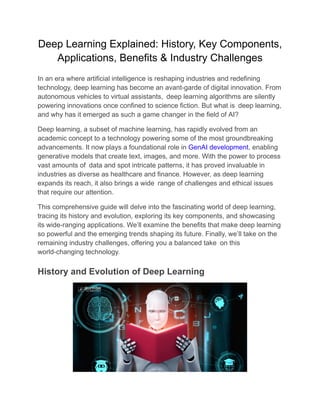
History and Evolution of Deep Learning
Roots in Artificial Neural Networks
The story of deep learning begins with the concept of artificial neural networks
(ANNs), which are directly inspired by the biological neural networks that
constitute human brains. In 1943, Warren McCulloch and Walter Pitts presented
the first mathematical model of a neural network, laying the groundwork for future
developments in the field.
The perceptron, invented by Frank Rosenblatt in 1958, marked a significant
milestone in the evolution of neural networks. This simple algorithm could be
programmed to learn to classify the pattern of linearly separable patterns,
sparking excitement about the potential of machine learning. But the early
enthusiasm was tempered when Marvin Minsky and Seymour Papert’s 1969
book “Perceptrons” pointed out the limitations of single-layer neural networks.
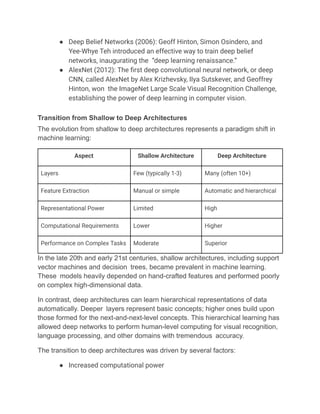
The evolution of deep learning is marked by several important breakthroughs:
●​ Backpropagation Algorithm (1986): The backpropagation introduced
by David Rumelhart, Geoffrey Hinton, and Ronald Williams is
an efficient method for training multi-layer neural networks. This was a
breakthrough that renewed interest in neural networks.
●​ Convolutional Neural Networks (1989): Yann LeCun and colleagues
developed convolutional neural networks (CNNs), which proved highly
effective for image recognition tasks.
●​ Long Short-Term Memory (1997): LSTM networks, proposed by Sepp
Hochreiter and Jürgen Schmidhuber, solved the vanishing gradient
problem of RNNs and allowed for better handling of sequential data.
●​ Deep Belief Networks (2006): Geoff Hinton, Simon Osindero, and
Yee-Whye Teh introduced an effective way to train deep belief
networks, inaugurating the “deep learning renaissance.”
●​ AlexNet (2012): The first deep convolutional neural network, or deep
CNN, called AlexNet by Alex Krizhevsky, Ilya Sutskever, and Geoffrey
Hinton, won the ImageNet Large Scale Visual Recognition Challenge,
establishing the power of deep learning in computer vision.
Transition from Shallow to Deep Architectures
The evolution from shallow to deep architectures represents a paradigm shift in
machine learning:
Aspect Shallow Architecture Deep Architecture
Layers Few (typically 1-3) Many (often 10+)
Feature Extraction Manual or simple Automatic and hierarchical
Representational Power Limited High
Computational Requirements Lower Higher
Performance on Complex Tasks Moderate Superior
In the late 20th and early 21st centuries, shallow architectures, including support
vector machines and decision trees, became prevalent in machine learning.
These models heavily depended on hand-crafted features and performed poorly
on complex high-dimensional data.
In contrast, deep architectures can learn hierarchical representations of data
automatically. Deeper layers represent basic concepts; higher ones build upon
those formed for the next-and-next-level concepts. This hierarchical learning has
allowed deep networks to perform human-level computing for visual recognition,
language processing, and other domains with tremendous accuracy.
The transition to deep architectures was driven by several factors:
●​ Increased computational power
●​ Availability of large-scale datasets
●​ Improved training algorithms
●​ Development of effective regularization techniques
Impact of Increased Computational Power
Deep learning has become possible due to advances in computing power. A few
crucial factors have driven this growth:
●​ Graphics Processing Units (GPUs): GPUs were initially intended for
rendering graphics in video games but have turned out to be effective
for parallelizing large-scale neural network computations. The
introduction of GPGUs for deep learning teaching drastically speeded
up the field.
●​ Distributed Computing: The ability to distribute neural network
training across machines was the key to scaling deep learning models
to unprecedented sizes.
●​ Cloud Computing: Cloud providers have democratized large-scale
computing, which enables researchers and practitioners to train big
models without a dedicated hardware budget.
●​ Specialized Hardware: AI-dedicated hardware development, i.e., Google
TPUs and NVIDIA DGX systems, has caused an advance in the speed
of deep learning computations.
The impact of more computing power on deep learning can be summed up in the
following steps:
●​ 2012: AlexNet proves ImageNet winning accuracy trained on two
GPUs.
●​ 2015: AlphaGo A variation of Google DeepMind used distributed
computing to train AlphaGo, which defeats a professional Go player.
●​ 2018: OpenAI trains GPT-2, a large language model, on a cluster of
thousands of GPUs.
●​ 2020: GPT-3, 175-billion-parameters, is trained using massive
computational resources.
This exponential growth in computing power has allowed researchers to
experiment with more complex model architectures and train on ever bigger
datasets — stretching the limits of what can be achieved with deep learning.
The interplay between algorithmic innovations and hardware advancements has
been crucial. As hardware became more robust, it allowed more sophisticated
algorithms to be implemented.
AI-Driven Entity Extraction System by Jellyfish
Technologies Transforms Document Processing for a
Leading InsurTech Firm
Jellyfish Technologies Developed a Cutting-Edge AI Document Intelligence
Solution, Automating Medicaid Verification with Precision, Compliance, and
Efficiency.
Download Full Case Study
On the other hand, the demand for running these advanced algorithms drove
further hardware development, creating a virtuous cycle of progress.
In addition, higher computational resources enabled the exploration of new lines
of research:
●​ Transfer Learning: The idea of pre-training large models on large
datasets and fine-tuning them on tasks of interest has become a
common practice due to the possibility of training and storing large
models.
●​ Neural Architecture Search: Search for the best neural network
architecture has recently been made possible due to advances in
hardware.
●​ Reinforcement Learning: There are a large number of complex
reinforcement learning algorithms, for which some parameter
optimization processes need/need to run many simulations,
which have exploited the growing computational resources.
●​ Generative Models: Training of complex generative models, e.g., GANs
and VAEs, that usually involve simultaneous optimization of
competing criteria, have been facilitated by strong computer systems.
The evolution of Deep Learning, from traditional artificial neural networks to the
present era of large-scale models and custom hardware, captures the dynamic
landscape of the field. As we push the limits of computing power and algorithmic
innovations, the applications and potentiality of deep learning are growing,
ensuring that AI and machine learning will see more leaps and bounds.
Core Components of Deep Learning
Neural Network Layers
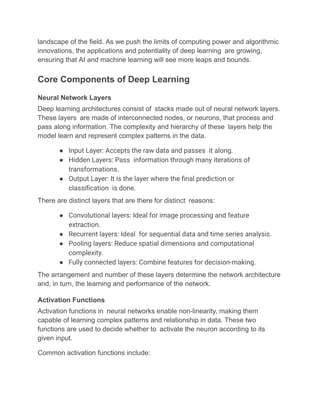
Deep learning architectures consist of stacks made out of neural network layers.
These layers are made of interconnected nodes, or neurons, that process and
pass along information. The complexity and hierarchy of these layers help the
model learn and represent complex patterns in the data.
●​ Input Layer: Accepts the raw data and passes it along.
●​ Hidden Layers: Pass information through many iterations of
transformations.
●​ Output Layer: It is the layer where the final prediction or
classification is done.
There are distinct layers that are there for distinct reasons:
●​ Convolutional layers: Ideal for image processing and feature
extraction.
●​ Recurrent layers: Ideal for sequential data and time series analysis.
●​ Pooling layers: Reduce spatial dimensions and computational
complexity.
●​ Fully connected layers: Combine features for decision-making.
The arrangement and number of these layers determine the network architecture
and, in turn, the learning and performance of the network.
Activation Functions
Activation functions in neural networks enable non-linearity, making them
capable of learning complex patterns and relationship in data. These two
functions are used to decide whether to activate the neuron according to its
given input.
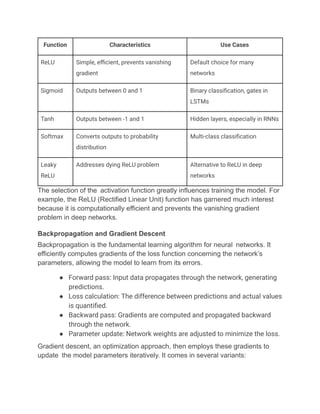
Common activation functions include:
Function Characteristics Use Cases
ReLU Simple, efficient, prevents vanishing
gradient
Default choice for many
networks
Sigmoid Outputs between 0 and 1 Binary classification, gates in
LSTMs
Tanh Outputs between -1 and 1 Hidden layers, especially in RNNs
Softmax Converts outputs to probability
distribution
Multi-class classification
Leaky
ReLU
Addresses dying ReLU problem Alternative to ReLU in deep
networks
The selection of the activation function greatly influences training the model. For
example, the ReLU (Rectified Linear Unit) function has garnered much interest
because it is computationally efficient and prevents the vanishing gradient
problem in deep networks.
Backpropagation and Gradient Descent
Backpropagation is the fundamental learning algorithm for neural networks. It
efficiently computes gradients of the loss function concerning the network’s
parameters, allowing the model to learn from its errors.
●​ Forward pass: Input data propagates through the network, generating
predictions.
●​ Loss calculation: The difference between predictions and actual values
is quantified.
●​ Backward pass: Gradients are computed and propagated backward
through the network.
●​ Parameter update: Network weights are adjusted to minimize the loss.
Gradient descent, an optimization approach, then employs these gradients to
update the model parameters iteratively. It comes in several variants:
●​ Batch Gradient Descent: This updates the model’s parameters by
computing the performance gradients on the whole training dataset.
●​ Stochastic Gradient Descent SGD: Parameters are updated after
every training example.
●​ Mini-batch Gradient Descent: Upgrades parameters by small chunks
of samples.
Such methods trade the computational cost for the updates’ stability,
and mini-batch gradient descent performs, often providing a good compromise.
Optimization Algorithms
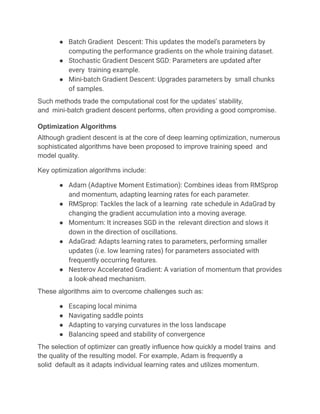
Although gradient descent is at the core of deep learning optimization, numerous
sophisticated algorithms have been proposed to improve training speed and
model quality.
Key optimization algorithms include:
●​ Adam (Adaptive Moment Estimation): Combines ideas from RMSprop
and momentum, adapting learning rates for each parameter.
●​ RMSprop: Tackles the lack of a learning rate schedule in AdaGrad by
changing the gradient accumulation into a moving average.
●​ Momentum: It increases SGD in the relevant direction and slows it
down in the direction of oscillations.
●​ AdaGrad: Adapts learning rates to parameters, performing smaller
updates (i.e. low learning rates) for parameters associated with
frequently occurring features.
●​ Nesterov Accelerated Gradient: A variation of momentum that provides
a look-ahead mechanism.
These algorithms aim to overcome challenges such as:
●​ Escaping local minima
●​ Navigating saddle points
●​ Adapting to varying curvatures in the loss landscape
●​ Balancing speed and stability of convergence
The selection of optimizer can greatly influence how quickly a model trains and
the quality of the resulting model. For example, Adam is frequently a
solid default as it adapts individual learning rates and utilizes momentum.
Curious how deep learning can power your next project?
Talk to our AI experts today and discover how tailored deep learning solutions
can drive smarter, faster results for your business.
Let’s Talk Deep Learning
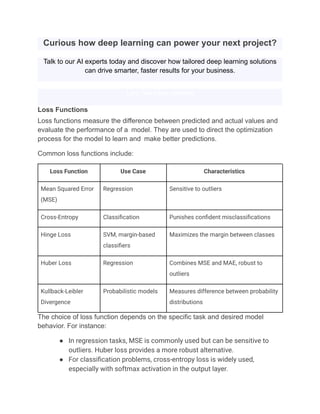
Loss Functions
Loss functions measure the difference between predicted and actual values and
evaluate the performance of a model. They are used to direct the optimization
process for the model to learn and make better predictions.
Common loss functions include:
Loss Function Use Case Characteristics
Mean Squared Error
(MSE)
Regression Sensitive to outliers
Cross-Entropy Classification Punishes confident misclassifications
Hinge Loss SVM, margin-based
classifiers
Maximizes the margin between classes
Huber Loss Regression Combines MSE and MAE, robust to
outliers
Kullback-Leibler
Divergence
Probabilistic models Measures difference between probability
distributions
The choice of loss function depends on the specific task and desired model
behavior. For instance:
●​ In regression tasks, MSE is commonly used but can be sensitive to
outliers. Huber loss provides a more robust alternative.
●​ For classification problems, cross-entropy loss is widely used,
especially with softmax activation in the output layer.
●​ In generative models like VAEs and GANs, specialized loss functions
like KL divergence or adversarial loss are employed.
Understanding the properties of different loss functions is crucial for effective
model design and training. Some loss functions may lead to faster convergence
or better generalization, while others might be more appropriate for handling
imbalanced datasets or specific types of errors.
In conclusion, these core components of deep learning – neural network layers,
activation functions, backpropagation and gradient descent, optimization
algorithms, and loss functions – work in concert to enable the powerful learning
capabilities of deep neural networks. These networks rely heavily on clean
training data, often supported by AI data annotation processes. Their interplay
determines the network’s ability to extract meaningful features, learn complex
patterns, and make accurate predictions across a wide range of applications. As
the field of deep learning continues to evolve, innovations in these components
drive advancements in model architecture, training efficiency, and overall
performance.
Practical Applications of Deep Learning
Deep learning is transforming industries and disciplines across the board,
providing solutions to problems that were once either unsolvable or out of reach.
This robust branch of machine learning has been applied across several different
areas, proving its adaptability and scope for future development.
Computer Vision and Image Recognition
Deep learning, computer vision, and image recognition are significant application
areas of AI. These technologies have changed how machines perceive and
approximate visual information, leading to rapid advancements in computer
vision development across industries.
Key Applications in Computer Vision:
●​ Object Detection and Recognition
●​ Facial Recognition
●​ Medical Image Analysis
●​ Autonomous Vehicle Vision Systems
●​ Quality Control in Manufacturing
Deep learning algorithms, especially Convolutional Neural Networks (CNN), have
significantly increased the accuracy and efficiency of image recognition. For
example, in healthcare, deep learning can identify anomalies in X-rays, MRIs,
and CT scans much more accurately than humans can. It can even outperform
human experts in some instances.
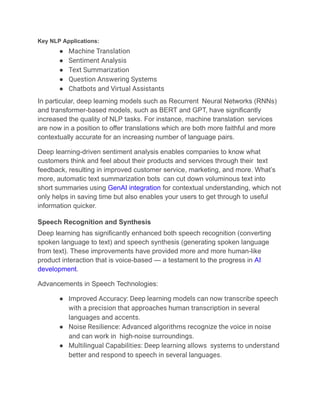
Application Deep Learning Advantage Real-world Impact
Object
Detection
High accuracy in identifying
multiple objects in complex
scenes
Enhanced security systems, improved
retail analytics
Facial
Recognition
Ability to recognize faces in
various conditions and angles
Advanced biometric authentication,
personalized user experiences
Medical
Imaging
Early detection of diseases,
improved diagnostic accuracy
Faster and more accurate medical
diagnoses, potentially saving lives
Natural Language Processing
Another domain that has recently advanced a lot with deep learning is Natural
Language Processing (NLP). Deep learning is revolutionizing many forms of
communication and information processing, especially through advanced NLP
development services– machines can now understand, interpret, and
generate human language thanks to deep learning.
Key NLP Applications:
●​ Machine Translation
●​ Sentiment Analysis
●​ Text Summarization
●​ Question Answering Systems
●​ Chatbots and Virtual Assistants
In particular, deep learning models such as Recurrent Neural Networks (RNNs)
and transformer-based models, such as BERT and GPT, have significantly
increased the quality of NLP tasks. For instance, machine translation services
are now in a position to offer translations which are both more faithful and more
contextually accurate for an increasing number of language pairs.
Deep learning-driven sentiment analysis enables companies to know what
customers think and feel about their products and services through their text
feedback, resulting in improved customer service, marketing, and more. What’s
more, automatic text summarization bots can cut down voluminous text into
short summaries using GenAI integration for contextual understanding, which not
only helps in saving time but also enables your users to get through to useful
information quicker.
Speech Recognition and Synthesis
Deep learning has significantly enhanced both speech recognition (converting
spoken language to text) and speech synthesis (generating spoken language
from text). These improvements have provided more and more human-like
product interaction that is voice-based — a testament to the progress in AI
development.
Advancements in Speech Technologies:
●​ Improved Accuracy: Deep learning models can now transcribe speech
with a precision that approaches human transcription in several
languages and accents.
●​ Noise Resilience: Advanced algorithms recognize the voice in noise
and can work in high-noise surroundings.
●​ Multilingual Capabilities: Deep learning allows systems to understand
better and respond to speech in several languages.
●​ Emotional Intelligence: Some can interpret emotions in speech, which
allows for more empathetic AI interactions.
These advances have also resulted in the now ubiquitous voice-activated
assistants, voice-enabled devices, and tools for accessibility. You might
notice real-time speech-to-text is getting better and more widespread – this
benefits professional and personal communication. This progress also powers
scalable AI chatbot development across industries.
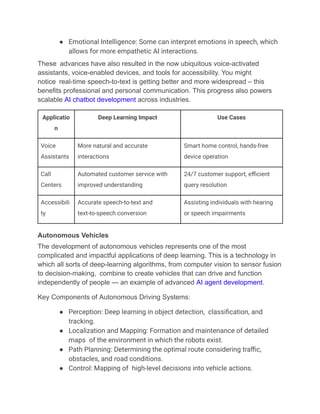
Applicatio
n
Deep Learning Impact Use Cases
Voice
Assistants
More natural and accurate
interactions
Smart home control, hands-free
device operation
Call
Centers
Automated customer service with
improved understanding
24/7 customer support, efficient
query resolution
Accessibili
ty
Accurate speech-to-text and
text-to-speech conversion
Assisting individuals with hearing
or speech impairments
Autonomous Vehicles
The development of autonomous vehicles represents one of the most
complicated and impactful applications of deep learning. This is a technology in
which all sorts of deep-learning algorithms, from computer vision to sensor fusion
to decision-making, combine to create vehicles that can drive and function
independently of people — an example of advanced AI agent development.
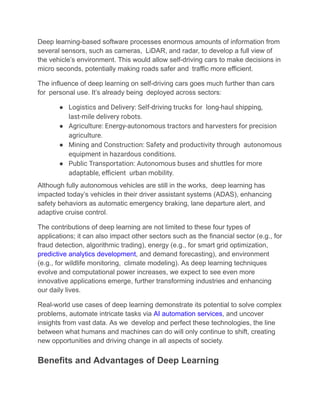
Key Components of Autonomous Driving Systems:
●​ Perception: Deep learning in object detection, classification, and
tracking.
●​ Localization and Mapping: Formation and maintenance of detailed
maps of the environment in which the robots exist.
●​ Path Planning: Determining the optimal route considering traffic,
obstacles, and road conditions.
●​ Control: Mapping of high-level decisions into vehicle actions.
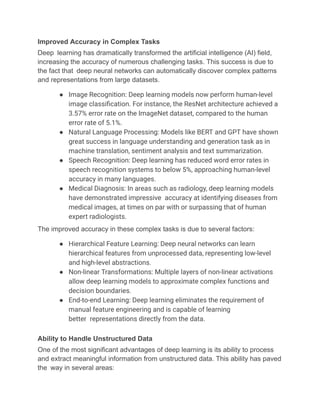
Deep learning-based software processes enormous amounts of information from
several sensors, such as cameras, LiDAR, and radar, to develop a full view of
the vehicle’s environment. This would allow self-driving cars to make decisions in
micro seconds, potentially making roads safer and traffic more efficient.
The influence of deep learning on self-driving cars goes much further than cars
for personal use. It’s already being deployed across sectors:
●​ Logistics and Delivery: Self-driving trucks for long-haul shipping,
last-mile delivery robots.
●​ Agriculture: Energy-autonomous tractors and harvesters for precision
agriculture.
●​ Mining and Construction: Safety and productivity through autonomous
equipment in hazardous conditions.
●​ Public Transportation: Autonomous buses and shuttles for more
adaptable, efficient urban mobility.
Although fully autonomous vehicles are still in the works, deep learning has
impacted today’s vehicles in their driver assistant systems (ADAS), enhancing
safety behaviors as automatic emergency braking, lane departure alert, and
adaptive cruise control.
The contributions of deep learning are not limited to these four types of
applications; it can also impact other sectors such as the financial sector (e.g., for
fraud detection, algorithmic trading), energy (e.g., for smart grid optimization,
predictive analytics development, and demand forecasting), and environment
(e.g., for wildlife monitoring, climate modeling). As deep learning techniques
evolve and computational power increases, we expect to see even more
innovative applications emerge, further transforming industries and enhancing
our daily lives.
Real-world use cases of deep learning demonstrate its potential to solve complex
problems, automate intricate tasks via AI automation services, and uncover
insights from vast data. As we develop and perfect these technologies, the line
between what humans and machines can do will only continue to shift, creating
new opportunities and driving change in all aspects of society.
Benefits and Advantages of Deep Learning
Improved Accuracy in Complex Tasks
Deep learning has dramatically transformed the artificial intelligence (AI) field,
increasing the accuracy of numerous challenging tasks. This success is due to
the fact that deep neural networks can automatically discover complex patterns
and representations from large datasets.
●​ Image Recognition: Deep learning models now perform human-level
image classification. For instance, the ResNet architecture achieved a
3.57% error rate on the ImageNet dataset, compared to the human
error rate of 5.1%.
●​ Natural Language Processing: Models like BERT and GPT have shown
great success in language understanding and generation task as in
machine translation, sentiment analysis and text summarization.
●​ Speech Recognition: Deep learning has reduced word error rates in
speech recognition systems to below 5%, approaching human-level
accuracy in many languages.
●​ Medical Diagnosis: In areas such as radiology, deep learning models
have demonstrated impressive accuracy at identifying diseases from
medical images, at times on par with or surpassing that of human
expert radiologists.
The improved accuracy in these complex tasks is due to several factors:
●​ Hierarchical Feature Learning: Deep neural networks can learn
hierarchical features from unprocessed data, representing low-level
and high-level abstractions.
●​ Non-linear Transformations: Multiple layers of non-linear activations
allow deep learning models to approximate complex functions and
decision boundaries.
●​ End-to-end Learning: Deep learning eliminates the requirement of
manual feature engineering and is capable of learning
better representations directly from the data.
Ability to Handle Unstructured Data
One of the most significant advantages of deep learning is its ability to process
and extract meaningful information from unstructured data. This ability has paved
the way in several areas:
●​ Text Analysis: Deep learning can interpret context, sentiment, and
semantics in natural language, as demonstrated by applications such
as chatbots, content recommendation systems, and automated text
summarization.
●​ Image and Video Processing: Convolutional neural networks (CNNs),
which are developed for purposes like object detection, facial
recognition, and video understanding, are increasingly important in
applications like autonomous driving and surveillance.
●​ Audio Processing: Deep learning has advanced speech recognition
(but understanding has not been as much), music generation, and
audio event detection, all of which have enhanced voice assistance
and music streaming applications.
●​ Sensor Data Analysis: In IoT applications, deep learning can process
and interpret complex sensor data, enabling predictive maintenance
and anomaly detection in industrial settings.
The ability to handle unstructured data is particularly valuable because:
●​ It allows organizations to derive insights from previously untapped
data sources.
●​ It reduces the need for manual data preprocessing and feature
extraction.
●​ It enables the development of more robust and versatile AI systems
that can operate in real-world, uncontrolled environments. Many
organizations now seek GenAI consulting to implement such systems
effectively.
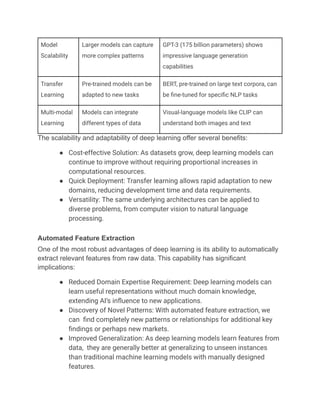
Scalability and Adaptability
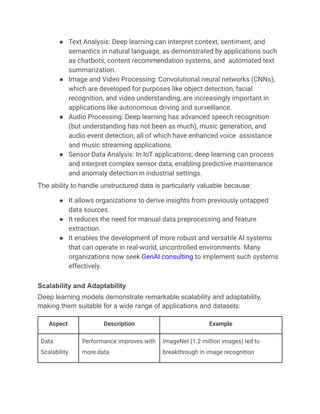
Deep learning models demonstrate remarkable scalability and adaptability,
making them suitable for a wide range of applications and datasets:
Aspect Description Example
Data
Scalability
Performance improves with
more data
ImageNet (1.2 million images) led to
breakthrough in image recognition
Model
Scalability
Larger models can capture
more complex patterns
GPT-3 (175 billion parameters) shows
impressive language generation
capabilities
Transfer
Learning
Pre-trained models can be
adapted to new tasks
BERT, pre-trained on large text corpora, can
be fine-tuned for specific NLP tasks
Multi-modal
Learning
Models can integrate
different types of data
Visual-language models like CLIP can
understand both images and text
The scalability and adaptability of deep learning offer several benefits:
●​ Cost-effective Solution: As datasets grow, deep learning models can
continue to improve without requiring proportional increases in
computational resources.
●​ Quick Deployment: Transfer learning allows rapid adaptation to new
domains, reducing development time and data requirements.
●​ Versatility: The same underlying architectures can be applied to
diverse problems, from computer vision to natural language
processing.
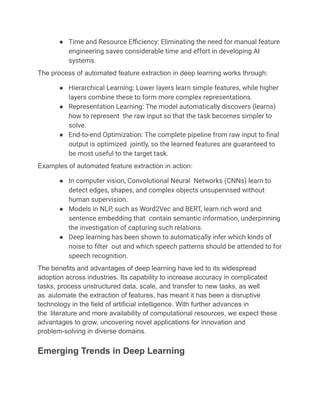
Automated Feature Extraction
One of the most robust advantages of deep learning is its ability to automatically
extract relevant features from raw data. This capability has significant
implications:
●​ Reduced Domain Expertise Requirement: Deep learning models can
learn useful representations without much domain knowledge,
extending AI’s influence to new applications.
●​ Discovery of Novel Patterns: With automated feature extraction, we
can find completely new patterns or relationships for additional key
findings or perhaps new markets.
●​ Improved Generalization: As deep learning models learn features from
data, they are generally better at generalizing to unseen instances
than traditional machine learning models with manually designed
features.
●​ Time and Resource Efficiency: Eliminating the need for manual feature
engineering saves considerable time and effort in developing AI
systems.
The process of automated feature extraction in deep learning works through:
●​ Hierarchical Learning: Lower layers learn simple features, while higher
layers combine these to form more complex representations.
●​ Representation Learning: The model automatically discovers (learns)
how to represent the raw input so that the task becomes simpler to
solve.
●​ End-to-end Optimization: The complete pipeline from raw input to final
output is optimized jointly, so the learned features are guaranteed to
be most useful to the target task.
Examples of automated feature extraction in action:
●​ In computer vision, Convolutional Neural Networks (CNNs) learn to
detect edges, shapes, and complex objects unsupervised without
human supervision.
●​ Models in NLP, such as Word2Vec and BERT, learn rich word and
sentence embedding that contain semantic information, underpinning
the investigation of capturing such relations.
●​ Deep learning has been shown to automatically infer which kinds of
noise to filter out and which speech patterns should be attended to for
speech recognition.
The benefits and advantages of deep learning have led to its widespread
adoption across industries. Its capability to increase accuracy in complicated
tasks, process unstructured data, scale, and transfer to new tasks, as well
as automate the extraction of features, has meant it has been a disruptive
technology in the field of artificial intelligence. With further advances in
the literature and more availability of computational resources, we expect these
advantages to grow, uncovering novel applications for innovation and
problem-solving in diverse domains.
Emerging Trends in Deep Learning
As deep learning continues to evolve, several cutting-edge trends like LLMs
development are shaping the future. These emerging directions are pushing
the envelope for deep learning models and tackling some of the biggest
obstacles in the field. Let’s take a look at the most critical developments that are
stretching the limits of deep learning.
A. Transfer Learning and Few-Shot Learning
Transfer learning and few-shot learning are changing the landscape of deep
learning training and application. These methods overcome one of the main
drawbacks of classical deep learning-based methods: the requirement of large
quantities of labeled samples.
Transfer Learning
Transfer learning involves leveraging knowledge gained from solving one
problem and applying it to a new, similar problem. The advantages of this
method are:
●​ Reduced training time
●​ Enhanced generalization in low-resource settings
●​ Reduced computational demand
Transfer learning usually means utilizing pre-trained models to get started on
new problems. For instance, a model trained on a large set of natural
images can be fine-tuned for particular image classification tasks using far less
data.
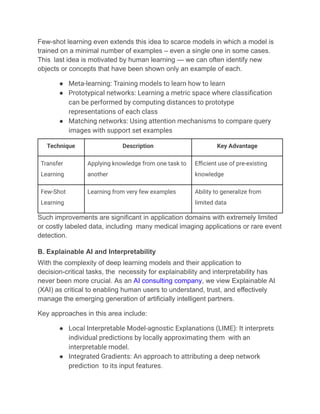
Few-Shot Learning
Few-shot learning even extends this idea to scarce models in which a model is
trained on a minimal number of examples – even a single one in some cases.
This last idea is motivated by human learning — we can often identify new
objects or concepts that have been shown only an example of each.
●​ Meta-learning: Training models to learn how to learn
●​ Prototypical networks: Learning a metric space where classification
can be performed by computing distances to prototype
representations of each class
●​ Matching networks: Using attention mechanisms to compare query
images with support set examples
Technique Description Key Advantage
Transfer
Learning
Applying knowledge from one task to
another
Efficient use of pre-existing
knowledge
Few-Shot
Learning
Learning from very few examples Ability to generalize from
limited data
Such improvements are significant in application domains with extremely limited
or costly labeled data, including many medical imaging applications or rare event
detection.
B. Explainable AI and Interpretability
With the complexity of deep learning models and their application to
decision-critical tasks, the necessity for explainability and interpretability has
never been more crucial. As an AI consulting company, we view Explainable AI
(XAI) as critical to enabling human users to understand, trust, and effectively
manage the emerging generation of artificially intelligent partners.
Key approaches in this area include:
●​ Local Interpretable Model-agnostic Explanations (LIME): It interprets
individual predictions by locally approximating them with an
interpretable model.
●​ Integrated Gradients: An approach to attributing a deep network
prediction to its input features.
●​ Layer-wise Relevance Propagation (LRP): This method involves the
bottom-up computation of the relevance contribution of each input
value back from the output layer through the network layers.
●​ Attention Visualization: Models with attention mechanisms may
benefit from visualization of attention weights to help understand what
part of the input the model is paying attention to.
Jellyfish Technologies Transforms Medicaid Verification for
Leading Community Care Provider with AI-Powered
Document Intelligence
Jellyfish Technologies Delivered an AI-Driven Entity Extraction System, Enabling
Faster, More Accurate, and Scalable Document Processing.
Download Full Case Study
But the benefits of explainable AI go beyond just transparency:
●​ Increased trust in AI systems
●​ More effective debugging and model optimization
●​ Adherence to regulation in sensitive areas
●​ Human-AI partnership increased
With deep learning models being used increasingly in sensitive applications such
as healthcare, finance, and self-driving cars, the ability to describe and
understand why a model made a particular decision will be essential to ensure
the responsible adoption of these technologies.
C. Federated Learning for Privacy Preservation
In an era of increasing data privacy concerns and stringent regulations like
GDPR, federated learning has emerged as a promising approach to train deep
learning models while preserving data privacy.
Federated learning allows for training models on distributed datasets without
centralizing the data. Here’s how it works:
●​ A central server initializes a global model
●​ The model is sent to participating devices or institutions
●​ Each participant trains the model on their local data
●​ Only model updates are sent back to the central server
●​ The server aggregates these updates to improve the global model
This approach offers several advantages:
●​ Data Privacy: Sensitive data never leaves the local device or institution
●​ Reduced Data Transfer: Only model updates are transmitted, not raw
data
●​ Collaborative Learning: Enables learning from diverse, distributed
datasets
Applications of federated learning are particularly relevant in:
●​ Mobile devices: Improving keyboard predictions or voice recognition
without sending user data to central servers
●​ Healthcare: Allowing hospitals to collaborate on model training without
sharing patient data
●​ Finance: Enabling banks to detect fraud patterns collaboratively while
maintaining client confidentiality
As privacy concerns continue growing, federated learning will likely become an
increasingly important paradigm in deep learning, especially for applications
involving sensitive data.
D. Neuromorphic Computing
Neuromorphic computing represents a paradigm shift in how we approach deep
learning hardware. This approach aims to design computing systems that mimic
the structure and function of biological neural networks.
Key characteristics of neuromorphic systems include:
●​ Parallel Processing: Emulating the massively parallel nature of
biological brains
●​ Event-Driven Computation: Operating based on spikes or events,
similar to neurons
●​ Low Power Consumption: Aiming for energy efficiency comparable to
biological systems
●​ Co-location of Memory and Processing: Reducing the von Neumann
bottleneck
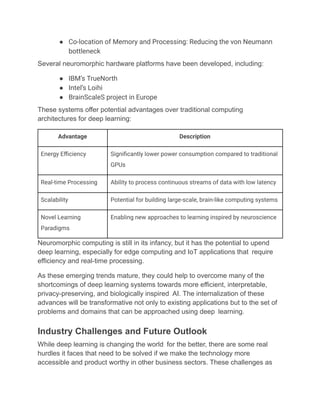
Several neuromorphic hardware platforms have been developed, including:
●​ IBM’s TrueNorth
●​ Intel’s Loihi
●​ BrainScaleS project in Europe
These systems offer potential advantages over traditional computing
architectures for deep learning:
Advantage Description
Energy Efficiency Significantly lower power consumption compared to traditional
GPUs
Real-time Processing Ability to process continuous streams of data with low latency
Scalability Potential for building large-scale, brain-like computing systems
Novel Learning
Paradigms
Enabling new approaches to learning inspired by neuroscience
Neuromorphic computing is still in its infancy, but it has the potential to upend
deep learning, especially for edge computing and IoT applications that require
efficiency and real-time processing.
As these emerging trends mature, they could help to overcome many of the
shortcomings of deep learning systems towards more efficient, interpretable,
privacy-preserving, and biologically inspired AI. The internalization of these
advances will be transformative not only to existing applications but to the set of
problems and domains that can be approached using deep learning.
Industry Challenges and Future Outlook
While deep learning is changing the world for the better, there are some real
hurdles it faces that need to be solved if we make the technology more
accessible and product worthy in other business sectors. These challenges as
well as new trends dictate the further development of deep learning. Let’s
explore the key issues and their implications for the field.
A. Data quality and availability issues
Data quality and sparsity are one of the major issues with deep learning. Deep
learning applications need big, diverse, high-quality and representative data to
perform well.
Data quality concerns:
●​ Inconsistent or inaccurate data
●​ Biased or unrepresentative datasets
●​ Noise and outliers in the data
●​ Incomplete or missing information
Data availability challenges:
●​ Limited access to large-scale datasets in certain domains
●​ Privacy concerns and data protection regulations
●​ Proprietary data owned by organizations
●​ Lack of standardized datasets for specific applications
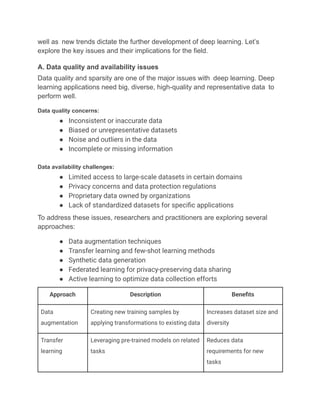
To address these issues, researchers and practitioners are exploring several
approaches:
●​ Data augmentation techniques
●​ Transfer learning and few-shot learning methods
●​ Synthetic data generation
●​ Federated learning for privacy-preserving data sharing
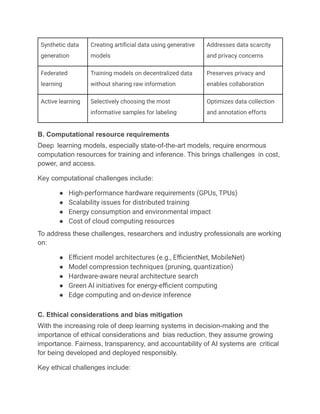
●​ Active learning to optimize data collection efforts
Approach Description Benefits
Data
augmentation
Creating new training samples by
applying transformations to existing data
Increases dataset size and
diversity
Transfer
learning
Leveraging pre-trained models on related
tasks
Reduces data
requirements for new
tasks
Synthetic data
generation
Creating artificial data using generative
models
Addresses data scarcity
and privacy concerns
Federated
learning
Training models on decentralized data
without sharing raw information
Preserves privacy and
enables collaboration
Active learning Selectively choosing the most
informative samples for labeling
Optimizes data collection
and annotation efforts
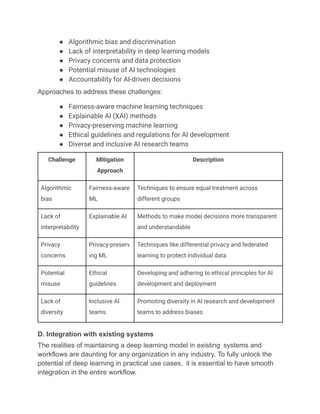
B. Computational resource requirements
Deep learning models, especially state-of-the-art models, require enormous
computation resources for training and inference. This brings challenges in cost,
power, and access.
Key computational challenges include:
●​ High-performance hardware requirements (GPUs, TPUs)
●​ Scalability issues for distributed training
●​ Energy consumption and environmental impact
●​ Cost of cloud computing resources
To address these challenges, researchers and industry professionals are working
on:
●​ Efficient model architectures (e.g., EfficientNet, MobileNet)
●​ Model compression techniques (pruning, quantization)
●​ Hardware-aware neural architecture search
●​ Green AI initiatives for energy-efficient computing
●​ Edge computing and on-device inference
C. Ethical considerations and bias mitigation
With the increasing role of deep learning systems in decision-making and the
importance of ethical considerations and bias reduction, they assume growing
importance. Fairness, transparency, and accountability of AI systems are critical
for being developed and deployed responsibly.
Key ethical challenges include:
●​ Algorithmic bias and discrimination
●​ Lack of interpretability in deep learning models
●​ Privacy concerns and data protection
●​ Potential misuse of AI technologies
●​ Accountability for AI-driven decisions
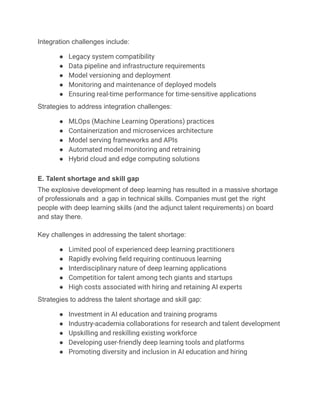
Approaches to address these challenges:
●​ Fairness-aware machine learning techniques
●​ Explainable AI (XAI) methods
●​ Privacy-preserving machine learning
●​ Ethical guidelines and regulations for AI development
●​ Diverse and inclusive AI research teams
Challenge Mitigation
Approach
Description
Algorithmic
bias
Fairness-aware
ML
Techniques to ensure equal treatment across
different groups
Lack of
interpretability
Explainable AI Methods to make model decisions more transparent
and understandable
Privacy
concerns
Privacy-preserv
ing ML
Techniques like differential privacy and federated
learning to protect individual data
Potential
misuse
Ethical
guidelines
Developing and adhering to ethical principles for AI
development and deployment
Lack of
diversity
Inclusive AI
teams
Promoting diversity in AI research and development
teams to address biases
D. Integration with existing systems
The realities of maintaining a deep learning model in existing systems and
workflows are daunting for any organization in any industry. To fully unlock the
potential of deep learning in practical use cases, it is essential to have smooth
integration in the entire workflow.
Integration challenges include:
●​ Legacy system compatibility
●​ Data pipeline and infrastructure requirements
●​ Model versioning and deployment
●​ Monitoring and maintenance of deployed models
●​ Ensuring real-time performance for time-sensitive applications
Strategies to address integration challenges:
●​ MLOps (Machine Learning Operations) practices
●​ Containerization and microservices architecture
●​ Model serving frameworks and APIs
●​ Automated model monitoring and retraining
●​ Hybrid cloud and edge computing solutions
E. Talent shortage and skill gap
The explosive development of deep learning has resulted in a massive shortage
of professionals and a gap in technical skills. Companies must get the right
people with deep learning skills (and the adjunct talent requirements) on board
and stay there.​
​
Key challenges in addressing the talent shortage:
●​ Limited pool of experienced deep learning practitioners
●​ Rapidly evolving field requiring continuous learning
●​ Interdisciplinary nature of deep learning applications
●​ Competition for talent among tech giants and startups
●​ High costs associated with hiring and retaining AI experts
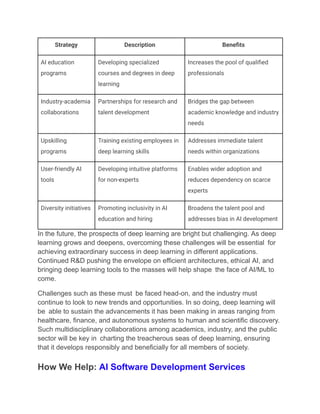
Strategies to address the talent shortage and skill gap:
●​ Investment in AI education and training programs
●​ Industry-academia collaborations for research and talent development
●​ Upskilling and reskilling existing workforce
●​ Developing user-friendly deep learning tools and platforms
●​ Promoting diversity and inclusion in AI education and hiring
Strategy Description Benefits
AI education
programs
Developing specialized
courses and degrees in deep
learning
Increases the pool of qualified
professionals
Industry-academia
collaborations
Partnerships for research and
talent development
Bridges the gap between
academic knowledge and industry
needs
Upskilling
programs
Training existing employees in
deep learning skills
Addresses immediate talent
needs within organizations
User-friendly AI
tools
Developing intuitive platforms
for non-experts
Enables wider adoption and
reduces dependency on scarce
experts
Diversity initiatives Promoting inclusivity in AI
education and hiring
Broadens the talent pool and
addresses bias in AI development
In the future, the prospects of deep learning are bright but challenging. As deep
learning grows and deepens, overcoming these challenges will be essential for
achieving extraordinary success in deep learning in different applications.
Continued R&D pushing the envelope on efficient architectures, ethical AI, and
bringing deep learning tools to the masses will help shape the face of AI/ML to
come.
Challenges such as these must be faced head-on, and the industry must
continue to look to new trends and opportunities. In so doing, deep learning will
be able to sustain the advancements it has been making in areas ranging from
healthcare, finance, and autonomous systems to human and scientific discovery.
Such multidisciplinary collaborations among academics, industry, and the public
sector will be key in charting the treacherous seas of deep learning, ensuring
that it develops responsibly and beneficially for all members of society.
How We Help: AI Software Development Services
We at Jellyfish Technologies have expertise in developing high-end AI software
solutions that make the most of deep learning algorithms to address the actual
problems of the world. Whether you need help creating your own deep learning
models, adding intelligent automation, or parsing through large amounts of
unstructured data – our team of experts is here to walk you through it — from
training to LLM fine-tuning.
With years of combined deep learning and data science experience, we provide
every service you need:
●​ GenAI Consulting & Strategy: We provide in-depth learning, what is
deep learning, how it can apply to your business, how it will affect your
business strategy and what deep learning use cases are in line with
your business strategy.
●​ Model Development & Training: From creating scalable deep
learning architectures to deploying AI deep learning algorithms in
production, we manage the entire model lifecycle.
●​ Data Preparation & Engineering: Our data science team excels in
curating, cleaning, and structuring the right datasets—because data
quality is essential to overcoming many deep learning challenges.
●​ End-to-End AI Solutions: With deep learning in data science, natural
language processing, or computer vision, our tailor-made AI systems
work effortlessly with your current systems.
We have experience with several deep learning approaches, working in areas
such as convolutional neural networks (CNNs), recurrent neural networks
(RNNs), transformers, and the cutting-edge deep learning algorithms that power
today’s AI. Our solution overcomes the most common struggles associated with
deep learning, such as lack of data, model interpretability, and model
generalization — helping you safely and swiftly unlock the potential of AI through
deep learning.
Whether you want to learn deep learning to deepen your familiarity with deep
learning and AI, or if you are a technology historian exploring use cases of deep
learning that enterprises need to adopt, we enable your AI vision through our
responsible, innovative, and business-ready solutions.
Let’s Build AI-Powered Solutions
Deep learning isn’t just a fancy-sounding tech trend; it has revolutionized
industries and venues all across the globe, changing the way we live, work,
and experience our environment. We’ve gone through a short form of deep
learning history to today’s trends of where deep learning came from and where
it’s going. But the true power emerges when you use it to solve real problems.
Now is the time to act.
If you’re ready to uncover relevant deep learning applications for your industry,
un-tap high-impact deep learning business use cases, or solve the challenges of
deep learning in production, we want to help.
Let’s work together to:
●​ Leverage the advantages of deep learning to build intelligent, adaptive
systems
●​ Apply proven deep learning algorithms and components of deep
learning to your unique datasets
●​ Tap into emerging deep-learning trends to stay ahead of the
competition
●​ Build scalable solutions that evolve with the latest in deep learning
techniques, including Llama integration for optimized LLM
deployment.
The future of AI is being constructed now — be sure not to be left out.
Contact us now to start building powerful, future-ready AI products using the best
in deep learning models and AI software development.

Deep Learning Explained-History, Key Components, Applications, Benefits & Industry Challenges

  • 1.
    Deep Learning Explained:History, Key Components, Applications, Benefits & Industry Challenges In an era where artificial intelligence is reshaping industries and redefining technology, deep learning has become an avant-garde of digital innovation. From autonomous vehicles to virtual assistants, deep learning algorithms are silently powering innovations once confined to science fiction. But what is deep learning, and why has it emerged as such a game changer in the field of AI? Deep learning, a subset of machine learning, has rapidly evolved from an academic concept to a technology powering some of the most groundbreaking advancements. It now plays a foundational role in GenAI development, enabling generative models that create text, images, and more. With the power to process vast amounts of data and spot intricate patterns, it has proved invaluable in industries as diverse as healthcare and finance. However, as deep learning expands its reach, it also brings a wide range of challenges and ethical issues that require our attention. This comprehensive guide will delve into the fascinating world of deep learning, tracing its history and evolution, exploring its key components, and showcasing its wide-ranging applications. We’ll examine the benefits that make deep learning so powerful and the emerging trends shaping its future. Finally, we’ll take on the remaining industry challenges, offering you a balanced take on this world-changing technology. History and Evolution of Deep Learning
  • 2.
    Roots in ArtificialNeural Networks The story of deep learning begins with the concept of artificial neural networks (ANNs), which are directly inspired by the biological neural networks that constitute human brains. In 1943, Warren McCulloch and Walter Pitts presented the first mathematical model of a neural network, laying the groundwork for future developments in the field. The perceptron, invented by Frank Rosenblatt in 1958, marked a significant milestone in the evolution of neural networks. This simple algorithm could be programmed to learn to classify the pattern of linearly separable patterns, sparking excitement about the potential of machine learning. But the early enthusiasm was tempered when Marvin Minsky and Seymour Papert’s 1969 book “Perceptrons” pointed out the limitations of single-layer neural networks. The evolution of deep learning is marked by several important breakthroughs: ●​ Backpropagation Algorithm (1986): The backpropagation introduced by David Rumelhart, Geoffrey Hinton, and Ronald Williams is an efficient method for training multi-layer neural networks. This was a breakthrough that renewed interest in neural networks. ●​ Convolutional Neural Networks (1989): Yann LeCun and colleagues developed convolutional neural networks (CNNs), which proved highly effective for image recognition tasks. ●​ Long Short-Term Memory (1997): LSTM networks, proposed by Sepp Hochreiter and Jürgen Schmidhuber, solved the vanishing gradient problem of RNNs and allowed for better handling of sequential data.
  • 3.
    ●​ Deep BeliefNetworks (2006): Geoff Hinton, Simon Osindero, and Yee-Whye Teh introduced an effective way to train deep belief networks, inaugurating the “deep learning renaissance.” ●​ AlexNet (2012): The first deep convolutional neural network, or deep CNN, called AlexNet by Alex Krizhevsky, Ilya Sutskever, and Geoffrey Hinton, won the ImageNet Large Scale Visual Recognition Challenge, establishing the power of deep learning in computer vision. Transition from Shallow to Deep Architectures The evolution from shallow to deep architectures represents a paradigm shift in machine learning: Aspect Shallow Architecture Deep Architecture Layers Few (typically 1-3) Many (often 10+) Feature Extraction Manual or simple Automatic and hierarchical Representational Power Limited High Computational Requirements Lower Higher Performance on Complex Tasks Moderate Superior In the late 20th and early 21st centuries, shallow architectures, including support vector machines and decision trees, became prevalent in machine learning. These models heavily depended on hand-crafted features and performed poorly on complex high-dimensional data. In contrast, deep architectures can learn hierarchical representations of data automatically. Deeper layers represent basic concepts; higher ones build upon those formed for the next-and-next-level concepts. This hierarchical learning has allowed deep networks to perform human-level computing for visual recognition, language processing, and other domains with tremendous accuracy. The transition to deep architectures was driven by several factors: ●​ Increased computational power
  • 4.
    ●​ Availability oflarge-scale datasets ●​ Improved training algorithms ●​ Development of effective regularization techniques Impact of Increased Computational Power Deep learning has become possible due to advances in computing power. A few crucial factors have driven this growth: ●​ Graphics Processing Units (GPUs): GPUs were initially intended for rendering graphics in video games but have turned out to be effective for parallelizing large-scale neural network computations. The introduction of GPGUs for deep learning teaching drastically speeded up the field. ●​ Distributed Computing: The ability to distribute neural network training across machines was the key to scaling deep learning models to unprecedented sizes. ●​ Cloud Computing: Cloud providers have democratized large-scale computing, which enables researchers and practitioners to train big models without a dedicated hardware budget. ●​ Specialized Hardware: AI-dedicated hardware development, i.e., Google TPUs and NVIDIA DGX systems, has caused an advance in the speed of deep learning computations. The impact of more computing power on deep learning can be summed up in the following steps: ●​ 2012: AlexNet proves ImageNet winning accuracy trained on two GPUs. ●​ 2015: AlphaGo A variation of Google DeepMind used distributed computing to train AlphaGo, which defeats a professional Go player. ●​ 2018: OpenAI trains GPT-2, a large language model, on a cluster of thousands of GPUs. ●​ 2020: GPT-3, 175-billion-parameters, is trained using massive computational resources. This exponential growth in computing power has allowed researchers to experiment with more complex model architectures and train on ever bigger datasets — stretching the limits of what can be achieved with deep learning.
  • 5.
    The interplay betweenalgorithmic innovations and hardware advancements has been crucial. As hardware became more robust, it allowed more sophisticated algorithms to be implemented. AI-Driven Entity Extraction System by Jellyfish Technologies Transforms Document Processing for a Leading InsurTech Firm Jellyfish Technologies Developed a Cutting-Edge AI Document Intelligence Solution, Automating Medicaid Verification with Precision, Compliance, and Efficiency. Download Full Case Study On the other hand, the demand for running these advanced algorithms drove further hardware development, creating a virtuous cycle of progress. In addition, higher computational resources enabled the exploration of new lines of research: ●​ Transfer Learning: The idea of pre-training large models on large datasets and fine-tuning them on tasks of interest has become a common practice due to the possibility of training and storing large models. ●​ Neural Architecture Search: Search for the best neural network architecture has recently been made possible due to advances in hardware. ●​ Reinforcement Learning: There are a large number of complex reinforcement learning algorithms, for which some parameter optimization processes need/need to run many simulations, which have exploited the growing computational resources. ●​ Generative Models: Training of complex generative models, e.g., GANs and VAEs, that usually involve simultaneous optimization of competing criteria, have been facilitated by strong computer systems. The evolution of Deep Learning, from traditional artificial neural networks to the present era of large-scale models and custom hardware, captures the dynamic
  • 6.
    landscape of thefield. As we push the limits of computing power and algorithmic innovations, the applications and potentiality of deep learning are growing, ensuring that AI and machine learning will see more leaps and bounds. Core Components of Deep Learning Neural Network Layers Deep learning architectures consist of stacks made out of neural network layers. These layers are made of interconnected nodes, or neurons, that process and pass along information. The complexity and hierarchy of these layers help the model learn and represent complex patterns in the data. ●​ Input Layer: Accepts the raw data and passes it along. ●​ Hidden Layers: Pass information through many iterations of transformations. ●​ Output Layer: It is the layer where the final prediction or classification is done. There are distinct layers that are there for distinct reasons: ●​ Convolutional layers: Ideal for image processing and feature extraction. ●​ Recurrent layers: Ideal for sequential data and time series analysis. ●​ Pooling layers: Reduce spatial dimensions and computational complexity. ●​ Fully connected layers: Combine features for decision-making. The arrangement and number of these layers determine the network architecture and, in turn, the learning and performance of the network. Activation Functions Activation functions in neural networks enable non-linearity, making them capable of learning complex patterns and relationship in data. These two functions are used to decide whether to activate the neuron according to its given input. Common activation functions include:
  • 7.
    Function Characteristics UseCases ReLU Simple, efficient, prevents vanishing gradient Default choice for many networks Sigmoid Outputs between 0 and 1 Binary classification, gates in LSTMs Tanh Outputs between -1 and 1 Hidden layers, especially in RNNs Softmax Converts outputs to probability distribution Multi-class classification Leaky ReLU Addresses dying ReLU problem Alternative to ReLU in deep networks The selection of the activation function greatly influences training the model. For example, the ReLU (Rectified Linear Unit) function has garnered much interest because it is computationally efficient and prevents the vanishing gradient problem in deep networks. Backpropagation and Gradient Descent Backpropagation is the fundamental learning algorithm for neural networks. It efficiently computes gradients of the loss function concerning the network’s parameters, allowing the model to learn from its errors. ●​ Forward pass: Input data propagates through the network, generating predictions. ●​ Loss calculation: The difference between predictions and actual values is quantified. ●​ Backward pass: Gradients are computed and propagated backward through the network. ●​ Parameter update: Network weights are adjusted to minimize the loss. Gradient descent, an optimization approach, then employs these gradients to update the model parameters iteratively. It comes in several variants:
  • 8.
    ●​ Batch GradientDescent: This updates the model’s parameters by computing the performance gradients on the whole training dataset. ●​ Stochastic Gradient Descent SGD: Parameters are updated after every training example. ●​ Mini-batch Gradient Descent: Upgrades parameters by small chunks of samples. Such methods trade the computational cost for the updates’ stability, and mini-batch gradient descent performs, often providing a good compromise. Optimization Algorithms Although gradient descent is at the core of deep learning optimization, numerous sophisticated algorithms have been proposed to improve training speed and model quality. Key optimization algorithms include: ●​ Adam (Adaptive Moment Estimation): Combines ideas from RMSprop and momentum, adapting learning rates for each parameter. ●​ RMSprop: Tackles the lack of a learning rate schedule in AdaGrad by changing the gradient accumulation into a moving average. ●​ Momentum: It increases SGD in the relevant direction and slows it down in the direction of oscillations. ●​ AdaGrad: Adapts learning rates to parameters, performing smaller updates (i.e. low learning rates) for parameters associated with frequently occurring features. ●​ Nesterov Accelerated Gradient: A variation of momentum that provides a look-ahead mechanism. These algorithms aim to overcome challenges such as: ●​ Escaping local minima ●​ Navigating saddle points ●​ Adapting to varying curvatures in the loss landscape ●​ Balancing speed and stability of convergence The selection of optimizer can greatly influence how quickly a model trains and the quality of the resulting model. For example, Adam is frequently a solid default as it adapts individual learning rates and utilizes momentum.
  • 9.
    Curious how deeplearning can power your next project? Talk to our AI experts today and discover how tailored deep learning solutions can drive smarter, faster results for your business. Let’s Talk Deep Learning Loss Functions Loss functions measure the difference between predicted and actual values and evaluate the performance of a model. They are used to direct the optimization process for the model to learn and make better predictions. Common loss functions include: Loss Function Use Case Characteristics Mean Squared Error (MSE) Regression Sensitive to outliers Cross-Entropy Classification Punishes confident misclassifications Hinge Loss SVM, margin-based classifiers Maximizes the margin between classes Huber Loss Regression Combines MSE and MAE, robust to outliers Kullback-Leibler Divergence Probabilistic models Measures difference between probability distributions The choice of loss function depends on the specific task and desired model behavior. For instance: ●​ In regression tasks, MSE is commonly used but can be sensitive to outliers. Huber loss provides a more robust alternative. ●​ For classification problems, cross-entropy loss is widely used, especially with softmax activation in the output layer.
  • 10.
    ●​ In generativemodels like VAEs and GANs, specialized loss functions like KL divergence or adversarial loss are employed. Understanding the properties of different loss functions is crucial for effective model design and training. Some loss functions may lead to faster convergence or better generalization, while others might be more appropriate for handling imbalanced datasets or specific types of errors. In conclusion, these core components of deep learning – neural network layers, activation functions, backpropagation and gradient descent, optimization algorithms, and loss functions – work in concert to enable the powerful learning capabilities of deep neural networks. These networks rely heavily on clean training data, often supported by AI data annotation processes. Their interplay determines the network’s ability to extract meaningful features, learn complex patterns, and make accurate predictions across a wide range of applications. As the field of deep learning continues to evolve, innovations in these components drive advancements in model architecture, training efficiency, and overall performance. Practical Applications of Deep Learning Deep learning is transforming industries and disciplines across the board, providing solutions to problems that were once either unsolvable or out of reach. This robust branch of machine learning has been applied across several different areas, proving its adaptability and scope for future development. Computer Vision and Image Recognition
  • 11.
    Deep learning, computervision, and image recognition are significant application areas of AI. These technologies have changed how machines perceive and approximate visual information, leading to rapid advancements in computer vision development across industries. Key Applications in Computer Vision: ●​ Object Detection and Recognition ●​ Facial Recognition ●​ Medical Image Analysis ●​ Autonomous Vehicle Vision Systems ●​ Quality Control in Manufacturing Deep learning algorithms, especially Convolutional Neural Networks (CNN), have significantly increased the accuracy and efficiency of image recognition. For example, in healthcare, deep learning can identify anomalies in X-rays, MRIs, and CT scans much more accurately than humans can. It can even outperform human experts in some instances. Application Deep Learning Advantage Real-world Impact Object Detection High accuracy in identifying multiple objects in complex scenes Enhanced security systems, improved retail analytics Facial Recognition Ability to recognize faces in various conditions and angles Advanced biometric authentication, personalized user experiences Medical Imaging Early detection of diseases, improved diagnostic accuracy Faster and more accurate medical diagnoses, potentially saving lives Natural Language Processing Another domain that has recently advanced a lot with deep learning is Natural Language Processing (NLP). Deep learning is revolutionizing many forms of communication and information processing, especially through advanced NLP development services– machines can now understand, interpret, and generate human language thanks to deep learning.
  • 12.
    Key NLP Applications: ●​Machine Translation ●​ Sentiment Analysis ●​ Text Summarization ●​ Question Answering Systems ●​ Chatbots and Virtual Assistants In particular, deep learning models such as Recurrent Neural Networks (RNNs) and transformer-based models, such as BERT and GPT, have significantly increased the quality of NLP tasks. For instance, machine translation services are now in a position to offer translations which are both more faithful and more contextually accurate for an increasing number of language pairs. Deep learning-driven sentiment analysis enables companies to know what customers think and feel about their products and services through their text feedback, resulting in improved customer service, marketing, and more. What’s more, automatic text summarization bots can cut down voluminous text into short summaries using GenAI integration for contextual understanding, which not only helps in saving time but also enables your users to get through to useful information quicker. Speech Recognition and Synthesis Deep learning has significantly enhanced both speech recognition (converting spoken language to text) and speech synthesis (generating spoken language from text). These improvements have provided more and more human-like product interaction that is voice-based — a testament to the progress in AI development. Advancements in Speech Technologies: ●​ Improved Accuracy: Deep learning models can now transcribe speech with a precision that approaches human transcription in several languages and accents. ●​ Noise Resilience: Advanced algorithms recognize the voice in noise and can work in high-noise surroundings. ●​ Multilingual Capabilities: Deep learning allows systems to understand better and respond to speech in several languages.
  • 13.
    ●​ Emotional Intelligence:Some can interpret emotions in speech, which allows for more empathetic AI interactions. These advances have also resulted in the now ubiquitous voice-activated assistants, voice-enabled devices, and tools for accessibility. You might notice real-time speech-to-text is getting better and more widespread – this benefits professional and personal communication. This progress also powers scalable AI chatbot development across industries. Applicatio n Deep Learning Impact Use Cases Voice Assistants More natural and accurate interactions Smart home control, hands-free device operation Call Centers Automated customer service with improved understanding 24/7 customer support, efficient query resolution Accessibili ty Accurate speech-to-text and text-to-speech conversion Assisting individuals with hearing or speech impairments Autonomous Vehicles The development of autonomous vehicles represents one of the most complicated and impactful applications of deep learning. This is a technology in which all sorts of deep-learning algorithms, from computer vision to sensor fusion to decision-making, combine to create vehicles that can drive and function independently of people — an example of advanced AI agent development. Key Components of Autonomous Driving Systems: ●​ Perception: Deep learning in object detection, classification, and tracking. ●​ Localization and Mapping: Formation and maintenance of detailed maps of the environment in which the robots exist. ●​ Path Planning: Determining the optimal route considering traffic, obstacles, and road conditions. ●​ Control: Mapping of high-level decisions into vehicle actions.
  • 14.
    Deep learning-based softwareprocesses enormous amounts of information from several sensors, such as cameras, LiDAR, and radar, to develop a full view of the vehicle’s environment. This would allow self-driving cars to make decisions in micro seconds, potentially making roads safer and traffic more efficient. The influence of deep learning on self-driving cars goes much further than cars for personal use. It’s already being deployed across sectors: ●​ Logistics and Delivery: Self-driving trucks for long-haul shipping, last-mile delivery robots. ●​ Agriculture: Energy-autonomous tractors and harvesters for precision agriculture. ●​ Mining and Construction: Safety and productivity through autonomous equipment in hazardous conditions. ●​ Public Transportation: Autonomous buses and shuttles for more adaptable, efficient urban mobility. Although fully autonomous vehicles are still in the works, deep learning has impacted today’s vehicles in their driver assistant systems (ADAS), enhancing safety behaviors as automatic emergency braking, lane departure alert, and adaptive cruise control. The contributions of deep learning are not limited to these four types of applications; it can also impact other sectors such as the financial sector (e.g., for fraud detection, algorithmic trading), energy (e.g., for smart grid optimization, predictive analytics development, and demand forecasting), and environment (e.g., for wildlife monitoring, climate modeling). As deep learning techniques evolve and computational power increases, we expect to see even more innovative applications emerge, further transforming industries and enhancing our daily lives. Real-world use cases of deep learning demonstrate its potential to solve complex problems, automate intricate tasks via AI automation services, and uncover insights from vast data. As we develop and perfect these technologies, the line between what humans and machines can do will only continue to shift, creating new opportunities and driving change in all aspects of society. Benefits and Advantages of Deep Learning
  • 15.
    Improved Accuracy inComplex Tasks Deep learning has dramatically transformed the artificial intelligence (AI) field, increasing the accuracy of numerous challenging tasks. This success is due to the fact that deep neural networks can automatically discover complex patterns and representations from large datasets. ●​ Image Recognition: Deep learning models now perform human-level image classification. For instance, the ResNet architecture achieved a 3.57% error rate on the ImageNet dataset, compared to the human error rate of 5.1%. ●​ Natural Language Processing: Models like BERT and GPT have shown great success in language understanding and generation task as in machine translation, sentiment analysis and text summarization. ●​ Speech Recognition: Deep learning has reduced word error rates in speech recognition systems to below 5%, approaching human-level accuracy in many languages. ●​ Medical Diagnosis: In areas such as radiology, deep learning models have demonstrated impressive accuracy at identifying diseases from medical images, at times on par with or surpassing that of human expert radiologists. The improved accuracy in these complex tasks is due to several factors: ●​ Hierarchical Feature Learning: Deep neural networks can learn hierarchical features from unprocessed data, representing low-level and high-level abstractions. ●​ Non-linear Transformations: Multiple layers of non-linear activations allow deep learning models to approximate complex functions and decision boundaries. ●​ End-to-end Learning: Deep learning eliminates the requirement of manual feature engineering and is capable of learning better representations directly from the data. Ability to Handle Unstructured Data One of the most significant advantages of deep learning is its ability to process and extract meaningful information from unstructured data. This ability has paved the way in several areas:
  • 16.
    ●​ Text Analysis:Deep learning can interpret context, sentiment, and semantics in natural language, as demonstrated by applications such as chatbots, content recommendation systems, and automated text summarization. ●​ Image and Video Processing: Convolutional neural networks (CNNs), which are developed for purposes like object detection, facial recognition, and video understanding, are increasingly important in applications like autonomous driving and surveillance. ●​ Audio Processing: Deep learning has advanced speech recognition (but understanding has not been as much), music generation, and audio event detection, all of which have enhanced voice assistance and music streaming applications. ●​ Sensor Data Analysis: In IoT applications, deep learning can process and interpret complex sensor data, enabling predictive maintenance and anomaly detection in industrial settings. The ability to handle unstructured data is particularly valuable because: ●​ It allows organizations to derive insights from previously untapped data sources. ●​ It reduces the need for manual data preprocessing and feature extraction. ●​ It enables the development of more robust and versatile AI systems that can operate in real-world, uncontrolled environments. Many organizations now seek GenAI consulting to implement such systems effectively. Scalability and Adaptability Deep learning models demonstrate remarkable scalability and adaptability, making them suitable for a wide range of applications and datasets: Aspect Description Example Data Scalability Performance improves with more data ImageNet (1.2 million images) led to breakthrough in image recognition
  • 17.
    Model Scalability Larger models cancapture more complex patterns GPT-3 (175 billion parameters) shows impressive language generation capabilities Transfer Learning Pre-trained models can be adapted to new tasks BERT, pre-trained on large text corpora, can be fine-tuned for specific NLP tasks Multi-modal Learning Models can integrate different types of data Visual-language models like CLIP can understand both images and text The scalability and adaptability of deep learning offer several benefits: ●​ Cost-effective Solution: As datasets grow, deep learning models can continue to improve without requiring proportional increases in computational resources. ●​ Quick Deployment: Transfer learning allows rapid adaptation to new domains, reducing development time and data requirements. ●​ Versatility: The same underlying architectures can be applied to diverse problems, from computer vision to natural language processing. Automated Feature Extraction One of the most robust advantages of deep learning is its ability to automatically extract relevant features from raw data. This capability has significant implications: ●​ Reduced Domain Expertise Requirement: Deep learning models can learn useful representations without much domain knowledge, extending AI’s influence to new applications. ●​ Discovery of Novel Patterns: With automated feature extraction, we can find completely new patterns or relationships for additional key findings or perhaps new markets. ●​ Improved Generalization: As deep learning models learn features from data, they are generally better at generalizing to unseen instances than traditional machine learning models with manually designed features.
  • 18.
    ●​ Time andResource Efficiency: Eliminating the need for manual feature engineering saves considerable time and effort in developing AI systems. The process of automated feature extraction in deep learning works through: ●​ Hierarchical Learning: Lower layers learn simple features, while higher layers combine these to form more complex representations. ●​ Representation Learning: The model automatically discovers (learns) how to represent the raw input so that the task becomes simpler to solve. ●​ End-to-end Optimization: The complete pipeline from raw input to final output is optimized jointly, so the learned features are guaranteed to be most useful to the target task. Examples of automated feature extraction in action: ●​ In computer vision, Convolutional Neural Networks (CNNs) learn to detect edges, shapes, and complex objects unsupervised without human supervision. ●​ Models in NLP, such as Word2Vec and BERT, learn rich word and sentence embedding that contain semantic information, underpinning the investigation of capturing such relations. ●​ Deep learning has been shown to automatically infer which kinds of noise to filter out and which speech patterns should be attended to for speech recognition. The benefits and advantages of deep learning have led to its widespread adoption across industries. Its capability to increase accuracy in complicated tasks, process unstructured data, scale, and transfer to new tasks, as well as automate the extraction of features, has meant it has been a disruptive technology in the field of artificial intelligence. With further advances in the literature and more availability of computational resources, we expect these advantages to grow, uncovering novel applications for innovation and problem-solving in diverse domains. Emerging Trends in Deep Learning
  • 19.
    As deep learningcontinues to evolve, several cutting-edge trends like LLMs development are shaping the future. These emerging directions are pushing the envelope for deep learning models and tackling some of the biggest obstacles in the field. Let’s take a look at the most critical developments that are stretching the limits of deep learning. A. Transfer Learning and Few-Shot Learning Transfer learning and few-shot learning are changing the landscape of deep learning training and application. These methods overcome one of the main drawbacks of classical deep learning-based methods: the requirement of large quantities of labeled samples. Transfer Learning Transfer learning involves leveraging knowledge gained from solving one problem and applying it to a new, similar problem. The advantages of this method are: ●​ Reduced training time ●​ Enhanced generalization in low-resource settings ●​ Reduced computational demand Transfer learning usually means utilizing pre-trained models to get started on new problems. For instance, a model trained on a large set of natural images can be fine-tuned for particular image classification tasks using far less data. Few-Shot Learning
  • 20.
    Few-shot learning evenextends this idea to scarce models in which a model is trained on a minimal number of examples – even a single one in some cases. This last idea is motivated by human learning — we can often identify new objects or concepts that have been shown only an example of each. ●​ Meta-learning: Training models to learn how to learn ●​ Prototypical networks: Learning a metric space where classification can be performed by computing distances to prototype representations of each class ●​ Matching networks: Using attention mechanisms to compare query images with support set examples Technique Description Key Advantage Transfer Learning Applying knowledge from one task to another Efficient use of pre-existing knowledge Few-Shot Learning Learning from very few examples Ability to generalize from limited data Such improvements are significant in application domains with extremely limited or costly labeled data, including many medical imaging applications or rare event detection. B. Explainable AI and Interpretability With the complexity of deep learning models and their application to decision-critical tasks, the necessity for explainability and interpretability has never been more crucial. As an AI consulting company, we view Explainable AI (XAI) as critical to enabling human users to understand, trust, and effectively manage the emerging generation of artificially intelligent partners. Key approaches in this area include: ●​ Local Interpretable Model-agnostic Explanations (LIME): It interprets individual predictions by locally approximating them with an interpretable model. ●​ Integrated Gradients: An approach to attributing a deep network prediction to its input features.
  • 21.
    ●​ Layer-wise RelevancePropagation (LRP): This method involves the bottom-up computation of the relevance contribution of each input value back from the output layer through the network layers. ●​ Attention Visualization: Models with attention mechanisms may benefit from visualization of attention weights to help understand what part of the input the model is paying attention to. Jellyfish Technologies Transforms Medicaid Verification for Leading Community Care Provider with AI-Powered Document Intelligence Jellyfish Technologies Delivered an AI-Driven Entity Extraction System, Enabling Faster, More Accurate, and Scalable Document Processing. Download Full Case Study But the benefits of explainable AI go beyond just transparency: ●​ Increased trust in AI systems ●​ More effective debugging and model optimization ●​ Adherence to regulation in sensitive areas ●​ Human-AI partnership increased With deep learning models being used increasingly in sensitive applications such as healthcare, finance, and self-driving cars, the ability to describe and understand why a model made a particular decision will be essential to ensure the responsible adoption of these technologies. C. Federated Learning for Privacy Preservation In an era of increasing data privacy concerns and stringent regulations like GDPR, federated learning has emerged as a promising approach to train deep learning models while preserving data privacy. Federated learning allows for training models on distributed datasets without centralizing the data. Here’s how it works:
  • 22.
    ●​ A centralserver initializes a global model ●​ The model is sent to participating devices or institutions ●​ Each participant trains the model on their local data ●​ Only model updates are sent back to the central server ●​ The server aggregates these updates to improve the global model This approach offers several advantages: ●​ Data Privacy: Sensitive data never leaves the local device or institution ●​ Reduced Data Transfer: Only model updates are transmitted, not raw data ●​ Collaborative Learning: Enables learning from diverse, distributed datasets Applications of federated learning are particularly relevant in: ●​ Mobile devices: Improving keyboard predictions or voice recognition without sending user data to central servers ●​ Healthcare: Allowing hospitals to collaborate on model training without sharing patient data ●​ Finance: Enabling banks to detect fraud patterns collaboratively while maintaining client confidentiality As privacy concerns continue growing, federated learning will likely become an increasingly important paradigm in deep learning, especially for applications involving sensitive data. D. Neuromorphic Computing Neuromorphic computing represents a paradigm shift in how we approach deep learning hardware. This approach aims to design computing systems that mimic the structure and function of biological neural networks. Key characteristics of neuromorphic systems include: ●​ Parallel Processing: Emulating the massively parallel nature of biological brains ●​ Event-Driven Computation: Operating based on spikes or events, similar to neurons ●​ Low Power Consumption: Aiming for energy efficiency comparable to biological systems
  • 23.
    ●​ Co-location ofMemory and Processing: Reducing the von Neumann bottleneck Several neuromorphic hardware platforms have been developed, including: ●​ IBM’s TrueNorth ●​ Intel’s Loihi ●​ BrainScaleS project in Europe These systems offer potential advantages over traditional computing architectures for deep learning: Advantage Description Energy Efficiency Significantly lower power consumption compared to traditional GPUs Real-time Processing Ability to process continuous streams of data with low latency Scalability Potential for building large-scale, brain-like computing systems Novel Learning Paradigms Enabling new approaches to learning inspired by neuroscience Neuromorphic computing is still in its infancy, but it has the potential to upend deep learning, especially for edge computing and IoT applications that require efficiency and real-time processing. As these emerging trends mature, they could help to overcome many of the shortcomings of deep learning systems towards more efficient, interpretable, privacy-preserving, and biologically inspired AI. The internalization of these advances will be transformative not only to existing applications but to the set of problems and domains that can be approached using deep learning. Industry Challenges and Future Outlook While deep learning is changing the world for the better, there are some real hurdles it faces that need to be solved if we make the technology more accessible and product worthy in other business sectors. These challenges as
  • 24.
    well as newtrends dictate the further development of deep learning. Let’s explore the key issues and their implications for the field. A. Data quality and availability issues Data quality and sparsity are one of the major issues with deep learning. Deep learning applications need big, diverse, high-quality and representative data to perform well. Data quality concerns: ●​ Inconsistent or inaccurate data ●​ Biased or unrepresentative datasets ●​ Noise and outliers in the data ●​ Incomplete or missing information Data availability challenges: ●​ Limited access to large-scale datasets in certain domains ●​ Privacy concerns and data protection regulations ●​ Proprietary data owned by organizations ●​ Lack of standardized datasets for specific applications To address these issues, researchers and practitioners are exploring several approaches: ●​ Data augmentation techniques ●​ Transfer learning and few-shot learning methods ●​ Synthetic data generation ●​ Federated learning for privacy-preserving data sharing ●​ Active learning to optimize data collection efforts Approach Description Benefits Data augmentation Creating new training samples by applying transformations to existing data Increases dataset size and diversity Transfer learning Leveraging pre-trained models on related tasks Reduces data requirements for new tasks
  • 25.
    Synthetic data generation Creating artificialdata using generative models Addresses data scarcity and privacy concerns Federated learning Training models on decentralized data without sharing raw information Preserves privacy and enables collaboration Active learning Selectively choosing the most informative samples for labeling Optimizes data collection and annotation efforts B. Computational resource requirements Deep learning models, especially state-of-the-art models, require enormous computation resources for training and inference. This brings challenges in cost, power, and access. Key computational challenges include: ●​ High-performance hardware requirements (GPUs, TPUs) ●​ Scalability issues for distributed training ●​ Energy consumption and environmental impact ●​ Cost of cloud computing resources To address these challenges, researchers and industry professionals are working on: ●​ Efficient model architectures (e.g., EfficientNet, MobileNet) ●​ Model compression techniques (pruning, quantization) ●​ Hardware-aware neural architecture search ●​ Green AI initiatives for energy-efficient computing ●​ Edge computing and on-device inference C. Ethical considerations and bias mitigation With the increasing role of deep learning systems in decision-making and the importance of ethical considerations and bias reduction, they assume growing importance. Fairness, transparency, and accountability of AI systems are critical for being developed and deployed responsibly. Key ethical challenges include:
  • 26.
    ●​ Algorithmic biasand discrimination ●​ Lack of interpretability in deep learning models ●​ Privacy concerns and data protection ●​ Potential misuse of AI technologies ●​ Accountability for AI-driven decisions Approaches to address these challenges: ●​ Fairness-aware machine learning techniques ●​ Explainable AI (XAI) methods ●​ Privacy-preserving machine learning ●​ Ethical guidelines and regulations for AI development ●​ Diverse and inclusive AI research teams Challenge Mitigation Approach Description Algorithmic bias Fairness-aware ML Techniques to ensure equal treatment across different groups Lack of interpretability Explainable AI Methods to make model decisions more transparent and understandable Privacy concerns Privacy-preserv ing ML Techniques like differential privacy and federated learning to protect individual data Potential misuse Ethical guidelines Developing and adhering to ethical principles for AI development and deployment Lack of diversity Inclusive AI teams Promoting diversity in AI research and development teams to address biases D. Integration with existing systems The realities of maintaining a deep learning model in existing systems and workflows are daunting for any organization in any industry. To fully unlock the potential of deep learning in practical use cases, it is essential to have smooth integration in the entire workflow.
  • 27.
    Integration challenges include: ●​Legacy system compatibility ●​ Data pipeline and infrastructure requirements ●​ Model versioning and deployment ●​ Monitoring and maintenance of deployed models ●​ Ensuring real-time performance for time-sensitive applications Strategies to address integration challenges: ●​ MLOps (Machine Learning Operations) practices ●​ Containerization and microservices architecture ●​ Model serving frameworks and APIs ●​ Automated model monitoring and retraining ●​ Hybrid cloud and edge computing solutions E. Talent shortage and skill gap The explosive development of deep learning has resulted in a massive shortage of professionals and a gap in technical skills. Companies must get the right people with deep learning skills (and the adjunct talent requirements) on board and stay there.​ ​ Key challenges in addressing the talent shortage: ●​ Limited pool of experienced deep learning practitioners ●​ Rapidly evolving field requiring continuous learning ●​ Interdisciplinary nature of deep learning applications ●​ Competition for talent among tech giants and startups ●​ High costs associated with hiring and retaining AI experts Strategies to address the talent shortage and skill gap: ●​ Investment in AI education and training programs ●​ Industry-academia collaborations for research and talent development ●​ Upskilling and reskilling existing workforce ●​ Developing user-friendly deep learning tools and platforms ●​ Promoting diversity and inclusion in AI education and hiring
  • 28.
    Strategy Description Benefits AIeducation programs Developing specialized courses and degrees in deep learning Increases the pool of qualified professionals Industry-academia collaborations Partnerships for research and talent development Bridges the gap between academic knowledge and industry needs Upskilling programs Training existing employees in deep learning skills Addresses immediate talent needs within organizations User-friendly AI tools Developing intuitive platforms for non-experts Enables wider adoption and reduces dependency on scarce experts Diversity initiatives Promoting inclusivity in AI education and hiring Broadens the talent pool and addresses bias in AI development In the future, the prospects of deep learning are bright but challenging. As deep learning grows and deepens, overcoming these challenges will be essential for achieving extraordinary success in deep learning in different applications. Continued R&D pushing the envelope on efficient architectures, ethical AI, and bringing deep learning tools to the masses will help shape the face of AI/ML to come. Challenges such as these must be faced head-on, and the industry must continue to look to new trends and opportunities. In so doing, deep learning will be able to sustain the advancements it has been making in areas ranging from healthcare, finance, and autonomous systems to human and scientific discovery. Such multidisciplinary collaborations among academics, industry, and the public sector will be key in charting the treacherous seas of deep learning, ensuring that it develops responsibly and beneficially for all members of society. How We Help: AI Software Development Services
  • 29.
    We at JellyfishTechnologies have expertise in developing high-end AI software solutions that make the most of deep learning algorithms to address the actual problems of the world. Whether you need help creating your own deep learning models, adding intelligent automation, or parsing through large amounts of unstructured data – our team of experts is here to walk you through it — from training to LLM fine-tuning. With years of combined deep learning and data science experience, we provide every service you need: ●​ GenAI Consulting & Strategy: We provide in-depth learning, what is deep learning, how it can apply to your business, how it will affect your business strategy and what deep learning use cases are in line with your business strategy. ●​ Model Development & Training: From creating scalable deep learning architectures to deploying AI deep learning algorithms in production, we manage the entire model lifecycle. ●​ Data Preparation & Engineering: Our data science team excels in curating, cleaning, and structuring the right datasets—because data quality is essential to overcoming many deep learning challenges. ●​ End-to-End AI Solutions: With deep learning in data science, natural language processing, or computer vision, our tailor-made AI systems work effortlessly with your current systems. We have experience with several deep learning approaches, working in areas such as convolutional neural networks (CNNs), recurrent neural networks (RNNs), transformers, and the cutting-edge deep learning algorithms that power today’s AI. Our solution overcomes the most common struggles associated with deep learning, such as lack of data, model interpretability, and model generalization — helping you safely and swiftly unlock the potential of AI through deep learning. Whether you want to learn deep learning to deepen your familiarity with deep learning and AI, or if you are a technology historian exploring use cases of deep learning that enterprises need to adopt, we enable your AI vision through our responsible, innovative, and business-ready solutions. Let’s Build AI-Powered Solutions
  • 30.
    Deep learning isn’tjust a fancy-sounding tech trend; it has revolutionized industries and venues all across the globe, changing the way we live, work, and experience our environment. We’ve gone through a short form of deep learning history to today’s trends of where deep learning came from and where it’s going. But the true power emerges when you use it to solve real problems. Now is the time to act. If you’re ready to uncover relevant deep learning applications for your industry, un-tap high-impact deep learning business use cases, or solve the challenges of deep learning in production, we want to help. Let’s work together to: ●​ Leverage the advantages of deep learning to build intelligent, adaptive systems ●​ Apply proven deep learning algorithms and components of deep learning to your unique datasets ●​ Tap into emerging deep-learning trends to stay ahead of the competition ●​ Build scalable solutions that evolve with the latest in deep learning techniques, including Llama integration for optimized LLM deployment. The future of AI is being constructed now — be sure not to be left out. Contact us now to start building powerful, future-ready AI products using the best in deep learning models and AI software development.