International Research Journal of Engineering and Technology (IRJET) e-ISSN: 2395-0056
Volume: 09 Issue: 11 | Nov 2022 www.irjet.net p-ISSN: 2395-0072
© 2022, IRJET | Impact Factor value: 7.529 | ISO 9001:2008 Certified Journal | Page 316
Unraveling Information about Deep Learning
Simardeep Singh Mehta
Amity University Noida, Amity Road, Sector 125,Noida, Uttar Pradesh 201301
---------------------------------------------------------------------***---------------------------------------------------------------------
Abstract - A new field of machine learning (ML) study is deep learning. There are numerous concealedartificialneuralnetwork
layers in it. The deep learning methodology uses high level model abstractions and transformations in massive databases. Deep
learning architectures have recently made major strides in a variety of domains, and these developments have already had a big
impact on artificial intelligence. Additionally, the advantages of the layer-based hierarchy and nonlinear operations of deep
learning methodology are discussed and contrasted with those of more traditional techniques in widely used applications. It also
has a significant impact on face recognition methods, as demonstrated by Facebook'shighlyeffectiveDeep Facetechnology, which
enables users to tag photos.
1. INTRODUCTION
Artificial neural systems are the foundation of deep learning, which is a branch of AI that mimics the human brain in a similar
way to how neural systems function. We don't have to explicitly programme everythingindeeplearning.Deeplearningisnota
brand-new concept. At this point, it has been around for two or three years. Because we didn't have as much planning power
and information in the past, it's on hype these days. Deep learning and AI entered the scene as the preparing power increased
tremendously over the last 20 years.
1.1 A formal defining of deep learning is-
Deep learning is a particular kind of machine learning that achieves great power and flexibility by learning to represent the
world as a nested hierarchy of concepts, with each concept defined in relation to simpler concepts, and more abstract
representations computed in terms of less abstract ones.
In human brain approximately 100 billion neurons all together this is a picture of an individual neuron, and each neuron is
connected through thousands of their neighbors. The question here is how we recreate these neurons in a computer. So, we
create an artificial structure called an artificial neural net where we have nodes or neurons. We have some neurons for input
value and some for-output value and in between, there may be lots of neurons interconnected in the hidden layer. [1]
AI empowered computers benefited from genuine crude informationormodels,andit attempts toextricatedesigns fromitand
settle on better choices without anyone else. A portion of the AI calculations are strategic relapse, SVM and so forth.
The presentation of these AI calculations relies vigorously upon the portrayal oftheinformationthataregiven.Eachsnippetof
data remembered for the portrayal is known as highlights and these calculations figures out how to utilize these highlights to
extricate designs or to get information.
Nevertheless, sometimes it might be challenging to discern which details should be deleted. For instance, if we were trying to
identify cars from a photograph, we may enjoy the opportunity to use the proximity of the wheel asa cue.However,intermsof
pixel values, it is challenging to depict what a wheel looks like. Using AI to extract value from those traits (representation) but
not the highlights themselves is one way to solve this problem. This approach is called portrayal learning. Once more, if the
calculation learns without the assistance of anyone else and with very little human
2. HISTORY
Long time back in 1943, deep learning was introduced by Warren McCulloch and Walter Pitts, when they created a computer
based on neural networks in the brain Warren McColluchandWalterPittsmadea combinationof algorithmsandmathematical
evolutions which is known as threshold magic in order to replicate the thought process. And thus, after that deep learning has
evolved a lot and there have been two major breakthrough moments. [6] One of these was in 1960 by Henry J Kelly which was
the development of basics of continuous beam propagation model Later on in 1962 Stuart Drefyus found a simple version
based on the chain rule One of the earliest roles to develop deep learning algorithms was in 1965 where two people Alexey
Grigoryevich IvakhnenkoandValentinGrigor’evichLapa usedmodelsofpolynomial functionswhichwereanalyzedstatistically
International Research Journal of Engineering and Technology (IRJET) e-ISSN: 2395-0056
Volume: 09 Issue: 11 | Nov 2022 www.irjet.net p-ISSN: 2395-0072
© 2022, IRJET | Impact Factor value: 7.529 | ISO 9001:2008 Certified Journal | Page 317
There were various hurdles too in the development of it which is one of the most important and interesting topics in today’s
world. A major setback was when in 1970 due to lack of funding the research aboutartificial intelligenceanddeeplearninghad
to restricted. But even after such impossible conditions certain individuals researched aboutitevenafterlack offinancial help
The term convolutional neural networks which we hear the most in today’s time whenever we talk about deep learning was
used the first time by Kunihiko Fukushima. [6] He himself designed the neural networks usingconvolutional layers Hecreated
a multilayer and hierarchical design in1979 which was termedasneocognitron.Ithelpedthecomputertolearnvisual patterns.
The networks resembled modern versions and were trained to activate multiple recurring layers.
Later then the world was introduced with the FORTAN CODE for Back Propagation. This was developed in the 1970’s and it
used numerous errors to train the deep learning models.
This became popular later on when a thesis written by Seppo Linnainmaa including The FORTAN CODE became available and
known. [5] Even though the fact that it was developed in 1970 it wasn’t under action in neural networks until the year 1985.
Yann LeCunn was the first one to explain the and provide a practical demonstration in 1989.Something thathedidwasthathe
combined convolutional networks with back propagation in order to scan handwritten digits
As the next decade kicked in artificial intelligence and deep learning did not make a lot of progress. in 1995 Vladimir Vapnik
and Dana Cortes developed the support vector machine which is a system for mapping and recognizing similar data. Long
short-term memory or LSTM was developed in 1997 by Juergen Schmidhuber and Sepp Hochreiter for recurrent neural
networks.
Chart -1: History
Going into the next century The Vanishing Gradient downside came into the year
2000 once “features” (lessons) fashioned in lower layers weren't being learned by the higher layers since no learning signal
reached these layers were discovered. This wasn'tan elementarydownsideforall neural networkshoweveritwasrestrictedto
solely gradient-based learning ways.
In 2001, a quest report compiled by the META cluster (now known as Gartner) came up with the challenges andopportunities
of the three-dimensional knowledge growth. This report marked the onslaught of massive knowledge and represented the
increasing volume and speed of information as increasing the vary of information sources and kinds.
International Research Journal of Engineering and Technology (IRJET) e-ISSN: 2395-0056
Volume: 09 Issue: 11 | Nov 2022 www.irjet.net p-ISSN: 2395-0072
© 2022, IRJET | Impact Factor value: 7.529 | ISO 9001:2008 Certified Journal | Page 318
3. NEED OF DEEP LEARNING
Now the question that would pop in in everyone’s mind is that why it matters and why dowe needdeeplearning.injusta word,
deep learning can be defined using accuracy and precise work Deep learning has achieved higher accuracy in recognition
department than anyone ever before this has numerous benefits,oneofwhichismeetingcustomerexpectations andimportant
for the operation of self-learning devices such as driverless cars
Recent research shows and scientists believe that there are certain tasks at which deep learning is even better than humans
mainly being image recognition
Deep learning was firstly introduced in 1980s properly, since then it has been evolving and there are two main reasons for its
existence-
1. One of the major needs of deep learning is labelled data. For example, millions of images and hours of video are required
for development of driverless cars
2. Deep learning requires substantial computing power. High-performance GPUs have a parallel architecturethatisefficient
for deep learning. When combined with cloud computing, this enables development of teams to reduce training timefora
deep learning network from weeks to hours or less.
4. WORKING
Well what do you do when you get to know about a problem the first thing that you do is that you identify it and then find a
solution for the problem, the feasibility of the Deep Learning should also be checked. Second, we need to identify the relevant
data which corresponds to the actual problem and should be prepared accordingly. Third, picking the appropriate deep
learning algorithm. Fourth, Algorithm should be used while training the dataset. Fifth, Final testing should be done on the
dataset.
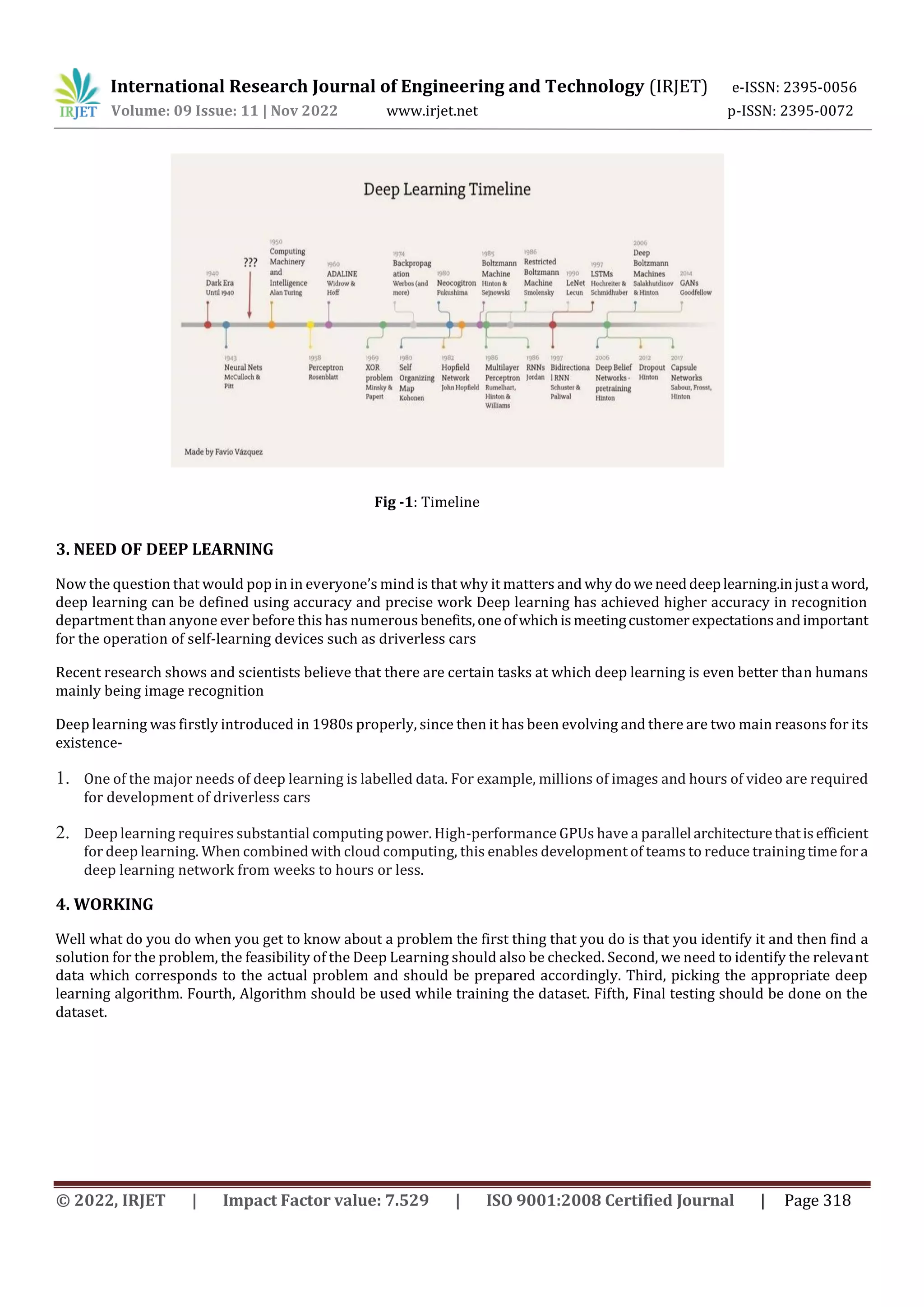
Fig -1: Timeline
International Research Journal of Engineering and Technology (IRJET) e-ISSN: 2395-0056
Volume: 09 Issue: 11 | Nov 2022 www.irjet.net p-ISSN: 2395-0072
© 2022, IRJET | Impact Factor value: 7.529 | ISO 9001:2008 Certified Journal | Page 319
Fig -1: Flow Graph
Most deep learning methods use neural network architectures,whichiswhydeeplearningmodelsareoftenmentionedasdeep
neural networks.
The term “deep” usually refers to the number of hidden layers within the neural network. [1] Generally, neural networks just
contain 2-3 hidden layers, while deep networks can have as many as 150.
Deep learning models are trained by using large sets of labelled data and neural network architectures that learn features
automatically from the data without the need for manual feature extraction.
Fig -1: Model
One of the foremost popular sorts of deep neural networks is understood as convolutional neural networks(CNN orConvNet).
A CNN convolves learned features with input file, and uses 2D convolutional layers, making this architecture compatible to
processing 2D data, like images.
International Research Journal of Engineering and Technology (IRJET) e-ISSN: 2395-0056
Volume: 09 Issue: 11 | Nov 2022 www.irjet.net p-ISSN: 2395-0072
© 2022, IRJET | Impact Factor value: 7.529 | ISO 9001:2008 Certified Journal | Page 320
CNNs eliminate the necessity for manual feature extraction, so you are doing not got to identify features wont to classify
images.[1] The CNN works by extractingfeaturesdirectlyfromimages.Therelevantfeaturesaren'tpre-trained;they'relearned
while the network trains on a set of images. This automated feature extraction makes deeplearningmodelshighlyaccuratefor
computer vision tasks like object classification.
Fig -1: CNN Working
CNNs learn to detect different features of a picture using tens or many hidden layers. Every hidden layer increases the
complexity of the learned image features. For example, the primary hidden layer could find out how to detect edges, and
therefore the last learns the way to detect more complex shapes specifically catered to the form of the object we are trying to
recognize.
5. FUTURE PROSPECTS
It is difficult to know about everything happening in the artificial intelligenceworld.Withsomanypapersbeing released,itcan
be difficult to talk about the reality which is the present existence and future prospects.
1. Architecture Search
Designing neural network architectures requires more art than science. Mostindividualsjustgraba well-likedspecificationoff
the shelf. Does anybody wonder how were these cutting-edge architectures discovered? The answer is simple- trial anderror
using powerful GPU computers.
The decision of when to use max-pooling, which convolution filter size to use, where to feature dropout layers is simply about
random guessing.
2. Compressing Neural Networks
Training deep learning networks may be a good way to urgeconversantinmemory.Atypical laptophas16GBofRAMmemory.
The latest iPhone has around 4 GB of RAM. The VGG16 image classification network, with around 144 million parameters, is
around 500 MB. Due to the big size of those networks it's very difficult to create mobile AI apps and apps that use multiple
networks. Having the networks loaded into RAM memory enables much faster computing time.
Research on compressingthesenetworkslikeDeepCompressionworksveryalmostlikeJPEGimagecompression, Quantization
and Huffman encoding. Deep Compression can reduce VGG-16 from 552 MB to 11.3 MB with no loss of accuracy.
3. GAN-based Data Augmentation
A major challenge while building deep learning models is the dataset. Deep learning models require a lot of data. GANs are a
promising generative modelling framework that can conclude new data points from a dataset. This can be used to create
humungous datasets from small ones.
International Research Journal of Engineering and Technology (IRJET) e-ISSN: 2395-0056
Volume: 09 Issue: 11 | Nov 2022 www.irjet.net p-ISSN: 2395-0072
© 2022, IRJET | Impact Factor value: 7.529 | ISO 9001:2008 Certified Journal | Page 321
6. APPLICATIONS
1.Automatic Text Generation – Corpus of text is learned and from this model new text is generated, word-by-word
eventually this model can learn how to spell, form sentences, and use punctuations.
2.Healthcare – It helps in diagnosing many diseases and helps in the treatment process withthehelpofmedical imaging[2].
3.Automatic Machine Translation – Certain words, sentences, or phrases in one language is transformed into another
language (Deep Learning is achieving top results in the areas of text, images).
4.Image Recognition – Recognizing and identifying people and objects in images as well being able to understand content
and context. [4] This area is already being used in Tourism and Gaming industry just to name a few
5.Predicting Earthquakes – Teaches a computer to perform viscoelastic computations which are used in predicting
earthquakes. [6]
7. CONCLUSIONS
We are on the verge of creating or might have successfully created the most intriguing technology in the history of mankind.
Thus, Artificial Intelligence (Deep Learning) is the most interesting topic in the field of Science and Technology. According to
recent research there was news that certain robotswerespeakinganaltogetherdifferentlanguageandpossiblymalfunctioned,
however as soon as engineers monitored the robots they concluded that machines had developed a language of their ownand
were communicating effectively. Later they were shut down.
So there are hundreds of possibilities in the land of artificial intelligence and specially in deep learning. Deep Learning can
change our lives completely with the advancement in technology. Once we can calibrate our braintosucha level wherewecan
unlock more capabilities of our brain, it can be breakthrough research for the mankind.
A major revolution is undertaking, and we are a part of it. Therefore, we must help in whatever way we can and contribute
towards the technology. Deep Learning has a lot of potential even beyond our imagination. Huge technological giant Elon
Musk’s new company Neuralink is profoundly researching on deep learning and neural networks. Apple has also beendoinga
lot of research lately and has filed various patents related to artificial intelligence. Also, when such established companies
invest billions of dollars in the technology we can very easily estimate its potential and capabilities.
REFERENCES
1. Yann LeCun, Yoshua Bengio & Geoffrey Hinton, Deep learning
2. Jonghoon Kim, Prospects of deep learning for medical imaging
3. S. M. S. Islam, S. Rahman, M. M. Rahman, E. K. Dey and M. Shoyaib, Application of deep learning to computer vision: A
comprehensive study
4. Kaiming He, Deep Residual Learning for Image Recognition
5. Deng, L. (2014). A tutorial survey of architectures, algorithms, and applications for deep learning.

Unraveling Information about Deep Learning

  • 1.
    International Research Journalof Engineering and Technology (IRJET) e-ISSN: 2395-0056 Volume: 09 Issue: 11 | Nov 2022 www.irjet.net p-ISSN: 2395-0072 © 2022, IRJET | Impact Factor value: 7.529 | ISO 9001:2008 Certified Journal | Page 316 Unraveling Information about Deep Learning Simardeep Singh Mehta Amity University Noida, Amity Road, Sector 125,Noida, Uttar Pradesh 201301 ---------------------------------------------------------------------***--------------------------------------------------------------------- Abstract - A new field of machine learning (ML) study is deep learning. There are numerous concealedartificialneuralnetwork layers in it. The deep learning methodology uses high level model abstractions and transformations in massive databases. Deep learning architectures have recently made major strides in a variety of domains, and these developments have already had a big impact on artificial intelligence. Additionally, the advantages of the layer-based hierarchy and nonlinear operations of deep learning methodology are discussed and contrasted with those of more traditional techniques in widely used applications. It also has a significant impact on face recognition methods, as demonstrated by Facebook'shighlyeffectiveDeep Facetechnology, which enables users to tag photos. 1. INTRODUCTION Artificial neural systems are the foundation of deep learning, which is a branch of AI that mimics the human brain in a similar way to how neural systems function. We don't have to explicitly programme everythingindeeplearning.Deeplearningisnota brand-new concept. At this point, it has been around for two or three years. Because we didn't have as much planning power and information in the past, it's on hype these days. Deep learning and AI entered the scene as the preparing power increased tremendously over the last 20 years. 1.1 A formal defining of deep learning is- Deep learning is a particular kind of machine learning that achieves great power and flexibility by learning to represent the world as a nested hierarchy of concepts, with each concept defined in relation to simpler concepts, and more abstract representations computed in terms of less abstract ones. In human brain approximately 100 billion neurons all together this is a picture of an individual neuron, and each neuron is connected through thousands of their neighbors. The question here is how we recreate these neurons in a computer. So, we create an artificial structure called an artificial neural net where we have nodes or neurons. We have some neurons for input value and some for-output value and in between, there may be lots of neurons interconnected in the hidden layer. [1] AI empowered computers benefited from genuine crude informationormodels,andit attempts toextricatedesigns fromitand settle on better choices without anyone else. A portion of the AI calculations are strategic relapse, SVM and so forth. The presentation of these AI calculations relies vigorously upon the portrayal oftheinformationthataregiven.Eachsnippetof data remembered for the portrayal is known as highlights and these calculations figures out how to utilize these highlights to extricate designs or to get information. Nevertheless, sometimes it might be challenging to discern which details should be deleted. For instance, if we were trying to identify cars from a photograph, we may enjoy the opportunity to use the proximity of the wheel asa cue.However,intermsof pixel values, it is challenging to depict what a wheel looks like. Using AI to extract value from those traits (representation) but not the highlights themselves is one way to solve this problem. This approach is called portrayal learning. Once more, if the calculation learns without the assistance of anyone else and with very little human 2. HISTORY Long time back in 1943, deep learning was introduced by Warren McCulloch and Walter Pitts, when they created a computer based on neural networks in the brain Warren McColluchandWalterPittsmadea combinationof algorithmsandmathematical evolutions which is known as threshold magic in order to replicate the thought process. And thus, after that deep learning has evolved a lot and there have been two major breakthrough moments. [6] One of these was in 1960 by Henry J Kelly which was the development of basics of continuous beam propagation model Later on in 1962 Stuart Drefyus found a simple version based on the chain rule One of the earliest roles to develop deep learning algorithms was in 1965 where two people Alexey Grigoryevich IvakhnenkoandValentinGrigor’evichLapa usedmodelsofpolynomial functionswhichwereanalyzedstatistically
  • 2.
    International Research Journalof Engineering and Technology (IRJET) e-ISSN: 2395-0056 Volume: 09 Issue: 11 | Nov 2022 www.irjet.net p-ISSN: 2395-0072 © 2022, IRJET | Impact Factor value: 7.529 | ISO 9001:2008 Certified Journal | Page 317 There were various hurdles too in the development of it which is one of the most important and interesting topics in today’s world. A major setback was when in 1970 due to lack of funding the research aboutartificial intelligenceanddeeplearninghad to restricted. But even after such impossible conditions certain individuals researched aboutitevenafterlack offinancial help The term convolutional neural networks which we hear the most in today’s time whenever we talk about deep learning was used the first time by Kunihiko Fukushima. [6] He himself designed the neural networks usingconvolutional layers Hecreated a multilayer and hierarchical design in1979 which was termedasneocognitron.Ithelpedthecomputertolearnvisual patterns. The networks resembled modern versions and were trained to activate multiple recurring layers. Later then the world was introduced with the FORTAN CODE for Back Propagation. This was developed in the 1970’s and it used numerous errors to train the deep learning models. This became popular later on when a thesis written by Seppo Linnainmaa including The FORTAN CODE became available and known. [5] Even though the fact that it was developed in 1970 it wasn’t under action in neural networks until the year 1985. Yann LeCunn was the first one to explain the and provide a practical demonstration in 1989.Something thathedidwasthathe combined convolutional networks with back propagation in order to scan handwritten digits As the next decade kicked in artificial intelligence and deep learning did not make a lot of progress. in 1995 Vladimir Vapnik and Dana Cortes developed the support vector machine which is a system for mapping and recognizing similar data. Long short-term memory or LSTM was developed in 1997 by Juergen Schmidhuber and Sepp Hochreiter for recurrent neural networks. Chart -1: History Going into the next century The Vanishing Gradient downside came into the year 2000 once “features” (lessons) fashioned in lower layers weren't being learned by the higher layers since no learning signal reached these layers were discovered. This wasn'tan elementarydownsideforall neural networkshoweveritwasrestrictedto solely gradient-based learning ways. In 2001, a quest report compiled by the META cluster (now known as Gartner) came up with the challenges andopportunities of the three-dimensional knowledge growth. This report marked the onslaught of massive knowledge and represented the increasing volume and speed of information as increasing the vary of information sources and kinds.
  • 3.
    International Research Journalof Engineering and Technology (IRJET) e-ISSN: 2395-0056 Volume: 09 Issue: 11 | Nov 2022 www.irjet.net p-ISSN: 2395-0072 © 2022, IRJET | Impact Factor value: 7.529 | ISO 9001:2008 Certified Journal | Page 318 3. NEED OF DEEP LEARNING Now the question that would pop in in everyone’s mind is that why it matters and why dowe needdeeplearning.injusta word, deep learning can be defined using accuracy and precise work Deep learning has achieved higher accuracy in recognition department than anyone ever before this has numerous benefits,oneofwhichismeetingcustomerexpectations andimportant for the operation of self-learning devices such as driverless cars Recent research shows and scientists believe that there are certain tasks at which deep learning is even better than humans mainly being image recognition Deep learning was firstly introduced in 1980s properly, since then it has been evolving and there are two main reasons for its existence- 1. One of the major needs of deep learning is labelled data. For example, millions of images and hours of video are required for development of driverless cars 2. Deep learning requires substantial computing power. High-performance GPUs have a parallel architecturethatisefficient for deep learning. When combined with cloud computing, this enables development of teams to reduce training timefora deep learning network from weeks to hours or less. 4. WORKING Well what do you do when you get to know about a problem the first thing that you do is that you identify it and then find a solution for the problem, the feasibility of the Deep Learning should also be checked. Second, we need to identify the relevant data which corresponds to the actual problem and should be prepared accordingly. Third, picking the appropriate deep learning algorithm. Fourth, Algorithm should be used while training the dataset. Fifth, Final testing should be done on the dataset. Fig -1: Timeline
  • 4.
    International Research Journalof Engineering and Technology (IRJET) e-ISSN: 2395-0056 Volume: 09 Issue: 11 | Nov 2022 www.irjet.net p-ISSN: 2395-0072 © 2022, IRJET | Impact Factor value: 7.529 | ISO 9001:2008 Certified Journal | Page 319 Fig -1: Flow Graph Most deep learning methods use neural network architectures,whichiswhydeeplearningmodelsareoftenmentionedasdeep neural networks. The term “deep” usually refers to the number of hidden layers within the neural network. [1] Generally, neural networks just contain 2-3 hidden layers, while deep networks can have as many as 150. Deep learning models are trained by using large sets of labelled data and neural network architectures that learn features automatically from the data without the need for manual feature extraction. Fig -1: Model One of the foremost popular sorts of deep neural networks is understood as convolutional neural networks(CNN orConvNet). A CNN convolves learned features with input file, and uses 2D convolutional layers, making this architecture compatible to processing 2D data, like images.
  • 5.
    International Research Journalof Engineering and Technology (IRJET) e-ISSN: 2395-0056 Volume: 09 Issue: 11 | Nov 2022 www.irjet.net p-ISSN: 2395-0072 © 2022, IRJET | Impact Factor value: 7.529 | ISO 9001:2008 Certified Journal | Page 320 CNNs eliminate the necessity for manual feature extraction, so you are doing not got to identify features wont to classify images.[1] The CNN works by extractingfeaturesdirectlyfromimages.Therelevantfeaturesaren'tpre-trained;they'relearned while the network trains on a set of images. This automated feature extraction makes deeplearningmodelshighlyaccuratefor computer vision tasks like object classification. Fig -1: CNN Working CNNs learn to detect different features of a picture using tens or many hidden layers. Every hidden layer increases the complexity of the learned image features. For example, the primary hidden layer could find out how to detect edges, and therefore the last learns the way to detect more complex shapes specifically catered to the form of the object we are trying to recognize. 5. FUTURE PROSPECTS It is difficult to know about everything happening in the artificial intelligenceworld.Withsomanypapersbeing released,itcan be difficult to talk about the reality which is the present existence and future prospects. 1. Architecture Search Designing neural network architectures requires more art than science. Mostindividualsjustgraba well-likedspecificationoff the shelf. Does anybody wonder how were these cutting-edge architectures discovered? The answer is simple- trial anderror using powerful GPU computers. The decision of when to use max-pooling, which convolution filter size to use, where to feature dropout layers is simply about random guessing. 2. Compressing Neural Networks Training deep learning networks may be a good way to urgeconversantinmemory.Atypical laptophas16GBofRAMmemory. The latest iPhone has around 4 GB of RAM. The VGG16 image classification network, with around 144 million parameters, is around 500 MB. Due to the big size of those networks it's very difficult to create mobile AI apps and apps that use multiple networks. Having the networks loaded into RAM memory enables much faster computing time. Research on compressingthesenetworkslikeDeepCompressionworksveryalmostlikeJPEGimagecompression, Quantization and Huffman encoding. Deep Compression can reduce VGG-16 from 552 MB to 11.3 MB with no loss of accuracy. 3. GAN-based Data Augmentation A major challenge while building deep learning models is the dataset. Deep learning models require a lot of data. GANs are a promising generative modelling framework that can conclude new data points from a dataset. This can be used to create humungous datasets from small ones.
  • 6.
    International Research Journalof Engineering and Technology (IRJET) e-ISSN: 2395-0056 Volume: 09 Issue: 11 | Nov 2022 www.irjet.net p-ISSN: 2395-0072 © 2022, IRJET | Impact Factor value: 7.529 | ISO 9001:2008 Certified Journal | Page 321 6. APPLICATIONS 1.Automatic Text Generation – Corpus of text is learned and from this model new text is generated, word-by-word eventually this model can learn how to spell, form sentences, and use punctuations. 2.Healthcare – It helps in diagnosing many diseases and helps in the treatment process withthehelpofmedical imaging[2]. 3.Automatic Machine Translation – Certain words, sentences, or phrases in one language is transformed into another language (Deep Learning is achieving top results in the areas of text, images). 4.Image Recognition – Recognizing and identifying people and objects in images as well being able to understand content and context. [4] This area is already being used in Tourism and Gaming industry just to name a few 5.Predicting Earthquakes – Teaches a computer to perform viscoelastic computations which are used in predicting earthquakes. [6] 7. CONCLUSIONS We are on the verge of creating or might have successfully created the most intriguing technology in the history of mankind. Thus, Artificial Intelligence (Deep Learning) is the most interesting topic in the field of Science and Technology. According to recent research there was news that certain robotswerespeakinganaltogetherdifferentlanguageandpossiblymalfunctioned, however as soon as engineers monitored the robots they concluded that machines had developed a language of their ownand were communicating effectively. Later they were shut down. So there are hundreds of possibilities in the land of artificial intelligence and specially in deep learning. Deep Learning can change our lives completely with the advancement in technology. Once we can calibrate our braintosucha level wherewecan unlock more capabilities of our brain, it can be breakthrough research for the mankind. A major revolution is undertaking, and we are a part of it. Therefore, we must help in whatever way we can and contribute towards the technology. Deep Learning has a lot of potential even beyond our imagination. Huge technological giant Elon Musk’s new company Neuralink is profoundly researching on deep learning and neural networks. Apple has also beendoinga lot of research lately and has filed various patents related to artificial intelligence. Also, when such established companies invest billions of dollars in the technology we can very easily estimate its potential and capabilities. REFERENCES 1. Yann LeCun, Yoshua Bengio & Geoffrey Hinton, Deep learning 2. Jonghoon Kim, Prospects of deep learning for medical imaging 3. S. M. S. Islam, S. Rahman, M. M. Rahman, E. K. Dey and M. Shoyaib, Application of deep learning to computer vision: A comprehensive study 4. Kaiming He, Deep Residual Learning for Image Recognition 5. Deng, L. (2014). A tutorial survey of architectures, algorithms, and applications for deep learning.