1
Conservation and Climate
Change
Patrick Grady
GIS/Data Manager
PICCC/PICSC
patrick.grady@piccc.net
(808) 687-6175
www.piccc.net
www.tinyurl.com/PacificCSC
PICSC/PICCC PROJECT: A Landscape-based assessment of climate change vulnerability for all
native Hawaiian plants
AGENCIES: Pacific Islands Climate Change Cooperative (PICCC); University of Hawaiʻi at
Hilo (UHH); U.S. Geological Survey (USGS); U.S Fish & Wildlife Service
(USFWS); Hawaiʻi Cooperative Studies Unit (HCSU); The Nature Conservancy
(TNC); United States Department of Agriculture (USDA)
PRINCIPAL
INVESTIGATOR: Lucas Fortini (PICCC,USGS)
WORKING GROUP: Jonathan Price (UHH); Jim Jacobi (USGS); Adam Vorsino (USFWS); Jeff Burgett
(PICCC,USFWS); Kevin Brinck (HCSU); Fred Amidon (USFWS); Steve Miller
(USFWS); Sam `Ohukani`ohi`a Gon III (TNC); Gregory Koob (USDA); Eben Paxton
(USGS)
Hawaii a center of plant
endangerment and extinction
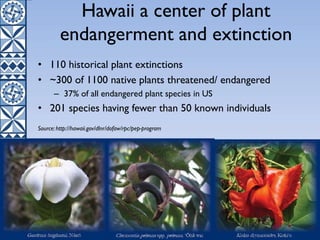
• 110 historical plant extinctions
• ~300 of 1100 native plants threatened/ endangered
– 37% of all endangered plant species in US
• 201 species having fewer than 50 known individuals
Source: http://hawaii.gov/dlnr/dofaw/rpc/pep-program
3
Hawaiian native plant vulnerability
assessment (VA)
• Goal: Evaluate the vulnerability of Main Hawaiian Island
terrestrial plant species to climate change
– All Main Hawaiian Island terrestrial native plants
(~1100) are initially considered
• Iterative process
– First iteration a landscape based analysis
– Resulting framework potentially applied to other
species groups, other resource types
4
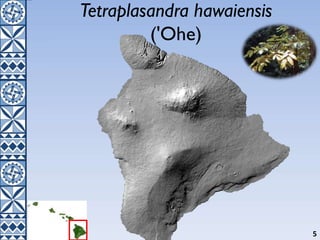
Tetraplasandra hawaiensis
('Ohe)
5
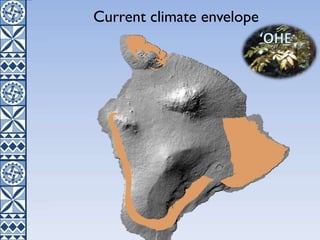
Current climate envelope
7
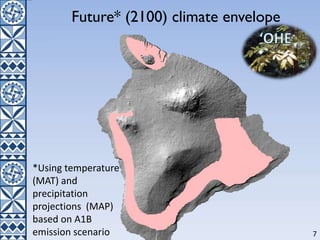
Future* (2100) climate envelope
*Using temperature
(MAT) and
precipitation
projections (MAP)
based on A1B
emission scenario
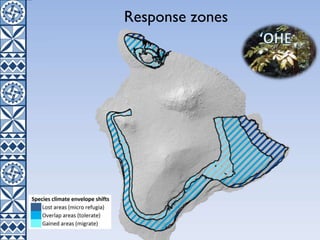
Response zones
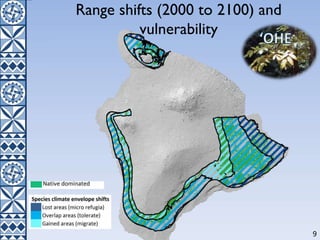
Range shifts (2000 to 2100) and
vulnerability
9
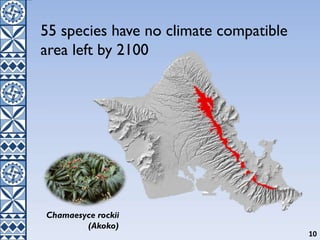
55 species have no climate compatible
area left by 2100
10
Chamaesyce rockii
(Akoko)
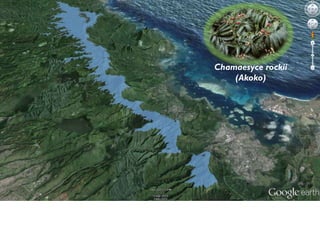
Chamaesyce rockii
(Akoko)
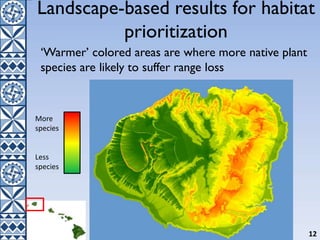
Landscape-based results for habitat
prioritization
ā€˜Warmer’ colored areas are where more native plant
species are likely to suffer range loss
12
More
species
Less
species
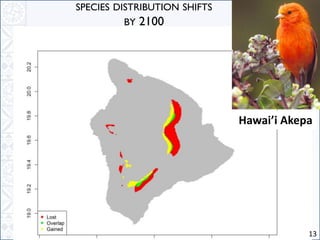
13
Hawai’i Akepa
SPECIES DISTRIBUTION SHIFTS
BY 2100
14
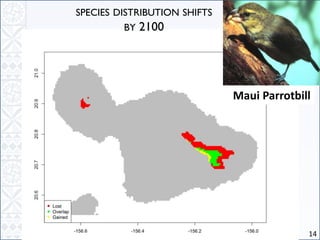
SPECIES DISTRIBUTION SHIFTS
BY 2100
Maui Parrotbill
PICSC/PICCC PROJECT: Modeling climate-driven changes to dominant vegetation in the
Hawaiian Islands
AGENCIES: Pacific Islands Climate Science Center (PICSC); Pacific Islands Climate
Change Cooperative (PICCC); University of Hawaiʻi at Hilo (UHH); U.S.
Geological Survey (USGS); University of Hawaiiʻi at Mānoa (UHM);
International Pacific Research Center (IPRC); NOAA
PRINCIPAL
INVESTIGATORS: Jonathan Price (UHH); Jim Jacobi (USGS)
RESEARCHER: Tamara M. Wong (UHH)
WORKING GROUP: Tom Giambelluca (UHM); Lucas Fortini (PICCC, USGS), Oliver Elison Timm
(University of Albany); Henry Diaz (NOAA); Michael Samuel (USGS); Carter
Atkinson (USGS); Dennis Lapointe (USGS)
Modeling climate-driven changes to
dominant vegetation in the Hawaiian Islands
• The goal of this study is to utilize a vast array of quantitative
vegetation plot data to model dominant vegetation composition.
• Hawaiian vegetation is unusual in that most ecologically important
species occur consistently across a wide range of physical
environments, but vary greatly in local abundance, largely driven by
climate.
• Changes in climate could also alter species' abundance, capacity to
persist within predicted ranges, and compete for local regeneration
sites.
• Uses predictive species distribution modeling (SDM) as it is an
important tool in addressing conservation biology and global change
issues.
• Whereas explicit spatial habitat models typically predict probability of
occurrence, this project aims to generate species-specific models of
estimated percent cover based in relation to several independent
variables (precipitation, temperature, substrate age, etc.).
• Has compiled 145,000 vegetation data records for over 4,000
locations into a relational database in MS Access.
• These sites represent a considerable proportion of the overall
climate variability in Hawaiʻi.
• Novel correlative species abundance models were generated using
powerful nonlinear statistical methods, quantitative vegetation plot
data, functionally relevant environmental variables, and downscaled
climate models
• Aimed to identify trends and predicted future shifts in key native
plant species in the Hawaiian Islands.
• As projecting species-specific abundance changes can complement
and improve predictive mapping of habitat quality, inform the
prioritization of habitat conservation and restoration efforts for
resource managers, and support ecological resilience in the future.
Modeling climate-driven changes to
dominant vegetation in the Hawaiian Islands
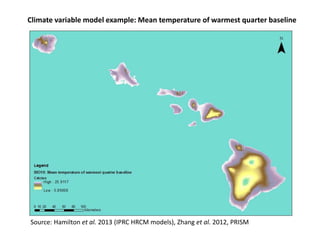
Climate variable model example: Mean temperature of warmest quarter baseline
Source: Hamilton et al. 2013 (IPRC HRCM models), Zhang et al. 2012, PRISM
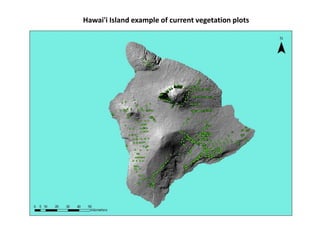
Hawai'i Island example of current vegetation plots
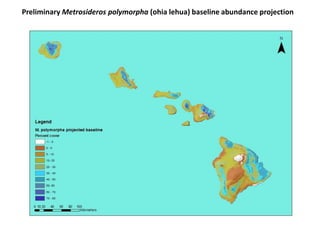
Preliminary Metrosideros polymorpha (ohia lehua) baseline abundance projection
21
Conservation and Climate
Change
Patrick Grady
GIS/Data Manager
PICCC/PICSC
patrick.grady@piccc.net
(808) 687-6175
www.piccc.net
www.tinyurl.com/PacificCSC

Conservation and Climate Change

  • 1.
    1 Conservation and Climate Change PatrickGrady GIS/Data Manager PICCC/PICSC patrick.grady@piccc.net (808) 687-6175 www.piccc.net www.tinyurl.com/PacificCSC
  • 2.
    PICSC/PICCC PROJECT: ALandscape-based assessment of climate change vulnerability for all native Hawaiian plants AGENCIES: Pacific Islands Climate Change Cooperative (PICCC); University of Hawaiʻi at Hilo (UHH); U.S. Geological Survey (USGS); U.S Fish & Wildlife Service (USFWS); Hawaiʻi Cooperative Studies Unit (HCSU); The Nature Conservancy (TNC); United States Department of Agriculture (USDA) PRINCIPAL INVESTIGATOR: Lucas Fortini (PICCC,USGS) WORKING GROUP: Jonathan Price (UHH); Jim Jacobi (USGS); Adam Vorsino (USFWS); Jeff Burgett (PICCC,USFWS); Kevin Brinck (HCSU); Fred Amidon (USFWS); Steve Miller (USFWS); Sam `Ohukani`ohi`a Gon III (TNC); Gregory Koob (USDA); Eben Paxton (USGS)
  • 3.
    Hawaii a centerof plant endangerment and extinction • 110 historical plant extinctions • ~300 of 1100 native plants threatened/ endangered – 37% of all endangered plant species in US • 201 species having fewer than 50 known individuals Source: http://hawaii.gov/dlnr/dofaw/rpc/pep-program 3
  • 4.
    Hawaiian native plantvulnerability assessment (VA) • Goal: Evaluate the vulnerability of Main Hawaiian Island terrestrial plant species to climate change – All Main Hawaiian Island terrestrial native plants (~1100) are initially considered • Iterative process – First iteration a landscape based analysis – Resulting framework potentially applied to other species groups, other resource types 4
  • 5.
  • 6.
  • 7.
    7 Future* (2100) climateenvelope *Using temperature (MAT) and precipitation projections (MAP) based on A1B emission scenario
  • 8.
  • 9.
    Range shifts (2000to 2100) and vulnerability 9
  • 10.
    55 species haveno climate compatible area left by 2100 10 Chamaesyce rockii (Akoko)
  • 11.
  • 12.
    Landscape-based results forhabitat prioritization ā€˜Warmer’ colored areas are where more native plant species are likely to suffer range loss 12 More species Less species
  • 13.
  • 14.
  • 15.
    PICSC/PICCC PROJECT: Modelingclimate-driven changes to dominant vegetation in the Hawaiian Islands AGENCIES: Pacific Islands Climate Science Center (PICSC); Pacific Islands Climate Change Cooperative (PICCC); University of Hawaiʻi at Hilo (UHH); U.S. Geological Survey (USGS); University of Hawaiiʻi at Mānoa (UHM); International Pacific Research Center (IPRC); NOAA PRINCIPAL INVESTIGATORS: Jonathan Price (UHH); Jim Jacobi (USGS) RESEARCHER: Tamara M. Wong (UHH) WORKING GROUP: Tom Giambelluca (UHM); Lucas Fortini (PICCC, USGS), Oliver Elison Timm (University of Albany); Henry Diaz (NOAA); Michael Samuel (USGS); Carter Atkinson (USGS); Dennis Lapointe (USGS)
  • 16.
    Modeling climate-driven changesto dominant vegetation in the Hawaiian Islands • The goal of this study is to utilize a vast array of quantitative vegetation plot data to model dominant vegetation composition. • Hawaiian vegetation is unusual in that most ecologically important species occur consistently across a wide range of physical environments, but vary greatly in local abundance, largely driven by climate. • Changes in climate could also alter species' abundance, capacity to persist within predicted ranges, and compete for local regeneration sites. • Uses predictive species distribution modeling (SDM) as it is an important tool in addressing conservation biology and global change issues. • Whereas explicit spatial habitat models typically predict probability of occurrence, this project aims to generate species-specific models of estimated percent cover based in relation to several independent variables (precipitation, temperature, substrate age, etc.).
  • 17.
    • Has compiled145,000 vegetation data records for over 4,000 locations into a relational database in MS Access. • These sites represent a considerable proportion of the overall climate variability in HawaiŹ»i. • Novel correlative species abundance models were generated using powerful nonlinear statistical methods, quantitative vegetation plot data, functionally relevant environmental variables, and downscaled climate models • Aimed to identify trends and predicted future shifts in key native plant species in the Hawaiian Islands. • As projecting species-specific abundance changes can complement and improve predictive mapping of habitat quality, inform the prioritization of habitat conservation and restoration efforts for resource managers, and support ecological resilience in the future. Modeling climate-driven changes to dominant vegetation in the Hawaiian Islands
  • 18.
    Climate variable modelexample: Mean temperature of warmest quarter baseline Source: Hamilton et al. 2013 (IPRC HRCM models), Zhang et al. 2012, PRISM
  • 19.
    Hawai'i Island exampleof current vegetation plots
  • 20.
    Preliminary Metrosideros polymorpha(ohia lehua) baseline abundance projection
  • 21.
    21 Conservation and Climate Change PatrickGrady GIS/Data Manager PICCC/PICSC patrick.grady@piccc.net (808) 687-6175 www.piccc.net www.tinyurl.com/PacificCSC

Editor's Notes

  • #4Ā - 110 historical plant extinctions and that number is growing Approx. 300 of nearly 1100 native plants threatened/ endangered 37% of all endangered plant species in US 201 species having fewer than 50 known individuals
  • #6Ā I am going to highlight the native Hawaiian plant ā€˜Ohe in this example of the VA’s findings and projections
  • #7Ā Here you can see the current climate envelope
  • #8Ā Here you can see the projected future climate envelope
  • #9Ā This slide shows the species response zones Lost areas or micro-refugia zones Overlap areas or tolerate zones Gained area or migration zones To come up with three zones: the microrefugia zone encompases climate-compatible areas that are lost by 2100, but where the species might persist over the long term in micro-climatic refugia; the toleration zone includes areas that remain compatible in climate between now and 2100, where individuals or populations may be able to tolerate projected changes in climate; and the migration zone includes areas beyond a species’ current climate-compatible areas but that by 2100 become suitable for the species.
  • #10Ā So, for instance, in our analysis a species is deemed more vulnerable if areas a species may populate/ migrate to in the future has limited compatible native vegetation, or if areas in which a species may tolerate change is too fragmented or highly suitable for invasion
  • #11Ā This image shows the existing climate envelope or current habitat for the Hawaiian Akoko - It is one of 55 species referred to as wink-out species essentially they are projected to become extinct by 2100 The Akoko is one of these species
  • #12Ā This slide gives an example of one way that the data can be made accessible to individuals. Along with GIS applications such as ArcGIS, we can utilize other useful visualization tools. Here we can see the existing climate envelope or habitat range for Akoko laid on top of aerial imagery available via Google Earth.
  • #13Ā Example of a how this data can be used to inform decision makers on the ground. In this example a natural resource manager could use the data to determine which areas to focus resources on for habitat preservation. Warmer colors like red indicate where a higher # of native plant species are likely to suffer range loss Greener colors indicaite where a lower # of species are likely to suffer range loss
  • #14Ā In addition to projecting vulnerability to all native Hawaiian plants, Lucas’s team took the data a step further and analyzed what this means for native Hawaiian forest birds. These next two slides will show species distribution shifts for two of our native Hawaiian forest birds. The red polygons show lost habitat, the yellow depicts gained and the green is essentially the overlap between lost and gained. - Here we can see this data for the Akepa
  • #15Ā Here we can see the data for the Maui Parrotbill
  • #17Ā Uses predictive species distribution modeling (SDM) - This is an important tool in addressing conservation biology and global change issues
  • #18Ā The research team has compiled 145,000 vegetation records for over 4,000 locations
  • #19Ā This map depicts the bioclimatic variable for Mean temperature of the warmest quarter baseline
  • #20Ā This simple map shows where the team utilized vegetation plots here on Hawwai’i
  • #21Ā A previous slide stated the use of powerful nonlinear statistical methods, quantitative vegetation plot data, functionally relevant environmental variables, and downscaled climate models to produce species abundance models. Here we see an example of this workflow in the form of an output as this map depicts baseline abundance projections for Ohia Lehua.