DOI Climate Science Centers &
National Climate Change and
Wildlife Science Center
U.S. Department of the Interior
U.S. Geological Survey
Support for Resource Management Decisions
Doug Beard, Chief
USGS National Climate Change & Wildlife
Science Center
State Wildlife Action Plan Workshop
NCTC,
June 5, 2013
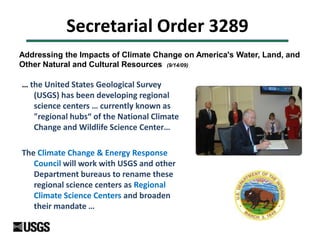
Secretarial Order 3289
… the United States Geological Survey
(USGS) has been developing regional
science centers … currently known as
"regional hubs“ of the National Climate
Change and Wildlife Science Center…
The Climate Change & Energy Response
Council will work with USGS and other
Department bureaus to rename these
regional science centers as Regional
Climate Science Centers and broaden
their mandate …
Addressing the Impacts of Climate Change on America's Water, Land, and
Other Natural and Cultural Resources (9/14/09)
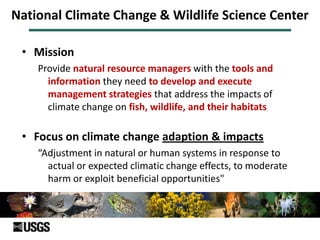
National Climate Change & Wildlife Science Center
• Mission
Provide natural resource managers with the tools and
information they need to develop and execute
management strategies that address the impacts of
climate change on fish, wildlife, and their habitats
• Focus on climate change adaption & impacts
“Adjustment in natural or human systems in response to
actual or expected climatic change effects, to moderate
harm or exploit beneficial opportunities"
NCCWSC & CSC Science Priorities
Science Infrastructure and Capacity Building Goals
1. Collaboration, Communication and Translation of Science
Results to Managers, Stakeholders and the Public interested
in Climate Change Activity.
2. Creation of a shared information and data management
platform.
3. Educate and train a core of climate scientists that will provide
expertise in the future.
4. Evaluate the impacts of the CSC/NCCWSC enterprise.
NCCWSC & CSC Science Priorities
Science Goals
1. Assess and synthesize our state of knowledge about climate
and land use change impacts to DOI natural and cultural
resources.
2. Perform vulnerability assessments of species and
ecosystems.
3. Understand the social-ecological impacts of climate and land
use change.
4. Understand the interactions between climate and the
physical, biological, and chemical forces that influence the
structure and functioning of ecosystems and the goods and
services they provide.
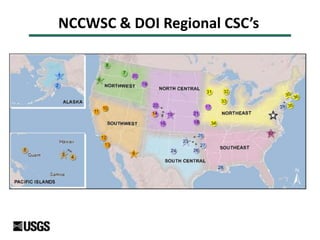
NCCWSC & DOI Regional CSC’s
2010 DOI CSCs
Alaska CSC – Located at Univ. of Alaska - Fairbanks in
Anchorage
• University of Alaska- Fairbanks PI –Scott Rupp
• USGS Director – Stephen Gray
2010 DOI CSCs
South East CSC – Established at North Carolina State University
• North Carolina State PI – Damian Shea
• USGS Director – Gerald McMahon
2010 DOI CSCs
Northwest CSC - Consortium of Univ. of Washington, Oregon State
Univ. and Univ. of Idaho
• Administrative Home – Oregon State University
• Oregon State PI – Phil Mote (also PI for NOAA RISA)
• University of Washington PI – Lisa Graumlich
• University of Idaho PI – Steve Daley-Laursen
• USGS Leader – Gustavo Bisbal
2011 DOI CSCs
North Central CSC – Located at Colorado State University
in consortium with Univ. of Colorado, Colorado School of
Mines, Iowa State, Univ. of Montana, Univ. of Nebraska-
Lincoln, Kansas State, Montana State, and Univ. of
Wyoming.
• Colorado State PI – Dennis Ojima
• USGS Director – Jeff Morisette
2011 DOI CSCs
South West CSC – Located at the Univ. of Arizona in
consortium with the Univ. of California – Davis, UCLA, Univ.
of Colorado, Desert Research Institute (Nevada) & Scripps
Institution
• University of Arizona PI – Jonathan Overpeck
• USGS Director – Steve Jackson
2012 DOI CSCs
Northeast CSC – located at University of Massachusetts-
Amherst, with College of Menominee Nation, Columbia
University, Marine Biological Laboratory, University of
Minnesota, University of Missouri at Columbia. University of
Wisconsin at Madison
• University of MA PI : Rick Palmer
• USGS Director–Mary Ratnaswamy
2012 DOI CSCs
Pacific Islands CSC : Located at University of Hawaii-
Manoa with University of Hawaii-Hilo, and
University of Guam
• University of HA- Manoa PI : Kevin Hamilton
• USGS Interim Coordinator – Dave Helweg
2012 DOI CSCs
South Central CSC Host: University of Oklahoma, with Texas
Tech, Louisiana State University, The Chickasaw Nation, The
Choctaw Nation of Oklahoma, Oklahoma State University,
and NOAA’s Geophysical Fluid Dynamics Laboratory
• University of OK PI – Berrian Moore
• USGS Director: Kim Winton
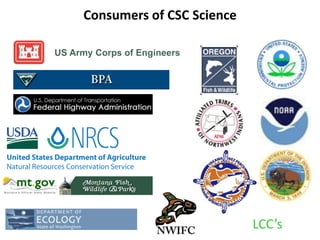
Consumers of CSC Science
LCC’s
U.S. Global Change Research Program:
• Provide “usable information on which to base policy decisions…”
• Knowledge that could be “readily usable by policymakers attempting
to formulate effective strategies for preventing, mitigating, and
adapting to the effects of global change”
(U.S. Congress, 1990)
Science results leading to knowledge that meets constituent needs
• Policy relevant – NOT prescriptive
• Directly reflects expressed constituent needs
• Understandable to users
• Available at needed times/places
• Accessible through media available to the user community
• Users and producers working together from the start
• Evaluation of success: science usefulness to society?
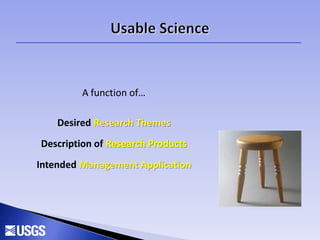
A function of…
Desired Research Themes
Description of Research Products
Intended Management Application
• Analyses
• Simulations
• Evaluations
• Assessments
• Probability
distributions
• Models
• Interpretive fact-
sheets
• Web applications
• Workshops
• Technical reports
• Peer-reviewed
publications
• Inventories
• Maps
• Time series animations
• Presentations
• Re-analyses
• Aerial photos
• Satellite remote
sensing
• Videos
• University courses
• Conceptual
frameworks
• Web portals
• GIS layers
• Datasets
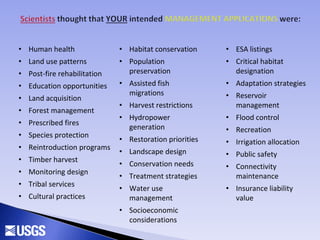
• Habitat conservation
• Population
preservation
• Assisted fish
migrations
• Harvest restrictions
• Hydropower
generation
• Restoration priorities
• Landscape design
• Conservation needs
• Treatment strategies
• Water use
management
• Socioeconomic
considerations
• Human health
• Land use patterns
• Post-fire rehabilitation
• Education opportunities
• Land acquisition
• Forest management
• Prescribed fires
• Species protection
• Reintroduction programs
• Timber harvest
• Monitoring design
• Tribal services
• Cultural practices
• ESA listings
• Critical habitat
designation
• Adaptation strategies
• Reservoir
management
• Flood control
• Recreation
• Irrigation allocation
• Public safety
• Connectivity
maintenance
• Insurance liability
value
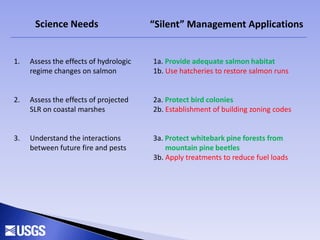
1. Assess the effects of hydrologic
regime changes on salmon
2. Assess the effects of projected
SLR on coastal marshes
3. Understand the interactions
between future fire and pests
Science Needs “Silent” Management Applications
1a. Provide adequate salmon habitat
1b. Use hatcheries to restore salmon runs
2a. Protect bird colonies
2b. Establishment of building zoning codes
3a. Protect whitebark pine forests from
mountain pine beetles
3b. Apply treatments to reduce fuel loads
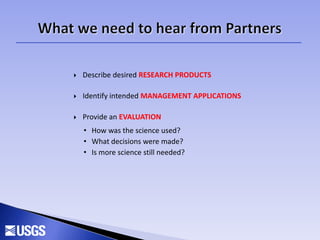
 Describe desired RESEARCH PRODUCTS
 Identify intended MANAGEMENT APPLICATIONS
 Provide an EVALUATION
• How was the science used?
• What decisions were made?
• Is more science still needed?
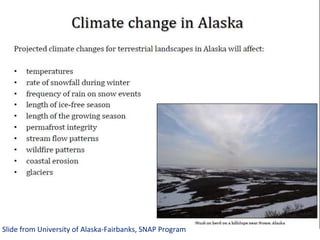
Slide from University of Alaska-Fairbanks, SNAP Program
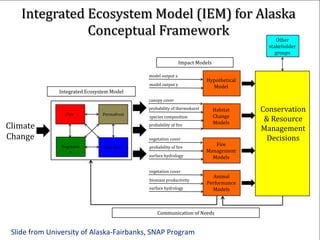
canopy cover
probability of fire
species composition
vegetation cover
probability of fire
surface hydrology
probability of thermokarst Habitat
Change
Models
Fire
Management
Models
Animal
Performance
Models
vegetation cover
biomass productivity
surface hydrology
Integrated Ecosystem Model (IEM) for Alaska
Conceptual Framework
Vegetatio
n
Climate
Change
Integrated Ecosystem Model
Fire Permafrost
Hydrology
Hypothetical
Model
model output x
model output y
Impact Models
Conservation
& Resource
Management
Decisions
Other
stakeholder
groups
Communication of Needs
Slide from University of Alaska-Fairbanks, SNAP Program
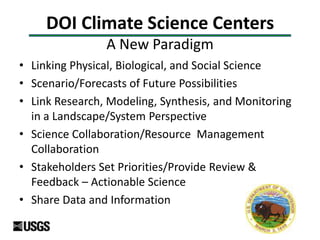
DOI Climate Science Centers
A New Paradigm
• Linking Physical, Biological, and Social Science
• Scenario/Forecasts of Future Possibilities
• Link Research, Modeling, Synthesis, and Monitoring
in a Landscape/System Perspective
• Science Collaboration/Resource Management
Collaboration
• Stakeholders Set Priorities/Provide Review &
Feedback – Actionable Science
• Share Data and Information
Slide from University of Alaska-Fairbanks, SNAP Program

State action plan june 2013 briefing

  • 1.
    DOI Climate ScienceCenters & National Climate Change and Wildlife Science Center U.S. Department of the Interior U.S. Geological Survey Support for Resource Management Decisions Doug Beard, Chief USGS National Climate Change & Wildlife Science Center State Wildlife Action Plan Workshop NCTC, June 5, 2013
  • 2.
    Secretarial Order 3289 …the United States Geological Survey (USGS) has been developing regional science centers … currently known as "regional hubs“ of the National Climate Change and Wildlife Science Center… The Climate Change & Energy Response Council will work with USGS and other Department bureaus to rename these regional science centers as Regional Climate Science Centers and broaden their mandate … Addressing the Impacts of Climate Change on America's Water, Land, and Other Natural and Cultural Resources (9/14/09)
  • 3.
    National Climate Change& Wildlife Science Center • Mission Provide natural resource managers with the tools and information they need to develop and execute management strategies that address the impacts of climate change on fish, wildlife, and their habitats • Focus on climate change adaption & impacts “Adjustment in natural or human systems in response to actual or expected climatic change effects, to moderate harm or exploit beneficial opportunities"
  • 4.
    NCCWSC & CSCScience Priorities Science Infrastructure and Capacity Building Goals 1. Collaboration, Communication and Translation of Science Results to Managers, Stakeholders and the Public interested in Climate Change Activity. 2. Creation of a shared information and data management platform. 3. Educate and train a core of climate scientists that will provide expertise in the future. 4. Evaluate the impacts of the CSC/NCCWSC enterprise.
  • 5.
    NCCWSC & CSCScience Priorities Science Goals 1. Assess and synthesize our state of knowledge about climate and land use change impacts to DOI natural and cultural resources. 2. Perform vulnerability assessments of species and ecosystems. 3. Understand the social-ecological impacts of climate and land use change. 4. Understand the interactions between climate and the physical, biological, and chemical forces that influence the structure and functioning of ecosystems and the goods and services they provide.
  • 6.
    NCCWSC & DOIRegional CSC’s
  • 7.
    2010 DOI CSCs AlaskaCSC – Located at Univ. of Alaska - Fairbanks in Anchorage • University of Alaska- Fairbanks PI –Scott Rupp • USGS Director – Stephen Gray
  • 8.
    2010 DOI CSCs SouthEast CSC – Established at North Carolina State University • North Carolina State PI – Damian Shea • USGS Director – Gerald McMahon
  • 9.
    2010 DOI CSCs NorthwestCSC - Consortium of Univ. of Washington, Oregon State Univ. and Univ. of Idaho • Administrative Home – Oregon State University • Oregon State PI – Phil Mote (also PI for NOAA RISA) • University of Washington PI – Lisa Graumlich • University of Idaho PI – Steve Daley-Laursen • USGS Leader – Gustavo Bisbal
  • 10.
    2011 DOI CSCs NorthCentral CSC – Located at Colorado State University in consortium with Univ. of Colorado, Colorado School of Mines, Iowa State, Univ. of Montana, Univ. of Nebraska- Lincoln, Kansas State, Montana State, and Univ. of Wyoming. • Colorado State PI – Dennis Ojima • USGS Director – Jeff Morisette
  • 11.
    2011 DOI CSCs SouthWest CSC – Located at the Univ. of Arizona in consortium with the Univ. of California – Davis, UCLA, Univ. of Colorado, Desert Research Institute (Nevada) & Scripps Institution • University of Arizona PI – Jonathan Overpeck • USGS Director – Steve Jackson
  • 12.
    2012 DOI CSCs NortheastCSC – located at University of Massachusetts- Amherst, with College of Menominee Nation, Columbia University, Marine Biological Laboratory, University of Minnesota, University of Missouri at Columbia. University of Wisconsin at Madison • University of MA PI : Rick Palmer • USGS Director–Mary Ratnaswamy
  • 13.
    2012 DOI CSCs PacificIslands CSC : Located at University of Hawaii- Manoa with University of Hawaii-Hilo, and University of Guam • University of HA- Manoa PI : Kevin Hamilton • USGS Interim Coordinator – Dave Helweg
  • 14.
    2012 DOI CSCs SouthCentral CSC Host: University of Oklahoma, with Texas Tech, Louisiana State University, The Chickasaw Nation, The Choctaw Nation of Oklahoma, Oklahoma State University, and NOAA’s Geophysical Fluid Dynamics Laboratory • University of OK PI – Berrian Moore • USGS Director: Kim Winton
  • 15.
    Consumers of CSCScience LCC’s
  • 16.
    U.S. Global ChangeResearch Program: • Provide “usable information on which to base policy decisions…” • Knowledge that could be “readily usable by policymakers attempting to formulate effective strategies for preventing, mitigating, and adapting to the effects of global change” (U.S. Congress, 1990)
  • 17.
    Science results leadingto knowledge that meets constituent needs • Policy relevant – NOT prescriptive • Directly reflects expressed constituent needs • Understandable to users • Available at needed times/places • Accessible through media available to the user community • Users and producers working together from the start • Evaluation of success: science usefulness to society?
  • 18.
    A function of… DesiredResearch Themes Description of Research Products Intended Management Application
  • 19.
    • Analyses • Simulations •Evaluations • Assessments • Probability distributions • Models • Interpretive fact- sheets • Web applications • Workshops • Technical reports • Peer-reviewed publications • Inventories • Maps • Time series animations • Presentations • Re-analyses • Aerial photos • Satellite remote sensing • Videos • University courses • Conceptual frameworks • Web portals • GIS layers • Datasets
  • 20.
    • Habitat conservation •Population preservation • Assisted fish migrations • Harvest restrictions • Hydropower generation • Restoration priorities • Landscape design • Conservation needs • Treatment strategies • Water use management • Socioeconomic considerations • Human health • Land use patterns • Post-fire rehabilitation • Education opportunities • Land acquisition • Forest management • Prescribed fires • Species protection • Reintroduction programs • Timber harvest • Monitoring design • Tribal services • Cultural practices • ESA listings • Critical habitat designation • Adaptation strategies • Reservoir management • Flood control • Recreation • Irrigation allocation • Public safety • Connectivity maintenance • Insurance liability value
  • 21.
    1. Assess theeffects of hydrologic regime changes on salmon 2. Assess the effects of projected SLR on coastal marshes 3. Understand the interactions between future fire and pests Science Needs “Silent” Management Applications 1a. Provide adequate salmon habitat 1b. Use hatcheries to restore salmon runs 2a. Protect bird colonies 2b. Establishment of building zoning codes 3a. Protect whitebark pine forests from mountain pine beetles 3b. Apply treatments to reduce fuel loads
  • 22.
     Describe desiredRESEARCH PRODUCTS  Identify intended MANAGEMENT APPLICATIONS  Provide an EVALUATION • How was the science used? • What decisions were made? • Is more science still needed?
  • 23.
    Slide from Universityof Alaska-Fairbanks, SNAP Program
  • 24.
    canopy cover probability offire species composition vegetation cover probability of fire surface hydrology probability of thermokarst Habitat Change Models Fire Management Models Animal Performance Models vegetation cover biomass productivity surface hydrology Integrated Ecosystem Model (IEM) for Alaska Conceptual Framework Vegetatio n Climate Change Integrated Ecosystem Model Fire Permafrost Hydrology Hypothetical Model model output x model output y Impact Models Conservation & Resource Management Decisions Other stakeholder groups Communication of Needs Slide from University of Alaska-Fairbanks, SNAP Program
  • 25.
    Slide from Universityof Alaska-Fairbanks, SNAP Program
  • 26.
    DOI Climate ScienceCenters A New Paradigm • Linking Physical, Biological, and Social Science • Scenario/Forecasts of Future Possibilities • Link Research, Modeling, Synthesis, and Monitoring in a Landscape/System Perspective • Science Collaboration/Resource Management Collaboration • Stakeholders Set Priorities/Provide Review & Feedback – Actionable Science • Share Data and Information
  • 27.
    Slide from Universityof Alaska-Fairbanks, SNAP Program

Editor's Notes

  • #3 Serve all missions of DOILandscape scale information on climate impacts and potential adaptationPartnership organization that focuses on priorities and fills information gapsData , information, models, and syntheses belong to the community at large
  • #4 -read missionRead goals The high level goals
  • #5 Serve all missions of DOILandscape scale information on climate impacts and potential adaptationPartnership organization that focuses on priorities and fills information gapsData , information, models, and syntheses belong to the community at large
  • #6 Serve all missions of DOILandscape scale information on climate impacts and potential adaptationPartnership organization that focuses on priorities and fills information gapsData , information, models, and syntheses belong to the community at large