Food:	
  Too	
  Good	
  to	
  Waste	
  
A	
  Food	
  Recycling	
  Case	
  Study	
  on	
  the	
  Island	
  of	
  Guam	
  
Renee	
  Schnabel	
  
University	
  of	
  Guam	
  Center	
  for	
  Island	
  Sustainability,	
  Dr.	
  Mari	
  Marutani	
  
University	
  of	
  San	
  Diego,	
  Department	
  of	
  Environmental	
  and	
  Ocean	
  Sciences	
  	
  
Introduc=on	
  
Approximately	
  one-­‐third	
  of	
  the	
  food	
  produced	
  for	
  human,	
  
consumpEon	
  is	
  disposed	
  which	
  is	
  about	
  1.3	
  billion	
  tons	
  per	
  year	
  
(FAO	
  2011).	
  In	
  the	
  US,	
  over	
  95%	
  of	
  unused	
  food	
  ends	
  up	
  in	
  landfills	
  
or	
  incinerators,	
  esEmated	
  at	
  35	
  million	
  tons	
  of	
  waste	
  per	
  year	
  (EPA	
  
2015).	
  Once	
  in	
  landfills,	
  food	
  breaks	
  down	
  to	
  produce	
  methane,	
  a	
  
strong	
  greenhouse	
  gas.	
  In	
  the	
  US,	
  about	
  18%	
  of	
  methane	
  emissions	
  
comes	
  from	
  landfills	
  (EPA	
  2013).	
  Reducing	
  food	
  wastes	
  and	
  
implemenEng	
  food	
  recycling	
  programs	
  has	
  been	
  receiving	
  
increasing	
  global	
  interest	
  and	
  acEon.	
  This	
  study	
  assesses	
  the	
  
importance	
  of	
  implemenEng	
  food	
  recycling	
  programs,	
  by	
  focusing	
  
on	
  a	
  small-­‐scale,	
  pilot	
  food	
  waste	
  recycling	
  program	
  conducted	
  by	
  
the	
  University	
  of	
  Guam’s	
  Center	
  for	
  Island	
  Sustainability	
  enEtled	
  
EcoFeed.	
  The	
  pilot	
  program	
  produces	
  compost	
  and	
  animal	
  feed	
  
from	
  collected	
  food	
  waste	
  to	
  reduce	
  the	
  amount	
  of	
  trash	
  in	
  the	
  
island’s	
  landfill.	
  
Results	
  
Discussion	
  
The	
  amount	
  of	
  total	
  food	
  waste	
  collected	
  in	
  the	
  first	
  7	
  months	
  of	
  
the	
  EcoFeed	
  program	
  (Figure	
  5)	
  shows	
  the	
  big	
  impact	
  that	
  a	
  small	
  
food	
  recycling	
  program	
  can	
  have	
  on	
  food	
  waste	
  diversion.	
  The	
  
EcoFeed	
  project	
  is	
  able	
  to:	


•  reduce	
  the	
  amount	
  of	
  trash	
  being	
  placed	
  in	
  landfills	
  
•  reuse	
  food	
  waste	
  to	
  feed	
  farm	
  animals	
  and	
  produce	
  compost	
  
•  recycle	
  nutrient	
  resources	
  from	
  food	
  waste	
  in	
  the	
  form	
  of	
  animal	
  
feed	
  or	
  plant	
  nutrients	
  and	
  soil	
  condiEoners	
  
Less	
  food	
  waste	
  being	
  dumped	
  in	
  the	
  island’s	
  landfill	
  results	
  in	
  less	
  
greenhouse	
  gases	
  being	
  emi[ed	
  into	
  the	
  atmosphere.	
  Such	
  a	
  small-­‐
scale	
  study	
  was	
  able	
  to	
  reduce,	
  reuse,	
  and	
  recycle	
  a	
  large	
  amount	
  of	
  
food	
  waste	
  from	
  only	
  4	
  food	
  venues	
  on	
  a	
  small	
  island.	
  Imagine	
  the	
  
posiEve	
  impact	
  a	
  larger	
  scale	
  study	
  can	
  have	
  on	
  the	
  environment.	
  	
  
Methods	
  
Food	
  waste	
  was	
  collected	
  daily	
  from	
  four	
  different	
  food	
  venues.	
  
The	
  food	
  waste	
  was	
  then	
  used	
  for	
  either	
  composEng	
  or	
  animal	
  
feed.	


Acknowledgments	
  
References	
  
•  Food	
  and	
  Agriculture	
  OrganizaEon	
  of	
  the	
  United	
  NaEons.	
  (2011)	
  
“Global	
  food	
  losses	
  and	
  food	
  waste.”	
  Rome.	
  	
  
•  Environmental	
  ProtecEon	
  Agency.	
  “Reducing	
  food	
  waste	
  basics.”	
  EPA.	
  
n.p.	
  Web.	
  5	
  Nov.	
  2015	
  
•  Environmental	
  ProtecEon	
  Agency.	
  (2015)	
  “Inventory	
  of	
  US	
  Greenhouse	
  
Gas	
  Emissions	
  and	
  Sinks:	
  1990-­‐2013.”	
  Washington.	
  
•  Hall,	
  K.D.,	
  Guo,	
  J.,	
  Dore,	
  M.,	
  Chow,	
  C.C.	
  (2009)	
  “The	
  progressive	
  impact	
  
of	
  food	
  waste	
  in	
  America	
  and	
  its	
  environmental	
  impact.”	
  PLoS	
  ONE.	
  
4(11)	


Figure	
  1.	
  The	
  process	
  of	
  the	
  compost	
  treatment.	


Figure	
  2.	
  The	
  process	
  of	
  food	
  waste	
  to	
  animal	
  feed	
  treatment.	
  	
  
Figure	
  3.	
  The	
  machine	
  used	
  to	
  process	
  
food	
  waste	
  into	
  animal	
  feed.	


Figure	
  4.	
  The	
  product	
  afer	
  the	
  process	
  
of	
  pulverizing,	
  sterilizing,	
  mixing,	
  and	
  
fermenEng	
  food	
  waste.	
  
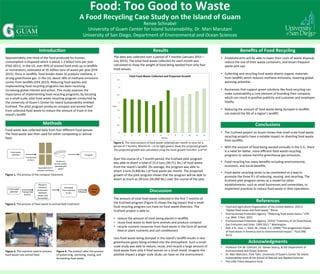
The	
  data	
  was	
  collected	
  over	
  a	
  period	
  of	
  7	
  months	
  (January	
  2015	
  –	
  
July	
  2015).	
  The	
  total	
  food	
  waste	
  collected	
  for	
  each	
  month	
  was	
  
calculated	
  to	
  show	
  the	
  weight	
  of	
  food	
  being	
  wasted	
  from	
  only	
  four	
  
food	
  venues.	
  
Figure	
  5.	
  The	
  total	
  amount	
  of	
  food	
  waste	
  collected	
  per	
  month	
  in	
  tons	
  for	
  a	
  
period	
  of	
  7	
  months.	
  Months	
  8	
  –	
  12	
  (in	
  light	
  green)	
  show	
  the	
  projected	
  growth.	
  
The	
  projected	
  growth	
  was	
  calculated	
  using	
  the	
  Excel	
  growth	
  funcEon:	
  y=b*mx.	


Over	
  the	
  course	
  of	
  a	
  7	
  month	
  period,	
  the	
  EcoFeed	
  pilot	
  program	
  
was	
  able	
  to	
  divert	
  a	
  total	
  of	
  15.4	
  tons	
  (30,711	
  lbs.)	
  of	
  food	
  waste	
  
from	
  the	
  island’s	
  landfill.	
  On	
  average,	
  the	
  program	
  was	
  able	
  to	
  
divert	
  2	
  tons	
  (4,400	
  lbs.)	
  of	
  food	
  waste	
  per	
  month.	
  The	
  projected	
  
growth	
  of	
  the	
  pilot	
  program	
  shows	
  that	
  the	
  program	
  will	
  be	
  able	
  to	
  
divert	
  as	
  much	
  as	
  28	
  tons	
  (56,000	
  lbs.)	
  over	
  the	
  course	
  of	
  the	
  year.	
  
Conclusions	
  
•  The	
  EcoFeed	
  project	
  on	
  Guam	
  shows	
  that	
  small-­‐scale	
  food	
  waste	
  
recycling	
  projects	
  have	
  a	
  notable	
  impact	
  on	
  diverEng	
  food	
  waste	
  
from	
  landfills.	
  	
  
•  With	
  the	
  amount	
  of	
  food	
  being	
  wasted	
  annually	
  in	
  the	
  U.S.,	
  there	
  
is	
  a	
  need	
  for	
  be[er,	
  more	
  efficient	
  food	
  waste	
  recycling	
  
programs	
  to	
  reduce	
  harmful	
  greenhouse	
  gas	
  emissions.	
  	
  
•  Food	
  recycling	
  has	
  many	
  benefits	
  including	
  environmental,	
  
economic,	
  and	
  social	
  benefits.	
  	
  
•  Food	
  waste	
  recycling	
  tends	
  to	
  be	
  overlooked	
  as	
  a	
  way	
  to	
  
promote	
  the	
  three	
  R’s	
  of	
  reducing,	
  reusing,	
  and	
  recycling.	
  The	
  
EcoFeed	
  pilot	
  program	
  serves	
  as	
  a	
  model	
  for	
  other	
  
establishments,	
  such	
  as	
  small	
  businesses	
  and	
  universiEes,	
  to	
  
implement	
  pracEces	
  to	
  reduce	
  food	
  waste	
  in	
  their	
  operaEons.	
  
•  Professor	
  Eric	
  M.	
  Cathcart,	
  Dr.	
  Steven	
  Searcy,	
  &	
  the	
  Department	
  of	
  
Environmental	
  and	
  Ocean	
  Sciences	
  
•  Dr.	
  Mari	
  Marutani,	
  Elvie	
  Tyler,	
  University	
  of	
  Guam’s	
  Center	
  for	
  Island	
  
Sustainability	
  team	
  &	
  the	
  School	
  of	
  Natural	
  and	
  Applied	
  Sciences	
  	
  
•  The	
  UOG	
  Triton	
  Research	
  Farm	


Benefits	
  of	
  Food	
  Recycling	
  
•  Establishments	
  will	
  be	
  able	
  to	
  lower	
  their	
  costs	
  of	
  waste	
  disposal,	
  
reduce	
  the	
  size	
  of	
  their	
  waste	
  containers,	
  and	
  lessen	
  frequent	
  
waste	
  pick-­‐ups.	
  
•  CollecEng	
  and	
  recycling	
  food	
  waste	
  diverts	
  organic	
  materials	
  
from	
  landfills	
  which	
  reduces	
  methane	
  emissions,	
  lowering	
  global	
  
warming	
  potenEal.	
  	
  
•  Businesses	
  that	
  support	
  green	
  soluEons	
  like	
  food	
  recycling	
  can	
  
make	
  sustainability	
  a	
  core	
  element	
  of	
  branding	
  their	
  company,	
  
which	
  can	
  result	
  in	
  posiEve	
  publicity	
  and	
  customer	
  and	
  employee	
  
loyalty.	
  
•  Reducing	
  the	
  amount	
  of	
  food	
  waste	
  being	
  dumped	
  in	
  landfills	
  
can	
  extend	
  the	
  life	
  of	
  a	
  region’s	
  landfill.	


FinalPoster

  • 1.
    Food:  Too  Good  to  Waste   A  Food  Recycling  Case  Study  on  the  Island  of  Guam   Renee  Schnabel   University  of  Guam  Center  for  Island  Sustainability,  Dr.  Mari  Marutani   University  of  San  Diego,  Department  of  Environmental  and  Ocean  Sciences     Introduc=on   Approximately  one-­‐third  of  the  food  produced  for  human,   consumpEon  is  disposed  which  is  about  1.3  billion  tons  per  year   (FAO  2011).  In  the  US,  over  95%  of  unused  food  ends  up  in  landfills   or  incinerators,  esEmated  at  35  million  tons  of  waste  per  year  (EPA   2015).  Once  in  landfills,  food  breaks  down  to  produce  methane,  a   strong  greenhouse  gas.  In  the  US,  about  18%  of  methane  emissions   comes  from  landfills  (EPA  2013).  Reducing  food  wastes  and   implemenEng  food  recycling  programs  has  been  receiving   increasing  global  interest  and  acEon.  This  study  assesses  the   importance  of  implemenEng  food  recycling  programs,  by  focusing   on  a  small-­‐scale,  pilot  food  waste  recycling  program  conducted  by   the  University  of  Guam’s  Center  for  Island  Sustainability  enEtled   EcoFeed.  The  pilot  program  produces  compost  and  animal  feed   from  collected  food  waste  to  reduce  the  amount  of  trash  in  the   island’s  landfill.   Results   Discussion   The  amount  of  total  food  waste  collected  in  the  first  7  months  of   the  EcoFeed  program  (Figure  5)  shows  the  big  impact  that  a  small   food  recycling  program  can  have  on  food  waste  diversion.  The   EcoFeed  project  is  able  to:       •  reduce  the  amount  of  trash  being  placed  in  landfills   •  reuse  food  waste  to  feed  farm  animals  and  produce  compost   •  recycle  nutrient  resources  from  food  waste  in  the  form  of  animal   feed  or  plant  nutrients  and  soil  condiEoners   Less  food  waste  being  dumped  in  the  island’s  landfill  results  in  less   greenhouse  gases  being  emi[ed  into  the  atmosphere.  Such  a  small-­‐ scale  study  was  able  to  reduce,  reuse,  and  recycle  a  large  amount  of   food  waste  from  only  4  food  venues  on  a  small  island.  Imagine  the   posiEve  impact  a  larger  scale  study  can  have  on  the  environment.     Methods   Food  waste  was  collected  daily  from  four  different  food  venues.   The  food  waste  was  then  used  for  either  composEng  or  animal   feed.       Acknowledgments   References   •  Food  and  Agriculture  OrganizaEon  of  the  United  NaEons.  (2011)   “Global  food  losses  and  food  waste.”  Rome.     •  Environmental  ProtecEon  Agency.  “Reducing  food  waste  basics.”  EPA.   n.p.  Web.  5  Nov.  2015   •  Environmental  ProtecEon  Agency.  (2015)  “Inventory  of  US  Greenhouse   Gas  Emissions  and  Sinks:  1990-­‐2013.”  Washington.   •  Hall,  K.D.,  Guo,  J.,  Dore,  M.,  Chow,  C.C.  (2009)  “The  progressive  impact   of  food  waste  in  America  and  its  environmental  impact.”  PLoS  ONE.   4(11)                       Figure  1.  The  process  of  the  compost  treatment.         Figure  2.  The  process  of  food  waste  to  animal  feed  treatment.     Figure  3.  The  machine  used  to  process   food  waste  into  animal  feed.         Figure  4.  The  product  afer  the  process   of  pulverizing,  sterilizing,  mixing,  and   fermenEng  food  waste.   The  data  was  collected  over  a  period  of  7  months  (January  2015  –   July  2015).  The  total  food  waste  collected  for  each  month  was   calculated  to  show  the  weight  of  food  being  wasted  from  only  four   food  venues.   Figure  5.  The  total  amount  of  food  waste  collected  per  month  in  tons  for  a   period  of  7  months.  Months  8  –  12  (in  light  green)  show  the  projected  growth.   The  projected  growth  was  calculated  using  the  Excel  growth  funcEon:  y=b*mx.             Over  the  course  of  a  7  month  period,  the  EcoFeed  pilot  program   was  able  to  divert  a  total  of  15.4  tons  (30,711  lbs.)  of  food  waste   from  the  island’s  landfill.  On  average,  the  program  was  able  to   divert  2  tons  (4,400  lbs.)  of  food  waste  per  month.  The  projected   growth  of  the  pilot  program  shows  that  the  program  will  be  able  to   divert  as  much  as  28  tons  (56,000  lbs.)  over  the  course  of  the  year.   Conclusions   •  The  EcoFeed  project  on  Guam  shows  that  small-­‐scale  food  waste   recycling  projects  have  a  notable  impact  on  diverEng  food  waste   from  landfills.     •  With  the  amount  of  food  being  wasted  annually  in  the  U.S.,  there   is  a  need  for  be[er,  more  efficient  food  waste  recycling   programs  to  reduce  harmful  greenhouse  gas  emissions.     •  Food  recycling  has  many  benefits  including  environmental,   economic,  and  social  benefits.     •  Food  waste  recycling  tends  to  be  overlooked  as  a  way  to   promote  the  three  R’s  of  reducing,  reusing,  and  recycling.  The   EcoFeed  pilot  program  serves  as  a  model  for  other   establishments,  such  as  small  businesses  and  universiEes,  to   implement  pracEces  to  reduce  food  waste  in  their  operaEons.   •  Professor  Eric  M.  Cathcart,  Dr.  Steven  Searcy,  &  the  Department  of   Environmental  and  Ocean  Sciences   •  Dr.  Mari  Marutani,  Elvie  Tyler,  University  of  Guam’s  Center  for  Island   Sustainability  team  &  the  School  of  Natural  and  Applied  Sciences     •  The  UOG  Triton  Research  Farm           Benefits  of  Food  Recycling   •  Establishments  will  be  able  to  lower  their  costs  of  waste  disposal,   reduce  the  size  of  their  waste  containers,  and  lessen  frequent   waste  pick-­‐ups.   •  CollecEng  and  recycling  food  waste  diverts  organic  materials   from  landfills  which  reduces  methane  emissions,  lowering  global   warming  potenEal.     •  Businesses  that  support  green  soluEons  like  food  recycling  can   make  sustainability  a  core  element  of  branding  their  company,   which  can  result  in  posiEve  publicity  and  customer  and  employee   loyalty.   •  Reducing  the  amount  of  food  waste  being  dumped  in  landfills   can  extend  the  life  of  a  region’s  landfill.