HIGH VOLTAGE DISTRIBUTION SYSTEM
AHTC-M.Tech 1 Departmentof EEE
TABLE OF CONTENTS
Contents Page No
INTRODUCTION 4
1. TYPES OF HVDS 4
1.1. Low Voltage Distribution system (LVDS) 4
1.2. High Voltage Distribution System (HVDS) 5
2. PROBLEMS AND MEASURES OF LVDS 5
2.1. Problems of Distribution Engineers 5
2.2. Short Term Measures 6
3. HVDS AND ITS TYPES.
3.1. Basic View of High Voltage Distribution System. 7
3.2. Different Types of High Voltage Distribution System. 7
 Phase Neutral HVDS (PN-HVDS) 8
 Phase-Phase HVDS (PP-HVDS) 10
 Phase-Ground HVDS (PG- HVDS) 12
4. ADVANTAGES OF HVDS COMPARED TO LVDS 13
5. CAPITAL COST 14
6. DISCUSSION 15
7. CONCLUSION 15
HIGH VOLTAGE DISTRIBUTION SYSTEM
AHTC-M.Tech 2 Departmentof EEE
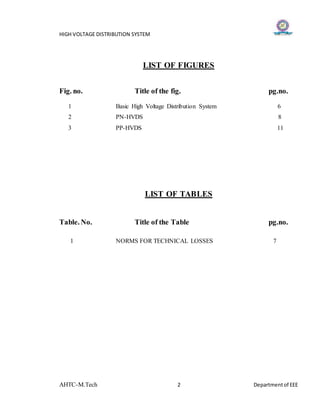
LIST OF FIGURES
Fig. no. Title of the fig. pg.no.
1 Basic High Voltage Distribution System 6
2 PN-HVDS 8
3 PP-HVDS 11
LIST OF TABLES
Table. No. Title of the Table pg.no.
1 NORMS FOR TECHNICAL LOSSES 7
HIGH VOLTAGE DISTRIBUTION SYSTEM
AHTC-M.Tech 3 Departmentof EEE
ABSTRACT
This project is about the comparison of existing low voltage distribution system (LVDS) with
proposed high voltage distribution system (HVDS). The study is based on a real low voltage
feeder in AP. The investigation is carried out to determine the losses in the existing low
voltage (LT) distribution system and then converting this low voltage distribution system to
proposed high voltage distribution system (HVDS) including bifurcation of load and replacing
the one large transformer with various transformers of small rating. Since loss reduction in
distribution system is of keen importance and main reason behind these losses is the use of
low voltage for distribution in existing system.
As for the low voltage in existing distribution system, current is high which leads to high
power losses and also allow the hooking and hence power theft. This paper aims at reducing
losses by using LT less or less LT ‘HVDS’ system and then determining the reduction in
losses in terms of units and annual savings in terms of rupees due to proposed method. To
check the feasibility of the proposed work, the annual saving and payback period of the
proposed method is also determined.
HIGH VOLTAGE DISTRIBUTION SYSTEM
AHTC-M.Tech 4 Departmentof EEE
HIGH VOLTAGE DISTRIBUTION SYSTEM
INTRODUCTION:
The comparison of existing low voltage distribution system (LVDS) with
proposed high voltage distribution system (HVDS). The study is based on a real low voltage
feeder in AP. The investigation is carried out to determine the losses in the existing low
voltage (LT) distribution system and then converting this low voltage distribution system to
proposed high voltage distribution system (HVDS) including bifurcation of load and replacing
the one large transformer with various transformers of small rating. Since loss reduction in
distribution system is of keen importance and main reason behind these losses is the use of
low voltage for distribution in existing system.
As for the low voltage in existing distribution system, current is high which leads to high
power losses and also allow the hooking and hence power theft. This paper aims at reducing
losses by using LT less or less LT ‘HVDS’ system and then determining the reduction in
losses in terms of units and annual savings in terms of rupees due to proposed method. To
check the feasibility of the proposed work, the annual saving and payback period of the
proposed method is also determined.
The two widely prevalent distribution practices in vogue across the world are:
 LVDS
 HVDS
Low Voltage Distribution System (LVDS):
 It is based on European practice.
 A Three phase transformer of considerable capacity is installed and LV lines are extended
to cater to a group of loads.
 This system is best suited to meet the concentrated loads of high load density.
HIGH VOLTAGE DISTRIBUTION SYSTEM
AHTC-M.Tech 5 Departmentof EEE
High Voltage Distribution System (HVDS):
 It is based on North American practice.
 A Three phases or single phase HV line is taken as near the load as possible and a
distribution transformer of appropriate capacity, generally one or more single phase
transformers are installed to feed one or a small group of loads, such that the length of the
LV lines is minimum or is eliminated altogether.
 This system is best suited to meet the scattered loads of low load density.
Problems of Distribution Engineers:
 Low Voltages
 Break Downs
 Pilferage
 DTR Failures
 High T & D Loses
 Accidents (L.T Lines)
 Voltage Fluctuations / Reliability of Supply
 Quality of Supply to the customer is poor
 Due to the poor quality of Supply the rated and use efficiency is poor
The above drawbacks are automatically solved by adopting HVDS
HIGH VOLTAGE DISTRIBUTION SYSTEM
AHTC-M.Tech 6 Departmentof EEE
Short Term Measures:
Different Types of short term measures are
 Network reconfiguration
 Network Reinforcement
 Shunt Compensation
 Automatic Voltage Booster
 Series Compensation
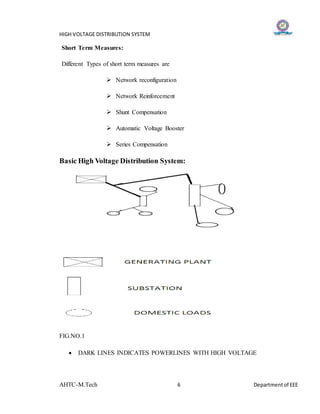
Basic High Voltage Distribution System:
FIG.NO.1
 DARK LINES INDICATES POWERLINES WITH HIGH VOLTAGE
HIGH VOLTAGE DISTRIBUTION SYSTEM
AHTC-M.Tech 7 Departmentof EEE
Different Types of High Voltage Distribution System:
There are three types of High Voltage distribution system in vogue:
 Phase Neutral HVDS (PN-HVDS)
 Phase Phase HVDS (PP-HVDS)
 Phase-Ground HVDS (PG HVDS)
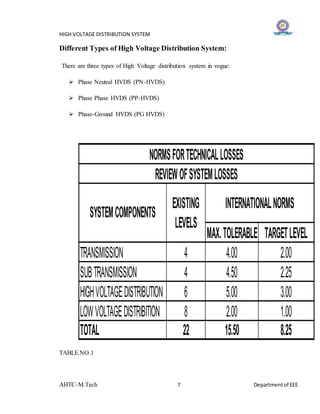
TABLE.NO.1
MAX.TOLERABLE TARGETLEVEL
TRANSMISSION 4 4.00 2.00
SUBTRANSMISSION 4 4.50 2.25
HIGHVOLTAGEDISTRIBUTION 6 5.00 3.00
LOWVOLTAGEDISTRIBITION 8 2.00 1.00
TOTAL 22 15.50 8.25
SYSTEMCOMPONENTS
EXISTING
LEVELS
INTERNATIONALNORMS
NORMSFORTECHNICALLOSSES
REVIEWOFSYSTEMLOSSES
HIGH VOLTAGE DISTRIBUTION SYSTEM
AHTC-M.Tech 8 Departmentof EEE
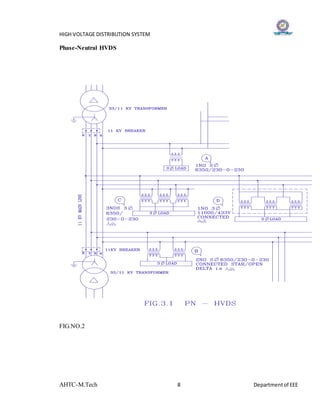
Phase-Neutral HVDS
FIG.NO.2
HIGH VOLTAGE DISTRIBUTION SYSTEM
AHTC-M.Tech 9 Departmentof EEE
Phase-Neutral HVDS:
 It is widely adopted in North America.
 Under this system, the main line from substation is three-phase 4 wire (3 phases +
Neutral) and laterals are single-phase 2 wire line or two-phase 3-wire line or three-phase
4-wire line depending upon the loads and feeding arrangement.
 Unique feature of the system lies in providing the neutral right through the system, viz
from substation to all nodes on the network.
Single-phase Loads
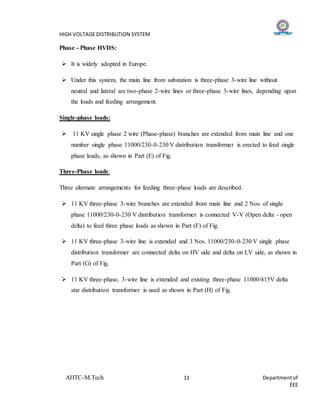
 11 KV single phase line (phase neutral) branch is extended from main line and 1 No.
6350/230-0-230 V distribution transformer is erected to feed single phase loads as shown
in Part (A) of Fig.
Three-phase loads:
Three alternative arrangements for feeding three phase loads are described.
 11 KV two-phase 3-wire branches are extended from the main line and 2 Nos. of single-
phase 6350/230-0-230 V distribution transformer is connected, star on HV side and open
delta on LV side to feed three-phase loads, as shown in part (B) of Fig.
 11 KV three-phase, 4-wire line is extended and 3 Nos. 6350/230-0-230 V single phase
transformers are connected, star- delta to feed three-phase loads as shown in Part (C)of
Fig.
 Existing 11 KV three-phase 4-wire line is extended and three-phase delta/Star distribution
transformer is used as shown in part (D) of Fig.
HIGH VOLTAGE DISTRIBUTION SYSTEM
AHTC-M.Tech 10 Departmentof
EEE
Phase - Phase HVDS:
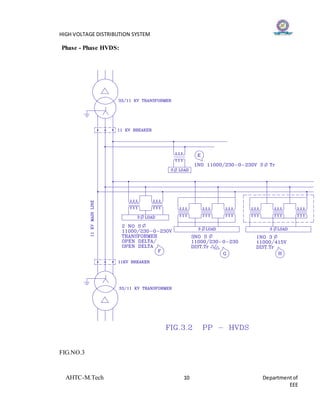
FIG.NO.3
HIGH VOLTAGE DISTRIBUTION SYSTEM
AHTC-M.Tech 11 Departmentof
EEE
Phase - Phase HVDS:
 It is widely adopted in Europe.
 Under this system, the main line from substation is three-phase 3-wire line without
neutral and lateral are two-phase 2-wire lines or three-phase 3-wire lines, depending upon
the loads and feeding arrangement.
Single-phase loads:
 11 KV single phase 2 wire (Phase-phase) branches are extended from main line and one
number single phase 11000/230-0-230 V distribution transformer is erected to feed single
phase loads, as shown in Part (E) of Fig.
Three-Phase loads:
Three alternate arrangements for feeding three-phase loads are described.
 11 KV three-phase 3-wire branches are extended from main line and 2 Nos. of single
phase 11000/230-0-230 V distribution transformer is connected V-V (Open delta - open
delta) to feed three phase loads as shown in Part (F) of Fig.
 11 KV three-phase 3-wire line is extended and 3 Nos. 11000/230-0-230 V single phase
distribution transformer are connected delta on HV side and delta on LV side, as shown in
Part (G) of Fig.
 11 KV three-phase, 3-wire line is extended and existing three-phase 11000/415V delta
star distribution transformer is used as shown in Part (H) of Fig.
HIGH VOLTAGE DISTRIBUTION SYSTEM
AHTC-M.Tech 12 Departmentof
EEE
Phase - Ground HVDS:
 It is similar to Phase- Neutral HVDS in all respects except that ground is used as return
path and neutral wire is not provided all along the system.
 The transformer HV neutral or star point on HV side (when more than one transformer is
used) is earthed solidly at every location, and thereby ground is used as return path.
 This system is used in certain parts of North America and Australia.
 It is unsuitable to Indian conditions due to technical and practical reasons like :
 Since ground is used for return path of the current, the soil resistivity of the area plays a
vital role. The system may be hazardous in areas where soil resistivity is high.
 Good quality Earthing is required for the safety of personnel and animals. The code of
practice stipulates that the voltage rise at the point of Earthing shall not exceed 20 V.
Providing effective Earthing and ensuring its maintenance throughout the period at a
number of locations in rural areas is beset with several practical problems.
 Interference with telecommunication lines.
HIGH VOLTAGE DISTRIBUTION SYSTEM
AHTC-M.Tech 13 Departmentof
EEE
Advantages of HVDS compared to LVDS:
The important drawbacks of LVDS and the way in which these are automatically solved by
adopting popular Phase – Neutral HVDS are:
 Line Losses: The loss in HV system for the distribution of the same amount of power is
less than 1% as compared to that of LV line.
 Voltage Drop: The voltage drop for distribution of same quantum of power is less than
1% as against that in LVDS and this ensures proper voltage profile at all customer points.
 System Power Factor: The single phase motors can be used for all Agricultural services.
The single phase motors have built in capacitors and the PF is more than 0.95 and almost
unity. Thus system power factor is always maintained high.
 Failure of Distribution Transformers: The length of LV lines is minimum. Thus the
failure of transformers due to LV line faults is minimized. The loading of transformer
beyond its capacity is effectively prevented by consumers whom it serves.
 Theft of Energy: The LV lines are virtually eliminated and even the short LV line
required is of AB cable. This makes direct tapping of lines a very difficult task. Each
transformer caters to 2 or 3 consumers.
 End use equipment efficiency: The voltage drop for distribution of same amount of
power is about 1% that of LVDS and thus, the voltages at the consumer premises can be
maintained satisfactorily.
 Reliability of supply: The LV lines are short and insulated, avoiding all LV faults. The
faults on HT line comes to the notice of the operator immediately due to the tripping of
substation breaker.
 Voltage fluctuations: The voltage drop on the LV line is negligible. The additional drop
due to extension of HV line up to consumer premises is also negligible. Thus the voltage
profile is very stable and there is no need to use voltage stabilizer.
HIGH VOLTAGE DISTRIBUTION SYSTEM
AHTC-M.Tech 14 Departmentof
EEE
Capital Cost:
 Higher investment on transformation equipment
 Larger capacity due to low diversity
 High cost/KVA due to small capacity of DTR.
 Lower investment on lines
 Small size conductors are adequate due to
A) Low currents
B) Less number of conductors
 Operating cost.
 higher transformation losses due to higher no load losses per KVA capacity
 Lower line losses due to low currents handled
 Quality of supply
 Better voltage profile
 Lower system losses
 Better reliability
 Prevents direct tapping of lines
 Load management is easier
HIGH VOLTAGE DISTRIBUTION SYSTEM
AHTC-M.Tech 15 Departmentof
EEE
Discussion:
 HVDS is technically superior and provides ready solution to the problems of distribution
system.
 Capital investment required for building new HVDS is 16.5% lower than that of LVDS.
The Peak Power loss and energy losses of HVDS are 33% and 18% lower than that of
LVDS respectively.
 Capital investment required to restructure the existing network as HVDS is marginally
cheaper than restructuring the network as LVDS.
 The peak power loss and energy losses of restructuring HVDS are lower by 25% and 27%
respectively compared to that of LVDS.
 The peak power losses and energy losses reduction by restructuring as HVDS are 80%
and 66 % respectively.
 Restructuring of existing distribution network as HVDS is highly viable as the payback
period is about 18 months.
Conclusions:
 Phase neutral HVDS is identified as the best system among the different HVDS schemes.
 HVDS effectively tackles the problems faced by the utilities in the existing LVDS.
 The strategy proposed for implementation of HVDS and its integration with the existing
network is found to be technically feasible and financially viable.
 The restructuring of existing LVDS as HVDS is practically feasible and financially
viable.
 The cluster based algorithm proposed for restructuring the existing LVDS as HVDS is an
effective tool for large scale restructuring of the existing network.
 Summing up, the recommendation is that the utilities should adopt HVDS in place of the
prevailing LVDS; extend it to all new extensions; also restructure the existing network as
HVDS simultaneously. This is the only technically feasible and least cost solution
approach for reduction of losses in Low Voltage network.

HIGH VOLTAGE DISTRIBUTION SYSTEM(HVDS).

  • 1.
    HIGH VOLTAGE DISTRIBUTIONSYSTEM AHTC-M.Tech 1 Departmentof EEE TABLE OF CONTENTS Contents Page No INTRODUCTION 4 1. TYPES OF HVDS 4 1.1. Low Voltage Distribution system (LVDS) 4 1.2. High Voltage Distribution System (HVDS) 5 2. PROBLEMS AND MEASURES OF LVDS 5 2.1. Problems of Distribution Engineers 5 2.2. Short Term Measures 6 3. HVDS AND ITS TYPES. 3.1. Basic View of High Voltage Distribution System. 7 3.2. Different Types of High Voltage Distribution System. 7  Phase Neutral HVDS (PN-HVDS) 8  Phase-Phase HVDS (PP-HVDS) 10  Phase-Ground HVDS (PG- HVDS) 12 4. ADVANTAGES OF HVDS COMPARED TO LVDS 13 5. CAPITAL COST 14 6. DISCUSSION 15 7. CONCLUSION 15
  • 2.
    HIGH VOLTAGE DISTRIBUTIONSYSTEM AHTC-M.Tech 2 Departmentof EEE LIST OF FIGURES Fig. no. Title of the fig. pg.no. 1 Basic High Voltage Distribution System 6 2 PN-HVDS 8 3 PP-HVDS 11 LIST OF TABLES Table. No. Title of the Table pg.no. 1 NORMS FOR TECHNICAL LOSSES 7
  • 3.
    HIGH VOLTAGE DISTRIBUTIONSYSTEM AHTC-M.Tech 3 Departmentof EEE ABSTRACT This project is about the comparison of existing low voltage distribution system (LVDS) with proposed high voltage distribution system (HVDS). The study is based on a real low voltage feeder in AP. The investigation is carried out to determine the losses in the existing low voltage (LT) distribution system and then converting this low voltage distribution system to proposed high voltage distribution system (HVDS) including bifurcation of load and replacing the one large transformer with various transformers of small rating. Since loss reduction in distribution system is of keen importance and main reason behind these losses is the use of low voltage for distribution in existing system. As for the low voltage in existing distribution system, current is high which leads to high power losses and also allow the hooking and hence power theft. This paper aims at reducing losses by using LT less or less LT ‘HVDS’ system and then determining the reduction in losses in terms of units and annual savings in terms of rupees due to proposed method. To check the feasibility of the proposed work, the annual saving and payback period of the proposed method is also determined.
  • 4.
    HIGH VOLTAGE DISTRIBUTIONSYSTEM AHTC-M.Tech 4 Departmentof EEE HIGH VOLTAGE DISTRIBUTION SYSTEM INTRODUCTION: The comparison of existing low voltage distribution system (LVDS) with proposed high voltage distribution system (HVDS). The study is based on a real low voltage feeder in AP. The investigation is carried out to determine the losses in the existing low voltage (LT) distribution system and then converting this low voltage distribution system to proposed high voltage distribution system (HVDS) including bifurcation of load and replacing the one large transformer with various transformers of small rating. Since loss reduction in distribution system is of keen importance and main reason behind these losses is the use of low voltage for distribution in existing system. As for the low voltage in existing distribution system, current is high which leads to high power losses and also allow the hooking and hence power theft. This paper aims at reducing losses by using LT less or less LT ‘HVDS’ system and then determining the reduction in losses in terms of units and annual savings in terms of rupees due to proposed method. To check the feasibility of the proposed work, the annual saving and payback period of the proposed method is also determined. The two widely prevalent distribution practices in vogue across the world are:  LVDS  HVDS Low Voltage Distribution System (LVDS):  It is based on European practice.  A Three phase transformer of considerable capacity is installed and LV lines are extended to cater to a group of loads.  This system is best suited to meet the concentrated loads of high load density.
  • 5.
    HIGH VOLTAGE DISTRIBUTIONSYSTEM AHTC-M.Tech 5 Departmentof EEE High Voltage Distribution System (HVDS):  It is based on North American practice.  A Three phases or single phase HV line is taken as near the load as possible and a distribution transformer of appropriate capacity, generally one or more single phase transformers are installed to feed one or a small group of loads, such that the length of the LV lines is minimum or is eliminated altogether.  This system is best suited to meet the scattered loads of low load density. Problems of Distribution Engineers:  Low Voltages  Break Downs  Pilferage  DTR Failures  High T & D Loses  Accidents (L.T Lines)  Voltage Fluctuations / Reliability of Supply  Quality of Supply to the customer is poor  Due to the poor quality of Supply the rated and use efficiency is poor The above drawbacks are automatically solved by adopting HVDS
  • 6.
    HIGH VOLTAGE DISTRIBUTIONSYSTEM AHTC-M.Tech 6 Departmentof EEE Short Term Measures: Different Types of short term measures are  Network reconfiguration  Network Reinforcement  Shunt Compensation  Automatic Voltage Booster  Series Compensation Basic High Voltage Distribution System: FIG.NO.1  DARK LINES INDICATES POWERLINES WITH HIGH VOLTAGE
  • 7.
    HIGH VOLTAGE DISTRIBUTIONSYSTEM AHTC-M.Tech 7 Departmentof EEE Different Types of High Voltage Distribution System: There are three types of High Voltage distribution system in vogue:  Phase Neutral HVDS (PN-HVDS)  Phase Phase HVDS (PP-HVDS)  Phase-Ground HVDS (PG HVDS) TABLE.NO.1 MAX.TOLERABLE TARGETLEVEL TRANSMISSION 4 4.00 2.00 SUBTRANSMISSION 4 4.50 2.25 HIGHVOLTAGEDISTRIBUTION 6 5.00 3.00 LOWVOLTAGEDISTRIBITION 8 2.00 1.00 TOTAL 22 15.50 8.25 SYSTEMCOMPONENTS EXISTING LEVELS INTERNATIONALNORMS NORMSFORTECHNICALLOSSES REVIEWOFSYSTEMLOSSES
  • 8.
    HIGH VOLTAGE DISTRIBUTIONSYSTEM AHTC-M.Tech 8 Departmentof EEE Phase-Neutral HVDS FIG.NO.2
  • 9.
    HIGH VOLTAGE DISTRIBUTIONSYSTEM AHTC-M.Tech 9 Departmentof EEE Phase-Neutral HVDS:  It is widely adopted in North America.  Under this system, the main line from substation is three-phase 4 wire (3 phases + Neutral) and laterals are single-phase 2 wire line or two-phase 3-wire line or three-phase 4-wire line depending upon the loads and feeding arrangement.  Unique feature of the system lies in providing the neutral right through the system, viz from substation to all nodes on the network. Single-phase Loads  11 KV single phase line (phase neutral) branch is extended from main line and 1 No. 6350/230-0-230 V distribution transformer is erected to feed single phase loads as shown in Part (A) of Fig. Three-phase loads: Three alternative arrangements for feeding three phase loads are described.  11 KV two-phase 3-wire branches are extended from the main line and 2 Nos. of single- phase 6350/230-0-230 V distribution transformer is connected, star on HV side and open delta on LV side to feed three-phase loads, as shown in part (B) of Fig.  11 KV three-phase, 4-wire line is extended and 3 Nos. 6350/230-0-230 V single phase transformers are connected, star- delta to feed three-phase loads as shown in Part (C)of Fig.  Existing 11 KV three-phase 4-wire line is extended and three-phase delta/Star distribution transformer is used as shown in part (D) of Fig.
  • 10.
    HIGH VOLTAGE DISTRIBUTIONSYSTEM AHTC-M.Tech 10 Departmentof EEE Phase - Phase HVDS: FIG.NO.3
  • 11.
    HIGH VOLTAGE DISTRIBUTIONSYSTEM AHTC-M.Tech 11 Departmentof EEE Phase - Phase HVDS:  It is widely adopted in Europe.  Under this system, the main line from substation is three-phase 3-wire line without neutral and lateral are two-phase 2-wire lines or three-phase 3-wire lines, depending upon the loads and feeding arrangement. Single-phase loads:  11 KV single phase 2 wire (Phase-phase) branches are extended from main line and one number single phase 11000/230-0-230 V distribution transformer is erected to feed single phase loads, as shown in Part (E) of Fig. Three-Phase loads: Three alternate arrangements for feeding three-phase loads are described.  11 KV three-phase 3-wire branches are extended from main line and 2 Nos. of single phase 11000/230-0-230 V distribution transformer is connected V-V (Open delta - open delta) to feed three phase loads as shown in Part (F) of Fig.  11 KV three-phase 3-wire line is extended and 3 Nos. 11000/230-0-230 V single phase distribution transformer are connected delta on HV side and delta on LV side, as shown in Part (G) of Fig.  11 KV three-phase, 3-wire line is extended and existing three-phase 11000/415V delta star distribution transformer is used as shown in Part (H) of Fig.
  • 12.
    HIGH VOLTAGE DISTRIBUTIONSYSTEM AHTC-M.Tech 12 Departmentof EEE Phase - Ground HVDS:  It is similar to Phase- Neutral HVDS in all respects except that ground is used as return path and neutral wire is not provided all along the system.  The transformer HV neutral or star point on HV side (when more than one transformer is used) is earthed solidly at every location, and thereby ground is used as return path.  This system is used in certain parts of North America and Australia.  It is unsuitable to Indian conditions due to technical and practical reasons like :  Since ground is used for return path of the current, the soil resistivity of the area plays a vital role. The system may be hazardous in areas where soil resistivity is high.  Good quality Earthing is required for the safety of personnel and animals. The code of practice stipulates that the voltage rise at the point of Earthing shall not exceed 20 V. Providing effective Earthing and ensuring its maintenance throughout the period at a number of locations in rural areas is beset with several practical problems.  Interference with telecommunication lines.
  • 13.
    HIGH VOLTAGE DISTRIBUTIONSYSTEM AHTC-M.Tech 13 Departmentof EEE Advantages of HVDS compared to LVDS: The important drawbacks of LVDS and the way in which these are automatically solved by adopting popular Phase – Neutral HVDS are:  Line Losses: The loss in HV system for the distribution of the same amount of power is less than 1% as compared to that of LV line.  Voltage Drop: The voltage drop for distribution of same quantum of power is less than 1% as against that in LVDS and this ensures proper voltage profile at all customer points.  System Power Factor: The single phase motors can be used for all Agricultural services. The single phase motors have built in capacitors and the PF is more than 0.95 and almost unity. Thus system power factor is always maintained high.  Failure of Distribution Transformers: The length of LV lines is minimum. Thus the failure of transformers due to LV line faults is minimized. The loading of transformer beyond its capacity is effectively prevented by consumers whom it serves.  Theft of Energy: The LV lines are virtually eliminated and even the short LV line required is of AB cable. This makes direct tapping of lines a very difficult task. Each transformer caters to 2 or 3 consumers.  End use equipment efficiency: The voltage drop for distribution of same amount of power is about 1% that of LVDS and thus, the voltages at the consumer premises can be maintained satisfactorily.  Reliability of supply: The LV lines are short and insulated, avoiding all LV faults. The faults on HT line comes to the notice of the operator immediately due to the tripping of substation breaker.  Voltage fluctuations: The voltage drop on the LV line is negligible. The additional drop due to extension of HV line up to consumer premises is also negligible. Thus the voltage profile is very stable and there is no need to use voltage stabilizer.
  • 14.
    HIGH VOLTAGE DISTRIBUTIONSYSTEM AHTC-M.Tech 14 Departmentof EEE Capital Cost:  Higher investment on transformation equipment  Larger capacity due to low diversity  High cost/KVA due to small capacity of DTR.  Lower investment on lines  Small size conductors are adequate due to A) Low currents B) Less number of conductors  Operating cost.  higher transformation losses due to higher no load losses per KVA capacity  Lower line losses due to low currents handled  Quality of supply  Better voltage profile  Lower system losses  Better reliability  Prevents direct tapping of lines  Load management is easier
  • 15.
    HIGH VOLTAGE DISTRIBUTIONSYSTEM AHTC-M.Tech 15 Departmentof EEE Discussion:  HVDS is technically superior and provides ready solution to the problems of distribution system.  Capital investment required for building new HVDS is 16.5% lower than that of LVDS. The Peak Power loss and energy losses of HVDS are 33% and 18% lower than that of LVDS respectively.  Capital investment required to restructure the existing network as HVDS is marginally cheaper than restructuring the network as LVDS.  The peak power loss and energy losses of restructuring HVDS are lower by 25% and 27% respectively compared to that of LVDS.  The peak power losses and energy losses reduction by restructuring as HVDS are 80% and 66 % respectively.  Restructuring of existing distribution network as HVDS is highly viable as the payback period is about 18 months. Conclusions:  Phase neutral HVDS is identified as the best system among the different HVDS schemes.  HVDS effectively tackles the problems faced by the utilities in the existing LVDS.  The strategy proposed for implementation of HVDS and its integration with the existing network is found to be technically feasible and financially viable.  The restructuring of existing LVDS as HVDS is practically feasible and financially viable.  The cluster based algorithm proposed for restructuring the existing LVDS as HVDS is an effective tool for large scale restructuring of the existing network.  Summing up, the recommendation is that the utilities should adopt HVDS in place of the prevailing LVDS; extend it to all new extensions; also restructure the existing network as HVDS simultaneously. This is the only technically feasible and least cost solution approach for reduction of losses in Low Voltage network.