Vendor Workshop
SEMI-THERM 2016
March 16th, 2016
High Performance SSD Memory Application
utilizing compressible TIM
based on Phase Change Technology
Stewart Dunlap - Micron
&
Chris Lee, Hyo Xi, Linda Shen – Honeywell
© 2015 by Honeywell International Inc. All rights reserved.
Additional Disclaimers As Needed (Consult Legal)
OUTLINE
1.  Thermal Trends
2.  Compressible TIM Overview
3.  PCM Technology
4.  Application and Methods
5.  Results & Summary
© 2015 by Honeywell International Inc. All rights reserved.
Additional Disclaimers As Needed (Consult Legal)
© 2015 by Honeywell International Inc. All rights reserved.
Additional Disclaimers As Needed (Consult Legal)
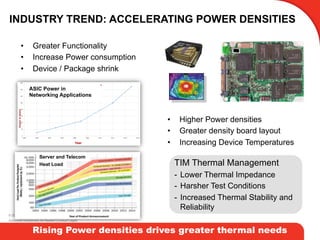
INDUSTRY TREND: ACCELERATING POWER DENSITIES
•  Greater Functionality
•  Increase Power consumption
•  Device / Package shrink
•  Higher Power densities
•  Greater density board layout
•  Increasing Device Temperatures
Rising Power densities drives greater thermal needs
TIM Thermal Management
-  Lower Thermal Impedance
-  Harsher Test Conditions
-  Increased Thermal Stability and
Reliability
Server and Telecom
ASIC Power in
Networking Applications
Heat Load
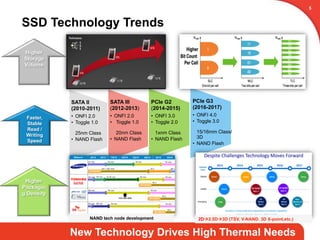
SATA II
(2010-2011)
•  ONFI 2.0
•  Toggle 1.0
25nm Class
•  NAND Flash
SATA III
(2012-2013)
•  ONFI 2.0
•  Toggle 1.0
20nm Class
•  NAND Flash
PCIe G2
(2014-2015)
•  ONFI 3.0
•  Toggle 2.0
1xnm Class
•  NAND Flash
PCIe G3
(2016-2017)
•  ONFI 4.0
•  Toggle 3.0
15/16mm Class/
3D
•  NAND Flash
SSD Technology Trends
New Technology Drives High Thermal Needs
5
Faster,
Stable
Read /
Writing
Speed
Higher
Packagin
g Density
NAND tech node development
Higher
Storage
Volume
2Dà2.5Dà3D (TSV, V-NAND. 3D X-point,etc.)
© 2015 by Honeywell International Inc. All rights reserved.
Additional Disclaimers As Needed (Consult Legal)
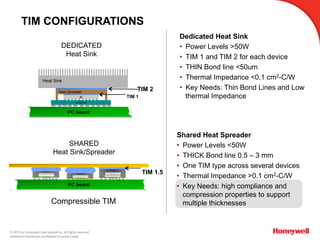
TIM CONFIGURATIONS
Dedicated Heat Sink
•  Power Levels >50W
•  TIM 1 and TIM 2 for each device
•  THIN Bond line <50um
•  Thermal Impedance <0.1 cm2-C/W
•  Key Needs: Thin Bond Lines and Low
thermal ImpedanceIC
TIM 2
substrate
PC board
TIM 1
PC board
TIM 1.5
Heat Spreader
Shared Heat Spreader
•  Power Levels <50W
•  THICK Bond line 0.5 – 3 mm
•  One TIM type across several devices
•  Thermal Impedance >0.1 cm2-C/W
•  Key Needs: high compliance and
compression properties to support
multiple thicknesses
DEDICATED
Heat Sink
SHARED
Heat Sink/Spreader
Heat Sink
Compressible TIM
© 2015 by Honeywell International Inc. All rights reserved.
Additional Disclaimers As Needed (Consult Legal)
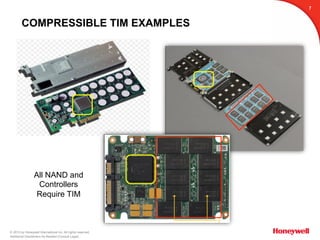
COMPRESSIBLE TIM EXAMPLES
7
All NAND and
Controllers
Require TIM
© 2015 by Honeywell International Inc. All rights reserved.
Additional Disclaimers As Needed (Consult Legal)
© 2015 by Honeywell International Inc. All rights reserved.
Additional Disclaimers As Needed (Consult Legal)
Lower Contact Resistance and Impedance is critical to Thermal Performance
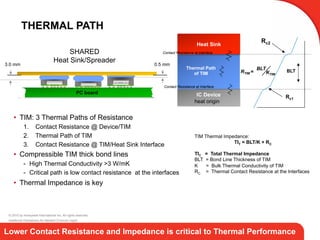
THERMAL PATH
•  TIM: 3 Thermal Paths of Resistance
1.  Contact Resistance @ Device/TIM
2.  Thermal Path of TIM
3.  Contact Resistance @ TIM/Heat Sink Interface
•  Compressible TIM thick bond lines
-  High Thermal Conductivity >3 W/mK
-  Critical path is low contact resistance at the interfaces
•  Thermal Impedance is key
Heat Sink
Thermal Path
of TIM
IC DevicePC board
SHARED
Heat Sink/Spreader 0.5 mm3.0 mm
RTIM =
Contact Resistance at Interface
Rc1
Rc2
BLTKTIM
BLT
TIM Thermal Impedance:
TIT = BLT/K + RC
TIT = Total Thermal Impedance
BLT = Bond Line Thickness of TIM
K = Bulk Thermal Conductivity of TIM
RC = Thermal Contact Resistance at the Interfaces
Contact Resistance at Interface
heat origin
© 2015 by Honeywell International Inc. All rights reserved.
© 2015 by Honeywell International Inc. All rights reserved . PMT STRAP 2016-2020
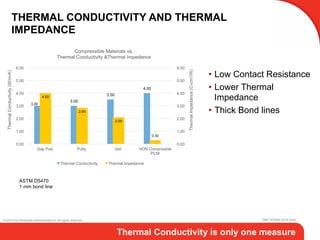
Thermal Conductivity is only one measure
THERMAL CONDUCTIVITY AND THERMAL
IMPEDANCE
•  Low Contact Resistance
•  Lower Thermal
Impedance
•  Thick Bond lines
ASTM D5470
1 mm bond line
3.00
3.00
3.50
4.00
4.00
2.84
2.09
0.30
0.00
1.00
2.00
3.00
4.00
5.00
6.00
0.00
1.00
2.00
3.00
4.00
5.00
6.00
Gap Pad Putty Gel HON Compresible
PCM
ThermalImpedance(C-cm2/W)
ThermalConductivity(W/m-K)
Compressible Materials vs.
Thermal Conductivity &Thermal Impedance
Thermal Conductivity Thermal Impedance
© 2015 by Honeywell International Inc. All rights reserved.
Additional Disclaimers As Needed (Consult Legal)
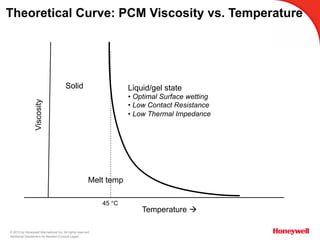
Viscosity
Melt temp
Solid Liquid/gel state
• Optimal Surface wetting
• Low Contact Resistance
• Low Thermal Impedance
Temperature !
45 °C
Theoretical Curve: PCM Viscosity vs. Temperature
© 2015 by Honeywell International Inc. All rights reserved.
© 2015 by Honeywell International Inc. All rights reserved . PMT STRAP 2016-2020
PCM Polymer Structure Enables
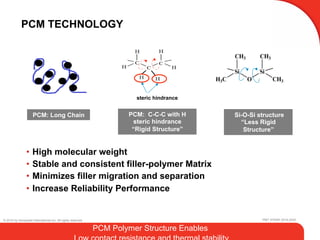
PCM TECHNOLOGY
PCM: Long Chain Si-O-Si structure
“Less Rigid
Structure”
PCM: C-C-C with H
steric hindrance
“Rigid Structure”
steric hindrance
•  High molecular weight
•  Stable and consistent filler-polymer Matrix
•  Minimizes filler migration and separation
•  Increase Reliability Performance
12
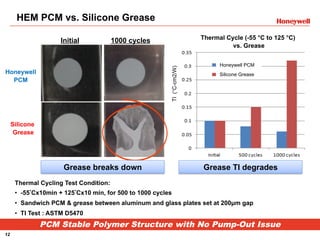
Honeywell
PCM
Initial 1000 cycles
Silicone
Grease
Thermal Cycling Test Condition:
•  -55°Cx10min + 125°Cx10 min, for 500 to 1000 cycles
•  Sandwich PCM & grease between aluminum and glass plates set at 200µm gap
•  TI Test : ASTM D5470
Thermal Cycle (-55 °C to 125 °C)
vs. Grease
HEM PCM vs. Silicone Grease
Grease breaks down Grease TI degrades
Silicone Grease
Honeywell PCM
PCM Stable Polymer Structure with No Pump-Out Issue
© 2015 by Honeywell International Inc. All rights reserved.
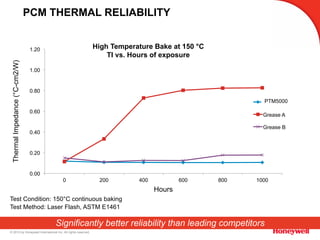
0.00
0.20
0.40
0.60
0.80
1.00
1.20
0 200 400 600 800 1000
ThermalImpedance(°C-cm2/W)
Hours
High Temperature Bake at 150 °C
TI vs. Hours of exposure
PTM3180
Grease A
Grease B
PCM THERMAL RELIABILITY
Test Condition: 150°C continuous baking
Test Method: Laser Flash, ASTM E1461
Significantly better reliability than leading competitors
PTM5000
© 2015 by Honeywell International Inc. All rights reserved.
0.12
0.09
0.52
0.11 0.09 0.09 0.09 0.11
0.00
0.10
0.20
0.30
0.40
0.50
0.60
AC 96hrs 120hrs 192hrs 240hrs
PTM3180 Avg PTM6000 Avg
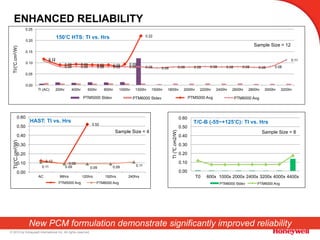
TI/('C.cm2/W)
ENHANCED RELIABILITY
150’C HTS: TI vs. Hrs
HAST: TI vs. Hrs
Sample Size = 4
Sample Size = 12
PTM5000 Avg
0.00
0.10
0.20
0.30
0.40
0.50
0.60
T0 600x 1000x 2000x 2400x 3200x 4000x 4400xTI(℃.cm2/W)
PTM6000 Stdev PTM6000 Avg
Sample Size = 8
T/C-B (-55~+125’C): TI vs. Hrs
0.12
0.09 0.09 0.09 0.09 0.09
0.22
0.11
0.08 0.08 0.08 0.08 0.08 0.08 0.08 0.08 0.08 0.08 0.08 0.08 0.08 0.08
0.11
0.00
0.05
0.10
0.15
0.20
0.25
TI (AC) 200hr 400hr 600hr 800hr 1000hr 1300hr 1500hr 1800hr 2000hr 2200hr 2400hr 2600hr 2800hr 3000hr 3200hr
PTM3180 Stdev PTM6000 Stdev PTM3180 Avg PTM6000 Avg
TI/('C.cm2/W)
PTM5000 Stdev PTM5000 Avg
New PCM formulation demonstrate significantly improved reliability
© 2015 by Honeywell International Inc. All rights reserved.
Additional Disclaimers As Needed (Consult Legal)
© 2015 by Honeywell International Inc. All rights reserved.
Additional Disclaimers As Needed (Consult Legal)
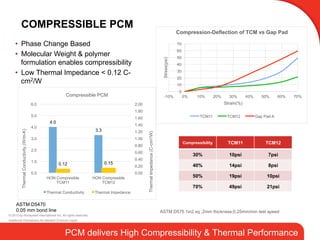
PCM delivers High Compressibility & Thermal Performance
COMPRESSIBLE PCM
•  Phase Change Based
•  Molecular Weight & polymer
formulation enables compressibility
•  Low Thermal Impedance < 0.12 C-
cm2/W
Compressibility TCM11 TCM12
30% 10psi 7psi
40% 14psi 8psi
50% 19psi 10psi
70% 49psi 21psi
0
10
20
30
40
50
60
70
-10% 0% 10% 20% 30% 40% 50% 60% 70%
Stress(psi)
Strain(%)
Compression-Deflection of TCM vs Gap Pad
TCM11 TCM12 Gap Pad A
ASTM D575 1in2 sq ;2mm thickness;0.25mm/min test speed
4.0
3.3
0.12 0.15
0.00
0.20
0.40
0.60
0.80
1.00
1.20
1.40
1.60
1.80
2.00
0.0
1.0
2.0
3.0
4.0
5.0
6.0
HON Compresible
TCM11
HON Compresible
TCM12
ThermalImpedance(C-cm2/W)
ThermalConductivity(W/m-K)
Compressible PCM
Thermal Conductivity Thermal Impedance
ASTM D5470
0.05 mm bond line
© 2015 by Honeywell International Inc. All rights reserved.
Additional Disclaimers As Needed (Consult Legal)
© 2015 by Honeywell International Inc. All rights reserved.
Additional Disclaimers As Needed (Consult Legal)
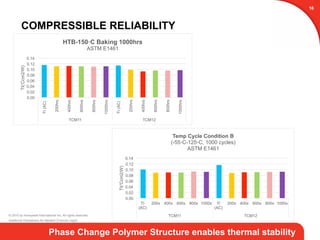
Phase Change Polymer Structure enables thermal stability
COMPRESSIBLE RELIABILITY
16
0.00
0.02
0.04
0.06
0.08
0.10
0.12
0.14
TI(AC)
200hrs
400hrs
600hrs
800hrs
1000hrs
TI(AC)
200hrs
400hrs
600hrs
800hrs
1000hrs
TCM11 TCM12
TI('Ccm2/W)
HTB-150◦C Baking 1000hrs
ASTM E1461
0.00
0.02
0.04
0.06
0.08
0.10
0.12
0.14
TI
(AC)
200x 400x 600x 800x 1000x TI
(AC)
200x 400x 600x 800x 1000x
TCM11 TCM12
TI('Ccm2/W)
Temp Cycle Condition B
(-55◦C-125◦C, 1000 cycles)
ASTM E1461
©2014 Micron Technology, Inc. All rights reserved. Products are warranted only to meet Micron’s production data sheet specifications. Information, products, and/or specifications are subject to change without notice. All information is provided on an “AS IS”
basis without warranties of any kind. Dates are estimates only. Drawings are not to scale. Micron and the Micron logo are trademarks of Micron Technology, Inc. All other trademarks are the property of their respective owners.
17	
   |	


  ©2014	
  Micron	
  Technology,	
  Inc.	


  |	


  Micron	
  Confiden:al	
  	
  
Applica:on:	
  Micron	
  PCie	
  SSD	
  
17
18	
   |	


  ©2014	
  Micron	
  Technology,	
  Inc.	


  |	


  Micron	
  Confiden:al	
  	
  
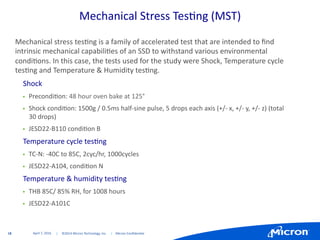
Mechanical	
  Stress	
  Tes:ng	
  (MST)	
  
Mechanical	
  stress	
  tes:ng	
  is	
  a	
  family	
  of	
  accelerated	
  test	
  that	
  are	
  intended	
  to	
  find	
  
intrinsic	
  mechanical	
  capabili:es	
  of	
  an	
  SSD	
  to	
  withstand	
  various	
  environmental	
  
condi:ons.	
  In	
  this	
  case,	
  the	
  tests	
  used	
  for	
  the	
  study	
  were	
  Shock,	
  Temperature	
  cycle	
  
tes:ng	
  and	
  Temperature	
  &	
  Humidity	
  tes:ng.	
  
•  Shock	
  
"  Precondi:on:	
  48	
  hour	
  oven	
  bake	
  at	
  125°	
  
"  Shock	
  condi:on:	
  1500g	
  /	
  0.5ms	
  half-­‐sine	
  pulse,	
  5	
  drops	
  each	
  axis	
  (+/-­‐	
  x,	
  +/-­‐	
  y,	
  +/-­‐	
  z)	
  (total	
  
30	
  drops)	
  
"  JESD22-­‐B110	
  condi:on	
  B	
  
•  Temperature	
  cycle	
  tes:ng	
  
"  TC-­‐N:	
  -­‐40C	
  to	
  85C,	
  2cyc/hr,	
  1000cycles	
  
"  JESD22-­‐A104,	
  condi:on	
  N	
  	
  
•  Temperature	
  &	
  humidity	
  tes:ng	
  
"  THB	
  85C/	
  85%	
  RH,	
  for	
  1008	
  hours	
  
"  JESD22-­‐A101C	
  
April	
  7,	
  2016	
  
19	
   |	


  ©2014	
  Micron	
  Technology,	
  Inc.	


  |	


  Micron	
  Confiden:al	
  	
  
Honeywell	
  TIM	
  Experimental	
  Results	
  
PCie	
  SSD	
  
April	
  7,	
  2016	


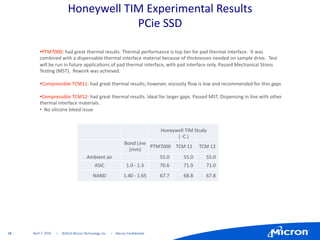
• PTM7000:	
  had	
  great	
  thermal	
  results.	
  Thermal	
  performance	
  is	
  top	
  :er	
  for	
  pad	
  thermal	
  interface.	
  	
  It	
  was	
  
combined	
  with	
  a	
  dispensable	
  thermal	
  interface	
  material	
  because	
  of	
  thicknesses	
  needed	
  on	
  sample	
  drive.	
  	
  Test	
  
will	
  be	
  run	
  in	
  future	
  applica:ons	
  of	
  pad	
  thermal	
  interface,	
  with	
  pad	
  interface	
  only.	
  Passed	
  Mechanical	
  Stress	
  
Tes:ng	
  (MST).	
  	
  Rework	
  was	
  achieved.	


• Compressible	
  TCM11:	
  had	
  great	
  thermal	
  results;	
  however,	
  viscosity	
  flow	
  is	
  low	
  and	
  recommended	
  for	
  thin	
  gaps	
  
• Compressible	
  TCM12:	
  had	
  great	
  thermal	
  results.	
  Ideal	
  for	
  larger	
  gaps.	
  Passed	
  MST.	
  Dispensing	
  in	
  line	
  with	
  other	
  
thermal	
  interface	
  materials.	


• 	
  	
  No	
  silicone	
  bleed	
  issue	


Honeywell	
  TIM	
  Study	
  
(	
  ◦C	
  )	
  
Bond	
  Line	
  
(mm)	
  
PTM7000	
   TCM	
  11	
   TCM	
  12	
  
Ambient	
  air	


  55.0	


  55.0	


  55.0	
  	
  
ASIC	
  	
   1.0	
  -­‐	
  1.3	


  70.6	


  71.9	


  71.0	
  	
  
NAND	
   1.40	
  -­‐	
  1.65	


  67.7	


  68.8	


  67.8	
  	
  
20	
   |	


  ©2014	
  Micron	
  Technology,	
  Inc.	


  |	


  Micron	
  Confiden:al	
  	
  
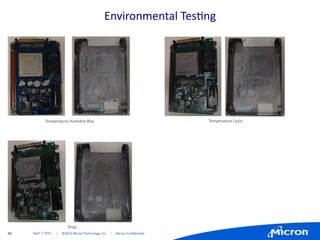
Environmental	
  Tes:ng	
  
April	
  7,	
  2016	
  
Drop	
  
Temperature	
  Cycle	
  Temperature	
  Humidity	
  Bias	
  
21	
   |	


  ©2014	
  Micron	
  Technology,	
  Inc.	


  |	


  Micron	
  Confiden:al	
  	
  
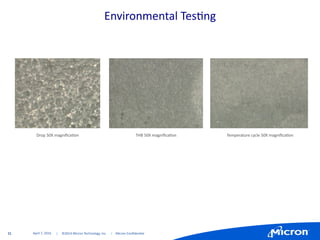
Environmental	
  Tes:ng	
  
April	
  7,	
  2016	
  
Drop	
  50X	
  magnifica:on	
   THB	
  50X	
  magnifica:on	
   Temperature	
  cycle	
  50X	
  magnifica:on	
  
© 2015 by Honeywell International Inc. All rights reserved.
Additional Disclaimers As Needed (Consult Legal)
SUMMARY
• Increasing power densities and board layout
drive higher temperatures
• Gap Pads and Putty delivery compressibility and
compliance
• Formulating PCM enables compressibility, low
thermal impedance and thermal stability
• Tested in SSD Memory Application
22
THANK YOU
QUESTIONS?
© 2015 by Honeywell International Inc. All rights reserved.
Additional Disclaimers As Needed (Consult Legal)
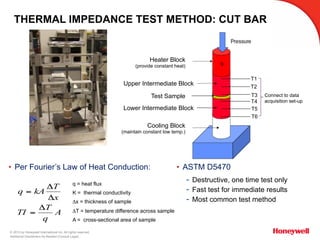
•  Per Fourier’s Law of Heat Conduction:
Connect to data
acquisition set-up
Cooling Block
(maintain constant low temp.)
Lower Intermediate Block
Test Sample
Upper Intermediate Block
Heater Block
(provide constant heat)
T1
T3
T2
T4
T6
T5
A
q
T
TI
x
T
kAq
Δ
=
Δ
Δ
=
q = heat flux
K = thermal conductivity
Δx = thickness of sample
ΔT = temperature difference across sample
A = cross-sectional area of sample
THERMAL IMPEDANCE TEST METHOD: CUT BAR
•  ASTM D5470
-  Destructive, one time test only
-  Fast test for immediate results
-  Most common test method
© 2015 by Honeywell International Inc. All rights reserved.
Additional Disclaimers As Needed (Consult Legal)
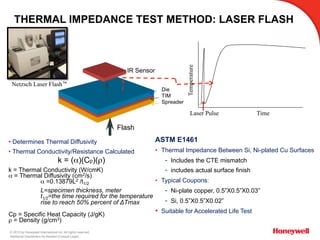
THERMAL IMPEDANCE TEST METHOD: LASER FLASH
ASTM E1461
•  Thermal Impedance Between Si, Ni-plated Cu Surfaces
-  Includes the CTE mismatch
-  includes actual surface finish
•  Typical Coupons:
-  Ni-plate copper, 0.5”X0.5”X0.03”
-  Si, 0.5”X0.5”X0.02”
•  Suitable for Accelerated Life Test
Die
TIM
Spreader
Flash
IR Sensor
Time
Temperature
Laser Pulse
Netzsch Laser Flash™
k = (α)(Cp)(ρ)
k = Thermal Conductivity (W/cmK)
α = Thermal Diffusivity (cm2/s)
α =0.13879L2 /t1/2
L=specimen thickness, meter
t1/2=the time required for the temperature
rise to reach 50% percent of ΔTmax
Cp = Specific Heat Capacity (J/gK)
ρ = Density (g/cm3)
• Determines Thermal Diffusivity
• Thermal Conductivity/Resistance Calculated
© 2015 by Honeywell International Inc. All rights reserved.
Additional Disclaimers As Needed (Consult Legal)
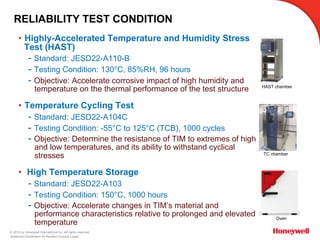
RELIABILITY TEST CONDITION
•  Highly-Accelerated Temperature and Humidity Stress
Test (HAST)
- Standard: JESD22-A110-B
- Testing Condition: 130°C, 85%RH, 96 hours
- Objective: Accelerate corrosive impact of high humidity and
temperature on the thermal performance of the test structure
•  Temperature Cycling Test
- Standard: JESD22-A104C
- Testing Condition: -55°C to 125°C (TCB), 1000 cycles
- Objective: Determine the resistance of TIM to extremes of high
and low temperatures, and its ability to withstand cyclical
stresses
•  High Temperature Storage
- Standard: JESD22-A103
- Testing Condition: 150°C, 1000 hours
- Objective: Accelerate changes in TIM’s material and
performance characteristics relative to prolonged and elevated
temperature
HAST chamber
TC chamber
Oven

High Performance SSD Memory Application with Compressible TIM- Based On Phase Change Technology

  • 1.
  • 2.
    High Performance SSDMemory Application utilizing compressible TIM based on Phase Change Technology Stewart Dunlap - Micron & Chris Lee, Hyo Xi, Linda Shen – Honeywell
  • 3.
    © 2015 byHoneywell International Inc. All rights reserved. Additional Disclaimers As Needed (Consult Legal) OUTLINE 1.  Thermal Trends 2.  Compressible TIM Overview 3.  PCM Technology 4.  Application and Methods 5.  Results & Summary
  • 4.
    © 2015 byHoneywell International Inc. All rights reserved. Additional Disclaimers As Needed (Consult Legal) © 2015 by Honeywell International Inc. All rights reserved. Additional Disclaimers As Needed (Consult Legal) INDUSTRY TREND: ACCELERATING POWER DENSITIES •  Greater Functionality •  Increase Power consumption •  Device / Package shrink •  Higher Power densities •  Greater density board layout •  Increasing Device Temperatures Rising Power densities drives greater thermal needs TIM Thermal Management -  Lower Thermal Impedance -  Harsher Test Conditions -  Increased Thermal Stability and Reliability Server and Telecom ASIC Power in Networking Applications Heat Load
  • 5.
    SATA II (2010-2011) •  ONFI2.0 •  Toggle 1.0 25nm Class •  NAND Flash SATA III (2012-2013) •  ONFI 2.0 •  Toggle 1.0 20nm Class •  NAND Flash PCIe G2 (2014-2015) •  ONFI 3.0 •  Toggle 2.0 1xnm Class •  NAND Flash PCIe G3 (2016-2017) •  ONFI 4.0 •  Toggle 3.0 15/16mm Class/ 3D •  NAND Flash SSD Technology Trends New Technology Drives High Thermal Needs 5 Faster, Stable Read / Writing Speed Higher Packagin g Density NAND tech node development Higher Storage Volume 2Dà2.5Dà3D (TSV, V-NAND. 3D X-point,etc.)
  • 6.
    © 2015 byHoneywell International Inc. All rights reserved. Additional Disclaimers As Needed (Consult Legal) TIM CONFIGURATIONS Dedicated Heat Sink •  Power Levels >50W •  TIM 1 and TIM 2 for each device •  THIN Bond line <50um •  Thermal Impedance <0.1 cm2-C/W •  Key Needs: Thin Bond Lines and Low thermal ImpedanceIC TIM 2 substrate PC board TIM 1 PC board TIM 1.5 Heat Spreader Shared Heat Spreader •  Power Levels <50W •  THICK Bond line 0.5 – 3 mm •  One TIM type across several devices •  Thermal Impedance >0.1 cm2-C/W •  Key Needs: high compliance and compression properties to support multiple thicknesses DEDICATED Heat Sink SHARED Heat Sink/Spreader Heat Sink Compressible TIM
  • 7.
    © 2015 byHoneywell International Inc. All rights reserved. Additional Disclaimers As Needed (Consult Legal) COMPRESSIBLE TIM EXAMPLES 7 All NAND and Controllers Require TIM
  • 8.
    © 2015 byHoneywell International Inc. All rights reserved. Additional Disclaimers As Needed (Consult Legal) © 2015 by Honeywell International Inc. All rights reserved. Additional Disclaimers As Needed (Consult Legal) Lower Contact Resistance and Impedance is critical to Thermal Performance THERMAL PATH •  TIM: 3 Thermal Paths of Resistance 1.  Contact Resistance @ Device/TIM 2.  Thermal Path of TIM 3.  Contact Resistance @ TIM/Heat Sink Interface •  Compressible TIM thick bond lines -  High Thermal Conductivity >3 W/mK -  Critical path is low contact resistance at the interfaces •  Thermal Impedance is key Heat Sink Thermal Path of TIM IC DevicePC board SHARED Heat Sink/Spreader 0.5 mm3.0 mm RTIM = Contact Resistance at Interface Rc1 Rc2 BLTKTIM BLT TIM Thermal Impedance: TIT = BLT/K + RC TIT = Total Thermal Impedance BLT = Bond Line Thickness of TIM K = Bulk Thermal Conductivity of TIM RC = Thermal Contact Resistance at the Interfaces Contact Resistance at Interface heat origin
  • 9.
    © 2015 byHoneywell International Inc. All rights reserved. © 2015 by Honeywell International Inc. All rights reserved . PMT STRAP 2016-2020 Thermal Conductivity is only one measure THERMAL CONDUCTIVITY AND THERMAL IMPEDANCE •  Low Contact Resistance •  Lower Thermal Impedance •  Thick Bond lines ASTM D5470 1 mm bond line 3.00 3.00 3.50 4.00 4.00 2.84 2.09 0.30 0.00 1.00 2.00 3.00 4.00 5.00 6.00 0.00 1.00 2.00 3.00 4.00 5.00 6.00 Gap Pad Putty Gel HON Compresible PCM ThermalImpedance(C-cm2/W) ThermalConductivity(W/m-K) Compressible Materials vs. Thermal Conductivity &Thermal Impedance Thermal Conductivity Thermal Impedance
  • 10.
    © 2015 byHoneywell International Inc. All rights reserved. Additional Disclaimers As Needed (Consult Legal) Viscosity Melt temp Solid Liquid/gel state • Optimal Surface wetting • Low Contact Resistance • Low Thermal Impedance Temperature ! 45 °C Theoretical Curve: PCM Viscosity vs. Temperature
  • 11.
    © 2015 byHoneywell International Inc. All rights reserved. © 2015 by Honeywell International Inc. All rights reserved . PMT STRAP 2016-2020 PCM Polymer Structure Enables PCM TECHNOLOGY PCM: Long Chain Si-O-Si structure “Less Rigid Structure” PCM: C-C-C with H steric hindrance “Rigid Structure” steric hindrance •  High molecular weight •  Stable and consistent filler-polymer Matrix •  Minimizes filler migration and separation •  Increase Reliability Performance
  • 12.
    12 Honeywell PCM Initial 1000 cycles Silicone Grease ThermalCycling Test Condition: •  -55°Cx10min + 125°Cx10 min, for 500 to 1000 cycles •  Sandwich PCM & grease between aluminum and glass plates set at 200µm gap •  TI Test : ASTM D5470 Thermal Cycle (-55 °C to 125 °C) vs. Grease HEM PCM vs. Silicone Grease Grease breaks down Grease TI degrades Silicone Grease Honeywell PCM PCM Stable Polymer Structure with No Pump-Out Issue
  • 13.
    © 2015 byHoneywell International Inc. All rights reserved. 0.00 0.20 0.40 0.60 0.80 1.00 1.20 0 200 400 600 800 1000 ThermalImpedance(°C-cm2/W) Hours High Temperature Bake at 150 °C TI vs. Hours of exposure PTM3180 Grease A Grease B PCM THERMAL RELIABILITY Test Condition: 150°C continuous baking Test Method: Laser Flash, ASTM E1461 Significantly better reliability than leading competitors PTM5000
  • 14.
    © 2015 byHoneywell International Inc. All rights reserved. 0.12 0.09 0.52 0.11 0.09 0.09 0.09 0.11 0.00 0.10 0.20 0.30 0.40 0.50 0.60 AC 96hrs 120hrs 192hrs 240hrs PTM3180 Avg PTM6000 Avg TI/('C.cm2/W) ENHANCED RELIABILITY 150’C HTS: TI vs. Hrs HAST: TI vs. Hrs Sample Size = 4 Sample Size = 12 PTM5000 Avg 0.00 0.10 0.20 0.30 0.40 0.50 0.60 T0 600x 1000x 2000x 2400x 3200x 4000x 4400xTI(℃.cm2/W) PTM6000 Stdev PTM6000 Avg Sample Size = 8 T/C-B (-55~+125’C): TI vs. Hrs 0.12 0.09 0.09 0.09 0.09 0.09 0.22 0.11 0.08 0.08 0.08 0.08 0.08 0.08 0.08 0.08 0.08 0.08 0.08 0.08 0.08 0.08 0.11 0.00 0.05 0.10 0.15 0.20 0.25 TI (AC) 200hr 400hr 600hr 800hr 1000hr 1300hr 1500hr 1800hr 2000hr 2200hr 2400hr 2600hr 2800hr 3000hr 3200hr PTM3180 Stdev PTM6000 Stdev PTM3180 Avg PTM6000 Avg TI/('C.cm2/W) PTM5000 Stdev PTM5000 Avg New PCM formulation demonstrate significantly improved reliability
  • 15.
    © 2015 byHoneywell International Inc. All rights reserved. Additional Disclaimers As Needed (Consult Legal) © 2015 by Honeywell International Inc. All rights reserved. Additional Disclaimers As Needed (Consult Legal) PCM delivers High Compressibility & Thermal Performance COMPRESSIBLE PCM •  Phase Change Based •  Molecular Weight & polymer formulation enables compressibility •  Low Thermal Impedance < 0.12 C- cm2/W Compressibility TCM11 TCM12 30% 10psi 7psi 40% 14psi 8psi 50% 19psi 10psi 70% 49psi 21psi 0 10 20 30 40 50 60 70 -10% 0% 10% 20% 30% 40% 50% 60% 70% Stress(psi) Strain(%) Compression-Deflection of TCM vs Gap Pad TCM11 TCM12 Gap Pad A ASTM D575 1in2 sq ;2mm thickness;0.25mm/min test speed 4.0 3.3 0.12 0.15 0.00 0.20 0.40 0.60 0.80 1.00 1.20 1.40 1.60 1.80 2.00 0.0 1.0 2.0 3.0 4.0 5.0 6.0 HON Compresible TCM11 HON Compresible TCM12 ThermalImpedance(C-cm2/W) ThermalConductivity(W/m-K) Compressible PCM Thermal Conductivity Thermal Impedance ASTM D5470 0.05 mm bond line
  • 16.
    © 2015 byHoneywell International Inc. All rights reserved. Additional Disclaimers As Needed (Consult Legal) © 2015 by Honeywell International Inc. All rights reserved. Additional Disclaimers As Needed (Consult Legal) Phase Change Polymer Structure enables thermal stability COMPRESSIBLE RELIABILITY 16 0.00 0.02 0.04 0.06 0.08 0.10 0.12 0.14 TI(AC) 200hrs 400hrs 600hrs 800hrs 1000hrs TI(AC) 200hrs 400hrs 600hrs 800hrs 1000hrs TCM11 TCM12 TI('Ccm2/W) HTB-150◦C Baking 1000hrs ASTM E1461 0.00 0.02 0.04 0.06 0.08 0.10 0.12 0.14 TI (AC) 200x 400x 600x 800x 1000x TI (AC) 200x 400x 600x 800x 1000x TCM11 TCM12 TI('Ccm2/W) Temp Cycle Condition B (-55◦C-125◦C, 1000 cycles) ASTM E1461
  • 17.
    ©2014 Micron Technology,Inc. All rights reserved. Products are warranted only to meet Micron’s production data sheet specifications. Information, products, and/or specifications are subject to change without notice. All information is provided on an “AS IS” basis without warranties of any kind. Dates are estimates only. Drawings are not to scale. Micron and the Micron logo are trademarks of Micron Technology, Inc. All other trademarks are the property of their respective owners. 17   |          ©2014  Micron  Technology,  Inc.          |        Micron  Confiden:al     Applica:on:  Micron  PCie  SSD   17
  • 18.
    18   |          ©2014  Micron  Technology,  Inc.          |        Micron  Confiden:al     Mechanical  Stress  Tes:ng  (MST)   Mechanical  stress  tes:ng  is  a  family  of  accelerated  test  that  are  intended  to  find   intrinsic  mechanical  capabili:es  of  an  SSD  to  withstand  various  environmental   condi:ons.  In  this  case,  the  tests  used  for  the  study  were  Shock,  Temperature  cycle   tes:ng  and  Temperature  &  Humidity  tes:ng.   •  Shock   "  Precondi:on:  48  hour  oven  bake  at  125°   "  Shock  condi:on:  1500g  /  0.5ms  half-­‐sine  pulse,  5  drops  each  axis  (+/-­‐  x,  +/-­‐  y,  +/-­‐  z)  (total   30  drops)   "  JESD22-­‐B110  condi:on  B   •  Temperature  cycle  tes:ng   "  TC-­‐N:  -­‐40C  to  85C,  2cyc/hr,  1000cycles   "  JESD22-­‐A104,  condi:on  N     •  Temperature  &  humidity  tes:ng   "  THB  85C/  85%  RH,  for  1008  hours   "  JESD22-­‐A101C   April  7,  2016  
  • 19.
    19   |          ©2014  Micron  Technology,  Inc.          |        Micron  Confiden:al     Honeywell  TIM  Experimental  Results   PCie  SSD   April  7,  2016     • PTM7000:  had  great  thermal  results.  Thermal  performance  is  top  :er  for  pad  thermal  interface.    It  was   combined  with  a  dispensable  thermal  interface  material  because  of  thicknesses  needed  on  sample  drive.    Test   will  be  run  in  future  applica:ons  of  pad  thermal  interface,  with  pad  interface  only.  Passed  Mechanical  Stress   Tes:ng  (MST).    Rework  was  achieved.       • Compressible  TCM11:  had  great  thermal  results;  however,  viscosity  flow  is  low  and  recommended  for  thin  gaps   • Compressible  TCM12:  had  great  thermal  results.  Ideal  for  larger  gaps.  Passed  MST.  Dispensing  in  line  with  other   thermal  interface  materials.       •     No  silicone  bleed  issue       Honeywell  TIM  Study   (  ◦C  )   Bond  Line   (mm)   PTM7000   TCM  11   TCM  12   Ambient  air                    55.0                  55.0                55.0     ASIC     1.0  -­‐  1.3                70.6                  71.9                71.0     NAND   1.40  -­‐  1.65                67.7                  68.8                67.8    
  • 20.
    20   |          ©2014  Micron  Technology,  Inc.          |        Micron  Confiden:al     Environmental  Tes:ng   April  7,  2016   Drop   Temperature  Cycle  Temperature  Humidity  Bias  
  • 21.
    21   |          ©2014  Micron  Technology,  Inc.          |        Micron  Confiden:al     Environmental  Tes:ng   April  7,  2016   Drop  50X  magnifica:on   THB  50X  magnifica:on   Temperature  cycle  50X  magnifica:on  
  • 22.
    © 2015 byHoneywell International Inc. All rights reserved. Additional Disclaimers As Needed (Consult Legal) SUMMARY • Increasing power densities and board layout drive higher temperatures • Gap Pads and Putty delivery compressibility and compliance • Formulating PCM enables compressibility, low thermal impedance and thermal stability • Tested in SSD Memory Application 22
  • 23.
  • 24.
    © 2015 byHoneywell International Inc. All rights reserved. Additional Disclaimers As Needed (Consult Legal) •  Per Fourier’s Law of Heat Conduction: Connect to data acquisition set-up Cooling Block (maintain constant low temp.) Lower Intermediate Block Test Sample Upper Intermediate Block Heater Block (provide constant heat) T1 T3 T2 T4 T6 T5 A q T TI x T kAq Δ = Δ Δ = q = heat flux K = thermal conductivity Δx = thickness of sample ΔT = temperature difference across sample A = cross-sectional area of sample THERMAL IMPEDANCE TEST METHOD: CUT BAR •  ASTM D5470 -  Destructive, one time test only -  Fast test for immediate results -  Most common test method
  • 25.
    © 2015 byHoneywell International Inc. All rights reserved. Additional Disclaimers As Needed (Consult Legal) THERMAL IMPEDANCE TEST METHOD: LASER FLASH ASTM E1461 •  Thermal Impedance Between Si, Ni-plated Cu Surfaces -  Includes the CTE mismatch -  includes actual surface finish •  Typical Coupons: -  Ni-plate copper, 0.5”X0.5”X0.03” -  Si, 0.5”X0.5”X0.02” •  Suitable for Accelerated Life Test Die TIM Spreader Flash IR Sensor Time Temperature Laser Pulse Netzsch Laser Flash™ k = (α)(Cp)(ρ) k = Thermal Conductivity (W/cmK) α = Thermal Diffusivity (cm2/s) α =0.13879L2 /t1/2 L=specimen thickness, meter t1/2=the time required for the temperature rise to reach 50% percent of ΔTmax Cp = Specific Heat Capacity (J/gK) ρ = Density (g/cm3) • Determines Thermal Diffusivity • Thermal Conductivity/Resistance Calculated
  • 26.
    © 2015 byHoneywell International Inc. All rights reserved. Additional Disclaimers As Needed (Consult Legal) RELIABILITY TEST CONDITION •  Highly-Accelerated Temperature and Humidity Stress Test (HAST) - Standard: JESD22-A110-B - Testing Condition: 130°C, 85%RH, 96 hours - Objective: Accelerate corrosive impact of high humidity and temperature on the thermal performance of the test structure •  Temperature Cycling Test - Standard: JESD22-A104C - Testing Condition: -55°C to 125°C (TCB), 1000 cycles - Objective: Determine the resistance of TIM to extremes of high and low temperatures, and its ability to withstand cyclical stresses •  High Temperature Storage - Standard: JESD22-A103 - Testing Condition: 150°C, 1000 hours - Objective: Accelerate changes in TIM’s material and performance characteristics relative to prolonged and elevated temperature HAST chamber TC chamber Oven