Compatherm
Ankit Sharma
Key Account Manager India
91-9742444088
1
Part One
The Physics
of
Heat Transfer
6
What Is ”Heat”?
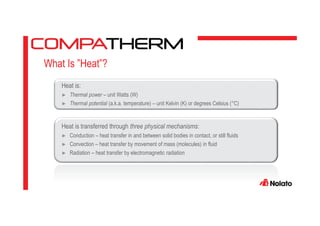
Heat is:
► Thermal power – unit Watts (W)
► Thermal potential (a.k.a. temperature) – unit Kelvin (K) or degrees Celsius (°C)
Heat is transferred through three physical mechanisms:
► Conduction – heat transfer in and between solid bodies in contact, or still fluids
► Convection – heat transfer by movement of mass (molecules) in fluid
► Radiation – heat transfer by electromagnetic radiation
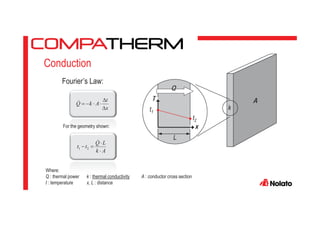
Conduction
x
t
AkQ
21
Ak
LQ
tt
Fourier’s Law:
For the geometry shown:
Where:
Q : thermal power k : thermal conductivity A : conductor cross section
t : temperature x, L : distance
A
Q
t1
t2
T
x
L
k
Conduction
Thermal Conductivity (k)
► Unit W/(m·K)
► Value determined by
material
Magnitude Material k [W/(m∙K)]
10-2 Still air ~0,02
10-1 Polymers ~0,2
100 TIM’s (typical) ~1+
101 Stainless steel ~20
102 Aluminium extrusion ~200
103 Graphene ~2 000
104 Heat pipes (equiv.) <20 000
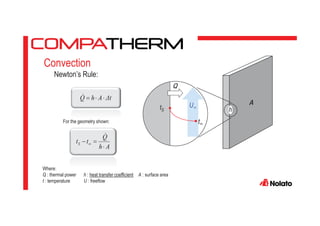
Convection
Newton’s Rule:
Where:
Q : thermal power h : heat transfer coefficient A : surface area
t : temperature U : freeflow
Ah
Q
ttS
ΔtAhQ
For the geometry shown:
A
Q
tS
t∞
h
U∞
Part Two
A
Simplified
Approach
17
x
t
kAQ
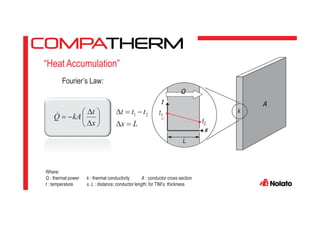
Fourier’s Law:
Where:
Q : thermal power k : thermal conductivity A : conductor cross section
t : temperature x, L : distance; conductor length; for TIM’s: thickness
A
Q
t1
t2
t
x
L
k
“Heat Accumulation”
Lx
21 ttt
Δt
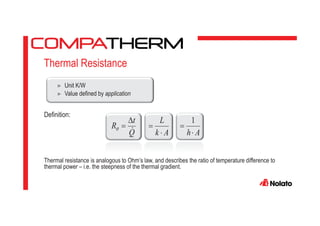
► Unit K/W
► Value defined by application
Definition:
Thermal resistance is analogous to Ohm’s law, and describes the ratio of temperature difference to
thermal power – i.e. the steepness of the thermal gradient.
cribes the rat
nt.
law, and des
hermal gradie
Thermal Resistance
logous to Ohm’s
eepness of the t
Q
t
R
Ak
L
Ah
1
“Heat Accumulation”
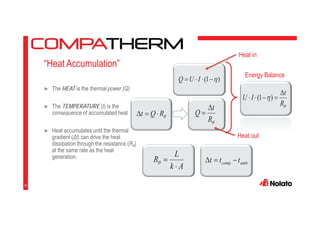
► The HEAT is the thermal power (Q)
► The TEMPERATURE (t) is the
consequence of accumulated heat
► Heat accumulates until the thermal
gradient (Δt) can drive the heat
dissipation through the resistance (Rθ)
at the same rate as the heat
generation.
20
)1(IUQ
RQt
Ak
L
R ambcomp ttt
R
t
IU )1(
R
t
Q
Heat in
Heat out
Energy Balance
“Heat Accumulation”
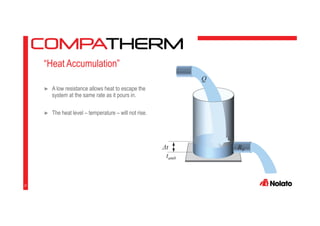
► A low resistance allows heat to escape the
system at the same rate as it pours in.
► The heat level – temperature – will not rise.
21
Q
RθΔt
tamb
“Heat Accumulation”
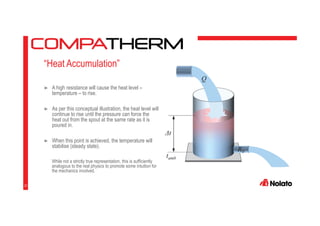
► A high resistance will cause the heat level –
temperature – to rise.
► As per this conceptual illustration, the heat level will
continue to rise until the pressure can force the
heat out from the spout at the same rate as it is
poured in.
► When this point is achieved, the temperature will
stabilise (steady state).
While not a strictly true representation, this is sufficiently
analogous to the real physics to promote some intuition for
the mechanics involved.
22
Q
Rθ
Δt
tamb
Thermal Management 101
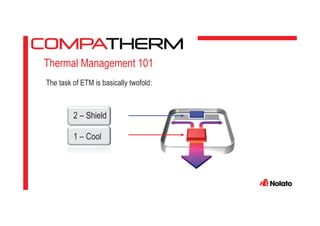
The task of ETM is basically twofold:
2 – Shield
1 – Cool
Thermal Management 101
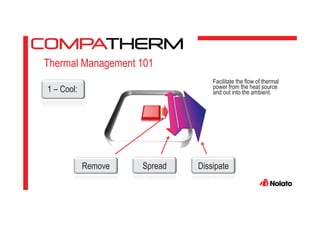
1 – Cool:
Spread DissipateRemove
Facilitate the flow of thermal
power from the heat source
and out into the ambient.
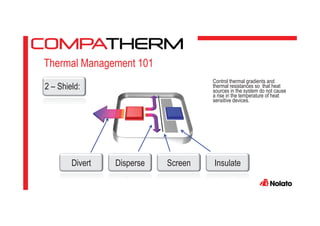
Thermal Management 101
2 – Shield:
Screen InsulateDisperseDivert
Control thermal gradients and
thermal resistances so that heat
sources in the system do not cause
a rise in the temperature of heat
sensitive devices.
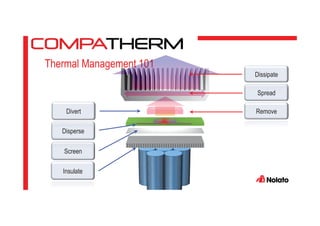
Thermal Management 101
Screen
Insulate
Screen
DisperseDisperse
Divert
SpreadSpread
Dissipate
Remove
Part Three
Thermal
Management
Solutions
27
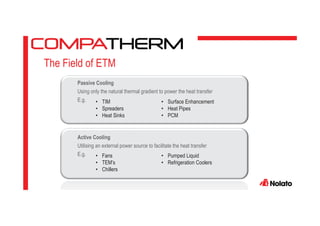
The Field of ETM
Passive Cooling
Using only the natural thermal gradient to power the heat transfer
E.g.
Active Cooling
Utilising an external power source to facilitate the heat transfer
E.g.
• TIM
• Spreaders
• Heat Sinks
• Surface Enhancement
• Heat Pipes
• PCM
• Fans
• TEM’s
• Chillers
• Pumped Liquid
• Refrigeration Coolers
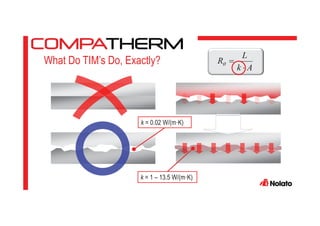
What Do TIM’s Do, Exactly?
k = 0.02 W/(m·K)
k = 1 – 13.5 W/(m·K)
Ak
L
R
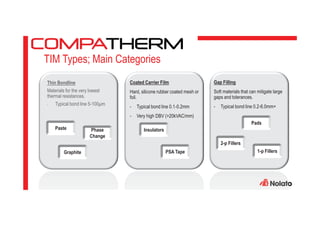
TIM Types; Main Categories
Thin Bondline
Materials for the very lowest
thermal resistances.
- Typical bond line 5-100μm
Coated Carrier Film
Hard, silicone rubber coated mesh or
foil.
- Typical bond line 0.1-0.2mm
- Very high DBV (>20kVAC/mm)
Gap Filling
Soft materials that can mitigate large
gaps and tolerances.
- Typical bond line 0.2-6.0mm+
Insulators
PSA Tape
Paste
1-p Fillers
Phase
Change
Graphite
2-p Fillers
Pads
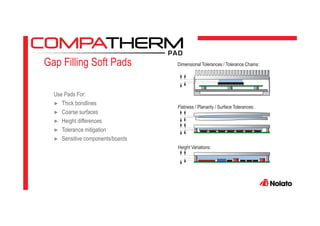
Gap Filling Soft Pads
Use Pads For:
► Thick bondlines
► Coarse surfaces
► Height differences
► Tolerance mitigation
► Sensitive components/boards
Height Variations:
Dimensional Tolerances / Tolerance Chains:
Flatness / Planarity / Surface Tolerances:
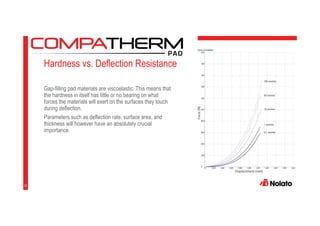
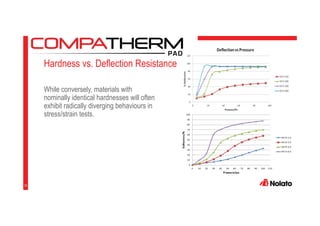
Hardness vs. Deflection Resistance
Gap-filling pad materials are viscoelastic. This means that
the hardness in itself has little or no bearing on what
forces the materials will exert on the surfaces they touch
during deflection.
Parameters such as deflection rate, surface area, and
thickness will however have an absolutely crucial
importance.
32
100 mm/min
50 mm/min
10 mm/min
1 mm/min
0,1 mm/min
Hardness vs. Deflection Resistance
While conversely, materials with
nominally identical hardnesses will often
exhibit radically diverging behaviours in
stress/strain tests.
33
37
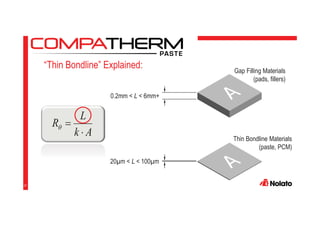
Thin Bondline Materials
(paste, PCM)(p
20μm < L < 100μm
Ak
L
R
Gap Filling Materials
(pads, fillers)
p g
(pad
0.2mm < L < 6mm+
“Thin Bondline” Explained:
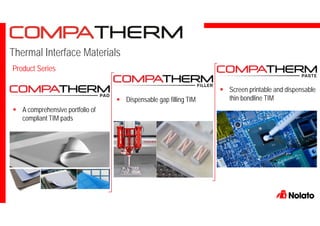
Thermal Interface Materials
Product Series
 A comprehensive portfolio of
compliant TIM pads
 Dispensable gap filling TIM
 Screen printable and dispensable
thin bondline TIM
3
4
[W/(m·K)] [Shore00] [g/cm3
] [VAC/mm] [mm]
9410 1 40 2.37 5 000 0.25 - 5.00 Pink
9411 1.3 9 2.50 5 000 0.25 - 5.00 Lt Blue
9420 2 40 2.73 5 000 0.25 - 5.00 Lt Blue
9421 2.5 40 2.70 5 000 0.50 - 5.00 Lt Brown
9422 2 25 2.70 5 000 0.50 - 5.00 Lt Blue
9430 3 60 2.65 400 0.25 - 5.00 Grey
9431 3 40 3.10 > 8 000 0.25 - 5.00 Blue
9432 3 10 2.92 > 7 000 1.00 - 5.00 Brown
9433 3 28 2.65 400 0.25 - 5.00 Grey
9440 4 40 3.10 > 8 000 0.75 - 5.00 Green
9441 4 8 3.10 > 8 000 1.00 - 5.00 Green
9450 5 40 3.10 > 7 000 0.50 - 5.00 Grey
9451 5 28 3.07 > 5 000 0.30 - 5.00 Grey
9452 5 60 3.10 > 5 000 1.00 - 5.00 Grey
9470 7 40 2.55 1 500 1.00 - 5.00 Lt Grey
9471 7 40 3.10 8 000 1.00 - 5.00 Pink
9472 7 20 2.55 1 500 1.00 - 5.00 Lt Grey
9473 7 20 3.10 8 000 1.00 - 5.00 Pink
9480 8 40 3.10 8 000 0.50 - 5.00 Blue
Material Code
Thermal
Conductivity
Hardness Density Colour
Dielectric
Breakdown Voltage
Thickness Range
5
[W/(m·K)] [Shore00] [g/cm3
] [VAC/mm] [mm]
9610 13.5 55 2.70 n/a 1.00 - 5.00 Dk Grey
Material Code
Thermal
Conductivity
Hardness Density Colour
Dielectric
Breakdown Voltage
Thickness Range
6
7
[W/(m·K)] [Pa·s] [g/cm3
] [VAC/mm] [h] [h]
9310 1.8 110 2.8 5 000 3 18 Blue + White
9343 4 350 3.1 5 000 4 24 Pink + White
9344 4 300 3.1 5 000 2.5 12 Green + White
Pot Life
Cure Time
@25°C
ColourMaterial Code
Thermal
Conductivity
Viscosity
(mixed)
Density
Dielectric
Breakdown Voltage
Material Code Thermal Conductivity Flow Rate Density
Dielectric
Breakdown Voltage
Colour
[W/(m·K)] [g/min] [g/cm3] [VAC/mm]
9240 4.5 22 3.2 >5 000 White
8
9
[W/(m·K)] [cP] [g/cm3
] [µm] [K·cm2
/W]
9520 2.5 80 000 2.2 20 0.08 Grey
9521 2 110 000 2.8 20 0.20 White
9522 2.8 225 000 2.8 20 0.08 Grey
9530 3 80 000 2.2 20 0.07 Grey
9540 4.3 300 000 2.3 20 0.06 Grey
9541 4.3 500 000 2.3 20 0.06 Grey
Minimum Achievable
Bondline Thickness
ColourMaterial Code
Thermal
Conductivity
Viscosity Density
Thermal Resistance
@40PSI
10
PCM
► Samples can be provided
Phase-Change Materials
11
12
What Sets Us Apart?
NOLATO USP’s
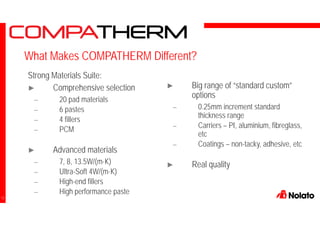
Strong Materials Suite:
► Comprehensive selection
– 20 pad materials
– 6 pastes
– 4 fillers
– PCM
► Advanced materials
– 7, 8, 13.5W/(m·K)
– Ultra-Soft 4W/(m·K)
– High-end fillers
– High performance paste
► Big range of “standard custom”
options
– 0.25mm increment standard
thickness range
– Carriers – PI, aluminium, fibreglass,
etc
– Coatings – non-tacky, adhesive, etc
► Real quality
What Makes COMPATHERM Different?
13
Strong Competence:
► Ability to modify & tailor existing materials to specific
requirements on request
► Ability to create new materials and solutions when needed
► Ability to guide customers through materials selection
► Ability to provide thermal design assistance worldwide
► Ability to discuss, analyse, and solve thermal issues at
considerable technical depth
What Makes COMPATHERM Different?
14
Good Service:
► Provide samples quickly and conveniently worldwide
► Respond and solve issues quickly
► We have short lead times
What Makes COMPATHERM Different?
15

Nolato thermal solutions.pdf

  • 1.
    Compatherm Ankit Sharma Key AccountManager India 91-9742444088 1
  • 2.
  • 3.
    What Is ”Heat”? Heatis: ► Thermal power – unit Watts (W) ► Thermal potential (a.k.a. temperature) – unit Kelvin (K) or degrees Celsius (°C) Heat is transferred through three physical mechanisms: ► Conduction – heat transfer in and between solid bodies in contact, or still fluids ► Convection – heat transfer by movement of mass (molecules) in fluid ► Radiation – heat transfer by electromagnetic radiation
  • 4.
    Conduction x t AkQ 21 Ak LQ tt Fourier’s Law: For thegeometry shown: Where: Q : thermal power k : thermal conductivity A : conductor cross section t : temperature x, L : distance A Q t1 t2 T x L k
  • 5.
    Conduction Thermal Conductivity (k) ►Unit W/(m·K) ► Value determined by material Magnitude Material k [W/(m∙K)] 10-2 Still air ~0,02 10-1 Polymers ~0,2 100 TIM’s (typical) ~1+ 101 Stainless steel ~20 102 Aluminium extrusion ~200 103 Graphene ~2 000 104 Heat pipes (equiv.) <20 000
  • 6.
    Convection Newton’s Rule: Where: Q :thermal power h : heat transfer coefficient A : surface area t : temperature U : freeflow Ah Q ttS ΔtAhQ For the geometry shown: A Q tS t∞ h U∞
  • 7.
  • 8.
    x t kAQ Fourier’s Law: Where: Q :thermal power k : thermal conductivity A : conductor cross section t : temperature x, L : distance; conductor length; for TIM’s: thickness A Q t1 t2 t x L k “Heat Accumulation” Lx 21 ttt Δt
  • 9.
    ► Unit K/W ►Value defined by application Definition: Thermal resistance is analogous to Ohm’s law, and describes the ratio of temperature difference to thermal power – i.e. the steepness of the thermal gradient. cribes the rat nt. law, and des hermal gradie Thermal Resistance logous to Ohm’s eepness of the t Q t R Ak L Ah 1
  • 10.
    “Heat Accumulation” ► TheHEAT is the thermal power (Q) ► The TEMPERATURE (t) is the consequence of accumulated heat ► Heat accumulates until the thermal gradient (Δt) can drive the heat dissipation through the resistance (Rθ) at the same rate as the heat generation. 20 )1(IUQ RQt Ak L R ambcomp ttt R t IU )1( R t Q Heat in Heat out Energy Balance
  • 11.
    “Heat Accumulation” ► Alow resistance allows heat to escape the system at the same rate as it pours in. ► The heat level – temperature – will not rise. 21 Q RθΔt tamb
  • 12.
    “Heat Accumulation” ► Ahigh resistance will cause the heat level – temperature – to rise. ► As per this conceptual illustration, the heat level will continue to rise until the pressure can force the heat out from the spout at the same rate as it is poured in. ► When this point is achieved, the temperature will stabilise (steady state). While not a strictly true representation, this is sufficiently analogous to the real physics to promote some intuition for the mechanics involved. 22 Q Rθ Δt tamb
  • 13.
    Thermal Management 101 Thetask of ETM is basically twofold: 2 – Shield 1 – Cool
  • 14.
    Thermal Management 101 1– Cool: Spread DissipateRemove Facilitate the flow of thermal power from the heat source and out into the ambient.
  • 15.
    Thermal Management 101 2– Shield: Screen InsulateDisperseDivert Control thermal gradients and thermal resistances so that heat sources in the system do not cause a rise in the temperature of heat sensitive devices.
  • 16.
  • 17.
  • 18.
    The Field ofETM Passive Cooling Using only the natural thermal gradient to power the heat transfer E.g. Active Cooling Utilising an external power source to facilitate the heat transfer E.g. • TIM • Spreaders • Heat Sinks • Surface Enhancement • Heat Pipes • PCM • Fans • TEM’s • Chillers • Pumped Liquid • Refrigeration Coolers
  • 19.
    What Do TIM’sDo, Exactly? k = 0.02 W/(m·K) k = 1 – 13.5 W/(m·K) Ak L R
  • 20.
    TIM Types; MainCategories Thin Bondline Materials for the very lowest thermal resistances. - Typical bond line 5-100μm Coated Carrier Film Hard, silicone rubber coated mesh or foil. - Typical bond line 0.1-0.2mm - Very high DBV (>20kVAC/mm) Gap Filling Soft materials that can mitigate large gaps and tolerances. - Typical bond line 0.2-6.0mm+ Insulators PSA Tape Paste 1-p Fillers Phase Change Graphite 2-p Fillers Pads
  • 21.
    Gap Filling SoftPads Use Pads For: ► Thick bondlines ► Coarse surfaces ► Height differences ► Tolerance mitigation ► Sensitive components/boards Height Variations: Dimensional Tolerances / Tolerance Chains: Flatness / Planarity / Surface Tolerances:
  • 22.
    Hardness vs. DeflectionResistance Gap-filling pad materials are viscoelastic. This means that the hardness in itself has little or no bearing on what forces the materials will exert on the surfaces they touch during deflection. Parameters such as deflection rate, surface area, and thickness will however have an absolutely crucial importance. 32 100 mm/min 50 mm/min 10 mm/min 1 mm/min 0,1 mm/min
  • 23.
    Hardness vs. DeflectionResistance While conversely, materials with nominally identical hardnesses will often exhibit radically diverging behaviours in stress/strain tests. 33
  • 24.
    37 Thin Bondline Materials (paste,PCM)(p 20μm < L < 100μm Ak L R Gap Filling Materials (pads, fillers) p g (pad 0.2mm < L < 6mm+ “Thin Bondline” Explained:
  • 25.
    Thermal Interface Materials ProductSeries  A comprehensive portfolio of compliant TIM pads  Dispensable gap filling TIM  Screen printable and dispensable thin bondline TIM
  • 26.
  • 27.
    4 [W/(m·K)] [Shore00] [g/cm3 ][VAC/mm] [mm] 9410 1 40 2.37 5 000 0.25 - 5.00 Pink 9411 1.3 9 2.50 5 000 0.25 - 5.00 Lt Blue 9420 2 40 2.73 5 000 0.25 - 5.00 Lt Blue 9421 2.5 40 2.70 5 000 0.50 - 5.00 Lt Brown 9422 2 25 2.70 5 000 0.50 - 5.00 Lt Blue 9430 3 60 2.65 400 0.25 - 5.00 Grey 9431 3 40 3.10 > 8 000 0.25 - 5.00 Blue 9432 3 10 2.92 > 7 000 1.00 - 5.00 Brown 9433 3 28 2.65 400 0.25 - 5.00 Grey 9440 4 40 3.10 > 8 000 0.75 - 5.00 Green 9441 4 8 3.10 > 8 000 1.00 - 5.00 Green 9450 5 40 3.10 > 7 000 0.50 - 5.00 Grey 9451 5 28 3.07 > 5 000 0.30 - 5.00 Grey 9452 5 60 3.10 > 5 000 1.00 - 5.00 Grey 9470 7 40 2.55 1 500 1.00 - 5.00 Lt Grey 9471 7 40 3.10 8 000 1.00 - 5.00 Pink 9472 7 20 2.55 1 500 1.00 - 5.00 Lt Grey 9473 7 20 3.10 8 000 1.00 - 5.00 Pink 9480 8 40 3.10 8 000 0.50 - 5.00 Blue Material Code Thermal Conductivity Hardness Density Colour Dielectric Breakdown Voltage Thickness Range
  • 28.
    5 [W/(m·K)] [Shore00] [g/cm3 ][VAC/mm] [mm] 9610 13.5 55 2.70 n/a 1.00 - 5.00 Dk Grey Material Code Thermal Conductivity Hardness Density Colour Dielectric Breakdown Voltage Thickness Range
  • 29.
  • 30.
    7 [W/(m·K)] [Pa·s] [g/cm3 ][VAC/mm] [h] [h] 9310 1.8 110 2.8 5 000 3 18 Blue + White 9343 4 350 3.1 5 000 4 24 Pink + White 9344 4 300 3.1 5 000 2.5 12 Green + White Pot Life Cure Time @25°C ColourMaterial Code Thermal Conductivity Viscosity (mixed) Density Dielectric Breakdown Voltage Material Code Thermal Conductivity Flow Rate Density Dielectric Breakdown Voltage Colour [W/(m·K)] [g/min] [g/cm3] [VAC/mm] 9240 4.5 22 3.2 >5 000 White
  • 31.
  • 32.
    9 [W/(m·K)] [cP] [g/cm3 ][µm] [K·cm2 /W] 9520 2.5 80 000 2.2 20 0.08 Grey 9521 2 110 000 2.8 20 0.20 White 9522 2.8 225 000 2.8 20 0.08 Grey 9530 3 80 000 2.2 20 0.07 Grey 9540 4.3 300 000 2.3 20 0.06 Grey 9541 4.3 500 000 2.3 20 0.06 Grey Minimum Achievable Bondline Thickness ColourMaterial Code Thermal Conductivity Viscosity Density Thermal Resistance @40PSI
  • 33.
  • 34.
    ► Samples canbe provided Phase-Change Materials 11
  • 35.
    12 What Sets UsApart? NOLATO USP’s
  • 36.
    Strong Materials Suite: ►Comprehensive selection – 20 pad materials – 6 pastes – 4 fillers – PCM ► Advanced materials – 7, 8, 13.5W/(m·K) – Ultra-Soft 4W/(m·K) – High-end fillers – High performance paste ► Big range of “standard custom” options – 0.25mm increment standard thickness range – Carriers – PI, aluminium, fibreglass, etc – Coatings – non-tacky, adhesive, etc ► Real quality What Makes COMPATHERM Different? 13
  • 37.
    Strong Competence: ► Abilityto modify & tailor existing materials to specific requirements on request ► Ability to create new materials and solutions when needed ► Ability to guide customers through materials selection ► Ability to provide thermal design assistance worldwide ► Ability to discuss, analyse, and solve thermal issues at considerable technical depth What Makes COMPATHERM Different? 14
  • 38.
    Good Service: ► Providesamples quickly and conveniently worldwide ► Respond and solve issues quickly ► We have short lead times What Makes COMPATHERM Different? 15