Dea Mulolli
Andrei Bondarenko
Majik Huang
Marc Janin
Samuli Ylisalo
Mrs.Rosen is the international sales representative for his
coumper equipment company. His most recent trip takes
him to China,where he is scheduled to meet with his
Chinese counterpart, Mr.Chang.
Mrs. Rosen : Dea Mulolli
Mr. Chang: Majik Huang
Secretary: Marc Janin
Employee : Andrei Bondarenko


The angle under which you perceive different
situations



Any everyday situation has context which might be
interpreted differently



The way you see context depends of different
factors, mainly on culture



Verbal communication is capable of delivering small
percentage of information


Most of the information is coded, explicit part of
message is small compared to the coded one



In order to define the actual message one must
be aware of various background factors



Common for cultures with long history, important
role of traditions and little cultural diversity



Strict distinction between “insiders” and
“outsiders”



Deeper personal involvement into relationships
which are more long-lasting


Explicit part of message dominates over the
coded one



Core message is more important than background
information and environment



Common for multicultural societies with high
level of technological development



Relationship requires less personal involvement,
often brief



Easier to become a part of system
High Context

Low Context

polite
• respectful
• integrates by similarities/harmony
• indirect

•

•

open
• true
• integrates by authenticity
• direct
High Context claims Low Context

Low Context claims High Context

impolite
• “cannot read between the lines”
• naive
• no self discipline
• too fast

•

•

hiding information
• not trustable
• arrogant
• too formal
• too slow
High Context Cultures
Japan
Arab Countries
Greece
Spain
Italy
England
France
North America
Scandinavian Countries
German-Speaking Countries

Low Context Cultures
What the British say

With the greatest
respect.

What foreigners
understand

What the British
mean

He is listening to me.

You are an idiot.

They are impressed.

That is clearly
nonsense.

Very interesting.

I only have a few minor
comments.

He has found a
few mistakes.

Please rewrite
completely.
Societies all contain both modes


Useful in describing some aspects of a culture.



Sometimes, less relevant as a description of a whole
people.



Useful to describe and understand particular situations
and environment.






Bold line between Work life and Private life
It is not important to have relationships between the
people they do business with
Direct and straight to the point communication
Large public space with everyone, but small and very
limited private space
Representative countries with Specific culture: US, UK,
Germany, Scandinavian countries, Netherland etc.


”If it quacks like a duck, then it’s a duck” 



A colleague is moving out and asks for help
from another colleague. He is not very
pleasent to do this ’favor’ that she just
asked. Deriving from specific culture, what
does he do in this case?






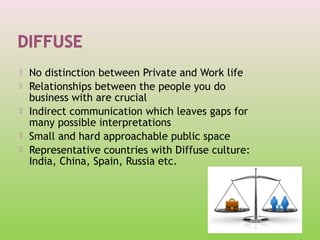
No distinction between Private and Work life
Relationships between the people you do
business with are crucial
Indirect communication which leaves gaps for
many possible interpretations
Small and hard approachable public space
Representative countries with Diffuse culture:
India, China, Spain, Russia etc.


Student-teacher rapports



Or even teacher-teacher rapports






Diffuse cultures can be referred as High
Context
Specific cultures can be referred as Low
Context
Feedback example
High Context

-Open, direct, many things left unsaid
-Japan, Arab Countries, Spain, India, Russia
Low Context

-Respectful, indirect, polite
-Germany, Australia, Scandinavian
Countries, England
High/Low vs Diffuse/Specific

-Diffuse stands for High Context
-Specific stands for Low Context
High and low contextppt  final1 (1)

High and low contextppt final1 (1)

  • 1.
    Dea Mulolli Andrei Bondarenko MajikHuang Marc Janin Samuli Ylisalo
  • 2.
    Mrs.Rosen is theinternational sales representative for his coumper equipment company. His most recent trip takes him to China,where he is scheduled to meet with his Chinese counterpart, Mr.Chang. Mrs. Rosen : Dea Mulolli Mr. Chang: Majik Huang Secretary: Marc Janin Employee : Andrei Bondarenko
  • 3.
     The angle underwhich you perceive different situations  Any everyday situation has context which might be interpreted differently  The way you see context depends of different factors, mainly on culture  Verbal communication is capable of delivering small percentage of information
  • 4.
     Most of theinformation is coded, explicit part of message is small compared to the coded one  In order to define the actual message one must be aware of various background factors  Common for cultures with long history, important role of traditions and little cultural diversity  Strict distinction between “insiders” and “outsiders”  Deeper personal involvement into relationships which are more long-lasting
  • 5.
     Explicit part ofmessage dominates over the coded one  Core message is more important than background information and environment  Common for multicultural societies with high level of technological development  Relationship requires less personal involvement, often brief  Easier to become a part of system
  • 6.
    High Context Low Context polite •respectful • integrates by similarities/harmony • indirect • • open • true • integrates by authenticity • direct
  • 7.
    High Context claimsLow Context Low Context claims High Context impolite • “cannot read between the lines” • naive • no self discipline • too fast • • hiding information • not trustable • arrogant • too formal • too slow
  • 8.
    High Context Cultures Japan ArabCountries Greece Spain Italy England France North America Scandinavian Countries German-Speaking Countries Low Context Cultures
  • 9.
    What the Britishsay With the greatest respect. What foreigners understand What the British mean He is listening to me. You are an idiot. They are impressed. That is clearly nonsense. Very interesting. I only have a few minor comments. He has found a few mistakes. Please rewrite completely.
  • 10.
    Societies all containboth modes  Useful in describing some aspects of a culture.  Sometimes, less relevant as a description of a whole people.  Useful to describe and understand particular situations and environment.
  • 13.
         Bold line betweenWork life and Private life It is not important to have relationships between the people they do business with Direct and straight to the point communication Large public space with everyone, but small and very limited private space Representative countries with Specific culture: US, UK, Germany, Scandinavian countries, Netherland etc.
  • 14.
     ”If it quackslike a duck, then it’s a duck”   A colleague is moving out and asks for help from another colleague. He is not very pleasent to do this ’favor’ that she just asked. Deriving from specific culture, what does he do in this case?
  • 15.
         No distinction betweenPrivate and Work life Relationships between the people you do business with are crucial Indirect communication which leaves gaps for many possible interpretations Small and hard approachable public space Representative countries with Diffuse culture: India, China, Spain, Russia etc.
  • 16.
  • 17.
       Diffuse cultures canbe referred as High Context Specific cultures can be referred as Low Context Feedback example
  • 19.
    High Context -Open, direct,many things left unsaid -Japan, Arab Countries, Spain, India, Russia Low Context -Respectful, indirect, polite -Germany, Australia, Scandinavian Countries, England High/Low vs Diffuse/Specific -Diffuse stands for High Context -Specific stands for Low Context