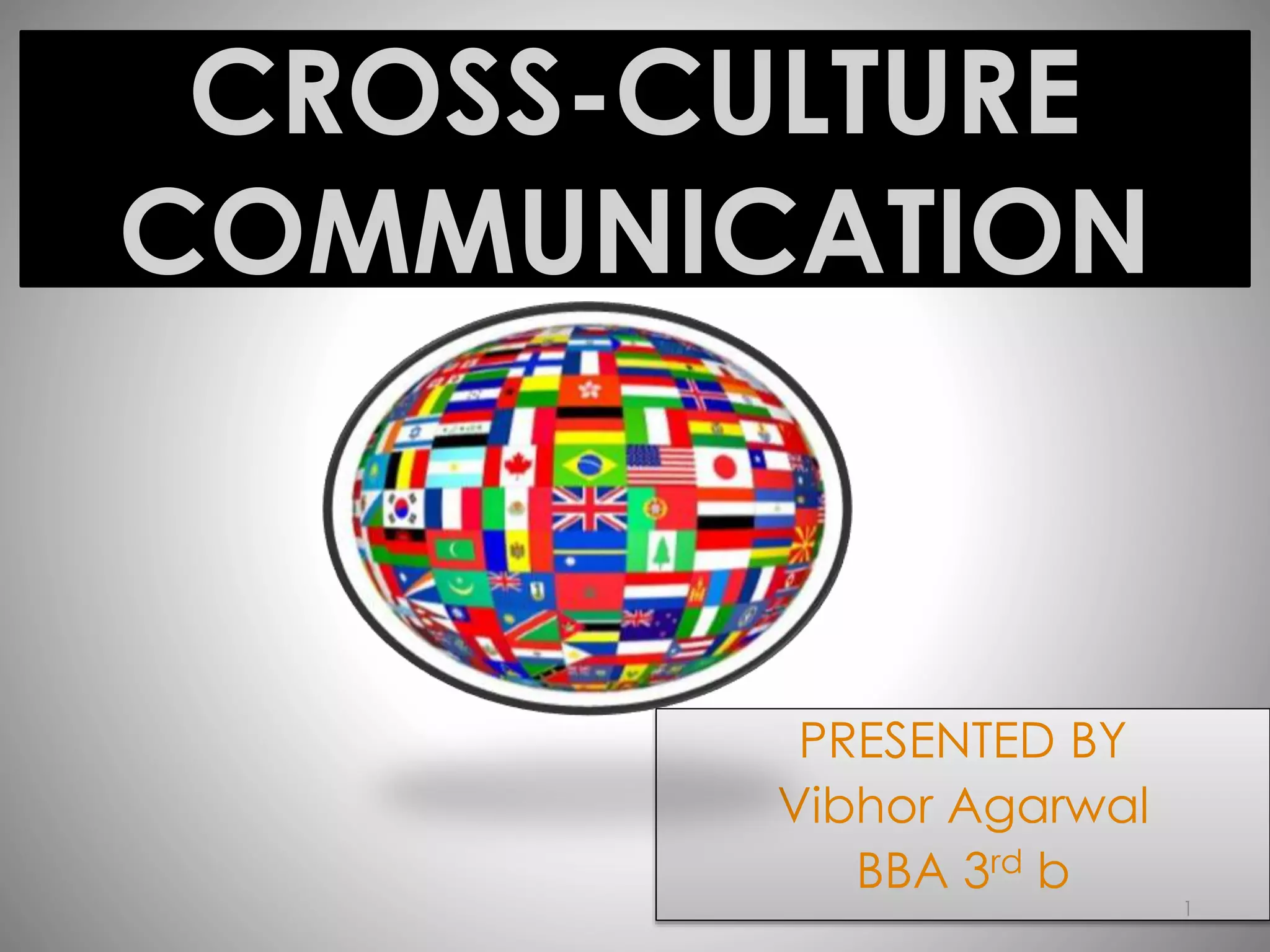
CROSS-CULTURE 
COMMUNICATION 
PRESENTED BY 
Vibhor Agarwal 
BBA 3rd b 
1
INRODUCTION : 
Cross-culture communication involves 
understanding culture difference and 
overcoming language problems. 
Communicating across cultures effectively 
improves your productivity and efficiency 
and promotes harmonious work 
environments.
ROLE OF CULTURE : 
Culture is “the shared ways in which 
groups of people understand and 
interpret the world. 
The customs, ideas, and social behavior of 
a particular people or group. 
Culture is a shared system of symbols, 
beliefs, attitudes, values, expectations and 
norms for behavior.
PROBLEMS OF CULTURAL 
DIFFERENCES : 
Two of dimensions that impact communications 
are the cultural differences in : 
Body Positions and Movements. 
Views and practices concerning various factors of 
human relationships(time, space, intimacy, odors, 
frankness, values, emotions). 
Body Positions and Movements: 
Body positions and movements differ among 
cultures and the differences can effect 
communication. 
Some of the movements have no definite 
meaning even within a culture. But some have 
clear meanings and they differ by culture.
COMMUNICATION WITH BODY PARTS : 
'OK' to a Westerner, 'money' to a Japanese, 'zero' 
to the French and ‘insulting’ to the Turks and 
Brazilians. 
This can mean 'two' to an American ,'Victory' to a 
German and 'Up yours' in Britain.
COMMUNICATION WITH BODY PARTS : 
EYE MOVEMENTS : 
The meanings that movements of our eyes convey also 
vary by culture. 
In North America we are taught to maintain eye contact 
in giving formal speech. But in Indonesia , it is considered 
to be disrespectful. 
SMILE : 
In our culture, smiles are viewed positively in most 
situations. But in some other cultures (notably African 
cultures), a smile is regarded as a sign of weakness in 
certain situations.
High and low context: 
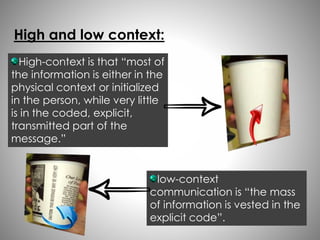
High-context is that “most of 
the information is either in the 
physical context or initialized 
in the person, while very little 
is in the coded, explicit, 
transmitted part of the 
message.” 
low-context 
communication is “the mass 
of information is vested in the 
explicit code”.
High and low context culture: 
High context refers to societies or groups where people 
have close connections over a long period of time. Many 
aspects of cultural behavior are not made explicit(Clear) 
because most members know what to do and what to 
think from years of interaction with each other. 
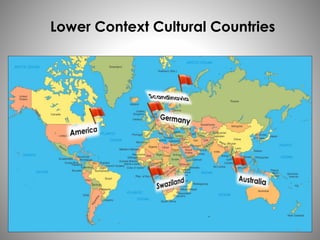
Low context refers to societies where people tend to 
have many connections but of shorter duration or for 
some specific reason. In these societies, cultural behavior 
and beliefs may need to be spelled out explicitly so that 
those coming into the cultural environment know how to 
behave.
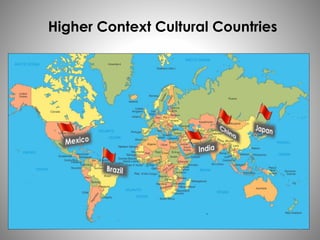
Higher Context Cultural Countries 
9
Lower Context Cultural Countries 
10
Views and Practices Concerning Factors of 
Human Relations : 
Differing attitudes toward various factors of human 
relationships cause communication problems. 
For illustrative purposes, we will review seven major 
factors: 
TIME : Views about time differ widely. Some cultures stress 
punctuality and some do not. 
SPACE : Space is viewed differently by different 
culture. In some cultures, people want to be far 
apart and in other cultures, they want to be 
close. 
ODORS : Some cultures view body odors as bad 
and others view them as normal.
Views and Practices Concerning Factors of 
Human Relations : 
FRANKNESS : Low-context cultures are more frank 
and explicit than high-context cultures. 
INTIMACY OF RELATIONSHIPS : In many cultures, 
strict social classes exist and class status 
determines how intimately people are addressed 
and treated in communication. 
VALUES : Each culture has different values 
concerning such matters as attitude towards 
work, employee-employer relations and authority. 
EXPRESSION OF EMOTIONS : Social behavior 
varies by culture, such as practices concerning 
affection, laughter, and emotion.
PROBLEMS OF LANGUAGE : 
The people on earth use more than 3,000 
languages. 
Communication problems are caused by the 
existence of many languages. 
LACK OF LANGUAGE EQUIVALENCY : 
Differences among languages make equivalent 
translations difficult. 
Grammar and syntax differences add to the 
difficulty. 
The problem of multiple word meanings .Like 
English, other languages have more than one 
meaning for many words.
LACK OF LANGUAGE EQUIVALENCY : 
Even words with the same meaning can differ in 
usage by culture. 
Overcome such language problems by knowing 
languages well and by questioning.
A General Suggestion For 
Communicating Cross Cultures 
Use simple, basic English. 
Continually check the accuracy of the 
communication.
THANK YOU

cross culture communication

  • 1.
    CROSS-CULTURE COMMUNICATION PRESENTEDBY Vibhor Agarwal BBA 3rd b 1
  • 2.
    INRODUCTION : Cross-culturecommunication involves understanding culture difference and overcoming language problems. Communicating across cultures effectively improves your productivity and efficiency and promotes harmonious work environments.
  • 3.
    ROLE OF CULTURE: Culture is “the shared ways in which groups of people understand and interpret the world. The customs, ideas, and social behavior of a particular people or group. Culture is a shared system of symbols, beliefs, attitudes, values, expectations and norms for behavior.
  • 4.
    PROBLEMS OF CULTURAL DIFFERENCES : Two of dimensions that impact communications are the cultural differences in : Body Positions and Movements. Views and practices concerning various factors of human relationships(time, space, intimacy, odors, frankness, values, emotions). Body Positions and Movements: Body positions and movements differ among cultures and the differences can effect communication. Some of the movements have no definite meaning even within a culture. But some have clear meanings and they differ by culture.
  • 5.
    COMMUNICATION WITH BODYPARTS : 'OK' to a Westerner, 'money' to a Japanese, 'zero' to the French and ‘insulting’ to the Turks and Brazilians. This can mean 'two' to an American ,'Victory' to a German and 'Up yours' in Britain.
  • 6.
    COMMUNICATION WITH BODYPARTS : EYE MOVEMENTS : The meanings that movements of our eyes convey also vary by culture. In North America we are taught to maintain eye contact in giving formal speech. But in Indonesia , it is considered to be disrespectful. SMILE : In our culture, smiles are viewed positively in most situations. But in some other cultures (notably African cultures), a smile is regarded as a sign of weakness in certain situations.
  • 7.
    High and lowcontext: High-context is that “most of the information is either in the physical context or initialized in the person, while very little is in the coded, explicit, transmitted part of the message.” low-context communication is “the mass of information is vested in the explicit code”.
  • 8.
    High and lowcontext culture: High context refers to societies or groups where people have close connections over a long period of time. Many aspects of cultural behavior are not made explicit(Clear) because most members know what to do and what to think from years of interaction with each other. Low context refers to societies where people tend to have many connections but of shorter duration or for some specific reason. In these societies, cultural behavior and beliefs may need to be spelled out explicitly so that those coming into the cultural environment know how to behave.
  • 9.
  • 10.
  • 11.
    Views and PracticesConcerning Factors of Human Relations : Differing attitudes toward various factors of human relationships cause communication problems. For illustrative purposes, we will review seven major factors: TIME : Views about time differ widely. Some cultures stress punctuality and some do not. SPACE : Space is viewed differently by different culture. In some cultures, people want to be far apart and in other cultures, they want to be close. ODORS : Some cultures view body odors as bad and others view them as normal.
  • 12.
    Views and PracticesConcerning Factors of Human Relations : FRANKNESS : Low-context cultures are more frank and explicit than high-context cultures. INTIMACY OF RELATIONSHIPS : In many cultures, strict social classes exist and class status determines how intimately people are addressed and treated in communication. VALUES : Each culture has different values concerning such matters as attitude towards work, employee-employer relations and authority. EXPRESSION OF EMOTIONS : Social behavior varies by culture, such as practices concerning affection, laughter, and emotion.
  • 13.
    PROBLEMS OF LANGUAGE: The people on earth use more than 3,000 languages. Communication problems are caused by the existence of many languages. LACK OF LANGUAGE EQUIVALENCY : Differences among languages make equivalent translations difficult. Grammar and syntax differences add to the difficulty. The problem of multiple word meanings .Like English, other languages have more than one meaning for many words.
  • 14.
    LACK OF LANGUAGEEQUIVALENCY : Even words with the same meaning can differ in usage by culture. Overcome such language problems by knowing languages well and by questioning.
  • 15.
    A General SuggestionFor Communicating Cross Cultures Use simple, basic English. Continually check the accuracy of the communication.
  • 16.