INTERCULTURAL
COMMUNICATION
Dino & Som
AIM & OBJECTIVE
To understand the concept of Intercultural Communication
To examine the different between high-context society and
low-context society
To assess the role of culture influencing marketing activities
To apply the Intercultural Communication concept to
marketing strategy
Objectives
Aim
TABLE OF CONTENTS
Culture and Communication
The definition of Intercultural Communication
Hall’s Theory - High-context vs Low-context
Direct vs Indirect communication
Intercultural communication (Hall’s theory) & Marketing
Conclusion
Recommendations
References
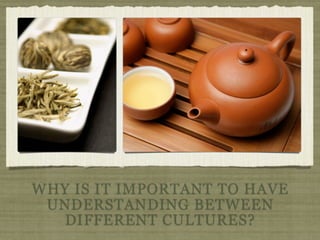
WHY IS IT IMPORTANT TO HAVE
UNDERSTANDING BETWEEN
DIFFERENT CULTURES?
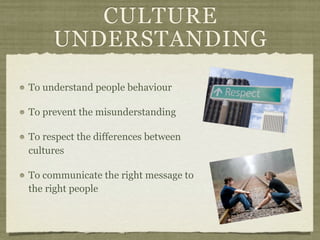
CULTURE
UNDERSTANDING
To understand people behaviour
To prevent the misunderstanding
To respect the differences between
cultures
To communicate the right message to
the right people
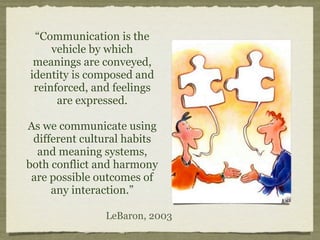
“Communication is the
vehicle by which
meanings are conveyed,
identity is composed and
reinforced, and feelings
are expressed.
As we communicate using
different cultural habits
and meaning systems,
both conflict and harmony
are possible outcomes of
any interaction.”
LeBaron, 2003
WHAT IS
INTERCULTURAL
COMMUNICATION?
“Interpersonal interaction between members of different
groups, which differ from each other in respect of knowledge
shared by their members and in respect of their linguistic
forms of symbolic behaviour”
Miric, 2008
INTERCULTURAL COMMUNICATION
HTTP://WWW.YOUTUBE.COM/WATCH?V=GR-YSA_UAWU
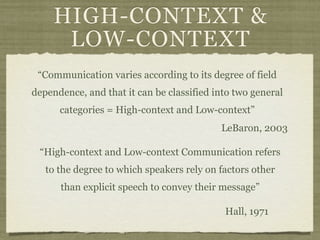
HIGH-CONTEXT &
LOW-CONTEXT
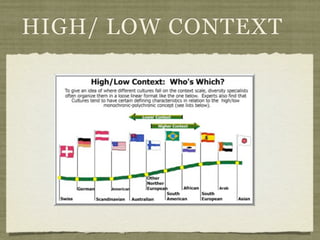
“High-context and Low-context Communication refers
to the degree to which speakers rely on factors other
than explicit speech to convey their message”
“Communication varies according to its degree of field
dependence, and that it can be classified into two general
categories = High-context and Low-context”
LeBaron, 2003
Hall, 1971
EDWARD T. HALL
Cultural anthropologist
Ph.D., Columbia university
Best known for his work in
intercultural relation and
communication
One of the founders of
intercultural communication
study
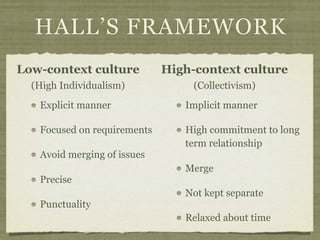
HALL’S FRAMEWORK
Explicit manner
Focused on requirements
Avoid merging of issues
Precise
Punctuality
Implicit manner
High commitment to long
term relationship
Merge
Not kept separate
Relaxed about time
Low-context culture High-context culture
(High Individualism) (Collectivism)
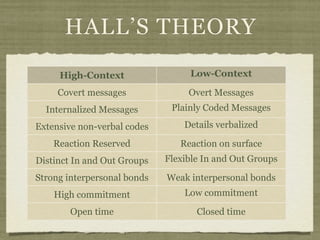
HALL’S THEORY
High-Context Low-Context
Covert messages Overt Messages
Internalized Messages Plainly Coded Messages
Extensive non-verbal codes Details verbalized
Reaction Reserved Reaction on surface
Distinct In and Out Groups Flexible In and Out Groups
Strong interpersonal bonds Weak interpersonal bonds
High commitment Low commitment
Open time Closed time
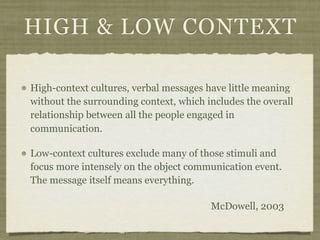
HIGH & LOW CONTEXT
High-context cultures, verbal messages have little meaning
without the surrounding context, which includes the overall
relationship between all the people engaged in
communication.
Low-context cultures exclude many of those stimuli and
focus more intensely on the object communication event.
The message itself means everything.
McDowell, 2003
PAUSE FOR THOUGHTS
Do I recognize implied messages from others, and am I
aware of the verbal and non-verbal cues that let me
understand the speaker’s meaning?
Do I let my words speak for themselves? Do I prefer to be
more direct, relying on what is explicitly stated in my
speech?
HIGH/ LOW CONTEXT
WHY UNDERSTANDING
THE INTERCULTURAL
COMMUNICATION BENEFIT
MARKETING ACTIVITIES?
CROSS-CULTURAL &
MARKETING
Cross-cultural marketing can be seen as the strategic process of
marketing among customers whose culture differs from that the
marketers’ own culture
Consumption research is an essential precondition for appropriate
product design
All market behaviours are culture-bound, so the marketers need to
understand the culture and match marketing mix with consumer
preferences, purchasing behaviour and product-used patterns in a
potential market.
DIRECT VS. INDIRECT
COMMUNICATION
DIRECT-INDIRECT
COMMUNICATION
* Direct communication is when the meaning of the message
is communicated mainly via words
* Indirect communication is when meaning is not only in the
words, but mainly in the surrounding context of a
conversation. In other words, somebody who is indirect will
leave it up to the listener to fill in the blanks and make out
the meaning by correctly reading the contextual clues (non-
verbal communication, status and/or age of people involved
in the conversation etc.)
BODY LANGUAGE &
SILENT LANGUAGE
Body language is a form of non-verbal communication,
which consist of body posture, gestures, facial expressions
and eyes movement
Body language may provide clues to the attitude or state of
mind of a person
Silent or indirect communication doesn’t always show
disinterest, but could be a sign for respect
CULTURAL DIFFERENCES
& MARKETING APPROACHES
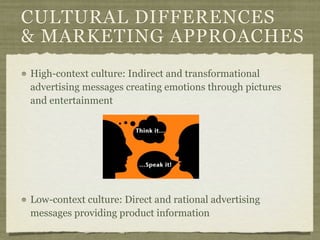
High-context culture: Indirect and transformational
advertising messages creating emotions through pictures
and entertainment
Low-context culture: Direct and rational advertising
messages providing product information
HIGH-CONTEXT
ADVERTISEMENT EXAMPLE
High-context communication
* Ambiguous message with very
little information about the
product
Advertisement for Kewpie half
50% less cholesterol Mayonnaise
(From top to bottom): Whether or not I’m by myself is fine
(the direct translation is actually ‘by myself is fine, not by
myself is fine too’), Convenience, Kewpie half
LOW-CONTEXT
ADVERTISEMENT EXAMPLE
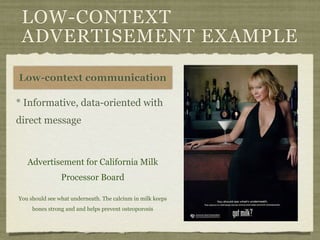
Low-context communication
* Informative, data-oriented with
direct message
Advertisement for California Milk
Processor Board
You should see what underneath. The calcium in milk keeps
bones strong and and helps prevent osteoporosis
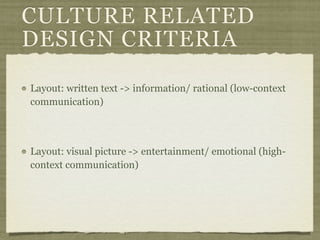
CULTURE RELATED
DESIGN CRITERIA
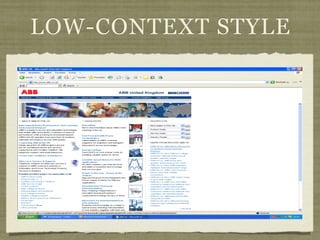
Layout: written text -> information/ rational (low-context
communication)
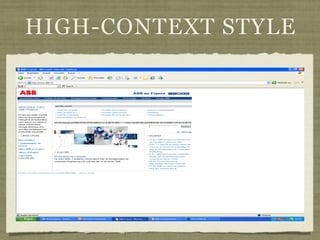
Layout: visual picture -> entertainment/ emotional (high-
context communication)
HIGH-CONTEXT STYLE
LOW-CONTEXT STYLE
NISSAN FOUR WHEEL
HTTP://WWW.YOUTUBE.COM/WATCH?V=7QSKAWMXAJS&FEATURE=RELATED
HONDA JAZZ
HTTP://WWW.YOUTUBE.COM/WATCH?V=GR-YSA_UAWU
CLASS ACTIVITIES
How can you sell this product according to the cultural concept
of High-context and Low-context?
CONCLUSION
Companies have to consider cultural differences and
establish a global mindset
Culture influences consumer behaviour and their perception
To send the right message, to the right person at the right
time is the key of intercultural communication of marketing
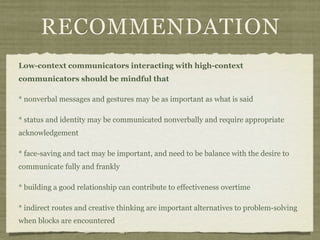
RECOMMENDATION
Low-context communicators interacting with high-context
communicators should be mindful that
* nonverbal messages and gestures may be as important as what is said
* status and identity may be communicated nonverbally and require appropriate
acknowledgement
* face-saving and tact may be important, and need to be balance with the desire to
communicate fully and frankly
* building a good relationship can contribute to effectiveness overtime
* indirect routes and creative thinking are important alternatives to problem-solving
when blocks are encountered
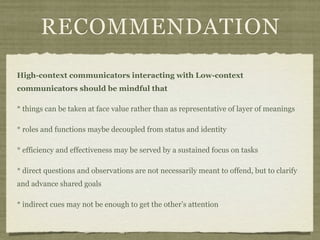
RECOMMENDATION
High-context communicators interacting with Low-context
communicators should be mindful that
* things can be taken at face value rather than as representative of layer of meanings
* roles and functions maybe decoupled from status and identity
* efficiency and effectiveness may be served by a sustained focus on tasks
* direct questions and observations are not necessarily meant to offend, but to clarify
and advance shared goals
* indirect cues may not be enough to get the other’s attention
Any Question?
REFERENCES
Annonymous, (2002-2011). Hall’s cultural factors, Changing mind. Available at http://changingminds.org/explanations/culture/
hall_culture.htm [Accessed on September 17, 2011].
Beyond Intractability, (2003). Cultural Diversity. Available at http://www.beyondintractability.org/essay/communication_tools/
[Accessed on October 8, 2011].
Hall, E., (2011). Nonverbal communication; Intercultural relations; Anthropology, Edward T. Hall. Available at http://
www.edwardthall.com/ [Accessed on September 17, 2011].
Hubpage, (2011). High Context vs. Low Context Communication. Available at http://mqjeffrey.hubpages.com/hub/High-Context-vs-Low-
Context-Communication [Accessed on October 7, 2011]
McDowell, M. (2003). High Context & Low Context. Available at faculty.pcc.edu/~mmcdowel/eng240fall03/eng240highlowcontext.pdf.
[Accessed on October 8, 2011].
Melcrum Publishing, (2009). Understand cultural differences for clearer communication. Available at http://
www.internalcommshub.com/open/news/shrm08.us.shtml [Accessed on October 7, 2011].
Miric, N., (2008). Re-imaging Understanding of Intercultural Communication, Culture and Culturing, Journal of Intercultural
Communication. xx(17). pp. xx. Available at http://www.immi.se/intercultural/nr17/bakic.htm [Accessed on October 8,2011].
REFERENCES
Missana, S., (xx). The silent language, The Grip of Culture: Edward T. Hall. Available at http://www.ishk.net/hall.pdf [Accessed on
October 7, 2011].
Rika’s blog, (2009). High and Low Context Communication. Available at http://rninomiya.wordpress.com/2009/05/24/high-and-low-
context-communication/ [Accessed on October 7, 2011].
THANK YOU
FOR YOURATTENTION

Intercultural Communication-1.pdf

  • 1.
  • 2.
    AIM & OBJECTIVE Tounderstand the concept of Intercultural Communication To examine the different between high-context society and low-context society To assess the role of culture influencing marketing activities To apply the Intercultural Communication concept to marketing strategy Objectives Aim
  • 3.
    TABLE OF CONTENTS Cultureand Communication The definition of Intercultural Communication Hall’s Theory - High-context vs Low-context Direct vs Indirect communication Intercultural communication (Hall’s theory) & Marketing Conclusion Recommendations References
  • 4.
    WHY IS ITIMPORTANT TO HAVE UNDERSTANDING BETWEEN DIFFERENT CULTURES?
  • 5.
    CULTURE UNDERSTANDING To understand peoplebehaviour To prevent the misunderstanding To respect the differences between cultures To communicate the right message to the right people
  • 6.
    “Communication is the vehicleby which meanings are conveyed, identity is composed and reinforced, and feelings are expressed. As we communicate using different cultural habits and meaning systems, both conflict and harmony are possible outcomes of any interaction.” LeBaron, 2003
  • 7.
  • 8.
    “Interpersonal interaction betweenmembers of different groups, which differ from each other in respect of knowledge shared by their members and in respect of their linguistic forms of symbolic behaviour” Miric, 2008
  • 9.
  • 10.
    HIGH-CONTEXT & LOW-CONTEXT “High-context andLow-context Communication refers to the degree to which speakers rely on factors other than explicit speech to convey their message” “Communication varies according to its degree of field dependence, and that it can be classified into two general categories = High-context and Low-context” LeBaron, 2003 Hall, 1971
  • 11.
    EDWARD T. HALL Culturalanthropologist Ph.D., Columbia university Best known for his work in intercultural relation and communication One of the founders of intercultural communication study
  • 12.
    HALL’S FRAMEWORK Explicit manner Focusedon requirements Avoid merging of issues Precise Punctuality Implicit manner High commitment to long term relationship Merge Not kept separate Relaxed about time Low-context culture High-context culture (High Individualism) (Collectivism)
  • 13.
    HALL’S THEORY High-Context Low-Context Covertmessages Overt Messages Internalized Messages Plainly Coded Messages Extensive non-verbal codes Details verbalized Reaction Reserved Reaction on surface Distinct In and Out Groups Flexible In and Out Groups Strong interpersonal bonds Weak interpersonal bonds High commitment Low commitment Open time Closed time
  • 14.
    HIGH & LOWCONTEXT High-context cultures, verbal messages have little meaning without the surrounding context, which includes the overall relationship between all the people engaged in communication. Low-context cultures exclude many of those stimuli and focus more intensely on the object communication event. The message itself means everything. McDowell, 2003
  • 15.
    PAUSE FOR THOUGHTS DoI recognize implied messages from others, and am I aware of the verbal and non-verbal cues that let me understand the speaker’s meaning? Do I let my words speak for themselves? Do I prefer to be more direct, relying on what is explicitly stated in my speech?
  • 16.
  • 17.
  • 18.
    CROSS-CULTURAL & MARKETING Cross-cultural marketingcan be seen as the strategic process of marketing among customers whose culture differs from that the marketers’ own culture Consumption research is an essential precondition for appropriate product design All market behaviours are culture-bound, so the marketers need to understand the culture and match marketing mix with consumer preferences, purchasing behaviour and product-used patterns in a potential market.
  • 19.
  • 20.
    DIRECT-INDIRECT COMMUNICATION * Direct communicationis when the meaning of the message is communicated mainly via words * Indirect communication is when meaning is not only in the words, but mainly in the surrounding context of a conversation. In other words, somebody who is indirect will leave it up to the listener to fill in the blanks and make out the meaning by correctly reading the contextual clues (non- verbal communication, status and/or age of people involved in the conversation etc.)
  • 21.
    BODY LANGUAGE & SILENTLANGUAGE Body language is a form of non-verbal communication, which consist of body posture, gestures, facial expressions and eyes movement Body language may provide clues to the attitude or state of mind of a person Silent or indirect communication doesn’t always show disinterest, but could be a sign for respect
  • 22.
    CULTURAL DIFFERENCES & MARKETINGAPPROACHES High-context culture: Indirect and transformational advertising messages creating emotions through pictures and entertainment Low-context culture: Direct and rational advertising messages providing product information
  • 23.
    HIGH-CONTEXT ADVERTISEMENT EXAMPLE High-context communication *Ambiguous message with very little information about the product Advertisement for Kewpie half 50% less cholesterol Mayonnaise (From top to bottom): Whether or not I’m by myself is fine (the direct translation is actually ‘by myself is fine, not by myself is fine too’), Convenience, Kewpie half
  • 24.
    LOW-CONTEXT ADVERTISEMENT EXAMPLE Low-context communication *Informative, data-oriented with direct message Advertisement for California Milk Processor Board You should see what underneath. The calcium in milk keeps bones strong and and helps prevent osteoporosis
  • 25.
    CULTURE RELATED DESIGN CRITERIA Layout:written text -> information/ rational (low-context communication) Layout: visual picture -> entertainment/ emotional (high- context communication)
  • 26.
  • 27.
  • 28.
  • 29.
  • 30.
    CLASS ACTIVITIES How canyou sell this product according to the cultural concept of High-context and Low-context?
  • 31.
    CONCLUSION Companies have toconsider cultural differences and establish a global mindset Culture influences consumer behaviour and their perception To send the right message, to the right person at the right time is the key of intercultural communication of marketing
  • 32.
    RECOMMENDATION Low-context communicators interactingwith high-context communicators should be mindful that * nonverbal messages and gestures may be as important as what is said * status and identity may be communicated nonverbally and require appropriate acknowledgement * face-saving and tact may be important, and need to be balance with the desire to communicate fully and frankly * building a good relationship can contribute to effectiveness overtime * indirect routes and creative thinking are important alternatives to problem-solving when blocks are encountered
  • 33.
    RECOMMENDATION High-context communicators interactingwith Low-context communicators should be mindful that * things can be taken at face value rather than as representative of layer of meanings * roles and functions maybe decoupled from status and identity * efficiency and effectiveness may be served by a sustained focus on tasks * direct questions and observations are not necessarily meant to offend, but to clarify and advance shared goals * indirect cues may not be enough to get the other’s attention
  • 34.
  • 35.
    REFERENCES Annonymous, (2002-2011). Hall’scultural factors, Changing mind. Available at http://changingminds.org/explanations/culture/ hall_culture.htm [Accessed on September 17, 2011]. Beyond Intractability, (2003). Cultural Diversity. Available at http://www.beyondintractability.org/essay/communication_tools/ [Accessed on October 8, 2011]. Hall, E., (2011). Nonverbal communication; Intercultural relations; Anthropology, Edward T. Hall. Available at http:// www.edwardthall.com/ [Accessed on September 17, 2011]. Hubpage, (2011). High Context vs. Low Context Communication. Available at http://mqjeffrey.hubpages.com/hub/High-Context-vs-Low- Context-Communication [Accessed on October 7, 2011] McDowell, M. (2003). High Context & Low Context. Available at faculty.pcc.edu/~mmcdowel/eng240fall03/eng240highlowcontext.pdf. [Accessed on October 8, 2011]. Melcrum Publishing, (2009). Understand cultural differences for clearer communication. Available at http:// www.internalcommshub.com/open/news/shrm08.us.shtml [Accessed on October 7, 2011]. Miric, N., (2008). Re-imaging Understanding of Intercultural Communication, Culture and Culturing, Journal of Intercultural Communication. xx(17). pp. xx. Available at http://www.immi.se/intercultural/nr17/bakic.htm [Accessed on October 8,2011].
  • 36.
    REFERENCES Missana, S., (xx).The silent language, The Grip of Culture: Edward T. Hall. Available at http://www.ishk.net/hall.pdf [Accessed on October 7, 2011]. Rika’s blog, (2009). High and Low Context Communication. Available at http://rninomiya.wordpress.com/2009/05/24/high-and-low- context-communication/ [Accessed on October 7, 2011].
  • 37.